
At 2:17 a.m., First Sergeant Ronald Sutton’s phone rang across a damp Georgia training field.
The white floodlights made the mist look like smoke, and the generators behind the barracks produced a low mechanical hum that seemed to swallow every smaller sound.
Ronald was two days from finishing an eight-month deployment when he saw Anna’s name on the screen.
His 9-year-old daughter should have been asleep.
Instead, she whispered, “Dad, I’m at the hospital in Charleston.”
Her voice was so thin that he pressed the phone against his ear and turned away from the other soldiers.
“Everything hurts,” she said.
Ronald forced his breathing to remain even.
Years of military training had taught him that fear could move through a phone line faster than reassurance, and the person in pain usually ended up carrying both.
He asked Anna to take one slow breath.
Then another.
Then he asked her to tell him what happened, one fact at a time.
Luke and Reid Higgins, the brothers of Ronald’s ex-wife Dahlia, had come to the family house in Blackwood Ridge after drinking.
Anna had spilled soda on Luke’s boots.
He became angry.
The brothers pulled her into the backyard, took a lug wrench from a pickup truck, and attacked her while Dahlia stood at an upstairs window.
“They took turns, Dad,” Anna whispered.
Ronald closed his eyes.
A training vehicle moved somewhere beyond the lights, tires grinding over wet gravel.
Then Anna said the sentence that changed everything.
“Mom closed the curtain while they were beating me.”
A nurse gently took the phone before Anna could continue.
Ronald stood alone beneath the field lights with one fist pressed against his chest and the other hand wrapped around the phone.
He wanted to drive through the night.
He wanted to reach Blackwood Ridge before anyone had time to prepare a story.
He wanted to find Luke and Reid before they found a lawyer, a police officer, or another relative willing to call brutality a misunderstanding.
For one terrible minute, he imagined giving them the confrontation they expected.
Then he thought of Anna in a hospital bed, waiting to learn whether her father would come home as her protector or become another problem she had to survive.
Ronald chose the harder form of strength.
He began making calls.
Twelve hours later, he entered the hospital carrying a paper coffee cup he had forgotten to drink.
The corridor smelled of antiseptic, overheated plastic, and burnt coffee from a vending station near the elevators.
A supply cart squeaked past him.
A monitor pulsed softly behind a half-closed door.
Dr. Megan Foster met him outside Anna’s room and did not soften the medical facts.
Both arms were fractured.
Three ribs were broken.
Her left femur was shattered.
Two fingers had been crushed when she tried to shield her face.
“She will walk again,” Dr. Foster said, choosing every word carefully.
Then she added that bones were only one part of recovery.
No one could promise when Anna would stop waking in fear.
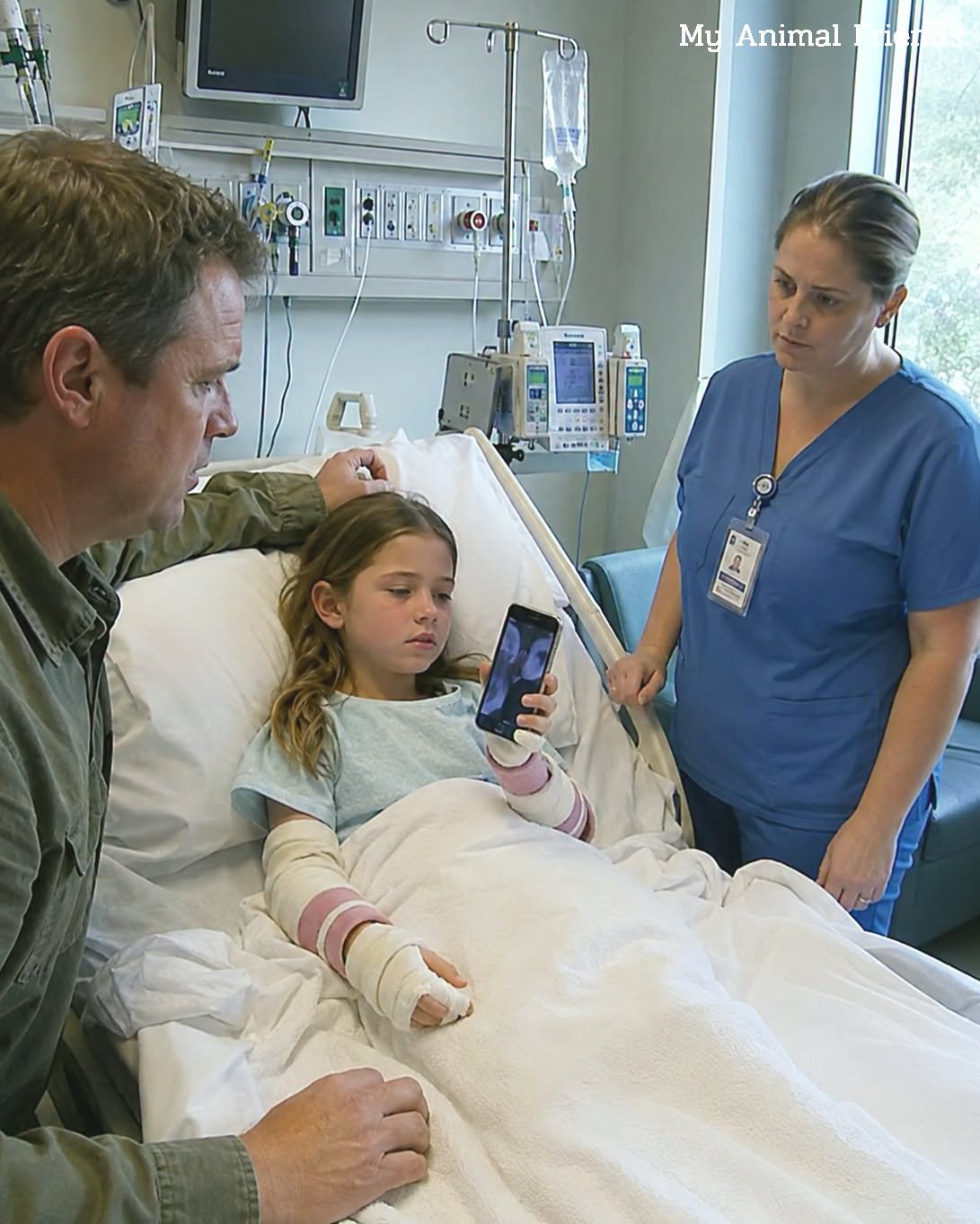
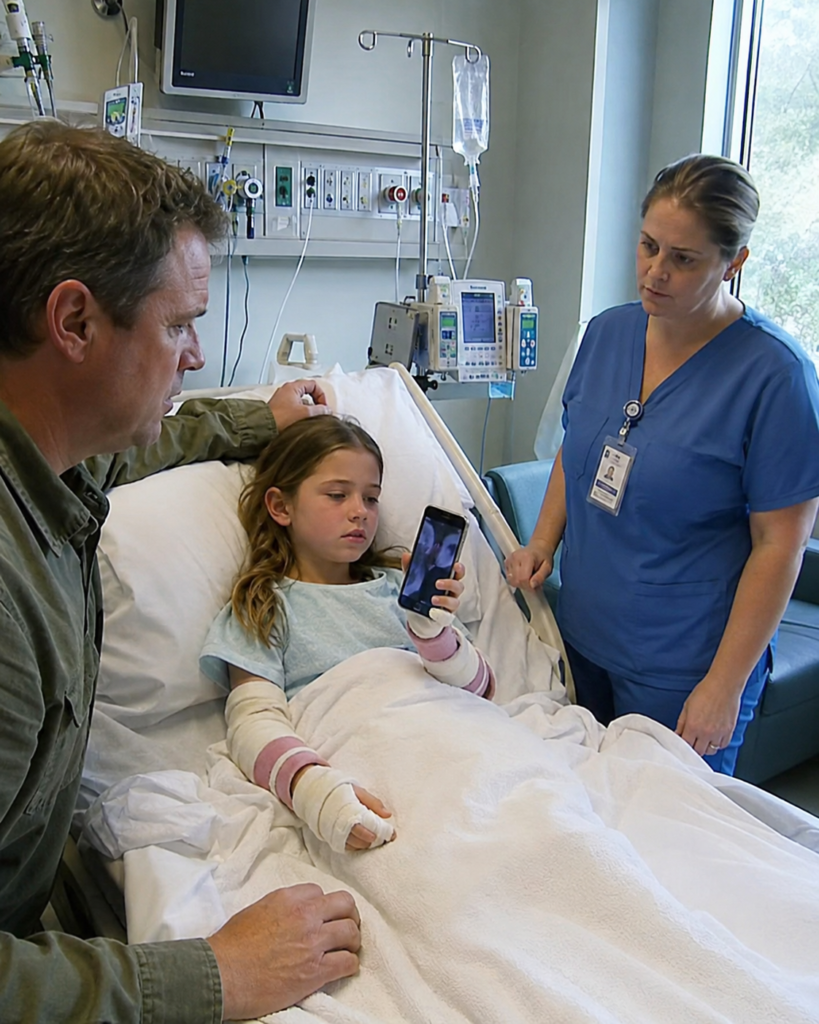
Ronald entered the room and found his daughter nearly hidden beneath sheets, casts, rails, and the raised support beneath her injured leg.
Her face looked smaller than he remembered.
He sat beside her without touching anything until she opened her eyes.
Then he placed two fingers beneath the only part of her hand that was not wrapped.
Anna did not ask whether Luke and Reid had been arrested.
She did not ask whether her mother had called.
She asked, “Do I have to go back there?”
“No,” Ronald said.
His voice did not shake.
“Not while I’m breathing.”
Blackwood Ridge had spent years teaching people what happened when they challenged the Higgins family.
Ellis Higgins owned the lumber mill that employed hundreds of local workers.
His finance company held mortgages on homes throughout town.
His radio station could turn an accusation into gossip by breakfast and make the gossip disappear by lunch.
Police Chief Gordon May attended Sunday dinner at the Higgins estate.
Local officials accepted favors, invitations, campaign support, and the quiet understanding that cooperation would be remembered.
Dahlia had grown up inside that system.
During their marriage, Ronald had mistaken the Higgins family’s constant presence for loyalty.
They had keys to the house.
They knew the alarm code.
They offered advice about money, parenting, holidays, and custody until advice became instruction and instruction became control.
After the divorce, Ronald secured joint custody of Anna.
The Higgins family treated the order as a piece of paper that mattered only when someone powerful was watching.
That history had made Ronald angry before.
Now it made him methodical.
He stayed beside Anna for four days.
He wrote down the time of her original call: 2:17 a.m.
He saved the hospital intake record.
He requested copies of Dr. Foster’s injury summary.
He documented the condition of Anna’s casts and bandages only with the medical team’s guidance.
He asked that every statement Anna gave be recorded through the hospital’s normal process so she would not have to repeat the same terror to every new adult who entered the room.
This was not revenge.
It was preservation.
People who rely on power often expect emotion to become their opponent’s weakness.
Ronald understood that a time stamp, an original file, and a consistent record could be stronger than the loudest man in town.
On the fourth afternoon, Anna was sleeping when Cheyenne Higgins called.
Ronald recognized her number and put the phone on speaker.
“I heard you’re back, little soldier,” she said with a laugh.
The nickname was meant to shrink him.
“My sons are protected,” Cheyenne continued. “My husband runs this town, the police, and the courts. Take your daughter when she’s discharged, and be grateful we’re letting you.”
Ronald looked at Anna’s face against the pillow.
He said nothing.
Cheyenne mistook his silence for fear.
“Luke says that when you finally come looking for him, he’ll finish what he started with her.”
The hospital room seemed to contract around those words.
A soft oxygen hiss came from the next bed beyond the curtain.
Anna shifted beneath the blanket but did not wake.
Cheyenne hung up.
She did not know the call had been on speaker.
She also did not know Ronald had recorded every word out of professional habit.
His first impulse was physical.
He pictured the Higgins estate, the long driveway, and Luke answering the door.
He pictured Cheyenne watching confidence leave her son’s face.
Then Ronald looked at Anna’s casts.
He did not call Luke.
He did not drive to the estate.
He called Colonel Kenneth Cole, his former commanding officer.
Cole listened to the recording from beginning to end without interrupting.
When it stopped, the silence lasted several seconds.
“Gather your team,” Cole finally said.
Ronald waited.
“Not to fight,” Cole added. “To prove everything.”
The distinction became the center of Ronald’s plan.
He created an evidence log.
The log listed the 2:17 a.m. call, the hospital intake time, the physician’s summary, Cheyenne’s recording, and the names of the people who had received copies.
He stored duplicates separately.
He preserved the original audio file on the phone that captured it.
He did not edit the recording, post it online, or send it through a chain of friends who might accidentally damage its value.
Cole helped him contact a civilian attorney outside Blackwood Ridge and advised him to let the evidence travel through documented channels rather than through rumor.
That evening, the Higgins family gathered at their estate.
They believed Ronald would eventually lose control.
Their preferred version of the story was already forming: a dangerous soldier comes home angry, threatens a respected family, and proves he should never have custody.
At 10:43 p.m., Ronald’s phone vibrated on the hospital windowsill.
The number was unknown.
The message contained one sentence.
“My name is Paige. I was upstairs. I recorded what happened.”
A video file appeared beneath it.
Ronald stared at the thumbnail before touching the screen.
The image showed the backyard, part of the fence, the side of a pickup truck, and Anna’s small figure near the grass.
Two men were moving toward her.
In the bright upstairs window, a woman stood with one hand near the curtain.
Ronald called Cole before pressing play.
The video opened with the scrape of a truck door and Paige’s frightened breathing behind the phone.
A time stamp showed 8:46 p.m.
Anna stood near the fence with soda darkening one sleeve.
Luke pointed toward his boots.
Reid reached into the pickup bed and lifted the lug wrench.
Paige whispered, “Stop.”
Her voice was too quiet to carry into the yard.
The phone trembled as Anna tried to move backward.
Then the upstairs window entered the center of the frame.
Dahlia stood behind the glass in a gray sweatshirt.
For one brief second, Ronald believed she was reaching for the latch.
Instead, she looked down at her daughter and pulled the curtain closed.
Ronald stopped the video.
He could hear his own breathing through the call with Cole.
“Play it through,” Cole said softly.
Ronald resumed.
The frame swung away from the window and into the upstairs hallway.
Heavy footsteps struck the stairs.
Paige backed into a bedroom.
The doorknob turned once.
Then it turned harder.
Luke’s voice came from the hall.
“Paige, open the door.”
The recording ended.
Ronald immediately typed, “Are you safe right now?”
Three dots appeared on the screen.
They vanished.
Then they returned.
Paige answered that she had left the house and was staying somewhere the Higgins family did not know.
She still had the original file on the phone that recorded it.
That detail mattered.
A forwarded clip could be challenged.
An original device could preserve the file’s metadata, creation time, and sequence.
Ronald instructed Paige not to meet him alone and not to send the video to anyone else.
Through the attorney, arrangements were made for her to speak with investigators outside the local chain of influence.
The process was slower than Ronald wanted.
Nothing about it felt like the clean, immediate justice people imagine when they hear that a video exists.
There were interviews.
There were requests for records.
There were questions about who possessed which file and when.
There was a hospital social worker’s report, a formal medical record, a custody filing, and the preserved audio of Cheyenne’s threat.
The video did not stand alone.
It matched Anna’s call.
It matched the documented injuries.
It matched the pickup in the backyard.
It matched the time window described by hospital staff and the sequence Anna had given before anyone knew Paige had recorded anything.
Outside investigators took control of the criminal case because the local relationships created an obvious conflict.
Ronald did not announce that development.
He did not post Cheyenne’s call.
He did not appear on the Higgins radio station or argue with people online.
He stayed in the hospital.
Luke and Reid were questioned.
Dahlia was questioned separately.
Their accounts shifted.
First, Anna had fallen.
Then there had been an accident near the pickup.
Then Luke claimed he had only tried to move the tool out of her reach.
The video made those explanations collapse one frame at a time.
Cheyenne’s recording caused another problem for the family.
Her words did not prove the entire assault by themselves, but they showed knowledge, intimidation, and confidence that local influence would protect her sons.
The attorney placed the recording beside the medical documentation and the original video.
Power depends on isolation.
The evidence had stopped being isolated.
Police Chief Gordon May was not allowed to control the investigation after his relationship with the Higgins family came under scrutiny.
The case moved beyond the comfortable circle that had protected them.
Luke and Reid were taken into custody while prosecutors reviewed charges connected to the assault and threats.
Dahlia faced legal consequences tied to her failure to protect Anna and her conduct during the incident.
The precise decisions belonged to the courts, but the family could no longer decide privately what counted as truth.
The custody hearing happened while Anna was still recovering.
Ronald entered the family-court hallway carrying a folder instead of anger.
Inside were the hospital intake documents, the injury summary, the call log, the recorded threat, and confirmation that the original video had been secured.
The Higgins family arrived with attorneys and the polished confidence of people accustomed to making rooms adjust around them.
Cheyenne did not laugh when she saw Ronald.
Ellis did not speak to him.
Dahlia looked at the floor.
The judge reviewed the evidence and issued emergency protections that kept Anna from returning to the Higgins home.
Ronald received sole physical custody while the broader proceedings continued.
Contact with the people involved in the incident was restricted under court supervision.
The order did not heal Anna.
It did something more immediate.
It made “no” official.
No, she did not have to return to the house.
No, the family could not collect her from school.
No, Dahlia could not dismiss the incident as a misunderstanding and take her back behind the same closed curtain.
Anna left the hospital weeks later in a wheelchair with one leg stabilized and both arms still healing.
Ronald pushed her through the automatic doors into bright afternoon light.
She flinched when a pickup truck started in the parking lot.
He stopped walking.
He did not tell her there was nothing to fear.
He crouched beside her chair and asked what she needed.
“Just wait,” she said.
So they waited until the truck drove away.
Recovery came in small, ordinary pieces.
A physical therapist helped Anna rebuild strength.
A counselor taught her how to name fear before it became panic.
Ronald learned not to touch her shoulder from behind.
He learned to announce himself at doorways.
He learned that a night-light could matter more than a speech and that keeping a promise sometimes meant sitting on the floor outside a bedroom until dawn.
Anna eventually stood with support.
Later, she took steps with crutches.
The first time she crossed the therapy room without stopping, Ronald did not cheer until he saw her smile.
Paige’s cooperation remained essential.
She gave investigators the original phone.
Technical reviewers confirmed the video’s timing and continuity.
Her account explained why the recording moved from the window to the hallway and why it ended when Luke reached the bedroom door.
She had been afraid.
She had also understood that deleting the file would make Anna’s truth easier to erase.
That choice cost Paige the protection of people she had once depended on.
It also gave Anna something the Higgins family had never expected her to have.
A witness who refused to close the curtain.
Months later, Ronald asked Anna whether she wanted to know what happened in court.
She thought about it.
“Did they believe me?” she asked.
“Yes,” he said.
That was the only answer she wanted that day.
The rest could wait.
Blackwood Ridge did not change overnight.
The lumber mill still opened before sunrise.
Mortgages still came due.
The radio station still spoke in a polished voice.
But the town had seen something it could not completely unsee.
Ellis Higgins could influence people.
He could not erase a hospital record.
Cheyenne could threaten a father.
She could not pull her own words back from a recording.
Dahlia could close a curtain.
She could not close the camera behind it.
For Ronald, the case was never about defeating an entire family in one dramatic moment.
It was about making sure Anna never had to carry the burden of proving her pain alone.
The sentence from that first call never left him.
“Mom closed the curtain while they were beating me.”
For a long time, those words sounded like the end of trust.
Eventually, they came to mean something else too.
Someone upstairs had kept recording.
A father had stayed calm long enough to preserve the truth.
A doctor had documented what power wanted minimized.
A witness had saved the original file.
And a little girl who had been taught that adults could look away finally learned that some adults would keep looking until she was safe.
The Higgins family had believed control meant owning the town, the story, and everyone who might speak.
They were wrong.
Sometimes power is a mill, a mortgage, a police connection, or a courtroom full of familiar faces.
And sometimes power is one frightened girl refusing to delete a video.