
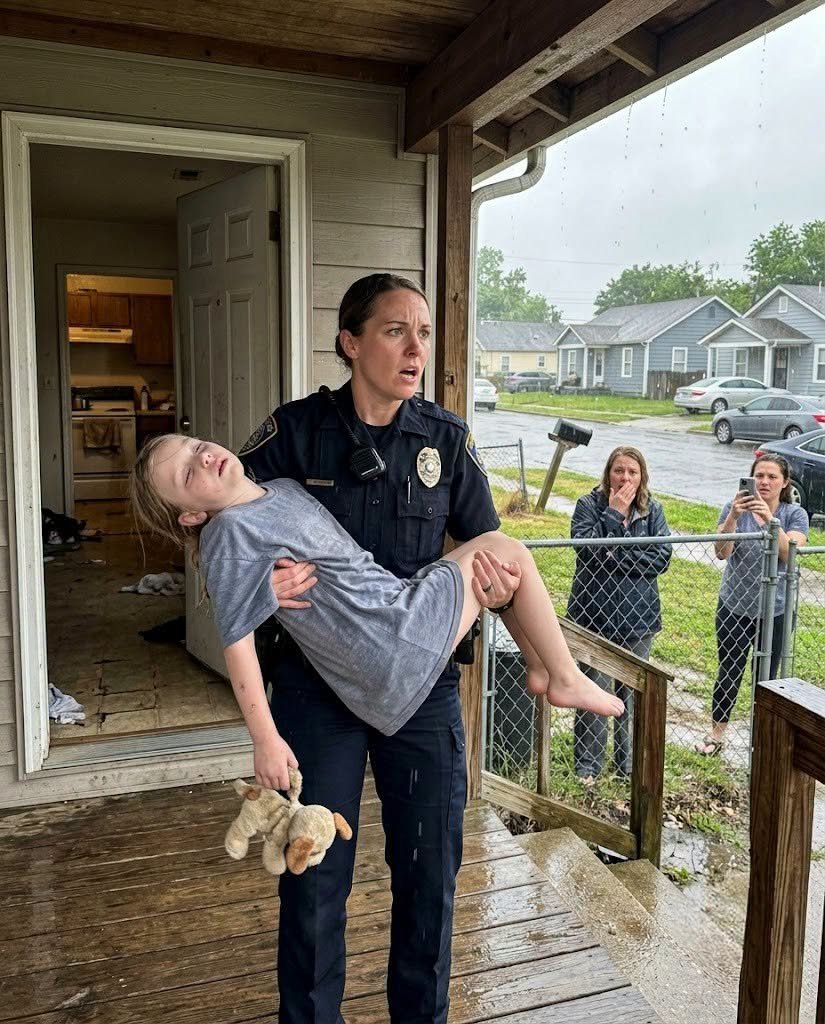
“My daddy said he would only be gone for thirty minutes…”
The seven-year-old’s voice trembled so badly that the 911 dispatcher nearly lost her words beneath the pounding rain.
“But now it’s been four whole days.”
The entire neighborhood would soon brand her father a monster who had deserted his sick daughter.
Then rescuers discovered something beside a flooded roadway that changed everything people believed they knew.
Eric Dawson leaned toward his monitor and adjusted his headset.
Calls from frightened children required patience. Children often mixed up time, addresses, and details when they were scared.
But this child sounded exhausted before she had even finished explaining what had happened.
“What’s your name, sweetheart?”
“Ashley.”
Her breath caught.
“Ashley Turner. I’m seven.”
Eric entered the name into the emergency call form.
“Okay, Ashley. I’m Eric. Are you alone in the house?”
For several seconds, he heard only shallow breathing and rain striking a window.
Then came a quiet sob.
“Yes.”
“Is there another adult nearby? A neighbor or relative?”
“No.”
“Where is your daddy?”
“He went to buy my medicine and some food.”
“When did he leave?”
Ashley sniffed.
“He said thirty minutes.”
Eric kept his tone gentle.
“Was that today?”
“No.”
“Yesterday?”
“No.”
Her voice dropped.
“It was four sleeps ago.”
Eric’s fingers stopped above the keyboard.
Four days.
He checked the address Ashley had given him. It belonged to a small rental house in a working-class neighborhood where people noticed unfamiliar vehicles and knew which families left early for work.
Somehow, no one had realized a seven-year-old child had been alone for days.
“Are the doors locked?”
“Yes.”
“Good. You did a smart thing. Are you hurt?”
“My tummy hurts.”
“When did you last eat?”
Ashley did not answer immediately.
“There was soup.”
“When did you eat it?”
“I don’t know.”
“Is there anything else in the house?”
“The soup smelled bad today.”
Eric closed his eyes briefly.
“What have you been drinking?”
“Water from the kitchen.”
“That’s good. Keep drinking water.”
“I gave some to Buddy too.”
“Who is Buddy?”
“My puppy.”
“Is Buddy a real puppy?”
“No.”
For the first time, a little warmth entered her voice.
“He’s stuffed, but he gets thirsty.”
Eric looked toward his supervisor and raised one hand.
The supervisor understood immediately and alerted child-protection services while Eric dispatched the nearest patrol unit.
“You did exactly the right thing by calling,” Eric told her. “An officer named Natalie is coming to help you. Stay on the phone with me until she arrives, okay?”
“Okay.”
“Can you tell me what you can see outside?”
“A police car.”
Eric checked the tracking screen.
Officer Natalie Reed had arrived.
Rain streamed from the porch roof as Natalie pulled up in front of the house.
The mailbox leaned toward the street. Weeds grew through the cracks in the walkway, and the rooms behind the windows were nearly dark.
One curtain moved.
Ashley had been watching every vehicle that passed.
Natalie approached the porch slowly and knocked with an open hand.
“Ashley? My name is Officer Natalie. Eric sent me to help you.”
The door opened less than an inch.
One frightened eye appeared in the gap.
“You’re not going to yell at me?”
Natalie immediately crouched so she would not tower over her.
“No. Nobody is going to yell at you.”
“Did I do something bad?”
“No, sweetheart.”
“Daddy said not to open the door.”
“Your daddy was right. You should never open the door for strangers. But Eric told you I was coming, remember?”
Ashley nodded.
“I can show you my badge.”
Natalie held it where the child could see without moving closer.
After several seconds, the door opened farther.
Ashley stood barefoot on the cold floor wearing one of her father’s oversized T-shirts.
Her lips were badly cracked. Her arms looked painfully thin, and she held a worn stuffed puppy so tightly that one ear had folded flat.
Beneath the loose shirt, Natalie could see that the child’s stomach was swollen.
Anger rose in her chest, but she pushed it down.
Ashley did not need another upset adult.
She needed someone steady.
“May I come inside?”
Ashley looked past her toward the empty street.
“Are you going to take me away?”
“I’m going to make sure a doctor checks you.”
“What if Daddy comes back?”
“We’ll find him.”
“He might be mad if I’m not here.”
“Your daddy will want you safe.”
Ashley stepped aside.
The house smelled stale and damp.
A blanket had been dragged into the living room. Several empty cups stood beside the couch. A child’s coloring book lay open on the floor with a green crayon beside it.
The refrigerator held almost nothing.
A cloudy container of spoiled soup.
A nearly empty bottle of mustard.
Half a lemon.
Natalie opened the cabinets and found a small amount of dry cereal, but the bag had been torn open and insects had gotten inside.
Two handwritten notes on the kitchen table stopped her.
The first was a grocery list written in careful block letters.
Rice.
Chicken.
Bananas.
Electrolyte drinks.
Ashley’s medication.
The second was a reminder about an urgent appointment early Monday morning at the county children’s clinic.
Nothing suggested Ashley’s father had planned to disappear.
Everything suggested that he intended to come home.
Beside the notes sat a pharmacy coupon and the empty cardboard box from Ashley’s last prescription.
“Ashley, what medicine does your daddy buy for you?”
“The one for my tummy.”
“Do you know why your tummy hurts?”
“The doctor said my inside gets angry.”
Natalie suspected a chronic digestive condition, but she did not press.
“Did your daddy say where he was going?”
“The pharmacy first. Then the grocery store.”
“Did he take his phone?”
“Yes.”
“Did he call you?”
“No.”
“Do you know his phone number?”
Ashley recited it from memory.
Natalie wrote it down.
By then, neighbors had gathered beyond the chain-link fence.
One woman crossed her arms beneath a yellow raincoat.
“I knew something was wrong with that man,” she announced.
Another neighbor lifted a phone and began recording.
“He finally abandoned her,” the woman in yellow continued. “Single father, no steady job. It was only a matter of time.”
Natalie looked through the doorway.
“Did any of you check on this child during the last four days?”
The woman’s expression changed.
“We assumed Andrew took her somewhere.”
“Did anyone see them leave together?”
“No.”
“Did anyone call?”
“He keeps to himself.”
The person recording moved closer.
“Officer, is it true he left her alone?”
Natalie turned away.
Ashley had begun swaying in the doorway.
“Ashley, I’m going to pick you up now.”
The child gave a tiny nod.
“Please don’t leave Buddy.”
“I won’t.”
Natalie slid one arm beneath Ashley’s knees and the other behind her back.
The little girl weighed far less than she should have.
Then Ashley’s body suddenly went limp.
Buddy slipped from her fingers toward the rain-soaked porch.
Natalie caught the stuffed puppy against her arm while pulling Ashley tightly to her chest.
She grabbed her radio.
“Unconscious minor. Possible severe dehydration. Send medical assistance immediately.”
The neighbors stopped whispering.
Natalie checked Ashley’s pulse and covered her with her rain jacket.
Then she looked directly at the people who had already decided what kind of father Andrew Turner was.
“This does not look like abandonment.”
The ambulance arrived within minutes.
Paramedics placed Ashley on a stretcher, started treating her dehydration, and carried her toward the waiting vehicle.
Even half-conscious, she kept reaching for Buddy until Natalie tucked the stuffed puppy beside her shoulder.
While the ambulance pulled away, Natalie returned to the kitchen table.
The grocery list was not old.
Andrew had written the date at the top.
The appointment reminder matched the morning he disappeared.
A receipt beneath the pharmacy coupon showed that he had filled Ashley’s medication at the same store three weeks earlier.
Natalie called dispatch.
“I need Andrew Turner’s vehicle description and his phone’s last available location.”
Eric answered immediately.
“Older dark-green pickup. License plate ending four-seven-two.”
“Last phone location?”
“Stopped transmitting Sunday afternoon.”
“Where?”
Eric hesitated.
“Along County Road Six, between the Turner residence and the shopping center.”
Natalie looked at the grocery list.
County Road Six led directly to the nearest pharmacy and grocery store.
The same road had flooded during the first night of heavy rain.
“Send a unit to check every ditch and service road along that route.”
“Already moving.”
Natalie drove toward the hospital.
Halfway there, her radio crackled.
A patrol officer had located Andrew’s pickup.
It sat angled deep inside a drainage ditch near a washed-out section of road. The front of the truck had struck a tree, and the driver’s door hung open.
A torn grocery bag lay on the shoulder.
Cans, electrolyte drinks, bananas, and a child’s prescription bottle were scattered through the wet grass.
Then the officer’s voice changed.
“There’s someone below the guardrail.”
Natalie gripped the steering wheel.
“Status?”
“My flashlight caught a hand.”
The officer scrambled down the muddy slope.
For several seconds, only heavy breathing came through the radio.
Then he shouted for medical assistance.
Andrew Turner was alive.
He was lying beneath a fallen branch near the drainage channel, one hand still gripping a root in the muddy bank.
His clothes were soaked.
His face was swollen.
A deep cut crossed his forehead.
His right leg was trapped beneath part of the tree.
The responding officer later reconstructed what had happened.
Andrew’s truck had reached the flooded section of County Road Six shortly after the rain began.
Water covered part of the pavement, but another vehicle had already crossed.
Andrew attempted to turn around.
The weakened shoulder collapsed beneath his truck.
The vehicle slid into the ditch and struck the tree.
Andrew survived the impact and forced open the driver’s door.
His phone was damaged in the crash.
He tried to climb back toward the road, but a second rush of floodwater swept him downhill.
The tree branch pinned his leg before he reached the drainage channel.
The location was hidden from the road by weeds and the guardrail.
Andrew could hear vehicles passing above him.
They could not hear him over the rain.
For four days, he survived on rainwater and two small packets of crackers from his coat pocket.
Each time he tried to pull himself free, the branch shifted against his leg.
He eventually lost consciousness.
The hand beside the guardrail had not been reaching upward when police found him.
It had simply remained wrapped around the root he had used to stop himself from being swept farther downstream.
At the hospital, Dr. Lena Morris examined Ashley.
The child was severely dehydrated and malnourished. Her abdominal swelling was related to a digestive disorder that required regular medication and a careful diet.
Missing several doses had worsened her condition.
But she was alive.
Her kidneys had been placed under strain, though doctors believed she would recover.
When Natalie entered Ashley’s room, the girl had an intravenous line in one arm and Buddy tucked beneath her chin.
“Did you find Daddy?” she whispered.
Natalie sat beside the bed.
“Yes.”
Ashley’s eyes widened.
“Is he coming?”
“He was hurt.”
“Is he dead?”
“No.”
The word came quickly.
“He is alive.”
Ashley began crying.
Not loudly.
Her small body simply shook beneath the hospital blanket.
“I thought he didn’t want me.”
Natalie’s throat tightened.
“He was trying to come home.”
“Why didn’t he?”
“There was an accident.”
“Did he get my medicine?”
Natalie placed the recovered prescription bottle on the bedside table.
“Yes.”
Ashley reached toward it.
The bottle was scratched, but her name remained visible on the label.
“He didn’t forget?”
“No.”
“What about the food?”
“He bought that too.”
Ashley held Buddy against her chest.
“I knew he said thirty minutes.”
Natalie smiled sadly.
“He meant it.”
Across the hospital, Andrew was undergoing emergency surgery.
He had a broken leg, several fractured ribs, a shoulder injury, and a serious infection in the wounds caused by days of exposure.
Doctors warned that his recovery would be long.
But his first words after briefly regaining consciousness were not about his injuries.
“My daughter.”
A nurse leaned closer.
“Her name is Ashley?”
His eyes opened.
“She’s alone.”
“She’s here.”
Andrew tried to sit up.
The movement sent his monitors into alarm.
“She’s here?”
“She called for help. She is being treated.”
He began crying.
“I left her.”
“You were in an accident.”
“She waited.”
“She survived.”
“I promised thirty minutes.”
The nurse placed one hand on his shoulder.
“You came as close to home as you could.”
By evening, the story had spread through the neighborhood.
The woman in the yellow raincoat had posted a video before learning about the truck.
The caption read:
Father abandons sick seven-year-old for four days.
The video showed Ashley being carried to the ambulance.
It did not show the dated grocery list.
It did not show the medicine scattered beside Andrew’s crashed truck.
It did not show his hand gripping the muddy bank.
Within hours, thousands of people had shared it.
Comments called Andrew cruel.
A coward.
A monster.
People demanded that he lose custody.
One stranger posted his work address.
Another shared an old photograph taken from his social-media page.
By the time police confirmed Andrew had been found, the accusation had already traveled farther than the truth.
Natalie contacted the original poster.
“You need to remove the video.”
The woman looked offended.
“I was documenting what happened.”
“You documented a child’s medical emergency and added a claim that was not verified.”
“He was missing.”
“He was trapped beside a flooded road.”
“I didn’t know that.”
“That is exactly the problem.”
The woman removed the post.
Copies remained.
Some accounts corrected the story.
Others continued sharing the original claim because outrage attracted more attention than clarification.
At the hospital, a child-protection investigator named Rachel Kim reviewed Ashley’s living conditions and Andrew’s history.
She examined school records, medical appointments, employment files, and statements from teachers.
Andrew worked nights repairing industrial refrigeration systems.
His hours changed frequently, but he had never left Ashley without care.
Teachers described him as attentive.
He attended parent conferences in work clothes and often arrived carrying a toolbox because he came directly from a job.
Ashley’s doctor confirmed that Andrew had never missed a medical appointment before the crash.
The refrigerator had been nearly empty because he planned to shop that afternoon.
The spoiled soup had been cooked the previous evening.
The utility bills were current.
The house was modest but safe.
Nothing supported abandonment.
Still, Rachel asked difficult questions.
“Why didn’t anyone notice Ashley was missing from school?”
The school had been closed Monday because of severe weather.
On Tuesday and Wednesday, roads remained flooded, and attendance was optional.
Andrew had previously informed the school that Ashley sometimes stayed home during digestive flare-ups.
The absence did not trigger an immediate welfare call.
“What about family?” Rachel asked.
Andrew’s parents were dead.
Ashley’s mother, Rebecca, had died from complications after surgery when Ashley was two.
Andrew’s only sibling lived overseas.
He had no nearby relatives.
“What about neighbors?”
Andrew had asked the woman next door to watch Ashley during emergencies.
She had been visiting her daughter in another state and did not return until the day police arrived.
The neighborhood had noticed Andrew’s truck was gone.
They assumed Ashley was with him.
Everyone had seen something.
Nobody had put the pieces together.
Two days later, Andrew was stable enough to see his daughter.
Hospital staff arranged for their beds to be moved temporarily into adjoining rooms.
Natalie stood near the doorway when Ashley was wheeled inside.
Andrew looked smaller beneath the blankets.
His leg was elevated in a heavy brace. Bandages covered his head and shoulder.
Ashley stared at him.
“Daddy?”
His face crumpled.
“I’m sorry.”
She reached both arms toward him.
A nurse lifted her carefully and placed her beside his uninjured side.
Andrew held her with one arm.
“I tried to come back.”
“I know.”
“I said thirty minutes.”
“You got hurt.”
“I should have called someone.”
“Your phone broke.”
He looked at her.
“Who told you?”
“Officer Natalie.”
Ashley placed the scratched prescription bottle on his chest.
“You remembered.”
Andrew closed his eyes.
“Of course I remembered.”
“I ate the bad soup.”
“I’m sorry.”
“It tasted funny.”
“I’m so sorry.”
“I gave Buddy water.”
Andrew laughed through his tears.
“That was kind.”
“He was thirsty too.”
They remained like that for several minutes.
Nobody in the room spoke.
Outside the door, the woman who had first accused Andrew waited with a grocery bag.
Her name was Denise Porter.
She had lived across the street from Andrew for three years.
She was the one who had posted the video.
Natalie almost sent her away.
Andrew saw her through the glass.
“Let her in.”
Denise entered slowly.
She kept both hands around the grocery bag.
“I owe you an apology.”
Andrew did not answer.
“I thought…”
She stopped.
The sentence had nowhere honest to go.
“You thought I abandoned her,” he said.
“Yes.”
“Why?”
“You kept to yourself. You worked odd hours. Sometimes Ashley wore the same coat several days in a row.”
“It is her favorite coat.”
“I know that now.”
“You posted her face online.”
Denise lowered her eyes.
“I removed it.”
“After thousands of people saw it.”
“Yes.”
“What is in the bag?”
“Food. For when you’re discharged.”
Andrew looked toward Ashley.
“Give it to the nurses’ station.”
Denise nodded.
She placed the bag near the door.
“I’m sorry.”
Andrew’s voice remained calm.
“My daughter was alone for four days. You lived across the street.”
The words struck harder than anger.
Denise began crying.
“I didn’t know.”
“You noticed enough to judge me when the ambulance came.”
She had no answer.
After she left, Ashley looked at her father.
“Is Ms. Denise bad?”
Andrew considered the question.
“No.”
“She said bad things.”
“Yes.”
“Then why isn’t she bad?”
“People can do something wrong without being bad forever.”
Ashley frowned.
“Like when I drew on the wall?”
“More serious than that.”
“Can she fix it?”
“Some of it.”
“How?”
“By telling the truth as loudly as she told the wrong story.”
Denise tried.
She recorded a second video outside the flooded roadway.
Behind her, crews removed Andrew’s damaged truck from the ditch.
She showed the scattered groceries, the prescription bottle’s location, and the place where police had found him.
“I accused Andrew Turner of abandoning his daughter,” she said. “I was wrong. He was trapped here after an accident while returning with her food and medicine.”
She explained that Ashley had survived alone because no one in the neighborhood checked.
Then she included herself.
“I was more willing to record a frightened child than to ask whether she needed help before that day.”
The correction did not spread as quickly as the accusation.
But it traveled far enough to begin repairing the truth.
Local news stations covered the rescue.
Eric’s 911 call with Ashley was not released publicly, but reporters interviewed him about the importance of teaching children how to contact emergency services.
The county launched a review of welfare procedures during school closures.
The neighborhood formed an emergency contact network for children, elderly residents, and people living alone.
Someone repaired Andrew’s leaning mailbox.
Someone else stocked his freezer.
But Andrew refused most public fundraising.
“I need help recovering,” he told Natalie. “I don’t want to become a story people use to feel generous for one week.”
He accepted assistance with rent and medical bills.
He accepted grocery deliveries.
He accepted rides to physical therapy.
But he insisted that people remember the larger lesson.
Ashley had not been invisible.
Her bedroom light had remained on at night.
She had stood behind the curtain whenever a car passed.
She had carried cups of water from the kitchen.
Neighbors had heard a television playing because she left it on to make the house feel less empty.
They had explained each sign instead of investigating it.
The rehabilitation team estimated Andrew would need months before he could return to full work.
His employer kept his position open.
One of his coworkers repaired the damaged truck, though the water had ruined much of the interior.
Inside the cab, they found a small receipt stuck beneath the passenger seat.
It was time-stamped twelve minutes before the crash.
Andrew had purchased Ashley’s medication first.
Then groceries.
He had been less than ten minutes from home.
Rachel Kim closed the child-protection investigation with no finding of neglect or abandonment.
Her report stated that Ashley had been left alone because of an unforeseeable accident that rendered her father physically unable to return or communicate.
It also praised Ashley’s ability to seek help.
But Andrew struggled to accept the official conclusion.
One evening, Natalie found him staring through the hospital window after Ashley had fallen asleep.
“You are not responsible for the flood,” she said.
“I drove onto that road.”
“You tried to turn around.”
“I should have stopped earlier.”
“You were buying medicine for your child.”
“I should have made sure someone checked on her if I was late.”
“You expected to be gone thirty minutes.”
He looked at her.
“Parents don’t get to expect accidents away.”
“No,” Natalie said. “But they also don’t get to control every accident.”
Andrew pressed one hand against his eyes.
“She believed I left her.”
“For a little while.”
“That will stay with her.”
“So will what happened afterward.”
“What do you mean?”
“She learned you did not abandon her. She learned police officers can help. She learned how to call 911. She learned that she survived something frightening.”
“I don’t want survival to be her childhood lesson.”
“Then make the next lesson safety.”
Andrew nodded slowly.
When they returned home six weeks later, the neighborhood gathered along the street.
There were balloons tied to the repaired mailbox.
Andrew disliked the attention, but Ashley smiled from the car window.
She wore her favorite coat even though the afternoon was warm.
Denise stood near the porch holding Buddy.
Hospital staff had washed the stuffed puppy after he fell into the rain.
One ear remained folded.
Ashley ran to him.
“You fixed him.”
“I cleaned him,” Denise said. “He was already okay.”
Ashley hugged the toy.
Then she looked across the street.
“You should check next time.”
Denise’s face reddened.
“Yes.”
“Not record.”
“Yes.”
Ashley seemed satisfied.
Inside, the refrigerator was full.
Rice.
Chicken.
Bananas.
Electrolyte drinks.
The exact items from Andrew’s grocery list.
Someone had framed the original list and placed it near the kitchen door.
Andrew almost took it down.
Then Ashley stopped him.
“It shows you were coming back.”
He left it there.
For months, Ashley refused to sleep unless Andrew remained in the hallway.
If he took out the trash, she watched from the window until he returned.
A thirty-minute grocery trip became impossible.
He did not force her to get over it.
A therapist helped them build small routines.
Andrew told her exactly where he was going.
He left written notes.
He arranged two emergency contacts.
Ashley practiced calling both.
They started with five-minute trips.
Then ten.
Eventually, Andrew could drive to the pharmacy without Ashley crying.
The first time he returned after thirty minutes, she stood at the door holding Buddy.
“You came back.”
“I said I would.”
“You said that before.”
The words hurt him.
He knelt despite the pain still remaining in his leg.
“You’re right. Sometimes people mean to come back and something stops them.”
Ashley watched him carefully.
“So promises don’t work?”
“Promises matter. But we also make plans in case something goes wrong.”
He showed her the emergency numbers on the refrigerator.
“Promises and plans,” she said.
“Yes.”
“That’s better?”
“Much better.”
A year later, Eric received an envelope at the dispatch center.
Inside was a drawing.
A little girl stood beside a man with one leg in a brace.
A police officer, an ambulance, and a stuffed puppy surrounded them.
Across the top, Ashley had written:
THANK YOU FOR STAYING ON THE PHONE.
Eric pinned it beside his monitor.
Natalie received a similar drawing.
Hers showed the front porch in the rain.
Beneath it, Ashley wrote:
THANK YOU FOR NOT YELLING.
The neighborhood remembered the story as the time a father was wrongly accused.
Andrew remembered it differently.
To him, it was the story of a child who waited four days for a promise to come through the door.
She rationed water.
Ignored her hunger.
Protected her stuffed puppy.
Watched every vehicle.
Then, when she realized waiting was no longer enough, she asked for help.
People called Andrew a monster because judgment filled the empty space before facts arrived.
They looked at the dark house, the thin child, and the missing father and decided the easiest explanation must be true.
But easy explanations are often built from what nobody bothered to check.
The grocery list had a date.
The prescription had Ashley’s name.
The truck had crashed on the road home.
And Andrew’s hand remained wrapped around the muddy root where he had fought for four days not to be swept away.
He had promised thirty minutes.
He did not break that promise by choice.
The storm broke the road beneath him.
The flood broke his phone.
The tree broke his leg.
But nothing had broken his attempt to return.
Years later, Ashley no longer remembered every detail of the four days alone.
She remembered the rain.
The spoiled soup.
The sound of Eric’s voice.
Officer Natalie kneeling outside the door.
And the scratched medicine bottle on her father’s hospital blanket.
Whenever someone asked whether her father had abandoned her, Ashley gave the same answer.
“No.”
Then she added the part people had once been too quick to discover.
“He was coming home.”