
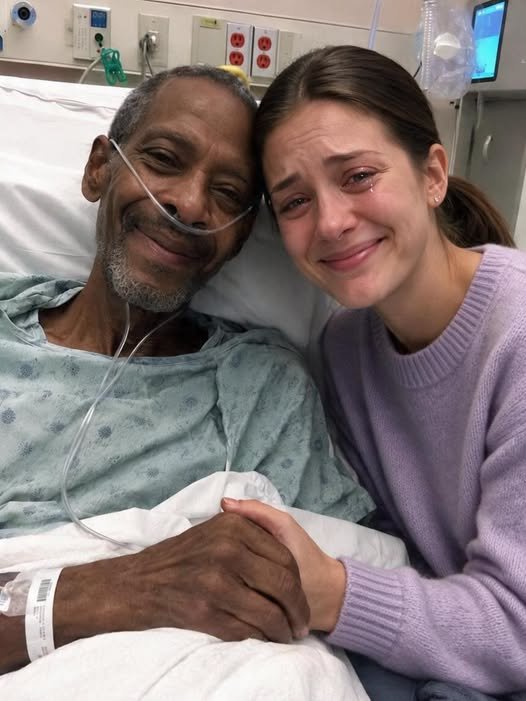
Part One: The Father Who Chose to Stay
The nurse was smoothing the blanket over Frank’s legs when I found myself telling her about the pancakes.
“He made them in the shape of stars,” I said, watching her work around the thin hospital tubes. “Every Sunday morning, without fail. Even after I grew up, got married, and started bringing my own daughter to breakfast, he still used that little metal cutter.”
For most of the afternoon, Frank had drifted in and out of sleep. His breathing was faint, and every rise of his chest seemed to require more effort than the one before it. Yet at the word pancakes, his eyelids lifted.
He looked straight at me.
I waited for the uneven grin that had softened every difficult moment of my life. It never came. Instead, tears gathered in his tired eyes.
“Dad?” I bent closer. “Do you hurt anywhere?”
He moved his head slightly from side to side.
The nurse glanced at the monitor, then rested her hand on my shoulder. “I will be just outside.”
When the door closed, I took the damp cloth from the bedside table and touched it gently to his forehead.
“Those pancakes were not exactly perfect,” I whispered. “You always burned the points.”
A trace of amusement passed over his face.
“You ate them anyway,” he murmured.
“I had no choice. The alternative was your oatmeal.”
His fingers shifted beneath mine, and for a brief moment the hospital room disappeared. I was four years old again, sitting at our kitchen table with sticky hands, waiting for a man I did not yet trust to slide a star onto my plate.
Frank entered my life carrying two suitcases and an extraordinary amount of patience. My biological father had disappeared so early that I had no clear memory of him, but I still understood that adults could leave. Because of that, I greeted my mother’s new husband with silence.
I would not call him Frank. I certainly would not call him Dad. When he offered toast, I pointed at the loaf. When he asked which bedtime story I wanted, I pulled my blanket over my head. If he sat beside me, I moved away.
He never demanded affection. He simply paid attention.
He learned that I wanted strawberry jam spread into every corner of the bread. He discovered that I was frightened of thunder but too proud to admit it, so during storms he sat in the hallway outside my bedroom, close enough for me to hear him turning pages in a book. And every Sunday, he mixed apples and cinnamon into pancake batter, pressed it into a dented star-shaped cutter, and pretended not to notice when I watched him from the doorway.
One morning, about three months after he married my mother, I walked into the kitchen and said, “Dad, is breakfast ready?”
The spatula slipped from his hand and struck the floor.
Neither of us spoke about what I had called him. He picked up the spatula, washed it, and gave me the best pancake in the batch – the one with all five points intact.
Five months later, my mother died suddenly from a brain aneurysm.
The last ordinary exchange I remembered having with her was about my shoes. She had asked me to put them away. I had complained. For years afterward, I would have given anything to return to that small moment and answer her more kindly.
After the funeral, relatives filled our house with casseroles, lowered voices, and opinions they assumed I could not understand.
“Frank is not her real father.”
“Her aunt should take her.”
“He is still young. He will want another life.”
That night, I crawled beneath the kitchen table and curled myself into the smallest shape I could make. I stayed there until the windows began to pale with morning.
Frank found me just before sunrise. Without asking me to come out, he lowered himself to the floor and sat beside the table.
“Are you going away too?” I asked.
His face changed as if the question had wounded him.
“No, Rosie.”
“People always go.”
“I am staying.”
“Can you promise?”
He reached beneath the table and offered me his little finger. I wrapped mine around it.
“I promise,” he said.
For thirty-six years, I believed that promise had been simple for him to make.
I did not know what it had cost.
Part Two: The Last Week
Frank became the only father I ever truly knew.
He attended every school performance, even the one in which I stood at the back and forgot all the words. He taught me to drive in an old sedan that stalled whenever I became nervous. He waited at the end of the aisle on my wedding day with tears already shining in his eyes, then tried to pretend they came from the bright chapel windows.
When my daughter was christened, he hovered beside me with one hand ready beneath her head, convinced that a thirty-two-year-old woman might suddenly forget how to hold her own baby.
I occasionally asked about his life before he met my mother. His answer never changed.
“The part worth telling began when you arrived.”
I heard those words as devotion. It never occurred to me that they might also be a locked door.
Soon after his seventy-eighth birthday, Frank began losing his strength. At first, he blamed age. Then his clothes became loose, the stairs left him breathless, and our weeks filled with tests and appointments. Eventually, the doctors began speaking in careful phrases that offered comfort without offering hope.
During his final week, I slept in a stiff chair beside his hospital bed. I learned the language of the machines: which beep meant a nurse would come, which alarm was harmless, and which change in his breathing would pull me awake before I even understood why.
On the last evening, his doctor asked me to step into the corridor.
“Rosalie,” he said gently, “you may only have a few hours left with him.”
I nodded because any attempt to speak would have shattered the little control I had.
When I returned, Frank seemed to be sleeping. I sat down, slid my hand beneath his, and traced the familiar knuckles that had repaired my bicycle, buttoned my winter coat, steadied me at my wedding, and cradled my newborn daughter.
Without warning, his fingers closed tightly around my wrist.
His eyes opened.
“Before I tell you something,” he said, each word thin but deliberate, “promise you will listen to all of it.”
“Of course.”
“And promise you will not decide what it means until you know everything.”
Uneasiness moved through me. “Dad, what is this about?”
His gaze held mine.
“I let you believe a version of your childhood that was not complete.”
I tried to smile, hoping to ease whatever confusion or fear had seized him. “You are exhausted. Let me call the nurse.”
“No.” His grip tightened. “My thoughts are clear. I should have told you years ago, but I was asked to keep silent – and I was afraid the truth would change the way you looked at me.”
My heart began to hammer. Questions arrived faster than I could sort them. Was my biological father still alive? Had letters been hidden from me? Had Frank kept another family secret all these years?
With a trembling hand, he reached beneath the blanket and drew out a folded piece of paper. He pressed it into my palm.
“Go to this address. Tonight.”
“I am not leaving you.”
Tears slipped toward the gray stubble on his cheek.
“Please, Rosalie. I need you to understand while there is still time.”
He had not called me Rosalie since I was a child. The sound of my full name frightened me more than the machines surrounding us.
I leaned close enough for my forehead to touch his.
“Tell me yourself.”
His eyes slowly closed.
“Some truths are safer in the hands of the person who witnessed them.”
Those were the last words my father ever spoke to me.

Part Three: The Address
Moments later, the monitor sounded. A nurse hurried in, checked Frank’s pulse, and adjusted his oxygen.
“He is still here,” she told me, “but he may not become alert again.”
I stepped into the hallway and unfolded the paper. An address had been written in Frank’s unsteady hand. I recognized the neighborhood. It was less than twenty minutes from the house where he had raised me.
For several minutes, I stood beside a vending machine with the paper clenched in my fist.
Leaving felt impossible. Nothing behind a stranger’s door could matter more than the man lying in that room. I nearly tore the note in half.
Then I remembered his expression. He had not looked afraid of dying. He had looked afraid that I would misunderstand his life after he was gone.
I asked the nurse to call me if anything changed, kissed Frank’s forehead, and hurried to my car.
The streets were nearly empty. At every intersection, my mind invented a different betrayal. Perhaps he had been married to someone else. Perhaps there was another child. Perhaps I would meet a stranger who would tell me the father I adored had stayed only because duty required it.
By the time I reached the address, my hands ached from holding the steering wheel.
The house was small and carefully kept, with a porch light glowing over a blue front door. I rang the bell once.
An elderly woman answered. Her silver hair was pinned loosely at the back of her head, and her pale blue eyes widened the instant she saw me. One hand rose to her mouth.
“Rosalie,” she breathed.
I stepped backward. “How do you know my name?”
“I am Caroline. Frank and I were friends a very long time ago.”
“What did he tell you?”
She looked past me toward the quiet street. “He called me last month. His voice was weak. He said you might appear at my door one day.”
“Might?”
“He wanted to send you. He just did not know whether he would find the courage.”
She opened the door wider. “Please come inside. You deserve the whole story.”
Every part of me wanted to return to the hospital. Yet I crossed the threshold.
Her kitchen smelled faintly of tea and cinnamon. It should have felt unfamiliar, but a strange sense of recognition followed me into the room.
“Tell me what he hid,” I said.
Caroline studied me for a moment, then went to a drawer beside the stove. She opened it and moved aside a folded dish towel.
Inside lay a collection of old metal cookie cutters: a heart, a flower, an apple, several animals – and a small five-pointed star.
My breath caught.
It looked exactly like the cutter Frank had used every Sunday of my childhood.
“Where did that come from?”
Caroline lifted it with both hands, as carefully as if it were made of glass. “It belonged to Frank.”
“No. His cutter is in my kitchen.”
Her eyes softened. “There were two.”
She reached beneath the cutters and removed a photograph.
In it, a little girl stood beside a kitchen table, beaming over a plate of star-shaped apple pancakes. She could not have been older than five. Behind her stood Frank, decades younger, his hands resting on her shoulders.
I had seen thousands of expressions on my father’s face, but never that one. His happiness in the photograph was bright and unguarded.
“Who is this child?” I asked.
Caroline sat across from me.
“Her name was Miley,” she said. “She was Frank’s daughter.”
Part Four: The Daughter Before Me
The kitchen seemed to tilt.
“His daughter?”
Caroline nodded. “Frank was married years before he met your mother.”
I stared at the smiling child in the photograph. She had Frank’s eyes and his crooked grin.
“Where is she now?”
Caroline lowered her gaze. “Miley died when she was five. There was an accident during a family day at a lake. It happened very quickly. Frank blamed himself, although everyone who knew the circumstances understood that he could not have prevented it.”
The words settled between us with terrible quietness.
I lowered myself into a chair because my knees had begun to shake. “Why did he never tell me?”
“After Miley was gone, his marriage fell apart beneath the grief,” Caroline explained. “Frank withdrew from everyone. I had been his closest friend since school, and even I could barely reach him. He packed away the photographs, the toys, and anything else that reminded him he had once been someone’s father.”
My attention returned to the metal star in her hand.
“The pancakes were hers,” I whispered.
“Yes. Apple and cinnamon, shaped like stars. They were her favorite.”
Suddenly, my happiest childhood memory no longer belonged only to me. The realization stung in a way I could not explain. I felt grief for a child I had never met, jealousy toward a memory, and shame for feeling jealous at all.
Caroline seemed to understand.
“He did not give you a life that had been meant for Miley,” she said. “And you did not take her place.”
I looked up.
“Then why repeat everything with me?”
“Because you brought the memory back to him in a way he could bear.”
She told me about a morning I could not remember. Not long after Frank married my mother, I had climbed onto his lap while he was reading and fallen asleep against his chest. When I woke, I had asked if he knew how to make pancakes shaped like stars.
“You must have seen the cutter,” Caroline said. “Perhaps it was in a drawer, or perhaps your mother had found it in a box. No one knows. But Frank made the pancakes for you.”
Caroline placed the photograph on the table between us.
“He telephoned me that afternoon. He could hardly speak through his tears. He said he had made star pancakes for the first time since Miley died. More importantly, he had spoken her name aloud. He realized that remembering her did not have to destroy every new moment of happiness.”
My eyes burned. I thought of all those Sunday mornings: Frank humming at the stove, pretending to be offended when I criticized a burned edge, choosing the best star for my plate.
I had assumed he created that tradition for me.
Now I understood that, in the beginning, the tradition had created a bridge for him.
“You helped him open a room in his heart that he had sealed shut,” Caroline said. “Not so you could replace Miley, but so he could carry her memory without closing himself to you.”
I pressed my fingertips to the little girl’s photograph.
“If that is the secret, why did he speak as if he had betrayed me?”
Caroline’s face changed. She folded her hands on the table and took a slow breath.
“Because there is another part. It concerns the night after your mother’s funeral.”

Part Five: The Night He Nearly Left
I saw the kitchen table of my childhood in my mind. I saw my four-year-old self beneath it, waiting for Frank to tell me whether I would lose another parent.
“What about that night?”
“Frank packed his truck,” Caroline said.
The sentence was quiet, but it struck with enormous force.
“No.”
“He believed your aunt could give you a more stable home. He thought leaving before you depended on him completely would be kinder than failing you later.”
“He came here?”
“A little after midnight.”
I pushed back from the table. “He told me he would never leave.”
“And he did not leave.”
“But he intended to.”
Caroline did not try to make the truth prettier. “Yes. For several hours, he did.”
Pain rose in me so quickly that I could barely breathe around it. The promise beneath the kitchen table had been the strongest certainty of my childhood. I had believed Frank saw my fear, chose me without hesitation, and never once looked toward the door.
“Why?” I asked. “Was I too much for him?”
“No, Rosalie. He was afraid because he already loved you.”
Caroline’s own voice began to tremble.
She told me Frank had sat in that same kitchen until dawn. He kept his truck keys on the table and repeated that he was not strong enough to become a father again. Every time I laughed, he heard an echo of Miley. Every time I ran too close to the road or climbed too high at the playground, terror seized him. Loving me had awakened both his joy and his fear of losing a child.
“He said staying would be selfish,” Caroline continued. “He believed he was asking you to live with a man whose old grief might make him overprotective or distant.”
I stared at the keys hanging beside Caroline’s back door, imagining Frank’s set on the table decades earlier.
“What did you say to him?”
“I told him fear was not proof that he should leave. It was proof that you mattered to him. I told him he should not decide your future while listening only to the worst night of his past.”
Caroline reached for my hand.
“Most of all, I told him that he was already your father. The only decision left was whether he would act like one when being a father felt frightening.”
Somewhere near sunrise, Frank picked up his keys. He drove home, unpacked the truck before I woke, thanked my aunt for staying with me, and found me beneath the kitchen table.
Only then had he offered me his little finger.
Only then had he promised.
My chest tightened as the memory rearranged itself. I had always pictured Frank waking that morning with certainty in his heart. Instead, he had returned after a night-long battle with every fear he carried.
“He nearly abandoned me,” I said.
“He nearly allowed grief to make the decision,” Caroline replied. “Then he chose love instead.”
I wiped my face with both hands. “Why keep that from me for all these years?”
“Because he never wanted a child to feel responsible for repairing an adult’s sorrow. He wanted you to grow up knowing that you were loved, not believing you had to earn his presence by making him happy.”
I remembered the many times Frank had told me I brought light back into his life. I had heard the words as ordinary tenderness. Now I understood the history beneath them.
“He let me believe he saved me,” I whispered.
Caroline squeezed my fingers.
“He did save you. But you also gave him the courage to become himself again. Love was not a debt between you. It was something you built together.”
Part Six: The Race Back
Caroline gave me the photograph of Miley and closed my hand around the second star cutter.
“Frank wanted you to have these,” she said.
I looked at the clock and felt panic sweep through me. I had been away too long.
“I need to tell him I understand.”
“Then go.”
I drove back with the photograph on the passenger seat and the metal star in my coat pocket. Every red light felt unbearably long. I rehearsed what I would say.
I would tell him the truth had not made his love smaller. I would tell him that returning counted for more than the moment he had considered leaving. I would tell him that courage was not the absence of fear; it was driving home while afraid, unpacking the truck, and crawling beneath a table to comfort a little girl.
Most of all, I would tell him he had never needed to hide Miley from me.
I ran from the parking lot to the hospital entrance and pressed the elevator button again and again, as though urgency could make it rise faster.
When the doors opened on Frank’s floor, the nurse was waiting in the hallway.
Her expression stopped me before she spoke.
“I am so sorry.”
I walked past her into the room.
Frank lay beneath the same pale blanket, but the machines were quiet now. The stillness felt impossible. I took his hand and held it against my cheek.
“You should have trusted me with the whole story,” I whispered. “I would have loved every part of you.”
The words I had prepared vanished. I could only sit beside him and wish I had returned five minutes earlier, or asked better questions five years earlier, or listened more carefully whenever he spoke about the life that began with me.
After a while, the nurse placed a small clear bag on the bedside table. “These are his personal belongings. Take all the time you need.”
Inside were his watch, his keys, a handkerchief, and the brown wallet he had carried for as long as I could remember.
I opened it.
Behind his driver’s license was an old photograph with edges worn soft from years of touch. Miley stood at a kitchen table, proudly showing off a plate of star-shaped pancakes.
Behind it was a second picture.
I was five years old, grinning at the camera while holding a lopsided pancake with one darkened point.
Frank had kept the two photographs together.
There was no note explaining them, and none was needed. He had carried both daughters with him every day. He had not erased Miley to love me. He had not repeated his old life because I was a replacement.
He had remembered exactly how deeply a father could love and how painfully life could change – and he had chosen to become my father anyway.

Part Seven: Two Stars
I returned to Caroline’s house after the funeral.
We sat in her kitchen drinking tea that neither of us touched. This time, the silence between us did not feel like a guarded secret. It felt like a shared place where Frank’s two lives could finally meet.
Caroline showed me a small box of photographs. There was Frank holding baby Miley with an expression of astonished tenderness. Frank teaching her to ride a tricycle. Frank crouching beside a birthday cake while Miley reached toward the candles.
I showed Caroline pictures from my own albums: Frank beside me at graduation, Frank crying at my wedding, Frank asleep in an armchair with my daughter curled against him.
For decades, those sets of photographs had existed in separate houses. Now we placed them side by side across the table.
For the first time, I saw my father whole.
He was not only the patient man who entered my childhood with two suitcases. He was also a young father who had known a devastating loss, a frightened man who once packed his truck, and a brave one who turned it around before sunrise.
Understanding that did not damage my memories. It gave them depth.
The star pancakes were still mine, but they were also Miley’s. The promise beneath the table was still real, even if courage had been required before Frank could make it. His love for me was not weakened by the daughter who came first. If anything, it was more remarkable because he knew love could bring both joy and sorrow, yet he opened his heart again.
Before I left, Caroline placed the second cutter in a small cloth pouch.
“Frank once told me that the two stars belonged together,” she said. “I think he meant more than the cutters.”
I carried it home beside the one from my childhood.
They were not perfectly identical. Mine was darker from years of use, and one point had bent slightly inward. Miley’s was smoother, protected in a drawer for decades. Yet when I placed them next to each other, they looked like part of the same story.
So did we.
Part Eight: Every Sunday After
That evening, my daughter was waiting at our kitchen table. Her eyes searched the doorway behind me.
“Is Grandpa coming home?”
I sat beside her and gathered her into my arms.
“No, sweetheart. Grandpa died today.”
Her face folded against my shoulder, and I held her until her tears quieted. I did not rush her grief or cover it with promises that everything would soon feel normal. Frank had taught me that love did not require forgetting pain. Sometimes it simply stayed beside you while the storm passed.
After a while, I opened the drawer beside the stove and took out the old star cutter. Then I removed Caroline’s cloth pouch from my coat and placed the second star beside it.
My daughter touched them carefully. “Why are there two?”
“Because Grandpa loved two little girls,” I said. “One was his daughter Miley, who came before me. The other was me.”
I told her the gentlest version of the story – enough truth to honor Frank, but not so much that she would feel responsible for carrying grief that belonged to adults. I told her that he had once been very sad and very afraid, yet he had found the courage to build a family again.
Together, we mixed flour, eggs, milk, cinnamon, and chopped apples. I poured the batter carefully into the two metal stars.
The first pancake came out crooked. One point stuck to the pan and the other grew too dark.
My daughter looked at it and laughed.
“Grandpa made them better.”
“Not always,” I said. “He burned the points too.”
We ate at the same kitchen table where Frank had served Sunday breakfast for most of my life. Beside us rested the photographs from his wallet: Miley smiling over her plate and me lifting my imperfect star toward the camera.
For a moment, my daughter’s laughter filled the room. It was bright, careless, and alive.
Once, that sound had reminded Frank of everything he feared losing. In time, it had also reminded him why love was worth choosing again.
When we finished, I washed both cutters and placed them side by side near the stove.
They would be there the following Sunday, and the Sunday after that.
Not because sorrow had vanished. Not because one daughter had replaced another. And not because the truth had made our family simpler.
They would remain there because Frank had shown me something I had not fully understood until his final night: a heart does not honor one love by refusing another. It honors love by remembering, by returning, and by making room.
My father had almost left.
Then he came home.
And for the rest of his life, he stayed.