
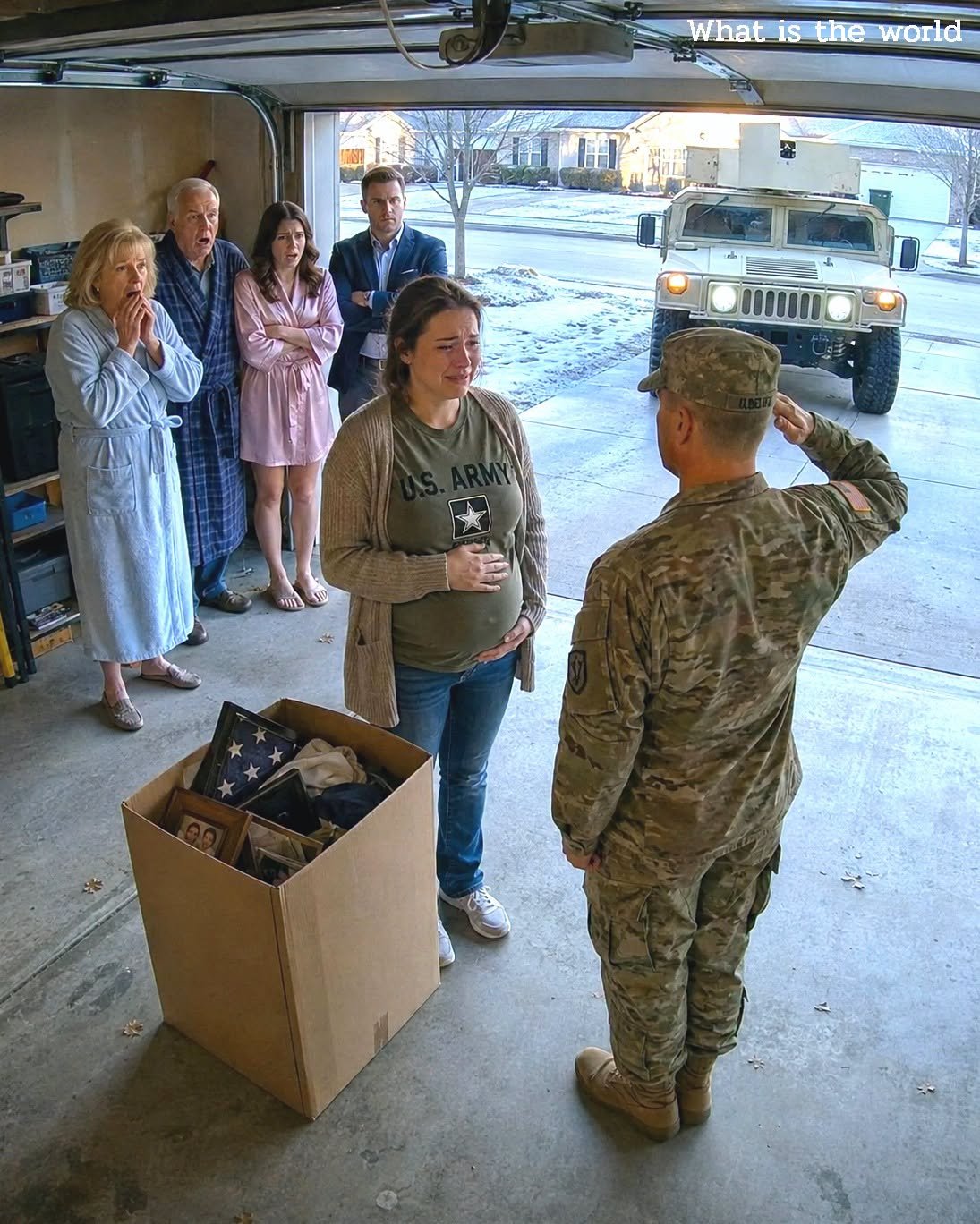
The soldier held the salute long enough for everyone in the driveway to understand that it was not ceremonial.
“Major,” he said, his eyes fixed on me. “The convoy is secure. We are ready to move on your order.”
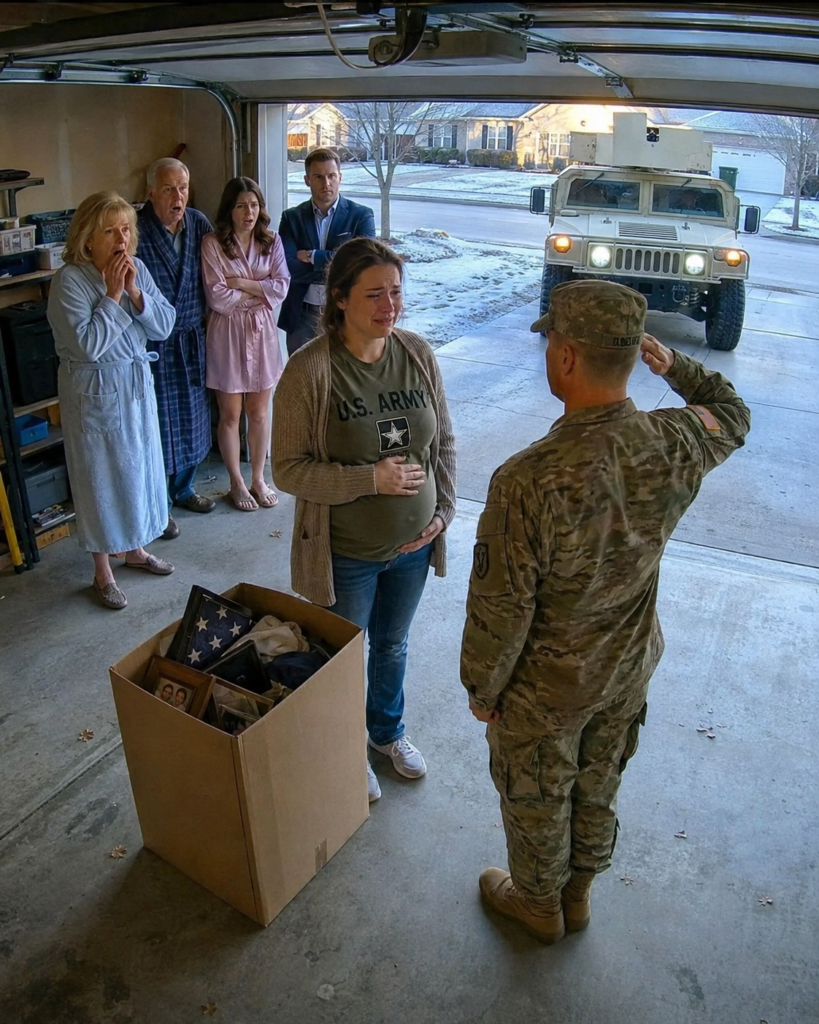
Julian’s Audi keys stopped turning around his finger.
My father stepped onto the porch with his newspaper still pressed against his chest, while my mother and Harper stood behind him in the open doorway.
None of them spoke.
I returned the salute, then lowered my hand to the curve of my stomach.
“At ease,” I said. “I need one secured case from the bedroom and the cardboard box beside the garage door. Nothing else.”
“Yes, ma’am.”
The soldier signaled to another member of the team, who moved toward the house but stopped before crossing the threshold.
“Permission to enter?” he asked.
The question mattered more than anyone in my family understood.
For months, they had walked through David’s home as if my permission were unnecessary. They had moved furniture, filled closets, invited guests, and argued over rooms without once asking the person whose name was on the title.
Now a uniformed stranger was showing me more respect at my own front door than my family had shown me hours after I buried my husband.
“Permission granted,” I said. “Straight upstairs. First door on the left.”
Harper pushed past my mother.
“What is this?” she demanded. “Some kind of performance?”
The soldier did not look at her.
The team had not come to intimidate my family, settle a property dispute, or make anyone apologize. Their orders were narrow: locate me, confirm my condition, secure my classified materials, and transport me to protected temporary housing before my emergency leave officially ended.
David’s final mission had exposed information that could no longer be treated as contained. The risk assessment had changed during the night, and my pregnancy had raised my extraction priority.
The convoy was there because of that risk.
The humiliation unfolding in the driveway belonged entirely to my family.
My father finally found his voice.
“You’re a major?”
“I am.”
“In the Army?”
“Yes.”
He looked from me to the vehicles and then back to the old T-shirt stretched over my stomach.
“But you said you worked in an office.”
“I said my work involved Department of Defense administration. That was the cover I was authorized to give you.”
Harper folded her arms.
“So you lied to us for twelve years.”
“I protected classified work for twelve years.”
“That is the same thing.”
“No, Harper. It isn’t.”
Julian glanced at her.
“You told me she had already left the service.”
Harper’s head snapped toward him.
“I said she was basically done.”
“You said she had agreed to let me use the room.”
The sentence landed harder than his laughter had in the kitchen.
Harper had not merely assumed I would surrender my bedroom after the funeral. She had promised it to him before anyone asked me.
My mother stepped off the porch and pulled her robe tighter around herself.
“We can discuss all of this inside,” she said. “The neighbors don’t need to see military trucks sitting in the driveway.”
“The vehicles aren’t here for the neighbors,” I replied.
My father’s embarrassment hardened into anger.
“You brought armed men to your family’s home on Thanksgiving.”
“This is my home.”
His mouth tightened.
“We have lived here for seven months.”
“Because I invited you to stay after David was reported dead.”
“You needed us.”
“I needed my parents. That is not what I got.”
The second soldier returned carrying the compact field case David and I used for secured materials.
He placed it beside me, verified the seal without opening it, and lifted the cardboard box from the freezing concrete.
The box contained two uniforms, my medical file, several photographs, and the folded blanket David had bought after we learned I was pregnant.
Harper watched him carry it as if she could not understand why the belongings she had ordered into the garage were being handled with care.
The team leader approached me.
“Major, are all occupants authorized to remain at this location after your departure?”
It was a routine security question, not an offer to remove anyone.
Still, every face in the doorway changed.
I looked at my mother first.
She had known David made every mortgage payment. She had watched him replace the kitchen cabinets and repair the drywall. She had stood in that kitchen while telling me to put my belongings beside Julian’s car.
Then I looked at my father, who had treated my grief as bad manners because it made Thanksgiving uncomfortable.
Finally, I looked at Harper.
She was still standing beside the bedroom she had promised to her husband.
“They are authorized to remain temporarily,” I said. “I will provide written notice regarding future access today.”
My father took one step forward.
“You are throwing your parents out?”
“I am ending an arrangement that you abused.”
“On Thanksgiving?”
“You ordered your pregnant daughter into a freezing garage on Thanksgiving morning.”
“That was temporary.”
“So is your permission to live here.”
My mother pressed both hands together.
“Please lower your voice.”
“I’m not raising it.”
That was what unsettled them most.
They had expected grief to make me collapse, scream, or beg. They wanted an emotional reaction they could use as proof that I was unstable and needed them to make decisions for me.
Instead, I opened my phone and sent the message I had been composing since the soldier’s salute.
It went to my parents, Harper, and Julian.
The message stated that no room in the house could be converted into a business office, no personal property could be removed or relocated, and no one had permission to represent themselves as an owner of the home.
It also informed my parents that I was withdrawing their open-ended permission to live there and would follow the ordinary required process for their departure.
I did not invent a deadline in the driveway or ask soldiers to enforce a family dispute.
I simply created a record that no one could later rewrite.
Four phones sounded within seconds.
Julian read his first.
Then he looked at Harper.
“You told me your parents owned this place.”
Harper lowered her voice.
“They practically do.”
“No,” I said. “They do not.”
Julian turned to my father.
“Is your name on the deed?”
My father did not answer.
“Is Harper’s?” Julian asked.
Again, there was no answer.
His gaze moved toward the Audi, then back to the house.
For the first time that morning, he looked less like a wealthy man claiming a private office and more like a man realizing his wife had invited him into a conflict built on a lie.
That realization did not make him innocent.
He had heard them order a pregnant widow into a garage and laughed when my mother reminded me not to block his car.
But it changed the shape of the confrontation.
Harper had promised him authority she did not possess because she had been certain I would never challenge her in front of him.
“I’m leaving,” Julian said.
Harper stared at him.
“What?”
“I’m not moving my business into a house you don’t own.”
“You were excited about it ten minutes ago.”
“I was told it had been offered.”
“You heard her say okay.”
“I heard her say it after you told her to sleep in a garage.”
He did not apologize to me.
He simply opened the Audi, tossed his coffee into the cup holder, and started the engine.
Harper stepped into the driveway and struck the passenger window with the flat of her hand.
“Julian, don’t you dare leave me here.”
He lowered the window only a few inches.
“You need to tell me what else you lied about.”
Then he backed out carefully around the military vehicles and drove away.
My father pointed at me as if I had caused it.
“You have destroyed your sister’s marriage.”
“I told the truth about my house.”
“You embarrassed her husband.”
“He embarrassed himself.”
Harper turned on me.
“You couldn’t let me have one thing.”
I looked at the house David had rebuilt between deployments, the frost on the lawn, and the box now secured in the back of the lead vehicle.
“You tried to take my bedroom before the flowers from my husband’s funeral had even wilted.”
“You always get treated like you’re special.”
The bitterness in her voice was older than that morning.
It had been there when David and I missed birthdays because we were deployed, when we could not explain where we had been, and when family members decided our silence meant our work was unimportant.
Harper had turned that old resentment into a story in which I was weak, dependent, and lucky to be tolerated in my own home.
“I did not ask you to admire my work,” I said. “I expected you to respect my grief.”
She gave a sharp laugh.
“Your grief has controlled this house for seven months.”
“No. Your impatience has.”
The baby shifted again, and a dull cramp tightened across my lower back.
The team leader noticed me brace one hand against the vehicle.
“Major, we need to move.”
I nodded.
My mother came down the driveway quickly.
“You cannot leave like this.”
“The convoy has orders.”
“I mean with us angry.”
“You were already angry when you thought I was powerless.”
Her eyes filled, but I could no longer treat tears as proof of accountability.
“Please come inside,” she said. “I’ll make your father apologize.”
“I don’t need you to make him say words he does not mean.”
“We are your family.”
“Then you should have acted like it before the uniform appeared.”
I climbed into the rear seat of the lead vehicle.
The interior smelled faintly of cold vinyl and coffee, and someone had placed a folded blanket across the seat for me.
The team leader handed me the seat belt and waited until I had fastened it below my stomach.
My mother stood beside the open door.
“Where are they taking you?”
“I cannot tell you.”
“When are you coming back?”
“I cannot tell you that either.”
Her face tightened as she heard the same boundary she had dismissed for years.
Before the door closed, my father called from the porch.
“You think those people care about you more than we do?”
I looked at the soldier holding the door, the blanket placed across my knees, and the box secured so David’s photographs would not slide during the drive.
“I think they understand the difference between duty and ownership,” I said.
The door shut.
As the convoy pulled away, I watched the mailbox pass the window and felt the first clean break between the life David and I had protected and the version of that life my family had claimed.
I did not feel victorious.
I felt exhausted.
By the time we reached the temporary quarters arranged for me, the adrenaline had drained from my body and left my hands shaking.
The apartment was plain: a small kitchen, a couch, a bedroom, and a table beside a window.
Someone had stocked the refrigerator with bottled water, eggs, fruit, and the kind of ginger tea I had been drinking for morning sickness.
Those ordinary things nearly broke me more than the funeral had.
David used to stock the refrigerator before every one of my returns, even if he had only been home a few hours himself.
He never gave speeches about taking care of me.
He checked the tires, filled the gas tank, washed my coffee mug, and made sure there was food I could keep down.
I sat on the kitchen floor with his old T-shirt stretched over my stomach and cried until I could breathe without fighting it.
No one told me I was ruining Thanksgiving.
My phone collected messages while I slept.
Harper accused me of humiliating her in front of Julian.
My father wrote that I had become arrogant and ungrateful.
My mother sent seven versions of the same request: call us so we can fix this privately.
I answered only once.
“I will communicate about the house in writing. I am not discussing my orders. I need space to grieve and protect my pregnancy.”
My father replied within a minute.
“After everything we did for you?”
I set the phone facedown.
During the following week, their explanations changed repeatedly.
First, the garage had supposedly been warmer than I remembered.
Then Harper claimed she had meant for me to stay there only while Julian held one meeting.
My father insisted he had believed the military bracelet on my wrist was a sentimental keepsake from David.
My mother said everyone had been tired after the funeral and that Thanksgiving pressure had made them careless.
None of those explanations answered the central question.
Why had four adults seen a pregnant widow standing in a freezing kitchen and decided her bedroom mattered less than Julian’s convenience?
The answer came from Harper, although she did not intend to give it.
She called from my mother’s phone after I stopped answering hers.
“Julian has moved into a hotel,” she said. “He says he cannot trust me.”
“I’m sorry you’re hurting.”
“No, you’re not.”
“I’m sorry you’re hurting. I am not sorry I corrected the lie.”
“You could have agreed and sorted it out later.”
“That is what you expected.”
“Because you always give in eventually.”
Her words settled between us.
That was the plan.
There had been no misunderstanding about the temperature, my pregnancy, or the ownership of the house.
Harper had told Julian the room was available because she believed I would surrender it rather than create conflict after David’s funeral.
My parents had supported her because my compliance had become part of the household routine.
Every time I stayed quiet to preserve peace, they treated the silence as permission for the next demand.
“You did not think I agreed,” I said. “You thought I could be forced to agree.”
Harper began crying.
“Do you know what it’s like being your sister? You disappear for months, you never explain anything, and then military vehicles show up like you’re some important person in a movie.”
“I am not in a movie.”
“You made us look insignificant.”
“I was trying to stay alive and keep other people safe.”
She became quiet.

For years, my family had interpreted secrecy as rejection because that explanation protected their pride.
It was easier to believe David and I considered ourselves too important for them than to accept that some parts of our lives could not be shared.
But resentment did not explain the garage.
It only explained why they felt entitled to punish me when I was too tired to resist.
“I cannot repair your marriage,” I told her. “I cannot make Julian trust you, and I will not tell him your lie was harmless.”
“So that’s it?”
“For now, yes.”
I ended the call before she could turn my boundary into another negotiation.
The required process concerning the house continued without spectacle.
I sent written instructions, protected the property from unauthorized business use, and gave my parents the time required to arrange another place to live.
My father fought every step through angry messages, but he never produced a reason he had the right to remain beyond my revoked permission.
He wanted an argument about gratitude because gratitude could be stretched until it covered anything.
I kept returning the conversation to access, dates, and belongings.
My mother stopped repeating his accusations after the second week.
She began asking practical questions instead: which dishes belonged to me, whether the old dresser should stay, and where David kept the spare garage remote.
I answered each one without reopening the larger wound.
Then, three days before they were scheduled to leave, she asked to see me alone.
We met at the house in the middle of the afternoon.
The convoy was gone, the frost had melted, and the driveway looked painfully ordinary.
My mother stood beside a row of taped boxes wearing jeans and an old sweater instead of her robe.
She held the spare house key in her palm.
“I knew the house was yours,” she said.
“I know.”
“I knew David paid for it. I knew your father’s name was never on anything.”
I waited.
She looked toward the garage.
“When Harper said Julian needed the room, I knew it was wrong. I also knew your father wanted to prove that we still had some authority over you.”
“Why?”
“Because the funeral made him feel shut out. There were officers there who knew things about David that we didn’t. There were parts of the service we did not understand. Your father hated feeling like a guest in David’s life.”
“So he treated me like a guest in my own home.”
“Yes.”
It was the first answer anyone had given me without trying to make the cruelty sound accidental.
My mother closed her fingers around the key.
“I went along with it because I liked believing you needed us,” she said. “If you needed us, then I did not have to admit how much we were taking from you.”
The truth was uglier than a misunderstanding, but it finally made the morning comprehensible.
They had not ordered me into the garage because they believed it was warm enough.
They had done it because they needed me to remain the weakest person in the house.
My uniform had frightened them because it exposed a reality they had worked hard not to see.
“I am not asking you to forgive me today,” my mother said.
“Good.”
She nodded once.
“Your father wants me to keep the key in case you change your mind.”
“And what do you want?”
She opened her hand and placed it in mine.
“I want to stop pretending your boundaries are attacks on me.”
The key was cold against my skin.
It did not repair what she had done, and I did not invite her to stay.
But returning it without conditions was the first choice she had made that cost her something.
My father left two days later without speaking to me.
Harper moved her belongings out of the guest room and sent a brief message saying she would not contact me again unless I contacted her first.
I accepted that boundary.
Julian never used the house as an office, and I never asked for details about what happened between them.
Their marriage was theirs to confront.
The house remained mine, but I did not move back immediately.
Too much of the kitchen still belonged to the morning my father called my grief inconvenient.
Too much of the garage still felt like the place my family had tried to put me when they believed I had nowhere else to go.
I stayed in secure housing until my orders changed and my medical team cleared each transition.
Months later, when my daughter was born, I gave her David’s middle name.
My mother met her only after accepting the rules I set: no surprise visits, no questions about classified work, no criticism of my grief, and no contact through Harper or my father.
She did not argue.
The first time she visited, she brought groceries and left them on the kitchen counter without rearranging anything.
Then she asked where I wanted her to sit.
It was a small question, but I noticed it.
The cardboard box from the garage stayed with me through every move.
After my daughter came home, I reinforced the bottom with packing tape and placed it beside the crib.
Inside, I kept David’s old Army T-shirt, the photographs from our deployments, his military bracelet, and the folded blanket he had bought when we learned about the baby.
The box had once held the belongings my family ordered out of my bedroom.
Now it held the pieces of David’s life that I would give our daughter when she was old enough to understand them.
One evening, I found my mother kneeling beside it with a package of archival sleeves in her hands.
She did not open the box.
She looked at me and asked, “May I help you protect these?”
I considered the question before answering.
Then I sat on the floor beside her, lifted the lid myself, and handed her the first photograph.