
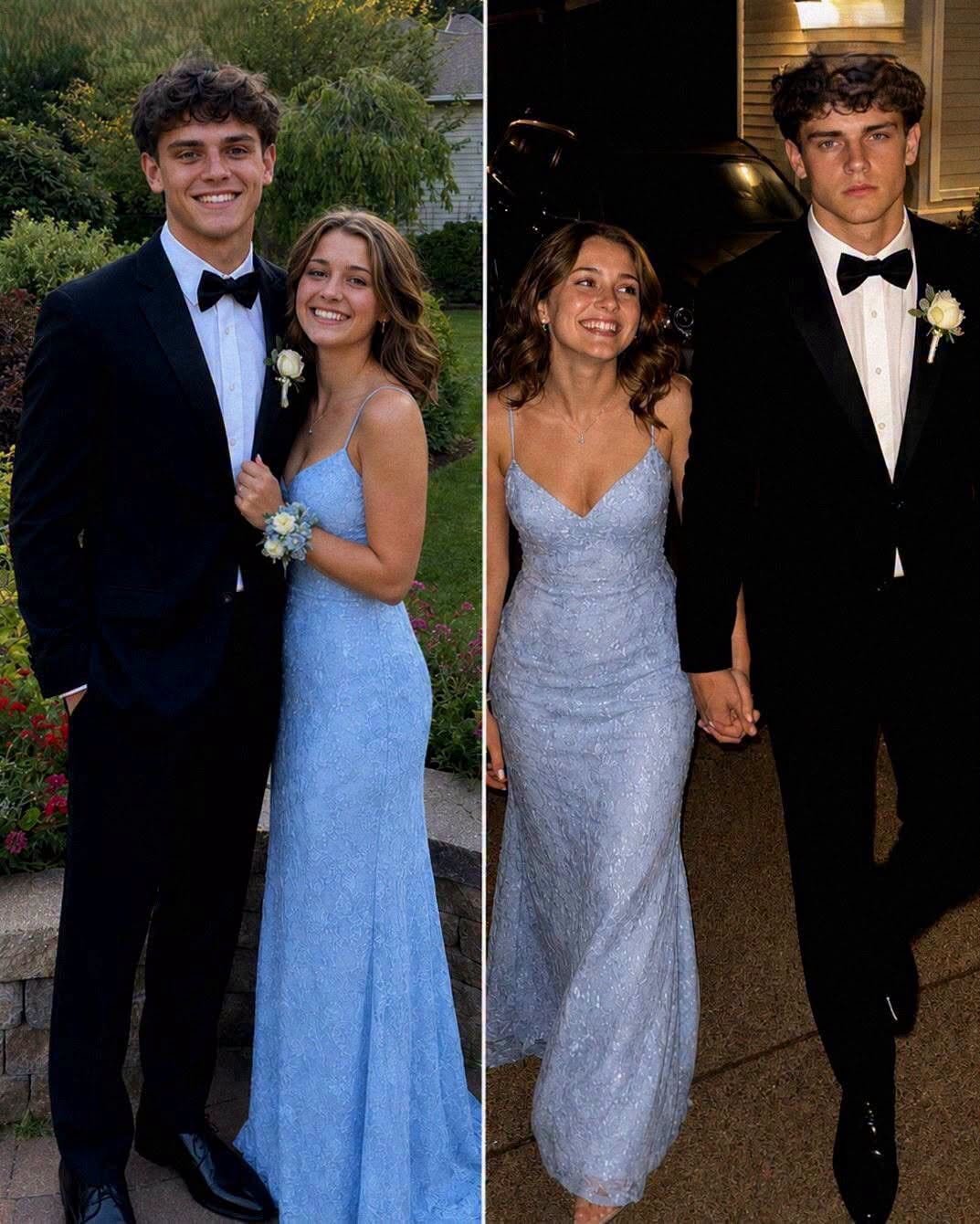
The Boy Standing in My Living Room
“You have five minutes to tell her the truth, or I will.”
Ryan Cole stood in my living room in a black tuxedo, his shoulders square and his voice unnervingly steady.
From the kitchen came the clink of ice dropping into a glass. My daughter, Iris, was humming to herself, still floating on the happiness of prom night.
She had no idea that everything she believed about her life was about to change.
I stared at Ryan—the boy every girl at Westbridge High had wanted as a prom date.
Three hours earlier, I had thought he was the answer to a mother’s prayer. He was polite, responsible, and kind enough to make my daughter feel special.
Now he was looking at me as if I were a stranger he could no longer trust.
“What are you talking about?” I whispered.
His jaw tightened.
“The man in Iris’s locket.”
My knees nearly gave out.
Ryan reached into his jacket and placed his phone on the coffee table. On the screen was a recent photograph of a silver-haired man standing at the opening of a new community arts center.
Even after seventeen years, I recognized him instantly.
Thomas Bennett.
Iris’s father.
The man I had told her was dead.
The Night I Wanted to Be Perfect
Iris had been counting down to prom for months.
I had never seen my daughter so excited. She was usually careful with her feelings—the kind of girl who pretended not to care if she was invited somewhere because disappointment hurt less when nobody knew she had hoped.
But prom was different.
Her date was Ryan—the football captain, an honor student, and the boy nearly every girl at school noticed when he walked into a room.
When he asked Iris, she came bursting through our front door with tears in her eyes.
“Mom!” she cried, pressing both hands to her cheeks. “Ryan Cole asked me to prom.”
I laughed and hugged her so tightly that she squealed.
For the next three weeks, our small house filled with dress bags, shoe boxes, hair clips, and nervous questions.
“Is this too much?”
“Do these earrings look old-fashioned?”
“What if I trip?”
“What if he regrets asking me?”
“He won’t,” I told her. “And if you trip, stand up like you meant to do it.”
She rolled her eyes, but she smiled.
Iris had grown up without a father. That absence had followed her through every school dance, every father-daughter event, every family-tree assignment, and every moment when other girls casually complained about dads who embarrassed them.
I had done my best to be enough.
Still, I knew there were empty places in her life that love alone had not filled.
That was why I wanted prom night to be perfect.
When Ryan arrived, he brought a wrist corsage made of white roses and tiny blue flowers that matched Iris’s dress. He shook my hand, looked me in the eye, and promised to bring her home by midnight.
Then Iris came down the stairs.
She wore a deep blue gown that made her gray eyes shine. For one breathless moment, I saw both the little girl she had been and the woman she was becoming.
“You look beautiful,” I said.
She hugged me carefully so she would not smudge her makeup.
“Don’t cry, Mom.”
“I’m not crying.”
“You’re definitely crying.”
“It’s allergies.”
“In April?”
“Very aggressive allergies.”
She laughed.
As Ryan led her toward his car, Iris glanced back and waved.
I stood in the doorway long after their taillights disappeared.
I should have felt only joy.
Instead, an old fear moved quietly through me—the fear that happiness had a way of opening doors I had spent years trying to keep closed.

The Message That Changed Everything
A few hours later, my phone buzzed.
MOM. YOU ARE NEVER GOING TO BELIEVE WHAT JUST HAPPENED.
I smiled and immediately typed back.
What happened?
Her reply came a minute later.
I’LL TELL YOU WHEN I GET HOME. IT’S CRAZY.
Then she stopped answering.
At first, I assumed she was dancing. Then eleven o’clock came. Then eleven-thirty.
By midnight, I was standing at the front window, checking the driveway every few seconds.
Finally, headlights swept across the curtains.
Iris rushed through the door looking thrilled, confused, and overwhelmed all at once.
“Mom, something happened tonight, and I—”
She suddenly glanced back at Ryan, who had followed her inside.
“Actually, let me get Ryan some water. This is going to be a long story.”
The moment she disappeared into the kitchen, Ryan turned to me.
His warm smile vanished.
“You have five minutes,” he said.
And the past I had buried came roaring back.
The Lie I Built
Thomas Bennett had not died before Iris was born.
That was the lie I had told my daughter because, at the time, it felt kinder than the truth I believed.
Thomas and I met during my first year at a community college outside St. Louis. I worked evenings at a diner, and he came in every Thursday after an architecture class, ordering coffee and a slice of apple pie he rarely finished.
He was funny without trying to impress anyone. He sketched buildings on napkins and talked about designing libraries, shelters, and schools—places that made ordinary people feel that they mattered.
We fell in love quickly, as young people sometimes do when they believe time belongs entirely to them.
When I learned I was pregnant, I was terrified.
Thomas was shocked, but then he held both my hands.
“We’ll figure it out,” he promised. “You and me.”
He wanted to marry me. He wanted to tell his mother in person.
Evelyn Bennett came from old money and believed Thomas’s future had already been planned. She had arranged an internship for him in Chicago and expected him to join the family development company after graduation.
I was a waitress whose mother cleaned offices at night.
Evelyn never insulted me directly.
She was too polished for that.
She simply looked at me as though I were a stain someone else should remove.
A week after Thomas left for Chicago, his car was hit by a truck on an icy highway.
I heard about the accident from Evelyn.
She told me Thomas was alive but badly injured. She said he did not want to see me.
Then she handed me an envelope containing a typed letter and a cashier’s check.
The letter said Thomas had changed his mind. It said he was not ready to ruin his future. It instructed me never to contact him again.
I was nineteen, pregnant, and shattered.
I tore up the check.
Two months later, when I called the hospital, I was told Thomas Bennett was no longer a patient. Evelyn claimed he had been transferred overseas for treatment and had asked her to make his wishes clear.
Every letter I sent came back unopened.
Then my mother became sick, and we moved to Indiana to live with my aunt.
Iris was born the following spring.
When she was four and asked why she did not have a daddy, I panicked.
I told her he had died in an accident before she was born.
The lie came out softly.
After that, it became part of our family history.
Each year made it harder to take back.
The Truth I Learned Too Late
For sixteen years, I believed Thomas had abandoned us.
Then, eleven months before prom, I saw him on television.
I was folding laundry when a local news program showed the opening of the Bennett Community Arts Center.
Thomas stood behind a podium, older but unmistakable.
Alive.
The basket fell from my hands.
I searched his name until sunrise.
He had returned to the Midwest years earlier. He had become an architect and then a developer known for restoring old buildings. He had been married briefly, divorced, and had no children.
Buried in one interview was a sentence that stopped my heart.
Thomas said his greatest regret was losing someone he loved after his accident, when other people had “made decisions for both of them.”
I contacted an attorney.
Within weeks, I learned enough to understand what had happened.
Thomas had spent months recovering from a serious head injury. Evelyn had told him I had lost the baby and moved away with someone else. She had intercepted his letters just as she had intercepted mine.
The letter I received had never been written by him.
For almost seventeen years, two people had lived inside the same lie.
I wrote Thomas a twelve-page letter.
Then I locked it inside my desk.
I told myself I needed time.
I told myself Iris was preparing for college applications.
I told myself I needed proof before I turned her world upside down.
But beneath every excuse was the truth.
I was afraid.
Afraid Thomas would hate me for not finding him sooner.
Afraid Iris would choose him over me.
Afraid that admitting the lie would destroy the trust I had spent her entire life building.
So I waited.
And on prom night, the truth found us anyway.
What Happened at Prom
Ryan pointed toward the photograph on his phone.
“My dad works with Mr. Bennett,” he explained. “He’s been to our house for dinner.”
I could barely breathe.
“How did you recognize him?”
“Iris’s locket opened while we were taking pictures. I saw the old photo inside.”
The locket had once belonged to me. On one side was a picture of Iris as a baby. On the other was the only photograph I still had of Thomas and me together.
Ryan had recognized him.
“At first, I thought I was wrong,” Ryan continued. “Then Iris said the man was her father and that he died before she was born.”
Ryan had stepped away and called his father.
David Cole had been Thomas’s business attorney for years. He knew about the accident. He also knew about the young woman Thomas had unsuccessfully tried to find.
When Ryan showed him a picture of Iris, David recognized my face immediately.
“He told me not to say anything until he could talk to you,” Ryan said. “But Iris deserves to hear this from her mother. Not from gossip. Not from a stranger.”
“I know.”
“Do you?”
The question hurt because I had earned it.
The kitchen faucet turned off.
Ryan lowered his voice.
“She trusts you more than anyone. Don’t make her discover this another way.”
I looked toward the hallway.
“How much does she know?”
“Only that I recognized the man. I told her I might know someone connected to him. That’s what she was texting you about.”
He checked the clock on the wall.
“You have about three minutes left.”

When My Daughter Walked Back In
Iris returned carrying two glasses of water.
She looked from Ryan to me.
“Why do you both look like somebody died?”
The cruel irony of her words made my chest ache.
“Iris,” I said, “please sit down.”
Her smile disappeared.
She set the glasses on the table but remained standing.
“Mom, what is going on?”
I wanted to protect her.
For seventeen years, that instinct had guided every decision I made. I worked double shifts to keep our home. I stayed awake through fevers, heartbreaks, and thunderstorms. I learned to braid hair, fix leaking faucets, negotiate medical bills, and make birthdays feel abundant on a small budget.
But somewhere along the way, protection had become control.
Love did not give me the right to decide which truths she was strong enough to know.
“Ryan recognized the man in your locket,” I said.
“My dad?”
I nodded.
“He recognized him because…”
My voice broke.
“Because your father is alive.”
The room went completely still.
Iris stared at me.
Then she laughed once—a small, confused sound.
“That’s not funny.”
“I’m not joking.”
“You said he died.”
“I know.”
“You said his car went off the road.”
“There was an accident, but he survived.”
Her expression changed as the meaning reached her.
“You lied to me.”
“Yes.”
“For my whole life?”
I could not soften it.
“Yes.”
She stepped backward.
Ryan moved as if to steady her but stopped before touching her.
“Did he leave us?” she asked.
“No. Not the way I thought.”
I told her everything.
I told her about the forged letter, the intercepted mail, the move, the television interview, the attorney, and the letter locked inside my desk.
When I admitted that I had known for eleven months, her eyes filled with tears.
“Eleven months?”
“I was trying to find the right way.”
“No,” she said. “You were trying not to tell me.”
She was right.
“I was scared.”
“So you let me keep believing he was dead?”
“Iris—”
“Do you know how many times I talked to him?”
I froze.
She touched the locket at her throat.
“Before big tests. Before my driving exam. When I got rejected from the summer program. I sat on the back steps and talked to a dead man because you told me he was dead.”
Tears slipped down her cheeks.
“I’m sorry,” I whispered.
She shook her head.
“That isn’t big enough.”
Then she turned and ran upstairs.
Her bedroom door slammed.
The Man Waiting Outside
I stood in the living room, unable to move.
Ryan picked up his phone.
“My dad is outside,” he said quietly. “He didn’t want to come in without permission.”
“Outside?”
“He came to get me.”
Ryan hesitated.
“Mr. Bennett is with him.”
My heart pounded.
Thomas was in my driveway.
I almost said no.
Then I thought of all the decisions made in secret. All the doors closed by fear. All the years stolen because someone believed they had the right to control another person’s life.
“Tell them to come in,” I said.
David entered first.
Behind him stood Thomas.
Time did something strange when I saw him.
He was no longer the twenty-one-year-old who sketched buildings on diner napkins. Silver touched his hair. A thin scar ran near his temple. His face carried the weight of years I had not witnessed.
But his eyes were the same.
He looked at me as though he had found a ghost.
“Claire?”
I could not speak.
His gaze moved toward the staircase.
“Is she here?”
I nodded.
“I just told her.”
Thomas closed his eyes.
For a moment, none of us moved.
Then a floorboard creaked.
Iris stood halfway down the stairs.
She had washed off most of her makeup, although dark streaks remained beneath her eyes. She looked at Thomas with a mixture of anger, hope, and fear.
He did not rush toward her.
He did not call her his daughter.
He simply said, “My name is Thomas. I think you deserve to decide what happens next.”
Iris gripped the railing.
“Did you know about me?”
“No,” he answered. “But I should have questioned what I was told. I should have searched harder.”
He took a slow breath.
“I searched for your mother under her old address and maiden name. I was told the baby had not survived. I believed it because I was injured, confused, and surrounded by people I trusted.”
His voice shook.
“That does not give me back the years. It only explains why I lost them.”
Iris studied his face.
“Do you have proof?”
Thomas nodded.
“Letters. Medical records. Copies of reports. You can see all of them. You do not have to believe me tonight.”
That answer seemed to matter.
Not because it solved anything, but because he did not demand instant forgiveness.
Truth Did Not Fix Everything
That night did not end with a perfect reunion.
Iris did not run into Thomas’s arms.
She asked Ryan to take her to her best friend’s house. Before leaving, she told me she loved me but could not look at me.
Those words hurt more than anger.
For three days, she barely spoke to me.
On the fourth day, she agreed to meet Thomas at a quiet coffee shop. I sat at another table while they talked for two hours.
He brought the letters he had written after the accident.
One began:
Claire, if you still want me, I am trying to come home.
Another asked about the baby.
A third was returned with a false forwarding address.
Iris read every page.
Over the next several months, the truth came to us in pieces.
Thomas admitted that his mother’s control had shaped more of his life than he wanted to acknowledge. Evelyn had died two years earlier, taking many answers with her.
He did not excuse what she had done.
I began counseling because an apology without change would have been another empty promise.
Iris established rules.
No surprise visits.
No public announcements.
No pretending we were suddenly a happy family.
Thomas respected every boundary.
He attended her graduation but sat where she asked him to sit. When she was accepted to college, he offered to help with tuition.
She said she needed time before accepting anything from him.
He replied, “Time is the one thing I owe you most.”
As for Ryan, he apologized to me for the ultimatum.
“I shouldn’t have threatened you,” he said.
“You were protecting her,” I answered.
He shook his head. “I was angry.”
“Sometimes those are both true.”
He and Iris did not become the perfect prom-night couple everyone expected. What happened that evening was too heavy for a teenage romance to carry.
But they remained close friends.
In a way, that was better.
Ryan had not rescued Iris.
He had simply refused to help adults keep a secret that belonged to her.
One Year Later
A year after prom, Iris came home from college for spring break.
Thomas joined us for dinner.
The first few meals we shared had been painfully formal. This one was different.
Iris teased him about his habit of sketching on napkins. He told her she had inherited my stubbornness.
I told him she had inherited his terrible sense of direction.
For the first time, all three of us laughed without immediately feeling guilty.
After dinner, Iris brought out the blue prom dress.
“I’m donating it,” she said. “The school has a closet for students who can’t afford formal clothes.”
She ran her hand over the fabric.
“That night was awful,” she added. “But it was also the night my life stopped being built around a lie.”
I swallowed hard.
“I wish I had told you sooner.”
“I know.”
“I will always be sorry.”
“I know that too.”
She looked at me for a long moment.
“Mom, forgiving you doesn’t mean what you did was okay.”
“I understand.”
“It means I don’t want the worst thing you did to erase every good thing you’ve done.”
Tears filled my eyes.
She stepped forward and hugged me.
Not the quick, careful hug she had given me before prom.
A real one.
The kind that does not erase pain but makes room beside it for love.
Later, Thomas stood on the porch preparing to leave.
Iris called after him.
“Dad?”
He stopped.
It was the first time she had used the word.
Thomas turned around slowly, afraid even to breathe.
“You forgot your sketchbook,” she said, holding it up.
His eyes shone as he walked back toward her.
Nothing about our family had happened the way it should have.
We lost years to pride, manipulation, grief, and fear.
But we finally learned something I wish I had understood much earlier:
A painful truth may break the life you recognize.
A lie breaks the people who live inside it.
That night, Ryan gave me five minutes.
Telling the truth took less than that.
Living honestly afterward took courage every day.
And it was worth every second.
Note: This story is a work of fiction inspired by real events. Names, characters, and details have been altered. Any resemblance is coincidental. The author and publisher disclaim accuracy, liability, and responsibility for interpretations or reliance. All images are for illustration purposes only.