
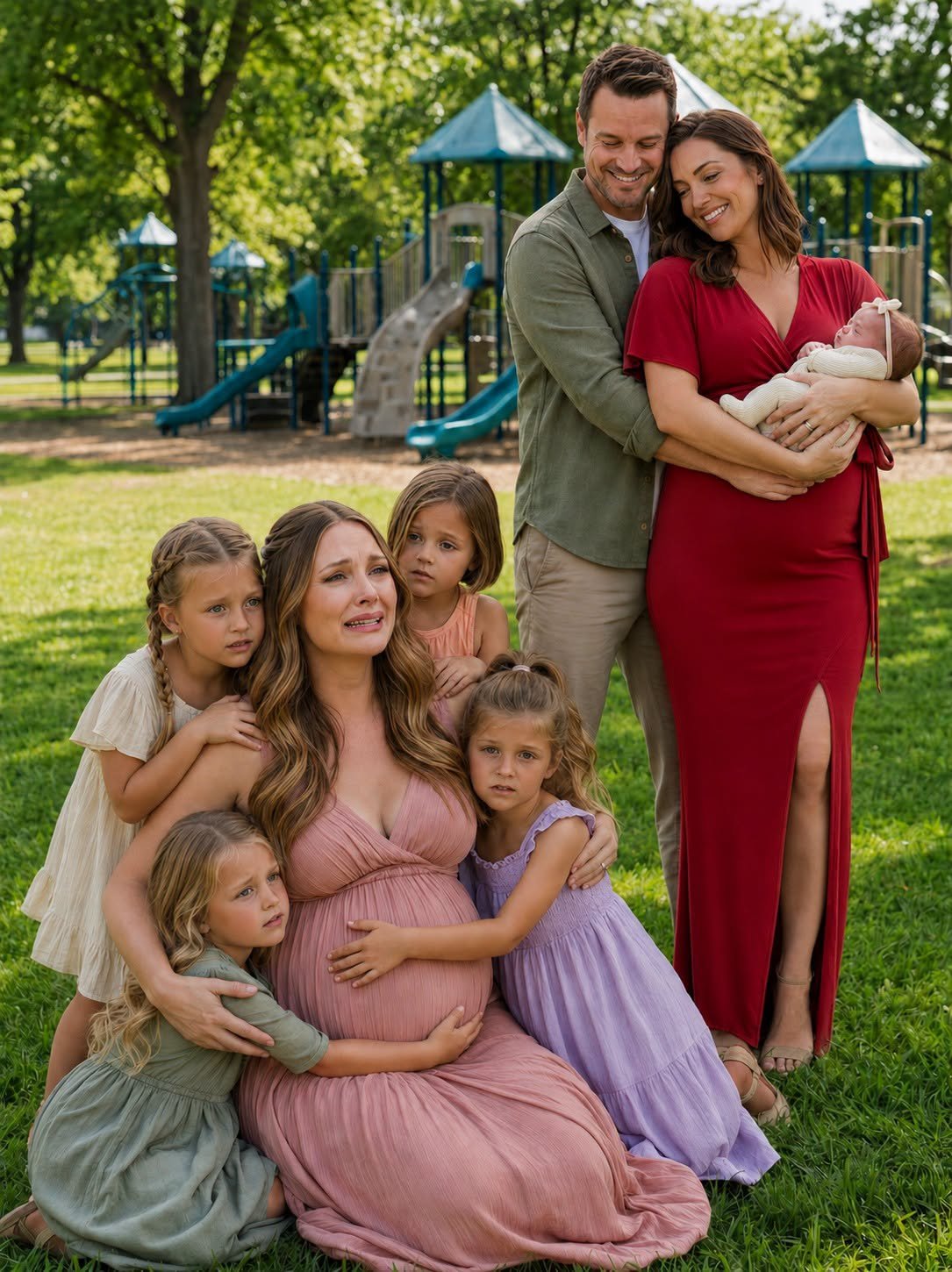
Part I – The Son He Was Waiting For
The first time Marcus held the son he had prayed for, he did not kiss him. He studied the baby’s face, lingered over his thick dark hair, and then looked at me as if I had handed him a question instead of a child.
“He does not look like me,” he said.
Our son was less than ten minutes old. I was still trembling from eleven hours of labor, my body sore and exhausted, my heart wide open from the rush of relief that came when the doctor announced that the baby was healthy. I had expected Marcus to laugh, cry, or press his lips to the tiny forehead he had imagined for years. I had not expected suspicion to be the first thing he placed in our son’s hands.
My name is Hannah. Marcus and I had been married for eight years, and Noah was our fifth child. We had always talked about having a large family, but as the years passed, I realized that we had never been dreaming about the same thing. I wanted children. Marcus wanted a son.
He never said he did not love our daughters. That was what made the difference difficult to explain to anyone outside our home. He read bedtime stories, carried sleepy children from the car, and knew exactly how to make Ava laugh when she was upset. He helped Rose practice spelling words and taught Chloe how to balance on a bicycle. He held Nora against his chest when she had a fever and stayed awake until morning.
His love was real. So was the expectation that kept standing beside it.
After Ava was born, Marcus cried so hard that the nurse handed him a tissue. I watched him cradle our firstborn and thought the longing he had spoken about before our wedding had disappeared the moment he saw her. A few weeks later, while changing her diaper, he smiled down at her and said, “You are going to have a little brother someday.”
I laughed because the words sounded harmless. At the time, I did not understand how often a child can hear a promise as a comparison.
When I became pregnant again, Marcus began calling the baby “little man” before the first scan. The technician eventually told us we were having another girl. Marcus squeezed my hand and said he was happy, and I believed him. On the drive home, however, he barely spoke. That evening, he kissed Rose’s forehead and smiled at her, but the disappointment had already settled into the quiet spaces around him.
When people joked that he was becoming an expert at raising daughters, he laughed quickly and answered, “We are not finished yet.”
Chloe arrived two years later. By then, Marcus no longer pretended the baby’s sex was unimportant. During the pregnancy, he rested his hand on my stomach and said, “Third time has to be the charm.” When the doctor confirmed another girl, Marcus smiled in the examination room. That night, he sat alone on the back step for nearly an hour. When I asked what was wrong, he told me he only needed time to adjust.
I should have listened to the word adjust. Instead, I told myself that disappointment was not the same as rejection. Marcus loved Chloe once she was in his arms. He photographed her tiny fingers, sang to her while he prepared bottles, and proudly showed her to everyone who visited. But he also started talking more often about his family name, his father’s expectations, and the traditions he believed only a son could carry forward.
Whenever I reminded him that our daughters could inherit every tradition that mattered, he gave me a patient smile and said I was making too much of it.
Our fourth pregnancy was the hardest. Morning sickness followed me for months. My back hurt constantly, and by the final weeks I was sleeping in short, uncomfortable stretches. When the ultrasound showed another girl, I looked at Marcus before I looked at the monitor. His face answered for him.
He recovered quickly. He kissed my forehead and murmured, “We are lucky.” I wanted to believe that was all he felt. On the drive home, while I was still carrying the child whose birth he had just learned to accept, he said, “Maybe we should try one more time.”
I turned toward him. “I am still pregnant with this baby.”
“I know. I am only thinking ahead.”
That was the first time his dream frightened me. Our fourth daughter, Nora, was born healthy, and I loved her before the nurse had finished placing her in my arms. Marcus loved her too, but the language around our family had changed. When friends asked whether we were done having children, he answered before I could.
“Not until we have our boy.”
At first, people laughed. Eventually, I stopped laughing with them.
Four pregnancies had taken a physical toll on me. I told Marcus that I needed time before discussing another baby, and for almost a year the subject remained buried under school schedules, bills, and the daily noise of raising four children. Then I saw a positive test in my hand.
The pregnancy was not planned. When I showed Marcus, his entire face changed. He pulled me into such a tight embrace that I had to remind him to let me breathe.
“This is him,” he said.
I tried to smile. “You do not know that.”
“I do.”
From that day on, Marcus behaved as if the future had already been decided. He searched for boys’ names, ordered tiny baseball jerseys, and filled a notebook with plans for fishing trips and camping weekends. He talked about teaching our son everything he knew, though he had never once taken our daughters fishing or camping.
That detail stayed with me.
One evening, Ava overheard Marcus describing all the things he would finally be able to do with a boy. She was seven, old enough to understand the difference between a plan and a promise. Later, she found me folding laundry and asked, “Dad can do those things with us too, right?”
I set down the shirt in my hands. “Of course he can.”
Ava nodded, but she did not look convinced. I realized then that Marcus’s longing was no longer an adult issue between husband and wife. Our girls were listening. They were taking notes with the quiet seriousness children use when they are trying to decide whether they are enough.
At twenty weeks, the technician smiled and told us the baby was a boy.
Marcus began to cry before she had finished speaking. He kissed my hands, thanked me repeatedly, and called his parents from the parking lot. For the next several months, he was happier than I had seen him in years. He built the crib himself, painted one wall a soft blue, and bought so many clothes that Noah could have changed outfits three times a day and still left half of them unworn.
Everyone called his excitement sweet. Part of me did too. Another part watched him and wondered why joy seemed to come more easily when the baby matched the picture he had carried in his head.
I tried not to examine that question. Pregnancy was exhausting enough, and I had spent years learning how to smooth over the sharp edges of Marcus’s disappointment. I told myself that once the baby arrived, love would settle everything.
When labor began, I was physically and emotionally spent. Marcus stayed beside me through the long night, holding my hand, wiping my forehead, and whispering that we were almost there. For those hours, he looked like the man I had married. His hand was warm around mine, and I let myself believe that the moment we had all been waiting for would finally bring peace.
Then Noah was born.
He cried immediately. He had ten fingers, ten toes, and a full crown of dark hair. The nurse wrapped him and placed him in Marcus’s arms. For a few seconds, my husband simply stared at him.
I smiled through my exhaustion. “Well?”
Marcus did not answer. The happiness on his face faded first. Then the wonder. What replaced them was a guarded expression I had never seen while he held one of our daughters.
He looked at Noah’s hair, then at his eyes, and finally at me.
“He does not look like me.”
I thought he was joking. Newborns did not arrive looking like polished family portraits, and Marcus knew that. I let out a tired laugh. “He has been here for five minutes. Give him a chance.”
Marcus kept staring. “None of the girls had hair this dark.”
The room seemed to shrink around us. “Babies change, Marcus.”
He lowered his voice. “You went to Chicago before you got pregnant.”
I stared at him, trying to understand how he had moved from looking at our newborn to searching the past for a crime. Months earlier, I had spent five days in Chicago for a work conference. My days had been filled with meetings, and I had called him every night from my hotel room.
“You think I was unfaithful?” I asked.
Marcus looked at me without blinking. “I think we need a paternity test.”
The nurse stopped adjusting the bassinet. I felt humiliation spread through me, hot and immediate. After eight years of marriage, after four daughters, after carrying the son he had begged me to give him, my husband was holding our baby as if he were evidence in a case.
“Listen to what you are saying,” I whispered.
“I am listening. I deserve to know the truth.”
That was the moment something inside me shifted. He was not asking because he had been startled by a newborn’s hair. He had already chosen suspicion. He had simply been waiting for a reason to speak it aloud.
Marcus placed Noah in the bassinet and reached for his jacket. I told him that walking out of the room would change something between us. He paused at the door and said, “If you have nothing to hide, the truth should not frighten you.”
Then he left.
The nurse lifted Noah and placed him against my chest. His face turned instinctively toward me, and the tears I had been holding back finally came. I had imagined the birth of our son hundreds of times because Marcus had spoken about it for years. Not once had I pictured being left alone with him while my husband questioned whether he belonged to us.
As I held Noah, I replayed Marcus’s words. The reference to Chicago had come too quickly, with too much detail. It did not sound like a new fear. It sounded like a story he had already told himself.
And for the first time, I wondered whether the distance in our marriage had never been caused by work, exhaustion, or the demands of raising children. Maybe Marcus had been carrying a secret long before he carried our son.

Part II – The Secret Waiting Behind the Accusation
Marcus did not return to the hospital that night. He sent one message saying he would arrange the paternity test in the morning, then stopped answering when I asked whether he planned to check on the son he had spent years longing for.
I barely slept. Noah stirred beside me, and every time I opened my eyes, the room looked unreal: the dim hospital light, the folded blanket on the chair, the empty space where Marcus should have been. I was not afraid of the test. I knew the result before anyone collected a sample. What kept me awake was the certainty in his accusation.
The next morning, Marcus arrived with a technician from a private testing company. He spoke to the technician instead of looking at me. He watched the swab taken from Noah’s cheek and the sample taken from his own as if he expected the truth to change while he was watching.
I did not resist. I wanted the answer documented, not because I doubted myself, but because I no longer trusted Marcus to accept anything he had not demanded in writing.
When the technician said the expedited results would take forty-eight hours, Marcus folded his arms. “Until then, I think we should keep some distance.”
I looked at him from the hospital bed. “You accused me ten minutes after I gave birth, and now you think distance is what we need?”
“I am trying not to make this worse.”
The words were so absurd that a laugh caught in my throat. “You already made it worse.”
He told me he had moved into the guest room and that his mother, Evelyn, would help with the girls until the report arrived. I reminded him that our daughters should not be dragged into a question their father had created. Marcus said they would not be involved, but he would not meet my eyes.
That silence frightened me more than anger would have.
When I was discharged later that afternoon, my sister drove Noah and me home. Ava ran to the door first. Rose asked whether she could hold the baby. Chloe announced that Noah looked like a tiny bear, and Nora repeated his name over and over because she liked how it sounded.
For a few minutes, the house felt like itself again. My daughters gathered around their brother with the tender excitement only children can bring to a new baby. They argued gently over whose turn it would be to choose his first story. I watched them and felt a sharp ache beneath my happiness. They should have been celebrating without sensing that one adult in the house was waiting to decide whether Noah deserved to be called their brother.
Then Evelyn entered the room.
She greeted the girls, but her eyes paused on Noah. “Perhaps we should keep everyone calm until the results come back,” she said.
Her tone was careful, almost kind. The meaning underneath it was not.
I held Noah closer. “He is their brother now, regardless of a piece of paper.”
Evelyn folded her hands. “No one said otherwise.”
The answer came too quickly. I knew Marcus had already told her what he believed, and I understood that the suspicion was no longer contained inside our marriage. It had entered the family through a side door, bringing its judgment with it.
That evening, after the girls went to bed, the house became painfully quiet. Marcus stayed in his office. Evelyn left after dinner. I sat in the nursery feeding Noah and tried to understand how a family could look exactly the same from the outside while feeling completely unfamiliar from within.
My phone lit up on the dresser. A notification had appeared from the tablet account Marcus and I had shared for school calendars and family photographs. I normally would have ignored it. The preview contained a woman’s name and a question.
Leah: Did she find out yet?
I stared at the screen. A second message appeared before I could move.
You promised me this would be over when the baby came.
My hands went cold.
I placed Noah safely in his crib and picked up the tablet. The conversation was open because Marcus had used the device earlier that day. I told myself there could be an innocent explanation. I knew that was a lie before I scrolled very far.
The messages stretched back almost two years. Leah was not a coworker discussing a project. She was the woman Marcus had been seeing in secret.
At first, the messages were complaints about work, money, and the strain of raising children. Then they became personal. Marcus wrote about feeling trapped inside a life he said he had never imagined. He complained that I was always tired, that the girls needed too much, that our home did not have the kind of legacy he believed a man should leave behind.
Several messages had been sent shortly after Nora was born. In one of them, Marcus wrote that he loved his daughters but could not keep pretending they were the family he had wanted. Leah asked whether he meant he was still waiting for a son. Marcus answered that he had always wanted one and that I did not understand how important it was to him.
I had to set the tablet down.
For years, I had treated his fixation as an immature wish that would fade with time. I was seeing it now in his own words. He had not simply been disappointed by four daughters. He had been measuring our family against an imaginary one and finding us lacking.
I continued scrolling. Leah knew about the pregnancy from the beginning. When Marcus believed the baby might be another girl, he wrote that he was afraid the disappointment would break him. After the twenty-week scan, his messages changed. He told Leah they were having a boy. He described the nursery, the names he was considering, and the future he had already planned.
Leah began asking what that meant for them. Marcus never gave her a real answer. He wanted to keep the marriage, the child he had been waiting for, and the relationship that made him feel admired. He had built a second life beside ours and expected both lives to remain available to him.
Then I found the messages about Chicago.
Three months before Noah was born, Marcus had written that if the baby did not resemble him, he would demand a test. When Leah asked why he was thinking that way, he replied that I had traveled before the pregnancy and that sometimes he wondered whether I had done what he had done.
I read the sentence again. Then again.
The accusation in the delivery room had not been born from Noah’s hair. It had grown from Marcus’s guilt. He had betrayed me, and because he knew what betrayal looked like from the inside, he had begun imagining it in me.
I took photographs of the messages, making sure the dates and the surrounding conversation were visible. My hands shook, but I did not rush. I saved everything that might later become a question. Then I returned the tablet to the dresser and placed Noah against my shoulder.
A minute later, the office door opened. Marcus came into the nursery and looked at Noah sleeping in the crib. His face softened for a moment. When he noticed me watching him, the softness disappeared.
“What?” he asked.
I studied him: the husband I had trusted, the father of my five children, and the person who had accused me of betrayal while carrying a secret for nearly two years.
“Nothing,” I said.
He frowned. “You look strange.”
“I gave birth two days ago. I am allowed to look tired.”
He nodded as though exhaustion explained everything and left the room.
I waited until his footsteps faded. Then I called my sister. After that, I called an attorney. I was not calling to punish Marcus. I was calling because the paternity test was no longer the only truth that needed to be faced.
For the next two days, Marcus acted as if a laboratory report held the future of our marriage. He did not know I had already seen the truth about Leah. He did not know I had saved the messages. And he did not know that when the report proved Noah was his son, he would have to explain why the only person who had actually betrayed our marriage was the man demanding proof of my loyalty.
Late Thursday afternoon, Marcus’s phone chimed. He looked at the screen and became completely still.
“The results are here,” he said.
I was standing beside the nursery window with Noah in my arms. Marcus opened the email. Color drained from his face as he read. I did not need to see the report to know what it said, but I reached for the folder on the table anyway.
Inside were the messages he had thought no one would ever find.

Part III – The Test Proved His Son Was His
Marcus read the final line of the report twice. “The probability of paternity is 99.99 percent,” he said, but his voice sounded hollow, as if the number had not brought him relief so much as removed the last excuse he had been holding.
I looked down at Noah. “He was always your son.”
Marcus lowered the phone. Relief crossed his face, followed immediately by panic. “Hannah, I am sorry. I saw his hair, remembered Chicago, and let my mind go somewhere terrible.”
“That is not what happened,” I said.
I picked up the folder. Marcus watched me open it, and the moment he saw the printed screenshots, his expression changed. He looked toward the hallway as if he could still escape the room, even though there was nowhere left for him to hide.
His first question was not whether I was hurt. It was, “How did you get those?”
That question told me more than an apology would have. Even then, his instinct was to locate the breach in his secrecy instead of facing the damage he had caused.
I placed the first page on the table. It contained his words about loving the girls while wishing for a different family. I placed the next page beside it, the one where he admitted that he had stayed partly because he kept hoping another pregnancy would give him a boy.
Marcus closed his eyes.
“Hannah…”
I raised my hand. “No. You have explained yourself for years. This time, you are going to listen.”
I laid out the message about Chicago last. Marcus stared at the line about wondering whether I had done what he had done. He did not deny it. The defense he had prepared for the paternity test collapsed under the weight of his own words.
“You accused me because you knew what you had done,” I said.
He shook his head weakly. “It was not that simple.”
“Then tell me the complicated version.”
Marcus sat down. For the first time in years, he looked smaller than the man who had made all the decisions in our home. He rubbed his hands over his face and said the affair had begun after Nora was born.
I already knew. I needed to hear whether he would tell the truth without being forced to.
He said Leah had started as someone from work who listened when he complained. He talked about money, exhaustion, and the pressure he felt from his own father. He said other men joked about him having only daughters, and he had let those jokes turn into shame. He worried that his family name would disappear. He convinced himself that his longing was a duty, then used that duty to excuse every choice that followed.
“She made me feel wanted,” he said. “With her, I did not feel like I was failing at the life I was supposed to have.”
I kept my voice steady. “You could have talked to me.”
“I know.”
“You could have gone to counseling.”
“I know.”
“You could have stopped after the first message.”
His eyes dropped. “I know.”
That was the first time he stopped defending himself. It was also the first time I understood how little an explanation could repair. Marcus had not stumbled into the affair. He had made a series of decisions and then protected those decisions with secrecy, blame, and suspicion.
He stood and moved toward the crib. Noah stirred but did not wake.
“Please do not end our marriage over this,” Marcus said.
“Over what?”
He hesitated. “The affair.”
I shook my head. “You still do not understand.”
I placed Noah carefully in the crib and turned back to him. “I am not leaving only because you were with another woman. I am leaving because you spent years teaching our daughters that they were the wrong answer to a question you refused to stop asking.”
Marcus’s eyes filled.
I pointed toward Noah. “And when you finally got the son you wanted, you did not see him. You saw a test of your pride. You saw a possible threat to the story you had been telling yourself.”
He looked at the baby, then at me.
“You wanted a boy so badly that the first thing you gave him was doubt,” I said. “What will you do when he grows old enough to understand that?”
Marcus began to cry. I did not feel triumphant. I felt emptied out. For years, I had told myself that his disappointment was harmless because he still hugged the girls, attended their birthdays, and said he loved them. But children hear the difference between love and preference. They notice who receives the biggest celebration, which future is described with the brightest voice, and who is treated like the answer to a prayer.
The next morning, I met with my attorney. I did not ask how to take everything from Marcus. I asked how to protect myself and the children while we separated. We discussed housing, finances, custody, the affair, and the fact that Noah was only days old.
There was no dramatic afternoon when Marcus lost his home, his children, and every dollar he had. Real life is more complicated than that. We agreed that he would stay somewhere else while we worked through the separation. He remained the girls’ and Noah’s father. That mattered to me, even though being their father did not give him the right to pretend nothing had happened.
When we told the girls that Marcus would be staying somewhere else for a while, Ava looked at him first and then at me.
“Is it because of Noah?” she asked.
My heart tightened. “No. This is not because of your brother.”
Ava twisted the hem of her shirt. “Is it because Dad wanted a boy?”
The room went quiet.
Marcus knelt in front of her. His mouth opened, but no answer came quickly enough to protect him. Ava looked at him with the directness children use when they have already understood the truth and are giving an adult one last chance to say it honestly.
“You were happier when Noah was born,” she said. “You wanted him more.”
Marcus’s face crumpled. He reached for her, but she did not move into his arms immediately. He had to wait. He had to accept that love could not be demanded simply because he was sorry.
Finally, he said, “I have always loved you. But I made you feel as if you were not enough, and that was my fault. I am sorry.”
He apologized to Rose, Chloe, and Nora too. He did not tell them they had misunderstood. He did not explain that he had been under pressure. He did not ask them to forgive him before they were ready. It was the first apology he had given without reaching for something in return.
That night, after the girls were asleep, I sat alone beside Noah’s crib. I had spent years translating Marcus’s behavior into kinder language. His sadness became stress. His silence became fatigue. His obsession became a harmless dream. I had believed that if I softened everything, our children would not feel the sharp edges.
But children do not need adults to pretend the edges are not there. They need someone to name what hurts and help them step away from it.
I promised myself that I would never again ask my daughters to prove that they deserved joy. I would not ask Noah to carry the burden of being the child who finally fulfilled his father’s dream. He would be loved because he was Noah, not because he was a boy.
Part IV – A Family Had to Be Chosen, Not Imagined
The months after the separation were not easy. I learned how to feed a newborn while answering school emails, how to sign custody paperwork with one hand, and how to keep my voice calm when the children were watching my face for clues. Grief did not arrive in a single wave. It appeared in ordinary moments: an empty hook by the door, a grocery list written in Marcus’s handwriting, a birthday invitation that still had both parents’ names printed on it.
Marcus began therapy. He told me he was doing it because he wanted a healthier relationship with the children, not because he expected me to take him back. I appreciated the distinction. Change that is performed for reconciliation often disappears when reconciliation is no longer possible. Change undertaken for the sake of the children has a better chance of becoming a habit.
The affair with Leah ended. A few months later, Leah sent me a short message. She apologized for participating in a relationship she knew was hidden, and she did not ask me to understand her or to help her repair things with Marcus. I never replied. I had spent enough time carrying explanations that belonged to other people.
The divorce became final before Noah’s first birthday. Custody was arranged around the children’s schedules and emotional needs. Marcus remained involved, but involvement was no longer measured by grand promises. It was measured by consistency: showing up when he said he would, remembering which book Rose was reading, attending Chloe’s school play, and asking Nora about her drawings before talking about himself.
He started taking the girls on the outings he had once reserved for an imaginary son. Ava went fishing with him first. When she came home, she told me that the fish had been small but that the sandwiches were good. Marcus later took Rose camping in the backyard because she did not want to sleep in a tent far from home. He learned that Chloe preferred museums to baseball and that Nora liked to repair old radios with a screwdriver she was not supposed to have.
These things did not erase the past. They did, however, show the children that a person could recognize harm and begin acting differently without demanding that anyone forget.
Marcus and I did not become friends. We became careful co-parents. Our conversations stayed focused on the children, and I kept the boundaries my attorney had helped me establish. Some people assumed that because Marcus was sorry, I should have been willing to rebuild the marriage. They did not understand that forgiveness and reconciliation are separate decisions.
I could believe that Marcus regretted what he had done and still know that I no longer wanted to be married to him.
One afternoon, my mother brought over a box of old family photographs. She had found it while clearing a closet and thought the children might enjoy seeing pictures of themselves as babies. We sat at the kitchen table, turning pages while Noah played on the floor.
Near the bottom of the box, my mother stopped. She pulled out a photograph of Marcus’s grandfather, Samuel, as a baby. The picture was faded, but the resemblance was unmistakable: the thick dark hair, the deep-set eyes, and the small curve of the chin.
I stared at it for a long time. Then I asked my mother to make a copy.
The next time Marcus came to pick up the children, I handed it to him. He looked down at the photograph and went still.
“That is where Noah got it,” he said.
“Yes.”
He studied the picture. Once, I might have wanted the discovery to embarrass him. I might have imagined the shame of seeing how quickly he had doubted a child who carried his family’s face. But by then, the DNA report had already established the truth. The photograph could explain Noah’s hair. It could not restore the trust Marcus had spent years dismantling.
“I thought I was protecting myself,” he said quietly.
I did not answer immediately.
“You were protecting the story you had already decided was true,” I said. “That is different.”
Marcus nodded. He did not argue.
For a moment, we stood in the hallway while the children laughed in the living room. He looked at the photograph again.
“I spent years mourning a son while I was holding four daughters,” he said. “I did not understand what I was doing to them.”
“You understand now?”
“I am beginning to.”
That was the most honest answer he had given me. Beginning was not the same as finished. It was not an apology large enough to close the wound. But it was a place from which a different kind of father might grow.
I told him that the children could have a better relationship with him if he kept showing up, kept listening, and stopped asking them to comfort him about the consequences of his choices. He said he understood. This time, I believed he was trying to understand, even though belief did not mean surrendering my boundaries.
The last piece of the marriage I had lost was not Marcus’s affair. It was the version of myself who thought endurance was the same as loyalty. I had remained quiet because I wanted the children to grow up in one home. I had accepted small hurts because I believed a family was something a mother was supposed to hold together by herself.
Leaving did not destroy our family. It changed its shape. More importantly, it stopped teaching our children that a woman must disappear inside a marriage to keep everyone else comfortable.

Part V – The Family We Already Had
Years later, the sentence I remember most is not the paternity result. It is not the message on Marcus’s tablet or the accusation in the delivery room. It is Ava’s quiet question after she heard her father describe all the things he would do with a boy.
Dad can do those things with us too, right?
She had been asking whether she was included in a future that had been designed before she was born. I answered her that night, but it took me years to understand that my answer had to be more than reassurance. I had to help build a life in which none of my children needed to compete for a place.
Marcus eventually learned to be present in a way that was not dependent on a child’s gender. He still made mistakes. Sometimes he overcorrected and turned ordinary moments into proof that he was a better father now. When that happened, I reminded him that parenthood was not a performance and that the children did not need a perfect apology. They needed dependable love.
Ava grew into a confident teenager who loved the outdoors and never stopped teasing her father about the first fish she caught. Rose became the child who carried a book everywhere. Chloe discovered a talent for drawing buildings and filled notebooks with floor plans. Nora joined a robotics club and learned how to repair things that adults had already decided were broken. Noah loved all of them fiercely and never understood why anyone had once treated his birth like the end of a long argument.
That was how it should have been.
Noah’s hair eventually lightened to brown. The dark-haired newborn Marcus had doubted became a lanky boy with a quick smile and a habit of asking questions at the exact moment adults wanted silence. He knew that he had sisters who would protect him, a mother who would tell him the truth, and a father who was still learning how to love without keeping score.
I kept the paternity report in a folder with the divorce papers, but I rarely opened it. The number had mattered to Marcus because he believed certainty could repair trust. I learned that certainty and trust were not the same thing. A test could prove who a father was. Only his choices could show whether he was willing to act like one.
The photograph of Samuel remained on our mantel for a while. When Noah was old enough to understand family resemblance, I showed it to him. He laughed and said the baby in the picture looked grumpy. I told him that some babies simply had serious faces.
I did not tell him that the photograph had once been used to explain a fear that nearly broke our family. He did not need to carry that story as part of his identity. Children should not be assigned the weight of adult mistakes simply because they were present when the truth came out.
Marcus and I stayed connected through the children, but we did not return to the marriage. There was no single villainous scene that made the decision easy and no magical conversation that made it painless. There was only the steady understanding that love can exist alongside damage, and that a relationship can end even when the people in it once cared deeply for each other.
I did not leave because Marcus wanted a son. Wanting something is not a crime. I left because he turned that desire into a measure of our daughters’ worth, used it to justify a hidden relationship, and then accused me of the betrayal he had already committed.
I left because when Noah arrived, Marcus did not see a baby who needed him. He saw a symbol, a prize, and a test of whether the life he had imagined belonged to him. I could not allow my children to learn that this was what love looked like.
For a long time, I blamed myself for not confronting the problem sooner. I wondered whether I should have spoken more firmly after Ava was born, or refused another pregnancy, or recognized the meaning of every quiet drive home. Eventually, I understood that self-blame was another way of keeping the entire marriage on my shoulders.
Marcus made his choices. I made mine when I finally stopped protecting those choices from their consequences.
Our family was not completed when Noah was born. It had been complete every time another child came home. Ava had not been a first attempt. Rose had not been a disappointment. Chloe had not been a compromise. Nora had not been a reason to try again. Noah had not been a reward for enduring four daughters.
They were five separate people, each deserving to be welcomed without comparison.
That is what I want my children to remember. A son is not a prize. A daughter is not a placeholder. A baby should never arrive carrying the responsibility of proving a parent worthy, masculine, successful, or complete.
Marcus spent years waiting for the child he believed would give him the family he wanted. In the end, getting that child forced him to look at the family he had nearly destroyed.
And I learned that protecting my children did not mean preserving the marriage at any cost. Sometimes it meant showing them, through my own decision, that love should not make anyone feel like second place, that trust cannot survive on one-sided forgiveness, and that a family is built by making every child feel wanted from the beginning.
The family we had was already enough. It had always been enough.