
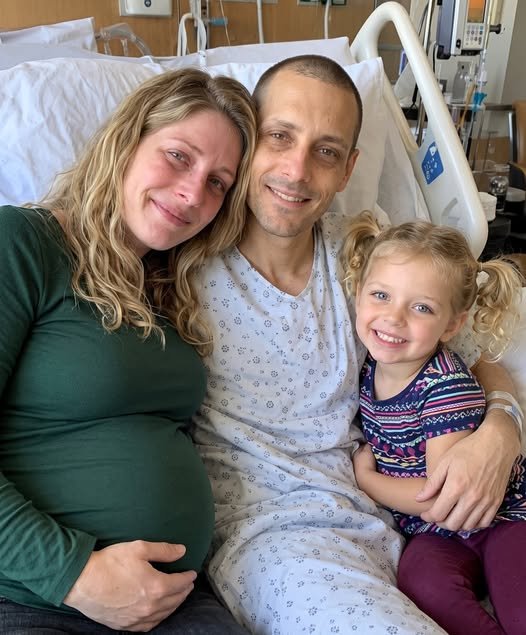
I was thirty-five years old and six months pregnant with our second daughter when my husband died.
Our first, Lucy, was four. She still believed Daddy was going to get better, because in her world that was simply what grown-ups did. They caught colds and got better. They scraped their knees and got better. They went to the hospital, and the doctors fixed them, and they came home.
I let her believe it for as long as I could. Some days I think I believed it too.
For eight months, my life had been nothing but lists.
- Medication times.
- Oncology appointments.
- Insurance calls.
- Bills.
- Lucy’s preschool schedule.
- My own prenatal appointments, squeezed into whatever gaps were left.
I kept them on a clipboard on the kitchen counter, in a notebook in my purse, in three different apps on my phone. If I could just keep everything written down, I told myself, then nothing could slip. Nothing could surprise us. Nothing else could go wrong.
One evening, Jack sat across from me at the kitchen table and watched me sort his pills into a plastic organizer with a little lid for every day of the week. Morning. Noon. Evening. Bedtime. I counted each one twice.
“You know you don’t have to control every second of the day, right?” he said.
I didn’t look up. “I’m six months pregnant, Lucy is four, and my husband has cancer. Which part should I stop controlling?”
“Maybe start with me.”
“You’re the least trustworthy one.”
He pressed a hand to his chest, wounded. “We’ve been together since high school.”
“Exactly. I have evidence.”
That made him smile, the tired, crooked smile I had fallen in love with when we were sixteen and he’d tried to impress me by juggling oranges in the cafeteria and dropped every single one.
“You’re terrifying,” he said.
“Good. Cancer should be terrified of me.”
He laughed. Then the laugh turned into a cough, and the cough went on and on, until he had to grip the edge of the table with both hands and I had to stop counting pills and rub slow circles on his back until it passed.
That was us.
I organized. Jack joked.
And neither of us ever said the obvious thing out loud.
During his last few months, Jack started disappearing.
Not for long at first. An hour here. Two hours there. He’d tell me he was going for a drive, or to the pharmacy, or just “out,” and he’d come back pale and exhausted and strangely quiet.
One afternoon, he came through the front door after nearly three hours. I was waiting in the hallway with my arms crossed over my belly.
“Where were you?”
“Out.”
“For three hours?”
“I needed air.”
“Jack, you can barely walk through Target without sitting down.”
“I’m fine.”
I looked at his jacket. There was a bulge in the inside pocket, the stiff, squared-off shape of folded paper.
“What’s in your jacket?”
“Nothing.”
“Those are papers.”
“Claire.”
“And you were on your laptop at two o’clock this morning. I saw the light under the office door.”
He came over, slowly, and kissed my forehead. His lips were cool and dry.
“Please don’t interrogate the dying man,” he said.
“I hate that joke.”
“I know.”
I caught his wrist before he could walk away. “Whatever you’re doing, you can tell me.”
He looked at me for a long moment. “I wish I could.”
“Then tell me.”
His eyes dropped to the papers sticking out of his pocket. “You already have enough to carry.”
“That’s not your decision.”
“It should be. Sometimes.”
“What does that even mean?”
He sighed and leaned against the wall, the way he did now when standing for too long made his legs shake.
“It means if someone needed help tomorrow,” he said quietly, “you’d say yes before you ever stopped to ask whether you could afford to give it.”
“That sounds like a compliment.”
“It scares me.”
“Why?”
“Because you never know when to let someone else be the problem.”
I didn’t understand what he meant. Not then.
I let go of his wrist. I told myself he deserved one small corner of his life where cancer wasn’t watching him, where I wasn’t watching him, where he could just be a man doing something private and ordinary.
That decision became the first thing I regretted after he died.
Five weeks later, he got much worse.
It happened the way the doctors had warned us it might. Slowly, and then all at once. He went back into the hospital on a Tuesday, and by Friday they were talking to me in the soft, careful voices that meant there was nothing left to try.
I sat beside his bed and held his hand. His fingers were so thin I could feel every bone.
“You look scared,” he whispered.
“So do you.”
“I’m allowed.”
“So am I.”
He almost smiled. “You’ll be okay.”
“Don’t say that.”
“You will.”
“No, Jack.”
His grip tightened, just barely. “Promise me you’ll keep going.”
“I don’t know how.”
“You’ll figure it out.” His eyes were already drifting shut. “You always do.”
Those were the last clear words he ever said to me.
He died two days later, early in the morning, while the sky outside his window was still the color of dishwater. I was holding his hand. The baby kicked once, hard, as if she knew.
Three days after that, I sat at my kitchen table with a funeral bill, two overdue notices, and a woman from the bank on speakerphone.
She cleared her throat. “Mrs. Harlow, I’m afraid there isn’t enough left in the account to cover next month.”
“I know.”
“And the loan against the house…”
“I know about the loan.”
“Do you have any other savings?”
“We spent them.”
“Anything you could sell?”
“I already sold my jewelry.” My engagement ring had gone in March. My grandmother’s pearls in May.
There was a pause. “I’m sorry.”
“So am I.”
“Was it all for his treatment?”
“Yes.”
“And that’s why you borrowed against the house?”
I stared at the stack of envelopes in front of me. “When someone offers you one more treatment,” I said, “you don’t stop and ask whether you can afford hope.”
She went quiet on the other end of the line.
That was the thing nobody tells you. You spend everything on hope. And then hope dies, and the bills stay.
A week after the funeral, I went back to the hospital to collect Jack’s belongings.
I had put it off as long as I could. Walking through those sliding doors again felt like walking backward into the worst week of my life. The same antiseptic smell. The same humming lights. The same vending machine on the third floor that only took exact change.
A nurse named Rachel met me at the station. She’d been on shift most nights during Jack’s last stay. She had kind eyes and a habit of humming while she checked his IV.
“I’m so sorry, Claire,” she said, and handed me a plastic bag with a drawstring.
“Thank you.”
I opened it right there at the counter. I don’t know why. Maybe I just needed to see what was left.
His watch, the cheap one he refused to replace because I’d given it to him on our first anniversary.
His phone charger.
His toiletry bag.
A paperback mystery with the corner folded down on page 212. He never got to find out who did it.
And at the very bottom, folded neatly, a soft gray women’s cardigan.
I pulled it out and held it up. It was a size small. It smelled faintly of a perfume I didn’t recognize. Something warm, a little like vanilla.
“This isn’t mine,” I said.
Rachel looked at the cardigan, and something shifted in her face. A flicker of discomfort.
“Oh,” she said. “I thought it belonged to the woman who visited him.”

The floor seemed to tilt very slightly beneath my feet.
“What woman?”
Rachel blinked. “I… I assumed she was family.”
“Jack didn’t have any family. He grew up in foster care. It was only ever him. And then us.”
“I’m sorry. I didn’t realize.”
“How often was she here?”
Rachel hesitated. I could see her weighing how much she should say.
“Several times,” she said finally. “Over a few weeks. Sometimes she stayed a few hours.”
“What did she look like?”
“Dark hair. Early forties, maybe.”
“Did they argue?”
“Not that I ever saw.”
“Then what did they do?”
“Mostly talked.” Rachel paused. “There were usually papers everywhere. All over the tray table, the bed. She’d bring a folder with her.”
“Papers?”
“Yes.”
I thought of the stiff, squared-off shape inside Jack’s jacket. The light under the office door at two in the morning. You already have enough to carry.
“Can I see the security footage?” I asked.
Rachel shook her head. “I’m not allowed to show you hospital surveillance, Claire. I’m sorry.”
“Then tell me who she was.”
“I don’t know her name. I swear I don’t.”
It took me four days, three phone calls, a meeting with a patient advocate, and one conversation with a hospital administrator during which I may have cried in a way that made him very uncomfortable. But finally, I was sitting in a small, windowless security office in front of a monitor, with a guard named Luis clicking through grainy black-and-white clips.
“There,” he said, and pointed.
A woman was walking down the corridor toward Jack’s room. Dark hair pulled back. A long coat. A thick folder held tight against her chest like a shield.
I leaned closer to the screen.
“I’ve never seen her before,” I said.
“She came carrying that folder every time,” Luis said.
“How long did she stay that day?”
He checked the timestamps. “Almost two hours.”
He clicked to another clip. Same corridor. Same woman. But this time, as she came out of Jack’s room, she stopped against the wall, pressed her hand over her mouth, and her shoulders started to shake.
“And that one?”
“The following day.”
“She’s crying.”
“Yes, ma’am.”
I swallowed. “Were they alone in there?”
“Yes.”
“Every time?”
Luis glanced at me, then at the patient advocate standing behind my chair. “Mrs. Harlow…”
“Were they?”
He looked back at the screen. “Mostly.”
I stared at the frozen image of that stranger crying outside my dying husband’s room, and I felt something inside me crack straight down the middle.
For three days after that, I barely slept.
I replayed everything. The secret drives. The hidden papers. The late-night glow under the office door. The way he’d kissed my forehead and told me not to interrogate him. The way he’d said I wish I could.
On the third night, at two in the morning, I lay alone in our bed with one hand on my belly and the gray cardigan balled up on the floor where I’d thrown it, and I whispered into the dark.
“Were you cheating on me?”
Nobody answered. Of course nobody answered.
I hated myself for asking a dead man a question he could never defend himself against.
The next afternoon, Lucy was coloring at the kitchen table, tongue poking out of the corner of her mouth in concentration, when someone knocked on the front door.
Three slow knocks.
Lucy looked up. “Mommy, who’s here?”
“I don’t know, baby.”
I wiped my hands on a dish towel and walked down the hallway. I opened the door.
And the woman from the security footage was standing on my porch.