
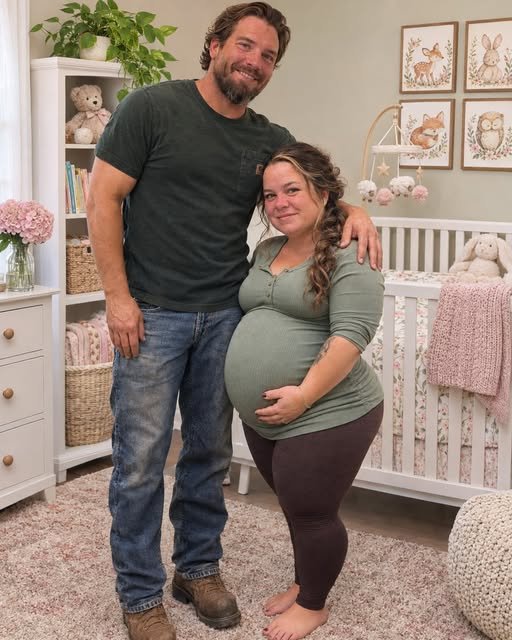
I’m 3 feet 8 inches tall, and for most of my life people treated me like a joke. At 38, I finally had a husband who loved me and a baby on the way. Then my mother-in-law slid a $100,000 check across her kitchen table and said, “Leave the baby at the hospital.” I said no. I had no idea why she’d asked.
Part 1: The Check on the Kitchen Table
The check was made out to me. That’s the part I still can’t get past.
Not “Cash.” Not some made-up name. Hannah Brooks, written in my mother-in-law’s neat, slanted handwriting, with $100,000.00 in the box and a line through the empty space after it so nobody could add a zero.
I was seven months pregnant, sitting in Patricia Brooks’s kitchen in Dublin, Ohio, on a Tuesday afternoon in May. My feet didn’t reach the floor from her tall kitchen chairs. They never had. She’d never once offered me a different seat.
“Take it,” she said.
I looked at the check. Then at her.
“What’s this for?”
Patricia folded her hands on the granite countertop. Her nails were painted the same pale pink they’d been every time I’d seen her for three years.
“When the baby is born, leave it at the hospital. I’ll arrange everything. A good family. A good life.”
I want to tell you I said something brave right away. I didn’t. I sat there with my hand on my belly, feeling my daughter kick against my palm, and I couldn’t get a single word out.
I’m 3 feet 8 inches tall. I was born with achondroplasia, the most common form of dwarfism. I’d heard a lot of cruel things in 38 years.
I had never heard anything like that.
“You want me to abandon my child,” I finally said.
“I want you to give that child a better life than the one it’s going to have.”
It. She kept saying it.
I pushed the check back across the counter. My arms are short, so I had to lean, and I hated that she watched me do it.
“Get out of my life, Patricia.”
She didn’t argue. She just picked up the check, folded it once, and slid it into the pocket of her cardigan.
“Then don’t say I didn’t warn you.”
I didn’t know it then, but that check wasn’t the first one ever written in that family. And the person it was really meant for wasn’t me.
Part 2: The Girl Nobody Asked to Prom
I should tell you who I was before Michael, because it matters.
I grew up in Mansfield, Ohio, the only kid in my school who needed a step stool at the drinking fountain. In second grade, a boy named Tyler called me “the doll,” and by Friday the whole class was doing it. In fifth grade, someone wrote LITTLE FREAK on my locker in purple marker. The janitor scrubbed it off. The shadow of those letters stayed there until I graduated.
In eleventh grade, a basketball player named Cody asked me to prom in the cafeteria. I said yes before I looked at his friends.
They were already laughing.
It had been a dare. Twenty dollars, I found out later. I went home, put my mother’s ironing board up, and pressed my church dress anyway, because I’d decided I wasn’t going to let them see me cry. I didn’t go to prom. But I ironed that dress every spring for three years, like a promise to myself.
As an adult, I worked in medical billing at a clinic in Columbus. I was good at it. I could find a $14 coding error on a 40-page claim. I had a little house with a ramp I’d built with my dad, lowered countertops, and a grabber tool in every room.
What I didn’t have was anyone who looked at me like I was a woman instead of a curiosity.
Dating was worse than school. Men either rejected me in the first message or asked questions no one should ask a stranger. One man sat through an entire dinner, then asked if he could take a picture of me “for his buddies.”
By 35, I’d stopped hoping. I told my mom I was happy alone, and I almost believed it.
Then my coworker’s husband threw a Fourth of July cookout, and a man in a faded Ohio State cap handed me a paper plate and said, “The good potato salad’s on the low table. Somebody had the sense to put it where everybody can reach it.”
That was Michael.
He was 6 feet 1, seven years older than me, and taught shop class at a high school in Hilliard. On our first date, he pulled out my chair at a diner, then asked the waitress for a booster cushion without making a single joke about it. He listened to every word I said. He never once mentioned my height.
On our third date, I asked him why.
He shrugged. “I figured you’d already heard everything anybody could say about it. I wanted to hear about everything else.”
Two years later, we were married at a lake pavilion in Delaware County. He’d built me a little wooden step for the altar so we could look each other in the eye.
What I wanted, on the outside, was simple: a family.
What I needed was harder. I needed to believe I deserved one.
And the only person in Michael’s life who seemed to doubt that was his mother.
Part 3: “Are You Sure This Is a Good Idea?”
Patricia had always been polite. That was the problem. She was polite the way a hotel lobby is clean, smooth and cold, with nothing personal anywhere.
She never insulted me. She sent birthday cards with $25 checks inside. She came to our wedding in a navy suit and left before the cake was cut, saying she had a headache.
But she never hugged me. And sometimes I caught her staring at me with an expression I couldn’t read. Not disgust. Something closer to fear.
Michael’s father, Richard, had died of a heart attack in 2019, before I met Michael. Michael said his mom had “closed up” since then.
“She wasn’t exactly warm before,” he admitted. “But she got quieter.”
When I found out I was pregnant at 38, I cried so hard in our bathroom that Michael pounded on the door, thinking I’d fallen. I opened it holding the test in both hands.
He sat down on the edge of the tub and cried too.
We told Patricia over Sunday dinner at her house. Michael said it, grinning like a kid. “Mom, you’re going to be a grandma.”
Patricia set down her fork. She didn’t look at Michael. She looked at my stomach.
“Are you sure this is a good idea?”
The room went silent.
“Mom,” Michael said.
“I’m only asking,” she said quietly. “Because of… the risks.”
I assumed she meant my health. Pregnancy with achondroplasia is high-risk. My pelvis is small, so a C-section was always the plan. My doctors at the OSU Wexner Medical Center were watching me closely. I told her all of that, calmly, and she nodded and said nothing else.
On the way home, Michael gripped the steering wheel.
“She’s just scared,” he said. “My mom had a baby before me. A girl. She was stillborn. Nobody ever talks about it. I think pregnancy just… brings it back for her.”
That softened me. I sent Patricia a card the next week with our first ultrasound picture inside. She never mentioned it.
I didn’t know yet that Michael had been told a version of the truth that wasn’t true.
Then, at seven months, Patricia called and invited me over for lunch. Just me. Michael was teaching summer school.
I almost said no. I said yes because I thought she might finally be trying.
I drove home from her house that afternoon gripping the wheel so hard my fingers went numb. In my purse was nothing. She’d kept the check.
But I’d seen something on her refrigerator while she was getting the iced tea, and I couldn’t stop thinking about it.
Part 4: The Receipt on the Refrigerator
I told Michael everything that night.
I’ve only seen my husband truly angry twice. That was the first time. He didn’t yell. He went completely still, and then he walked out to the garage and stood with his hands flat on his workbench for a long time.
When he came back in, his eyes were red.
“She’s never coming near our baby.”
He called her. I heard only his side.
“No, Mom. No. I don’t care what you meant. You don’t get to explain this… Then put it in writing, because I’m not listening to you right now.”
He hung up. He blocked her number. I’d never loved him more, and I’d never felt worse, because I knew what it cost him. She was the only parent he had left.
For the next two months, we didn’t speak to Patricia.
But I kept thinking about the refrigerator.
Under a magnet shaped like a cardinal, there had been a donation receipt. Little People of America, the national nonprofit for people with dwarfism. $2,500. And beneath it, half covered, another one, from the year before. Same amount.
Why would a woman who wanted my baby gone give $5,000 to an organization for people like me?
My first thought was ugly: guilt. She’d donated to feel better about how she treated me.
But the dates didn’t work. One receipt was from 2023. I’d met her in 2023. The other was from 2022. Before she even knew I existed.
I asked Michael, carefully, if his mom had any connection to the dwarfism community.
He frowned. “No. Not that I know of. Why?”
I didn’t tell him. Not yet. It felt like pulling a thread on a sweater that wasn’t mine.
Then, three weeks later, a small padded envelope arrived at our house addressed only to me, in Patricia’s slanted handwriting. No letter inside. Just one thing.
A tiny bracelet. The old-fashioned kind hospitals used before barcodes, a strip of white plastic with little alphabet beads strung inside.
The beads spelled B-R-O-O-K-S G-I-R-L.
On the back of the plastic tag, in faded ballpoint ink: 3/9/78.
Michael was born in 1981.
I sat on our kitchen floor, which I do when I need to think, and turned it over and over in my fingers. The baby girl who’d been stillborn. The one nobody talked about.
Hospitals don’t usually send a baby home with a bracelet when she doesn’t come home.
And Patricia had sent it to me, not to her son.
Part 5: The Choice I Didn’t Want to Make
I had a choice to make, and I hated both options.
If I showed Michael the bracelet, I’d be handing him a question about his own family that could break something in him, two months before he became a father. He was already grieving a mother who was still alive.
If I didn’t, I’d be keeping a secret from my husband. And I’d spent my whole life being the person other people talked about behind closed doors. I didn’t want to become someone who held doors closed.
There was a third option, too. Throw the bracelet away. Forget the receipts. Protect my own peace. After what she’d said to me, nobody would blame me.
I’d almost decided to do that. I actually put the envelope in the kitchen trash.
Then my daughter kicked, hard, right under my ribs. And I thought about the shadow of LITTLE FREAK on my locker, how nobody ever asked me what it felt like to walk past it every morning. How everyone assumed it was easier to scrub something and pretend it was gone.
I took the envelope out of the trash.
That night, I put the bracelet on the table between us.
“Your mom sent this. To me.”
Michael picked it up. I watched him read the date. I watched him do the math.
“That’s… that’s the baby,” he said. “That’s my sister.”
“Michael. Did anyone ever tell you where she was buried?”
He opened his mouth. Closed it.
“No,” he said slowly. “Dad said it was too painful. There’s no grave. I asked once, when I was maybe twelve. Mom left the room.”
We sat there a long time.
“I’m not calling her,” he finally said. “Not before the baby. I can’t, Hannah. If I hear her voice right now, I’ll say something I can’t take back.”
“Okay.”
“And if she has something to say, she can say it to both of us. In writing. Like I told her.”
I agreed. I tucked the bracelet into the zipper pocket of my hospital bag, next to the tiny pink knit hat my mom had made.
I don’t know why I packed it. Maybe I thought someone should be holding onto it.
I told my OB, Dr. Alvarez, and the hospital’s social worker, a calm woman named Denise Carter, about Patricia’s offer. Dr. Alvarez’s jaw tightened. Denise wrote everything down.
“We’ll put a note in your chart,” she said. “No information released to her. If she shows up, security gets called and your nurses get notified. Your baby will have an electronic security tag on her ankle the whole time she’s here. Nobody leaves this unit with her unless it’s you, Michael, or staff.”
“Thank you,” I said.
“Do you want her flagged as a possible threat?”
I thought about the receipts. The bracelet. The fear I’d seen on Patricia’s face for three years.
“Yes,” I said. “I’m sorry. Yes.”
It was the right call. It was also the call that nearly turned the happiest day of my life into a nightmare.
Part 6: The Woman in the Hallway
At 38 weeks, two days, my water broke in the cereal aisle at Kroger. My C-section had been scheduled for that Friday. Charlotte decided Tuesday was fine.
They took me straight into surgery at 4:12 p.m. Michael sat by my head in blue scrubs, holding my hand and narrating everything, because I couldn’t see past the curtain.
“Okay, they’re… oh. Oh, Hannah. She’s got so much hair.”
At 4:31 p.m., I heard her cry.
I’ve never heard a sound like it. Angry and loud and perfect. I sobbed so hard the anesthesiologist checked my monitors.
Charlotte Grace Brooks. Six pounds even. A tiny button nose, a full head of dark hair, and a furious little face.
Later, Dr. Alvarez would confirm what the shape of her head and her short arms already told the nurses: Charlotte had achondroplasia, just like me.
When they laid her on my chest in recovery, skin to skin, I looked at her short little fingers and her round cheeks and thought, She looks like me.
For the first time in my life, that didn’t feel like a warning. It felt like a gift.
Every cruel word anyone had ever said about my body went quiet.
By 5:40, we were in a postpartum room on the fourth floor. A nursing student named Kayla took Charlotte to the nursery for her weight check and a quick bath, then wheeled her back in a clear plastic bassinet, wrapped tight in a striped hospital blanket. Michael was taking pictures of her yawning.
Our happiness lasted less than an hour.
At 6:18 p.m., a nurse named Tamika came in, her face careful.
“There’s a woman downstairs at the front desk claiming to be the baby’s grandmother.”
My stomach dropped. “Tell her she’s not welcome.”
Tamika hesitated. “She says there’s been a mistake. She’s asking for you specifically, Hannah.”
Before I could answer, the charge nurse, an older woman named Lorraine, came through the door fast. She didn’t look at me. She went straight to Charlotte’s bassinet, unwrapped the bottom of the blanket, and checked my daughter’s tiny ankle.
Her face changed.
“Who brought this baby into the room?”
Michael stood up. “The student. Kayla. Why? What do you mean?”
Lorraine looked toward the door. “Please, nobody touch the bassinet.”
Then the overhead speaker clicked on, and a calm recorded voice said the words every parent in a maternity ward dreads:
“Code Pink, Fourth Floor. Code Pink, Fourth Floor.“
I tried to sit up. Pain from the incision tore through my abdomen like a zipper.
“What’s happening? That’s my daughter! That’s my daughter!”
Lorraine had one hand flat on the bassinet. “Ma’am, I need you to stay still. I need to check something.”
From the hallway came the sound of running feet. A door clanging. And then a woman’s voice, high and cracking, shouting:
“I’m not here to take her! Please! I’m not here to take anybody!“
I knew that voice.
Michael was already at the door. I heard him say, “Mom?” in a voice I’d never heard before. Like he was twelve years old.
Lorraine was digging through the folds of Charlotte’s blanket. Ten seconds. Fifteen. I counted them in my head because I couldn’t breathe.
Then she pulled out a small gray plastic tag on a broken strap.
“Here,” she said, and let out a breath. “Here it is. It slipped off. Her ankle’s too small for the band. When the student wheeled her past the stairwell door, the strap must’ve come loose and the system flagged it.”
She held Charlotte’s other ankle up to the light and read the identification band, then reached for mine. “Four-four-seven-one. Four-four-seven-one. She’s yours, honey. She’s yours. She never left the floor.”
I put both hands over my face and shook.
Out in the hallway, the shouting had stopped.
When I looked up, two security officers were standing at our doorway on either side of Patricia Brooks. She was 71 years old, wearing her navy cardigan, her hair coming out of its clip. She’d taken the stairs. All four flights.
She was holding a thick white envelope against her chest with both hands, the way you’d hold something you were afraid would be taken.
“I’m sorry,” she said. “I heard the alarm and I thought… I thought someone was taking her. I thought it was happening again.”
Michael’s voice was very low. “Again?“
Patricia looked past him. At me. At Charlotte.
“Her name was Grace,” she said.
Part 7: The Truth in the Envelope
The officers didn’t leave, and I didn’t ask them to. Lorraine stayed too. I needed people in that room who weren’t family.
Patricia stood at the foot of my bed. She didn’t sit. She didn’t come closer. I think she knew she wasn’t allowed.
“In March of 1978, I had a baby girl,” she said. “She had achondroplasia. Like you. Like… her.” She nodded at Charlotte without looking directly at her. “Richard’s mother came to the hospital the day after. Eleanor. She brought a check for five thousand dollars and a lawyer’s card. She said a child like that would ruin Richard’s career and ruin my life. She said there were ‘places’ and ‘good families.’ Richard didn’t say a word. He just stood by the window.”
Her hands were shaking. The envelope crinkled.
“I was twenty-three. I signed the papers. They told everyone the baby died. Eleanor arranged it all. I went home without her, and I’ve had that bracelet in my jewelry box for forty-eight years.”
Michael sat down hard on the vinyl recliner.
“I had a sister,” he said. “I have a sister.”
“Yes.”
“And you let me believe she was dead.”
“Yes.” She didn’t try to soften it. “Every year on March ninth, I told myself she’d had a better life than I could’ve given her. That’s what I needed to believe. Because if it wasn’t true, then I’d done the worst thing a mother can do for nothing.”
I finally found my voice. “So you tried to make me do it too.”
Patricia closed her eyes.
“When you told us you were pregnant, I couldn’t sleep for a month. I kept thinking about the things people said to you. Michael told me about the prom. About the locker. And I thought, she knows. She knows what the world does to a little girl like that. Why would she choose it?” She opened her eyes. “I told myself I was saving the baby. That’s the same lie Eleanor told me. I didn’t hear it until you pushed that check back across my counter. You leaned all the way over to do it, and you looked at me like…”
She stopped.
“Like what?” I asked.
“Like Grace would’ve looked at me. If I’d ever given her the chance.”
Nobody spoke. Charlotte made a tiny squeak in her bassinet. Lorraine adjusted her blanket.
Patricia held out the envelope. Not to Michael. To me.
“I’m not asking you to forgive me. I wrote everything down, like Michael asked. And there’s something else.”
I opened it. Inside were three things.
A six-page letter, handwritten.
A yellowed carbon copy of a check dated March 10, 1978, from Eleanor Brooks, for $5,000.
And a printout from a DNA testing website. A match labeled Close Family: Parent/Child. A woman named Grace Whitfield, age 48, Tucson, Arizona.
“After you threw me out of your life,” Patricia said, “I took the test. I’d been too scared for years. The donations, that was the only thing I let myself do. Grace’s son had tested last year. She showed up as a match in six weeks.”
“Did you contact her?” Michael asked.
“I wrote to her through the website. Two months ago.” Her voice broke for the first time. “She hasn’t answered. She doesn’t have to. But I couldn’t keep pretending she wasn’t real. And I couldn’t let you have that baby thinking it was about you, Hannah. It was never about you. It was about what I did.”
I looked down at the DNA match. At the carbon copy of a check that a frightened young mother had let someone else write.
Then I looked at Charlotte. At her short, perfect fingers curled against the striped blanket.
“Patricia,” I said. “Look at her.”
She hesitated.
“No. Really look at her. Not at her arms. Not at her head. At her.”
Patricia took one step closer. Lorraine shifted, but I shook my head slightly. Patricia stood there, hands clasped around nothing now, and looked at my daughter.
“She has your chin,” she whispered to Michael.
“She has Hannah’s chin,” he said.
“Yes,” Patricia said. “She does.”
“You were right about one thing,” I told her. “People are going to be cruel to her. Kids will call her names. Some boy might ask her to a dance on a dare. I can’t stop any of that.”
Patricia’s face crumpled.
“But you were wrong about the rest. The cruelty was never the worst part of my life. The worst part was believing it. And I only stopped believing it because people kept showing up. My mom. My dad building ramps. Michael and his stupid booster cushion.” My voice cracked. “That’s what she’s getting. People who show up. The only question is whether you’re one of them.”
Patricia didn’t answer. She just nodded, over and over, like someone agreeing to something she wasn’t sure she could carry.
Part 8: The Boundary and the Door
I want to be honest about what happened next, because Facebook stories always skip this part.
I didn’t forgive her that night.
I told Patricia she could look at Charlotte from where she stood. She did. For a long time. She didn’t cry loudly. She just pressed her knuckles against her mouth, and when the officers walked her out, she said, “Thank you,” to me, and “I’m sorry,” to Michael, and nothing else.
Michael didn’t speak to her for six weeks.
When he did, it was on the phone, with me sitting next to him. And it was mostly him talking.
We wrote down our conditions together at the kitchen table, on a yellow legal pad, the way Michael plans every project in his shop:
- Patricia sees a family therapist, starting now, not “when she’s ready.”
- She tells her sister and Michael’s cousins the truth about Grace, in her own words.
- She never makes a decision about Charlotte, ever, including what Charlotte “can” or “can’t” do because of her height.
- For the first year, visits happen at our house, with one of us in the room.
- She doesn’t contact Grace again unless Grace reaches out first.
Patricia agreed to all five in under a minute. Then she asked one question.
“Can I bring something for her? Something she can reach?”
I thought about that for days.
The first time Patricia came to our house, Charlotte was eight weeks old. Patricia stood in our living room, looked at our low couch, our lowered countertops, my step stools, and the grabber tool hanging by the door.
Then she did something I’ll never forget. She sat down on the floor. Seventy-one years old, in good slacks, she lowered herself onto our rug so she could be at eye level with the baby on her play mat.
“I should’ve done this a long time ago,” she said. “With a lot of people.”
She came every other Sunday after that. She went to therapy on Thursdays. She called her sister in Cincinnati and told her everything. Her sister hung up on her. Then she called back two days later.
In October, an email arrived. Not to Patricia. To Michael.
My name is Grace Whitfield. I think you’re my brother. I’m not ready to talk to her yet. But I’d like to know about you. And I’d really like to know about your daughter.
Michael read it to me standing in our kitchen with the phone shaking in his hand. He and Grace talked for two hours that night. She’s a high school librarian. She was raised in Tucson by two schoolteachers who adopted her when she was nine months old. She grew up knowing she was adopted, but never knowing why.
“She was loved,” Michael told me afterward, wiping his face. “Hannah, she was loved.”
When we told Patricia, she didn’t ask for Grace’s number. She asked, “Is she happy?”
“Yes,” Michael said.
Patricia nodded and looked out the window for a long time.
“Then that’s more than I deserve to know.”
Charlotte turned one last month.
We had her party in our backyard. Low tables for the food, because somebody has to have the sense to put the good potato salad where everybody can reach it.
A package arrived from Tucson that morning. Inside was a board book, a pair of tiny purple sneakers, and a card in handwriting I’d never seen before.
For Charlotte. From your Aunt Grace. Tell her the women in this family are taller than they look.
Patricia sat on the grass all afternoon. She didn’t once tell anyone what to do.
That night, after everyone left, I opened Charlotte’s baby book and slid in two hospital bracelets side by side.
One is new and printed with a barcode: BROOKS, GIRL. 4471.
The other is forty-eight years old, with alphabet beads that spell BROOKS GIRL, and a date in faded blue ink.
Two girls. Same last name. Born almost half a century apart, into the same family, with the same body.
One was handed away for a check.
The other was handed to me.
I used to think the cruelest thing in the world was being laughed at. I don’t anymore. The cruelest thing is when someone decides, before you’ve lived a single day, that your life isn’t worth the trouble.
Patricia believed that once. Her mother-in-law believed it before her.
It stops with us.
My daughter is going to grow up hearing every cruel word I ever heard. I can’t stop that.
But she’ll also grow up with a mother who knows exactly what to say back. A father who builds her steps. An aunt in Arizona who sends purple sneakers. And a grandmother who learned, too late for one little girl but just in time for another, how to sit down on the floor.