
My wife, Leah, had been going on weekend retreats for years.
Yoga workshops, silent meditation, and digital detoxes helped her recover from the stress of her job. I never understood the appeal of spending 3 days without a phone, but she always came home calmer and more like herself.
That spring, she returned to a coastal wellness center she had visited before.
She left Friday morning with a canvas bag and kissed me beside her car.
“Don’t let Benny live on pizza while I’m gone,” she said.
“No promises.”
She laughed, wrapped both arms around my waist, and pressed her cheek against my chest.
That was how Leah always hugged me.
On Sunday evening, her car pulled into the driveway.
Benny raced toward the door, whining with excitement. But when Leah stepped inside, he stopped several feet away.
His tail lowered.
“Benny?” she said, reaching for him.
He backed into the hallway.
“Maybe you smell like all those essential oils,” I suggested.
“Maybe.”
Then she hugged me.
It was brief and stiff, like something she had remembered to do rather than something that came naturally.
“You okay?” I asked.
“Just tired.”
She carried her bag into the kitchen, opened a cabinet, and stared at the plates.
“Where are the coffee mugs?”
I laughed because I thought she was joking.
She looked at me blankly.
“You chose that cabinet when we renovated,” I said, pointing beside the refrigerator.
“Right. Long weekend.”
It was strange, but not alarming. Anyone could forget something while exhausted.
That night, however, she climbed into bed on my side.
“You’re in my spot,” I said.
She glanced down.
“Am I?”
“You’ve slept on the left for 15 years.”
She moved quickly and blamed her confusion on fatigue.
The next morning, she crossed the bedroom wearing a towel after her shower.
That was when I saw the mark.
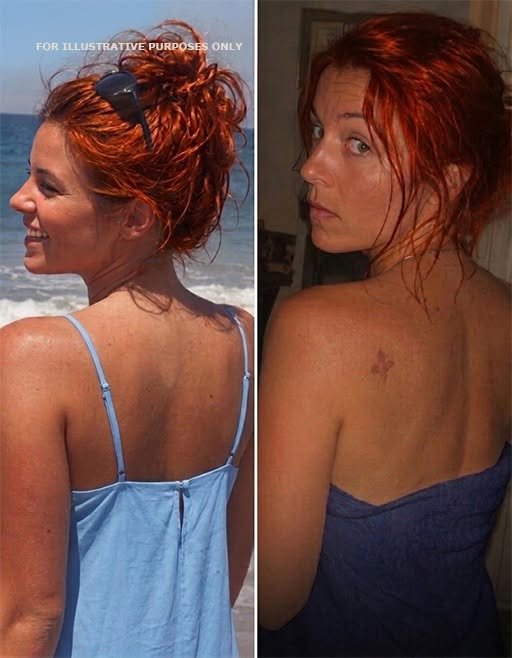
Just below her left shoulder blade was a dark birthmark shaped like a lily.
I had been married to Leah for 15 years. I had seen her in swimsuits, backless dresses, and summer clothes.
That mark had never been there.
“What are you staring at?” she asked.
“The birthmark on your back.”
She turned toward the mirror. The moment she saw it, her face went pale.
For half a second, she looked terrified.
Then she forced a laugh.
“Maybe it’s always been there.”
“It hasn’t.”
“You could have missed it.”
“I didn’t.”
Her expression hardened.
“Then I’ll see a dermatologist. Can we not turn this into something dramatic?”
That evening, I searched through old photographs.
Our honeymoon. Beach vacations. A wedding at which Leah wore a dress that exposed her entire back.
There was no birthmark.
When I showed her, she became quiet.
“I said I’ll get it checked.”
During the next few days, more things felt wrong.
She stopped adding cinnamon to her coffee, even though she had done so every morning since we met. She called my sister Madeline instead of Maddie. She searched for a light switch inside a closet she used every day.
She knew our anniversary, my work schedule, and the names of my relatives.
But she could not remember the private joke Leah and I repeated whenever it rained.
The woman in my house knew the facts of Leah’s life.
She did not know the habits.
Benny continued avoiding her. He growled whenever she approached his bed and refused to sleep in our room.
On Thursday afternoon, I came home early and found her standing before the bedroom mirror with her shirt pulled down.
She was tracing the lily-shaped mark with one finger.
Her expression was not confusion.
It was recognition.
I stepped away before she saw me.
That night, I considered every reasonable explanation—stress, memory loss, neurological illness—but none explained the birthmark or Benny’s reaction.
The next morning, she was upstairs when a sharp electronic chime sounded.
A few seconds later, she hurried down the stairs carrying her purse.
“I forgot something at the grocery store,” she said.
“You haven’t gone shopping yet.”
She froze briefly.
“I meant I need to pick something up.”
Then she left.
I went upstairs and entered the bedroom.
On the desk, partially hidden beneath Leah’s work papers, was a slim black laptop I had never seen before.
The screen was still awake.

A notification flashed in the corner:
Movement detected: cellar camera.
She must have heard the alert and rushed out before closing it.
I clicked the notification.
A live feed opened.
The room on the screen had concrete walls, a small lamp, and an old couch. A woman sat curled beneath a blanket, her wrists se::cured in front of her.
Then she raised her head.
I stopped breathing.
The woman had Leah’s face.
My wife was tra::pped in a cellar.
Yet another woman who looked exactly like her had been sleeping beside me for 5 nights.
Then I remembered something Leah had told me before we married.
She had an identical twin sister named Camille.
They had not spoken in nearly 20 years.
Camille had spent much of their childhood copying Leah’s clothes, mannerisms, and friendships. As they grew older, her behavior became obsessive. She contacted Leah’s boyfriends, impersonated her online, and once entered Leah’s college dorm while pretending to be her.
Their parents always made excuses.
Camille was sensitive.
Camille only wanted to feel close to her sister.
The final break came when Camille kissed Leah’s boyfriend at a party and claimed he had confused them.
After that, Leah cut her out of her life.
I photographed the screen, grabbed my phone, and left through the back door. From my neighbor’s house, I called the police.
“My wife has been kid::napped,” I told the dispatcher. “Her identical twin has taken her place.”
The claim sounded impossible, but the live feed proved someone was being held against her will.
Officers arrived within minutes. The laptop’s camera account contained a recovery email registered to Camille, and public records showed she owned a house approximately 40 minutes away.
Because a restrained victim was visible on a live feed, detectives obtained emergency authorization to enter the property.
A rescue team was sent to Camille’s house while other officers watched mine.
They instructed me to remain across the street and avoid confronting her.
At 3:17 p.m., Camille returned carrying grocery bags.
When the officers approached, she smiled nervously.
“Is something wrong?”
“Camille Lawson?” one officer asked.
Her smile disappeared.
“I’m Leah.”
“Put the bags down.”
For several seconds, she maintained the disguise.
Then one officer mentioned the cellar camera.
Camille dropped the groceries and ran.
They caught her before she reached the backyard.
When she saw me standing beside an unmarked car, she stopped struggling.
“How long have you known?” she asked.
“The camera showed me Leah.”
Fear entered her eyes.
“You found her?”
“You left your laptop open.”
“You were never supposed to touch it.”
“You were never supposed to touch my wife.”
Her expression hardened.
“You were supposed to believe me. I only needed more time.”
“To do what?”
“To learn everything else.”
“You knew dates and names,” I said. “You didn’t know which side of the bed she slept on. You didn’t know how she drank her coffee or where we kept the mugs.”
“I could have learned.”
“You studied Leah’s life. You never knew her.”
Her face twisted with rage.
“She didn’t deserve that life.”
Detectives later reconstructed what had happened.
Camille had followed Leah online for years. She recorded her voice, copied her handwriting, watched our home, and filled notebooks with our schedules and family details.
When she learned Leah was returning to the coastal retreat, Camille booked a room under another name.
On Saturday, she approached Leah in a public garden and claimed she wanted to apologize. She brought an old family letter and said their late mother had wanted them to reconcile.
Leah did not trust her, but Camille remained near other guests and staff. By Sunday morning, several people at the retreat believed the estranged twins were repairing their relationship.
Camille then bought Leah a cup of herbal tea from the retreat café and secretly added a se:dative.
When Leah became confused and weak, Camille told staff her sister was ill and offered to drive her home. Because the employees had already seen them together, no one became suspicious.
Instead, Camille took Leah to her house and locked her in the cellar.
She changed into clothes she had prepared, took Leah’s phone, keys, bag, and car, then returned to our home.
The camera allowed her to monitor Leah while pretending to be her.
Her plan was not simply to impersonate Leah for a few days.
Investigators found a key to an isolated cabin that had once belonged to their father, a map with a route marked from Camille’s house, and supplies hidden in her car. They also found a forged farewell email saved under Leah’s name and searches about making a disappearance look voluntary.
Camille intended to force Leah to reveal private passwords and personal details she could not learn through surveillance.
Then she planned to move her to the cabin and make sure she never returned.
She had not intended to borrow Leah’s life.
She intended to erase her and take it permanently.
Police found Leah alive in the cellar.
She had been held there for almost 5 days with bottled water and canned food. She was weak from the se:dative and had brui:ses around her wrists, but she was conscious.
At the hospital, a nurse led me into a private room.
Leah sat beneath a white blanket.
After days of seeing her face on someone else, my mind faltered for a fraction of a second.
Then she looked at me.
“Owen,” she whispered.
I crossed the room.
She wrapped both arms around my waist and pressed her cheek against my chest.
The way she always had.
I held her until the nurse reminded me to be careful.
“I’m sorry,” I said.
“For what?”
“I should have known immediately.”
“You did know.”
“Not quickly enough.”
“You found me.”
Her voice broke.
“She kept telling me you would never notice. She said she had studied me so well that she could become me.”
I touched her face.
“Benny knew the moment she walked through the door.”
Leah laughed through her tears.
“Of course he did.”
Camille was charged with kid::napping, unlawful imprisonment, stalking, identity the::ft, and administering a controlled sub::stance. Prosecutors later added an attempted-mu::rd3r charge after investigators uncovered evidence of her plan for the cabin.
The lily-shaped birthmark was the one feature she could not remove. She had intended to keep it covered with makeup but became careless inside our home.
Leah returned 12 days after her rescue.
Benny ran toward her before the front door was fully open. He jumped against her legs, whining and wagging his tail until she sat on the floor and buried her face in his fur.
That evening, she entered the kitchen and opened the correct cabinet without thinking.
When she saw the mugs, she began to cry.
Recovery was slow.
She feared locked doors and dark rooms. She woke from nightmares and avoided mirrors because her own reflection reminded her of Camille.
We both went to therapy.
Camille eventually received a lengthy prison sentence. Neither of us attended the hearing.
People sometimes ask how I realized the woman in my house was not my wife.
The birthmark made me suspicious.
The camera showed me the truth.
But I knew something was wrong before I understood why.
A face can be copied. A voice can be practiced. A life can be studied through photographs, schedules, and messages.
But love lives in smaller places.
The cabinet someone opens without thinking.
The side of the bed they choose in the dark.
The way they prepare their coffee.
The way a dog recognizes the person beneath a familiar face.
And the way your wife holds you when she finally comes home.