
My grandmother, June, believed flowers remembered things.
When I was 8, she gave me a green watering can and led me through the garden behind her lake house. Beside a row of pink peonies, she stopped and smiled.
“These bloomed the year you were born, Mara. Plants have families too.”
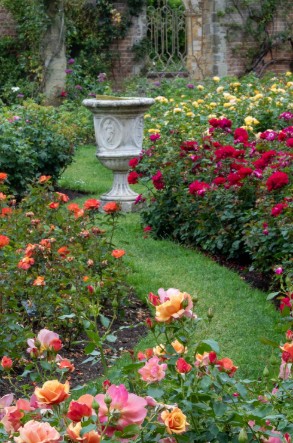
The lavender along the path marked her recovery from surgery. The red roses beside the porch celebrated her wedding anniversary. The white daisies appeared after my 1st school recital, and the bee balm filled an empty corner after what she called “a summer when the family needed something cheerful.”
Every plant had a story.
“Flowers are better than photographs,” she once told me. “A photograph captures a moment. A garden proves someone kept caring afterward.”
I finally understood after she died.
Grandma left me the lake house with a handwritten note containing only 4 words:
Keep it lived in.
I repaired what needed fixing but preserved everything that made the house hers—the yellow cabinets, hand-sewn cushions, cast-iron pancake griddle, and old rocking chair.
Most importantly, I cared for the garden.
Every Saturday, my husband, Colin, and I drove 2 hours to the lake. I followed the large garden map Grandma had drawn by hand, with every bed measured, numbered, and labeled with a memory.
In one corner, she had written:
Leave a little room for memories that haven’t happened yet.
Colin understood what the house meant to me.
His younger sister, Tessa, did not.
Two days before her wedding, Tessa arrived at our home carrying her planning binder.
“The restaurant flooded,” she announced. “A pipe burst, and they canceled every event.”
I felt terrible for her. 74 guests were already traveling, and she had spent nearly a year planning everything.
“Our coordinator can transfer the caterer, tables, and decorations,” she continued. “We’ve found portable bathrooms and a shuttle company. We only need a location.”
She opened her binder to a photograph of Grandma’s lake house.
“So we’ll have it there.”
I stared at her. “It isn’t a wedding venue.”
“It has a lawn, a dock, and a lake. It’s perfect.”
I wanted to refuse, but I knew how much she stood to lose. Eventually, I agreed under strict conditions.
“No vehicles or heavy equipment on the soft lawn. Nothing inside the house goes outdoors, and the garden is completely off-limits. No cutting, digging, or moving flowers.”
I sent the rules in a group message to Tessa, her fiancé, Grant, and the wedding coordinator.
Tessa replied:
We understand and agree. Nothing will be touched without your permission.
On the morning of the wedding, my aunt Diane collapsed at home. Because she lived alone and I was her emergency contact, Colin and I rushed to the hospital.
From the parking lot, I called Tessa and explained that we would miss the ceremony.
She sounded irritated before remembering to sound concerned.
“Fine. Just send me the code for the back door.”
“The rules still apply.”
“Yes, Mara. I remember the sacred flowers.”
Aunt Diane stabilized that night but remained under observation, and Colin and I were too exhausted to drive another 2 hours to the lake.
We returned the following morning.
I knew something was wrong before I opened the gate.
One of Grandma’s hand-sewn cushions lay facedown beside the driveway, soaked from the overnight rain.
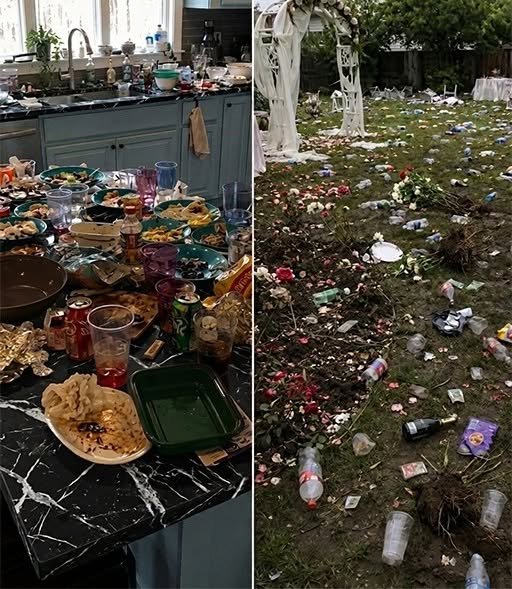
Plastic cups, bottles, and napkins covered the lawn. Confetti floated near the dock. Deep tracks crossed the grass where tables and a dance floor had been dragged toward the lake.
Then I saw the wedding arch.
It was covered in Grandma’s flowers.
The anniversary roses had been cut down to ragged stems. The lavender had been ripped out in clumps. The daisies from my 1st recital hung upside down from ribbons, already turning brown.
Several peonies had been uprooted entirely. Their exposed roots were wrapped in wire around the base of the arch.
Inside, wine stained Grandma’s cushions. Hot serving trays had scorched her antique linens, and someone had moved her rocking chair onto the wet porch, splitting one of its legs.
Colin stood beside me, pale with anger.
“I called Tessa yesterday,” he said. “She promised me again that they wouldn’t touch the garden.”
I photographed everything before calling her.
She answered on the 4th ring.
“Can this wait? We’re leaving for our honeymoon.”
“What did you do to the garden?”
She groaned. “Not this already.”
“You destroyed Grandma’s plants.”
“The florist’s delivery arrived wilted, and the arch looked terrible. We needed fresh flowers.”
“So you gave them permission to take mine?”
“It was my wedding, Mara. What was I supposed to do—stand in front of an empty wooden frame?”
“You were supposed to respect the agreement.”
“Flowers grow back. Hire someone to clean the place.”
Then she hung up.
Normally, Colin would have asked me to calm down and promised to speak to her later.
This time, he looked at the ruined garden and said, “Tell me what you need.”
We documented every damaged room, flower bed, and piece of furniture. The wedding coordinator later admitted that Tessa had told the florist she owned the property and had permission to use anything growing there.
Grant called that evening. He had been getting ready at a hotel and claimed he knew nothing about the decision. He apologized, offered to help clean, and agreed that he and Tessa would cover the damage.
Tessa still insisted everyone was overreacting.
The following Monday, I hired a horticulturist specializing in historic gardens. Using Grandma’s map, she identified 286 damaged or destroyed plantings. Some could be saved, but others needed professional treatment or replacement. Restoring the soil, lawn, furniture, and garden would take months and cost thousands.
That evening, Colin and I unrolled Grandma’s map across the dining table.
Beside every numbered section, she had written a memory.
Peonies. Mara’s 1st summer.
Lavender. Healthy again.
White daisies. Mara’s 1st recital. She smiled all the way home.
Red roses. 40th anniversary. He still remembered.
Grandma had never forgotten anything that mattered.
We placed a laminated copy of the map inside her old cedar seed box, along with 286 numbered wooden markers, the restoration report, the invoices, photographs of the damage, and copies of Tessa’s written agreement.
On top, I attached a small brass plaque:
RESTORATION KIT
The box arrived shortly after Tessa returned from her honeymoon.
She called within an hour.
“What is this?”
“My wedding gift.”
“You sent me 286 plant markers?”
“One for every planting you said would simply grow back.”
“This is ridiculous.”
“No, Tessa. Ridiculous was destroying a garden you had promised not to touch.”
She unfolded the map.
“You expect me to replace all of these?”
“I expect you and Grant to pay the documented costs. If you refuse, I’ll pursue the claim using the photographs, written agreement, and coordinator’s statement.”
“You would do that to family?”
“You did this to family.”
She fell silent.
Grant convinced her to pay, but money alone wasn’t enough for me.
“I also want you here during the restoration,” I said. “You don’t need to do the professional work, but you need to help.”
“I’m not spending my Saturdays gardening.”
“You don’t have to. But then you’ll never understand what you destroyed.”
She hung up again.
The following Saturday, a car pulled into the driveway at 8:15 a.m.
Tessa stepped out wearing spotless white sneakers and new gardening gloves with the tags still attached. Grant climbed out behind her in old jeans.
“This is humiliating,” she muttered.
I handed her the 1st marker.
“Lavender.”
She studied the map. “Where does it go?”
“The measurements are beside the number.”
“You’re joking.”
“Grandma measured everything.”
Mrs. Halpern, Grandma’s elderly neighbor, appeared with a pitcher of lemonade.
“You must be the bride,” she said.
“I’m the person Mara sentenced to gardening.”
Mrs. Halpern looked toward the ruined beds.
“June always said gardens only love people who keep showing up.”
Tessa rolled her eyes but returned to work.
Over the next several months, Grant helped repair the lawn and furniture while Tessa worked beside the horticulturist and me. At first, she complained constantly. Then she began reading Grandma’s notes.
“Why are these roses planted around the bench?” she asked one Saturday.
“That’s where Grandma and Grandpa spent every anniversary.”
Tessa looked again at the map.
“Oh.”
Neighbors occasionally stopped by and shared their memories. One remembered the roses surviving a terrible storm. Another had helped Grandma build the herb beds after Grandpa developed arthritis.
Little by little, Tessa stopped seeing plants and began seeing people.
After the 4th Saturday, she nearly quit. She skipped the following weekend without calling. I didn’t chase her.
The next Saturday, she arrived before me.
“I almost decided that paying was enough,” she admitted. “Then I looked at the wedding photographs. I finally realized the arch only looked beautiful because I had stolen that beauty from somewhere else.”
That was the 1st apology I believed.
Later, while we repaired the peony bed, Colin set down his shovel.
“I owe Mara an apology too,” he said. “For years, I asked her to be reasonable because I knew you wouldn’t be. That wasn’t keeping the peace. It was making the kinder person pay for it.”
Tessa lowered her eyes.
“I’m sorry,” she told me. “I didn’t have to understand why the garden mattered. I only had to respect that it belonged to you.”
By then, Aunt Diane had fully recovered, the house had been professionally cleaned, and Grant and Tessa had paid every restoration invoice.
The following spring, the garden began returning.
The lavender was still small. The restored roses produced fewer blooms, and several peonies sent up only red shoots. It wasn’t exactly Grandma’s garden, and it never would be.
But its shape had returned.
One Saturday morning, I found Tessa kneeling beside the peonies, pulling weeds before I had unlocked the shed.
A little girl from the neighboring cottage reached toward a new shoot.
Tessa gently stopped her.
“Careful.”
“Why?” the child asked.
“Because somebody loved that flower long before we did.”
Later that afternoon, Tessa and I stood beside the empty corner Grandma had preserved on her map.
Together, we planted yellow coneflowers.
Beneath Grandma’s final note, I added one of my own:
Spring 2027. The year we learned that restoration means returning after the damage is done.
As butterflies drifted through the young lavender, I finally understood why Grandma had asked me to keep the house lived in instead of keeping it unchanged.
Photographs captured a moment.
The garden proved someone kept coming back.