
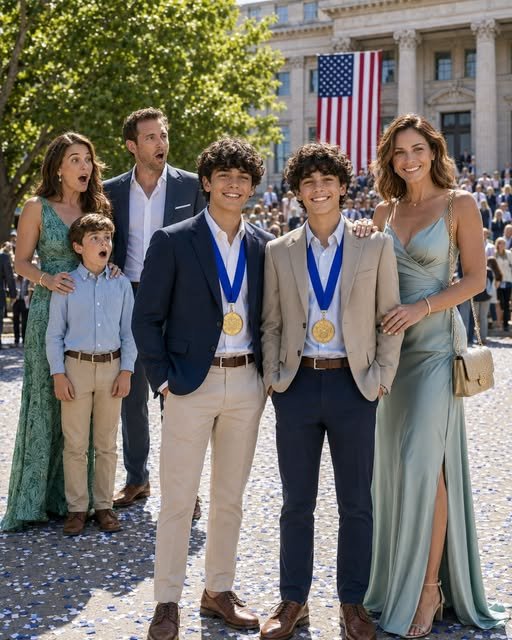
“How Dare You Come Here?”
Thirteen years after our divorce, my ex-husband saw me standing outside one of the biggest youth academic competitions in the state.
His face changed instantly.
He pushed through a crowd of parents, stopped a few feet in front of me, and stared as if I had walked into his private home uninvited.
“Claire?”
I hadn’t heard Daniel say my name in person in more than a decade.
Behind him stood the woman he had left me for.
Vanessa.
She looked almost exactly the way I remembered her—perfect hair, expensive dress, polished smile—except now there were faint lines around her eyes.
Beside them was a boy around thirteen wearing the navy blazer of one of the most prestigious private schools in the state.
Their son, Mason.
I recognized him immediately from the occasional photographs that found their way onto social media.
Daniel’s shock quickly turned to anger.
“What are you doing here?”
Before I could answer, Vanessa stepped closer.
“This is a private academic event,” she said coldly.
“It’s actually a statewide competition,” I replied.
Daniel’s jaw tightened.
Then he lowered his voice.
“How dare you come here today?”
Several parents nearby turned to look.
I could feel my twins, Eli and Owen, standing several steps behind me.
Daniel hadn’t noticed them.
Or perhaps he had noticed them but didn’t know who they were.
That realization hurt more than I expected.
He was looking directly past his own sons.
I remained calm.
“I’m here for my children.”
Daniel actually laughed.
“Your children?”
His eyes flicked toward Eli and Owen for barely a second.
“You brought them here?”
“Yes.”
Vanessa folded her arms.
“Daniel told me you had twins. I just didn’t realize…” She stopped.
She didn’t realize they were competitors.
Daniel looked at their simple navy jackets and the badges hanging around their necks.
Then he looked back at me.
“This weekend is important to Mason.”
“So is it to Eli and Owen.”
Daniel’s expression hardened.
“Claire, whatever resentment you still have about the past, don’t make today about that.”
For a moment, I couldn’t believe what I was hearing.
Thirteen years of silence.
Thirteen years of missed birthdays.
Thirteen years of school concerts, scraped knees, science projects, stomach bugs, parent-teacher conferences, midnight fevers, orthodontist appointments, spelling tests, soccer practices, disappointments, victories, and two boys growing into young men.
And Daniel thought I had driven three hours to an academic competition because I was still chasing him.
I almost laughed.
Instead, I said quietly,
“Daniel, I didn’t know you were going to be here.”
His smile disappeared.
“I’m not here for you.”
Then I turned around.
“Come on, boys. Registration closes in ten minutes.”
As we walked away, Owen leaned toward me.
“Mom?”
“Yes?”
“That was him, wasn’t it?”
I knew exactly what he meant.
I nodded.
“Yes.”
Eli glanced over his shoulder.
“Our father?”
“Yes.”
Neither boy said another word.
But as we entered the enormous university auditorium, I realized something.
Daniel had no idea what was about to happen.
And neither did Vanessa.
The Day My Marriage Ended
People sometimes imagine marriages end with screaming.
Mine ended with silence.
Daniel and I had been married for six years.
When we met, he was ambitious, funny, and endlessly curious. He could walk into a bookstore and disappear for three hours. He loved puzzles, biographies, science documentaries, and anything that made him think.
That was one of the reasons I fell in love with him.
In the beginning, we didn’t have much.
Our first apartment had a kitchen so small we couldn’t open the refrigerator and dishwasher at the same time.
We ate frozen pizza on the floor because we couldn’t afford a dining table.
And we were happy.
Then Daniel’s career took off.
Promotions came quickly.
So did money.
Business dinners became weekend conferences. Weekend conferences became overseas trips.
I was proud of him.
Maybe too proud.
Because I ignored things I shouldn’t have ignored.
The new password on his phone.
The late-night messages.
The sudden interest in expensive clothes.
The way he started criticizing things about me that had never bothered him before.
Then there was Vanessa.
She worked with Daniel.
Young, polished, confident.
Whenever I met her at company events, she was overly friendly.
That should have warned me.
Instead, I told myself I was being insecure.
Around that same time, after nearly two years of trying, I learned I was pregnant.
I was terrified to celebrate too early.
My doctor wanted me to return for another appointment before I announced anything.
So I waited.
Three weeks later, I found out there were two heartbeats.
Twins.
I drove home with the ultrasound picture on the passenger seat.
I remember smiling at every red light.
I had planned everything.
I would cook Daniel’s favorite dinner.
I would place the ultrasound photograph inside a small box.
I imagined his face when he opened it.
But when I arrived home, Daniel was already sitting at the kitchen table.
No jacket.
No laptop.
No phone in his hand.
Just an envelope.
“I need to talk to you,” he said.
You know that strange feeling when your body understands something before your mind does?
I felt it immediately.
I sat down.
Daniel wouldn’t look at me.
“There’s someone else.”
I stared at him.
He continued.
“It wasn’t supposed to happen.”
“Vanessa?”
His silence was my answer.
I felt as though the room had tilted.
“How long?”
“Several months.”
Several months.
While I had been taking vitamins.
While I had been tracking appointments.
While I had been praying for a baby.
My husband had been building another life.
Then Daniel said the sentence that destroyed whatever part of me was still hoping the marriage could be repaired.
“Vanessa is pregnant.”
I don’t remember breathing.
He finally looked at me.
“I’m sorry.”
I reached into my purse.
My hand was shaking.
I placed the ultrasound photograph on the table.
Daniel stared at it.
“What’s that?”
“I went to the doctor today.”
His face turned pale.
“I’m pregnant too.”
He looked at me for several seconds.
Then at the ultrasound.
Then back at me.
“Twins.”
For one brief moment, I saw something in his eyes.
Shock.
Fear.
Maybe even happiness.
But it disappeared.
He leaned back in his chair and covered his face.
“This can’t be happening.”
Those were the first words my children’s father said after learning they existed.
Not we’re having twins.
Not are they healthy?
Not even I’m scared.
Just:
“This can’t be happening.”
That night, I understood my marriage was over.
“I Can’t Live Two Lives”
For the next few months, Daniel tried to explain himself.
He said he was “confused.”
He said he had “made mistakes.”
He said he still cared about me.
But every time I asked one question, his answer told me everything.
“Are you leaving Vanessa?”
Silence.
Eventually he admitted the truth.
“No.”
Vanessa’s pregnancy was several months ahead of mine.
Daniel had already moved into an apartment with her.
He told me he wanted to be “responsible.”
I remember asking, “Responsible to whom?”
He didn’t answer.
During one conversation, he said something I never forgot.
“I can’t live two lives, Claire.”
I looked at him.
“You already created two.”
He promised financial support.
He promised he would visit the twins.
He promised he would “figure everything out.”
But promises are easy when children are still abstract ideas inside an ultrasound image.
Reality was different.
Mason was born first.
Daniel was there for his birth.
When Eli and Owen arrived four months later, Daniel showed up at the hospital the following afternoon.
He stayed forty-seven minutes.
I know because I watched the clock.
He held Eli for about five minutes.
Owen for even less.
Then his phone rang.
Vanessa needed him.
Mason had a fever.
Daniel handed Owen back to me.
“I should go.”
I looked down at my newborn son.
“You just got here.”
“I know. I’m sorry.”
That phrase became Daniel’s specialty.
I’m sorry.
When the twins were three months old, he visited twice.
At six months, once.
Their first birthday?
He sent gifts.
Their second?
A card.
Their third?
A bank transfer and a text.
Eventually, everything came through lawyers and automatic payments.
Daniel never fought for custody because he never asked for it.
I never prevented him from seeing the boys.
There was simply nothing to prevent.
He stopped coming.
By the time Eli and Owen were five, Daniel was a photograph in a drawer.
And I stopped waiting for him to become someone he clearly didn’t want to be.

Raising Two Boys Without Raising Them to Be Bitter
Being a single mother to twins was not heroic.
Most days it was just exhausting.
I worked.
I packed lunches.
I searched couch cushions for missing library books.
I cleaned cereal from places cereal should never be.
I learned that two children can somehow require six shoes but only ever know where three of them are.
Money was sometimes tight, but we were okay.
What mattered most was that our home felt safe.
Eli and Owen were different from the beginning.
Eli loved numbers.
At six, he asked why multiplication worked.
Not how.
Why.
At eight, he started solving logic puzzles meant for teenagers.
Owen loved building things.
Radios.
Model bridges.
Little machines made from broken toys.
Once, when our toaster stopped working, I caught ten-year-old Owen sitting on the kitchen floor with a screwdriver.
“What are you doing?”
“Diagnosing it.”
“You’re ten.”
“That doesn’t mean the toaster knows.”
That was Owen.
Neither boy thought he was extraordinary.
They were simply curious.
I never pushed them to be first.
I pushed them to finish what they started.
When they brought home good grades, I praised the effort before the score.
When they lost, I let them be disappointed.
When they won, I reminded them to thank their teachers.
And when they eventually asked about their father, I told them the truth without turning it into poison.
They were nine the first time Eli asked directly.
“Why doesn’t Dad visit?”
There are questions mothers wish they could answer without hurting anyone.
That was one.
I sat between them on the couch.
“Your father made choices about how he wanted to live his life.”
“Because of us?” Owen asked.
“No.”
I was firm about that.
“Adults sometimes make selfish decisions. Those decisions belong to the adults.”
Eli stared at his hands.
“Does he have another kid?”
“Yes.”
“Mason?”
I looked at him in surprise.
They had searched online.
Kids always find what you think you’ve hidden.
“Yes.”
“Does he live with him?”
“Yes.”
Owen was quiet.
Then he asked, “Does Mason know about us?”
“I don’t know.”
That was the truth.
For several days afterward, I worried the conversation had changed them.
But children are often wiser than adults give them credit for.
They went back to homework.
Baseball.
Video games.
Arguing over who had eaten the last chocolate-chip cookie.
Daniel became part of their history.
Not the center of their lives.
And I worked hard to keep it that way.
The Competition That Changed Everything
When the boys entered seventh grade, their science teacher encouraged them to join the school’s academic team.
Our middle school wasn’t famous.
It wasn’t wealthy.
The team practiced in a classroom with mismatched chairs and a buzzer system held together with duct tape.
But the teacher, Mr. Reynolds, believed in them.
They competed in math, science, literature, history, and logic.
Eli became the team’s strongest mathematics competitor.
Owen dominated science and engineering.
They started winning.
First district.
Then regional.
Then state qualifiers.
One evening, they came racing through the front door.
“Mom!”
Owen was waving an envelope.
“We made Nationals!”
Technically, it was called the National Junior Scholars Invitational, a three-day competition hosted by a university in Washington, D.C.
Hundreds of students from across the country would attend.
There were team events, individual challenges, timed exams, engineering demonstrations, and a championship quiz round.
I hugged them so hard they complained.
Then I spent the next two months figuring out how to pay for the trip.
Our community helped.
Teachers organized a fundraiser.
A local engineering company sponsored part of the team.
Parents baked cookies, washed cars, and sold raffle tickets.
By spring, we had enough.
The boys never mentioned Mason.
Neither did I.
I knew he attended an elite private academy, but I had no idea whether he participated in academic competitions.
So when we walked onto the university campus that Saturday morning and I saw Daniel standing near the entrance, I genuinely thought my eyes were playing tricks on me.
Then I saw Vanessa.
Then Mason.
Then the giant banner.
NATIONAL JUNIOR SCHOLARS INVITATIONAL
And underneath it, listed among the corporate sponsors:
THE MERCER FOUNDATION FOR ACADEMIC EXCELLENCE.
Of course.
Daniel had built a successful consulting company over the years.
Apparently, he had also built an image around supporting education.
The irony would have been funny if it hadn’t been so sad.
And that was when Daniel saw me.
That was when he stormed across the courtyard.
That was when he said:
“How dare you come here?”
He Thought His Son Had Already Won
After registration, I assumed Daniel would leave us alone.
I was wrong.
During the first break, Vanessa approached me near the refreshment tables.
She kept her voice low.
“Claire, I hope you understand why Daniel reacted that way.”
“I don’t.”
“This weekend means a great deal to Mason.”
“I’m sure it does.”
“He’s been preparing for almost a year.”
“So have my sons.”
Her eyes moved toward Eli and Owen.
For the first time, she studied them closely.
I watched the moment recognition began to creep across her face.
The shape of Eli’s jaw.
Owen’s eyes.
Daniel’s smile when he was young.
Genetics can be inconvenient when people are trying to ignore the past.
Vanessa looked away.
“Mason’s school is expected to win.”
“Good luck to him.”
She seemed irritated that I wouldn’t argue.
“I just don’t want unnecessary drama.”
“Then we agree.”
I picked up my coffee.
“I came to watch my children compete, Vanessa. Whatever story you and Daniel have told yourselves for thirteen years is your business.”
Then I walked away.
The preliminary rounds began.
Mason was good.
I’ll say that clearly.
He was intelligent, quick, and well prepared.
None of what had happened between the adults was his responsibility.
His school dominated the literature round and performed well in history.
Daniel sat near the front, applauding loudly every time Mason answered correctly.
I sat with the Cedar Grove parents ten rows back.
Our kids had no matching blazers.
No professional coaches.
No foundation bearing their father’s name.
But they were fearless.
Eli won the individual mathematics semifinal by one point.
Owen built a functioning water-filtration model in under twenty minutes and scored highest in the engineering challenge.
Their team advanced.
By Saturday evening, Cedar Grove was ranked second overall.
Mason’s academy was first.
The championship would be Sunday afternoon.
At dinner that night, Eli barely spoke.
Finally, I asked, “Nervous?”
“A little.”
Owen stabbed a french fry.
“I hate that he’s here.”
I knew who he meant.
“Your father?”
Owen nodded.
“He keeps watching us now.”
Eli added, “I think he figured it out.”
“He already knows who you are.”
“No,” Eli said. “I mean I think he figured out we’re actually good.”
That broke my heart in a strange way.
Not because Eli wanted Daniel’s approval.
Because he had noticed Daniel’s surprise.
I put my hands on the table.
“Listen to me. Tomorrow has nothing to do with him.”
They both looked at me.
“You don’t have to prove that he made a mistake. You don’t have to prove that you deserved his attention. You certainly don’t have to beat Mason to make some point about our family.”
Owen frowned.
“What are we supposed to do then?”
I smiled.
“What you came here to do.”
Eli smiled back.
“Win?”
“Do your best.”
Owen grinned.
“So… win.”
I laughed.
“Eat your dinner.”
The Final Question
Sunday’s championship was held in the main auditorium.
The room was packed.
Parents filled the seats.
Teachers lined the walls.
Cameras streamed the competition online.
The top four schools sat onstage behind long tables.
Cedar Grove had entered the final round in second place.
Mason’s academy was still first.
Before the event began, Daniel walked past me.
This time he didn’t shout.
He leaned down.
“I know those boys are Eli and Owen.”
I looked up.
“Congratulations.”
His face tightened.
“You could have told me.”
I stared at him.
“Told you what?”
“That they were involved in this.”
I almost couldn’t speak.
“You haven’t asked me a question about them in eleven years.”
He straightened.
“That’s not fair.”
“No, Daniel. Fair would have been them having a father.”
He glanced around nervously.
“Not here.”
“You started this conversation.”
The lights dimmed.
I turned away.
“Go sit with your family.”
The championship began.
Cedar Grove fell behind early.
Then Owen answered three science questions in a row.
Eli solved a probability problem no other team attempted.
With five questions remaining, the scores were tied.
My hands were shaking.
Question one.
Mason buzzed first.
Correct.
His academy took the lead.
Question two.
Cedar Grove answered.
Tie again.
Question three.
Nobody knew.
Question four.
Mason buzzed.
Wrong.
The penalty dropped his team five points behind.
I saw Daniel put both hands over his mouth.
Then came the final question.
A logic problem appeared on the screen.
The moderator read it aloud.
Thirty seconds.
Twenty.
Ten.
Eli leaned toward Owen.
Owen whispered something.
Eli shook his head.
Five seconds.
Then Owen hit the buzzer.
“Cedar Grove.”
Owen answered.
The auditorium went silent.
The moderator looked down.
Then smiled.
“Correct.”
For one second, nobody moved.
Then the Cedar Grove section exploded.
Teachers jumped up.
Parents screamed.
I covered my face and cried.
My boys had done it.
Their little public school with the broken buzzer system had won the national team championship.
But that wasn’t the biggest surprise.
Not yet.
Then They Called Both Their Names
After the team awards, the organizers announced the individual medals.
Third place in mathematics.
Then silver.
Then:
“And the gold medal for individual mathematics goes to…”
I knew before the name was spoken.
“Eli Bennett, Cedar Grove Middle School!”
I screamed louder than I had in my life.
Eli walked onto the stage, embarrassed and smiling, while his teammates cheered.
A blue ribbon with a large gold medal was placed around his neck.
He looked into the audience.
Not at Daniel.
At me.
Then came science and engineering.
Bronze.
Silver.
“And this year’s gold medal goes to Owen Bennett of Cedar Grove Middle School!”
Owen’s mouth dropped open.
Eli grabbed his brother and shoved him toward the podium.
The crowd laughed.
Owen walked onto the stage.
A second gold medal.
Two brothers.
Two golds.
One mother in the audience crying so hard she could barely see.
Then I looked across the aisle.
Daniel’s face had turned a deep, stunned red.
Vanessa looked almost purple.
Neither of them was clapping.
Mason was.
That mattered to me.
Their thirteen-year-old son was standing beside his chair applauding the two boys his parents had spent all weekend treating like intruders.
Daniel stared at Eli and Owen as if he were seeing ghosts.
Perhaps in some way he was.
He was looking at thirteen years he had missed.
The missing front teeth.
The first bicycles.
The school plays.
The nights before exams.
The hundreds of ordinary moments that create a childhood.
And now those children were standing beneath bright lights while an auditorium applauded them.
The announcer asked the medalists to stay for photographs.
Eli wrapped one arm around Owen.
They held their medals.
I took out my phone.
Then something unexpected happened.
Daniel stepped into the aisle.
For a second, I thought he was coming toward me.
He wasn’t.
He was moving toward the stage.
I stood.
“Daniel.”
He stopped.
He looked at me.
“I want a picture with them.”
I stared at him.
“A picture?”
“They’re my sons.”
There it was.
Not I want to congratulate them.
Not I want to tell them I’m proud.
A picture.
Thirteen years of absence, and suddenly he wanted proof of connection.
Perhaps he wanted it for himself.
Perhaps for his foundation.
Perhaps because people were watching.
I didn’t know.
But Eli had heard him.
He walked down from the stage.
The medal still hung around his neck.
Daniel smiled nervously.
“Eli.”
My son stood in front of the man who had given him half his DNA and almost none of his time.
Daniel swallowed.
“You were incredible up there.”
“Thank you.”
“I’m proud of you.”
Eli looked at him for a long moment.
Then he said something I will remember for the rest of my life.
“Mom is the one who should be proud.”
Daniel blinked.
Eli continued quietly.
“She was there for the work before there was a medal.”
Nobody spoke.
Then Owen joined us.
Daniel looked from one twin to the other.
“I know I haven’t been around.”
Owen raised an eyebrow.
“That’s one way to say it.”
“Owen,” I murmured.
“I’m not trying to be rude, Mom.”
Daniel took a breath.
“I made mistakes.”
Eli answered.
“We know.”
“I’d like a chance to explain.”
Owen glanced at his brother.
Then at me.
Finally he said, “Maybe someday.”
And I knew I had raised them well.
Not because they had won.
Because they didn’t humiliate him.
They didn’t shout.
They didn’t insult Mason.
They didn’t use their victory as a weapon.
They simply refused to pretend thirteen years hadn’t happened.

The Boy I Didn’t Expect to Speak
Before we left, someone called my name.
“Mrs. Bennett?”
I turned.
Mason stood behind me.
Without Daniel.
Without Vanessa.
He looked nervous.
“Hi.”
“Hi, Mason.”
He glanced toward Eli and Owen.
“I wanted to congratulate them.”
“You can tell them yourself.”
He hesitated.
Then walked over.
Eli and Owen stopped talking.
For one awkward second, three boys stood facing one another, connected by a history none of them had created.
Mason spoke first.
“You guys were really good.”
Owen smiled.
“You too.”
“I blew that second-to-last question.”
“I blew four in preliminaries,” Eli said.
Mason laughed.
The tension disappeared just a little.
Then Mason looked at me.
“My parents didn’t tell me much about you.”
I nodded.
“I figured.”
He looked back at the twins.
“I knew Dad had been married before. I didn’t know…”
His voice faded.
“That he had sons?” Eli asked.
Mason nodded.
That was another consequence Daniel had probably never considered.
His silence hadn’t only deprived my sons of a father.
It had deprived three boys of knowing they were brothers.
Mason looked embarrassed.
“I’m sorry about how they acted.”
I touched his shoulder gently.
“You don’t have to carry their choices.”
His eyes dropped.
Then Owen held out his hand.
“Still want to compare answers from the engineering round?”
Mason smiled.
“Yeah.”
Five minutes later, all three boys were arguing cheerfully about a bridge-design problem.
I stood a few feet away watching them.
And something inside me softened.
Not toward Daniel.
Not yet.
Maybe never in the way he wanted.
But toward the strange possibility that children could build something healthier from the wreckage adults had left behind.
Daniel Finally Asked the Right Question
Three days after we came home, Daniel called.
I almost didn’t answer.
Then I did.
“Claire.”
“What do you want?”
For once, he didn’t sound angry.
“I’ve been thinking.”
I waited.
“I looked up their school.”
Silence.
“I found the article about their regional championship.”
Still silence.
“I found Owen’s science fair project from last year. And Eli’s math league ranking.”
I closed my eyes.
For thirteen years, all of that information had existed.
He had simply never looked.
Daniel’s voice cracked slightly.
“I missed everything.”
“Yes.”
“I thought sending money meant I was doing what I was supposed to do.”
“No. It meant you were doing the easiest part.”
He didn’t argue.
Then he said something different.
“Do they hate me?”
It would have been easy to hurt him.
I could have said yes.
Instead, I told him the truth.
“They barely know you well enough to hate you.”
That hurt him more.
I could hear it.
“What do I do?”
For the first time in thirteen years, Daniel asked the right question.
Not How do I make them forgive me?
Not How do I get a picture?
Not What will people think?
What do I do?
“You start small.”
“Okay.”
“You don’t make promises.”
“Okay.”
“You don’t show up unexpectedly.”
“Okay.”
“You don’t expect them to call you Dad.”
He was silent.
Then:
“Okay.”
“And if they decide they aren’t ready, you respect that.”
“I will.”
I didn’t know whether he would.
But I gave him the opportunity to prove it.
Not for him.
For Eli and Owen.
There Was No Perfect Ending
Daniel did not transform overnight.
Life rarely works that way.
The boys didn’t suddenly spend weekends at his house.
We didn’t become one giant happy blended family.
Vanessa and I did not become friends.
There were difficult conversations.
Awkward dinners.
Canceled plans.
Old resentment.
There were moments when Owen wanted nothing to do with Daniel.
Other moments when Eli asked questions about his childhood.
Daniel had to learn that money couldn’t accelerate trust.
Trust grows at its own speed.
Mason occasionally texted the twins.
The three of them began sharing puzzle links and complaining about homework.
That relationship developed more naturally than any of the adults’ relationships ever had.
Several months after the competition, Daniel attended one of Owen’s science fairs.
He came alone.
No photographer.
No foundation representative.
No expensive gift.
He stood in the back of the school gym holding a paper cup of bad coffee.
When Owen finished presenting, Daniel walked over.
“That was impressive.”
Owen nodded.
“Thanks.”
And then something small happened.
Owen began explaining his project.
Daniel listened.
That was all.
Ten minutes.
No dramatic hug.
No forgiveness speech.
Just a father finally listening to a son.
Sometimes healing begins so quietly that no one notices it.
What I Actually Won That Day
People who heard about the competition later assumed my favorite moment was watching Daniel and Vanessa realize my twins had won.
I’ll admit it.
There was satisfaction in it.
For years, Daniel had lived as though the family he left behind had simply disappeared.
Then one afternoon, the two sons he had ignored walked onto a national stage and received gold medals.
You couldn’t write a more poetic moment.
But that wasn’t what stayed with me.
What stayed with me happened afterward.
Back at our hotel, the boys dropped their medals on the desk.
Then they ordered pizza.
Owen complained that his dress shoes hurt.
Eli lost his room key.
Within thirty minutes, they were lying across their beds watching ridiculous videos and arguing over who had answered more questions correctly.
Just my boys.
Not prodigies.
Not trophies.
Not proof that Daniel had been wrong.
My sons.
At one point, Eli looked at me.
“Mom?”
“What?”
“Were you happy today?”
I laughed.
“Are you kidding?”
“No, I mean before we won.”
I thought about it.
Then I understood what he was asking.
Was I happy before the validation?
Before the applause?
Before Daniel saw what he had missed?
I sat beside him.
“Yes.”
He studied my face.
“Really?”
“Really.”
I looked at both of them.
“I was happy when you were babies and neither of you slept more than two hours at a time.”
Owen laughed.
“I was happy when you started kindergarten. I was happy when Eli accidentally glued his hand to his science project.”
“That happened once.”
“I was happy when Owen got cut from the soccer team and went back the next year anyway.”
Owen smiled.
“I was happy before today.”
Then I touched the gold medal lying on the table.
“This is wonderful.”
I pointed toward them.
“But this was never the prize.”
Eli looked embarrassed.
“Mom.”
“What?”
“You’re doing the emotional speech thing.”
“I earned the emotional speech.”
Owen threw a pillow at me.
And we laughed.
Thirteen years earlier, Daniel had sat across from me at a kitchen table, looked at an ultrasound showing two tiny heartbeats, and said:
“This can’t be happening.”
Thirteen years later, those two heartbeats stood beneath bright lights with gold medals around their necks.
Daniel finally saw them.
But the truth was, they had never needed a stage to become worthy of being seen.
They had always been worthy.
They were worthy when they cried at 2 a.m.
They were worthy when they failed tests.
They were worthy when they won nothing.
They were worthy when the only person applauding was me.
That weekend didn’t prove my ex-husband had lost and I had won.
It proved something better.
A person can walk away from you.
They can underestimate you.
They can build another life and act as though yours stopped when they left.
But your life doesn’t stop.
You keep going.
You raise the children.
You rebuild the home.
You survive the ordinary days no one applauds.
And one day, you may look around and realize that while someone else was busy protecting their image…
you were building something real.
When the photographer sent us the official picture from the awards ceremony, I framed it.
Eli on one side.
Owen on the other.
Two blue ribbons.
Two gold medals.
Me between them.
All three of us smiling.
Daniel wasn’t in the photograph.
Vanessa wasn’t either.
And looking at it now, I don’t see revenge.
I see thirteen years of early mornings, late nights, sacrifices, laughter, fear, persistence, and love.
I see everything Daniel missed.
And everything we built anyway.