
THE WARNING
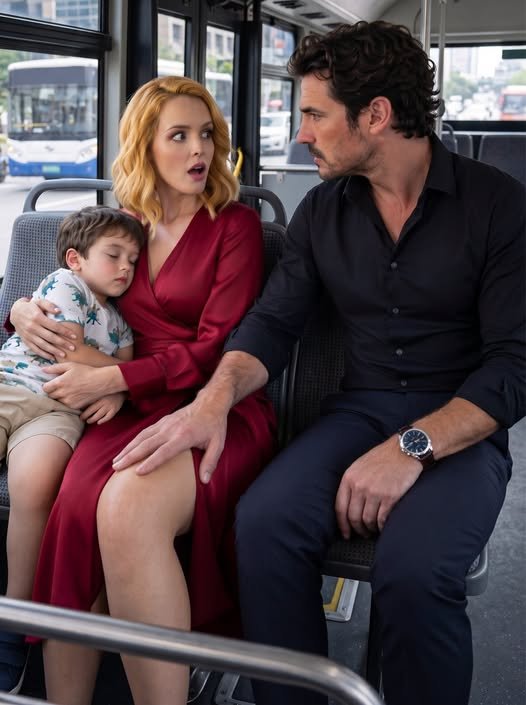
For almost three hours, the stranger sitting across the aisle kept brushing his hand against my leg.
At first, I told myself it was accidental.
The bus was crowded. The road through the mountains twisted sharply, forcing passengers to lean and shift whenever the driver took a curve.
But after the fourth time, I knew better.
His fingers touched the side of my knee, then disappeared.
I pulled my nine-year-old son, Noah, closer to me and stared at the man.
He looked to be in his late fifties, with neatly combed gray hair, a weathered face, and a brown coat that seemed too formal for a long-distance bus.
He didn’t look at me.
That somehow made it worse.
Noah had fallen asleep against my shoulder nearly an hour earlier. He had been quiet since we left Denver that morning, clutching the small wooden airplane his father had carved for him before he died.
Just seeing it still hurt.
My husband, Ethan, had been gone for almost two years.
Some mornings, I could finally say his name without feeling like something inside my chest had cracked open.
Other mornings, I couldn’t.
And now we were traveling to Pine Ridge because Ethan’s father, Charles Whitmore, was supposedly dying.
My mother-in-law, Diane, had called the night before.
Her voice had been shaking.
“Claire, please come. The doctors don’t think Charles has much time. He keeps asking for Noah.”
Whatever complicated feelings I had about the Whitmore family, I couldn’t deny a grandfather the chance to see his grandson.
So I’d packed two bags, called Noah’s school, and bought tickets on the earliest bus.
Now, three hours from home, I was sitting beside my sleeping son while a stranger repeatedly touched my leg.
The man’s hand moved again.
That was it.
I turned sharply.
“Excuse me—”
But before I could finish, the bus slowed into a roadside station.
The man stood.
He lifted a small suitcase from the overhead rack and stepped into the aisle.
As he passed me, something soft landed in my palm.
A folded gray handkerchief.
He leaned slightly closer without looking directly at me.
“Pretend you feel dizzy,” he whispered.
I froze.
Then he added four words that made my blood run cold.
“And don’t sign anything.”
He walked away.
I watched him step off the bus.
Noah stirred beside me.
“Mom?”
“It’s okay, sweetheart.”
I waited until the man disappeared behind the station building.
Then I unfolded the handkerchief.
Inside was a tiny piece of paper.
Five words were written in black ink.
Don’t trust anyone at Whitmore House.
For several seconds, all I could hear was the hum of the bus engine.
Whitmore House.
Not Pine Ridge.
Not “your in-laws.”
Not “the family.”
The stranger knew exactly where we were going.
And suddenly, our visit to a dying grandfather didn’t feel like a family emergency anymore.
It felt like a trap.
THE WHITMORE FAMILY
The Whitmores were the kind of family people in Pine Ridge knew by name.
Charles Whitmore had spent forty years building Whitmore Manufacturing from a struggling machine shop into a regional company with factories in three states.
He wasn’t a billionaire.
But he was wealthy enough that money changed the way people behaved around him.
Ethan had hated that.
When we first met, he barely mentioned his family.
He lived in a small apartment, drove an old Ford pickup, and worked as an engineer at a company that had nothing to do with Whitmore Manufacturing.
I didn’t learn who his father was until we’d been dating for four months.
“You’re a Whitmore?” I’d asked.
Ethan had laughed.
“Unfortunately.”
He loved his father.
But the rest of the family?
That was complicated.
His younger half-brother, Ryan, had joined the family company straight out of college. Ryan wore expensive watches, drove cars that cost more than our house, and had a talent for making insults sound like compliments.
Ethan avoided him whenever possible.
Then there were aunts, uncles, cousins, and family advisers who seemed permanently attached to Charles’s money.
After Ethan died, they became strangely attentive to me.
Ryan called twice during the first month.
Not to ask how I was doing.
To ask about Ethan’s paperwork.
Did he have investment accounts?
Did he still own company shares?
Had he left instructions?
I told him our lawyer was handling everything.
The calls stopped.
Until now.
When the bus finally reached Pine Ridge, Ryan was waiting beside a black SUV.
He walked toward us wearing a navy blazer and a concerned smile.
“Claire.”
He hugged me before I had a chance to decide whether I wanted him to.
Then he knelt in front of Noah.
“Hey, buddy. You’ve gotten tall.”
Noah smiled politely.
“Hi, Uncle Ryan.”
Ryan looked at the wooden airplane in Noah’s hand.
For one second, something flashed across his face.
Recognition.
Then it disappeared.
“Your dad made that?”
Noah nodded.
Ryan stood.
“We should go. Dad’s waiting.”
Waiting?
I thought Charles was barely conscious.
During the twenty-minute drive, I studied Ryan through the rearview mirror.
“How bad is Charles?”
Ryan’s hands tightened around the steering wheel.
“Bad.”
“Your mother said the doctors didn’t think he had much time.”
“They don’t.”
“Is he at home under hospice care?”
A pause.
“Something like that.”
Something like that?
My fingers closed around the gray handkerchief hidden inside my coat pocket.
When Whitmore House came into view, my uneasiness deepened.
The massive stone home sat behind iron gates at the edge of several wooded acres.
There were at least nine cars outside.
“Why are so many people here?” I asked.
Ryan smiled.
“Family.”
The moment we entered the house, conversation stopped.
More than a dozen people were gathered in the living room.
Ethan’s aunts.
Two uncles.
Several cousins.
Charles’s longtime accountant.
A man I recognized as the company’s chief financial officer.
And sitting beside the fireplace—
Charles.
Not in bed.
Not unconscious.
Not surrounded by medical equipment.
Sitting upright in an armchair.
He looked pale and thinner than I’d ever seen him, but he was completely awake.
His eyes found Noah.
For the first time since we arrived, his expression softened.
“My boy.”
Noah ran to him.
Charles hugged him tightly.
For a few seconds, the tension in the room disappeared.
Then Ethan’s Uncle Martin spoke.
“Well, there he is.”
He smiled at Noah.
“The Whitmore heir.”
Nobody laughed.
I looked around.
Every adult in that room was watching my son.
Charles’s face hardened.
“Martin.”
“What?” Martin lifted his hands. “I’m only saying what everyone is thinking.”
Noah looked confused.
I walked over and placed my hand on his shoulder.
“We’ve had a long trip. Maybe Noah should rest.”
“Of course,” Diane said quickly.
She hugged me, but even she seemed different.
Nervous.
Distracted.
Her eyes kept moving toward Ryan.
As we followed her upstairs, I looked back.
Charles was still watching me.
And for just a second, he shook his head.
Barely noticeable.
But unmistakable.
No.

“PROTECTING THE FAMILY”
Dinner was worse.
Charles didn’t join us.
Diane said he needed to rest.
Noah sat beside me while fourteen adults gathered around the long dining table.
At first, everyone pretended things were normal.
They asked Noah about school.
They asked whether he played sports.
Someone asked whether he wanted to work for Whitmore Manufacturing when he grew up.
Then the conversation shifted.
Ryan was the one who started it.
“Claire, how are things financially?”
I almost laughed.
“Fine.”
“I only ask because raising a child alone isn’t easy.”
“We’re doing well.”
Uncle Martin leaned forward.
“Ethan left some complicated assets.”
“My attorney handled Ethan’s estate.”
Ryan nodded slowly.
“Yes. We know.”
That bothered me.
“How?”
The room became quiet.
Ryan reached for his wine.
“It’s a family company, Claire. Certain ownership changes have to be reported.”
I remembered Ethan telling me years earlier that Charles had given him company shares when he turned thirty.
Not enough to control anything.
Maybe seven or eight percent.
Ethan rarely discussed them.
After he died, our attorney told me those shares would eventually pass to Noah through Ethan’s estate, with me acting as guardian until Noah became an adult.
I’d barely thought about them since.
Ryan continued.
“Dad’s health has made certain decisions urgent.”
“What decisions?”
“Management decisions.”
“Then management should make them.”
Martin sighed.
“This is exactly why we’ve been saying someone with experience needs to help you.”
I stared at him.
“Help me with what?”
“Protect Noah’s interests.”
“I’m his mother. That’s my job.”
“Of course,” Diane interrupted.
But Ryan continued.
“Nobody is questioning you as a mother.”
He smiled.
“We’re talking about corporate matters. Voting rights. Shareholder agreements. Transfers. Things you shouldn’t have to worry about.”
Shouldn’t have to worry about.
Not couldn’t understand.
Shouldn’t have to.
The stranger’s warning echoed in my mind.
Don’t sign anything.
I pushed my chair back.
“Noah’s exhausted. We’re going upstairs.”
Ryan’s expression changed.
Only slightly.
But the smile disappeared.
“We’re meeting with the attorneys at nine tomorrow morning.”
“For what?”
“Dad’s estate planning.”
“Why do I need to attend?”
Ryan picked up his glass.
“Because Ethan isn’t here.”
The silence that followed felt almost cruel.
I stood.
“Good night.”
WHAT I HEARD BEHIND THE DOOR
Noah fell asleep quickly.
I didn’t.
At 11:40 p.m., I was still lying awake when I heard footsteps in the hallway.
Then voices.
I slipped out of bed.
The sounds came from downstairs.
I followed them until I reached the small prayer room beside Charles’s study.
The door was slightly open.
Ryan was speaking.
“She has to sign tomorrow.”
I stopped.
A man’s voice answered.
Martin.
“If she refuses?”
“She won’t.”
“What makes you so sure?”
Ryan gave a humorless laugh.
“She’s a school administrator, Martin. She isn’t a corporate attorney. We tell her the restructuring protects Noah and she’ll sign.”
My heart pounded.
Then another voice spoke.
Charles.
Weak.
But furious.
“Leave the boy out of this.”
Silence.
I moved closer.
Ryan lowered his voice.
“Dad, there isn’t another option.”
“There is always another option.”
“Without Claire’s signature, Ethan’s shares remain tied to Noah. And if your new will surfaces—”
“Enough.”
Diane began crying.
“We’ve already hidden this for more than twenty years.”
My entire body went cold.
Hidden what?
Charles spoke.
“That was my mistake.”
Ryan answered immediately.
“No. It was the decision that kept this family together.”
“It kept your lifestyle together.”
“Dad—”
“You think I don’t understand what’s happening?”
Charles coughed.
Then he said something I would remember for the rest of my life.
“I should have told Ethan the truth while he was alive.”
I covered my mouth.
Ethan?
Diane whispered, “Charles, please.”
“He deserved to know.”
“Know what?” Ryan snapped. “That half this company should have belonged to his mother?”
I nearly lost my balance.
His mother?
Ethan’s mother had died when he was four.
Charles had married Diane two years later.
I’d seen only a handful of photographs of Ethan’s biological mother, Rebecca.
Ethan barely remembered her.
Inside the room, Charles said quietly,
“Rebecca saved this company.”
Martin muttered something I couldn’t hear.
Charles raised his voice.
“The money was hers. The patents were developed with her father’s equipment. And the original shares were hers.”
Ryan said, “That was decades ago.”
“Ownership doesn’t disappear because time passes.”
Then I heard paper moving.
Ryan spoke again.
“Tomorrow Claire signs the family settlement agreement. Ethan’s shares become non-voting shares. Noah receives a protected trust. Everyone wins.”
“No,” Charles said.
“You win.”
I backed away.
My knees felt weak.
I rushed upstairs, closed my bedroom door, and locked it.
For several minutes, I simply stood there.
Then I remembered something Charles had done earlier.
When he hugged Noah, he’d slipped the wooden airplane from Noah’s hand.
He’d examined it carefully.
Then returned it.
At the time, I assumed he was being sentimental.
Now I wasn’t so sure.
I picked it up from the nightstand.
Ethan had carved the airplane years ago.
There was a tiny screw beneath one wing.
I’d never noticed it before.
I searched my purse for a coin and loosened it.
The bottom panel opened.
Inside was a tiny brass key.
My breath caught.
I stared at it.
Then I remembered Charles’s study.
More specifically, the antique writing desk Ethan had once told me belonged to his mother.
I looked at Noah.
Still asleep.
Then I slipped into the hallway.

THE HIDDEN WILL
Charles’s study was unlocked.
The room smelled of cedar and old books.
I didn’t turn on the main light.
Using my phone, I crossed to the antique desk.
There were six drawers.
The brass key fit the smallest one.
Inside was a blue envelope.
Written across the front were three words.
For Claire Bennett.
My maiden name.
The name I had returned to using after Ethan died.
My hands shook as I opened it.
Inside were several documents and a handwritten letter.
The first page was titled:
LAST WILL AND TESTAMENT OF CHARLES EDWARD WHITMORE
It had been signed three months earlier.
I skimmed quickly.
Most of Charles’s personal property would go to Diane.
Several charitable gifts were listed.
Then I reached the company provisions.
I stopped breathing.
Charles owned forty-two percent of Whitmore Manufacturing.
According to the will, the majority of those shares were to be placed into a trust.
The beneficiary was Noah.
Not Ryan.
Not Diane.
Noah.
I read the section three times.
Then I found another document.
A legal memorandum.
It explained everything.
When Charles founded the company, Ethan’s biological mother, Rebecca Lawson Whitmore, had provided nearly all of the original investment using money inherited from her father.
More importantly, several early manufacturing patents had been created using designs developed by Rebecca and her father.
Legally, Rebecca had owned forty-eight percent of the original corporation.
When she died unexpectedly, her shares were supposed to pass to four-year-old Ethan.
But because Ethan was a minor, Charles controlled them as trustee.
Years later, during a company restructuring, those shares had been converted and redistributed.
Some went to Charles.
Some went to other relatives.
And eventually, some were issued to Ryan.
Ethan had never been told.
Charles’s letter explained why.
Claire,
If you are reading this, then I was not strong enough to fix my mistakes before the family tried to stop me.
Ethan believed I built this company alone.
I let him believe it.
The truth is that Rebecca built it with me.
After she died, I convinced myself that keeping control of her shares was necessary to protect the company until Ethan was old enough.
Then one year became five.
Five became ten.
Eventually, telling Ethan meant admitting what I had done.
So I remained silent.
Ryan later became involved in the company and benefited from decisions that should never have been made.
Ethan walked away from this family because he believed I loved the company more than I loved him.
He was right.
I cannot change what I did to my son.
But I can return what belongs to his child.
Tears blurred the words.
I kept reading.
Ryan knows about this will.
He also knows that Ethan’s existing shares, now belonging to Noah, give Noah’s trust enough combined voting power to prevent Ryan from controlling the company after my death.
They will ask you to sign what they call a family settlement agreement.
Do not sign it.
It permanently converts Noah’s shares to non-voting interests and waives any future claim connected to Rebecca’s estate.
I have asked Daniel Reeves to find you.
Trust him.
Daniel Reeves.
The stranger on the bus.
Footsteps sounded outside.
I quickly replaced the documents.
But the door opened.
Charles stood there.
One hand gripping the frame.
For a moment, neither of us spoke.
Then he looked at the open drawer.
“You found it.”
I swallowed.
“Yes.”
He nodded.
“Good.”
“Why didn’t you just tell me?”
“Because Ryan has people watching everything I do.”
“You’re his father.”
Charles gave me a sad smile.
“When money becomes the center of a family, relationships stop meaning what they should.”
I looked down at the letter.
“Did Ethan know any of this?”
“No.”
Charles’s voice broke.
“That is the greatest shame of my life.”
I was angry.
More than angry.
“My husband spent years believing you didn’t respect him because he refused to work for your company.”
“I know.”
“He thought Ryan was the son you actually wanted.”
“I know.”
“He died thinking that.”
Charles closed his eyes.
“I know.”
For a second, I hated him.
Then he whispered,
“I cannot ask Ethan to forgive me. But perhaps I can prevent my cowardice from hurting Noah too.”
I looked toward the hallway.
“What happens tomorrow?”
“They’ll put papers in front of you.”
“And if I refuse?”
Charles looked at me.
“Then Ryan loses control of the future he has spent fifteen years planning.”
A floorboard creaked upstairs.
Charles stepped back.
“Go.”
“What about you?”
“Tomorrow morning, tell them you feel dizzy.”
I stared at him.
He smiled faintly.
“Daniel told you, didn’t he?”
So Charles had arranged everything.
“Why the bus?”
“Ryan’s assistant has been monitoring my phone records. Daniel couldn’t call you. And if Ryan knew you had spoken with my attorney before arriving, he would have changed the papers.”
I finally understood.
Charles had needed Ryan to believe I knew nothing.
He touched my shoulder.
“Tomorrow, let them think that.”
THE DOCUMENTS
At nine the next morning, they were waiting.
Ryan.
Martin.
Diane.
The CFO.
The accountant.
And an attorney I’d never met.
Charles wasn’t there.
Ryan said he was sleeping.
A stack of papers sat on the dining table.
Coffee had been poured.
Pens had been placed neatly beside each folder.
It looked less like a family meeting and more like an ambush decorated with pastries.
Ryan smiled.
“Morning.”
I sat down.
Noah was upstairs watching a movie.
The attorney introduced himself as Gregory Hale.
He slid a document toward me.
“Claire, this is essentially a housekeeping matter.”
Housekeeping.
I almost admired the nerve.
He continued.
“Given Charles’s health, the family wants to simplify ownership of Whitmore Manufacturing.”
“And Noah?”
“His financial interests remain fully protected.”
Ryan leaned forward.
“Actually, he’ll be better protected.”
I looked at the document.
“Then why do you need my signature?”
Gregory answered smoothly.
“Because you are Noah’s legal guardian.”
“And Ethan’s shares belong to Noah?”
A flicker of irritation crossed Ryan’s face.
“Yes.”
“So you’re asking me to change my son’s property.”
“Technically,” Gregory said, “we’re modifying certain voting characteristics.”
I looked down.
The title read:
Family Shareholder Consolidation and Settlement Agreement.
Exactly as Charles had warned.
I flipped through the pages slowly.
Ryan tapped his fingers against the table.
“Everything’s standard.”
I kept reading.
Then I found it.
Page fourteen.
In exchange for creating a trust worth $750,000, Noah would relinquish voting rights attached to Ethan’s shares.
Page seventeen.
The guardian also waived all claims arising from prior ownership structures, inheritance disputes, trust arrangements, or estates associated with Rebecca Lawson Whitmore.
They weren’t simply taking Noah’s vote.
They were buying his silence before he was old enough to know he’d been cheated.
Ryan pushed a pen toward me.
“Just sign on the marked pages.”
I picked it up.
Everyone watched.
Then I remembered the stranger.
Pretend you feel dizzy.
I let the pen fall.
“Claire?” Diane asked.
I pressed my hand to my forehead.
“I don’t feel well.”
Ryan stared at me.
“What?”
“I’m dizzy.”
“Have some water.”
“I think I need air.”
I stood and deliberately stumbled.
Diane rushed over.
Ryan didn’t.
He was watching me too carefully.
“I’ll sign later,” I said.
His jaw tightened.
“The attorney has another appointment.”
“Then he’ll have to wait.”
“Claire.”
Something in his voice changed.
The friendly brother-in-law disappeared.
“We brought you here because Dad is dying. We don’t have time for this.”
I looked directly at him.
“Your father isn’t dying this morning.”
The room went silent.
Ryan’s face hardened.
“Excuse me?”
“He’s sick. But he’s not unconscious. He’s not incapable of speaking. And he certainly isn’t too weak to make decisions.”
Martin stood.
“Where is this coming from?”
I reached into my pocket.
Not for the hidden will.
For my phone.
I had photographed every page.
“I think we should wait for Charles.”
Ryan stared at the phone.
And suddenly he understood.
“You went into his study.”
Nobody moved.
He stood.
“What did you find?”
I said nothing.
Ryan took one step toward me.
Then a voice came from the doorway.
“Enough.”
Charles stood there.
Beside him was the stranger from the bus.
Daniel Reeves.
And behind them were two people I hadn’t seen before.
A woman carrying a legal briefcase.
And a man wearing a sheriff’s department jacket.
Ryan went white.
THE STRANGER RETURNS
Daniel walked into the room.
Without the brown coat, he looked completely different.
Professional.
Confident.
Dangerous in the way only an experienced attorney can be when everyone else realizes they’ve made a serious mistake.
He looked at me.
“Mrs. Bennett.”
I almost laughed.
“So you’re the man who spent three hours making me think I needed to call bus security.”
For the first time, he smiled.
“I apologize.”
“You could have passed the note sooner.”
“I tried.”
He glanced at Martin.
“Unfortunately, Mr. Martin Whitmore’s assistant was sitting two rows behind you for most of the trip.”
I turned.
Martin’s face drained of color.
Daniel continued.
“Every time I attempted to hand Claire the note, your employee looked up. The contact was my rather clumsy effort to get her attention without making the exchange obvious.”
Martin said nothing.
Daniel placed a folder on the table.
“Now, regarding this agreement.”
Gregory Hale stood.
“This is a private family matter.”
“No,” Daniel said.
“It became a legal matter the moment you attempted to induce the guardian of a minor to waive potential inheritance claims without disclosing those claims.”
Gregory’s expression changed.
“I was acting on information provided by my clients.”
“Then I suggest you choose your next words carefully.”
Ryan looked at Charles.
“You did this?”
Charles walked slowly to the table.
“No, Ryan.”
He looked around the room.
“I did something worse twenty-six years ago.”
Diane began crying.
Charles continued.
“I stole from my own son.”
Nobody spoke.
He explained everything.
Rebecca.
The original company.
The shares.
The restructuring.
Ethan’s inheritance.
His silence.
When he finished, Ryan was shaking with anger.
“You’re destroying the company over guilt.”
“No.”
Charles sat down.
“I’m correcting the ownership of the company because guilt finally forced me to tell the truth.”
“You gave me those shares.”
“I gave you shares I had no moral right to give.”
“They’re legally mine.”
“Some may be.”
Charles glanced at Daniel.
“Others will be reviewed.”
Ryan stared at me.
“This is what you want?”
I almost couldn’t believe the question.
“You think I came here for money?”
“You married Ethan.”
My chair scraped against the floor as I stood.
“Be very careful what you say next.”
Charles started to speak, but I raised my hand.
“No. Let him finish.”
Ryan looked away.
I continued.
“Ethan spent his entire adult life trying to prove he didn’t need this family’s money. He built our home with his own hands. He drove the same truck for eleven years because he’d rather fix it himself than ask your father for anything.”
My voice shook.
“And after he died, I went back to work full-time because Noah needed stability, not a trust fund.”
Ryan said nothing.
“I don’t care about your company.”
I pointed upstairs.
“But that boy is Ethan’s son. And if something belonged to Ethan, you don’t get to take it from Noah simply because he’s nine years old and you think his mother won’t understand the paperwork.”
Diane covered her face.
Charles looked at the proposed agreement.
“Destroy it.”
Gregory gathered the documents.
Ryan laughed bitterly.
“You think this fixes anything?”
“No,” Charles replied.
“It simply stops us from making it worse.”

THE TRUTH DIANE HAD BEEN HIDING
I thought that was the end.
It wasn’t.
Diane stood.
“There is something else.”
Charles turned toward her.
“Diane.”
“No.”
She wiped her eyes.
“If we’re telling the truth, then all of it.”
Ryan looked alarmed.
“Mom.”
She ignored him.
“Ethan discovered part of this before he died.”
My heart stopped.
“What?”
Diane looked at me.
“About six months before his accident, Ethan found an old shareholder ledger.”
I could barely speak.
“He knew?”
“Not everything.”
She shook her head.
“He knew something about Rebecca’s shares didn’t make sense.”
“Why didn’t he tell me?”
“He came here first.”
Charles looked shattered.
“He confronted me.”
I turned to him.
“And?”
Charles whispered, “I lied.”
The room seemed to tilt.
Again.
“He asked me whether his mother had owned part of the company. I told him she had invested a small amount but that everything had been settled after her death.”
My eyes burned.
“He believed you?”
“No.”
Charles shook his head.
“He left angry.”
Diane continued.
“Two weeks later, Ethan called me. He said he had decided not to pursue it.”
“Why?”
“He said he had you and Noah.”
She began crying again.
“He said he wasn’t going to let Whitmore money poison the family he’d built.”
That sounded exactly like Ethan.
So painfully like him that I had to sit down.
Diane walked toward me.
“He also said something else.”
“What?”
“He said, ‘If Dad ever decides to tell the truth, make sure Noah learns it from him, not from lawyers.’”
I looked at Charles.
The old man was crying silently.
For almost two years, I had wanted one more conversation with my husband.
One more morning.
One more stupid joke while he burned pancakes.
One more chance to ask him everything I hadn’t thought to ask.
Now I understood something he’d carried alone.
And strangely, the discovery didn’t make me feel farther from him.
It made me feel closer.
Because Ethan had made his choice.
He’d chosen us.
Not the company.
Not revenge.
Us.
WHAT HAPPENED TO THE MONEY
The following weeks were messy.
There was no dramatic moment where everyone apologized and became a happy family.
Real life rarely works that way.
Ryan hired his own attorney.
Several relatives challenged Charles’s new estate plan.
Independent accountants reviewed decades of corporate records.
Daniel discovered that some of Rebecca’s original ownership had been lawfully absorbed through legitimate transactions.
Other portions had not.
Eventually, a settlement was reached.
Noah’s inherited shares remained untouched.
Charles transferred additional shares into a trust for him, restoring a portion of what should have passed to Ethan years earlier.
But I insisted on one condition.
I would not let Noah grow up believing his identity depended on Whitmore Manufacturing.
The trust would pay for education, healthcare, and reasonable needs.
He wouldn’t gain unrestricted control at eighteen.
He would have time to grow up first.
If one day he wanted to work for the company, fine.
If he wanted to become a teacher, carpenter, pilot, musician, or open a tiny coffee shop in Montana, that would be fine too.
Charles agreed immediately.
Ryan didn’t.
He resigned as CEO six months later after the board voted to appoint an independent executive.
He still owned shares.
He was still wealthy.
He simply wasn’t in control.
That, I eventually realized, was the thing he’d feared losing most.
Not money.
Control.
Diane began visiting Noah once a month.
Our relationship remained complicated.
But she stopped pretending.
And that was a beginning.
As for Charles, his condition really was serious.
The family hadn’t lied about that part.
His heart was failing.
Doctors couldn’t predict whether he had months or a year.
So he began spending less time in boardrooms and more time doing things Ethan had once begged him to do.
Fishing.
Cooking.
Walking.
Sitting on our back porch while Noah explained video games he clearly didn’t understand.
One afternoon, I found Charles and Noah building a wooden model plane together.
For a second, I couldn’t breathe.
Noah looked so much like Ethan.
Same concentration.
Same crooked smile.
Charles must have noticed my expression.
“He used to sit exactly like that,” he said.
“I know.”
Charles stared at the wood in his hands.
“I missed so much.”
There was nothing comforting I could say.
So I didn’t lie.
“Yes.”
He nodded.
Then he looked at Noah.
“But maybe I don’t have to miss everything.”
“No.”
I sat beside them.
“Maybe you don’t.”
THE GRAY HANDKERCHIEF
A year later, Daniel Reeves came to our house for Noah’s tenth birthday.
He brought a book about airplanes.
Noah loved it.
After dinner, Daniel and I stood on the porch while the children played in the backyard.
I finally asked him the question I’d wondered about since that bus ride.
“What would you have done if I’d confronted you?”
He laughed.
“I had prepared for that possibility.”
“You spent nearly three hours brushing against my leg.”
“I was trying to pass you the handkerchief.”
“You were terrible at it.”
“I am an estate attorney, Claire. Covert operations are not included in my hourly rate.”
I laughed harder than I had in a long time.
Then Daniel’s expression softened.
“You did well.”
“I nearly signed.”
“But you didn’t.”
I looked through the window.
Noah was showing Charles the airplane book.
Charles had grown weaker.
But he was smiling.
“No,” I said.
“I didn’t.”
Daniel reached into his coat pocket.
Then he handed me something.
The gray handkerchief.
“You left this at Whitmore House.”
I stared at it.
For some reason, seeing it again gave me chills.
That tiny piece of cloth had divided my life into two versions.
Before I knew the truth.
And after.
I unfolded it.
The old note was still there.
Don’t trust anyone at Whitmore House.
I smiled.
Then I took a pen from the kitchen counter.
Beneath Daniel’s original message, I added one line.
Trust the truth, even when it arrives in a strange way.
I folded the handkerchief again.
Years later, Noah would learn everything.
About his grandmother Rebecca.
About the company.
About his grandfather’s mistakes.
About the uncle who tried to take advantage of a moment when he was too young to protect himself.
But most importantly, I would tell him about his father.
I would tell him that Ethan discovered enough of the truth to start a war over money—and chose not to.
Not because he was weak.
Not because the money didn’t matter.
But because he understood something the Whitmore family had forgotten.
An inheritance isn’t only what someone leaves in a bank account.
Sometimes it’s the way a father teaches his son to treat people.
The way he works honestly when nobody is watching.
The way he refuses to let bitterness become his legacy.
Ethan never inherited the life he should have been given.
But he gave Noah something better.
Freedom from needing it.
Charles died peacefully the following spring.
Noah and I were beside him.
Two days before he passed, he asked me to open the drawer beside his bed.
Inside was an envelope addressed to Noah.
“Not until he’s eighteen,” Charles whispered.
I promised.
After the funeral, Ryan approached me outside the church.
For the first time since that morning at Whitmore House, he looked tired rather than angry.
“Do you hate me?” he asked.
I thought about it.
“No.”
He seemed surprised.
“I did for a while.”
“What changed?”
I looked toward Noah, who was standing beneath an oak tree talking with Daniel.
“I realized carrying anger doesn’t protect Noah.”
Ryan looked down.
“I really thought I was protecting the company.”
“No.”
I said it gently.
“You were protecting your place in it.”
He didn’t argue.
That was the closest thing to an apology I ever received.
And strangely, it was enough.
Before leaving Pine Ridge, I walked through Whitmore House one final time.
The enormous rooms no longer frightened me.
Without Charles, they simply looked empty.
I passed the dining room where they’d placed the papers in front of me.
I passed the prayer room where I’d overheard the conversation that changed everything.
Finally, I entered Charles’s study.
The old desk was still there.
I opened the small drawer.
Empty now.
No secret documents.
No hidden will.
No brass key.
Just polished wood.
Noah appeared beside me.
“Mom?”
“Yeah?”
“Can we go home?”
I closed the drawer.
“Absolutely.”
He took my hand.
As we walked toward the front door, he asked something that made me smile.
“Grandpa said Dad hated this house.”
“He didn’t hate the house.”
“What did he hate?”
I looked around at the portraits, expensive furniture, and decades of family history.
“He hated what people became when they cared too much about owning things.”
Noah considered that.
Then he shrugged.
“I’d rather have Dad’s airplane.”
My throat tightened.
“Me too.”
We stepped outside.
For years, the Whitmore family had fought over factories, shares, voting rights, trusts, and fortunes.
But my nine-year-old son walked away from that mansion carrying a scratched wooden airplane his father had made at the kitchen table.
And somehow, that felt like the richest inheritance of all.
Sometimes I still think about that bus ride.
About how close I came to turning around and shouting at Daniel.
About how easily I might have thrown the gray handkerchief away.
About how one whispered warning changed everything.
Pretend you’re dizzy.
Don’t sign anything.
At the time, I thought a stranger was warning me about a piece of paper.
Now I know better.
He was warning me about something much more dangerous.
A room full of people who had spent so many years protecting a fortune that they’d forgotten what a family was supposed to protect.
And if I learned anything from the Whitmores, it was this:
Money can be inherited.
Property can be inherited.
Even mistakes can be inherited.
But so can courage.
And when the moment came to decide what I would pass on to my son, I knew exactly which inheritance I wanted him to keep.