
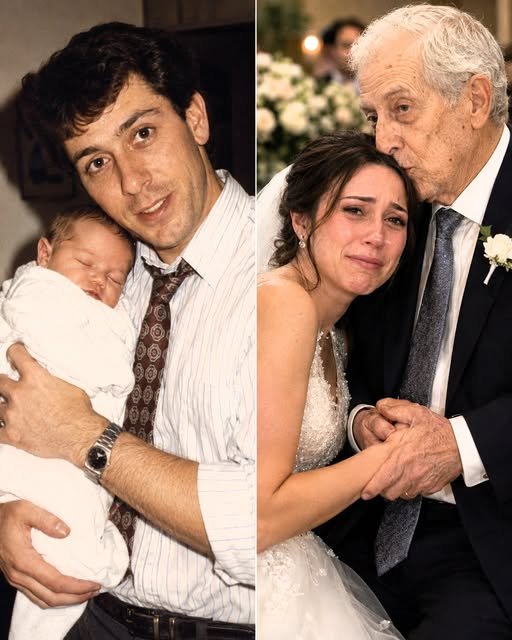
Part 1 — The Promise He Had Made Long Before I Knew It
My father had wanted a daughter for as long as he could remember.
He loved telling the story of the day I was born.
According to him, the moment a nurse stepped into the hospital corridor and announced that he had a baby girl, his legs nearly gave out beneath him. He had to sit down before he could even ask whether Mom and I were okay.
Mom used to laugh whenever he told the story.
“You make it sound more dramatic every year,” she would tease.
But Dad never changed a single detail.
From the time I was small enough to fit against his chest, I was his “Daddy’s Girl.”
Even when I was twenty-nine years old with a career, a home, and a fiancé, I could call him in the middle of a stressful workday and hear the same greeting.
“There’s my Daddy’s Girl. What happened?”
Sometimes nothing had happened.
Sometimes I simply needed to hear his voice.
Dad had also talked about my wedding for as long as I could remember.
Not because he wanted to send me away.
Quite the opposite.
In his mind, a wedding meant there would someday be a long aisle, and if there was an aisle, then naturally he would be the man beside me.
When I was little, he developed a habit that became our private language.
He would take my hand and squeeze it three times.
Once.
Twice.
Three times.
Each squeeze stood for one word.
I. Love. You.
I always squeezed back.
Three times.
No matter how old I became.
When I finally brought Daniel home, Dad behaved as though he had been preparing for that meeting for years.
He wore one of his nicest shirts to dinner, though he spent the entire evening pretending the occasion meant nothing special.
Months later, before Daniel proposed, he called Dad privately and asked for his blessing.
Dad said yes.
Then he hung up the phone, disappeared into the garage, and cried for nearly twenty minutes.
When he came back inside, he insisted he had been searching for a wrench.
No one believed him.
Dad liked Daniel almost immediately, but liking him wasn’t enough.
He observed him.
He paid attention to the little things.
Once, after I’d had an awful week at work, Daniel drove all the way across town simply to leave dinner outside my door. I was exhausted and didn’t want company, so he kissed my forehead, handed me the food, and went home.
When Dad heard about it, he nodded approvingly.
“That’s good,” he said. “A man should understand that caring for you doesn’t always mean he has to take up all the space around you.”
That was Dad.
He noticed how people treated me when there was nothing to gain from it.
By the time Daniel and I became engaged, Dad seemed completely certain I had chosen well.
Our wedding was eleven months away.
And then everything changed.
Dad became sick.
At first, we believed we were dealing with something manageable.
There were appointments.
Tests.
Specialists.
More tests.
Then another specialist.
Eventually, there came a conversation none of us were ready to hear.
The illness was progressing.
The treatments might help with comfort, but they could not give us back the future we had assumed was waiting.
By spring, Dad could no longer cross his bedroom without stopping to catch his breath.
By summer, Mom had placed a chair in the hallway because sometimes the distance between his bed and his wheelchair was simply too much.
Our wedding was scheduled for September.
And suddenly everyone had an opinion about the aisle.

Part 2 — “Everyone Can Wait”
My aunt was the first person brave enough to say it.
“You can’t expect your father to make that whole trip.”
“I’m not expecting anything from him,” I replied.
“You know what I mean.”
I did.
The church aisle was nearly one hundred feet long.
Months earlier, Dad had imagined walking beside me.
Now walking even a few steps was impossible.
The only realistic plan was for my uncle to push his wheelchair while I walked beside him.
Even that would cost Dad more energy than most people understood.
A week later, Mom sat across from me at the kitchen table.
Her hands were wrapped around a cup of coffee she had forgotten to drink.
“Honey,” she said carefully, “it could take a very long time to get him from the back of the church to the altar.”
“Then it takes a long time.”
“There will be more than a hundred people sitting there.”
“They can sit.”
She sighed.
“Your brother could walk you. Your dad could already be seated in the front row. He would still see everything.”
I knew why she was suggesting it.
She wasn’t trying to take something away from either of us.
She was terrified.
All of us were.
But every time someone suggested another arrangement, I pictured my father talking about that moment when I was seven years old.
Someday.
Someday I’ll walk you down the aisle.
I could not imagine standing at the back of that church without him.
Then one afternoon, Dad brought it up himself.
He wouldn’t meet my eyes.
He stared at the armrest of his wheelchair while his thumb rubbed slowly over the fabric.
“Maybe your brother should take you,” he said.
I stared at him.
“Why would he do that?”
Dad shrugged, though even that small movement looked tiring.
“I’ll hold everything up.”
There it was.
His body was betraying him, and somehow he was still worried that I might be embarrassed.
I crouched in front of his chair.
“Look at me.”
He resisted for a moment.
Then he did.
“This was always our moment,” I told him. “Yours and mine.”
His eyes immediately filled.
“If it takes two minutes, fine. If it takes ten, fine. If it takes twenty, everyone will survive. Nobody is starting without us.”
Dad blinked quickly and looked toward the window.
Then, after a long silence, he said the words he would repeat for the rest of the summer.
“I’m getting my girl to that altar.”
And from that moment on, he treated it like a mission.
He practiced.
That is the part I still struggle to think about without crying.
My uncle would come over and wheel him slowly up and down the hallway.
Dad would sit as straight as his weakening body allowed, holding his left hand out beside him as though mine were already resting inside it.
Sometimes he could only make one trip.
Then he would whisper, “I need to lie down.”
Mom once found him sitting alone in the hallway afterward.
He was staring toward the living room.
When she asked what he was doing, Dad simply said, “I need to know I can get her all the way there.”
He became strangely focused on one other detail.
“What happens when we reach Daniel?”
“What do you mean?”
“Do I put your hand in his?”
“Dad, I don’t think there’s a rule.”
“But does he come toward you? Or do I bring you to him?”
“Whatever feels natural.”
He frowned.
“I want to know.”
He asked again days later.
Then again.
At the time, I assumed he was simply obsessing over wedding details because so many other things were beyond his control.
I didn’t understand the real reason until much later.
Months before his diagnosis became visibly serious, Dad had bought a dark navy suit for the wedding.
By September, it hung loosely from his frame.
Mom had to alter the trousers.
The collar no longer touched his neck properly.
Dad stood in front of the mirror on the morning of the wedding and tugged at the jacket.
“Well,” he said, studying himself, “at least no one has to worry about me splitting my pants on the dance floor.”
Mom laughed.
I couldn’t.
I walked into the bathroom, closed the door, and cried silently.
Then I fixed my makeup and went to marry the man I loved.
Because Dad had spent months making sure his illness would not become the only thing I remembered about that day.
Part 3 — A Hundred Feet
When I arrived at the church, Dad was waiting near the back.
My uncle stood behind the wheelchair.
For several seconds, Dad simply stared at me.
His eyes moved from my veil to my dress and back to my face.
“Well?” I asked.
He cleared his throat.
“You look acceptable.”
I raised an eyebrow.
“Acceptable?”
“Don’t start fishing for compliments now.”
I laughed.
Then his face changed.
His mouth trembled.
His eyes filled.
And suddenly my father looked like the man in all those old photographs who had once held a tiny baby girl against his chest and wondered how he had gotten so lucky.
I leaned down and wrapped my arms around him.
“Dad.”
“I’m fine.”
“You are very obviously not fine.”
That made him laugh.
He wiped his eyes quickly, then held out his hand.
“Ready, Daddy’s Girl?”
I placed my hand in his.
The music began.
And we started down the aisle.
Slowly.
Very slowly.
Not one person complained.
No one looked impatient.
No one checked the time.
My uncle pushed Dad’s wheelchair with incredible care.
Once, Dad lifted his hand slightly, signaling that he needed to stop.
We waited while he caught his breath.
Then we continued.
I could hear people crying from the pews.
I didn’t look at them.
I kept my eyes forward because if I looked at anyone else, I knew I would fall apart.
Halfway down the aisle, Dad squeezed my hand.
Once.
Twice.
Three times.
My heart nearly broke.
I squeezed back.
Once.
Twice.
Three times.
I love you.
I love you too.
We continued.
One hundred feet had never felt so long.
Or so precious.
By the time we finally reached Daniel, Dad was breathing hard.
Daniel stepped toward us.
But Dad did not release my hand.
For a few seconds, the three of us simply remained there.
Then Dad squeezed me three times again.
Only after that did his fingers slowly open.
Daniel bent down to embrace him.
That was when I saw my father’s hand move toward Daniel’s jacket.
His fingers pressed against the breast pocket.
I thought he was trying to steady himself.
Daniel suddenly became very still.
His expression changed.
Dad leaned toward him for a moment.
Then his hand dropped away.
The music shifted.
The ceremony continued.
And I forgot about that strange little moment.
Dad stayed through dinner but did not have enough strength for the entire reception.
Before Mom wheeled him away, he pulled me close.
“I told you,” he whispered.
“Told me what?”
“I’d get you there.”
“You did.”
“Wasn’t exactly fast.”
I smiled through tears.
“Nobody died from waiting.”
Dad grinned.
Then he kissed my cheek and went home.
It was the last wedding-night conversation I ever had with him.
Twelve days later, my father died.

Part 4 — Photograph 212
Grief did strange things to my memory.
There are moments from those days I can remember with painful clarity.
Other hours seem to have disappeared completely.
I remember Mom calling me.
I remember Daniel gently taking the phone from my hand because I could no longer understand what anyone was saying.
I remember standing inside my childhood bedroom and staring at Dad’s slippers beside the bed.
They looked so ordinary.
That felt impossible.
How could the owner of those slippers simply stop existing while they remained exactly where he had left them?
But more than anything, I remembered the aisle.
Dad made it.
Every breath had been difficult.
Every foot had cost him something.
He had still made it.
He got himself to the back of that church.
He put his hand in mine.
And he got me to Daniel.
Nine days after Dad died, our wedding photographer sent the finished gallery.
There were 411 photographs.
Daniel and I sat together on the couch and went through them slowly.
Dad was everywhere.
There was Dad watching me enter the church.
Dad beside Mom.
Dad laughing at dinner.
Dad leaning back in his wheelchair during the reception with his eyes closed while everyone danced around him.
Seeing him hurt.
But it also felt like finding pieces of him I thought I had already lost.
Then I reached photograph 212.
I stopped scrolling.
“Wait.”
Daniel looked at me.
“What?”
I enlarged the photograph.
It had captured us at the altar.
There I was in my wedding dress.
Daniel was leaning toward Dad.
And Dad’s hand was pressed directly against the breast pocket of Daniel’s jacket.
That strange moment came rushing back.
I zoomed in farther.
Something about the image felt different from what I remembered.
Dad wasn’t trying to balance himself.
Daniel wasn’t supporting his weight.
Daniel was listening to him.
I turned the laptop toward my husband.
“What was Dad doing?”
Daniel glanced at the screen.
His face immediately changed.
“What?”
“His hand. What did he put in your pocket?”
Daniel said nothing.
Instead, he stood and walked into our bedroom.
I heard the closet open.
Then I heard the lid being lifted from the shoebox where Daniel kept important things he was terrified of losing.
When he returned, he sat beside me.
He had an old photograph in his hand.
The colors had faded into warm shades of orange and brown.
One corner was worn soft, as though someone had held it many times.
Then Daniel placed it in my hands.
I stared.
Dad was sitting in the brown armchair from the first house I remembered.
Except he looked impossibly young.
His sleeves were rolled to his elbows.
His hair was thicker.
And resting against his chest was a newborn baby.
Me.
One of Dad’s hands supported my entire head.
He wasn’t looking at the person taking the photograph.
He was looking down at me.
Nothing else in the room seemed to exist for him.
I had seen pictures from that day before.
But never this one.
“Where did you get this?”
Daniel nodded toward the photograph.
“Turn it over.”
So I did.
At the top was my grandmother’s handwriting and the date of my birth.
Beneath it was a message from Dad.
The handwriting was unmistakable.
The letters had been pressed into the paper so firmly that I could feel the grooves beneath my fingers.
The message said, in essence, that he had been holding me since the day that photograph was taken, and now he was trusting Daniel with the person he had treasured most.
He asked Daniel to look after his girl.
He told him he trusted him.
And at the bottom, Dad had added one final thought.
He thanked Daniel for being patient enough to wait for us at the end of the aisle.
I stopped breathing for a moment.
Suddenly, those questions Dad had asked all summer made sense.
Do I hand you to Daniel?
Does he come to you?
What exactly happens when we reach him?
Dad had not merely been worried about wedding etiquette.
He had been preparing himself for something much harder.
Part 5 — The Secret My Father Left at the Altar
“When did he give you this?” I asked.
“About three weeks before the wedding.”
Daniel explained that Dad had called him one afternoon while I was working and asked him to come to the house alone.
When Daniel arrived, Dad was already sitting in his chair.
The photograph was waiting on the table beside him.
By that stage, Dad’s hands were often weak.
His handwriting had become shaky.
There were days when even signing his name was difficult.
“He must have written the note earlier,” Daniel said. “Probably on one of his stronger days.”
I ran my finger over Dad’s handwriting.
He had planned it.
While all of us were wondering whether he had enough strength to reach the altar, Dad had been thinking about what he wanted to leave there once he arrived.
“Why didn’t you show this to me after the wedding?”
Daniel looked down.
“Because he asked me not to.”
“Why?”
“He told me to wait until the right moment.”
I looked back at photograph 212.
Dad’s hand.
Daniel’s jacket pocket.
Daniel bending closer.
“What happened right there?”
Daniel was quiet for several seconds.
Then he said something I had not expected.
“Your dad wasn’t putting the photograph in my pocket.”
I stared at him.
“What?”
“He was checking to make sure I still had it.”
Dad had asked Daniel to carry that old photograph inside his jacket during the ceremony.
The picture of Dad holding me as a newborn had been resting directly over Daniel’s heart while we stood at the altar.
Dad had originally planned for Daniel to give it to me there.
That was supposed to be the moment.
Twenty-nine years earlier, Dad had held me against his chest for the first time.
On my wedding day, he intended to place that memory into the hands of the man who would become my husband.
I looked at Daniel.
“Then why didn’t he let you give it to me?”
Daniel’s eyes filled with tears.
“He changed his mind.”
“Why?”
Daniel swallowed.
Then he repeated what Dad had whispered to him at the altar.
Dad had told him not to give it to me that day.
Not because he no longer wanted me to have it.
Because he looked at me and realized I was happy.
It was my wedding.
For once, despite everything our family had endured, I was having a beautiful day.
And Dad didn’t want his goodbye to take that away from me.
That was the moment I completely broke.
For the entire wedding, I had been watching him.
Was Dad breathing normally?
Was he in pain?
Was he too tired?
Would he make it through dinner?
Would this be the final photograph we ever took together?
Even while I was getting married, part of me had been preparing to lose him.
Dad knew that.
He knew how much his illness had already stolen from our family.
So when he finally reached that altar carrying one more goodbye, he made a decision.
Not today.
His daughter was happy.
Let her be happy.
He had spent months fighting his body to reach the end of that aisle.
Then, when he got there, he refused to make his approaching death the center of my beginning.

Part 6 — He Wasn’t Giving Me Away
For months afterward, I kept thinking about the questions Dad had asked me.
How exactly would he hand me to Daniel?
Where would Daniel stand?
When should Dad let go?
Back then, I thought he was trying to get the ceremony right.
Now I understand.
My father wasn’t asking how to hand over a bride.
He was trying to understand how a father lets go of his little girl.
Dad had been holding me, in one way or another, for twenty-nine years.
He carried me when I was a baby.
He held the back of my bicycle seat until I learned to balance.
He waited up when I started dating.
He answered late-night phone calls.
He worried about flat tires and difficult bosses and heartbreaks I thought would destroy me.
He secretly cried in a garage when Daniel asked to marry me.
Then, during the last months of his life, he practiced traveling one hundred feet down a church aisle because he had made me a promise long before either of us knew how difficult keeping it would become.
Dad knew his life was ending.
But he also knew mine was moving forward.
And he loved me enough not to confuse those two things.
I keep that old photograph beside my bed now.
Some mornings, I turn it over and read Dad’s handwriting.
Then I look at the young man in the photograph supporting his newborn daughter’s tiny head with one hand.
Sometimes I also open photograph 212 from my wedding gallery.
There are twenty-nine years between those two images.
In the first photograph, Dad is holding me at the beginning of my life.
In the second, his hand is touching the jacket pocket containing that very same moment while my future husband bends down to listen to him.
For a long time, I believed my favorite wedding photograph would always be the one of Dad and me making our slow journey down the aisle.
It isn’t.
It’s photograph 212.
Because now I know what was happening in that frozen second.
My father was not giving me away.
He was doing something far more meaningful.
He was telling another person:
I have loved her for her entire life. I cannot stay beside her forever. I trust you to stand beside her when I no longer can.
And Daniel understood something I had not understood during those final months.
Dad never delayed my wedding.
He gave me extra time with him.
One hundred feet.
About ten unforgettable minutes.
Three squeezes at a time.
I had understood the meaning of those three squeezes since childhood.
I love you.
I simply hadn’t understood how much my father was trying to place inside those three little squeezes that day.
He made it to the altar.
Slowly.
Painfully.
With everyone waiting.
But he made it.
And when we finally reached Daniel, Dad held my hand for several seconds longer than necessary.
At the time, I thought perhaps he was tired.
Or distracted.
Or maybe, for just a moment, he had forgotten that he was supposed to let go.
Now I know better.
My father hadn’t forgotten anything.
He knew exactly what he was doing.
After twenty-nine years of holding his little girl’s hand, he simply wanted a few more seconds before opening his fingers.
So he took his time.