
Part 1 — Learning to Steer My Own Life
The day I passed my driving test at sixty years old, I sat behind the wheel of my faded Chevrolet and stared at the little plastic license in my hand.
For most people, it probably would have been nothing more than a card.
To me, it felt like proof that my life was still capable of beginning again.
I had been married to Paul for forty-one years, and during all those decades, he had done nearly all the driving. Grocery stores, family gatherings, doctor appointments, vacations—Paul had always been in the driver’s seat.
It wasn’t because he controlled me.
He simply loved driving, and I was perfectly happy letting him.
Then, two years earlier, I lost him.
For months afterward, I discovered how many pieces of my independence had quietly been tied to him.
I could manage the bills.
I could mow the lawn badly enough to keep the neighbors from complaining.
I could replace a furnace filter after watching three instructional videos.
But every time I needed to go somewhere, I had to depend on someone else.
Eventually, I grew tired of asking.
So I learned.
That afternoon, I sat in the DMV parking lot gripping my steering wheel while my best friend Stella leaned through the open passenger-side window.
“Are you planning to live in this parking space now?” she asked.
“I’m appreciating the moment.”
“You’re terrified.”
“I prefer appreciating.”
Stella laughed.
We had been friends since our twenties, back when we’d worked together in an insurance office surrounded by metal filing cabinets and fluorescent lights.
She tapped the roof of my Chevy.
“Come on, licensed lady. Coffee’s waiting.”
I checked both mirrors again.
Then once more.
Stella groaned dramatically.
“You’re going to be one of those grandmothers doing forty in a forty-five, aren’t you?”
“Fifty in a fifty-five,” I corrected her.
“Rebel.”
Fifteen minutes later, we were sitting in a diner booth while Stella lifted her coffee mug.
“To Carol,” she announced. “Sixty years young, officially licensed, and a danger to absolutely no one because she uses her turn signal even in empty parking lots.”
I laughed.
“I’m a very responsible driver.”
“You’re the only person I know who would signal before entering her own driveway.”
The funny thing was, she was probably right.
Then Stella’s expression softened.
“Paul would be proud of you.”
The laughter caught in my throat.
For a second, I pictured him beside me—the slight tilt of his smile, the way he’d raise one eyebrow whenever I got nervous about something.
“He’d be terrified,” I said quietly. “The man barely trusted me to merge when he was sitting beside me.”
Stella smiled.
And somehow, that made the ache easier.
When I returned home later that afternoon, the late sunlight painted my little house gold.
I slowed before my driveway.
Then, because Stella was apparently psychic, I turned on my signal even though no one was behind me.
That was when I noticed Ryan.
He lived across the street.
Late thirties, maybe. He had moved into the neighborhood several months earlier and had never made much effort to know anyone.
He was standing on his porch with a beer in his hand, watching me pull in.
I gave him a polite wave.
“Afternoon, Ryan!”
He lifted his hand slightly but didn’t answer.
His eyes moved from me to the car.
Then back to me.
Something about the look bothered me, but I ignored it.
I had spent too much of my life worrying about what other people thought.
That day was supposed to be about freedom.
I carried my purse inside, placed my new license carefully in my wallet, and told myself that the hardest part was behind me.
I had no idea my new neighbor had already decided that my freedom offended him.
Part 2 — The First Warning
A few mornings later, I walked outside with my purse over my shoulder and stopped.
Ryan’s pickup truck was parked partly across the end of my driveway.
Not enough for it to look accidental.
Enough to make it impossible for me to pull out.
I checked my watch.
My doctor’s appointment was in forty-five minutes.
I stared at the truck, hoping Ryan would appear and move it.
He didn’t.
Finally, I crossed the street and knocked.
Ryan opened the door holding a coffee mug.
“Morning,” he said.
“Ryan, I’m sorry to bother you, but your truck is blocking my driveway. I have an appointment. Would you mind moving it?”
He glanced over my shoulder toward my Chevrolet.
Then he laughed.
Not a friendly laugh.
A dismissive one.
“Just take an Uber.”
I blinked.
“Excuse me?”
He leaned against the doorframe.
“Women your age really shouldn’t be driving anyway.”
For a moment, I genuinely thought I had misunderstood him.
“I’m sorry?”
“You heard me.”
I tightened my grip around my purse strap.
“That’s a very rude thing to say.”
“It’s also true.”
Then he closed the door.
Right in my face.
I stood there for several seconds.
There are moments when anger arrives immediately.
This wasn’t one of them.
First came embarrassment.
Then disbelief.
Then humiliation.
Finally, anger.
I ended up calling a cab and spending twenty-eight dollars I hadn’t planned on spending.
During the ride, I stared out the window and thought of Paul.
After he died, I had promised myself something.
I could cry because I missed him.
I could cry because the house felt too quiet.
I could cry because sometimes I still cooked enough dinner for two before remembering there was only one place setting now.
But I refused to waste tears on cruel people who hadn’t earned them.
So I swallowed the lump in my throat.
The next afternoon, I told Stella what happened.
Her coffee cup hit the table.
“You need to report him.”
“Report him for parking badly?”
“For harassing you!”
“Stella, I don’t want to become the neighborhood woman who calls the police every time somebody sneezes.”
She pointed at me.
“Carol, there’s a difference between sneezing and deliberately blocking someone’s driveway.”
I knew she was right.
But part of me still wanted to believe Ryan’s behavior had been a one-time display of stupidity.
It wasn’t.
That Saturday, I was parallel parking near my mailbox.
I was taking my time, easing backward carefully, when I heard Ryan’s voice.
“Watch out, Carol! The mailbox has a family!”
He was across the road, laughing.
Two teenagers walking nearby laughed too.
My cheeks burned.
But I said nothing.
I finished parking.
When I stepped out, I looked at the distance between my car and the curb.
Perfect.
Ryan had already gone inside.
And I told myself that was victory enough.

Part 3 — He Kept Pushing
The tires were different.
That wasn’t a joke.
That wasn’t an obnoxious comment.
That was deliberate.
I discovered them early Tuesday morning.
All four tires were flat.
When I bent down, I saw the cuts.
Clean slashes.
My stomach dropped.
I stood there in my slippers staring at the damage while something cold moved through me.
I didn’t have proof.
But I knew.
Before common sense could stop me, I marched across the street and pounded on Ryan’s door.
He opened it wearing an old T-shirt with a mustard stain near the collar.
“I’m sorry,” I said, my voice trembling with anger, “but this is my property. Why are you doing this to me?”
Ryan rolled his eyes.
“I don’t know what you’re talking about.”
“My tires.”
He shrugged.
Then that same ugly smile appeared.
“I’ve been trying to make something clear to you. Women can’t drive. Especially women your age. Driving is a man’s job.”
I stared at him.
“A man’s job?”
“That’s what I said.”
I should have walked away.
Instead, irritation got the better of me.
“Ryan, don’t you sell protein powder from your living room?”
His expression changed instantly.
Apparently, insulting my entire gender was acceptable.
Mentioning his online business was not.
“Get off my porch.”
“Gladly.”
I turned around before he could see how badly my hands were shaking.
The tire replacement cost me $462.
Four hundred and sixty-two dollars.
That afternoon, I drove straight to Stella’s house.
I didn’t take a cab.
I didn’t ask anyone for a ride.
I drove.
Because if I had stayed home, Ryan would have won something I wasn’t prepared to give him.
At Stella’s kitchen table, she listened with growing alarm.
“This has gone far enough.”
“I can’t prove he did it.”
“You don’t need proof to start documenting what’s happening.”
“I know.”
“Promise me you’ll be careful.”
I gave her a tired smile.
“Careful is practically my personality.”
But that night, when I returned home, I felt less brave.
I sat on the edge of my bed and looked at the framed photograph of Paul on the dresser.
Sometimes I still talked to him.
Not because I believed he could answer.
Because forty-one years of conversation is a difficult habit to break.
“I handled it,” I whispered. “New tires. Didn’t let him stop me.”
In my imagination, Paul gave me the same look he’d given me whenever I insisted on carrying too many grocery bags at once.
You don’t have to do everything alone, Carrie.
That had been his nickname for me.
I shook my head.
“Yes, I do,” I whispered.
Because wasn’t that what the license meant?
That I could handle things myself?
I switched off the lamp.
At the time, I didn’t understand something important.
Independence doesn’t mean refusing help.
Sometimes independence means choosing who deserves to stand beside you.
Part 4 — The Concrete Block
The sound woke me at 6:47 Monday morning.
A mechanical grinding.
Metal scraping.
A heavy engine idling.
For one confused second, I thought a garbage truck had driven onto the lawn.
Then I realized garbage collection wasn’t until Friday.
I threw on my robe, shoved my feet into slippers, and hurried toward the front window.
What I saw made my heart stop.
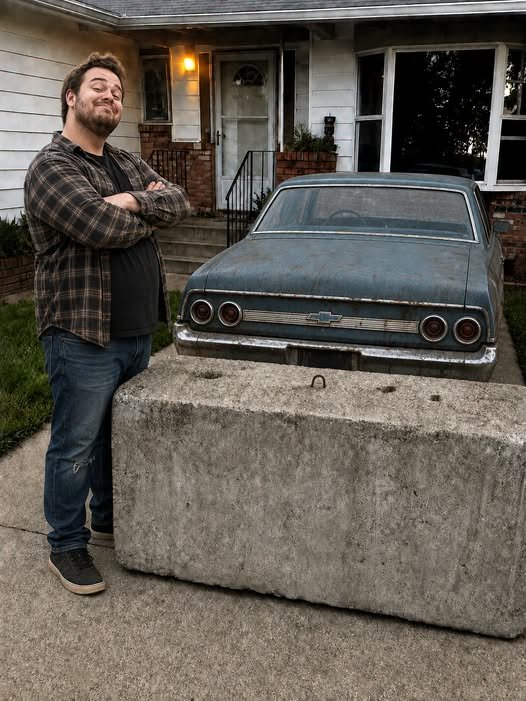
A small crane truck was parked near my driveway.
Two workers wearing orange safety vests were guiding a heavy chain.
Attached to that chain was an enormous concrete barrier.
And Ryan was directing them.
They were lowering it across my driveway.
Directly in front of my Chevrolet.
I ran outside.
“What are you doing?”
Ryan turned slowly.
He looked delighted.
“Morning, Carol.”
“Get that thing out of my driveway!”
One of the workers stopped moving.
The other looked at Ryan uncertainly.
Ryan walked toward me.
“Technically, it’s not your driveway.”
“What are you talking about?”
“The property line.”
He pointed casually toward the ground.
“Runs right through here.”
“Since when?”
“Had it checked.”
“By whom?”
He smiled.
“A guy I know.”
“You cannot put a concrete barrier across somebody else’s driveway!”
The enormous block touched the pavement with a deep thud.
I felt the vibration through my slippers.
My Chevy was trapped.
Completely.
I looked at it through the gap between Ryan and the workers.
A silly old car to anyone else.
To me, it represented months of fear, lessons, mistakes, practice, courage, and finally freedom.
And Ryan had blocked it because he could.
Or because he believed he could.
“I’m calling the police.”
Ryan shrugged.
“Go ahead. They’ll probably tell you it’s a property dispute.”
“You can’t be serious.”
“Then you’ll hire a lawyer.”
He began counting imaginary numbers on his fingers.
“Lawyer costs money. Court takes months. Maybe eventually someone makes me move it.”
His smile widened.
“Until then, enjoy Uber.”
My throat tightened.
Ryan folded his arms.
“Maybe this is better anyway. Neighborhood will be safer.”
I stared at him.
“Why do you hate me so much?”
He frowned as though I’d asked something ridiculous.
“I don’t hate you.”
“Then why are you doing this?”
“Because some people need to know their place.”
He paused.
Then smiled at his own joke.
“Or stay in their lane.”
The workers looked uncomfortable.
One cleared his throat.
“We’re going to head out.”
Ryan waved him away.
“Send me the invoice.”
I didn’t answer.
I couldn’t.
My face felt hot.
My eyes burned.
And suddenly I wasn’t a sixty-year-old widow who had learned to drive after losing her husband.
I felt like a child being bullied while everyone watched.
So I walked back inside.
Carefully.
Quietly.
I closed the front door.
Then I cried.
I gave myself ninety seconds.
Paul used to joke that a proper cry should have a beginning, middle, and ending.
“Don’t turn sadness into a six-season television series,” he’d say.
So I watched the microwave clock.
Ninety seconds.
Then I washed my face.
And that’s when I remembered Patricia.

Part 5 — The Phone Number I Almost Forgot
Three weeks earlier, several neighbors had gathered for a barbecue at the Hendersons’ house.
Ryan had spent most of the afternoon talking about himself.
At some point, he started bragging about the house he lived in.
“My mom helped me get it,” he’d said loudly. “She handles the paperwork. She handles everything.”
Someone joked that he was lucky.
Ryan laughed.
“If anyone gives me trouble, she takes care of it.”
Standing several feet behind him was a small woman in a navy cardigan.
Patricia.
His mother.
She hadn’t laughed.
Later that afternoon, while I stood near the drinks table, she approached me.
“Carol?”
“Yes?”
She looked toward Ryan before slipping a folded piece of paper into my hand.
“If he ever crosses a line, call me.”
I remember smiling awkwardly.
“I’m sure that won’t be necessary.”
Patricia’s expression didn’t change.
“Call me anyway.”
I’d tucked the number into my address book.
Then forgotten about it.
Until that morning.
I hurried to the drawer where I kept the book and flipped through the pages.
P.
Patricia.
Her number was still there.
I picked up the phone.
For several seconds, I hesitated.
Calling someone’s mother because her grown son was behaving badly seemed absurd.
Then I looked through my window.
The concrete block was still there.
And Ryan was still standing outside admiring it.
That imaginary voice of Paul’s returned.
You don’t have to fight every battle alone, Carrie.
I dialed.
Patricia answered almost immediately.
“Hello?”
“Patricia? It’s Carol. Ryan’s neighbor.”
Her voice changed.
“Carol. What happened?”
Not How are you?
Not Why are you calling?
What happened?
That told me more than anything else could have.
I explained the blocked driveway.
The comments.
The truck.
The tires.
The concrete barrier.
Patricia didn’t interrupt.
When I finished, there was silence.
Then a long exhale.
“I’ll be there shortly.”
“You don’t have to—”
“I do.”
The call ended.
I stood by the window.
A few minutes later, a silver sedan turned onto the street.
Patricia stepped out carrying a folder under one arm and speaking into her phone.
“Yes, the entire barrier,” she was saying. “Remove it today. Charge everything to Ryan.”
She ended the call and walked toward my driveway.
Ryan saw her.
Even from across the street, I watched the confidence disappear from his face.
“Mom?”
Patricia ignored him.
She examined the concrete barrier, then looked at the workers, who had not yet driven away.
“My contractor is coming to remove this,” she told them. “Any expense related to this morning goes directly to my son.”
Ryan hurried toward us.
“Mom, wait.”
Patricia opened the folder.
“Ryan.”
There was something about the way she said his name that made even me straighten my shoulders.
He stopped.
She removed a printed document.
“The house you’re living in belongs to me.”
Ryan’s face tightened.
“Mom—”
“Your agreement prohibits harassment of neighbors, property interference, and unauthorized modifications.”
His mouth opened.
Nothing came out.
“You have thirty days to leave.”
For once, Ryan had no clever answer.
No joke.
No smile.
Part 6 — Five Minutes Changed Everything
“Mom, come on.”
Ryan glanced toward me.
“It was a joke.”
I folded my arms.
“A concrete block?”
He forced a laugh.
“Carol knows I wasn’t serious.”
I looked at him.
“That’s interesting. I don’t remember laughing.”
Patricia remained calm.
That was somehow more frightening than yelling.
“You damaged your neighbor’s ability to access her property,” she said. “You repeatedly harassed her. And now you’ve hired workers to place construction material across her driveway without authorization.”
Ryan’s face turned pale.
“I can fix it.”
“You will.”
“I’ll apologize.”
“You should.”
He looked desperate now.
“Thirty days? Where am I supposed to go?”
Patricia slipped the document back into her folder.
“Somewhere that gives you an opportunity to grow up.”
“Mom!”
Then Ryan turned toward me.
“Carol, say something.”
I almost laughed.
For weeks, he hadn’t cared what I had to say.
Now suddenly my opinion mattered.
“I’ll move the block,” he promised. “I’ll pay for everything. I’ll even wash your car every week.”
I took a slow breath.
My hands weren’t shaking anymore.
“Ryan, you kept telling me I needed to learn my place.”
He stared at me.
“So here’s something you should learn.”
I pointed toward my house.
“That is my home.”
Then toward my car.
“That is my car.”
Then toward the street.
“And I have exactly as much right to use that road as you do.”
He looked down.
“You don’t get to decide someone’s freedom because she’s a woman. You don’t get to decide it because she’s older than you. And you certainly don’t get to bully someone simply because you think she won’t fight back.”
His jaw tightened.
I couldn’t resist one final sentence.
“If transportation becomes difficult after you move, perhaps you can take an Uber.”
Patricia’s mouth twitched.
She was trying not to smile.
Ryan noticed.
“Seriously?”
That was the first time I laughed that morning.

Part 7 — The Road Ahead
Before eight o’clock, another crew arrived.
The concrete barrier was lifted.
The driveway opened.
My Chevrolet was free.
I stood there watching that ridiculous block rise into the air and realized something.
I had spent most of the previous weeks believing the fight was about driving.
It wasn’t.
Not really.
It was about whether someone else could convince me to become smaller simply because my independence annoyed him.
Ryan moved out before his thirty days were over.
I didn’t celebrate.
Well, not officially.
Stella brought a cake.
But that was technically unrelated.
At least that’s what we told Patricia.
A few weeks later, the three of us went to lunch together.
I drove.
Stella sat in the passenger seat.
Patricia sat in the back.
As I approached an intersection, I slowed carefully and turned on my signal.
Stella groaned.
“Carol, there isn’t another vehicle within half a mile.”
“Rules are rules.”
Patricia laughed.
Then Stella pointed toward the speedometer.
“Forty-eight in a fifty-five.”
“I’m building confidence.”
“At this pace, we’ll build an entire retirement community before we reach the restaurant.”
We laughed so hard I nearly had to pull over.
Nearly.
When we finally reached the restaurant, I parked perfectly between the lines.
I switched off the engine but remained behind the wheel for a moment.
Sunlight reflected off the windshield.
For the first time in a long while, I thought about Paul without feeling crushed by the memory.
I could almost picture him beside me.
Proud.
Amused.
Probably complaining that I had braked too early.
Getting my driver’s license at sixty hadn’t simply taught me how to operate a car.
It taught me that losing the person who had shared my road for forty-one years didn’t mean my journey was over.
I could still learn.
I could still choose where I wanted to go.
I could still defend the space I’d worked so hard to reclaim.
And perhaps most importantly, I finally understood something Paul had probably known all along:
Being independent doesn’t mean you never need anyone.
Strength isn’t refusing every offered hand.
Sometimes strength is recognizing the right hand when it reaches toward you.
I looked at Stella.
Then Patricia.
Then at the open road ahead.
“Ready?” I asked.
Stella buckled her seat belt.
“Only if you promise to hit fifty.”
“No promises.”
And with all three of us laughing, I pulled back onto the road.
This time, I wasn’t afraid of where it might lead.