
Part 1 — The Sweater That Shouldn’t Exist
For nearly forty years, I carried the same unanswered question everywhere I went.
What happened to my twin sister?
Some questions fade as life moves on. This one never did.
It followed me through college, marriage, motherhood, funerals, birthdays, Christmas mornings, and sleepless nights. It waited quietly in the background of every happy moment, reminding me that one person who should have been there was missing.
My sister Laura disappeared on the night we turned sixteen.
And then, four decades later, my eight-year-old granddaughter walked into my kitchen wearing Laura’s sweater.
I was standing at the counter, drying a dinner plate, when Sophie came bouncing through the doorway.
“Grandma, look!”
I turned.
The plate slipped from my fingers.
It smashed against the tile.
Sophie jumped back with a gasp.
“Grandma!”
I barely heard her.
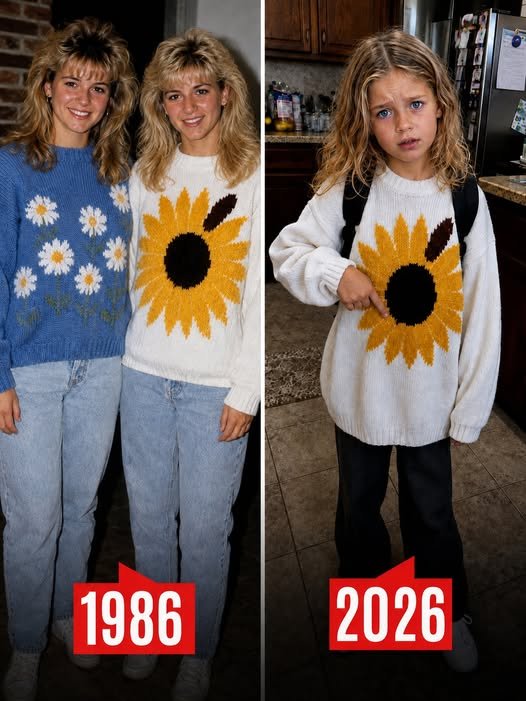
All I could see was the sweater.
Soft cream-colored yarn.
A large yellow sunflower spread across the front.
And near the bottom of the flower, one strange brown petal.
My lungs forgot how to work.
“Take that off.”
Sophie stared at me.
“What?”
I realized how frightened I sounded and forced myself to soften my voice.
“Please, sweetheart. Take off the sweater.”
Her cheerful expression vanished.
“But Dolly gave it to me.”
The name meant nothing to me.
“Who is Dolly?”
“The new lady who cleans our school.”
My heart began pounding harder.
I crouched in front of Sophie.
“Did she ask you to go anywhere with her?”
“No.”
“Did she tell you not to tell anyone about the sweater?”
Sophie shook her head quickly.
“She just saw me standing in the hallway because I was cold. My teacher was there. Dolly said I could borrow it.”
That eased one fear.
It did nothing about the bigger one.
Sophie slowly pulled the sweater over her head and handed it to me.
“Am I in trouble?”
“Oh, honey. No.”
I kissed her forehead.
“You didn’t do anything wrong.”
My hands were trembling as I turned the collar inside out.
The faded stitching was still there.
Two red letters.
L.M.
Laura’s initials.
I sat down because suddenly I no longer trusted my knees.
Forty years disappeared in a single heartbeat.
I was sixteen again.
It was 1986.
Laura and I had always looked enough alike to fool strangers, although anyone who knew us could tell us apart instantly.
She was louder.
Braver.
More impulsive.
I was the one who thought things through.
Laura liked to say that between the two of us, we made one sensible person.
For our sixteenth birthday, Mom had spent months knitting us matching sweaters.
Mine had white daisies.
Laura’s had a huge sunflower.
While knitting hers, Mom accidentally used brown yarn for one of the petals.
She groaned when she noticed it and offered to redo half the flower.
Laura refused.
“No way. Leave it.”
Then she looked at me and grinned.
“That way Emelia can’t pretend mine is hers.”
I threw a carrot at her across the kitchen table.
Mom laughed so hard she had to put down her knitting needles.
That was how I remembered us.
Laughing.
Teasing.
Certain that there would always be another birthday.
That evening, our house filled with relatives.
Dad grilled hamburgers outside. Mom brought out cake. Laura kept sneaking frosting whenever Mom turned away.
At around nine o’clock, Laura grabbed her sunflower sweater and headed toward the front door.
She kissed Mom on the cheek and said she was stepping outside for some air.
Before leaving, she made us promise to save her another piece of cake.
Then the door closed behind her.
Laura never came back through it.
At first, we assumed she’d wandered down the street.
Then ten minutes became thirty.
Thirty became an hour.
Dad drove around the neighborhood.
Mom called friends.
Someone called the police.
By midnight, our birthday celebration had become a search.
There was no note.
No packed suitcase.
No telephone call.
Nothing missing except Laura and the sunflower sweater.
For years afterward, any unexpected knock made my heart race.
Late-night phone calls terrified me.
If someone resembling Laura passed me in a grocery store, I followed them until they turned around.
Mom never stopped believing she would return.
Dad eventually stopped talking about her.
At first, he helped with searches. Then gradually, he withdrew.
Laura’s photographs disappeared into boxes.
Her bedroom was emptied.
Mentioning her name could make Dad leave the room.
I convinced myself that grief had hardened him.
Mom died still wondering what had happened to her daughter.
Dad survived.
At ninety, he now lived in a nursing home twenty minutes away. His body had weakened, but his mind remained remarkably clear.
Until the day Sophie wore that sweater, I believed my father’s silence came from pain.
Then Sophie said something that changed everything.
“Dolly told me you should look inside it.”
I stared at her.
“Inside what?”
“The sweater.”
She pointed toward the sunflower.
“Under the flower.”
I examined the stitching.
Near the lower edge was a seam so small I had never noticed it as a teenager.
I loosened a thread and slipped two fingers beneath the knitted sunflower.
Something hard touched my fingertip.
I pulled it free.
A tiny wooden charm dropped into my palm.
A sunflower.
I stopped breathing.
Dad used to carve little wooden flowers for Laura and me when we were children.
Mine was a daisy.
Laura’s was a sunflower.
And I remembered the last time I had seen hers.
The night Laura disappeared.
Dad had been standing beneath the porch light long after midnight.
His face had looked strange—angry, frightened, devastated.
In his hand was Laura’s wooden sunflower.
I had asked him why he had it.
He never answered.
Now, forty years later, it was hidden inside Laura’s sweater.
Sophie touched my arm.
“Grandma? Why are you crying?”
I looked at her.
“Because your great-grandfather had this the night my sister disappeared.”
Sophie frowned.
“Then how did Dolly get it?”
I stared at the little wooden flower.
For forty years, I had answered that question with the same words.
I don’t know.
That afternoon, I decided I was finished living with those words.

Part 2 — The Woman Who Knew My Name
I called Sophie’s mother and asked her to come home early.
Then I placed the sweater carefully on the passenger seat of my car and drove straight to Sophie’s school.
At the front office, I asked for Dolly.
The receptionist told me she was finishing work in another hallway.
I waited.
Every minute felt longer than the one before it.
Finally, a woman pushed a cleaning cart through the double doors.
She looked to be somewhere in her thirties.
The moment she saw me, she stopped.
Her gaze fell immediately to the sweater in my arms.
Then she looked at my face.
“You must be Emelia.”
Something inside me tightened.
We had never met.
Yet she knew my name.
“You gave this to my granddaughter.”
“Yes.”
“Why?”
She glanced nervously toward the office staff.
“Could we talk somewhere private?”
“No.”
She blinked.
I stepped closer.
“I have spent most of my life waiting for people to explain things to me. You can start here.”
I held up the wooden sunflower.
Her expression changed.
“Who gave you this sweater?”
“My mother.”
My pulse jumped.
“What is your mother’s name?”
She hesitated.
That hesitation felt unbearable.
“Please,” I said. “Don’t make me drag this out one sentence at a time.”
Her eyes began to shine.
“Laura.”
For a moment, every sound around us disappeared.
I studied her face.
The shape of her eyes.
The line of her jaw.
She did not look exactly like Laura.
But suddenly I could see pieces of my sister everywhere.
“Laura is your mother?”
“Yes.”
The next question came out as a whisper.
“Is she alive?”
Dolly nodded.
I sat down without meaning to.
For forty years, I had imagined hundreds of endings.
An accident.
A stranger.
A tragedy no one could explain.
I had even imagined Laura living somewhere without remembering who she was.
But I had never imagined this.
Alive.
Close enough that her daughter worked at my granddaughter’s school.
I forced myself to continue.
“Your father?”
“His name is Thomas.”
I knew the name.
Of course I knew it.
Thomas had been the boy Dad hated Laura seeing when we were sixteen.
I looked again at the sweater.
“So Laura left with him?”
Dolly hesitated.
“Not exactly.”
“What does that mean?”
“Thomas came to your house that night. His family was leaving town. He wanted your mother to go with them.”
My stomach twisted.
“And she agreed?”
“She intended to.”
“Then why didn’t anyone tell us?”
Dolly swallowed.
“Because your father saw them outside.”
I stared at her.
“What happened?”
“Mom said they argued near the gate.”
I could almost picture it.
Dad’s temper.
Laura’s stubbornness.
Two people who loved each other but refused to bend.
“What did he tell her?”
Dolly lowered her voice.
“He told her that if she walked away with Thomas, she shouldn’t expect to return.”
A cold feeling spread through me.
I had never heard Dad say those exact words.
Yet I immediately believed he could have.
Laura probably had too.
“But she left anyway.”
“Yes.”
I turned away.
For four decades, I had believed Laura disappeared against her will.
Instead, at sixteen, angry and impulsive, she had walked away.
I didn’t know whether to scream or cry.
“How long did she stay with Thomas?”
“Several years.”
“And you?”
“I was born when Mom was twenty.”
I looked sharply at Dolly.
That meant Laura had become a mother only four years after leaving us.
“What happened between them?”
“They grew apart. Mom wanted stability. Thomas still wanted to keep moving from place to place.”
“And eventually she wanted to come home.”
Dolly nodded.
“Not right away. She was ashamed.”
I understood shame.
What I didn’t understand was forty years of silence.
“When did she come back?”
“1992.”
Six years after our birthday.
Laura had been twenty-two.
My chest tightened.
“How do you know she really returned?”
“Because she brought me with her.”
I stared at Dolly.
“You were here?”
“I was two. I don’t remember it myself, but Mom told me.”
“What happened?”
“She knocked on the door expecting your mother to answer.”
“Was Mom there?”
“No.”
My heart sank before Dolly even finished.
“Neither were you.”
I already knew what was coming.
“Dad opened the door.”
Dolly nodded.
I felt something inside me break.
For forty years, my father had insisted he never saw Laura again after the night she disappeared.
“What did he do?”
“He refused to let her come back.”
I stood so quickly the chair scraped across the floor.
“No.”
Dolly reached toward me.
“Emelia—”
“He would not have done that without talking to Mom.”
She said nothing.
That silence told me everything.
“Did Laura ever return again?”
“Not to the house.”
“Why?”
“Because she believed what he told her.”
“And what exactly did he tell her?”
“That everyone had started healing. That you had moved forward. That showing up again would reopen everything.”
My hands were shaking now.
“Did he tell her I said that?”
“I don’t know the exact words he used.”
“Then don’t add anything.”
She nodded immediately.
I looked down at the sweater.
“Where is Laura now?”
“Not far.”
That answer hurt almost as much as everything else.
Forty years.
And she had been nearby.
“Does she know you gave Sophie this sweater?”
Dolly looked down.
“No.”
I laughed bitterly.
“So this was your idea?”
“I’ve begged Mom for years to contact you.”
“That wasn’t your decision to make.”
“I know.”
“Then why?”
Dolly looked miserable.
“Sophie’s class had family trees hanging on the wall. I was cleaning the classroom and saw hers. I recognized the names.”
She looked at me.
“I knew she was your granddaughter.”
I held up the wooden sunflower.
“One last question. Where did Laura get this?”
Dolly’s expression changed again.
“She told me your father gave it back to her when she returned in 1992.”
That was it.
The final piece.
Dad had held the charm on the night Laura disappeared.
Laura had possessed it afterward.
My father had seen her again.
There was no explanation left that could protect him.
I picked up my purse.
Dolly watched me.
“Where are you going?”
I looked at her.
“To ask my father why he let my mother die believing her daughter never came home.”

Part 3 — My Father’s Secret
Dad was watching television when I entered his room at the nursing home.
He smiled when he saw me.
“Emelia. I wasn’t expecting you until later this week.”
I didn’t answer.
I walked to his chair and placed the little wooden sunflower on the tray in front of him.
The color drained from his face.
His reaction told me the truth before he spoke a word.
“Where did you find that?”
I remained standing.
“Did you ever see Laura again after 1986?”
“No.”
Too quick.
Too certain.
I unfolded the sunflower sweater and laid it across his knees.
His eyes closed.
“She came back,” I said.
Dad turned his face toward the window.
I waited.
Finally, his shoulders sagged.
“When?”
I already knew.
I wanted him to say it.
“1992.”
My throat tightened.
“Was she alone?”
“No.”
“She had a little girl with her.”
Dad looked at me.
“Dolly.”
His surprise disappeared.
“You’ve met her.”
“Yes.”
For one brief second, relief crossed his face.
That relief made me angrier than denial would have.
“What happened?”
“Emelia, it was a very long time ago.”
I pulled a chair in front of him.
“For you.”
He looked at me.
“I found out today. So tell me as though it happened this morning.”
He stared at the wooden flower.
“Your mother wasn’t home. Laura came to the door and said she wanted to come back.”
My eyes burned.
“And?”
Dad rubbed his forehead.
“Life had finally become quiet again.”
I couldn’t believe what I was hearing.
“Quiet?”
“Your mother was sleeping again. You had started building your own life. People stopped asking questions.”
“People?”
His jaw tightened.
“Neighbors. Relatives. Everyone.”
I suddenly understood something ugly.
“This wasn’t only about Laura leaving, was it?”
Dad didn’t answer.
“You were embarrassed.”
His face changed.
He had spent decades presenting himself as the grieving father.
But beneath the grief was pride.
Shame.
The humiliation of a daughter who had refused to obey him.
He looked at his hands.
“I felt like I had failed.”
“Because you couldn’t control her?”
“That isn’t what I meant.”
“But that is what you felt.”
He didn’t deny it.
I leaned closer.
“What happened at the gate that night?”
Dad took a long breath.
“I told her Thomas was trouble. I told her to go back inside.”
“And she refused.”
“Yes.”
“So you threatened her.”
His eyes filled.
“I was angry.”
“What did you say?”
He hesitated.
I already knew, but I needed to hear it from him.
“I told her that if she chose him and walked away, she shouldn’t expect this house to still be waiting for her.”
I stared at the man who had raised me.
“You said that to a sixteen-year-old girl.”
“I didn’t think she would actually leave.”
“But she did.”
Dad looked down.
“And six years later, when she came back with her child, what did you say?”
His mouth trembled.
“I told her she couldn’t suddenly return and tear open wounds everyone had worked so hard to close.”
I felt tears gathering.
“Did Mom tell you she didn’t want Laura back?”
“No.”
“Did I?”
“No.”
“Did anyone?”
Silence.
I leaned forward.
“Then whose wounds were you protecting?”
“Emelia…”
“No.”
My voice cracked.
“You were protecting yourself.”
Dad’s eyes closed.
“You couldn’t bear to admit you had been wrong.”
His shoulders began to shake.
“I was ashamed.”
The confession didn’t bring the relief I expected.
It only made everything sadder.
One impulsive sentence spoken in anger had become another decision six years later.
Then another lie.
Then decades of silence.
“Did Laura ask about me?”
Dad nodded.
My heart broke differently this time.
“What did she ask?”
“She wanted to know whether you hated her.”
I could barely speak.
“And what did you tell her?”
“That you had suffered because she left.”
“That wasn’t what I asked.”
Dad said nothing.
“Did you tell her I looked for her?”
“No.”
“Did you tell her Mom looked for her until the day she died?”
“No.”
“Did you tell her I would have opened the door?”
His eyes filled with tears.
“No.”
I stood.
For once, I wanted him to look at me while I said what I had spent forty years needing someone to understand.
“You didn’t protect us.”
Dad wiped his face.
“I thought I was saving the family.”
“You made decisions for the family.”
He looked up.
“You decided what Mom could handle. You decided what I felt. You decided what Laura deserved.”
My own tears were falling now.
“You spared yourself one painful conversation and left the rest of us carrying unanswered questions for decades.”
Dad cried openly.
At ninety years old, he suddenly looked fragile.
Once, his tears would have ended the conversation.
I would have comforted him.
I would have told myself that he had suffered too.
And he had.
But pain does not erase responsibility.
“I love you, Dad.”
He looked up hopefully.
“But loving you doesn’t make what happened acceptable.”
I walked toward the door.
“Emelia.”
I stopped.
“Will you come back tomorrow?”
My hand rested against the door handle.
For most of my life, I had protected him from uncomfortable answers.
Not anymore.
“I don’t know.”
Then I walked away.
Part 4 — Laura Wasn’t Sixteen Forever
The next morning, I drove Sophie to school.
She kept glancing at me from the back seat.
“Is this because of Dolly?”
“Yes.”
Her face fell.
I quickly added, “But none of this is because you did something wrong.”
She nodded.
After Sophie disappeared inside, I waited near the entrance.
Dolly appeared several minutes later.
She stopped when she saw me.
“Emelia.”
“I need a few minutes.”
We walked away from the doors.
“How was your father?”
“He admitted everything.”
Dolly exhaled slowly.
“He told me Laura came back.”
She looked relieved.
“He also told me what he said to her.”
“I’m sorry.”
“I know.”
We walked several steps in silence.
Then I stopped.
“But there’s something you need to understand.”
Dolly faced me.
“My father was wrong. What he did was cruel.”
She nodded.
“But that doesn’t make Laura completely innocent.”
Her expression hardened slightly.
“He was the reason she stayed away.”
“He was a reason.”
Dolly looked surprised.
“Laura was sixteen when she left,” I continued. “Sixteen-year-olds make reckless decisions. They think consequences last a week instead of a lifetime.”
I looked toward the school windows.
“I can forgive a frightened, stubborn sixteen-year-old for running.”
Dolly’s eyes softened.
“But Laura didn’t remain sixteen.”
She looked down.
“She turned twenty-two.”
My voice trembled.
“Then twenty-five. Thirty. Forty. Fifty.”
Dolly said nothing.
“She had decades to find me.”
“She was ashamed.”
“So was I.”
“She was afraid you hated her.”
“And how did she know?”
Dolly looked at me.
“She didn’t.”
“Exactly.”
I had spent all night thinking about that.
Dad had shut a door in Laura’s face in 1992.
It was terrible.
But Laura had then allowed that one closed door to speak for everyone else.
For me.
For Mom.
For people who never even knew she had returned.
“She could have written me.”
Dolly nodded slowly.
“She could have called.”
“I know.”
“She could have found me after Dad was no longer living in that house.”
“I know.”
“She could have tried once.”
Dolly’s eyes filled.
“Mom knows that.”
“Good.”
The word came out sharper than I intended.
Dolly flinched.
I softened my voice.
“I don’t want to punish her. But I’m not going to pretend forty years happened because of one person.”
Dolly nodded.
“You’re right.”
Then she reached into her coat and pulled out a folded piece of paper.
“This is Mom’s phone number.”
I looked at it.
“She wants you to call.”
A strange laugh escaped me.
“Of course she does.”
“Should I tell her you don’t want contact?”
I thought about Dad standing in that doorway in 1992.
One man deciding what an entire family felt.
Then I thought about Dolly giving Sophie the sweater without permission.
Again, someone else deciding how Laura and I should reconnect.
“No.”
Dolly waited.
“Tell her I know the truth now.”
She nodded.
“Tell her I know why she left.”
Another nod.
“And tell her I know Dad sent her away when she tried to return.”
Dolly’s eyes glistened.
“But also tell her that I know she had many years after that when she could have come to me herself.”
“I will.”
She extended the paper again.
This time, I took it.
Dolly looked surprised.
“Are you going to call?”
“No.”
“Then why take the number?”
I folded it and placed it inside my purse.
“Because I’m finished letting other people decide what information I get to have.”
Dolly was silent.
“If Laura wants to see me, she knows where I am.”
“I’ll tell her.”
I began walking away, then turned back.
“One more thing.”
“Yes?”
“Don’t use Sophie as a bridge between us again.”
Regret crossed her face.
“I won’t.”
“Good.”
That was all I needed from her.
The rest belonged to Laura.

Part 5 — The Door
Three weeks passed.
Laura didn’t come.
I expected the waiting to consume me the way it had when I was sixteen.
Strangely, it didn’t.
This time, I knew she was alive.
I knew where she had gone.
I knew what Dad had done.
I knew what Laura had done afterward.
The mystery that had haunted me for four decades had finally become something much more ordinary and much more painful.
A family had been destroyed not by one dramatic tragedy but by pride, fear, shame, stubbornness, and silence.
One angry father had spoken words he could never take back.
One frightened daughter had believed those words longer than she should have.
And everyone else had paid for them.
I visited Dad once during those three weeks.
The visit was uncomfortable.
But for the first time in years, he said Laura’s name without lowering his voice.
He told me he had thought about her every birthday.
He admitted that after sending her away in 1992, he almost told Mom several times.
But each day he waited made telling the truth harder.
A week became a month.
A month became a year.
Eventually, confessing meant admitting not only what he’d done but how long he’d hidden it.
I listened.
I didn’t forgive him.
Not yet.
Perhaps someday I would.
Perhaps forgiveness would look different from what I once imagined.
Maybe it wouldn’t mean saying everything was fine.
Maybe it would simply mean refusing to carry his choices inside me forever.
One Sunday afternoon, Sophie sat at my kitchen table coloring.
The sunflower sweater lay folded beside me.
I had washed it carefully by hand.
The cream yarn had softened with age.
The sunflower was faded now.
But that brown petal remained unmistakable.
The mistake Mom once wanted to fix had become the thing that allowed me to recognize the sweater forty years later.
Sophie glanced up from her drawing.
“Grandma?”
“Yes?”
“Are you still waiting for your sister?”
I looked at the sweater.
For most of my life, waiting had defined me.
I had waited for Laura to call.
Waited for the police to find something.
Waited for Mom to stop crying.
Waited for Dad to talk.
Waited for answers.
I shook my head.
“No.”
Sophie frowned.
“But don’t you want her to come?”
“I do.”
“Then isn’t that waiting?”
I smiled.
Children sometimes ask the simplest questions and somehow find the deepest places inside you.
“No, sweetheart.”
I touched the brown petal.
“There’s a difference between making room for someone to return and putting your whole life on hold until they do.”
Sophie seemed to think about that.
Then she returned to coloring.
I carefully folded the sweater.
For forty years, Laura’s absence had shaped me.
My father had made a terrible decision.
Laura had made one terrible decision as a teenager, and then many quieter decisions as an adult.
And I had spent decades living inside the consequences of choices I had never made.
I couldn’t change any of that.
I couldn’t give Mom the truth before she died.
I couldn’t make Dad answer the door differently in 1992.
I couldn’t turn Laura back into the sixteen-year-old girl laughing over birthday cake.
But I could decide what happened next.
If Laura appeared at my door tomorrow, I would open it.
I would listen.
I would probably cry.
I might even become angry.
There would be questions only she could answer.
Why didn’t you find me?
Did you ever drive past my house?
Did you know when Mom died?
Did you think of me on our birthday?
Did you ever pick up the phone and almost call?
I wanted those answers.
But I no longer needed them in order to wake up the next morning.
That was the difference.
For decades, I had believed peace would arrive only when Laura did.
Now I understood something else.
Peace was not the return of everything I had lost.
Peace was realizing my life still belonged to me.
I placed the sweater inside a drawer instead of hiding it in a box.
Then I returned to the kitchen table and sat beside my granddaughter.
Outside, late-afternoon sunlight spilled across the floor.
Sophie was coloring a field of flowers.
Near the center was a huge yellow sunflower.
One of its petals was brown.
I looked at it and laughed softly.
Sophie smiled.
“What’s funny?”
“Nothing.”
I kissed the top of her head.
“It’s perfect.”
Some mistakes cannot be undone.
Some doors close because people are angry.
Others remain closed because people are afraid to knock.
But as long as I was alive, mine would not be locked.
If Laura came, I would hear what she had to say.
If she never came, I would still live.
And after forty years of standing in the shadow of one missing person, I finally understood that opening the door was enough.
I didn’t have to spend the rest of my life standing beside it.