
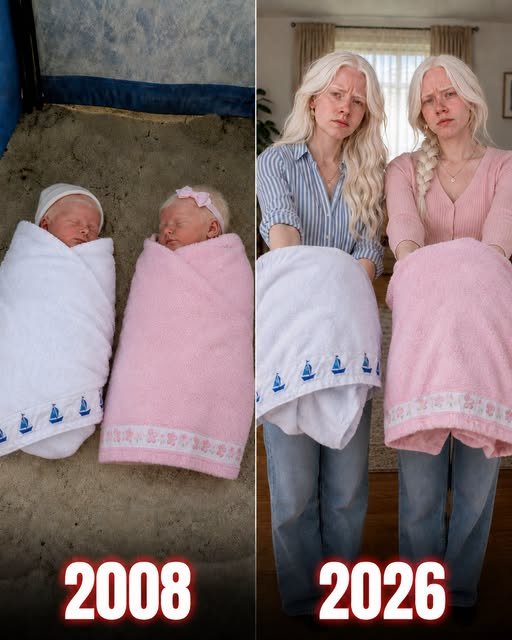
The Towels I Could Never Forget
On the evening my twin daughters turned eighteen, they placed two old beach towels on our kitchen table and asked me not to be angry with them.
I knew those towels before my hands even touched them.
One had once been white, though eighteen years had softened it into a dull cream. The other was faded pink.
My heart seemed to stop.
Eighteen years earlier, I had found Emily wrapped in the white towel and Grace bundled inside the pink one.
They had been newborn babies then, abandoned inside a changing cubicle beside the beach.
Now they stood across from me as young women.
Emily’s eyes were shining with nervous tears. Grace kept twisting her fingers together, something she had done since childhood whenever she was frightened.
“Dad,” Emily said quietly, reaching across the table for my hand.
Grace swallowed.
“We need to tell you the truth.”
I looked from their faces to the towels.
My fingers began to shake.
Whatever secret my daughters had been carrying, those two pieces of fabric had somehow brought us all the way back to the beginning.
And suddenly I was no longer standing in our kitchen.
I was thirty years old again, walking along a beach at the lowest point of my life.
Three Weeks After I Lost Everything
Three weeks before I found Emily and Grace, I buried the woman I had planned to spend my life with.
Sarah had been my fiancée.
She had also been carrying our daughter.
We had already named her Ivy.
Ivy never took her first breath, but she had already occupied an enormous place in our lives. There was a crib waiting for her at home. Tiny blankets had been folded in a dresser. Sarah had filled the closet with yellow baby clothes because she insisted yellow was happier than pink.
“Every baby deserves something bright,” she used to say.
Then, within a terrible stretch of time I still struggled to put into words, both Sarah and Ivy were gone.
After the funeral, I stopped functioning like a person who expected tomorrow to matter.
I ate only when someone placed food directly in front of me. I ignored phone calls. I left the curtains closed.
Most days, I sat inside the nursery.
The walls were pale yellow.
The crib stood untouched.
Sometimes I sat there for hours imagining the life that should have filled that room.
Then my best friend, Chris, showed up.
He took one look at me and walked straight to my bedroom.
“What are you doing?” I asked.
“Packing.”
“I’m not going anywhere.”
Chris continued putting clothes into a bag.
“You haven’t opened your curtains in three weeks.”
“That isn’t your concern.”
He stopped and looked at me.
“No,” he said. “But you are.”
I did not appreciate those words at the time.
I did not want encouragement.
I did not want company.
And I certainly did not want anyone trying to rescue me.
But Chris had known me long enough to understand that asking permission would get him nowhere.
So he put my bag in his car and drove me several states away.
To the ocean.
The Cry Behind the Changing-Stall Door
By sunset on our first day there, I had already decided the trip was a mistake.
Families were everywhere.
Children chased waves.
Parents rubbed sunscreen onto tiny shoulders.
Couples walked barefoot along the shore.
Every ordinary scene felt like a reminder of a life I had expected to have.
“I want to go home,” I told Chris.
He did not argue.
“Tomorrow,” he said.
I turned toward the parking area.
That was when I heard it.
A baby crying.
I stopped.
Chris looked at me.
“Did you hear that?”
Before I could answer, another cry followed.
Two babies.
We followed the sound toward a row of beach changing cubicles.
The crying grew louder.
One door stood partly open.
I pushed it wider.
And my entire world changed.
Two newborn girls were lying on the floor on top of the sand.
One was wrapped in a white beach towel.
The other was bundled in pink.
For one frozen second, I could not move.
Babies.
Two of them.
My mind collided with memories of Ivy, the daughter I had never been able to bring home.
Then one of the newborns whimpered.
Instinct took over.
I dropped to my knees.
“Chris, call somebody. Now.”
I removed my jacket and tucked it over both babies.
Their little faces were red from crying.
“They’re breathing,” I whispered.
I touched one tiny cheek.
“They’re cold, but they’re alive.”
Chris was already calling emergency services.
I stayed on the floor beside them until paramedics arrived.
Then came police officers.
Questions.
Social workers.
A woman named Andrea crouched beside me and explained that the babies would be taken to the hospital and placed somewhere safe while authorities searched for relatives.
I nodded.
That should have been the end of my part in their story.
I was simply the man who had found them.
I should have gone back to the hotel with Chris.
Instead, I followed the ambulance to the hospital.

“I Want to Become Their Father”
The nurses had temporarily called the girls Emily and Grace.
Emily had been wrapped in white.
Grace had been wrapped in pink.
I do not know why, but the names seemed to fit them.
So later, I kept them.
For several days, I told myself I was only concerned.
They had been abandoned.
Anyone with a heart would have worried about them.
But concern did not explain why I kept calling Andrea.
It did not explain why I asked about foster care.
It certainly did not explain why, one afternoon, I finally told her:
“I want to adopt them.”
Andrea studied me for a long moment.
Finding the babies, she explained gently, did not give me any special legal claim to them.
If I wanted to pursue adoption, I would have to go through the same process as anyone else.
Background checks.
Home inspections.
Parenting courses.
Interviews.
Financial reviews.
Months of uncertainty.
Then she asked me something much harder.
“Trent, do you want these children because they need a father—or because you need a reason to keep living?”
The question hurt because I knew there was truth inside it.
“Maybe both are true,” I admitted.
Andrea did not look away.
“But only one can come first.”
“Which one?”
I looked through the nursery window at the two sleeping babies.
“Them.”
She waited.
“They need safety,” I continued. “They need someone who will show up tomorrow and the day after that and every day after that. I can do that.”
“And what happens if they don’t heal your grief?”
I shook my head.
“That isn’t their responsibility.”
For the first time, Andrea’s expression softened.
“I don’t want them to save me,” I said. “I want to become a home for them.”
“Then prove it.”
So I did.
Learning How to Be Dad
I cleaned my house from top to bottom.
I took every required class.
I learned about newborn care, attachment, childhood development, emergencies, feeding schedules, and more things than I had ever imagined a person could know about diapers.
I prepared the nursery again.
But I did not repaint it.
The walls stayed yellow.
At first, I considered removing everything connected to Sarah and Ivy.
Then I realized that healing did not have to mean erasing them.
There could be room for grief and room for new love.
Eventually, Emily and Grace came home with me as foster daughters.
Later, once the legal process had run its course, they officially became mine.
I wish I could say I immediately became the perfect father.
I did not.
I became their father through mistakes.
Through midnight bottles I prepared incorrectly.
Through fevers that terrified me.
Through learning that two babies could somehow cry at exactly the same volume at exactly the same time.
Through toddler tantrums.
Through skinned knees.
Through school projects completed five minutes before bedtime because someone had “forgotten” to mention them for three weeks.
Through Emily demanding vanilla cake every birthday and Grace insisting that chocolate was the only cake worth eating.
Through learning to brush and braid hair.
Through parent-teacher conferences.
Through missing teeth and scraped elbows and handwritten Father’s Day cards.
Somewhere among all those ordinary moments, the house that had once felt unbearably empty became loud.
Messy.
Busy.
Alive.
And I loved every second of it.
The Things I Never Told Them
After the adoption was finalized, Andrea returned the two towels from the beach.
I placed them inside a cedar box.
Sarah’s photograph remained in my wallet.
I almost never spoke about her.
And I never spoke about Ivy.
I told myself I was protecting Emily and Grace.
I feared that if they knew too much about the family I had lost before finding them, they might believe they had been replacements.
Nothing could have been further from the truth.
Still, silence seemed safer.
At least, that was what I told myself.
When the girls turned fifteen, something changed.
They began spending long afternoons away from home.
Sometimes entire weekends were filled with vague plans.
“We’re studying.”
“There’s a school activity.”
“I’m helping a friend.”
“Grace has a project.”
“Emily promised somebody she’d babysit.”
Their adoption had never been a secret.
They had always known that I found them on a beach and later adopted them.
So naturally, one possibility took root in my mind.
They were searching for their biological family.
I had always promised myself I would support them if that day came.
I would never make them choose.
I would never tell them that loving the people they came from meant loving me less.
But there is a difference between believing something and being emotionally prepared for it.
For three years, I quietly practiced losing them.
I imagined them meeting their biological parents.
I imagined them discovering brothers or sisters.
I imagined them finding a family that looked like them in ways I never could.
And because I was afraid to hear the answers, I never asked the questions.

Their Eighteenth Birthday
On their eighteenth birthday, I made their favorite dinner.
Emily got her vanilla cake.
Grace got chocolate.
After dinner, they disappeared upstairs.
When they returned, each was carrying something folded in her arms.
My breath caught.
The towels.
“What are those doing out of the box?”
Emily laid the white towel on the kitchen table.
Grace placed the pink one beside it.
Then Grace said the words I had been dreading.
“For three years, we’ve been lying to you about where we were going.”
My stomach dropped.
I looked at them.
“Did you find your biological family?”
Emily’s face crumpled.
“Oh, Dad.”
She immediately came around the table.
“No. This isn’t about leaving you.”
Grace pushed the white towel toward me.
“Open it.”
My hands were shaking as I unfolded the fabric.
Something fell onto the table.
Plane tickets.
Three of them.
I stared at the names.
Emily.
Grace.
Trent.
Three passengers.
Three seats.
“We leave in three days,” Grace said.
“For where?”
Neither answered immediately.
I looked down.
My chest tightened.
The destination was the same coastal town Chris had taken me to eighteen years earlier.
The same beach.
“No.”
The word escaped before I could stop it.
Emily reached for me.
“Dad—”
“I can’t go back there.”
“Yes,” Grace said softly. “You can.”
I looked at her.
“And you won’t do it alone.”
They explained that the mysterious afternoons and weekends had nothing to do with searching for another family.
For three years, they had been working.
Babysitting.
Tutoring younger students.
Walking dogs.
Picking up weekend shifts.
Saving almost everything.
For plane tickets.
For me.
The Scrapbook
Then Grace unfolded the pink towel.
Inside was a scrapbook.
Across the cover, in their handwriting, were the words:
Our Family Began Before We Could Remember.
I opened it.
On the first page was an old photograph of me asleep on the sofa with two babies on my chest.
I remembered that night.
I had been so exhausted I fell asleep before moving them to their cribs.
The following pages held eighteen years of our lives.
Birthday parties.
Christmas mornings.
First days of school.
Report cards.
Missing teeth.
Halloween costumes.
School performances.
Bad haircuts.
Handmade cards.
Family vacations.
Photographs of three people who had somehow grown up together.
Then I reached one of the final pages.
My hands stopped.
Sarah.
Her photograph was there.
“Where did you get this?”
Emily looked embarrassed.
“Your wallet fell open years ago. I took a picture of the photo.”
I stared at Sarah’s familiar smile.
Grace spoke carefully.
“Is she why you always get quieter around our birthday?”
I looked at my daughters.
There was no point hiding anymore.
“Yes.”
“Who was she?”
“My fiancée.”
Emily sat beside me.
“And what happened?”
So I told them.
Not everything.
Not yet.
But enough.
I explained that Sarah had died only weeks before I found them.
“I never wanted you to know because I was afraid you’d think I chose you because I had lost her.”
“We’ve never felt like replacements,” Emily said.
“You don’t understand.”
“Then help us understand,” Grace replied.
I stared at Sarah’s photograph.
“If I talked about her, I was afraid all you would hear was what I lost before you came into my life.”
Emily slowly turned the page.
There were four names written across it.
Sarah.
Ivy.
Emily.
Grace.
I could barely breathe.
“You know about Ivy?”
The Name I Had Hidden for Eighteen Years
Grace nodded.
They had discovered Ivy’s blanket while searching the cedar box for old birthday decorations.
Her name had been stitched into the corner.
For eighteen years, I had barely allowed myself to say it aloud.
Ivy.
My daughter who never came home.
But Emily and Grace had written her name beside their own.
Not beneath them.
Not before them.
Beside them.
As though there had never been a competition.
As though love had never required me to erase one daughter in order to love two others.
Then Emily handed me a letter.
They had written it together.
They wrote about the man who found two newborn babies when his own life had fallen apart.
About the father who learned bottles and diapers.
Then ponytails and homework.
Then teenage moods, school dances, driving lessons, heartbreak, and independence.
They wrote that they had noticed the things I thought I had hidden.
That I avoided beaches.
That I became quieter around their birthday.
That sometimes, when I believed nobody was watching, sadness crossed my face without warning.
For years, they had wondered whether raising them had caused that sadness.
Eventually, they understood the truth.
I did not love them because I had stopped loving Sarah and Ivy.
I loved Emily and Grace while still loving Sarah and Ivy.
One love had never erased another.
Near the bottom of the letter, they included something Andrea had once told them.
You never wanted us to save you. But you saved us first, Dad. We’ve spent eighteen years trying to return the favor.
By the time I reached the final line, I could barely see.
Emily pushed the tickets toward me.
“Come back with us.”
I looked at both of them.
“I’m scared.”
Grace took my hand.
“That’s why we’re going together.”
Returning to the Beach
Three days later, I stood at the edge of the same beach.
Eighteen years had passed.
Yet the moment I saw the changing cubicles, my body remembered everything.
The sand.
The cries.
The ambulance.
The grief.
The babies.
For a moment, I considered turning around.
Then Emily slipped her hand into my left.
Grace took my right.
Neither said anything.
They simply walked.
So I walked with them.
We crossed the sand together.
And near the dunes, two people were waiting.
Chris.
Andrea.
I stared at my daughters.
“You brought reinforcements?”
Emily smiled.
“In case you tried to escape.”
Grace squeezed my hand.
“They were here when you chose us before we were old enough to choose you.”
Chris walked toward me and pulled me into a hug.
“I brought you here eighteen years ago because I thought maybe the ocean could keep you alive,” he said.
I looked toward the waves.
“It did.”
Chris shook his head.
Then he looked at Emily and Grace.
“No, Trent.”
He smiled.
“You did.”

The Note Andrea Had Kept
Andrea stepped forward holding an old piece of paper.
“I wrote this after one of your first visits with the girls,” she explained.
She admitted that when I first asked about adoption, she had been worried about me.
I was grieving.
Exhausted.
Lost.
She did not know whether a man who seemed so emotionally broken could give two vulnerable babies the stability they needed.
Then she watched me with them.
“You sat beside their hospital bassinets and talked to them,” she said. “They were newborns. They couldn’t understand a word you were saying, but you spoke to them like their fears mattered. Like their comfort mattered. Like they mattered.”
My throat tightened.
“They did matter.”
Andrea smiled.
“That’s when I began believing you could become their father.”
Four Names at the Ocean
A little farther down the beach, two chairs had been placed near the water.
The white towel was spread across one.
Emily gently set Sarah’s photograph on it.
Grace placed a small card beside the picture.
One name had been written across it.
Ivy.
Then my daughters stood beside me.
Emily looked toward Sarah’s photograph.
“Tell us about her.”
For eighteen years, I had avoided that conversation.
Now I sat down.
And finally, I began.
“Sarah was a terrible singer,” I said.
Grace laughed.
“Seriously?”
“Absolutely awful. And she sang constantly.”
Emily smiled.
“What else?”
“She hated folding laundry. She loved vegetables I couldn’t stand. She could spend twenty minutes deciding which movie to watch and then fall asleep ten minutes after it started.”
The girls laughed.
I did too.
And strangely, the laughter did not feel disrespectful.
It felt warm.
Alive.
For the first time in years, Sarah was not simply a tragedy.
She was a person again.
A woman who sang badly.
A woman who hated laundry.
A woman who laughed and argued and planned and loved.
Then Grace looked at the card.
“What about Ivy?”
The question hurt.
But this time, I did not run from the pain.
“I never got to hold her,” I said quietly.
Emily took my hand.
“But she was stubborn.”
Grace smiled through tears.
“How do you know?”
“She kicked constantly whenever Sarah tried to sleep. And for some reason, every time I burned dinner, she kicked even harder.”
Emily laughed, wiping her eyes.
“She sounds like us.”
I looked at her.
Then at Grace.
Then at Sarah’s photograph.
Then Ivy’s name.
Maybe she was right.
The Truth I Finally Understood
For eighteen years, I had divided my life into two pieces.
Before the beach.
And after the beach.
Before Emily and Grace, there had been Sarah and Ivy.
After Sarah and Ivy, there had been Emily and Grace.
I had treated those lives like separate rooms, afraid that opening the door between them would somehow damage everything.
But standing beside the ocean with my daughters, I finally understood.
Love does not work that way.
Grief does not disappear because happiness eventually returns.
And happiness does not betray the people we once lost.
I looked at the ocean and spoke four names aloud.
“Sarah.”
The waves rolled toward shore.
“Ivy.”
Emily tightened her grip on my hand.
“Emily.”
Grace leaned against my shoulder.
“Grace.”
Nothing broke.
Nothing vanished.
The daughters beside me did not become less precious because I acknowledged the daughter who had never made it home.
Sarah did not become less important because life had continued without her.
For years, I had believed healing meant leaving something behind.
Instead, my daughters had taught me that sometimes healing means finally allowing everything you love to belong to the same story.
I looked down at the faded white and pink towels.
Once, they had carried two abandoned newborn girls.
For years, I had thought those girls had arrived in my life when I was empty.
But that was not quite true.
I had still been carrying love.
I simply had nowhere to place it.
Emily and Grace had never replaced Sarah and Ivy.
They had become part of the family Sarah and I had already begun dreaming about.
My grief remained.
I knew it probably always would.
But for the first time, I did not feel obligated to defeat it.
I could carry it.
I could carry Sarah’s memory.
I could carry Ivy’s name.
And I could still walk forward with my daughters beside me.
Eighteen years earlier, I had arrived at that beach believing my life was over.
Then I heard two babies crying behind a changing-stall door.
I thought I was the one who had rescued them.
Maybe, in that moment, I had.
But standing there eighteen years later, with Emily holding one of my hands and Grace holding the other, I finally understood something else.
They had never been responsible for saving me.
They had simply given me the chance to keep loving.
And somehow, that had been enough.
I looked once more at the ocean.
Then at my daughters.
“Ready to go home?” Emily asked.
I smiled.
“Yes.”
Because this time, when I left that beach, I was not running away from what I had lost.
I was carrying every part of my family with me.
My grief was coming too.
But so was my love.
And this time, love was coming home.