
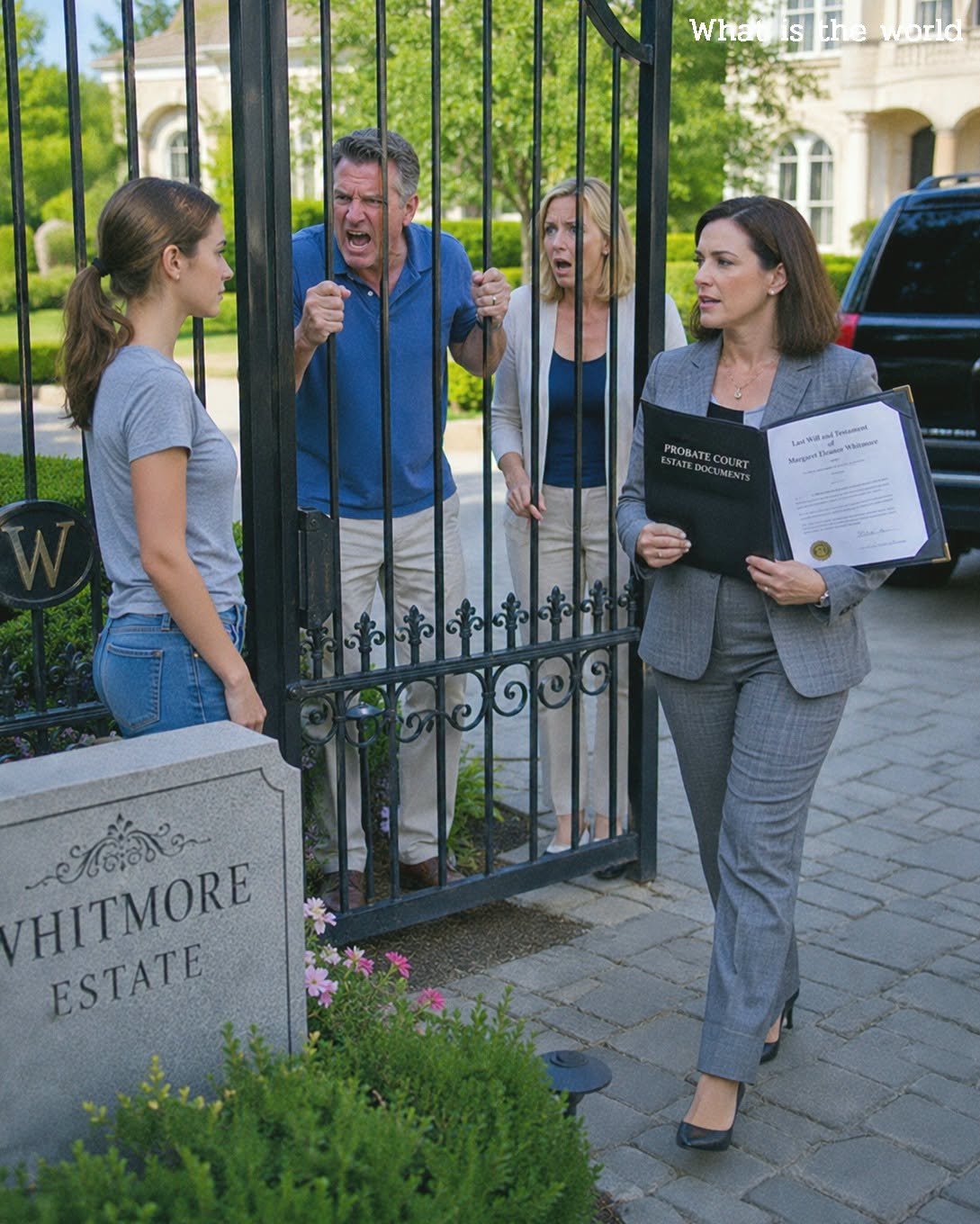
My father leaned toward the iron gate as Evelyn Mercer turned the final page in the folder.
The anger had disappeared from his face.
For the first time since he and my mother arrived in their black SUV, he looked uncertain.
“Who is that?” he asked.
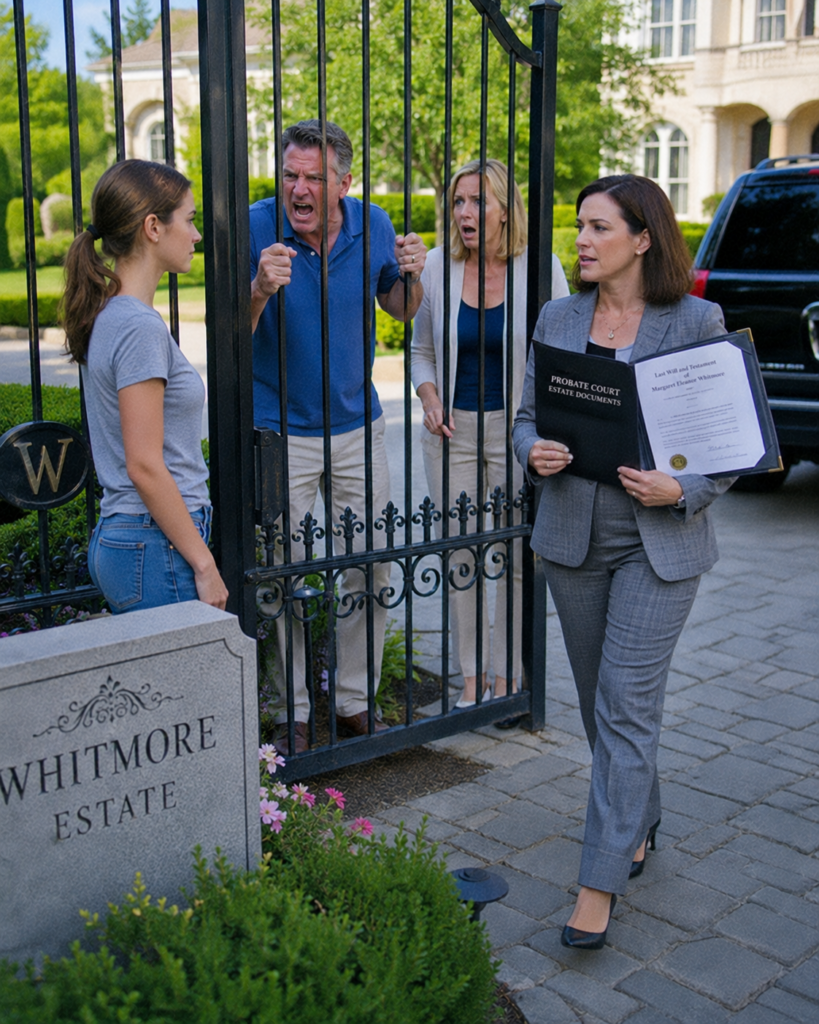
Evelyn held the document where only she and my parents could read it.
“Your mother’s independent trustee,” she said.
My mother blinked.
“That’s impossible.”
Evelyn glanced toward me, then back at them.
“No.
What’s impossible is pretending you didn’t know about him.
His name appears on correspondence sent to this address eighteen months ago.
Correspondence bearing your signature.”
My mother opened her mouth, but nothing came out.
I stood twenty feet up the driveway with my arms folded tightly across myself, not because I was cold this time, but because part of me still expected the scene to snap back into the old shape.
My father demanding.
My mother rewriting reality.
Me explaining myself until exhaustion sounded like guilt.
But the gate remained closed.
That mattered more than I expected.
For once, there was a physical boundary between their certainty and me.
Evelyn removed another document from the folder.
“Your mother knew her daughter might interfere with the estate,” she said.
“So she named an independent trustee and instructed him to release the trust directly to her granddaughter when she turned twenty-eight.
Neither parent was to control, redirect, administer, or delay the distribution.”
My father’s expression hardened again.
“We’re her parents.”
“You are,” Evelyn replied.
“You are not beneficiaries.”
My mother found her voice.
“This is ridiculous.
She lived with us.
We paid for everything.”
That was such a familiar lie that my body reacted before my mind did.
My jaw tightened.
For nearly a year I had transferred money to my parents every month.
I bought groceries.
I paid part of the internet and utilities.
I covered my own phone, medical costs, software subscriptions, transportation, and business expenses.
Yet whenever they wanted obedience, my parents described me as someone they were carrying.
Dependent.
Ungrateful.
Helpless without them.
They had repeated those words so often that some part of me had started to believe them.
Evelyn apparently had no interest in the family mythology.
“The estate received several communications claiming your daughter was incapable of managing her affairs,” she said.
“One requested that further contact be routed through you.
Another suggested the distribution should be postponed until she demonstrated financial stability.”
My father raised his chin.
“That was concern.”
“Concern doesn’t require hiding certified mail.”
My mother’s face flushed.
“We didn’t hide anything.”
Evelyn tapped the folder.
“Then perhaps you can explain why three notices were accepted at your home and never reached the beneficiary.”
“Mail gets misplaced.”
“Three times?”
My mother looked at me through the bars.
That was the moment she tried to pull me back into our old roles.
“You know how chaotic things have been,” she said.
“Your father and I have been under enormous pressure.
We were trying to protect you.”
Two nights earlier, she had forced me into freezing rain without shoes.
Now she was using the voice she reserved for guests and doctors.
Soft.
Reasonable.
Concerned.
I nearly laughed.
Instead I said, “You took my cards.”
She stiffened.
“Those cards were connected to accounts your father helped
you establish.”
“You emptied my purse.”
“You were being irrational.”
“You wouldn’t let me take my shoes.”
A silence settled over the entrance.
Even the guard looked away.
My father exhaled sharply.
“Enough drama.
Open the gate.
We’ll discuss this privately.”
I looked at Evelyn.
She didn’t answer for me.
That small choice gave me more dignity than I had felt in my parents’ house for years.
So I answered myself.
“No.”
My father’s eyes narrowed.
The word sounded different outside their house.
Two nights earlier, saying no had cost me my access to money, my bedroom, and the shoes on my feet.
Now it simply meant the gate stayed closed.
My mother stepped closer to the intercom.
“Do you have any idea what she’s doing?” she asked Evelyn.
“She’s vulnerable.
She makes impulsive decisions.
She doesn’t understand complicated financial matters.”
Evelyn’s expression barely changed.
“She’s spent the last forty-eight hours securing compromised accounts, establishing independent banking, documenting unauthorized access, reviewing trust documents, and answering every verification question my office requires.
She seems remarkably capable.”
My mother looked at me again.
This time, there was no concern in her face.
Only calculation.
“You’ve been filling her head with things,” she told Evelyn.
“Documents tend to do that.”
My father slapped one hand against the gate.
The sound cracked across the driveway.
The guard immediately stepped forward.
Evelyn didn’t flinch.
“Sir, I’d strongly advise you not to do that again.”
My father lowered his hand.
“What exactly are you accusing us of?”
“I’m not accusing you of anything,” Evelyn said.
“I’m informing you that the trustee has ordered a review of communications sent to the estate before distribution.
That review includes the statements made about your daughter’s competency, the certified notices received at your address, and any attempt to interfere with access to her funds.”
My mother swallowed.
That last phrase hit her harder than the others.
I saw it.
So did Evelyn.
My father tried to recover control.
“Her funds? She’s exaggerating.
We disabled a couple of cards because she was having a tantrum.”
I felt something cold move through me.
A couple of cards.
As if he had temporarily taken away a television remote.
Not deliberately used old recovery access to lock me out of financial tools while ordering me into the street.
Evelyn turned toward me.
“Did you authorize them to disable anything?”
“No.”
“Did you authorize changes to your account recovery settings?”
“No.”
“Did you give either parent permission to retain your cards?”
“No.”
My mother snapped, “She was living in our home.”
Evelyn closed the folder.
“That sentence doesn’t create financial authority.”
My father’s phone rang.
He looked at the screen and declined the call.
Almost immediately, it rang again.
He declined it a second time.
Evelyn noticed.
“You may want to answer that.”
“Why?”
“Because I believe that’s Mr.
Holloway.”
The independent trustee.
My father’s face changed again.
He looked down just as the phone began ringing a third time.
This time he answered.
“Hello?”
I couldn’t hear the voice on the other end, but I watched my father’s posture lose an inch at a time.
“No,” he said.
“That’s not what happened.”
Pause.
“You don’t understand the situation.”
Another pause.
Then louder: “She’s our daughter.”
Evelyn looked at me.
I understood without being told.
NEXT STORY
The trustee was not calling to negotiate.
My father walked several feet away from the gate, speaking in a low, urgent voice.
My mother stayed where she was.
“You really want to humiliate us like this?” she asked me.
The question almost worked.
That was the frightening part.
After everything, some trained reflex inside me still wanted to protect her from embarrassment.
Then I remembered wet socks stuck to my feet under fluorescent gas-station lights.
I remembered the porch light switching off.
I remembered her body blocking the bench where my shoes sat.
“I didn’t invite you here,” I said.
Her lips pressed together.
“We were worried.”
“You tracked me.”
“Your father noticed the device location.”
“And drove here.”
“Because you’re making decisions you don’t understand.”
I looked past her at the SUV.
“Like leaving?”
She didn’t answer.
My father’s call ended.
He returned looking furious.
“This has gone far enough,” he said to Evelyn.
“We’re leaving.”
My mother turned toward him.
“What did he say?”
“Get in the car.”
“What did he say?”
“Now.”
Evelyn opened the folder again.
“Mr.
Holloway has placed an immediate hold on any communication involving your parents,” she told me.
“All future estate contact will go through you and my office.
He’s also requested copies of the banking alerts from Thursday night.”
My father’s head snapped toward her.
“For what purpose?”
“To determine whether additional legal action is warranted.”
My mother’s confidence finally cracked.
“Legal action? Over a family disagreement?”
Evelyn’s voice stayed level.
“That depends on what the records show.”
My father pointed toward me.
“If you do this, don’t expect to come home when it falls apart.”
The threat landed softly because it was already obsolete.
Behind me stood a house my grandmother had deliberately placed beyond their reach.
Beside me stood a lawyer who did not need me to make my pain sound respectable before she believed the documents.
And somewhere across town sat Naomi, the woman who had answered one frightened phone call without asking what I had done to deserve help.
I realized home had already changed meaning.
“I’m not coming back,” I said.
My mother stared at me.
“You don’t mean that.”
“I do.”
My father gave a bitter laugh.
“You think a house and some money make you independent?”
“No.”
I looked at the folder in Evelyn’s hands.
“Saying no and surviving what you did afterward did that.”
He had no answer.
They left three minutes later.
The black SUV reversed from the gate, paused at the road, and disappeared behind the trees.
Only after it was gone did my hands begin shaking.
Evelyn waited until I steadied them.
“There’s something else you need to see,” she said.
We walked back toward the house.
Inside, sunlight stretched across hardwood floors that smelled faintly of cedar and dust.
I had only visited the property twice as a child, before my mother stopped speaking to my grandmother completely.
I remembered pieces of it rather than rooms.
A blue ceramic bowl.
A piano no one played.
My grandmother’s bracelets clicking together when she reached for my hand.
Evelyn placed the folder on the dining table and removed a sealed envelope.
My name was written across the front in my grandmother’s handwriting.
The sight of it hurt more than I expected.
“She left instructions that you receive this after the trust was verified,” Evelyn said.
I opened it carefully.
The letter was only two pages.
My grandmother did not spend them insulting my parents.
That surprised me.
Instead, she wrote about me.
She said she had watched my mother turn help into leverage for years.
She worried that if she left anything directly accessible through the family, I might never know it belonged to me.
She wrote that money could become another cage if someone convinced you that receiving it made you weak.
Then came the sentence that broke me.
I have not left this to rescue you.
I have left it where only you can decide what it becomes.
I cried then.
Not at the gate.
Not in the gas station.
Not when my mother took my cards.
At my grandmother’s dining table, with a letter in my hands and sunlight falling across a room my parents had spent years pretending no longer mattered.
The trust review took several weeks.
The results were ugly but clear.
My mother had accepted multiple certified notices and never given them to me.
She had communicated with the estate twice, presenting herself as a necessary intermediary even though the trust explicitly excluded her.
My father had used old account-recovery access to interfere with several financial accounts after I refused to show him my banking activity.
The trustee’s attorneys documented everything.
What followed was less dramatic than television and much more satisfying.
There was no screaming courtroom scene.
No instant arrest at the gate.
There were letters, account records, sworn statements, security logs, attorneys, and consequences arriving one page at a time.
My parents were formally barred from communicating with the trustee or estate except through counsel.
My bank removed the remaining legacy permissions and investigated the unauthorized security changes.
I replaced every card, froze my credit temporarily, changed phone plans, and separated every digital account I could identify.
On Evelyn’s advice, I documented the location tracking as well and revoked access from every old device.
The estate completed distribution directly to me.
The house transferred into my name.
The trust remained under the independent structure my grandmother had created, with no authority granted to either of my parents.
My parents threatened to challenge parts of the estate.
Their attorney apparently explained what the signed receipts, prior correspondence, and trust language would look like under scrutiny.
The challenge never came.
For months, my mother sent messages from new numbers.
Some were angry.
Some were wounded.
A few sounded almost apologetic until the final sentence turned into a demand.
You need to remember who supported you.
Family shouldn’t involve lawyers.
Your father deserves an apology too.
You’re letting money change you.
I stopped answering.
My father tried a different strategy.
He sent one email containing an itemized list of what he claimed it had cost them to let me live at home.
The number was absurd.
Evelyn asked if I wanted her office to respond.
I stared at the spreadsheet for a long time.
Then I said no.
Not every accusation deserved a defense.
That lesson took me longer to inherit than the house did.
I stayed in the property.
At first, every room felt borrowed.
I kept expecting someone to tell me which cabinets I could use or how long I was allowed to leave a cup beside the sink.
Then ordinary things began changing the atmosphere.
I bought groceries without explaining them.
I closed my bedroom door and nobody knocked.
I worked late at the dining table and no one asked how much I had earned that day.
I put a pair of sneakers beside the front door.
For weeks, seeing them there made me stop.
They became the smallest symbol of the whole story.
No one could tell me to leave them behind.
Naomi came over for dinner about a month after the transfer was complete.
She brought a houseplant and laughed when she saw how little furniture I owned.
“Big house,” she said.
“One chair.”
“The chair is excellent.”
“Clearly.”
We ate takeout on the floor because I had not bought a dining set yet.
At one point, she looked toward the windows facing the gate.
“Do you ever wish they’d handled it differently?”
I knew what she meant.
Did I wish my parents had simply given me the notices?
Did I wish my mother had told the truth about my grandmother?
Did I wish my father had heard the word no without turning it into punishment?
Of course.
But wishing for different parents was not the same as waiting for the ones I had to become different.
“I wish they had made different choices,” I said.
“I’m done building my life around whether they ever admit that.”
Naomi nodded.
No speech.
No lesson.
Just understanding.
A few days later, I drove past my parents’ neighborhood for the first time since that Thursday night.
I did not stop.
I did not need to prove that I could stand outside their house wearing expensive shoes or driving a nicer car.
That would still have made them the audience for my life.
Instead, I kept driving.
When I reached my grandmother’s property, the gate opened automatically for my car.
Late sunlight spilled across the driveway.
For a second, I remembered my parents standing outside it, frozen beneath the stone marker, finally realizing that the daughter they expected to come crawling home had found the one place they could not control.
But the memory no longer felt like victory.
Victory suggested I was still playing against them.
What I felt was quieter.
I parked beside the house, walked to the front door, and looked down at the sneakers on my feet.
Then I went inside and locked the door behind me.
Not because I was being thrown out.
Because, finally, I was the one with the key.