
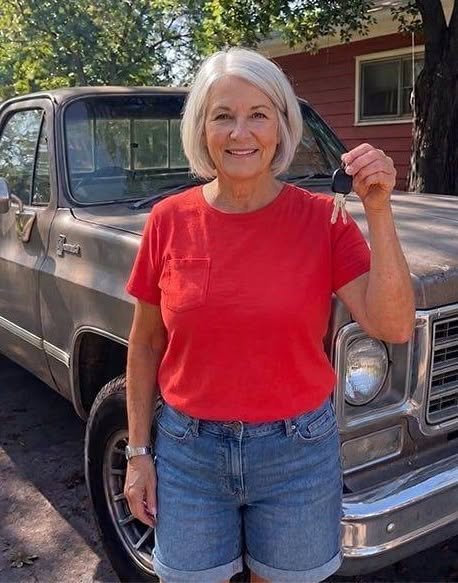
At 62, only weeks after burying my controlling husband, I finally did the one thing he had forbidden throughout our 40-year marriage: I learned to drive. But when I took his beloved truck out alone and selected the GPS address saved as “Home,” it led me to the last woman I expected—and exposed the lie that had shaped my entire adult life.
The house felt unbearably quiet after my husband, Graham, died.
Nearly 2 months had passed, yet I still reached for his coffee mug every morning. After 40 years together, it was difficult to separate grief from habit.
But losing Graham revealed something more frightening than loneliness.
I had no idea how to live independently.
I couldn’t drive to the supermarket, collect my prescriptions, or visit his grave without asking our daughter, Claire, for help. Graham had always insisted on driving.
“Your reflexes are too slow, Marianne.”
“The roads are dangerous.”
“You panic too easily.”
Whenever I protested, he would smile and say, “Why would you need a license when you have me?”
For years, I had mistaken control for protection.
One afternoon, while Claire was driving me home from the pharmacy, she sighed.
“Mom, I love you, but you can’t depend on me for every errand forever.”
“I know. Your father always handled these things.”
“I never understood why he discouraged you from driving. Grandma June is almost 85, and she still goes everywhere herself.”
The mention of my mother-in-law made me tense.
“June never liked me.”
“She’s never said anything unkind about you.”
“Your father told me what she said when we married. She thought I wasn’t good enough for him.”
Claire frowned. “But Dad was the one delivering all those messages. How do you know what Grandma actually said?”
“Your father spent decades keeping the peace between us.”
“Or keeping you apart.”
I turned toward the window. “Please take me home.”
That night, I studied the calendar Graham had kept beside the telephone. Every appointment and decision was recorded in his handwriting.
He had managed the finances, chosen our vacations, discouraged me from working, and gradually separated me from friends he considered “bad influences.”
I couldn’t remember the last important decision I had made entirely by myself.
“Enough,” I whispered. “I’m 62. I can learn to drive.”
After the funeral, Claire had helped transfer our joint accounts into my name. I used some of that money to enroll at a driving school nearly 2 miles away.
I studied for the written test, received my learner’s permit, and arranged for an instructor named Malcolm to collect me from home. I told no one. I wanted this decision to belong entirely to me.
The first lesson was terrifying, but Malcolm was patient.
“You don’t have to stop being afraid,” he told me. “You only have to keep going.”
So I did.
Over the next 5 weeks, I learned to reverse, change lanes, parallel park, and enter busy intersections. With every lesson, Graham’s critical voice in my head grew quieter.
I passed my road test on the first attempt.
When the examiner handed me a temporary license, I cried in the parking lot. For the first time in 40 years, I could go anywhere without asking permission.
Before driving Graham’s dark green pickup truck, I called the insurance company and added myself to the policy. The truck had transferred to me with the rest of his estate, but sitting behind its wheel still felt forbidden.
Graham had polished it every Sunday and refused to let anyone else drive it.
“Nobody touches this truck but me,” he used to say.
Now the keys were mine.
I started the engine and whispered, “Look at me now, Graham.”
While examining the dashboard, I touched the navigation screen. A house icon appeared with the word “Home” beneath it.
I selected it, expecting our address.
Instead, the GPS displayed an unfamiliar street in a town 20 minutes away.
My hands went cold.
Had Graham been visiting another woman? Had he maintained a second life during all those afternoons he claimed to be running errands?
I nearly switched off the engine. But I had spent 40 years going only where Graham allowed me to go.
“I need to know.”
I followed the directions into an old neighborhood lined with brick houses and mature trees. When the GPS announced that I had arrived, I looked through the passenger window and stopped breathing.
Blue shutters. Rosebushes. A white porch swing where I had once sat as a young bride.
It was June’s house—the home where Graham had grown up.
That explained why he might have labeled it “Home,” but not why he had been visiting without telling me.
For nearly 40 years, Graham had insisted that June despised me. He allowed her occasional visits with our children, but only when he was present and I stayed home. He had turned our supposed feud into accepted family history.
I climbed out and rang the bell.
June opened the door. Her eyes moved from my face to Graham’s truck.
“You drove here?”
“I received my license yesterday.”
Her expression collapsed.
“Then he never told you.”
“Told me what?”
She stepped aside. “You’d better come in.”
We sat in her lavender-scented living room while she poured tea with trembling hands.
“Graham told me you hated me,” I began. “He said you thought I was beneath him.”
June stared at me.
“He told me you wanted nothing to do with me. We were both lied to by the same man.”
“Why would he do that?”
“Do you remember the watercolors you used to paint?”
The question stole my breath.
Before marrying Graham, I painted boats, harbors, and coastal landscapes. I dreamed of becoming an artist, but Graham called it a childish hobby.
“A gallery owner named Leonard saw one of your paintings at a church fair,” June explained. “He wanted to include your work in an exhibition and offered you an apprenticeship.”
“I never knew.”
“I gave the letter to Graham. When he complained that the studio was 2 towns away, I offered to teach you to drive and lend you my car.”

“What did he say?”
“That you laughed at the offer and wanted to be a wife and mother, nothing more. Then he gave me a note supposedly from you, warning me to stay out of your marriage.”
“I never wrote it.”
“I know that now.”
June had tried calling and writing, but Graham intercepted her messages. When she came to our house, he threatened to end her contact with the children. After that, he allowed only occasional supervised visits and continued insisting that I despised her.
“By the time the children were adults, I suspected he had deceived us,” June admitted. “But I was ashamed that I had waited so long, and I feared you would never believe me.”
“Then why didn’t you contact me after he died?”
“I attended the funeral, but you were surrounded by the children. I couldn’t destroy their memories of him while you were standing beside his casket. I planned to visit after a few weeks, but I kept losing my courage.”
She lowered her eyes.
“I postponed the truth just as Graham did. I’m sorry.”
I couldn’t excuse her silence, but I understood what fear could do to a person.
“Why was he so determined to stop me from driving?”
“At first, he feared your art would give you confidence, friends, and money of your own. Later, he discovered that keeping you dependent allowed him to control every part of your life.”
I looked at my hands—the hands that had once held paintbrushes and then spent decades waiting beside passenger doors.
“The GPS shows he was coming here.”
June nodded. “He started visiting me 6 months ago, after learning how serious his heart condition was. He admitted destroying your opportunity and keeping us apart. He said he wanted to bring you here himself, but he kept postponing it.”
“He had 40 years.”
“I know.”
June retrieved a worn file box from a locked cabinet. Inside were returned letters addressed to me, a copy of the gallery offer, and the rejection Graham had submitted without my knowledge.
He had written that his wife had no interest in exhibiting her work.
At the bottom, he had forged my signature.
There was also a recent letter to June.
I told myself I was protecting my marriage, but I was afraid. Marianne’s art could have given her a life beyond me. Once I stopped her, every later lie became easier.
My eyes filled with tears.
“He knew what he had done.”
“Yes,” June said. “But regret is not the same as making things right.”
That afternoon, I drove June to my house and called Claire and my 2 sons, Jacob and Miles.
They resisted at first.
“Dad isn’t here to defend himself,” Jacob said.
“I’m not asking you to erase every good memory,” I replied. “I’m asking you to accept the truth.”
Then June opened the box.
Claire recognized Graham’s handwriting immediately. Miles read the confession, while Jacob examined my forged signature.
Slowly, other memories surfaced.
Claire remembered Graham refusing to let me accept a part-time job. Miles recalled him discouraging me from visiting an old friend. Jacob remembered how he mocked me whenever I asked about the bank accounts.
What had once seemed like isolated incidents suddenly formed a pattern.
“I still loved Dad,” Jacob said quietly.
“So did I,” I replied. “Loving him doesn’t make his actions right. A person can give us good memories and still cause terrible harm.”
The following week, I turned our spare bedroom into a small studio. I bought watercolor paper, brushes, and an easel.
My first painting was Graham’s truck beneath the maple tree.
It wasn’t perfect, but it was mine.
I continued painting and enrolled in an art class at the community center. June sometimes rode with me, but she offered directions only when I asked.
Several months later, I sold the truck and bought a small blue car that I chose entirely by myself.
At 62, I had spent most of my life in the passenger seat.
But I was finally holding the wheel—and no one else would ever decide my destination again.