
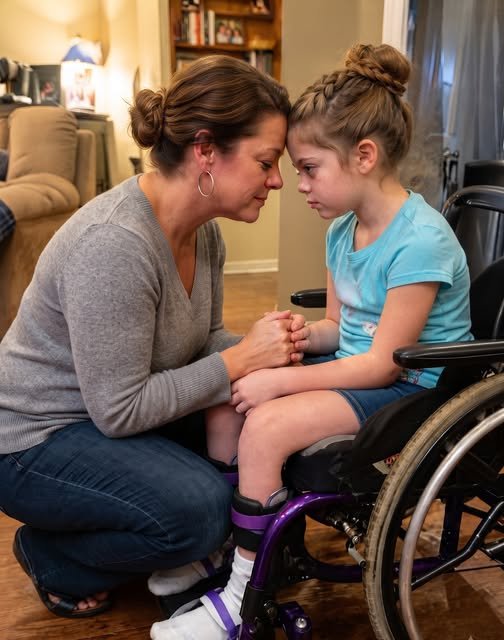
Part 1 — The One Room She Wanted to See
For almost three years, my husband Daniel and I had been trying to adopt a child.
By the time Ava came into our lives, I had learned how dangerous hope could be.
There had been forms stacked on top of forms, interviews, background checks, home visits, classes, phone calls that seemed promising, and meetings that ended with careful smiles and no guarantees.
More than once, I had allowed myself to imagine a child sitting at our kitchen table or leaving shoes beside our front door.
And more than once, that imagined future disappeared.
Eventually, I taught myself not to picture too much.
Then I met Ava.
She was nine years old when she rolled into the meeting room in her wheelchair and looked directly at me with serious gray eyes.
She was small for her age, with a quietness that seemed much older than nine.
Beth, her social worker, had already told us that Ava had suffered a spinal injury in a car accident when she was very young. She had also moved through several placements afterward.
“She’s very observant,” Beth explained. “She doesn’t usually react right away, even when she likes someone.”
Then Beth smiled slightly.
“She watches before she decides.”
That description stayed with me.
During our first meeting, Ava answered our questions politely, but rarely volunteered anything.
She liked drawing.
She liked lemon ice pops.
She liked books about animals.
She did not seem particularly impressed by Daniel or me.
Then Daniel accidentally bumped his coffee cup.
It tipped over, spilling coffee across the table.
“Oh, I’m sorry,” he told the table solemnly. “You didn’t deserve that.”
Ava immediately looked down.
But not before I saw the smallest smile tugging at the corner of her mouth.
It lasted less than a second.
For me, it was enough.
Six months later, after more interviews, more waiting, more paperwork, and countless nights when I tried not to imagine what might go wrong, we finally brought Ava home.
I had pictured that drive many times.
In some versions, she talked excitedly.
In others, she cried.
In reality, she did neither.
She sat quietly in the back seat, staring through the window as neighborhoods passed by.
There was something unusual in the way she watched the road.
It did not feel like ordinary curiosity.
It almost seemed as if she were looking for something.
I turned slightly in my seat.
“Your room is light green,” I told her. “We didn’t know what color you’d like, so we thought you could choose something different later.”
Ava nodded.
Daniel glanced at her in the rearview mirror.
“And if you absolutely hate green, we’ll repaint it.”
No response.
“Purple,” he continued. “Blue. Yellow. Polka dots. A mural of dinosaurs playing basketball—”
I gave him a warning look.
“No pressure,” he added quickly.
Ava returned her attention to the window.
I reminded myself of what Beth had said.
She watches before she decides.
Our house was an old brick place Daniel and I had bought the previous year.
It had belonged to an elderly man named Walter before us. He had died several years earlier, and after his estate went through a complicated liquidation process, the house eventually ended up at auction.
We had gotten it for much less than comparable homes because it needed repairs.
But it had something we desperately needed.
Space.
Wide hallways.
A bedroom on the first floor.
A bathroom we could modify.
Daniel and his brother had built ramps near the back entrance, and we had made several other changes before Ava arrived.
The basement was unfinished but dry, reached by a ramp we had installed beside the original stairs. Mostly, it held tools, old furniture, and boxes we kept promising to organize someday.
When we arrived, I gave Ava a tour.
The living room.
The kitchen.
The widened downstairs bathroom.
Then her bedroom.
I had imagined this moment more times than I could count.
There were bookshelves along one wall, a lamp beside the bed, fresh blankets, a desk where she could draw, and enough empty space for her wheelchair to move comfortably.
Ava looked around.
“It’s nice,” she said.
That was all.
I tried not to feel disappointed.
She had been moved from home to home. Of course she wasn’t going to fall in love with a room because I had bought pretty curtains.
We continued down the hallway.
Then Ava suddenly looked up at me.
“Can I see the basement?”
I blinked.
“The basement?”
She nodded.
Of all the questions I had expected, that was not one of them.
“Sure,” I said. “Maybe later. There’s not much to see down there. Mostly boxes and Daniel’s collection of tools he insists he’ll organize.”
“Someday,” Daniel called from the kitchen.
Ava did not laugh.
Instead, something changed in her face.
Only briefly.
A tiny drop of disappointment.
But it was unmistakable.
For the rest of the evening, she remained quiet.
Daniel made spaghetti for dinner. Ava thanked him when he handed her a plate. She thanked me when I brought her water. She even thanked us when we cleared the dishes.
Every word was polite.
Every movement was careful.
But twice, I caught her staring down the hallway.
Toward the basement door.
Later, after helping her settle into bed, I went back downstairs.
Daniel was washing dishes.
“That was strange,” I said.
He glanced over his shoulder.
“The basement?”
“What nine-year-old comes to a new house and cares more about the basement than the kitchen?”
“Maybe she likes basements.”
“Do you know any children who like basements?”
Daniel considered this.
“Future architects?”
I gave him a look.
He dried his hands and leaned against the counter.
“Claire, this is probably the biggest day she’s had in years. Maybe she focused on one random thing because everything else feels overwhelming.”
“I know.”
And logically, I did.
Still, something about Ava’s expression bothered me.
It had not looked like curiosity.
It had looked like recognition.
That night I slept lightly.
I had heard people talk about new mothers waking at every sound.
Apparently becoming a mother to a nine-year-old could do the same thing.
A little after six in the morning, I opened my eyes.
Daniel was still asleep.
The house was silent.
For the first week, we had placed a small camera in Ava’s room with her permission. Beth had recommended it as a temporary safety measure while everyone adjusted. We had explained to Ava that it could be removed whenever she wanted.
I reached for my phone and checked the feed.
Her bed was empty.
I sat upright.
For two seconds, I told myself she was probably in the bathroom.
Then panic took over.
I hurried into the hallway.
Bathroom.
Empty.
Kitchen.
Empty.
Living room.
Empty.
My mind immediately became my worst enemy.
What if she had tried to leave?
What if she had fallen?
What if we had failed her before our first full day together had even begun?
Then I heard something.
A faint metallic scrape.
From below us.
The basement.
I practically ran to the door.
“Ava?”
No answer.
I pulled it open.
The basement light was on.
At the bottom of the ramp sat Ava.
She was facing the far side of the room.
She did not even turn when I called her name.
She was staring at a section of old brick wall partly blocked by a large metal shelving unit.
“Ava?”
Slowly, she lifted one hand.
She pointed toward the wall.
And in the calmest voice imaginable, she said:
“That’s not where you hid it last time.”
I stopped.
Every hair on my arms rose.
“What?”
Ava finally turned toward me.
Her face was not mischievous.
She was confused.
“The box,” she said. “That’s not where you hid it last time.”
I gripped the railing.
“Ava, we’ve never been down here together.”
She stared at me.
Then the color slowly disappeared from her face.
Her gaze traveled around the basement.
The walls.
The stairs.
The ceiling.
Then back to me.
Her voice became barely more than a whisper.
“I know this house.”
Part 2 — A Memory Behind the Wall
I went down the ramp slowly.
Ava’s eyes had begun filling with tears, but she looked almost annoyed by them, as if crying were another thing she did not want anyone to see.
I crouched in front of her.
“What do you mean, you know this house?”
She swallowed.
“I wasn’t sure yesterday.”
“About what?”
“The hallway.”
I waited.
“And the basement door,” she continued. “It sounds the same.”
She looked around again.
“The kitchen used to be different. There wasn’t a ramp outside. There weren’t ramps here either. Just stairs.”
My heartbeat quickened.
“But I remember this basement.”
A thought slowly formed in my mind.
It seemed impossible.
But it was the only explanation that fit.
“Ava,” I asked carefully, “did you live here before?”
Her face tightened as she tried to search through memories that seemed broken into pieces.
“I think so.”
“When?”
“I don’t know.”
“Who did you live with?”
She looked toward the brick wall.
“My mom.”
Footsteps sounded behind us.
Daniel appeared at the basement entrance, hair messy from sleep.
“Claire? What’s happening?”
He came halfway down before noticing Ava.
I looked at him.
“I think Ava used to live here.”
His sleepy expression disappeared immediately.
“What?”
Ava pointed toward the far wall again.
“My mom kept something there.”
Daniel came down beside us.
“What kind of something?”
“A box.”
“What was inside?”
“I don’t remember.”
She pressed her fingers together in her lap.
“She told me I had to remember where it was.”
Ava closed her eyes.
“She said if she wasn’t there one day, I had to remember the wall.”
For several seconds, neither Daniel nor I spoke.
Finally he asked, “Ava, what was your mother’s name?”
“Marie.”
The name meant nothing to us.
From what we understood, Walter had owned the house for years.
Then another thought hit me.
Before buying the property, I had saved photographs from the real estate listing and estate auction.
I pulled out my phone and searched through them.
One photograph showed Walter standing near the fireplace years earlier.
I zoomed in and handed the phone to Ava.
“Do you recognize him?”
Her eyes widened.
“Granddad.”
Daniel and I looked at each other.
The impossible suddenly became very possible.
Walter had been Ava’s grandfather.
This house had been hers long before it became ours.
Ava turned toward the wall again.
“There should be a box.”
The shelving unit stood directly in front of the area she had indicated.
Daniel and I pushed it aside.
At first, I saw nothing unusual.
Just old brick.
Then Daniel stepped closer.
“Claire.”
He pointed.
One section of mortar was a slightly different shade from the rest.
Not obvious enough that we would ever have noticed it.
But once we knew what we were looking for, it was impossible not to see.
Daniel went to his workbench and returned with a hammer and screwdriver.
I held a flashlight while he carefully worked at the mortar.
Ava watched every movement.
One brick loosened.
Then another.
Behind them was a hollow cavity.
And inside that cavity sat a dusty metal box.
Ava inhaled sharply.
“That’s it.”
Daniel lifted it out and placed it on the floor.
There was no lock.
He opened the lid.
Inside were bundles of letters tied with ribbon.
Several photographs.
Documents sealed inside a plastic sleeve.
A packet of savings bonds.
And lying in one corner was a small stuffed rabbit with one missing button eye.
The moment Ava saw it, she gasped.
“My bunny.”
She grabbed it with both hands and pulled it against her chest.
Something inside me broke open.
Until that moment, part of me had still been trying to think rationally.
Maybe she had visited the house.
Maybe the resemblance was coincidence.
Maybe some adult had told her about the box.
But watching her hold that worn little rabbit erased every doubt.
This was not a strange fixation.
It was a piece of childhood she had somehow carried through years of upheaval.
A memory that had survived when almost everything else had disappeared.
On top of the letters lay an envelope.
Written across the front in careful handwriting were six words:
For Ava, when she’s old enough.
Ava stared at it.
“Do you want me to read it?” I asked.
She nodded.
I opened the letter.
“My dearest girl,
“If you’re reading this, something happened before I was able to give these things to you myself. I hope that isn’t true.
“I hope I’m sitting beside you one day, laughing about how dramatic your mother was for hiding letters inside a basement wall.”
Ava held the rabbit tighter.
I continued.
“But your grandfather has started drinking and gambling again. When he is like this, I don’t trust him with money, and I don’t trust his promises.
“So I’m making sure there will always be something here for you.
“You are the most important part of my life.
“And even if there comes a day when I cannot physically hold your hand, I hope these words will.”
My voice failed on the final sentence.
I stopped reading.
Daniel turned his face away.
Ava said nothing.
She simply stared at the letter in my hands.
Then she whispered:
“She wrote that?”
“Yes.”
“For me?”
I looked at her.
“Every word.”

Part 3 — The Life Ava Had Forgotten
There were dozens of letters.
Marie had apparently been writing them for years.
Some contained practical information.
Others were memories.
Inside the plastic sleeve were documents explaining the savings bonds. Marie had received compensation after being wrongfully dismissed from a job because of gender discrimination.
Instead of spending all the settlement money, she had placed part of it into savings for Ava.
She wrote that it was meant only for her daughter’s future.
College.
Vocational training.
An apartment.
A small business.
Whatever kind of life Ava eventually chose.
Marie wanted her daughter to have something that could not disappear because of Walter’s debts.
As we read, the story of Ava’s first years slowly returned to her.
Not through government files.
Not through reports.
Through her mother’s voice.
Marie wrote about Ava’s first day of preschool.
About the summer Ava became obsessed with wearing bright red rain boots, even when the weather was hot and dry.
About one evening when they camped in the backyard and ate marshmallows that tasted, in Marie’s words, “mostly like smoke with a little sugar.”
She wrote about Ava lying beneath the stars and inventing constellations.
One was apparently shaped like a rabbit.
Another was a spoon.
Ava listened with complete concentration.
Occasionally, her face changed.
A flicker of recognition.
A smile.
Once, a soft laugh.
Then came another letter.
“You told me today that your favorite color is purple,” Marie had written, “even though yesterday it was yellow and last week it was red.
“I hope you keep changing your mind about small things.
“People should be allowed to become new versions of themselves.”
Another letter described finger painting.
Marie had given Ava paintbrushes, but Ava abandoned them within minutes and covered both hands in paint.
Rather than stopping her, Marie joined in.
“Brushes are useful,” she wrote, “but sometimes they get in the way of originality.”
Daniel laughed through his tears.
“Sounds like your mom understood you.”
Ava smiled faintly.
Then I found another line.
Simple.
Unadorned.
“Your existence brings me so much joy.”
I had to stop.
There are sentences that look ordinary until you understand who needed to hear them.
Ava had spent years moving between homes.
Years adapting to new routines.
Years being introduced through files that described her injury, her needs, her behaviors, her history.
Somewhere along the way, she had become a child defined by what had happened to her.
But before that, she had simply been someone’s joy.
Marie had made sure that truth survived.
Later that morning, we called Beth.
At first, she could barely understand what we were telling her.
Then she started searching through Ava’s records.
A few hours later, she called back.
“It’s true,” she said.
Walter’s full name and the old property address matched.
Ava had lived in our house with Marie and Walter when she was small.
After the car accident that killed Marie and caused Ava’s spinal injury, Walter became her primary guardian.
But grief had apparently worsened problems he had already struggled with.
His drinking intensified.
So did his gambling.
Debts accumulated.
Bills went unpaid.
The house moved toward foreclosure.
Then Walter suffered a severe stroke.
Ava entered state care.
Walter died not long afterward.
His estate became tangled in debt and legal claims. Eventually almost everything was sold.
Three years later, Daniel and I bought the house at auction without knowing any of this.
Beth sounded stunned.
“I knew Walter had owned a house,” she told us. “But I never connected the old address to yours.”
None of us had.
Why would we?
Adoption records were designed to track people.
Property records were designed to track houses.
Somewhere between those systems was a little girl’s forgotten life.
The following days were quieter than I expected.
I worried that finding the letters might overwhelm Ava.
Instead, something inside her began to relax.
Not all at once.
She was still cautious.
Still thoughtful.
Still the girl who studied a room before deciding whether she belonged in it.
But the invisible tension around her slowly loosened.
At night, she sometimes asked me to read another letter.
“One short one,” she’d say.
Then after I finished:
“Maybe one more.”
Some nights she chose funny letters.
Other nights she wanted the difficult ones.
One evening I read the finger-painting story again.
When I finished, Ava stared at the stuffed rabbit resting in her lap.
Then she said:
“When you’re in different homes, you forget things.”
I waited.
“Not everything,” she continued. “But little things.”
She rubbed the rabbit’s worn ear.
“You remember that something happened. But you forget what it felt like before.”
“Before what?”
“Before everything hurt.”
Her words went straight through me.
I sat beside her bed.
“You don’t have to erase the life you had before us.”
Ava looked at me.
“Your mother is part of you,” I said. “Your memories are part of you. Loving her doesn’t take anything away from us.”
She remained quiet.
“And we aren’t here to replace her.”
Her eyes filled with tears.
“We’re here to love you too.”
Ava nodded.
It was small.
But that night, before I left her room, she reached out and briefly held my hand.
For a child who had learned not to hold on too tightly to anyone, it felt enormous.
Part 4 — What Marie Had Saved for Her
A week after we discovered the box, Daniel met with an attorney Beth recommended and took the financial documents to the bank.
The savings bonds were genuine.
Marie had set them aside correctly, and because of the way they had been protected, they still belonged to Ava.
It was not enough money to make her wealthy.
But that had never been Marie’s goal.
It was enough to matter.
Enough, managed carefully, to help with college or vocational training.
Enough to help with accessible housing when Ava became an adult.
Enough to give her options.
When Daniel explained everything to her, Ava stared at him for a long time.
“She saved all that for me?”
“She did.”
“Even when I was little?”
“Especially when you were little.”
Ava lowered her eyes.
Then she whispered something so simple that it nearly broke my heart.
“She loved me.”
Daniel immediately sat on the floor beside her chair.
“Yes,” he said. “She absolutely did.”
He waited before adding:
“And we do too.”
Ava looked at him.
Until then, affection had mostly happened when we initiated it.
A hand on her shoulder.
A goodnight hug we always asked permission for.
A gentle squeeze of her hand.
But this time, Ava leaned toward Daniel and wrapped her arms around his neck.
He froze.
Then he hugged her carefully.
Afterward, he went into the kitchen under the excuse of getting water and cried beside the refrigerator.
I pretended not to notice.
About a month later, I asked Ava whether she wanted to explore the rest of the house.
Not as our new house.
As her old one.
She said yes.
So one Saturday afternoon, the three of us began moving slowly from room to room.
Memories came back unpredictably.
In the kitchen, Ava remembered Marie singing.
“What did she sing?”
“I don’t know.”
“Was she good?”
Ava thought about it.
“No.”
Daniel laughed.
Ava smiled.
“But she sang anyway.”
Near the closet under the stairs, she remembered hiding there with a flashlight.
In the backyard, she remembered pumpkins.
“Granddad used to carve them,” she said.
This was one of the first good memories she had mentioned about Walter.
“He told ghost stories.”
“Scary ones?” Daniel asked.
Ava shook her head.
“Mostly silly. One ghost was afraid of curtains.”
We laughed.
I realized then that Ava did not need us to make Walter either a monster or a saint.
People can love someone who later fails them.
Children especially carry complicated versions of adults.
Before grief and addiction overwhelmed Walter, Ava remembered a grandfather who carved pumpkins.
Both things could be true.
In the living room, she remembered thunderstorms.
“My mom covered the windows with blankets.”
“Why?”
“Because I thought lightning could see me.”
I smiled.
“Did it work?”
“Obviously.”
“Obviously.”
Finally, we returned to the basement.
The repaired section of wall looked almost normal again.
Almost.
Ava touched one of the bricks.
“I think Mom brought me down here once.”
“To show you the box?”
“Maybe.”
She closed her eyes.
“She told me, ‘Remember this.’”
That fragment had survived.
Not her mother’s funeral clearly.
Not the accident.
Not the reason for the box.
Just a wall.
A basement.
A command to remember.
And somehow, years later, it had brought her back.
I once asked whether she remembered the accident itself.
Ava shook her head.
“Only afterward.”
“The hospital?”
She nodded.
“People talking.”
She paused.
“And pieces of Mom’s funeral.”
I did not ask again.
Some doors do not need to be forced open simply because they exist.
For years before meeting Ava, I had thought about adoption in a very simple way.
A child needed a family.
We wanted a child.
We would open our home.
We would love her.
Family.
I had imagined it almost like beginning a new book.
What Ava taught me was that adoption did not erase the earlier chapters.
She did not arrive empty-handed.
She brought history.
Grief.
Love.
Habits we did not understand.
A mother she would always belong to in some way.
A grandfather who had both loved and failed her.
A stuffed rabbit.
A basement wall.
A handful of memories she could not arrange into a complete story.
Our job was never to erase those chapters and write ourselves over them.
Our job was to give them somewhere safe to exist.
The past did not have to disappear for Ava to become our daughter.
It simply needed a place in the family we were building together.

Part 5 — The Picture on the Basement Floor
By Christmas, the quiet girl who had thanked us for every glass of water had developed opinions about nearly everything.
She had a favorite mug.
Nobody else was supposed to use it.
There was one blanket she insisted belonged on the living-room couch and nowhere else.
She regularly complained that Daniel forgot to replace her cereal.
“I remembered yesterday.”
“You remembered after I reminded you.”
“That still counts as remembering.”
“No, it doesn’t.”
She had also begun drawing again.
At first, she drew mostly rooms.
Windows.
Hallways.
Doorways.
Sometimes walls with light behind them.
Then one afternoon I found her at the kitchen table working on a picture of the basement.
I expected the drawing to show the hidden compartment.
It didn’t.
Instead, she had drawn the moment after we opened the box.
Daniel stood on one side.
I stood on the other.
Ava sat in the middle holding her rabbit.
Daniel was approximately eight feet tall.
My hair looked like it had been attacked by electricity.
Ava had drawn herself holding the rabbit against her chest like a queen posing for a royal portrait.
At the top of the page, in careful block letters, she had written:
MY FAMILY
I stood behind her for several seconds before speaking.
“Is that us?”
Ava looked up.
“Maybe.”
“Daniel looks very tall.”
“He thinks he’s tall.”
From across the kitchen Daniel called, “I am tall.”
Ava ignored him.
“Can I keep it?” I asked.
She immediately looked back at the paper as if the question were completely unimportant.
“Sure.”
That picture is still one of my favorite possessions.
Several months later, Ava and I were lying on her bed reading another of Marie’s letters.
This one told the story of Ava’s second birthday.
Apparently, two-year-old Ava had decided that birthday cake should be served for breakfast.
Marie had said no.
Ava argued that since it was her birthday, ordinary breakfast rules did not apply.
Marie eventually surrendered.
“Your logic was terrible,” she had written, “but your confidence was impressive.”
Ava laughed.
Then the laughter faded into a softer smile.
She looked at me.
“I think my mom would’ve liked you.”
I stopped breathing for a moment.
Of all the things she had said since arriving, nothing had prepared me for that.
“You think so?”
Ava nodded matter-of-factly.
“She would.”
“How do you know?”
“Because you read her letters to me.”
There are compliments people give you because they are polite.
There are compliments given because someone loves you.
And then there are words that settle somewhere so deep inside you that you know you’ll carry them forever.
That was one of those moments.
I had never wanted to replace Marie.
But hearing Ava say she believed her mother might have trusted me felt like being handed something sacred.
Part 6 — What Was Really Hidden in the Basement
It has been two years since the morning we found Ava staring at that basement wall.
She is eleven now.
She still uses her wheelchair.
She has also become remarkably strong and shockingly competitive at board games.
I no longer play Monopoly with her unless I am emotionally prepared to lose both my property and my dignity.
Daniel is still attempting to learn how to braid hair.
Results remain inconsistent.
He is also still convinced that pancakes should be flipped dramatically through the air.
This belief has caused several incidents.
The stuffed rabbit lives on Ava’s bed.
We never repaired the missing button eye.
Ava said it had survived too much to be “fixed into something different.”
The letters are stored in a fireproof box now.
Sometimes Ava reads them herself.
Sometimes she asks me to read them.
Sometimes she does not want them at all.
They are hers.
The money Marie saved has been placed into a protected account for Ava’s future.
And the basement wall?
Daniel repaired it.
Mostly.
One brick was deliberately left loose.
Not because we planned to hide anything there.
Ava already knows where we keep important documents.
And Daniel is incapable of keeping secrets anyway.
We left the brick loose because some reminders deserve to remain visible.
Sometimes families bury things because they are painful.
Sometimes things are buried because someone is trying to protect the person they love.
And sometimes, years later, those hidden things are meant to be found.
Ava arrived at our house carrying a broken fragment of memory.
She could not have explained why the basement mattered.
She did not remember everything Marie had said.
She did not know there were letters waiting.
She did not know about the money.
She did not even understand why the house felt familiar.
But some small part of her remembered.
A door.
A staircase.
A brick wall.
A mother’s voice telling her:
Remember this.
And she did.
For years, I thought the most extraordinary part of the story was the coincidence.
Out of all the families waiting to adopt, Ava was placed with us.
Out of all the houses Daniel and I could have purchased, we bought the one where she had once lived.
Out of all the forgotten things left behind after Walter’s estate was emptied, Marie’s box survived untouched inside a wall.
But I don’t think that is the most important part anymore.
The most important thing was what we found inside.
Not the bonds.
Not the documents.
Not even the photographs.
It was proof of something Ava had slowly begun to doubt.
Before the hospital.
Before foster care.
Before unfamiliar bedrooms and social workers and new families trying their best.
Before she learned to watch people carefully because people sometimes disappeared—
Ava had been deeply, completely loved.
Marie had wanted her.
Marie had delighted in her.
Marie had noticed the color of her rain boots.
She had remembered Ava’s invented stars.
She had laughed about birthday cake for breakfast.
She had saved for a future she desperately hoped her daughter would have.
She had written down ordinary days because she understood something beautiful:
Ordinary days become precious when they belong to someone you love.
Marie could not stay.
But she found a way to leave her daughter a path.
Years later, Ava followed it.
And somehow, unbelievably, that path led straight back to the same house.
Only this time, when she reached the end of it, she wasn’t alone.
Daniel and I were there.
Not to replace the family she’d lost.
Not to ask her to forget.
Just to stand beside her while she remembered.
Maybe that is what family really means.
Not claiming ownership of someone’s story.
Not demanding that the past disappear.
But helping them carry every chapter—old and new—without having to carry it alone.
Marie left Ava money for her future.
She left photographs of her past.
She left letters filled with her love.
But most of all, she left her daughter a way back to one essential truth:
You were loved before.
You are loved now.
And you will not have to face what comes next by yourself.
We thought we were bringing Ava home that afternoon.
We had no idea she had already been there.
We were simply lucky enough to be waiting when she finally found her way back.