
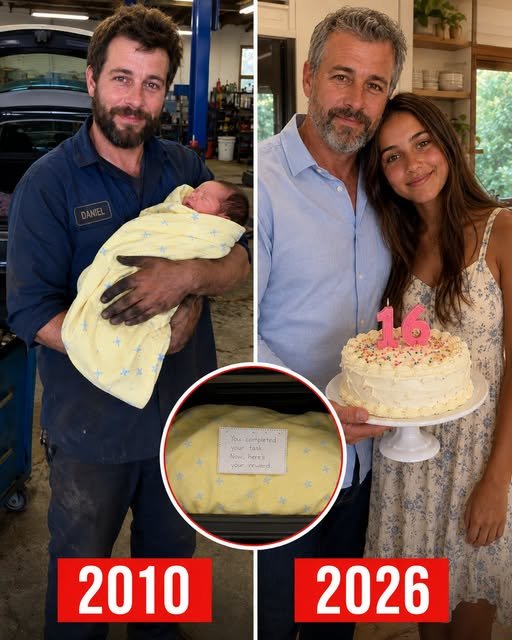
Part 1 — The Cry From the Trunk
Sixteen years ago, I was thirty-nine years old, single, and far more comfortable rebuilding an engine than holding a baby.
My name is Mike, and back then I worked at a small neighborhood garage with three other mechanics: Frank, Dennis, and Ray.
Cars made sense to me.
If an engine rattled, there was a reason.
If a transmission slipped, something was worn.
If a battery was dead, you replaced it.
People were harder.
Families were harder.
And babies?
I knew absolutely nothing about them.
That changed on a freezing January morning.
I had barely taken my first sip of coffee when my boss tossed a set of keys across the counter.
“Blue sedan outside,” he said. “Tow truck dropped it off overnight. Owner says it won’t start. Check everything.”
Nothing about the job seemed unusual.
I rolled the car into the bay, lifted the hood, and started with the obvious things.
Battery.
Cables.
Starter.
Connections.
Nothing immediately explained the problem.
My boss called from the office.
“Check the rest of it too.”
I sighed, wiped my hands on a rag, and opened the back door.
That was when I noticed something strange.
An empty car-seat base was strapped into the rear seat.
I stared at it longer than I should have.
There was no diaper bag.
No toys.
No blanket.
Just the base.
Something about it bothered me, though I couldn’t explain why.
Then I walked around to the trunk.
The moment I lifted the lid, I heard a sound.
At first, I thought it had come from outside.
A cat, maybe.
Then it came again.
A tiny, weak whimper.
I leaned forward.
There, beneath a yellow blanket decorated with little blue birds, was a newborn baby girl.
For one stunned second, I couldn’t move.
She was red-faced, trembling, and so impossibly small that my brain refused to accept what I was seeing.
Then instinct took over.
I dropped my flashlight.
“Frank!”
My shout echoed through the garage.
“Call 911! Now!”
Everything after that became a blur.
Frank grabbed the phone.
Dennis ran for clean shop towels.
Ray wasn’t there yet, which was strange because he was usually the first mechanic through the door every morning.
I lifted the baby carefully.
I was terrified I would hold her wrong.
Her entire body seemed to fit against my chest.
I tucked her beneath my work coat, trying to shield her from the January cold.
She cried for another few seconds.
Then, somehow, she became quiet.
One tiny hand reached out and wrapped around my finger.
I remember staring at those miniature fingers curled around my grease-stained hand.
Something happened inside me in that moment.
I just didn’t understand it yet.
When the paramedics arrived, one of them checked her over and smiled.
“She’s warm enough. You did good.”
I shook my head.
“I opened a trunk. That’s not exactly heroic.”
He glanced at my tattooed arms, my stained work clothes, and then at the baby still holding my finger.
“Maybe not,” he said. “But it mattered.”
I would remember those words for the next sixteen years.
Part 2 — Becoming Her Family
The police searched everything.
They examined the car.
They questioned us.
They reviewed the garage cameras.
They tried to track down the person connected to the sedan.
The paperwork led nowhere.
The information attached to the vehicle was a mess, and whoever had arranged the tow had paid cash.
Nobody seemed to know where the car had really come from.
More importantly, nobody knew who had left the baby inside it.
Eventually, the ambulance drove away.
I stood outside the garage watching it disappear.
I thought that would be the end of my part in the story.
It wasn’t.
The next morning, I called the hospital.
Then I called again.
After that, I contacted social services.
I told myself I only wanted to make sure she was okay.
But days passed, and I kept asking about her.
One afternoon, a caseworker finally told me she had been placed in foster care.
“Can I visit her?” I asked.
There was a pause.
“Are you family?”
“No.”
“Then probably not.”
I thanked her and hung up.
For a long time, I sat on the stool beside my toolbox.
I should have gone back to work.
Instead, all I could picture was that tiny hand around my finger.
That night, I called the caseworker again.
This time, I asked a different question.
“What would I have to do to become family?”
She made sure I understood what I was asking.
Becoming a licensed foster parent would take time.
There would be classes, background checks, home inspections, interviews, paperwork, and court involvement.
And even if I completed every requirement, there was no guarantee that particular baby would ever be placed with me.
“I understand,” I told her.
Then I began the process anyway.
When I told the guys at the garage, Dennis nearly choked on his coffee.
“You?” he said. “Raising a little girl?”
“Apparently.”
He laughed.
“A guy like you? Good luck.”
“Shut up, Dennis.”
He was teasing, but privately, I wondered if he was right.
My apartment had one bedroom.
I owned more socket wrenches than plates.
Two motorcycles sat outside.
I didn’t know how to change a diaper.
I didn’t know how to sterilize bottles.
I didn’t know what babies ate, how much they slept, or what you were supposed to do when they cried for no obvious reason.
But I learned.
Ray was the only one who didn’t joke about it.
When I told him what I was doing, he stared into his coffee for several seconds.
Then he quietly said, “Good.”
I noticed something strange in his expression.
At the time, I assumed he was simply surprised.
Months passed.
I took parenting classes.
I moved into a larger apartment.
I bought a safer car.
I sat through interviews where strangers asked me questions about my childhood, my finances, my relationships, my temper, and my reasons for wanting to raise a child who wasn’t mine.
Eventually, the little girl from the trunk came to live with me.
Her name was Lori.
More than a year after the morning I found her, the adoption became official.
Outside the courthouse, Ray shook my hand.
“Take care of her,” he said.
I looked him directly in the eye.
“I will.”
I had no idea how much he already knew.

Part 3 — Sixteen Years of Being Dad
Parenthood didn’t transform me overnight.
Most of the time, it felt like stumbling through one problem after another and hoping love would make up for my lack of experience.
I warmed bottles at three in the morning with my eyes half closed.
I took extra weekend repairs when money got tight.
I learned which cries meant hunger, which meant exhaustion, and which meant Lori simply wanted to be held.
When she was four, she came to me before preschool carrying a hairbrush.
“Dad, braid my hair.”
I stared at the brush.
Then at her.
Then back at the brush.
“I fix cars.”
“You fix everything.”
Apparently, that settled it.
My first braid was terrible.
Lori examined herself in the mirror and frowned.
“Dad?”
“Yeah?”
“Is my hair mad at me?”
I laughed so hard I had to sit down.
That night, after she went to sleep, I watched hair-braiding videos until nearly midnight.
The next morning, I tried again.
It still wasn’t perfect.
But it was better.
By six, Lori had me attending tea parties while wearing a plastic crown.
By ten, she could change a tire almost entirely by herself.
By thirteen, she rolled her eyes whenever I reminded her to text me when she arrived somewhere.
And every now and then, she asked about the woman who had given birth to her.
I never lied.
“I don’t know who she is,” I told her. “But if you ever decide you want to look for her, I’ll help.”
Sometimes Lori would think about it.
Then she would shrug.
“Maybe someday.”
I never pushed.
She deserved to decide what that part of her life meant.
As far as I was concerned, finding Lori had happened by accident.
Becoming her father had been a choice I made every day afterward.
Then her sixteenth birthday arrived.
And everything I thought I knew about that first morning changed.
Part 4 — The Second Yellow Blanket
Lori’s birthday fell on a Monday.
I woke up at five in the morning because I had decided to bake her cake myself.
That turned out to be a terrible idea.
By six fifteen, the kitchen looked as if somebody had detonated a bag of flour.
The frosting leaned heavily to one side, and the pink number sixteen I had attempted to pipe onto the top looked like it had been written during an earthquake.
Lori came downstairs in her pajamas, stopped in the doorway, and stared.
Then she burst out laughing.
“You made that?”
“Show some respect.”
She walked over and wrapped her arms around me.
“Best cake ever, Dad.”
“You’re a terrible liar.”
“Still eating it.”
Before I left for work, she dug the old plastic crown out of a drawer and placed it on my head.
“Happy birthday to you,” I muttered.
She grinned.
“Exactly.”
I drove to the garage smiling.
That smile disappeared less than an hour later.
A sedan was already waiting outside when I arrived.
Someone had left it before dawn.
I opened the key box.
Inside were the keys and a handwritten note.
Won’t start.
I stared at the words.
There was nothing unusual about them.
Cars arrived with that complaint every week.
Still, something about the situation made the hair on my arms rise.
I pulled the sedan inside.
I checked beneath the hood.
Battery.
Connections.
Starter.
Nothing serious.
Then I walked toward the rear of the car.
My hand touched the trunk release.
The lid lifted.
And sixteen years vanished in an instant.
A yellow blanket lay inside.
Tiny blue birds.
Same color.
Same pattern.
For one horrifying second, I was thirty-nine years old again.
I could almost hear that newborn whimper.
Something was underneath the blanket.
An envelope rested on top.
My name was written across the front.
Mike.
My hands began to shake.
Inside was a single sentence.
You completed your task. Now here’s your reward.
I read it twice.
Then a memory surfaced.
Ray.
Whenever one of us finished a difficult repair, Ray had a stupid little saying.
“Task completed. Where’s my reward?”
He had repeated that line hundreds of times.
My pulse hammered.
Slowly, I pulled the yellow blanket aside.
There was no baby underneath.
There was a framed photograph.
The moment I saw it, the wrench in my hand slipped and clattered onto the floor.
It was a picture of me.
Not the Mike I was now.
The Mike from sixteen years earlier.
I was standing beside the ambulance outside the garage, still wearing my work coat.
Newborn Lori was pressed against my chest.
Someone had photographed the exact moment that my life changed forever.
Behind that picture was another photograph.
The old garage crew.
Frank.
Dennis.
Ray.
Me.
Someone had drawn a blue circle around Ray.
Another envelope was taped to the back.
I opened it.
Inside were the words:
I left Lori there because I believed Ray would find her. You did instead. That changed everything.
I stopped breathing.
Suddenly, details I had forgotten began crashing back into my memory.
Ray being late that morning.
His silence when I said I wanted to foster Lori.
The way he had looked at her after the adoption.
His words outside the courthouse.
Take care of her.
My eyes blurred.
That morning sixteen years earlier hadn’t been as random as I had always believed.
Someone had expected Ray to find Lori.
And Ray had known something.
Maybe all along.

Part 5 — The Truth Ray Had Buried
I hadn’t spoken to Ray in more than ten years.
But I still had an old phone number.
I called.
Four rings later, a familiar voice answered.
“Hello?”
“Ray. It’s Mike.”
A pause.
“Mike? Goodness. It’s been forever.”
I stared at the yellow blanket.
“Do you remember a yellow blanket with blue birds?”
Silence.
Not the silence of confusion.
The silence of someone whose past had just knocked on the door.
I could hear him breathing.
Finally, he asked, “Where did you get it?”
“It’s sitting in my garage.”
Another pause.
Then his voice changed completely.
“You better come over.”
I called Lori’s school.
The second she heard my voice, she knew something was wrong.
“Tell me.”
“I found something at the garage.”
“What kind of something?”
“It might have to do with where you came from.”
She was quiet.
Then she said, “Come get me.”
Ray lived about forty minutes outside town and operated a small repair bay behind his house.
When Lori and I arrived, he came outside wiping his hands on an old rag.
He looked older than I remembered.
Thinner.
Tired.
Nervous.
Then Lori climbed out of my truck.
Ray froze.
Lori noticed immediately.
“You know who I am.”
He swallowed.
“Yeah.”
I held up the letter.
“Start talking.”
He led us into the repair bay and closed the door.
For a few seconds, nobody spoke.
Then Ray leaned against a workbench.
“My younger sister’s name is Carla,” he said. “Sixteen years ago, she was pregnant. Almost nobody knew.”
Lori folded her arms tightly.
“Was she my mother?”
Ray looked directly at her.
“Yes.”
The word seemed to change the temperature in the room.
I stepped forward.
“Did Carla expect you to find Lori?”
“Yes.”
“Did you know she planned to leave a newborn in that car?”
“No.”
His answer came quickly.
“Not until she called me that morning.”
“What did she say?”
“She told me to go to work, open the blue sedan, and not ask questions.”
Lori’s face tightened.
“And you understood what she meant?”
“Not immediately.”
Ray rubbed both hands over his face.
“I knew she was pregnant. I knew she was terrified. I had told her I would help. I even said I would raise the baby myself if that was what it took.”
“Then why didn’t she let you?” Lori asked.
Ray looked ashamed.
“I already had two children. Our father was sick. Carla thought giving me another baby would ruin my life.”
I shook my head.
“So she put Lori in a trunk?”
“She knew the sedan was coming to our garage. I must’ve mentioned it to her. And everybody knew I usually arrived first.”
I stared at him.
“But you didn’t.”
Ray gave a bitter, humorless laugh.
“My truck wouldn’t start.”
Lori blinked.
“You’re serious?”
“Dead battery. One stupid dead battery.”
He looked toward the floor.
“By the time I reached the garage, the ambulance was already there.”
I remembered.
Ray had arrived late.
At the time, it had seemed like nothing.
Now it felt like the hinge on which three lives had turned.
“Did Carla contact you afterward?” I asked.
“Yes.”
“And?”
“She begged me not to tell anyone who she was.”
“You agreed?”
“At first.”
Anger began climbing through me.
“You knew the police were looking for Lori’s family.”
“Yes.”
“You knew I was applying to foster her.”
“Yes.”
“You knew she eventually came home with me.”
“Yes.”
My voice rose.
“And you still said nothing?”
Ray lowered his head.
“Yes.”
I stepped closer.
“After the adoption, you shook my hand.”
He looked up.
“You told me to take care of her.”
His eyes filled with regret.
“I know.”
“You already knew who she was.”
“Yeah.”
Lori spoke before I could.
“Why?”
Her voice was quiet.
That made the question hurt more.
Ray looked at her for a long time.
“At first, because Carla begged me to keep quiet.”
He swallowed.
“But then I watched Mike.”
I frowned.
Ray continued.
“Every week, he changed something else in his life. Parenting classes. Bigger apartment. Safer car. Extra work.”
He looked at me.
“He wasn’t trying to repair somebody else’s mistake.”
Then he turned back to Lori.
“He loved you.”
My anger didn’t disappear.
Maybe part of me would always be angry at him.
But Lori had another question.
“Who left the car at Dad’s garage this morning?”
Ray glanced toward his house.
“Carla.”
My stomach twisted.
“Where is she?”
“At the diner near your shop.”
Lori stared at him.
“She sent the blanket?”
“Yes.”
“The pictures?”
“Yes.”
“The note?”
Ray nodded.
“She said sixteen years was long enough.”
Something inside me snapped.
“She doesn’t get to decide that.”
“I told her the same thing,” Ray replied.
“Good.”
I turned toward the door.
“We’re going home.”
“Dad.”
I stopped.
Lori stood directly in front of me.
“You don’t owe her anything,” I said.
“I know.”
“Then we don’t have to do this.”
She looked at me with an expression I suddenly realized wasn’t a child’s anymore.
“Dad, I spent sixteen years letting you make choices for me because I was little.”
Her voice softened.
“And I’m glad you did.”
Then she glanced toward the road.
“But let me make this one.”
There was nothing I could say to that.
So I nodded.
Part 6 — The Woman at the Diner
We drove back toward town in silence.
No radio.
No jokes.
No conversation.
Three blocks from my garage, I pulled into the diner parking lot.
Carla sat alone by the window.
She had a paper napkin between her hands and kept twisting it tighter and tighter.
When Lori and I entered, Carla stood.
The first thing I noticed was her eyes.
Lori had those eyes.
The same dark brown.
The same shape.
For sixteen years, I had looked into my daughter’s face every day.
And suddenly, one tiny piece of it had an origin.
Carla looked at me.
Then at Lori.
Her mouth opened.
Closed.
Finally, she whispered, “I don’t know how to start.”
Lori slid into the booth across from her.
“Start with why.”
I sat beside my daughter.
Carla didn’t launch into some grand explanation.
She didn’t ask for forgiveness.
She told us that at twenty-two, she had been frightened, broke, and convinced she had no good choices.
She had known Ray would normally arrive at the garage before anyone else.
“I believed he would find you within minutes,” she said.
Lori’s expression stayed still.
“You put a newborn baby in a trunk in January.”
Carla lowered her eyes.
“Yes.”
“You could have killed me.”
The words landed heavily between us.
Carla’s hands began trembling.
“I know.”
For a moment, I expected excuses.
Instead, she said, “I told myself Ray would be there almost immediately. I kept repeating that to myself because I was scared.”
She looked at Lori.
“But that doesn’t make what I did safe.”
That mattered.
Not enough to erase anything.
But it mattered.
Lori glanced at the photograph I had placed on the table.
“What did the note mean?”
Carla knew exactly which one.
“The task and reward?”
“Yes.”
Carla looked at me.
“Ray used to say that stupid thing after difficult repairs. I thought you would recognize it. I wanted you to understand the message was connected to somebody from the old garage.”
She hesitated.
“I wasn’t saying raising Lori was a task.”
Her voice cracked.
“And Lori wasn’t some reward.”
I said nothing.
Carla continued.
“I thought after sixteen years, Mike deserved to know why that car had been there.”
Lori asked another question.
“Did you ever come back?”
Carla nodded slowly.
“I watched from across the street after the ambulance came.”
My eyes dropped to the old photograph.
“You took this picture?”
“Yes.”
She stared at the image.
“I watched you hold her.”
The diner suddenly seemed very quiet.
“Later,” Carla continued, “Ray told me what you were doing. The foster application. The classes. Everything.”
She looked at me.
“I didn’t choose you.”
Lori turned toward me.
Our eyes met.
Sixteen years flashed through my mind.
The bottles.
The fevers.
The bad braids.
The plastic crown.
First days of school.
Birthday candles.
Homework.
Arguments.
Hugs.
Flat tires.
Late-night talks.
Then Lori turned back to Carla.
“No,” she said.
Her hand reached beneath the table and found mine.
“Finding me happened in one morning.”
Her fingers tightened around mine.
“Being my dad took sixteen years.”
I couldn’t speak.
Carla lowered her head.
For the first time that day, my anger made room for something else.
Not forgiveness.
Not yet.
Maybe not ever completely.
But understanding that Lori was no longer asking me to protect her from the past.
She was asking me to stand beside her while she faced it.
And that was different.

Part 7 — What Sixteen Years Really Meant
We stayed at the diner for another twenty minutes.
Lori asked questions.
Carla answered what she could.
Some answers were painful.
Some were incomplete.
Some created new questions.
But there were no dramatic embraces.
No instant reconciliation.
No promise that everything would suddenly become a perfect family.
Before we left, Lori and Carla exchanged phone numbers.
That was all.
And for that day, it was enough.
Outside, Lori stood beside my truck and looked at me.
For a few seconds, she said nothing.
Then she smiled faintly.
“You still found me.”
I squeezed her hand.
“Yeah.”
The truth was, I had spent most of the day wondering whether learning about Carla would somehow change what Lori and I were to each other.
It was irrational.
Love doesn’t disappear because another truth enters the room.
But fathers worry about irrational things.
Lori seemed to understand.
She leaned against me.
“Dad?”
“Yeah?”
“You know what the weirdest part is?”
“What?”
“If Ray’s battery hadn’t died, he would’ve gotten to the garage first.”
I nodded.
“And maybe my entire life would have been different.”
“Probably.”
She looked at me.
“Good thing his truck was junk.”
I laughed.
“Don’t ever tell a mechanic that.”
She grinned.
“There you are.”
We went home.
The ridiculous birthday cake was still sitting on the kitchen counter.
The frosting had slid even farther down one side.
Lori looked at it.
Then at me.
“Still the best cake ever.”
“Still a terrible liar.”
She cut two enormous slices.
While I found forks, she started rummaging through a kitchen drawer.
“What are you doing?”
“Nothing.”
That immediately made me suspicious.
Then she pulled out the old plastic crown.
“Absolutely not.”
She walked toward me.
“Lori.”
“Hold still.”
“You’re sixteen years old now.”
“Exactly.”
She placed the crown firmly on my head.
“I’m old enough to know exactly what embarrasses you.”
I looked at my sixteen-year-old daughter standing in our kitchen, laughing beside the ugliest birthday cake I had ever made.
Sixteen years earlier, I had opened a trunk expecting to find tools, groceries, or maybe somebody’s forgotten luggage.
Instead, I found Lori.
For years, I thought that single moment had made me her father.
I was wrong.
Opening that trunk only brought us together.
Being her father happened afterward.
It happened every morning I got up early for her.
Every night I stayed awake when she was sick.
Every terrible braid.
Every tea party.
Every argument.
Every birthday.
Every time she reached for my hand because she trusted it would be there.
Carla had believed Ray would find her baby.
Ray had believed staying silent would protect his sister.
I had believed I had stumbled into Lori’s life by accident.
Maybe we had all been wrong in different ways.
Because whatever set that first morning into motion, the sixteen years afterward weren’t an accident.
They were a life.
Our life.
Lori sat across from me and took a bite of cake.
Her face twisted.
“Okay.”
I raised an eyebrow.
“What?”
She struggled not to laugh.
“This cake is actually terrible.”
I pointed my fork at her.
“After sixteen years, this is the respect I get?”
She laughed.
And this time, I laughed with her.
The yellow blanket could explain where our story began.
But it could never explain what came afterward.
That part had been built slowly, one ordinary day at a time.
And if sixteen years of fatherhood had taught me anything, it was this:
Finding someone can happen by chance.
Becoming their family is something you choose again and again.