
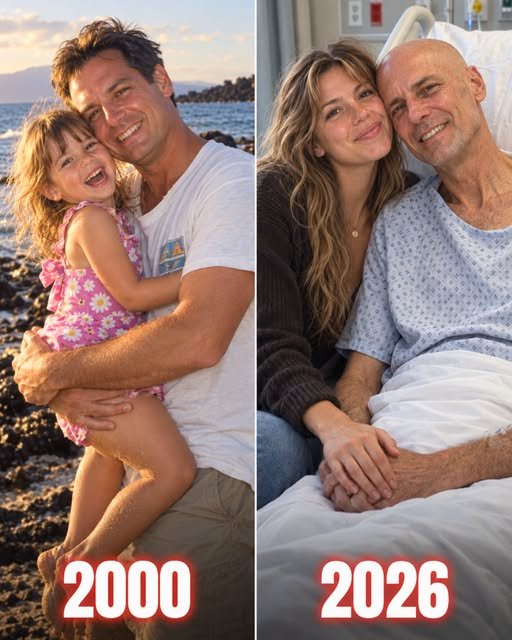
My stepdad raised me from the time I was four years old. He walked me down the aisle, held my daughter the day she was born, and never once let me believe I was anything less than his. Then, with hours left to live, he pulled me close and said the words that broke me open: “I’ve lied to you my whole life.” He pressed an address into my palm and told me to go there before I hated him. What I found on the other side of that door didn’t just answer a question. It rewrote everything I thought I knew about the man who loved me.
PART ONE — The Whisper
“He always cut them into stars,” I told the nurse, nodding at the tray beside Frank’s bed. “Even when I was thirty-five, married, with a daughter of my own, he’d still dig that little tin cutter out of the drawer.”
She smiled without quite looking up, smoothing the blanket over his legs, careful of the tubing that ran beneath his gown.
Frank’s eyes opened.
They’d stayed shut for most of the afternoon, his breath thin and uneven, but now they found me and held on. I braced for the crooked grin I’d known my whole life. Instead his eyes filled, and something in my chest dropped.
I leaned in close enough to feel his breath.
“Dad?”
His mouth moved. No sound came.
“Are you hurting?”
A small shake of his head.
The nurse glanced at the monitor, then touched my shoulder on her way out. “I’ll let you two have a minute.”
Once we were alone, I picked up the damp cloth from the nightstand and pressed it to his forehead, needing my hands to do something.
“You know,” I said, forcing lightness into my voice, “those pancakes were never actually that good. Burnt at every point, every single time.”
A breath slipped out of him. It might have been a laugh.
“You still ate every one,” he rasped.
“Only because I was terrified you’d make me eat oatmeal if I complained.”
That was Frank. He’d married my mother when I was four, and for a long time I gave him nothing to work with. Not “Frank.” Not “Dad.” Not one word. When he asked if I wanted toast, I just pointed at the loaf. When he tried to read me a bedtime story, I disappeared under the blanket. My real father had vanished before I was old enough to miss him, and some instinct in me already knew not to trust a man who showed up with a suitcase.
Frank never forced it. He noticed I liked strawberry jam spread edge to edge. He sat outside my door during thunderstorms because I wouldn’t let him past it. And every Sunday, without fail, he pressed apple-cinnamon batter into little stars with a scratched-up metal cutter.
Three months into their marriage, I wandered into the kitchen one morning and called him Dad before I’d even decided to. He dropped the spatula. Neither of us said a word about it — he just slid the least-burnt pancake onto my plate, like that settled something.
Five months later, my mother was gone. An aneurysm took her so fast that the last real conversation we’d had was about whether I’d put my shoes away. The house filled up with relatives who whispered in the hallway and glanced at Frank like he was a stranger who’d wandered in. He isn’t her real father. Her aunt could take her. He’ll want his life back now.
The night after the funeral, I hid under the kitchen table with my knees against my chest. Frank found me there just before dawn. He didn’t ask why. He just lowered himself onto the floor beside me.
“Are you leaving too?” I whispered.
He looked like I’d hit him. “No.”
“Everyone leaves.”
“I won’t.”
“Promise?”
He held out his little finger under the table. “I promise.”
He kept it. He walked me down the aisle years later. At my daughter’s christening he stood beside me with one hand cupped under her head, still afraid I might drop her, even though I was thirty-two. Whenever I asked about the years before my mother, he gave me the same line every time: “The part that mattered started when you showed up, sweetheart.”
I always heard love in that sentence. I never once heard what he was leaving out.
His health had started slipping not long after he turned seventy-eight — first the exhaustion, then the weight falling off him, then the tests and the specialists and the careful, rehearsed way doctors talk when they already know how the story ends. I slept in the vinyl chair beside his bed that final week, jerking awake at every change in his breathing, memorizing the rhythm of the monitors.
On the last night, the doctor pulled me into the hallway. “It could be a matter of hours now, Rosalie.”
I nodded because if I’d opened my mouth, I would have come apart.
When I came back in, Frank looked asleep. I sat and slid my hand under his.
His fingers closed around my wrist. Hard.
“Promise me you’ll hear all of it before you hate me,” he said.
I stared at him. “I could never hate you.”
His skin was cold under mine. “I’ve lied to you your whole life.”
I tried to laugh it off. “Dad, you’re exhausted. Let me call the nurse—”
“My mind is clear.” His grip tightened. “Everything you think you know about your childhood — about who I am — it’s only half the story.”
My pulse started slamming.
“What are you talking about?”
“I need you to find out before I’m gone. Even though I swore I’d carry it to my grave.”
A dozen questions crowded in at once. Was my real father alive somewhere? Had he hidden letters from me? Was there another family, another version of Frank I’d never been allowed to meet?
His hand shook as he pulled a folded scrap of paper from beneath the blanket and pressed it into my palm.
“Go there. Tonight.”
“I’m not leaving you.”
“You have to.” Tears slid into the gray stubble along his jaw. “Please, Rosalie.”
He hadn’t called me Rosalie since I was small.
I bent down close to his face. “Just tell me yourself.”
His eyes drifted shut. “Some truths need a different voice than mine.”
Those were the last words he ever said to me.
The monitor began to chirp, and a nurse hurried in to check his pulse and adjust the oxygen. “He’s still with us,” she said quietly. “But he may not wake again.”
Out in the hallway, I unfolded the paper. An address, written in Frank’s shaking hand, less than twenty minutes from the house he’d raised me in.
I almost threw it away. Whatever was behind that door couldn’t possibly matter more than the man dying in the room behind me.
Then I remembered the look on his face. It hadn’t been fear of dying. It had been fear that I’d never truly understand him.
I got in the car.

PART TWO — The House With the Star Cutter
I drove through streets gone empty and gray, both hands locked on the wheel, inventing worse and worse possibilities the whole way there. A secret wife. A stranger waiting to tell me Frank had never wanted me at all.
The woman who opened the door had silver hair, pale blue eyes, and one hand pressed over her mouth like she was looking at something impossible.
“Rosalie,” she breathed.
I actually flinched. “Who are you?”
“Caroline.” She kept staring, like she couldn’t quite believe I was real. “Frank called me last month. He could barely get the words out. He said you might come one day.”
“Might?”
“He was hoping he’d finally find the courage to send you.” She stepped back from the door. “I think you’d better come in.”
Every instinct told me to turn around and drive straight back to the hospital. I went inside anyway.
“Tell me what he lied about,” I said.
Caroline didn’t answer right away. She opened a drawer beside the stove and set it in front of me — a small collection of metal cookie cutters. A heart. A flower. A little rabbit. An apple. And one small, battered star.
I stopped breathing. It was identical to the one Frank had used every Sunday of my life.
“Where did you get that?”
“It was Frank’s.”
“No — his is at my house. I have it.”
“He had two, dear,” Caroline said gently.
Beneath the cutters was a photograph. She lifted it out and handed it to me with both hands, like it was something fragile.
A little girl stood beside a kitchen table, grinning down at a plate of star-shaped apple pancakes. She couldn’t have been more than five. Frank stood behind her, younger, thinner, and happier than I had ever once seen him in my life.
“Who is she?”
Caroline’s voice shook. “Her name was Miley.”
The room seemed to tilt around that single word.
“Frank was married before your mother,” she went on. “Miley was his daughter.”
My fingers dug into the edges of the photo. “Where is she now?”
Caroline’s eyes dropped. “She died. She was five.”
The words landed soft, which somehow made them land harder.
“There was an accident, at a lake. It happened fast. Frank blamed himself for years, even though there was nothing anyone could have done.”
I sat down because my legs had stopped agreeing to hold me up.
“Why would he hide that from me?”
“After Miley died, his marriage came apart,” Caroline said. “He stopped talking to almost everyone. Stopped returning my calls, and we’d been close for years. He packed away every photograph, every toy, anything that would remind him he’d once been someone’s father.”
My eyes went back to the small star cutter on the table.
“The pancakes.”
“He made them for her first.”

PART THREE — What the Table Never Told Me
Caroline sat down across from me, folding her hands like she was steadying herself for what came next.
“Then one morning, not long after he married your mother, you climbed into his lap and fell asleep against him. When you woke up, you asked him if he knew how to make pancakes shaped like stars.”
“I don’t remember that at all.”
“You were four.”
She set the cutter down between us.
“He called me that same afternoon. He was crying so hard I could barely make out the words. He told me he’d made the pancakes. He said he’d said Miley’s name out loud for the first time in years, and it hadn’t destroyed him.”
My hand tightened on the edge of the table.
“He didn’t hand you something that used to belong to his daughter,” Caroline said. “You gave him a way to keep her close without it killing him to remember her.”
The kitchen blurred behind my tears. “Then what was the lie?”
She looked toward the window, gathering herself.
“After your mother died, Frank packed his truck.”
My stomach dropped. “He was going to leave?”
“He drove straight here, that same night. He said your aunt could raise you. He said staying would be selfish of him.”
“Selfish?”
“He was terrified, Rosalie.” Her voice cracked. “He told me — I remember it exactly — ‘Every time she laughs, I hear Miley. Every time she runs toward the street, I stop breathing. I can’t survive burying another daughter.’”
Something in my chest ached in a way I didn’t have a name for.
“He promised me he’d stay. He told me he’d never leave.”
“He made that promise after he sat in this kitchen until sunrise,” Caroline said softly. “He kept telling me he wasn’t strong enough to love another child. That loving you would be the thing that finally broke him.”
“What did you say to him?”
“I told him not to run from loving you out of fear. I told him to stay, because he already did love you — he just hadn’t let himself say it yet.”
A sound came out of me that wasn’t quite a sob.
“He drove home that morning,” she continued. “Unpacked the truck before you were even awake. Thanked your aunt for staying with you through the night. And then he got down on the floor under that kitchen table and promised a four-year-old girl he would never leave her.”
I pressed a hand over my mouth.
That promise had been the floor my whole life stood on. I’d always believed he made it without a second thought — that he stayed simply because I needed him to. I had never once imagined how close he’d come to walking away, or how hard he’d had to fight himself to turn the truck around.
“He almost left me,” I said, the words barely making it out.
“Yes.”
Caroline didn’t try to cushion it. She let it sit there, true and painful, exactly as it was.
“But he came back,” she said quietly.
“Why hide all of this from me?”
“Because he never wanted you carrying the idea that you were the reason he stayed alive, sweetheart.” Her eyes were wet now too. “He knew exactly what it felt like to be a child holding up an adult’s grief. He refused to let you carry his.”
I thought of every time he’d told me, “You gave me a reason to keep going,” and how I’d always taken it as something parents just say. Now I understood how literally he’d meant it.
“He let me believe he was the one who rescued me.”
Caroline squeezed my hand across the table.
“He did rescue you.” Then, through her tears, she managed something close to a smile. “But you rescued him first.”

PART FOUR — What He Carried
I drove back to the hospital with the photograph resting on the passenger seat. Every red light felt like it was mocking me.
I needed him to know that I understood. That knowing the truth hadn’t shrunk one ounce of my love for him — if anything, it had only made it larger.
I ran from the parking lot straight up to his floor. The nurse was already standing outside his door, and one look at her face stopped me cold.
“I’m so sorry, ma’am. Your father—”
I pushed past her anyway.
Frank lay exactly as I’d left him. Except the room had gone completely silent. No hiss of oxygen. No uneven breath to count.
I took his hand and pressed it to my cheek.
“You should have told me,” I whispered into his cold fingers. “You should have let me thank you, Dad.”
The nurse set a small plastic bag down beside me. “These were his personal things.”
Inside: his watch, his keys, and the worn brown wallet he’d carried for as long as I could remember.
I opened it.
Tucked behind his driver’s license was a photograph gone soft at the corners from years of being touched. Miley, standing at a kitchen table beside a plate of star-shaped pancakes.
Behind that was another photo. Me, at five years old, grinning as I held up a lopsided pancake with one burnt point.
Nothing was written on either one. Nothing needed to be.
Frank had carried both of his daughters with him, every single day. He’d never replaced Miley with me — he’d never once loved me because he’d managed to forget her. He had loved me while remembering, down to the last detail, exactly how much that kind of love could cost him.
That evening I went home. My daughter was waiting at the kitchen table.
“Is Grandpa coming back?”
I sat down beside her. “No, sweetheart. He’s not.”
Her face crumpled, and I held her until it passed.
Then I opened the drawer beside our stove. The old star cutter was still there, scratched and dark with age, worn smooth by years of Sunday mornings.
I mixed flour, eggs, milk, cinnamon, chopped apple. My daughter watched the batter pour into that small tin star.
“Why did Grandpa always make them this shape, Mom?”
I looked at the two photographs propped beside the stove.
“Because someone once taught him that love can hold onto one person,” I said, “and still make plenty of room for another.”
We ate together at the table. She took one bite and smiled, and for a second the whole kitchen filled with her laughter — the same laughter that had once terrified a grieving man half to death, and had eventually taught him how to stay.
When we finished, I set the star cutter back beside the stove.
It’ll be there next Sunday. And every Sunday after that.
Not because the grief is gone. Because love finally grew large enough to carry it, and pass it on.