
Part 1 — The One Game He Couldn’t Stop Talking About
Six months after my eleven-year-old son nearly lost his life saving another child, I emptied what was left of my savings for two football tickets.
Not ordinary tickets.
Accessible seats close enough to the field that Caleb could smell the grass.
I knew it was irresponsible.
There were medical bills stacked on my kitchen counter. Rehab appointments seemed endless. My bank balance had become something I checked with one eye half closed.
But I also knew what the accident had already taken from my son.
Football had once been Caleb’s entire world.
He had started playing when he was six, back when his helmet looked too big for his body and he had to tie his cleats twice because the laces kept coming undone.
By eleven, he understood the sport better than I ever would.
He could see a blitz forming before the quarterback did.
He could explain why a defender had missed an assignment while I was still asking where the ball had gone.
His favorite player was Daniel Hayes, the longtime captain of our city’s professional team.
An old Hayes jersey hung beside Caleb’s bed.
It had been there before the accident.
It stayed there afterward.
One evening, long before everything changed, I had asked him, “Why Hayes? There are younger players with better stats.”
Caleb looked at me as if I had missed the most obvious thing in the world.
“Because Hayes never leaves his guy behind. If somebody gets knocked down, he goes back.”
At the time, I thought he was talking about football.
I would understand those words differently later.
Part 2 — The Day Everything Changed
The accident happened on an ordinary afternoon.
Caleb was walking home from school when a little boy—five years old, according to the police report—chased a bouncing ball into the street.
A pickup truck was coming.
Caleb saw it.
He ran.
He shoved the child back toward the sidewalk.
The truck struck Caleb instead.
I received the call while I was at work.
There are moments a mother remembers in strange fragments.
The fluorescent lights above my desk.
My coffee still sitting beside the keyboard.
Someone touching my shoulder.
The sound of my own voice asking, “Is he alive?”
He was.
But nothing after that came easily.
There were hours of surgery.
Days when I was afraid to leave the hospital room even long enough to shower.
Weeks filled with words I never expected to learn.
Spinal damage.
Mobility.
Rehabilitation.
Adaptive equipment.
Uncertain prognosis.
The doctors never said Caleb would definitely never walk again.
They also never promised that he would.
At eleven years old, my son had to learn how to move through the world all over again.
The physical pain was terrible.
But there were other wounds no scan could show.
The first time his teammates played without him, he locked himself in the bathroom and cried.
The first time he realized he needed help getting from his wheelchair into bed, he kept apologizing to me.
“Sorry, Mom.”
“You have nothing to apologize for.”
“I know. I just…”
He looked away.
“I hate making everything harder.”
Those words hurt more than anything else.
Caleb had saved a child’s life.
Yet somehow, he had begun believing his own needs were an inconvenience.
One evening during rehab, I asked a question I regretted almost before it left my mouth.
“Do you ever wish you hadn’t run into the street?”
Caleb stared at me.
“What?”
“I mean… if you had known what would happen…”
His expression changed.
“If I didn’t go after him, he would’ve gotten hit.”
“I know.”
“He could’ve died.”
“I know, sweetheart.”
He turned toward the television.
“Then there’s nothing to think about.”
That was Caleb.
He could accept losing the ability to walk more easily than he could accept letting somebody else get hurt.

Part 3 — One Last Home Game
Football became complicated after the accident.
Caleb’s old team practiced only a few blocks from our house.
Some afternoons, if the windows were open, we could hear the whistle from the field.
At first, Caleb would stop whatever he was doing and listen.
Later, he started closing the window.
He never asked to attend practice.
He never asked to visit his teammates.
But every Sunday, we watched professional football together.
And the Hayes jersey stayed beside his bed.
Then Daniel Hayes announced that he would retire at the end of the season.
His final home game sold out almost immediately.
Caleb tried to sound casual when he brought it up.
“Mom?”
“Hmm?”
“If I’m strong enough by then…”
I looked at him.
“Could we maybe go?”
“To the game?”
He nodded.
“Hayes’s last one.”
I knew what those tickets would cost.
Especially accessible seating near the field.
I also knew what was sitting on my kitchen counter.
Hospital bills.
Rehab bills.
Prescription receipts.
Insurance statements written in a language apparently designed to frighten ordinary people.
Still, I looked at my son.
“I’ll see what I can do.”
For the next several weeks, I cut everything.
I brought food from home and stopped buying lunch at work.
I canceled subscriptions.
I postponed repairs.
Eventually, I sold a bracelet my mother had given me when I graduated from college.
I sat in my car outside the jewelry shop for ten minutes afterward and cried.
Then I reminded myself why I had done it.
When two accessible seats near the field appeared online, I bought them before fear could stop me.
The charge left my account nearly empty.
But for the first time in months, Caleb had something to count down toward instead of another appointment.
The night before the game, he barely slept.
The morning of it, he pulled on the old Hayes jersey.
Then he looked at himself.
“Do I look like a little kid?”
“You’ve had that since you were eight.”
“That’s not an answer.”
“It’s three years old.”
He considered that.
“So it’s vintage.”
I laughed.
There he was.
My boy.
Part 4 — “Mom, I Can Smell the Grass”
The stadium overwhelmed him in the best possible way.
The moment we entered, Caleb sat taller in his chair.
People streamed around us in team colors.
Vendors shouted above the crowd.
Music echoed through the concrete corridors.
Every few feet, someone cheered.
Caleb looked everywhere at once.
When we finally came through the tunnel and saw the field, his hands stopped on his wheels.
“Mom.”
“What?”
He inhaled deeply.
His face broke into the widest smile I had seen since the accident.
“I can smell the grass.”
I laughed, although tears immediately filled my eyes.
For that one moment, the cost didn’t matter.
The bracelet didn’t matter.
The missed lunches didn’t matter.
Nothing mattered except the expression on Caleb’s face.
I had spent six months watching him enter places and immediately calculate what would be difficult.
Was there a ramp?
Was the doorway wide enough?
Would people stare when he needed more time?
Would somebody sigh because his chair took up space?
But the stadium had already prepared a place for him.
A place designed for his wheelchair.
A place where, for once, he wouldn’t have to apologize for existing exactly as he was.
Or at least that was what I thought.
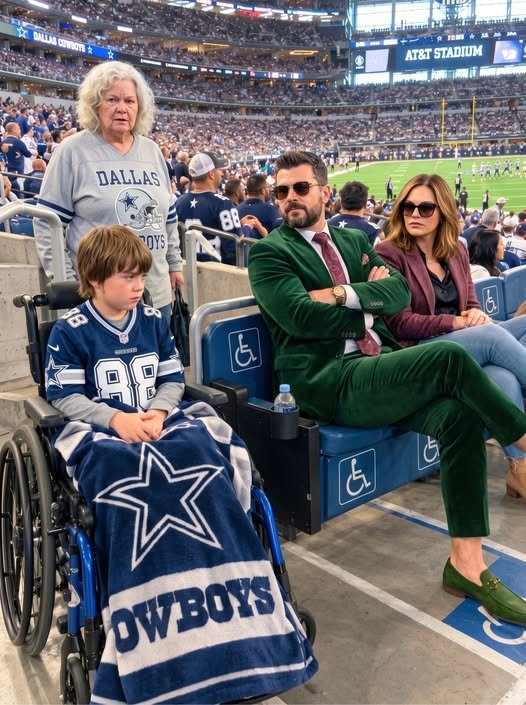
Then we reached our section.
And found two strangers sitting in our seats.
Part 5 — The Man Who Decided His View Mattered More
The man was perhaps fifty.
Everything about him looked expensive.
His jacket.
His shoes.
The watch on his wrist.
Beside him sat a woman wearing oversized sunglasses.
Her designer handbag occupied the wheelchair space.
That detail bothered me more than anything else.
They hadn’t simply mistaken the row.
They had looked at an empty area clearly reserved for a wheelchair and decided it was convenient storage for a purse.
I checked our tickets even though I had memorized the seat numbers weeks earlier.
Then I stepped closer.
“Excuse me.”
The man glanced up.
“I believe you’re in our seats.”
I showed him the tickets.
His eyes barely moved toward them.
“Find somewhere else.”
I actually thought I had misheard him.
“Excuse me?”
“These seats have a better view. There’s plenty of room around here. Sit somewhere else.”
I looked at Caleb.
Then back at him.
“These are accessible seats. That open area is where my son’s wheelchair goes.”
His eyes moved toward Caleb.
Not toward his face.
Toward the chair.
Then he shrugged.
“That’s not my problem.”
My chest tightened.
“Your wife’s bag is sitting in the wheelchair space.”
The woman touched the purse.
“It’s only a handbag.”
“Exactly. Which means it can move.”
The man’s expression hardened.
“Lady, don’t make a scene.”
For years, I had avoided scenes.
I had smiled through awkward conversations.
Apologized when Caleb’s chair took longer to maneuver through a doorway.
Thanked people excessively for doing things they should have done anyway.
That afternoon, I was finished apologizing.
“I’m not making a scene. I’m asking you to sit in the seats printed on your tickets.”
He leaned back.
“I’ve been a season-ticket holder for fifteen years.”
“Congratulations.”
“I’ve spent more money in this stadium than you probably make in—”
“I don’t care.”
That surprised him.
He pointed toward the concourse.
“Your son can watch from there.”
My hands went cold.
“He cannot use a regular stadium seat.”
“There are television screens everywhere.”
“We paid for these seats.”
“So did I.”
“No. You paid for different seats. You took ours because you preferred the view.”
He looked toward the field as though I had become boring.
Then he said, “Honestly, I doubt the kid even understands enough about football to care where he watches.”
The sentence landed harder than all the others.
I heard Caleb inhale.
His fingers curled around the rims of his wheels.
Then, so softly I almost missed it, he said,
“I understand football.”
The man didn’t respond.
Caleb lowered his head.
“I wasn’t always in this chair.”
Something inside me broke.

Part 6 — The Moment Caleb Tried to Make Himself Smaller
An usher arrived after another fan waved him over.
Finally, I thought.
This would be simple.
We had the tickets.
The seats were accessible.
The couple clearly did not belong there.
The usher checked everything.
“Sir, ma’am, you’ll need to return to your assigned seats.”
The man didn’t move.
“We’re staying.”
“Sir, these seats belong to this family.”
“Then put them somewhere else.”
The usher’s polite expression strained.
“That isn’t how assigned seating works.”
The man started talking about how long he had been a ticket holder, how much money he spent, how important this game was to him.
As though money had somehow transformed theft into entitlement.
More people began watching.
Caleb tugged lightly on my sleeve.
“Mom.”
I turned.
His cheeks were red.
Not angry red.
Embarrassed.
“Maybe we should just go.”
“What?”
“We could watch from the hallway.”
“No.”
“It’s okay.”
His voice dropped further.
“Everybody’s looking.”
And suddenly I understood.
My son wasn’t trying to be reasonable.
He was trying to disappear.
He had spent six months learning that whenever his wheelchair created difficulty, the easiest way to make other people comfortable was to ask for less.
Less room.
Less time.
Less attention.
Less help.
Now a grown man was teaching him that he should accept less dignity too.
I bent slightly so Caleb could see my face.
“No.”
He swallowed.
“Mom—”
“These are your seats.”
Then I stood.
“And you are allowed to take up the space that belongs to you.”
A calm voice behind us said,
“That boy’s mother is right.”
Everyone turned.
Part 7 — The Woman With the Old Lunchbox
An elderly woman sat one row behind us.
She was small and neatly dressed in a gray cardigan.
Her silver hair was brushed back from her face.
An old metal lunchbox rested on her lap.
She had been quiet through the entire argument.
Now she rose slowly.
The arrogant man gave an irritated laugh.
“Wonderful. Everyone has an opinion now.”
The woman looked directly at him.
“Stand up.”
He stared.
“What?”
“You seem very interested in getting something special today.”
She lifted the battered lunchbox.
“I have something more valuable than that seat.”
A few people nearby exchanged confused glances.
The man smirked.
“What, lunch?”
“Open it.”
Something in her voice made even him hesitate.
Finally, he took the lunchbox.
The metal latch clicked.
He lifted the lid.
His expression changed almost instantly.
Inside were photographs.
A faded team patch.
An old program.
A folded note written in a child’s hand.
And on top was a picture of a skinny boy wearing oversized football pads.
The boy was holding the same lunchbox.
Caleb leaned forward.
Then his eyes widened.
“Mom…”
I followed his gaze.
“No way.”
Caleb whispered the name.
“That’s Hayes.”
The man holding the lunchbox looked up sharply.
His face had lost all its color.
“You’re…”
The elderly woman took the lunchbox from him.
“Daniel Hayes is my son.”
The entire section seemed to go silent.
Even the usher looked stunned.
She ran one hand over the scratched metal lid.
“I packed his lunch in this when he was a boy. We didn’t have much money then. He asked me to bring it onto the field during his retirement tribute today.”
Caleb stared at her as though he had suddenly found himself inside a dream.
“You’re his mom?”
She smiled at him.
“I am.”
Caleb looked down at his jersey.
“He’s my favorite player.”
“So I gathered.”
“He always goes back for his guy.”
Something softened in her face.
Then her eyes settled on Caleb’s wheelchair.
“What happened to you, sweetheart?”
Caleb became quiet.
So I answered.
“He saw a five-year-old run into the street. A truck was coming. Caleb pushed the little boy out of the way.”
Her hand rose slowly toward her mouth.
“The truck hit him?”
I nodded.
“Six months ago.”
She looked at Caleb differently after that.
Not with pity.
With recognition.
As though she had just learned something important.
Then the man who had refused to move said,
“Please.”
Everyone looked at him.
He swallowed.
“Please don’t tell Daniel about this.”
And suddenly, the powerful man who had spent the last ten minutes treating us as if we didn’t matter looked terrified.
Part 8 — “You Didn’t Take My Seat”
The elderly woman’s expression remained calm.
“Why shouldn’t I tell him?”
The man lowered his voice.
“I made a mistake.”
“A few minutes ago, you seemed very certain.”
“I was wrong.”
He glanced toward Caleb.
“I’m asking for another chance.”
She considered him for several seconds.
Then said,
“One.”
The man stood immediately.
His wife snatched her handbag from the wheelchair space.
“I’m sorry,” he said quickly. “I didn’t realize who you were.”
Hayes’s mother looked almost disappointed.
“You still don’t understand.”
He blinked.
“You didn’t take my seat.”
She pointed toward Caleb.
“You took his.”
The man looked at Caleb.
No answer came.
His wife muttered, “We didn’t know it was going to become this serious.”
The elderly woman turned toward her.
“That is exactly the problem.”
The woman’s face tightened.
Hayes’s mother continued.
“You behaved this way because you believed the only people you would have to answer to were a boy in a wheelchair and his mother.”
By then, the usher’s supervisor had arrived.
Several fans immediately explained what they had witnessed.
The man looked around the section.
Not one person defended him.
A few minutes earlier, he had taken the best view he could find.
Now every eye in that row was on him.
As staff prepared to escort the couple back to their proper area, the man stopped beside Caleb.
Hayes’s mother had already left for the ceremony.
No famous connection remained nearby.
No one important was there to impress.
Only Caleb.
“I’m sorry,” the man said.
Caleb looked at the space where the handbag had been.
Then back at him.
“These aren’t special seats.”
The man frowned slightly.
Caleb continued.
“They’re just the seats I can actually use.”
For once, the man had nothing to say.
He nodded.
Then walked away.
I thought that was the end.
I had no idea Hayes’s mother had carried Caleb’s story with her.

Part 9 — For One Hour, I Got My Son Back
Caleb rolled into his spot.
I sat beside him.
Then I turned toward the field because if I looked directly at him, I knew I would cry.
The game began.
And slowly, something changed.
Caleb forgot about the argument.
Forgot the staring.
Forgot the wheelchair.
At least for a while.
He became the boy who loved football.
A few plays into the second quarter, he pointed toward the defense.
“They’re bringing pressure.”
“You sure?”
“Watch the safety.”
The ball snapped.
The defense blitzed.
Caleb grinned.
“Told you.”
I laughed.
The man who had mocked him had assumed a wheelchair erased everything Caleb knew before the accident.
But my son was still my son.
The chair had changed how he moved.
It had not changed his mind.
His courage.
His love for the game.
Then came the retirement ceremony.
Daniel Hayes walked onto the field to thunderous applause.
Caleb shouted so loudly the people in front of us turned around laughing.
Moments later, Hayes’s mother appeared carrying the old lunchbox.
The stadium announcer told the story.
Before packed arenas.
Before endorsements.
Before anyone knew Daniel Hayes’s name.
There had been a boy carrying simple lunches packed by a mother who believed in him.
Caleb stared at the field without blinking.
When the ceremony ended, he wiped at his eyes and pretended he had something in them.
I pretended to believe him.
Then a stadium employee approached our section.
“Excuse me?”
I looked up.
“Are you Caleb?”
My son froze.
“Yes.”
The employee smiled.
“Mr. Hayes would like to meet you after the game.”
Caleb stopped breathing.
At least that was what it looked like.
“What?”
“His mother told him about you.”
He turned toward me.
“Mom.”
“I heard.”
“Mom.”
“I’m sitting right here.”
“Hayes wants to meet me.”
I started laughing.
“Yes, Caleb.”
Daniel Hayes had no idea yet that he was about to give my son something far more valuable than a football souvenir.
Part 10 — “Sounds Like You Went Back for Your Guy Too”
After the game, stadium staff brought us to a small room near the players’ tunnel.
Hayes’s mother was already there.
She smiled when she saw Caleb.
Then footsteps sounded behind us.
Daniel Hayes walked in.
Caleb, who had spent four quarters confidently criticizing professional football decisions, suddenly forgot every word in the English language.
Hayes smiled.
“You must be Caleb.”
My son nodded.
Hayes crouched slightly so they were closer to eye level.
“My mom told me what happened.”
Caleb stared at his hands.
“I just saw the kid in the road.”
“And you went after him.”
“He was little.”
Hayes smiled gently.
“Mom says you used to play.”
“Linebacker.”
“Good position.”
Caleb finally looked up.
“The best.”
Hayes laughed.
For a few seconds, Caleb relaxed.
Then his face changed.
“I don’t know if I’ll ever play again.”
The room became quiet.
Hayes didn’t tell him everything would be fine.
He didn’t make promises nobody could guarantee.
Instead, he nodded.
“Maybe you will.”
Caleb waited.
“Maybe you won’t.”
My heart tightened.
Hayes continued.
“People in football use the word courage all the time. We talk about hitting somebody bigger than us. Playing hurt. Staying in the pocket. Running straight into contact.”
He tapped the front of Caleb’s old jersey.
“But that’s still a game.”
Caleb looked at him.
“What you did in that street wasn’t.”
Silence.
Then Hayes smiled.
“My mom told me why you like watching me.”
Caleb’s cheeks reddened.
“She did?”
“Something about me going back for my guy.”
Caleb nodded.
Hayes held his gaze.
“From what she told me, sounds like you went back for yours too.”
That did it.
Caleb’s eyes filled.
So did mine.
Hayes reached into a bag beside him.
He pulled out a pair of football gloves.
The gloves he had worn that afternoon.
His final home game.
He signed one across the wrist.
Then held them toward Caleb.
“These are for you.”
Caleb stared at them.
“No.”
Hayes blinked.
Caleb shook his head.
“I can’t take those. Those are your last-game gloves.”
“I know.”
“You should keep them.”
Hayes smiled.
“I know exactly where I want them.”
Slowly, Caleb reached out.
He took the gloves.
Then he held them against his chest.
For six months, almost every important conversation in Caleb’s life had involved something that had been taken away.
His ability to walk.
Football.
Independence.
Privacy.
The ease with which he used to move through ordinary places.
Now the player he admired most was placing part of the game back into his hands.
Hayes leaned closer.
“Whatever happens next, don’t let anybody convince you that the chair tells them who you are.”
Caleb swallowed.
Hayes added,
“And keep going back for your people.”
My son nodded.
“I will.”
Part 11 — What the Jersey Means Now
That night, Caleb asked me to hang the gloves beneath his Hayes jersey.
I stood on a chair beside his bed while he watched.
For months, I had hated looking at that jersey.
Before the accident, it had represented football practices, muddy cleats, bruised knees, and a future Caleb assumed would continue exactly as planned.
Afterward, it seemed to represent everything he had lost.
But as I fastened those signed gloves beneath it, I realized I had been looking at it the wrong way.
The accident changed my son’s life.
It did not erase the person he had always been.
Long before the stadium.
Long before the wheelchair.
Long before Daniel Hayes knew his name.
Caleb had already understood the lesson he admired most in his favorite player.
When someone needed him, he went back.
Even when it cost him.
Even when nobody was watching.
The wealthy stranger in the stadium had looked at my son and seen a wheelchair before he saw a child.
Hayes’s mother looked at him and saw courage.
Daniel Hayes looked at him and saw someone worth honoring.
But perhaps the most important change happened inside Caleb.
For months, he had been trying to make himself smaller so other people wouldn’t be inconvenienced.
That night, something shifted.
He stopped apologizing quite so often.
Not all at once.
Healing rarely works that way.
But gradually.
A few days later, we entered a crowded café and someone had pushed a chair into the accessible path.
Normally, Caleb would have waited quietly.
Instead, he said,
“Excuse me. I need room to get through.”
No apology.
No embarrassment.
Just the truth.
I nearly cried over my coffee.
I still don’t know what Caleb’s future will look like.
Maybe someday he’ll walk again.
Maybe he won’t.
Maybe football will return to his life in another form.
Coaching.
Strategy.
Broadcasting.
Something neither of us has imagined yet.
But I know this much.
My son does not need to become the boy he was before the accident in order to have a life worth celebrating.
He is already brave.
Already whole.
Already worthy of taking up space.
And whenever I look at those gloves hanging beneath the old jersey, I remember the afternoon I spent nearly everything I had just to give my son one good day.
I thought I was buying him a football game.
I was wrong.
I was buying him a moment in which someone reminded him of something the accident—and too many thoughtless strangers—had made him forget.
A wheelchair can change how a person moves through the world.
It does not tell you how much they understand.
How deeply they feel.
What they have survived.
Or who they are.
And sometimes the person everyone assumes needs saving is the one who has already shown the greatest courage of all.