
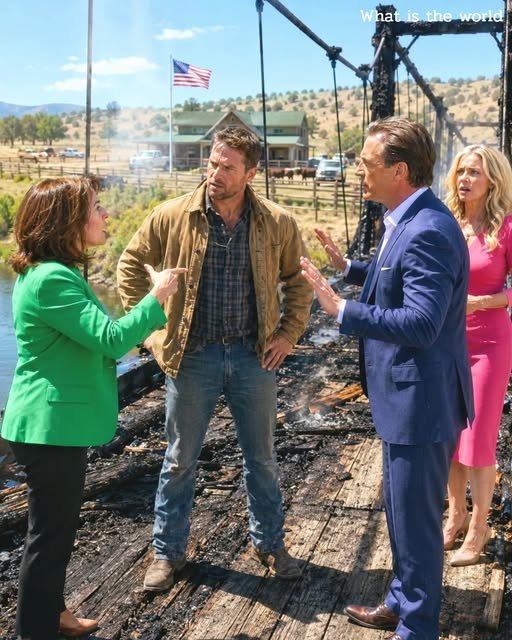
At 2:13 in the morning, my suspension bridge exploded hard enough to throw me out of bed.
At 2:16, the HOA president called and offered to buy my ranch for one-third of its value.
At 2:19, before the fire department had even arrived, she made the mistake that would eventually destroy everything she had built.
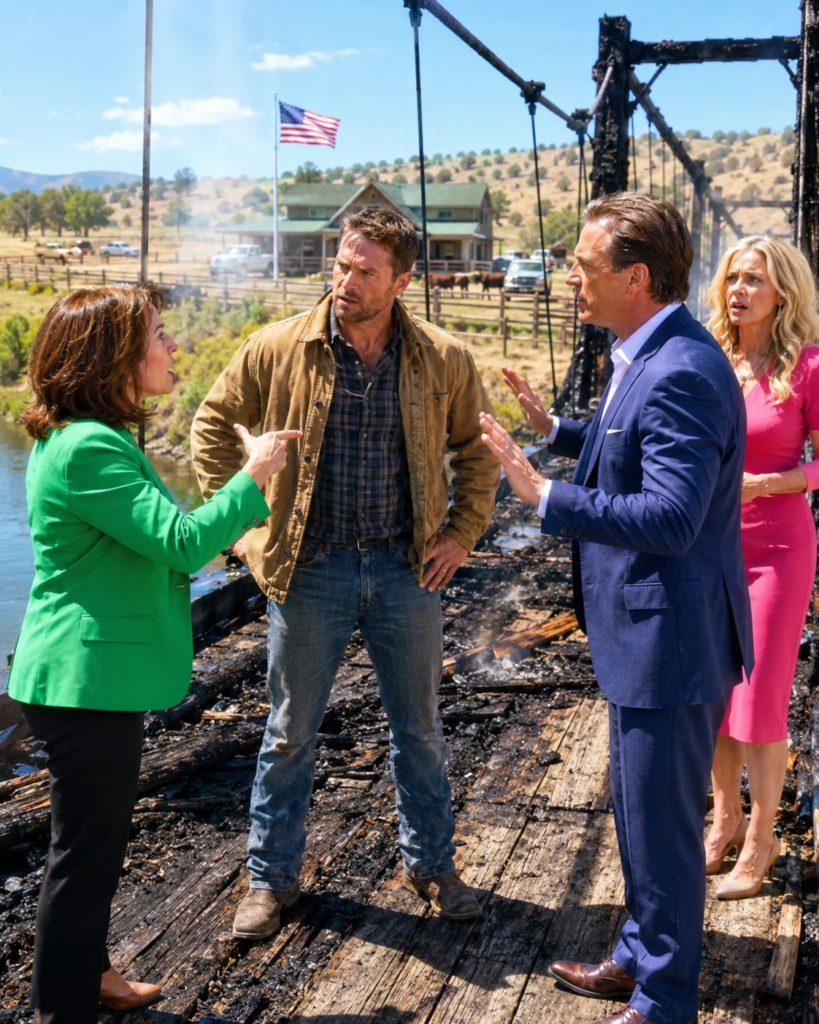
She told me the bridge could not be saved.
There was no way she should have known that yet.
I stood barefoot on the cold pine floor of my bedroom, phone against my ear, watching orange light pulse against the curtains.
Outside, somewhere beyond the cottonwoods, steel cables screamed in the dark.
Not snapped.
Screamed.
There is a sound a loaded cable makes when heat strips away its strength. It starts low, almost musical, then climbs until the metal gives up.
Most people hear chaos.
I hear sequence.
Ignition.
Expansion.
Load transfer.
Failure.
The eastern support cable parted first.
A second later, the timber deck rolled sideways and dropped into the Blackwater River.
The impact shook dust from the rafters of the house my grandfather had built seventy-two years earlier.
On the phone, Vanessa Voss spoke in the calm, sympathetic voice she used at county hearings when she wanted to sound reasonable.
“Caleb, I’m so sorry. This is terrible.”
Behind her voice, I heard a vehicle door close.
Then a man muttered something I couldn’t make out.
Vanessa lowered her voice.
“You’re stranded, aren’t you?”
I walked to the window.
The bridge had been the only vehicle route between Black Pine Ranch and County Road 18. On my side of the river sat 1,840 acres, four barns, two hundred head of Black Angus cattle, my home, my workshop, and enough winter hay to feed the herd until March.
On the other side sat Silver Ridge Estates.
Three hundred and twelve luxury houses.
A clubhouse with heated pools.
A golf course that had no business existing in a drought basin.
And an HOA board that had spent the last eighteen months trying to force a road through my north pasture.
“I’m still here,” I said.
Vanessa gave a small laugh, as though I had misunderstood her.
“I meant you can’t get out.”
“Those aren’t the same thing.”
A pause.
Another voice whispered behind her.
Male.
Close.
Vanessa’s husband was in Denver that week. She had announced it at the previous HOA meeting because Vanessa announced everything that made her life appear important.
“Emergency services may have trouble reaching you,” she continued. “Your cattle trailers can’t cross. Fuel deliveries can’t cross. Feed trucks can’t cross. It may be weeks before the county can approve a replacement.”
She was listing consequences too quickly.
Not discovering them.
Reciting them.
I opened the recording application on my tablet and placed the phone on speaker.
“What are you offering, Vanessa?”
“I’m trying to help.”
“At two-sixteen in the morning?”
“I saw the fire.”
“From where?”
Another pause.
Silver Ridge’s closest house was nearly four miles from the bridge, hidden behind a ridgeline.
Vanessa lived seven miles away.
“Grant called me,” she said.
Grant Halpern.
Developer.
Silver Ridge board member.
Owner of Halpern Land and Leisure.
The man who had offered me $4.1 million for a ranch worth at least twelve.
“How did Grant see it?” I asked.
“He was driving.”
“At two in the morning?”
“Some people work late.”
“Where was he driving?”
Her sympathy disappeared.
“Do you want help or not?”
“What help?”
“The board has authorized me to renew our purchase offer. Given the destruction of the bridge, we could close quickly. Cash. No inspection contingencies. We’d also arrange temporary housing for you.”
The bridge glowed like a furnace through the trees.
A burning plank lifted into the air and vanished downstream.
They thought fire would make me panic.
They thought isolation would make me beg.
They thought a dead bridge would kill the ranch.
They thought the county would finish what the flames started.
They thought I was alone.
They were wrong about every one of those things.
“I’ll call you back,” I said.
“Caleb, this offer may not remain available.”
“I know.”
“Then you should think carefully.”
“I am.”
I ended the call and saved the recording in three places.
Then I pulled on jeans, boots, a wool coat, and the old canvas field vest I had not worn since leaving federal service.
Inside the vest were sample bags, flagging tape, a folding ruler, nitrile gloves, a waterproof notebook, and a flashlight powerful enough to turn night into a white tunnel.
People imagine arson investigators rushing toward flames.
Good ones don’t.
Good ones wait.
Fire destroys evidence, but water, boots, machinery, and helpful idiots destroy more.
I stepped onto my porch.
The night smelled of burning creosote, wet stone, pine resin, and gasoline.
That last smell did not belong there.
The bridge timbers had been treated decades ago, but old creosote burns heavy and oily. Gasoline flashes sharp. Even from six hundred yards away, I could separate the odors.
I called 911.
The dispatcher already knew.
“Black Pine Ranch?” she asked.
“Yes.”
“Crews are responding from Silver Ridge Volunteer Station.”
“What time were they dispatched?”
“Two-fourteen.”
“What time was the first report?”
A pause.
“I can’t release caller information.”
“I didn’t ask who. I asked when.”
“Two-eleven.”
The explosion had occurred at 2:13.
Someone had reported the bridge fire two minutes before the main ignition.
“Please preserve the call recording,” I said.
“Sir?”
“Flag it. Do not overwrite it. Tell your supervisor the property owner is requesting preservation because the fire may be criminal.”
The dispatcher’s tone changed.
“Do you have reason to believe that?”
“I smell an accelerant.”
“You’re near the bridge?”
“Not yet.”
“Please keep a safe distance.”
“I will.”
That was true.
Safe and distant are not the same thing.
I took the ranch utility vehicle down the gravel lane until the heat began pressing against my face. I stopped three hundred feet from the west anchorage.
The bridge was gone.
The two main steel cables sagged into the river, glowing in places where grease burned along the strands. Half the western tower remained upright. The eastern tower leaned over the water like a broken rib.
Flames crawled across debris lodged against the rocks.
The Blackwater ran high from mountain snowmelt. Anything not attached would be in the next county by sunrise.
I photographed the approach road before walking farther.
Fresh tire marks crossed the frost.
Two vehicles.
One heavy pickup with an aggressive all-terrain tread.
One lighter utility vehicle.
Both had turned around near the western anchorage.
Neither belonged to me.
I set numbered flags beside the clearest impressions.
Then I saw the first thing Vanessa and Grant had failed to consider.
Mud.
It had rained the previous afternoon. The western bridge approach looked dry on top, but beneath the gravel sat red clay that clung to tire grooves.
The vehicles had carried that clay away when they left.
There would be a trail.
Maybe not for miles.
Maybe only a few hundred yards.
But enough.
Headlights flickered through the trees on the far bank.
A red fire engine stopped at the eastern approach.
Silver Ridge Volunteer Fire Station had arrived.
Seven minutes later, the second engine appeared.
No one came from the county station to the south.
I watched firefighters unroll hoses.
They could not attack effectively from their side because the prevailing wind pushed flames toward them. They also could not cross because the deck was gone.
Someone shouted across the river.
“Caleb!”
I recognized the voice of Chief Nolan Price.
Nolan had been a competent firefighter before Silver Ridge turned its volunteer station into a social club with emergency lights. He was fifty-six, broad shouldered, and permanently tired.
“I’m here,” I called.
“Stay back! We’ve got reports of propane tanks near the west end.”
“There are no propane tanks near the bridge.”
“That’s what dispatch told us.”
“Who reported them?”
He did not answer.
Two firefighters aimed water into the river, where most of it vanished into steam.
I raised my phone and recorded the scene.
“Chief, I smell gasoline on the west approach. Tell your crew not to enter until the state fire marshal is notified.”
Nolan stared across the gap.
“Gasoline?”
“Yes.”
“You sure it isn’t creosote?”
“I’m sure.”
A smaller figure moved behind him.
Grant Halpern stepped into the wash of the engine lights.
He wore a tan work jacket over a white dress shirt and dark slacks.
Not exactly what most men chose for a two-in-the-morning drive.
He lifted one hand, as if we were neighbors meeting beside a mailbox.
“Hell of a thing, Mercer.”
“Where’s your truck?”
He glanced toward the line of emergency vehicles.
“Up the road.”
“Why?”
“Didn’t want to block the engines.”
Grant was forty-eight and had the smooth, well-fed face of a man who spent his life entering rooms where someone else had already removed the inconvenience.
He had built Silver Ridge on cheap land purchased after the old Waverly sawmill collapsed. The first phase sold well. The second sold better.
The third phase had a problem.
It needed a second emergency exit.
Without one, the county would not approve another ninety-four homes.
The cheapest route ran through my north pasture.
Grant had tried charm.
Then pressure.
Then a lawsuit claiming an old logging path was a public road.
He lost.
He appealed.
He lost again.
Then Vanessa’s HOA began citing my ranch for violations of rules that did not apply to land outside Silver Ridge.
Unapproved fencing.
Excessive livestock noise.
Improper barn color.
One notice accused my cattle of creating an “unharmonious visual environment.”
I mailed that one back with a photograph of a bull relieving himself on the envelope.
The notices stopped.
The offers started.
Now my bridge was burning.
“Grant,” I called across the river, “what time did you report the fire?”
He pushed his hands into his jacket pockets.
“About when I saw it.”
“What time?”
“I don’t know. Two-ten. Two-fifteen.”
“The dispatcher received the call at two-eleven.”
“Then I guess two-eleven.”
“The main ignition happened at two-thirteen.”
The river filled the silence between us.
Chief Nolan turned slowly toward Grant.
Grant shrugged.
“Maybe your clock is wrong.”
“Maybe.”
He smiled.
I did not.
A white SUV rolled up behind the fire engines.
Vanessa climbed out wearing a belted camel coat, black leggings, and tall leather boots. Her hair was styled. Her makeup was complete.
Either she slept ready for television interviews, or she had not been asleep.
She walked directly to Grant.
Not the fire chief.
Not the bridge.
Grant.
They spoke for several seconds. Vanessa touched his arm. Grant leaned close to her ear.
I zoomed in and recorded that too.
The first county deputy arrived at 2:41.
Ben Tully parked on the eastern side because there was no other access to me. He was thirty-one, lean, quiet, and had grown up ten miles from Black Pine Ranch. His father used to shoe my grandfather’s horses.
Ben walked to the edge of the missing bridge and shined his flashlight across.
“You hurt?” he called.
“No.”
“Anybody else on the ranch?”
“Just me.”
“Any livestock near the fire?”
“No.”
“Can you reach the old fisherman’s trail downstream?”
“On foot.”
“I’ll meet you at the landing.”
Chief Nolan shouted that the trail was unsafe at night.
Ben ignored him.
So did I.
The landing sat three-quarters of a mile downstream, where a narrow trail descended to a shelf of stone near the river. In summer, fishermen used inflatable rafts there. In spring, the current was fast enough to kill careless people.
Ben crossed in a rescue boat with two county firefighters.
He stepped onto my side at 3:17.
The first thing he did was activate his body camera.
The second thing he did was look at my evidence flags.
The third thing he did was stop beside a blackened patch twenty feet from the bridge tower.
“What is that?” he asked.
“Probable pour pattern.”
The grass had burned in a narrow line leading from the approach road to the bridge deck.
Fire does not naturally travel against wind across damp grass in a straight path.
Ben crouched without touching it.
“You said gasoline?”
“Likely. I haven’t sampled it.”
“You still certified?”
“My federal certification expired when I left the Bureau. My engineering license is current. My testimony has been accepted in twenty-seven fire cases.”
He looked up.
“I thought you inspected bridge failures.”
“I did.”
“You never mentioned fire cases.”
“You never asked.”
One of the county firefighters whistled softly.
Ben stood.
“Let’s keep everybody out.”
Chief Nolan crossed twenty minutes later and was unhappy to find his scene controlled by a deputy twelve years younger than him.
“The fire is still active,” Nolan said. “I’m incident command.”
“For suppression,” Ben replied. “I’m establishing a potential crime scene outside the hot zone.”
“We don’t know it’s a crime.”
“Then staying off the tire tracks won’t hurt anybody.”
Nolan looked at me.
“You put him up to this?”
“I called 911 and reported an accelerant.”
“Creosote can smell like gasoline.”
“Not unless somebody refines it in a field.”
He tightened his jaw.
Nolan was not stupid.
That made his next decision more interesting.
He turned toward the rescue boat.
“We should pull back and wait for daylight.”
“We should photograph the west approach before the frost melts,” I said.
“The state investigator can do that.”
“When is the state investigator arriving?”
Nolan said nothing.
Ben checked his phone.
“Dispatch says no state request has been entered.”
Nolan looked genuinely surprised for half a second.
Then he covered it.
“I told my captain to make the call.”
“What captain?” Ben asked. “You’re chief.”
“I meant the duty officer.”
“Who is the duty officer?”
Nolan’s face reddened.
Across the river, Vanessa stood beside Grant, watching.
Ben followed my gaze.
He lowered his voice.
“What am I looking at?”
“Two people who knew the bridge was unsalvageable before the fire department evaluated it.”
“You have proof?”
“I have a recorded call.”
His eyes shifted back to me.
“You recorded Vanessa?”
“Yes.”
“Send it to me.”
“Once you generate an evidence receipt.”
Ben almost smiled.
“Federal habits?”
“Useful habits.”
By dawn, the fire had burned itself down to steam and scattered flame.
The damage looked worse in daylight.
The timber deck was gone from end to end. The eastern tower had collapsed. The western tower’s lower braces were warped. Both main cables would require replacement.
The bridge had been built in 1958 by my grandfather, two mining engineers, and half the ranchers in the valley. It had been strengthened twice. I had inspected it every spring.
Replacing it would cost between $1.8 and $2.4 million.
More importantly, permits could take a year.
Black Pine Ranch had no public road access without that bridge.
There was an old Forest Service trail along the western boundary, but it narrowed to six feet in several places and crossed federal land under a restricted maintenance easement. A horse could use it.
A truck could not.
At 6:12, Sheriff Walter Keene arrived by boat.
He wore mirrored sunglasses even though the sun had barely cleared the ridge.
Walter had been sheriff for seventeen years. He shook hands at church, remembered birthdays, sponsored youth rodeo, and never allowed anyone to photograph him from his left side.
He also played golf with Grant every Thursday.
Walter surveyed the scene while Ben briefed him.
When Ben mentioned the early 911 call, Walter removed his sunglasses.
“Could be a timing discrepancy.”
“When Vanessa called me,” I said, “she stated the bridge could not be saved before the chief had completed an assessment.”
Walter looked at me without warmth.
“You accusing somebody?”
“I’m describing facts.”
“Smelling gasoline isn’t a fact.”
“It’s an observation.”
“From a former federal employee with a grievance against the HOA.”
“I don’t belong to the HOA.”
“You’ve been in disputes with them.”
“They have been in disputes with me.”
Walter turned to Ben.
“Accidental cause until the fire marshal says otherwise. Keep the report clean.”
Ben’s expression did not move.
“What does clean mean?”
“It means no theories.”
“I documented physical evidence.”
“Then document it. Don’t editorialize.”
Walter walked toward the charred approach.
His boot came down six inches from the pour pattern.
I stepped in front of him.
“Please use the flagged path.”
His sunglasses tilted toward me.
“This is your property, Mr. Mercer, but it’s my investigation.”
“Then preserve your investigation.”
“You obstructing me?”
“No.”
“Sounds like it.”
“You’re about to step on probable evidence after being shown its location. I’m creating a verbal record.”
The county firefighter behind Walter turned his face to hide a reaction.
Walter stopped.
For one long second, neither of us moved.
Then he stepped sideways onto the flagged route.
“Still arrogant,” he said.
“Still careful.”
He knew my history.
Everybody in the county knew pieces of it.
They knew I had left Black Pine at twenty-two.
They knew I studied structural engineering.
They knew I worked for the federal government.
Most assumed I inspected damaged bridges after floods.
That was true.
What they did not know was that I spent eleven years with a federal interagency team investigating infrastructure failures involving sabotage, insurance fraud, organized crime, and domestic threats.
I had reconstructed bridge fires in three states.
I had testified against contractors who weakened supports to collect disaster funds.
I had helped convict an industrial landlord who burned a pedestrian span to conceal illegal dumping beneath it.
The last man who called me arrogant from a witness stand received sixteen years in federal prison.
I returned to Black Pine after my father suffered a stroke. When he died, I stayed.
I did not advertise the old work.
People reveal more when they underestimate you.
At 7:03, the state fire marshal’s office finally received a request.
Not from Chief Nolan.
Ben filed it himself.
At 7:26, Vanessa posted a statement on the Silver Ridge community page.
Our hearts go out to Mr. Mercer following the tragic failure of his aging private bridge. The Silver Ridge HOA has repeatedly expressed concerns regarding the structure’s condition and offered assistance. We remain committed to protecting residents from hazards associated with neighboring properties.
She called it a failure.
Not a fire.
She implied previous safety concerns.
There had been none.
By eight o’clock, local news had copied her statement.
By nine, county code enforcement emailed me a notice.
The ranch’s residential occupancy approval would be reviewed because emergency vehicles lacked all-weather access.
The hearing was scheduled for Monday.
Three days away.
That was fast.
Too fast.
I read the notice twice.
Then I called Tessa Ward.
She answered on the second ring.
“Tell me you didn’t finally shoot Grant Halpern.”
“Not yet.”
“Then why are you calling before breakfast?”
“My bridge burned.”
Silence.
“The suspension bridge?”
“Yes.”
“Accident?”
“No.”
“How sure?”
“Ninety-five percent.”
“What gets you to one hundred?”
“Laboratory results or a confession.”
“Who benefits?”
“Silver Ridge.”
“That was not my question.”
“Grant needs my north corridor for his third development phase. Vanessa offered to buy the ranch three minutes after the main ignition.”
Another silence.
“Say that again.”
I did.
“Is it recorded?”
“Yes.”
“Caleb, please tell me you haven’t spoken to reporters.”
“I haven’t.”
“Posted anything?”
“No.”
“Threatened anyone?”
“No.”
“Touched the scene?”
“Only to flag and photograph.”
“Collected samples?”
“Not yet. State investigators are coming.”
“Good. Do nothing dramatic.”
“I never do anything dramatic.”
“You once transported a burnt steel beam through a hotel lobby during a structural conference.”
“The freight entrance was locked.”
“You left soot across a marble floor.”
“It was evidentiary soot.”
Tessa exhaled.
“What does the county want?”
I sent her the occupancy notice.
She read it while we stayed on the line.
“This language was prepared before sunrise.”
“I thought so.”
“They cite an emergency-access provision revised last year.”
“Who proposed the revision?”
“I’ll find out.”
“The hearing is Monday.”
“That’s not a hearing. That’s an ambush with a calendar invitation.”
“What do you need?”
“Every message from the HOA. Every purchase offer. Every inspection record for the bridge. Your title documents. Survey maps. Insurance correspondence. And the recording.”
“Secure upload?”
“I’ll send a link.”
“Tessa.”
“Yes?”
“Vanessa knew the bridge was unsalvageable before anyone inspected it.”
“Then she either made a reckless guess or had advance knowledge.”
“She does not make reckless guesses.”
“No. She hires people to make them for her.”
The state investigators arrived at noon.
There were two of them.
Dana Cross, a fire investigator with twenty-two years in the field, and Eli Ramos, an electrical specialist.
They crossed by rescue boat and took control of the scene.
Dana recognized me before she stepped onto shore.
“Mercer.”
“Cross.”
“I heard you retired.”
“I heard you got promoted.”
“Only one of those things is true.”
She scanned the bridge ruins.
“You working this?”
“I own it.”
Dana removed her sunglasses.
“No kidding.”
Sheriff Walter stood several yards away, watching.
Dana glanced at him, then back at me.
“You have preliminary observations?”
“I do.”
“Give them to Deputy Tully. I don’t want anyone claiming you directed my exam.”
“Agreed.”
Her mouth twitched.
“You always were annoying.”
“Consistent.”
Dana and Eli worked for six hours.
They mapped char depth.
They photographed cable deformation.
They used a hydrocarbon detector along the approach.
The detector alarmed in four locations.
At the base of the western tower.
Along the grass line.
Beside the first deck support.
And near a melted plastic fragment forty feet from the bridge.
Eli lifted the fragment with forceps.
Part of a red gasoline container.
The cap was missing.
A white strip of label remained.
So did half a molded serial number.
Sheriff Walter watched the evidence enter a bag.
“Could’ve been stored there,” he said.
“No fuel is stored near the bridge,” I replied.
“Could’ve fallen from a ranch vehicle.”
“My fuel cans are yellow diesel containers with inventory markings.”
“Maybe an old one.”
Dana looked at Walter.
“Sheriff, is there a reason you’re arguing contamination theories before I finish collecting?”
“I’m considering alternatives.”
“Consider them outside my perimeter.”
Walter’s jaw tightened.
Dana turned back to the fragment.
Mini-payoff number one.
The scene was officially suspicious.
At sunset, Dana stood with me near the house.
“Preliminary origin is the west tower and deck connection,” she said.
“Multiple origins?”
“Possibly. We found a second intense burn area under the first twenty feet of decking.”
“Accelerant?”
“Field detection is positive. Lab confirms.”
“I heard Grant’s 911 call came before the main ignition.”
“Deputy Tully mentioned it.”
“Did you request the audio?”
“I did.”
“Walter?”
“Walter said dispatch timestamps can drift.”
“They’re synchronized to county emergency servers.”
“I know.”
We looked toward the river.
Silver Ridge houses glittered on the opposite hills.
Dana lowered her voice.
“Someone made a call from a mobile phone at 2:11 reporting flames on the bridge. The caller identified himself as Grant Halpern.”
“Grant admitted that.”
“The dispatcher asked his location. He said he was at the Silver Ridge overlook.”
“That overlook has no line of sight to the bridge.”
“I know that too.”
“Cell data?”
“Needs a warrant.”
“Will Walter request one?”
Dana watched Sheriff Walter speaking to Chief Nolan near the boat.
“I’m sending my preliminary findings directly to the state office.”
That answered the question.
At 8:40 that evening, a drone appeared above my house.
It hovered outside the second-story windows.
I stepped onto the porch with my own controller, activated a directional signal scanner, and recorded the drone’s operating frequency.
The drone swung toward the barns.
It flew over the hay storage building.
Then the cattle pens.
Then the bridge.
Someone was documenting the consequences of the fire.
Or searching for something.
I launched my smaller survey drone and followed at a legal distance.
The unknown drone crossed the river and descended behind the Silver Ridge maintenance facility.
I recorded the entire route.
At 9:05, Vanessa called again.
I let it ring twice before answering.
“How are you holding up?” she asked.
“Well.”
“I heard the ranch may be declared uninhabitable.”
“That would be premature.”
“The board is concerned about liability.”
“You don’t own the ranch.”
“We own the adjoining community. A wildfire or medical emergency could affect our residents.”
“Your residents are across a river.”
“Fire travels.”
“So do drones.”
Silence.
“What is that supposed to mean?”
“One crossed my property twenty-five minutes ago.”
“People fly drones everywhere.”
“This one returned to the HOA maintenance yard.”
“You can’t prove who operated it.”
“I didn’t say I could.”
Her breathing changed.
Barely.
Enough.
“I’m still authorized to discuss a purchase,” she said.
“Why do you want land you’re describing as dangerous and uninhabitable?”
“We see long-term potential.”
“At what price?”
“Given the bridge loss, environmental liabilities, and access restrictions, the board could offer three-point-eight million.”
Yesterday, Grant’s offer had been $4.1 million.
The fire had reduced their valuation by $300,000 in less than twenty-four hours.
“How generous.”
“Cash within ten business days.”
“You sound prepared.”
“We’ve discussed this possibility.”
“What possibility?”
“Your eventual decision to sell.”
“Not the bridge burning?”
“Don’t twist my words.”
“Then choose them carefully.”
“You’re stranded with two hundred cattle and no road, Caleb. This isn’t one of your government puzzles. Winter is five months away. You need diesel. Veterinary access. Feed transport. Equipment. You cannot operate a ranch through a hiking trail.”
Everything she said was true.
That was why she enjoyed saying it.
“You’re right,” I replied.
Vanessa paused.
She had expected resistance.
Agreement unsettled her.
“So you’ll consider the offer?”
“I’ll consider everything.”
“I can bring documents tomorrow.”
“How?”
Another pause.
“By boat.”
“The county restricted river access near the fire scene.”
“I’m sure an exception can be arranged.”
“By whom?”
“People understand the seriousness.”
“Which people?”
Her patience cracked.
“Do you want help or do you want to prove some point?”
“I want to know why your drone inspected my hay barn.”
“It was not our drone.”
“I didn’t say it inspected my hay barn.”
She ended the call.
I saved that recording too.
At 9:18, I sent it to Tessa.
At 9:22, she replied with four words.
Do not poke the bear.
I wrote back.
The bear called me.
The next morning, a contractor arrived at the eastern bank with an excavator.
The machine bore the logo of Halpern Infrastructure Services.
Grant’s company.
Its operator unloaded beside the bridge while a county code officer held a clipboard.
I watched through binoculars from my side.
They placed orange barriers around the eastern tower.
Then the excavator bucket reached toward the collapsed steel.
I called Ben.
“Is there a removal order?”
“Not that I know of.”
“Halpern’s excavator is touching the scene.”
“I’m ten minutes out.”
“Dana?”
“Calling her.”
The bucket lowered.
I activated the air horn mounted outside my workshop.
Its blast rolled across the river.
The excavator stopped.
The operator opened his door.
I raised a white board with four words written in black marker.
ACTIVE ARSON INVESTIGATION. DO NOT DISTURB.
The code officer lifted his phone and called someone.
Two minutes later, my phone rang.
Sheriff Walter.
“Turn off the damn horn.”
“Tell the excavator to leave.”
“The county ordered emergency stabilization.”
“Send me the order.”
“The eastern tower is a public hazard.”
“It sits on my deeded property.”
“Your deed doesn’t extend across the river.”
“It extends to the centerline. The tower is west of the centerline.”
“You want it falling on someone?”
“I want evidence preserved.”
“The state finished yesterday.”
“No, it didn’t.”
“You don’t control this.”
“Neither does Grant Halpern.”
Walter lowered his voice.
“You need friends right now, Mercer.”
“I need lawful process.”
“You’re cut off. Your operation is bleeding money every hour. Maybe stop acting like the smartest man in the room.”
“I’m not in the room.”
He disconnected.
The excavator moved again.
I called Dana.
She answered with, “I’m already on my way.”
The bucket touched the eastern tower.
Then Ben’s patrol SUV skidded into view.
He parked between the machine and the bridge.
Dana arrived six minutes later.
She climbed out before her truck stopped moving.
Even from across the river, I could hear her.
“Shut that machine down!”
The operator raised both hands.
Grant emerged from a black pickup behind the excavator.
He argued with Dana.
The county code officer showed her a document.
Dana read it, tore off the top page, and held it toward Grant.
Then she pointed up the road.
The excavator left.
Mini-payoff number two.
Grant’s cleanup attempt had failed in front of three witnesses and a state investigator.
Later, Dana emailed me a copy of the authorization.
It was not a county removal order.
It was a Silver Ridge HOA emergency-maintenance request signed by Vanessa.
The code officer had treated it as county authority because the form included the county seal.
The seal was copied.
Poorly.
Tessa called twenty minutes later.
“That form is fraudulent.”
“I know.”
“It claims the HOA has an easement across the bridge.”
“They don’t.”
“It cites Book 311, Page 88.”
“My bridge easement is Book 311, Page 86.”
“What’s on Page 88?”
“An abandoned telephone easement two miles south.”
“Someone changed the page number.”
“And added the county seal.”
“I’m filing for an emergency preservation order.”
“When?”
“Today.”
“The courthouse is closed.”
“Judges have houses.”
At noon, the HOA sent an email to all Silver Ridge residents.
Due to the hazardous collapse of the Mercer bridge and the owner’s refusal to cooperate with emergency stabilization, residents should avoid the western boundary. The board is taking all necessary steps to protect community safety.
Attached was a photograph of my bridge taken before the fire.
A red circle marked corrosion on one of the main cables.
Except it was not corrosion.
It was grease.
The photograph came from an inspection I had submitted during the public-road lawsuit.
Grant had access to the litigation file.
He was building an accidental-failure narrative.
I responded in the only place that mattered.
Court.
At 4:35 that afternoon, District Judge Miriam Hale signed a temporary preservation order.
No person, company, county employee, HOA representative, contractor, or agent could alter, remove, enter, inspect, repair, or disturb the bridge without approval from the state fire investigator or court.
The order also required preservation of:
HOA board communications.
Security-camera footage.
Vehicle GPS records.
Maintenance-yard access logs.
Drone flight records.
Purchase negotiations involving Black Pine Ranch.
Grant received the order at 5:12.
At 5:19, security cameras at the Silver Ridge maintenance yard went offline.
At 5:26, smoke appeared behind the maintenance building.
At 5:31, the volunteer fire department responded to a dumpster fire containing paper records and electronic equipment.
Grant called it an electrical accident.
Dumpsters do not usually have electrical systems.
By evening, the story had changed.
Local news no longer called my bridge failure accidental.
They called it a suspected arson.
Vanessa posted nothing.
Grant’s attorney released a statement accusing me of spreading “reckless and defamatory speculation.”
I had not made a public statement.
That told me he was afraid of evidence not yet released.
On Saturday morning, I rode horseback along the old Forest Service trail to meet Tessa at the southern boundary.
The trail climbed through dense timber, crossed a granite shelf, and descended toward a locked federal gate.
Tessa waited on the other side in hiking boots that looked recently purchased and deeply resented.
She held up a paper bag.
“Breakfast.”
“What is it?”
“A pastry.”
“What kind?”
“I don’t know. City kind.”
I unlocked the pedestrian gate.
She handed me coffee and a croissant large enough to require engineering review.
“You look terrible,” she said.
“I slept four hours.”
“That is four more than Grant’s attorneys.”
We walked toward an old line shack I used for storing fencing supplies.
Tessa opened her laptop on a workbench.
“I found the emergency-access code amendment.”
“Who proposed it?”
“County Planning Commissioner Lloyd Sutter.”
“Grant’s college roommate.”
“And Silver Ridge’s legal consultant.”
“That sounds like a conflict.”
“It would be if he disclosed the consulting work.”
“He didn’t?”
“No.”
She turned the screen toward me.
The amendment allowed the county to declare rural property unsafe for occupancy if its sole all-weather vehicle access became unusable for more than seventy-two hours.
After declaration, the county could authorize emergency access construction and charge the cost to the landowner.
If unpaid, the charge became a priority lien.
“What route would emergency construction use?” I asked.
Tessa opened a map.
A red line crossed my north pasture.
The same corridor Grant had tried to obtain.
“They don’t want the ranch declared uninhabitable,” she said. “They want the county to authorize a road.”
“Once the road exists, Grant claims permanent necessity.”
“Exactly. He gets his second emergency exit without paying market value.”
“And the county charges me to build it.”
“They turn you into the customer for your own taking.”
There it was.
The motive beneath the purchase offer.
The fire did not merely reduce my bargaining power.
It created a legal emergency designed to open the precise corridor Grant needed.
“Who drafted the amendment?” I asked.
“The metadata lists Halpern Land and Leisure.”
Mini-payoff number three.
The trap had fingerprints.
Tessa opened another document.
“Monday’s hearing has been moved.”
“To when?”
“Tomorrow morning.”
“Sunday?”
“Emergency session.”
“Who requested it?”
“Sheriff Keene and Commissioner Sutter.”
“They’re trying to beat the lab results.”
“My thought too.”
“Judge?”
“Administrative hearing officer named Paul Danner.”
“Grant’s attorney’s brother-in-law.”
Tessa shut the laptop.
“They are not even pretending anymore.”
“They don’t need to pretend if nobody stops them.”
“We will.”
She watched me drink the coffee.
“What are you not telling me?”
“A drone searched my property.”
“Grant?”
“Likely.”
“You have footage?”
“Yes.”
“What else?”
“Vanessa denied ownership before I identified the maintenance yard. Then she reacted when I mentioned the hay barn, even though I hadn’t told her where the drone flew.”
Tessa’s eyes narrowed.
“What is in the hay barn?”
“Hay.”
“Caleb.”
“Also bridge records.”
Her expression changed.
“What bridge records?”
“My grandfather’s original construction notes. Cable certificates. Load calculations. Every repair since 1958.”
“Do they know?”
“Grant’s attorneys requested them during the easement case. I produced copies.”
“Where are the originals?”
“In a fireproof cabinet beneath the workshop.”
“So the drone wasn’t looking for records in the hay barn.”
“Probably not.”
“What else is there?”
“Nothing valuable.”
“Valuable to whom?”
That question stayed with me.
At 6:10 Sunday morning, three county vehicles arrived at the eastern bank.
One carried Commissioner Sutter.
One carried Sheriff Walter.
One carried a building inspector named Marvin Pell.
A portable electronic sign announced:
EMERGENCY ACCESS HEARING — BLACK PINE RANCH.
They had staged the hearing beside the destroyed bridge, where I could not physically attend without crossing by boat.
The county livestream link failed.
My phone connection was rejected twice.
At 6:47, Tessa obtained access through the court clerk’s private conference line.
The hearing began at seven.
Paul Danner sat behind a folding table in a yellow safety vest.
Vanessa stood beside him with two HOA attorneys.
Grant stood behind them.
The camera framed the burnt bridge in the background.
It was theater.
Danner read the county’s petition.
Black Pine Ranch lacked emergency access.
Livestock operations created fire and public-health risks.
The destroyed bridge had allegedly been deteriorating.
The owner had refused emergency assistance.
A temporary road through the north pasture was the only practical solution.
Grant’s company had offered to construct it at “minimal cost.”
The proposed cost was $860,000.
Charged to me.
If I failed to pay, the county could place a lien against Black Pine Ranch.
Danner looked into the camera.
“Mr. Mercer, are you present?”
Tessa unmuted our line.
“Counsel for Mr. Mercer is present. My client is also present.”
Danner frowned.
“We can hear counsel. We cannot verify Mr. Mercer.”
I stepped into the video frame.
“I’m here.”
“Your image is unclear.”
“My image is high definition.”
“Connectivity appears unstable.”
“The connection is stable.”
Danner glanced toward someone off-camera.
“Mr. Mercer, this hearing concerns immediate safety, not your ongoing disputes with Silver Ridge.”
“The proposed road follows the exact route Silver Ridge sought in two failed lawsuits.”
“That is irrelevant.”
“The company offering to build it is owned by a party to those lawsuits.”
“Also irrelevant.”
“The code amendment authorizing the road was drafted by that company.”
Grant shifted behind Vanessa.
Danner removed his glasses.
“Do you have evidence?”
Tessa spoke.
“We do. We also have evidence Commissioner Sutter failed to disclose paid consulting work for Halpern Land and Leisure while sponsoring the amendment.”
Sutter leaned toward his microphone.
“That is a lie.”
Tessa shared the contract on-screen.
His name appeared above a payment schedule totaling $144,000.
The room went quiet.
Mini-payoff number four.
Commissioner Sutter’s emergency disappeared behind his need for a lawyer.
Danner attempted to continue.
Tessa interrupted him with the preservation order.
“The state is investigating arson. Any road construction near the scene may destroy evidence. Judge Hale’s order prohibits actions derived from alteration of the bridge site.”
“The north pasture is half a mile from the bridge,” Danner said.
“The proposed survey begins at the eastern anchorage.”
“It can be adjusted.”
“The county’s own petition says no alternative alignment is practical.”
Vanessa whispered to one of her attorneys.
Tessa continued.
“Additionally, the state fire investigator has identified multiple origins and probable accelerant use. The alleged emergency may have been deliberately created by parties benefiting from the proposed remedy.”
Danner’s face stiffened.
“That is an extraordinary allegation.”
“No. It is an extraordinary fact pattern.”
Grant stepped forward.
“This is nonsense.”
Danner banged a small wooden gavel against the folding table.
“Mr. Halpern, you are not recognized.”
Grant ignored him.
“My company offered equipment because Mercer refused to maintain that relic. Now he wants to blame everyone else for his negligence.”
I leaned toward my camera.
“Where were you at two-eleven Tuesday morning?”
Grant stopped.
Danner said, “Mr. Mercer, this is not a criminal proceeding.”
“I’m asking the man who reported a fire before the primary ignition.”
Grant looked at Vanessa.
That was the wrong direction to look.
“I saw flames,” he said.
“From the Silver Ridge overlook?”
“Yes.”
“There is no line of sight from the overlook.”
“I saw smoke.”
“At night?”
“I saw a glow.”
“Through a granite ridge?”
His attorney grabbed his arm.
“Do not answer.”
I continued.
“Why did the dispatcher hear a second person in your vehicle?”
Grant’s face changed.
Vanessa turned toward him.
Just slightly.
Enough.
I had guessed.
The 911 recording had not been released to me. Dana had only said Grant called.
But Grant’s expression told me there had been someone else with him.
Danner struck the table again.
“This hearing is suspended pending review of the state investigation and conflict disclosures.”
Vanessa stepped toward him.
“You can’t suspend it. The seventy-two-hour deadline expires today.”
Her attorney touched her elbow.
Too late.
Tessa heard it.
So did everyone watching the livestream.
Vanessa had been counting the hours.
The hearing ended.
The temporary road was not approved.
Mini-payoff number five.
Their seventy-two-hour trap expired in public.
By Sunday afternoon, Silver Ridge residents began asking questions.
Who drafted the emergency-access amendment?
Why had the HOA president offered to buy my ranch while the bridge burned?
Why did Grant’s company possess an unsigned construction proposal dated two weeks before the fire?
That last document came from the county hearing packet.
Its file name was:
BLACK PINE EMERGENCY ROAD — FINAL.
Created fourteen days before there was an emergency.
At 3:40, an anonymous email arrived in Tessa’s inbox.
No message.
One attachment.
A photograph of a whiteboard inside the Silver Ridge HOA office.
Across the top were three headings.
BRIDGE.
OCCUPANCY.
CORRIDOR.
Under BRIDGE was a date.
The night of the fire.
Under OCCUPANCY was the seventy-two-hour deadline.
Under CORRIDOR was a target construction date three weeks later.
At the bottom, someone had written:
GV says C will fold before cattle suffer.
GV.
Grant Halpern and Vanessa Voss.
Or one of them using the other’s initials.
C was almost certainly Caleb.
Me.
Tessa checked the file metadata.
The photograph had been taken Friday morning, after the court’s preservation order.
“Someone inside the HOA is scared,” she said.
“Or baiting us.”
“You think it’s fake?”
“I think anonymous evidence should be distrusted until it earns trust.”
“You really know how to ruin a good surprise.”
“Send it to Dana.”
“I already did.”
At dusk, one of my pregnant heifers went into distress.
She had been due the following week, but stress does not read calendars.
I found her circling near the south pasture, tail raised, sides trembling.
The calf was breech.
Normally I would call Dr. Emily Shaw, our large-animal veterinarian. She lived twenty minutes away by truck.
Now she was across a river with no bridge.
I called anyway.
“I can get to the eastern bank,” she said.
“I’ll bring you across by boat.”
“Current’s too high for my equipment.”
“We don’t need everything.”
“You haven’t seen the presentation.”
“One rear leg, one folded.”
“You checked?”
“Yes.”
“Caleb, if the calf is hip-locked—”
“I know.”
“Give me fifteen minutes.”
Ben arranged the rescue boat.
Emily crossed with a veterinary bag while evening wind whipped the river into black ridges.
Vanessa watched from the Silver Ridge side.
So did two local news cameras.
Emily and I rode double on my ATV to the south pasture.
For forty minutes, we worked under portable lights while the heifer strained against a gate.
Emily corrected the folded leg.
I attached obstetric chains.
The calf came out blue and still.
Emily cleared its airway.
Nothing.
She rubbed its chest.
Nothing.
I lifted the calf by the hind legs for three seconds, lowered it, and compressed its chest.
The calf coughed.
Then it drew one ragged breath.
The mother turned and began licking its face.
Emily sat back in the mud.
“Your HOA picked a bad week to make you popular.”
“I’m not popular.”
“There are two news crews filming you rescue a calf because someone burned your bridge.”
“That makes the calf popular.”
When we returned to the river, a reporter shouted a question from the eastern bank.
“Mr. Mercer, is it true the HOA offered to buy your ranch during the fire?”
I kept walking.
“Caleb,” Emily said quietly, “silence is useful until people fill it with someone else’s lies.”
She was right.
I stopped at the landing.
The camera lights reflected on the water.
“My attorney has advised me not to discuss the criminal investigation,” I said. “I can confirm that Silver Ridge representatives attempted to purchase Black Pine Ranch while the bridge was still burning. I can also confirm that their developer prepared an emergency-road proposal before the emergency existed.”
“Do you believe the HOA burned the bridge?”
“I believe evidence should answer that.”
“What do you say to residents who think you’re blocking necessary access?”
“My ranch survived seventy-two years without a subdivision. The subdivision’s expansion plan cannot survive without my ranch.”
“Will you sell?”
“No.”
One word.
No speech.
No anger.
No performance.
The clip aired that night.
By morning, it had three million views.
Not because I was charismatic.
Because people understand a bully when they see one.
They also understand a man standing across a destroyed bridge saying no.
Donations began appearing on a fundraising page I had not created.
I asked for it to be closed and the money returned.
A bridge engineering company in Oregon offered temporary modular components at cost.
A rancher fifty miles north offered two livestock barges.
A retired Army unit sent a message asking whether I still drank terrible coffee.
That message came from Marcus Reed.
Marcus and I had worked together after floods, tornadoes, and one bombing neither of us discussed.
He had retired from the Army Corps of Engineers and started a private emergency-bridge company.
I called him.
“You look older,” he said when the video connected.
“You look wider.”
“That is executive presence.”
“That is barbecue.”
He leaned closer to his screen.
“Show me the site.”
I sent drone scans, river width, bank profiles, soil reports, and historical drawings.
He studied them for ten minutes.
“You can’t replace the suspension span quickly.”
“I know.”
“But you could build a temporary modular truss seventy yards upstream.”
“Federal permit.”
“I know people.”
“Environmental review.”
“I know different people.”
“Endangered trout habitat.”
“I know fish people too.”
“How fast?”
“If the county cooperates, three weeks.”
“They won’t.”
“Then six.”
“I need vehicle access sooner.”
Marcus grinned.
“You still have the old cable carriage?”
I looked toward the north ridge.
A rusted cable system ran across the river nearly a mile upstream. It had been installed in the 1940s to move ore samples from an exploratory mine.
The carriage had not operated since before I was born.
“It’s scrap,” I said.
“So were half the bridges we reopened.”
“It can’t carry a truck.”
“No. But it can carry fuel drums, medicine, fencing supplies, and people one at a time.”
“Load rating?”
“You’re the engineer.”
“I hate you.”
“That’s why you called.”
For the next two days, I worked on the cable carriage.
The main cable was intact but corroded.
I replaced clamps.
Inspected anchors.
Built a new basket platform.
Installed a redundant safety line.
Marcus reviewed every calculation remotely and insulted my handwriting.
By Wednesday afternoon, the carriage moved a five-hundred-pound test load across the river.
Silver Ridge residents gathered on the opposite bank to watch.
Vanessa arrived as we transferred the first diesel drum.
Her face showed nothing.
Grant did not appear.
I raised my hand toward her.
Not a wave.
Just acknowledgment.
Her jaw tightened.
They had tried to isolate me.
Instead, they had given me a camera-ready supply line.
Mini-payoff number six.
Black Pine Ranch was operating again.
That evening, Dana called.
“The laboratory found gasoline and a medium petroleum distillate.”
“Two accelerants.”
“Likely gasoline for ignition, diesel to sustain burning in the heavy timbers.”
“Container fragment?”
“Sold as part of a two-pack by regional hardware chains.”
“Serial number?”
“Manufacturing batch, not unique unit.”
“Anything else?”
“A melted nitrile glove was fused beneath the western cable plate.”
“DNA?”
“Maybe.”
“Color?”
“Black.”
Grant’s maintenance crews used black nitrile gloves.
So did thousands of mechanics.
Not enough.
Dana continued.
“We obtained traffic-camera footage from County Road 18.”
“What does it show?”
“A Halpern Infrastructure pickup traveling toward the bridge at 1:34 a.m.”
“Return trip?”
“Two vehicles at 2:18. The Halpern pickup and a dark SUV.”
“Plate?”
“Pickup is visible. SUV isn’t.”
“Who was authorized to use the truck?”
“Grant says it was stolen from the maintenance yard.”
“Reported when?”
“After we showed him the footage.”
“Security cameras?”
“Offline.”
“Convenient.”
“Maintenance-yard gate logs show the truck leaving at 12:58 using a supervisor code assigned to Derek Pike.”
I knew the name.
Derek managed Silver Ridge landscaping, snow removal, irrigation repairs, and general maintenance.
He was forty, divorced, and had once asked permission to fish on my land with his son.
I had granted it.
“Where is Derek?” I asked.
“Missing.”
“For how long?”
“He didn’t report to work Wednesday. His apartment is empty.”
“Vehicle?”
“Found at the Denver airport.”
“Flight records?”
“No flight in his name.”
“So they have a suspect.”
“They have a convenient suspect.”
“Any connection to the dumpster fire?”
“Derek’s access code opened the maintenance building thirty minutes before it started.”
“Too convenient.”
“Yes.”
Dana went quiet.
“There’s more. The dispatcher preserved Grant’s 911 call.”
“What did the second voice say?”
“You knew there was a second voice?”
“I guessed during the hearing.”
“You should play poker.”
“I dislike games where lying is expected.”
“The voice is female.”
“Vanessa?”
“Audio quality is poor. We sent it for enhancement.”
“What does she say?”
“Six words.”
Dana played the clip.
Grant’s voice came first, urgent but controlled.
“There’s a fire at Mercer’s bridge.”
The dispatcher asked his location.
Grant said the overlook.
A muffled female voice spoke from close beside him.
I listened three times.
The words emerged through static.
“Not yet. The second line first.”
The second line.
Possibly the second accelerant trail.
Possibly a second ignition point.
Possibly something else.
Vanessa had called me five minutes later.
She had not been home.
She had been with Grant.
“Does Walter have this?” I asked.
“He received a copy.”
“Then they know we have it.”
“Yes.”
“Derek’s in danger.”
“We issued a statewide alert.”
“Officially as what?”
“A person of interest.”
“That will make him hide from you.”
“I argued that.”
“Walter?”
“Walter signed the bulletin.”
I looked across my dark pasture.
“Derek has a son.”
“Fourteen. Staying with Derek’s ex-wife.”
“Has anyone searched places he took the boy?”
“We’re working on it.”
“I know one.”
The abandoned Waverly sawmill sat twelve miles north of Silver Ridge.
Derek had brought his son fishing there years earlier, before the property was fenced. He once told me the boy liked exploring the old drying sheds.
I gave Dana the location.
She dispatched state officers.
They found Derek’s pickup camper hidden inside a collapsed lumber warehouse.
They did not find Derek.
They found blood on the camper steps.
A cracked phone.
And a message scratched into dust on the interior wall.
NOT THE ROAD.
Below it, three letters.
DAM.
When Dana told me, the first thing I felt was not fear.
It was recognition.
The drone had inspected my hay barn.
Tessa had asked what was valuable to someone else.
The HOA’s golf course and reservoir depended on water released from Harrow Dam, two miles upstream from my bridge.
My family held senior water rights on the Blackwater River.
Grant had tried to buy those rights with the ranch.
I had assumed the road was his main objective.
Maybe Derek was warning us that it wasn’t.
I pulled every water document from the workshop cabinet.
Diversion permits.
Historical usage records.
Dam inspection reports.
Reservoir agreements.
An easement granted in 1978 allowed the old Waverly Timber Company to construct a “temporary water-control structure” across a narrow parcel once owned by my grandfather.
The easement contained a reversion clause.
If sawmill operations ceased for more than five consecutive years, all rights returned automatically to Black Pine Ranch.
The sawmill closed in 1989.
Grant purchased the mill property in 2003.
Silver Ridge converted the old industrial pond into a landscaped reservoir feeding its golf course and private water system.
They had no active easement.
I had known that.
Grant knew I knew.
It was one reason he wanted the ranch.
But “DAM” suggested something beyond title.
I called the state dam-safety office.
The engineer on duty, Grace Kim, pulled the public file.
“Harrow Dam is classified as low hazard,” she said.
“What is downstream?”
“Mostly your ranch.”
“And the Silver Ridge lower phase?”
“According to this map, it sits on high ground east of the floodplain.”
“That map predates the lower phase.”
“I’m looking at the inspection submitted last year.”
“Who prepared it?”
“Halpern Infrastructure Services.”
“Grant inspected his own dam?”
“Through a licensed subcontractor.”
“Name?”
“Pell Engineering.”
Marvin Pell.
The building inspector who testified at the emergency-access hearing.
“When was the last independent inspection?” I asked.
Grace searched.
“Two thousand eleven.”
“Can you send me the reports?”
“Some may require a records request.”
“What would trigger an emergency inspection?”
“Visible seepage, deformation, undocumented modifications, credible evidence of falsified reports.”
“I may have the last one.”
Her voice sharpened.
“What evidence?”
“Not enough yet.”
“Mr. Mercer, if you believe the dam is unsafe—”
“I believe a missing maintenance supervisor wrote the word DAM in blood after his employer’s truck was used in an arson.”
Silence.
“That qualifies as credible,” she said.
The emergency inspection was scheduled for Friday morning.
Thursday night, someone shot my transformer.
The rifle round entered the steel casing at an angle, ruptured cooling fluid, and cut power to the house, workshop, and cattle pumps.
The sound came from across the river.
I saw the muzzle flash on the eastern ridge.
Then a vehicle sped away.
I did not shoot back.
I did not chase.
I marked the line of fire, photographed the transformer, collected the flattened bullet after it cooled, and started the ranch generator.
The bullet was a .308.
Common hunting ammunition.
The trajectory pointed toward a vacant Silver Ridge lot owned by Halpern Land and Leisure.
Ben crossed by cable carriage at midnight.
He looked at the transformer, then toward the ridge.
“You know how this looks,” he said.
“Yes.”
“They’ll say a hunter missed.”
“At midnight?”
“Poacher.”
“Who fired once at a transformer from a developed lot.”
“I didn’t say it was convincing.”
He bagged the bullet.
“Walter wants me off the bridge case.”
“Why?”
“He says I’m too close to you.”
“Are you?”
“My father knew your grandfather.”
“That describes half the county.”
“I also refused to change the timing language in my report.”
“What timing language?”
“That Grant called before witnesses reported the main ignition.”
“What did Walter want?”
“‘Near the time of ignition.’”
“And you refused?”
“Yes.”
“Good.”
Ben stared at the dark houses across the river.
“My wife wants me to quit.”
“Do you?”
“No.”
“Then don’t.”
“That simple?”
“No. But still correct.”
Before leaving, Ben handed me a small envelope.
“What’s this?”
“A copy of something I was told not to share.”
Inside was a county vehicle log.
Sheriff Walter’s department SUV had entered Silver Ridge at 1:42 on the morning of the fire.
It left at 3:06.
Walter claimed he had been asleep until dispatch contacted him at 5:30.
“What was he doing there?” I asked.
Ben’s face was hard.
“I don’t know.”
“Does Dana?”
“Not yet.”
“Why give it to me?”
“Because records disappear around this case.”
“Send it to Dana yourself.”
“I will.”
“Then why give it to me?”
“Because if I’m suspended tomorrow, somebody else needs it.”
At eight the next morning, Ben was placed on administrative leave.
Official reason: unauthorized disclosure of investigative information.
Walter had moved quickly.
Too quickly.
The dam inspection began at ten.
Grace Kim arrived with two state engineers, Dana, a wildlife officer, and a geotechnical specialist.
Grant’s attorney tried to block access.
Grace showed him the emergency order.
Vanessa stood near the reservoir in a cream jacket and sunglasses.
Silver Ridge residents watched from behind temporary fencing.
The reservoir looked peaceful.
Blue water.
Trimmed lawns.
Decorative stone.
A fountain spraying thirty feet into the air.
Grace’s team began at the downstream face.
Within twenty minutes, they found fresh concrete patches over older cracks.
Within forty, they found wet soil where last year’s report described the embankment as dry.
Within an hour, ground-penetrating radar detected voids beneath the western spillway.
Then the geotechnical specialist pulled a rusted pipe from a drainage outlet.
The pipe had been deliberately plugged with expanding foam and concrete.
Grace stared at it.
“Why would anyone plug an internal drain?”
“To hide seepage,” I said.
Grant’s lawyer objected to my presence.
Grace ignored him.
They lowered the reservoir by six inches.
As the water dropped, a row of steel plates appeared along the upstream face.
Unpermitted reinforcement.
Several plates had separated from the concrete.
Behind them, water moved through cracks wide enough to accept a pencil.
Grace ordered an immediate controlled drawdown.
The golf-course pumps shut off.
The fountains stopped.
Residents began asking whether their homes were safe.
Vanessa stepped forward.
“This inspection is becoming unnecessarily alarmist.”
Grace turned.
“I have undocumented structural modifications, concealed seepage, blocked drainage, and falsified inspection records.”
“You don’t know they were falsified.”
“The report states no steel plates exist.”
“Perhaps the engineer missed them.”
“They’re forty feet long.”
Vanessa’s sunglasses hid her eyes, but not the color leaving her face.
Grace ordered evacuation of twenty-eight homes in the lower drainage path.
Not three hundred and twelve.
Not yet.
But enough.
Grant arrived as residents packed vehicles.
He pushed through the crowd toward the inspectors.
“You cannot drain that reservoir.”
Grace did not look up from her tablet.
“I can.”
“The golf course irrigation system will be destroyed.”
“Then you’ll have a dry golf course.”
“Our fire-suppression reserve comes from that water.”
“Your association represented that municipal tanks provided primary reserve.”
“They do, but—”
Grace looked at him.
“You reported the reservoir as recreational only.”
Grant stopped speaking.
Another lie exposed.
Mini-payoff number seven.
The HOA had not only endangered my ranch.
It had concealed a failing dam beneath its own residents.
Dana found me near the spillway.
“We enhanced the 911 audio.”
“Vanessa?”
“Voice comparison is strongly consistent.”
“Enough for charges?”
“Not alone.”
“Truck footage?”
“Grant claims Derek stole it.”
“Derek’s blood?”
“Type confirmed. DNA pending.”
“Any sign of him?”
“No.”
She looked toward the exposed steel plates.
“What does ‘the second line’ mean to you now?”
“Possibly a second ignition trail.”
“Possibly.”
“What do you think?”
“The bridge had utility conduits beneath the deck.”
“Yes.”
“Two lines?”
“Power and an abandoned telephone cable.”
“Could someone have been looking for one?”
“I don’t know.”
She handed me a photograph.
Investigators had recovered a piece of copper tubing from the river downstream.
It did not belong to the bridge’s electrical conduit.
One end was threaded.
The other had been cut.
“Fuel delivery line?” I asked.
“Maybe.”
“For a delayed ignition system?”
“Maybe.”
“Then Grant didn’t need to stand near the bridge when it ignited.”
“No.”
“He could call before the main fire because he knew when it would happen.”
“Yes.”
“Why use a delayed system if they were already there?”
Dana’s gaze moved toward the western tower.
“To give themselves time to leave.”
“Or because the fire wasn’t supposed to start at two-thirteen.”
“What do you mean?”
“Vanessa said, ‘Not yet. The second line first.’ Maybe one ignition occurred early.”
Dana looked back at the bridge.
“The grass trail.”
“Improvised fuse or spill.”
“And the second line?”
“Something under the deck.”
“If the first ignition started early, Grant panicked and called before the main charge.”
“That would explain his timing.”
“But not why he called at all.”
“He needed the fire department response documented immediately. The seventy-two-hour clock depended on official confirmation.”
Dana nodded slowly.
“They weren’t just burning a bridge.”
“They were starting a deadline.”
That afternoon, the county attorney announced an independent investigation into Commissioner Sutter and Hearing Officer Danner.
Sutter resigned by sunset.
Danner claimed illness.
Sheriff Walter called a press conference and described himself as committed to transparency.
He did not mention Ben’s suspension.
He did not mention his own vehicle at Silver Ridge during the fire.
Tessa released the vehicle log to the state attorney general.
Not to reporters.
Not yet.
“You’re learning restraint,” I told her.
“I hate it.”
“Useful, though.”
“Still hate it.”
She sat at my kitchen table, surrounded by maps, legal pads, and bridge drawings.
The generator hummed outside.
“Grant’s purchase offers were never actually from the HOA,” she said.
“What?”
“The letters used HOA letterhead, but the proposed buyer is a shell company called GV Mountain Holdings.”
“GV.”
“Yes.”
“Grant and Vanessa.”
“Likely. The company was formed eight months ago.”
“Who funded it?”
“Initial deposit came from Northstar Meridian Group.”
I knew the name.
Northstar developed destination resorts, private ski communities, and luxury wilderness clubs across the West.
“What do they want with Silver Ridge?” I asked.
“Not Silver Ridge.”
She opened a confidential memorandum obtained from a title-company source.
Across the top was a project name.
NORTHSTAR BLACKWATER PRESERVE.
The conceptual plan included a hotel, private airstrip, equestrian center, 400 luxury residences, and a reservoir expansion.
At the center of the plan sat Black Pine Ranch.
Projected value after completion:
$486 million.
Grant and Vanessa had signed an option agreement.
If they delivered control of my ranch, water rights, and access corridor by September 30, they would receive $48 million in acquisition fees and equity.
If they failed, the option expired.
That was the first real twist.
They were not harassing me for a neighborhood road.
They were trying to complete a half-billion-dollar resort deal.
The HOA was their weapon.
Silver Ridge residents were not their clients.
They were disposable obstacles.
“The bridge fire was a deadline inside a deadline,” Tessa said.
“September thirtieth.”
“They needed time for county road construction, title transfer, and Northstar review.”
“So they manufactured an emergency in June.”
“And expected you to sell within ten days.”
“Vanessa said exactly that.”
“We have motive.”
“We still need the person who lit it.”
“We need Derek.”
My phone vibrated.
Unknown number.
I answered.
No one spoke.
Then I heard breathing.
A train horn sounded in the distance.
Three short blasts.
A crossing signal.
“Derek?” I asked.
The breathing stopped.
A man whispered, “Your father knew.”
The line went dead.
Tessa was already tracing the time and number.
“What did he say?”
“‘Your father knew.’”
“Knew what?”
“I don’t know.”
The call originated from a prepaid phone near a freight yard in Pueblo.
Dana sent officers.
They found the phone beneath a bench.
No fingerprints.
No Derek.
Only a strip of blue survey ribbon tied around it.
The same blue ribbon my father used to mark water boundaries.
That night, I went through his office.
I had preserved the room after his death more from neglect than sentiment. His desk held tax receipts, grazing records, veterinary invoices, and envelopes filled with hardware-store coupons he never used.
My father, Thomas Mercer, had not trusted computers.
He trusted paper, fence posts, and memory.
I searched until two in the morning.
Nothing.
Then I noticed one shelf sat half an inch shallower than the others.
I removed the books.
Behind them was a narrow compartment.
Inside lay a bridge inspection photograph dated August 14, 2004.
My father stood beside the western anchorage with Derek Pike.
Derek would have been eighteen.
On the back, my father had written:
D.P. found the old box. Told him to forget it until the north line is settled.
Below that:
If Grant learns what the bridge protects, he will burn the valley to get it.
I read the sentence twice.
Then a third time.
The bridge did not merely cross the river.
According to my father, it protected something.
I called Tessa.
She answered sleepily.
“You had better be bleeding.”
“I found a photograph.”
“Then email it like a normal person.”
“My father knew Derek.”
She became fully awake.
I read the note.
“What old box?” she asked.
“I don’t know.”
“What north line?”
“Our northern survey boundary has been disputed since the sawmill era.”
“Where was the photograph taken?”
“Western anchorage.”
“The part that burned hottest?”
“Yes.”
We reached the same conclusion together.
Someone had searched the bridge before burning it.
The arson was not only about trapping me.
Not only about the road.
Not only about the resort.
There was something in or beneath the western anchorage.
At first light, I walked to the bridge with Dana.
The preservation order remained active, but she authorized a controlled inspection.
We scanned the surviving concrete footing.
The western anchorage was a massive block poured into bedrock. Four main cable rods entered steel sleeves at the top.
Fire had cracked the outer surface.
Near the base, beneath soot and fractured concrete, we found a straight vertical seam.
Not a natural crack.
A formed joint.
Dana brushed ash away.
A rusted steel edge appeared.
“A door?” she asked.
“Too small.”
The concealed panel measured eighteen inches by twenty-four.
My grandfather had poured concrete around a steel compartment.
Someone had tried to reach it during the fire.
Fresh tool marks scarred the edge.
A drill bit had snapped inside one corner.
“They couldn’t open it,” Dana said.
“So they burned the bridge to hide the attempt.”
“Or to crack the concrete.”
She photographed everything.
Then she called for a forensic locksmith and a concrete specialist.
We waited six hours.
Silver Ridge residents gathered on the opposite bank.
Rumors spread.
Treasure.
Gold.
Weapons.
Government documents.
One community page claimed my grandfather had hidden stolen railroad money inside the bridge.
The truth was less cinematic at first.
The specialist cut around the panel.
Behind it sat a steel box sealed with lead and wax.
The lid bore three stamped words.
MERCER WATER RECORDS.
The lock had fused from heat.
Dana documented the opening.
Inside were oilcloth packets.
Survey maps.
Deeds.
Letters.
Photographs.
And a blue ledger.
Tessa crossed by cable carriage as soon as I called.
We carried the materials to my workshop under state supervision.
Most had survived.
The first deed dated to 1891.
The second to 1916.
The surveys showed shifting property lines along the northern boundary, where the Waverly Timber Company had operated.
Then we found a notarized agreement from 1978.
My grandfather had granted the sawmill a temporary dam easement.
That matched the county records.
But this version contained an attached page missing from the official copy.
The page required the company to remove the dam and restore the river if industrial operations ceased.
It also stated that failure to remove the structure would transfer ownership of the dam, reservoir basin, and all improvements to Black Pine Ranch.
The sawmill closed in 1989.
Legally, Harrow Dam belonged to me.
So did much of the reservoir basin.
Tessa stared at the page.
“This could invalidate every water agreement Silver Ridge has signed.”
“And the resort deal.”
“And Grant’s ownership claims.”
Dana pointed to the notary seal.
“Why is this page missing from county records?”
The blue ledger answered part of that question.
My grandfather had recorded every meeting, payment, survey change, and dispute related to the dam.
In 1990, he discovered the reversion page had been removed from the county deed file.
He accused the county recorder of altering the record.
Two weeks later, his equipment barn burned.
The fire was ruled accidental.
In 1994, he hired a private surveyor to mark the north line.
The surveyor disappeared before filing the map.
In 2004, Derek found the hidden box while helping my father inspect the bridge.
My father added his own entries to the ledger.
He believed the county, the sawmill’s successors, and several developers had concealed the true ownership of the reservoir for decades.
One name appeared repeatedly.
Keene.
Not Sheriff Walter Keene.
His father.
Robert Keene had been the county recorder in 1990.
The man my grandfather accused of removing the deed page.
Tessa closed the ledger.
“This is bigger than Grant.”
“Yes.”
Dana looked toward the river.
“Walter knew his father’s name was in here?”
“Maybe.”
“His vehicle was at Silver Ridge during the fire.”
“Yes.”
“He pressured Ben to change the timeline.”
“Yes.”
“He tried to let Halpern remove the bridge remains.”
“Yes.”
Tessa stood.
“We take this directly to the attorney general.”
Dana nodded.
“No county chain of custody.”
I photographed each page.
Dana sealed the originals into evidence containers.
At 4:12, we heard engines outside.
Three sheriff’s vehicles came down my ranch road.
Not from the river.
From the south.
They had forced the Forest Service gate and driven the restricted trail.
Walter stepped out with six deputies.
Ben was not among them.
Walter walked toward the workshop holding a warrant.
“State investigation is over,” he said. “County jurisdiction resumes.”
Dana met him outside.
“Not according to my office.”
He held up the paper.
“Search and seizure authorization for stolen county records.”
Tessa took the warrant, read it, and laughed once.
Not because it was funny.
Because it was desperate.
“This was signed by Paul Danner,” she said.
“He’s a hearing officer, not a judge. He has no authority to issue criminal warrants.”
Walter’s face remained flat.
“The documents were removed from county custody.”
“They were recovered from private property where they have been stored for decades.”
“They belong to the county.”
“The state has custody.”
“My deputies will secure them pending review.”
Dana stepped in front of the workshop door.
“No.”
Walter’s hand drifted toward his belt.
The deputies behind him shifted.
I counted positions.
Two near the vehicles.
Three facing the workshop.
One watching the barns.
Body cameras were active on only two of them.
I raised my phone.
“Sheriff, you are being recorded.”
“So are you.”
“Good.”
Tessa held the warrant toward his camera.
“For the record, this document is invalid on its face.”
Walter looked at me.
“You could’ve taken the purchase offer.”
“That would have been easier.”
“You think this ends well?”
“For whom?”
“You dug up old papers and decided they’re worth destroying a community.”
“The community was built on a lie.”
“Three hundred families live there.”
“Then Grant should have told them the truth.”
“You’ll drain their reservoir. Shut off their water. Sue them into bankruptcy.”
“I haven’t threatened any resident.”
“You don’t have to. That attorney will do it for you.”
Tessa smiled without warmth.
“I’m standing right here, Walter.”
He ignored her.
“Give me the box, Caleb.”
“You knew about it.”
His expression did not change.
But he did not deny it.
“My father wrote that the bridge protected something,” I said. “Was he protecting these records from your family?”
Walter stepped closer.
“Our fathers made choices to keep this valley alive.”
“My grandfather’s barn burned.”
“Old wiring.”
“A surveyor disappeared.”
“Men leave.”
“My bridge burned.”
“Timber catches fire.”
“Your vehicle was at Silver Ridge before the fire.”
One deputy turned toward Walter.
A small movement.
Walter saw it.
“Official business,” he said.
“What business?”
“Confidential.”
“At one-forty-two in the morning?”
“Give me the records.”
Dana reached for her radio.
Walter raised one hand.
The deputy near the vehicles drew his weapon.
Not fully.
Just enough to clear leather.
Everything became still.
The generator hummed.
Cattle moved in the distant pasture.
Wind lifted soot from my coat sleeve.
I did not shout.
I did not threaten.
I looked directly at the deputy’s body camera.
“Deputy, your sheriff is presenting an invalid warrant to seize evidence held by the state fire marshal’s office. You are now witnessing potential obstruction of an arson investigation. Decide carefully what you do next.”
The deputy’s hand froze.
Walter turned on him.
“Secure the building.”
No one moved.
Then an engine roared from the trail.
State police vehicles entered the yard.
Four of them.
Behind them came an attorney general’s investigative unit.
Dana had activated an emergency signal before stepping outside.
Walter’s face finally changed.
Not fear.
Calculation.
He knew the scene had turned.
The state commander approached.
“Sheriff Keene, step away from the building.”
Walter held up the invalid warrant.
“We have county authority.”
“No, you don’t.”
“This is interference.”
“You are ordered to stand down.”
Walter looked at his deputies.
None met his eyes.
He lowered the paper.
Mini-payoff number eight.
For the first time in seventeen years, Walter Keene obeyed someone in his own county.
The state investigators took the ledger.
They also took Walter’s department phone, vehicle records, and body-camera system under a preservation order issued by a real judge.
Walter was not arrested.
Not yet.
He left in the passenger seat of a state vehicle.
By evening, Ben’s suspension had been reversed.
He returned to duty under state supervision.
Chief Nolan resigned from the volunteer fire department.
Commissioner Sutter hired a criminal-defense attorney.
Paul Danner left the state.
Vanessa disappeared from public view.
Grant released a statement claiming he had been deceived by employees and county officials.
Then Derek Pike walked into a hospital in Pueblo with a stab wound beneath his ribs.
He had survived.
Dana interviewed him first.
Tessa and I watched through a video link the next morning.
Derek looked thinner than I remembered. His face was bruised. One wrist was cuffed to the hospital bed because Walter had classified him as a fugitive before losing control of the case.
A state agent removed the cuff.
Derek stared into the camera.
“I didn’t burn the bridge,” he said.
“I believe you,” I replied.
His eyes filled, but he did not look away.
“They used my code. Grant took my truck. He said he needed to inspect a broken irrigation line.”
“Who was with him?”
“Vanessa.”
“Walter?”
Derek swallowed.
“He met them at the maintenance building.”
“Why?”
“I don’t know everything.”
“Tell us what you do know.”
Derek looked toward Dana.
She nodded.
“Grant had me drill into the west bridge footing three weeks ago,” he said. “He said he needed concrete samples for the emergency-road application.”
“You found the steel compartment.”
“Yes.”
“You knew it was there from 2004.”
“Your father made me promise never to tell. I was a kid. He said people had already been hurt because of what was inside.”
“Why help Grant drill?”
“I thought the box had been removed. Your father said he moved the records after I found them.”
“He lied to protect you.”
Derek closed his eyes.
“I realized the box was still there when the drill hit steel.”
“What did you tell Grant?”
“Nothing. I said it was probably old reinforcement.”
“But he knew.”
“Maybe Walter told him. Maybe Vanessa. Two days later, Grant ordered fuel containers moved from the golf maintenance shed. He told me they were for controlled brush clearing.”
“Did you see them after the fire?”
“One was missing.”
“What happened the night the cameras went offline?”
“Grant told me to erase truck logs. I refused. Walter came to my apartment.”
“Sheriff Walter?”
“Yes.”
“What did he say?”
“That Grant was going to blame me. He said I could take money and disappear or stay and lose my son.”
“Then?”
“I tried to contact the state investigator. Someone hit me in the parking lot. I woke up in my camper near the sawmill.”
“Who stabbed you?”
“I didn’t see his face.”
“Why write DAM?”
“Because the bridge wasn’t the real target.”
The room went silent.
I leaned closer to the screen.
“What was?”
“The box had two sets of records. Water records and geological records.”
“We found surveys.”
“Not those.”
“What geological records?”
“Your father showed me one map in 2004. He said the sawmill drilled test shafts beneath the reservoir before they built Harrow Dam.”
“For bedrock?”
Derek shook his head.
“For uranium.”
Tessa looked at me.
I said nothing.
Derek continued.
“The tests found something. Not ore. A cavity. Huge. The timber company used it for disposal before environmental laws got strict.”
“What did they put there?”
“I don’t know. Your father said if the reservoir was ever drained too low, the cavity could open.”
Grace Kim’s emergency drawdown had already lowered Harrow Reservoir by nine feet.
“How low?” I asked.
Derek’s voice became almost inaudible.
“Twelve feet.”
I called Grace immediately.
No answer.
I called the dam site.
No answer.
Then the emergency sirens began across the river.
A deep mechanical wail rolled through the valley.
I ran outside.
Silver Ridge residents poured into the streets.
Cars started.
Doors slammed.
Above the trees, a column of gray dust rose from Harrow Reservoir.
Not smoke.
Dust.
The ground beneath my boots trembled once.
Then again.
A sound like distant thunder came from under the mountain.
My phone rang.
Grace.
I answered.
Her voice broke through static.
“Caleb, the reservoir floor collapsed.”
“How far?”
“Western basin. About sixty yards across. Water is draining underground.”
“Stop the drawdown.”
“We did. It’s still falling.”
“What’s inside the cavity?”
“We don’t know. Air monitors just alarmed.”
“For what?”
Before she answered, the connection cut.
Across the river, people began running uphill.
A black helicopter appeared over the southern ridge.
No county markings.
No news logo.
It descended toward the reservoir.
Tessa came onto the porch holding the final packet from the steel box.
“I found another envelope,” she said.
The paper was marked in my father’s handwriting.
CALEB ONLY — IF HARROW OPENS.
My hands were steady when I tore it open.
Inside was a photograph taken beneath the reservoir in 1981.
Men in protective suits stood beside rows of steel drums.
Behind them, painted across a concrete wall, was the seal of a federal agency that officially had never operated anywhere near Blackwater County.
On the back, my father had written one sentence.
The bridge was never built to keep people out of the ranch.
It was built to keep what they buried under Silver Ridge from getting out.
The helicopter landed.
Six armed men stepped onto the collapsing reservoir floor.
One of them raised binoculars and looked directly across the valley at me.
Then my phone received a text from Derek’s missing number.
Three words appeared beneath a photograph of my house taken from the trees behind me.
They found you.