
Part 1 — The Moment My Husband Saw Him
When my daughter came home from college wearing an engagement ring, I expected my husband to react like any protective father.
I imagined questions.
A little teasing.
Maybe a long speech about how nobody would ever be good enough for his only daughter.
What I did not expect was for Robert to take one look at her fiancé and turn pale.
Emily had barely stepped through the door before I noticed the ring.
I grabbed her hand so quickly that she laughed.
“Mom, you’re squeezing me.”
“I haven’t seen you in three months, and you walk in here wearing this?”
I lifted her hand toward the light.
The ring was elegant and understated, exactly the kind of thing Emily would choose.
“So this is really happening?”
She grinned.
“I’ve been telling you about Brian for almost a year.”
“Yes, but talking about your boyfriend and arriving home engaged are two very different things.”
“He’ll be here soon.”
Before I could ask another question, Robert walked downstairs.
He saw Emily.
Then the ring.
For a moment, his whole face lit up.
Robert and Emily had always been close.
He coached her soccer team when she was little, taught her to drive when she was sixteen, and cried in the airport parking lot after we dropped her off for college.
He loved that girl more openly than he loved almost anything.
That was why what happened next made so little sense.
The doorbell rang.
Emily practically ran to answer it.
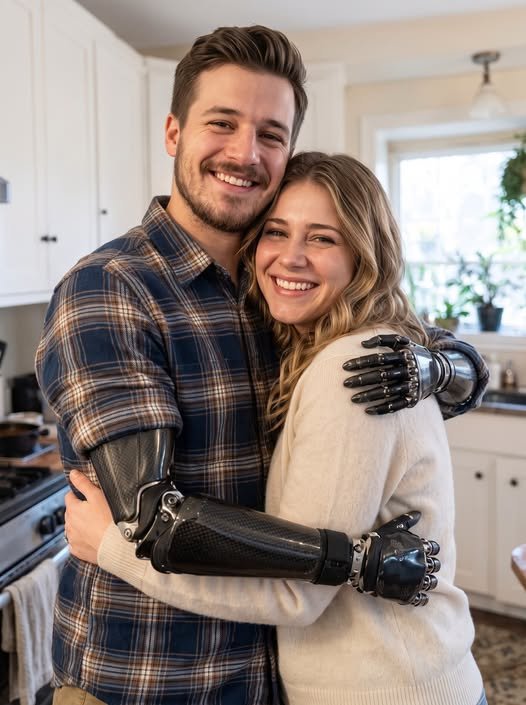
A tall young man stood outside holding a bottle of wine between two prosthetic hands.
“Mom, Dad—this is Brian.”
Brian smiled.
“So I finally get to meet the people I’ve been hearing stories about for a year.”
Emily had mentioned his accident before.
Years earlier, Brian had lost both arms after suffering a severe electrical injury. He had used prosthetics for so long that nearly every movement looked practiced and natural.
I liked him within minutes.
He had an easy sense of humor.
He listened when Emily spoke instead of waiting for his turn.
He asked me about my consulting work and genuinely seemed interested in the answer.
When he noticed Robert’s tomato plants through the kitchen window, he complimented the garden.
After dinner, he even insisted on helping clear the table.
Robert, however, barely spoke.
At first, I assumed he was simply adjusting.
Then I caught him staring at Brian’s prosthetic hands.
The moment Robert realized I had noticed, he looked away.
Later, while we were eating dessert, Brian turned to him.
“Emily told me you’re a surgeon.”
Robert’s expression tightened.
“I am.”
“What specialty?”
“Trauma surgery.”
Something changed in Brian’s face.
Only for a moment.
But I saw it.
His smile disappeared.
His shoulders stiffened.
Then he gave a small nod.
“I thought that might be the case.”
Robert looked directly at him.
Neither man said another word.
But something had just passed between them.
Something neither Emily nor I understood.
Part 2 — “That Wedding Isn’t Happening”
After Emily and Brian left, I found Robert standing alone in the kitchen pouring himself another glass of wine.
I leaned against the counter.
“All right. What was that about?”
He didn’t look at me.
“What was what about?”
“You barely said ten words to Brian all evening.”
Robert put the bottle down.
“I don’t like him.”
I stared at him.
“You met him tonight.”
“That was enough.”
“Enough to decide what?”
His jaw tightened.
“That Emily doesn’t know him as well as she thinks.”
The statement was so strange that I almost laughed.
“What exactly do you know about him?”
For one brief second, Robert looked frightened.
Not irritated.
Not disapproving.
Frightened.
Then the expression vanished.
“Nothing.”
“Robert.”
He picked up his glass.
“That young man can barely look after himself.”
I genuinely thought I had misunderstood him.
“What did you just say?”
“You heard me.”
“If you’re judging him because he uses prosthetic arms, I’m embarrassed for you.”
His eyes flashed.
“This isn’t about that.”
“Then what is it about?”
He didn’t answer.
“Brian has a career. He lives independently. Emily obviously loves him. What exactly are you objecting to?”
Robert struck the glass down against the counter hard enough to send wine over the rim.
“She is not marrying him.”
I stared at him.
“You don’t get to make that decision.”
“You have no idea what’s going on.”
“Then tell me.”
Silence.
For a moment, I thought he finally would.
Instead, Robert turned and walked out of the kitchen.
That became the pattern for the next several months.
Whenever Brian’s name came up, Robert shut down.
If Emily talked about wedding plans, he found an excuse to leave the room.
If I pressed him for an explanation, he became angry.
Once, Emily casually mentioned the accident in which Brian had lost his arms.
Robert went so still that I had to repeat his name.
“Did you hear me?”
“Yes.”
“Then why are you staring at the wall?”
He rubbed the back of his neck.
“Just leave it alone.”
I couldn’t.
Neither could Emily.
One afternoon, she called me crying.
“Mom, what is Dad’s problem with Brian?”
My stomach sank.
“What happened?”
“He barely looks at him anymore. Brian keeps pretending it doesn’t bother him, but I know it does.”
“I’ve asked your father.”
“And?”
“He won’t tell me anything.”
Emily was quiet.
Then she said something that stayed with me.
“That’s almost worse than if he just admitted he didn’t like him.”
She was right.
Robert wasn’t behaving like a stubborn father.
He was behaving like a man trying desperately not to say something.
Three weeks before the wedding, I decided the silence had gone on long enough.
I invited Emily and Brian to dinner.
Robert was furious.
“I don’t want them here.”
“They’re getting married in three weeks.”
“That doesn’t mean I have to pretend I’m happy about it.”
“I’m not asking you to pretend. I’m asking you to treat your daughter and the man she loves with basic respect.”
Robert stared at me for several seconds.
Then he walked away.
Again.

Part 3 — The Dinner That Finally Broke Everything Open
Brian arrived carrying lilies.
“Consider these a peace treaty,” he joked.
I hugged him.
Emily was wearing my mother’s pearl earrings, and for the first part of dinner, things were almost normal.
Brian told us a story about one of his coworkers accidentally sending a personal complaint to the entire company.
Emily laughed so hard she nearly spilled her drink.
Even Robert smiled.
For perhaps twenty minutes, I thought we had finally turned a corner.
Then Emily said, “Dad, I chose our song.”
Robert looked up.
“What song?”
“For the father-daughter dance.”
His fork slipped from his fingers and struck the plate.
The sharp sound stopped every conversation at the table.
Emily frowned.
“Dad?”
Robert pushed back his chair.
“There isn’t going to be a dance.”
I felt my stomach tighten.
“Robert.”
He ignored me.
“Because there shouldn’t be a wedding.”
Emily’s face drained of color.
“Please don’t do this again.”
“I’m serious.”
“So am I.”
Her voice shook.
“I’m marrying Brian.”
Robert stood.
“Not if you understand what’s actually happening.”
Brian’s eyes remained fixed on the table.
Emily looked between them.
“What has he ever done to you?”
Robert said nothing.
She pushed her chair back.
“Why do you hate him?”
“I don’t—”
“You’ve treated him like he’s some kind of burden from the moment you met him.”
Robert’s face hardened.
“He is not the man you believe he is.”
That was when Brian changed.
Until then, he had looked hurt.
Now he looked afraid.
Not angry.
Afraid.
And somehow that frightened me more than Robert’s outburst.
Brian stood.
“Excuse me.”
He left the table and walked into the kitchen.
Emily turned on her father.
“What is wrong with you?”
I didn’t wait for Robert’s answer.
I followed Brian.
He stood beside the sink with his eyes closed, breathing slowly.
“Brian, I’m sorry.”
He opened his eyes.
His face had gone pale.
Then he said quietly,
“Your husband still hasn’t told you why he really doesn’t want me around, has he?”
I froze.
“What are you talking about?”
A bitter smile crossed his face.
“So he hasn’t.”
“Brian.”
He reached inside his jacket.
“There’s something you need to see.”
He removed a folded photocopy and placed it on the kitchen counter.
I unfolded it.
At first, it looked like nothing more than an old medical record full of terminology I barely understood.
Then my eyes reached the bottom of the page.
There was a signature.
Robert’s.
I looked up.
“You were his patient?”
Brian nodded.
“I was seventeen.”
The room suddenly felt much smaller.
“What happened?”
“I was working a summer job. There was faulty electrical equipment.”
His gaze dropped briefly toward his prosthetic hands.
“I was badly injured.”
I swallowed.
“Robert treated you?”
“He was the senior trauma surgeon on duty.”
A horrible realization began forming.
“He was there when…”
Brian nodded.
“When the decision was made that my arms couldn’t be saved.”
I covered my mouth.
“Oh, Brian.”
He immediately shook his head.
“That’s not the reason I have a problem with him.”
I lowered my hand.
“You don’t blame Robert?”
“For the amputations?”
“No.”
He took a breath.
“I was dying. I understand what they had to do.”
His expression hardened.
“What happened afterward is different.”
Part 4 — The Medical Record Robert Never Wanted Us to See
Brian tapped the photocopy.
“Years later, I needed my full medical records for an insurance matter.”
I looked down at the page again.
“What did you find?”
“There was a result from shortly after I arrived at the hospital. Another doctor didn’t respond to it when they should have.”
My chest tightened.
“What kind of result?”
“Something that suggested my treatment needed to be escalated earlier.”
I stared at him.
“Would acting on it have saved your arms?”
Brian shook his head.
“No one can say that.”
There was no dramatic accusation in his voice.
No claim that his entire life would have been different.
Only certainty about what happened next.
“Maybe the outcome would have changed. Maybe it wouldn’t have. That’s not the point.”
“Then what is?”
He tapped a handwritten notation.
“This.”
I leaned closer.
“This shows Robert reviewed the result later.”
“So he discovered that somebody had missed it?”
“Yes.”
“And your family knew?”
“No.”
My stomach turned.
I looked at him.
“Robert knew they hadn’t been told?”
“Yes.”
“How can you be certain?”
Brian held my gaze.
“Because I asked him.”
“When?”
“Eight years ago.”
I stared at him.
“You confronted Robert eight years ago?”
“After I obtained my records.”
“What did he say?”
Brian gave a quiet, humorless laugh.
“He told me reopening the issue wouldn’t give me my arms back.”
I closed my eyes.
For a moment, all I could hear was Robert’s voice repeating the phrase he had used whenever I demanded answers.
It’s not that simple.
I looked back at Brian.
“So he knew there had been a mistake, or at least a possible mistake, and chose not to tell your family.”
Brian’s jaw tightened.
“He knew enough to understand that my parents should have been told there was a serious question about how my treatment had been handled.”
“Why didn’t you tell Emily?”
“I kept hoping he would.”
That answer surprised me.
Brian glanced toward the dining room.
“When I realized Emily was his daughter, I thought eventually he would sit down with all of us and tell the truth.”
“And when he didn’t?”
“I still waited.”
“Why?”
“Because I didn’t want Emily learning something like this from me if her father was willing to take responsibility himself.”
His expression darkened.
“But instead, he started using my disability against me.”
My stomach dropped.
Brian continued.
“He talked about whether I could take care of myself. Whether I could take care of Emily.”
He looked at his prosthetic hands.
“I knew exactly what he was doing.”
“What?”
“He wasn’t afraid I couldn’t take care of your daughter.”
Brian looked directly at me.
“He was afraid that every time he saw me, he remembered what he’d hidden.”
Behind us, a voice said,
“What did Dad hide?”
Brian’s eyes closed.
Emily stood in the kitchen doorway.
She was staring at the paper in my hands.
“Mom?”
I didn’t know how to answer.
So I walked back into the dining room.
Robert was still beside the table.
I placed the medical record in front of him.
“Is that your signature?”
He looked down.
And everything about him changed.
His shoulders sagged.
The anger disappeared.
He looked like a man who had spent years holding a door shut and had just realized it was finally open.
“Robert.”
He sat down.
Emily entered behind me.
“Dad?”
I pointed to the record.
“Brian says another doctor missed something important when he was seventeen. He says you discovered it afterward and never told his family.”
Robert stared at the table.
Brian came into the room.
Finally Robert whispered,
“It was more complicated than that.”
Brian let out one short laugh.
“You said the same thing eight years ago.”
Emily looked between them.
“You’ve talked about this before?”
Brian nodded.
“Once.”
Her eyes moved to her father.
“Tell me what happened.”
Robert opened his mouth.
Nothing came out.
Brian spoke quietly.
“Tell her.”
Robert looked at him.
Brian didn’t look away.
Finally, I asked the question that mattered.
“Did you know Brian’s family should have been informed?”
Robert closed his eyes.
“Yes.”
One word.
Somehow, it hurt more than any explanation could have.
Part 5 — The Truth Robert Had Buried
Later that week, with Brian’s permission, we took the complete records to an independent specialist who had no connection to Robert’s hospital.
Brian asked the question first.
“If the earlier result had been handled immediately, could things have ended differently?”
The specialist studied the records for a long time.
“Possibly.”
I leaned forward.
“That’s all you can say?”
“That’s all anyone can honestly say.”
He turned several pages.
“There are too many medical variables here to claim certainty about whether the amputations could have been avoided.”
Brian nodded.
That seemed to be the answer he expected.
Then the specialist continued.
“But there is another issue where the answer is much clearer.”
“What issue?”
“The patient and his family should have been informed that there had been a significant delay and that it may have affected his care.”
That evening, the four of us sat around our kitchen table.
There was no shouting this time.
No one walked away.
I looked at Robert.
“Why?”
He stared at his hands.
“I was younger than I am now.”
“That isn’t an explanation.”
“I was ambitious.”
I waited.
He swallowed.
“The physician who missed the result was respected. If the matter became formal, there would have been an investigation.”
“And?”
Robert looked at me.
“More than one career might have been affected.”
“Including yours?”
After a long silence, he nodded.
Something inside me went cold.
“So you kept quiet.”
“At the time, I told myself Brian was alive.”
Brian’s expression tightened.
Robert continued.
“I told myself that saving his life had to count for something.”
Brian finally spoke.
“You want to know the strangest part?”
Robert looked at him.
“The worst thing wasn’t waking up without my arms.”
No one moved.
“The worst thing came years later.”
Brian leaned forward.
“It was discovering that other people had information about my own life—my own body, my own treatment—and decided I didn’t deserve to know it.”
Robert lowered his eyes.
Brian continued.
“You’ve spent months talking about what I can or can’t do.”
His voice remained calm.
“Whether I’m capable of living independently. Whether I’m capable of being a husband.”
He shook his head.
“But this was never about my prosthetics.”
Robert looked up.
“This was about you seeing me and remembering what you did.”
Silence.
Brian held his gaze.
“You wanted me gone because as long as I was around Emily, there was a chance she would learn the truth.”
Robert’s face tightened.
Brian asked,
“Isn’t that right?”
For a long time, Robert said nothing.
Then he whispered,
“Yes.”
Emily wiped tears from her face.
When she spoke, her voice was steady.
“The wedding is still happening.”
Robert looked at her.
She continued.
“Whether you’re there is something else.”
His eyes widened.
“Emily—”
“No.”
She shook her head.
“You don’t get to spend months humiliating Brian because you were ashamed of yourself and then show up at my wedding pretending you’re the protective father.”
“I know.”
“I don’t think you do.”
Robert looked as though she had struck him.
Maybe he needed to.

Part 6 — An Apology Wasn’t Enough
Eventually, Robert turned toward Brian.
“Could we talk privately?”
Brian shook his head.
“If you’re going to say something, say it here.”
Robert glanced at Emily and me.
Neither of us moved.
So he stayed.
For several seconds, he struggled to speak.
Then he said,
“I’m sorry.”
Brian said nothing.
Robert tried again.
“For what happened afterward. For keeping information from you and your family.”
He swallowed.
“And for how I’ve treated you since you came back into my life.”
His voice cracked.
“I was terrified Emily would discover the truth. Instead of admitting that, I made your disability the issue.”
Brian’s expression didn’t change.
Robert looked down.
“I said things about you that I knew weren’t true because I wanted my family to believe there was a reason not to trust you.”
He took a shaky breath.
“You didn’t deserve that.”
Brian waited.
Then he said,
“I’m not forgiving you tonight.”
Robert nodded.
“I understand.”
“No. Listen.”
Brian leaned forward.
“Saying you’re sorry doesn’t repair eight years of silence or the way you’ve treated me these last few months.”
“I know.”
“Then don’t ask me to accept words.”
Robert looked at him.
“What do you want me to do?”
“Show me.”
That was all Brian said.
And strangely, it was the beginning of the first real change I had seen in my husband.
For the next three weeks, Robert stopped trying to control the situation.
He didn’t ask Emily to postpone the wedding.
He didn’t complain about Brian.
He didn’t pressure anyone to forgive him.
When Emily had questions, he answered them.
Even when the answers embarrassed him.
Even when they hurt.
When Brian wanted distance, Robert gave it.
And when Brian began considering what he wanted to do with the medical records, Robert did not tell him what decision to make.
Neither did I.
That was Brian’s choice.
It had always been his story.
Other people had made enough decisions about it already.
Two days before the wedding, Emily called me.
“Dad can come.”
I sat down.
“Are you sure?”
“No.”
Her answer surprised me.
Then she continued.
“But I want to see whether he’s actually changing or whether he’s only sorry because the truth came out.”
I understood.
Forgiveness and permission were not the same thing.
Sometimes allowing someone back into a room was simply giving them an opportunity to show who they intended to become.
Part 7 — The Wedding
Three weeks after that terrible dinner, Emily married Brian.
The ceremony was beautiful.
Robert arrived early.
He didn’t act as though everything had been repaired.
He didn’t attempt some grand public apology.
He didn’t corner Brian.
For most of the evening, he stayed close enough to be present but far enough not to intrude.
I could tell it was difficult for him.
Good.
Some discomfort was deserved.
Later, shortly before the father-daughter dance, I saw Robert approach Brian near the edge of the reception hall.
My instinct was to move closer.
Instead, I stayed where I was.
Robert pointed awkwardly toward Brian’s sleeve.
“Can I ask you something?”
Brian looked at him cautiously.
“All right.”
“Your cuff looks caught against the prosthetic.”
Brian glanced down.
“It is.”
Robert hesitated.
Then he asked something that, to anyone else, would have sounded completely ordinary.
“Can you show me how to fix it?”
Brian looked at him.
For several seconds, neither man moved.
Then Brian explained.
Robert listened.
He adjusted the fabric exactly the way Brian told him to.
It took less than a minute.
There was no hug afterward.
No declaration that everything was forgiven.
No miraculous moment in which years of hurt disappeared.
Robert simply asked instead of assuming.
He listened instead of deciding.
When he was finished, he stepped back.
“Thank you.”
Brian nodded.
Then Robert walked across the room toward Emily.
The music began.
My daughter placed her hand in her father’s.
And as they stepped onto the dance floor, I understood something I hadn’t understood when all of this began.
Robert had spent months insisting he was trying to protect Emily.
He wasn’t.
He had been protecting the version of himself he wanted his family to believe in.
Brian’s presence threatened that version—not because of what Brian couldn’t do, but because of what Robert had done.
The truth didn’t restore everything.
It didn’t erase the past.
And it certainly didn’t guarantee forgiveness.
But it finally gave all of us something we’d been denied for months.
A chance to make our own choices with the whole story in front of us.
Brian could decide what justice or closure meant to him.
Emily could decide what kind of relationship she wanted with her father.
And Robert could decide whether he was willing to become someone different from the man who had spent years hiding behind silence.
As I watched him dance with our daughter, I didn’t know where all of those choices would eventually lead.
But for the first time, Robert wasn’t running away from the truth.
And for that night, at least, that was enough.