
Part 1 — Superman Knelt Beside My Daughter’s Hospital Bed
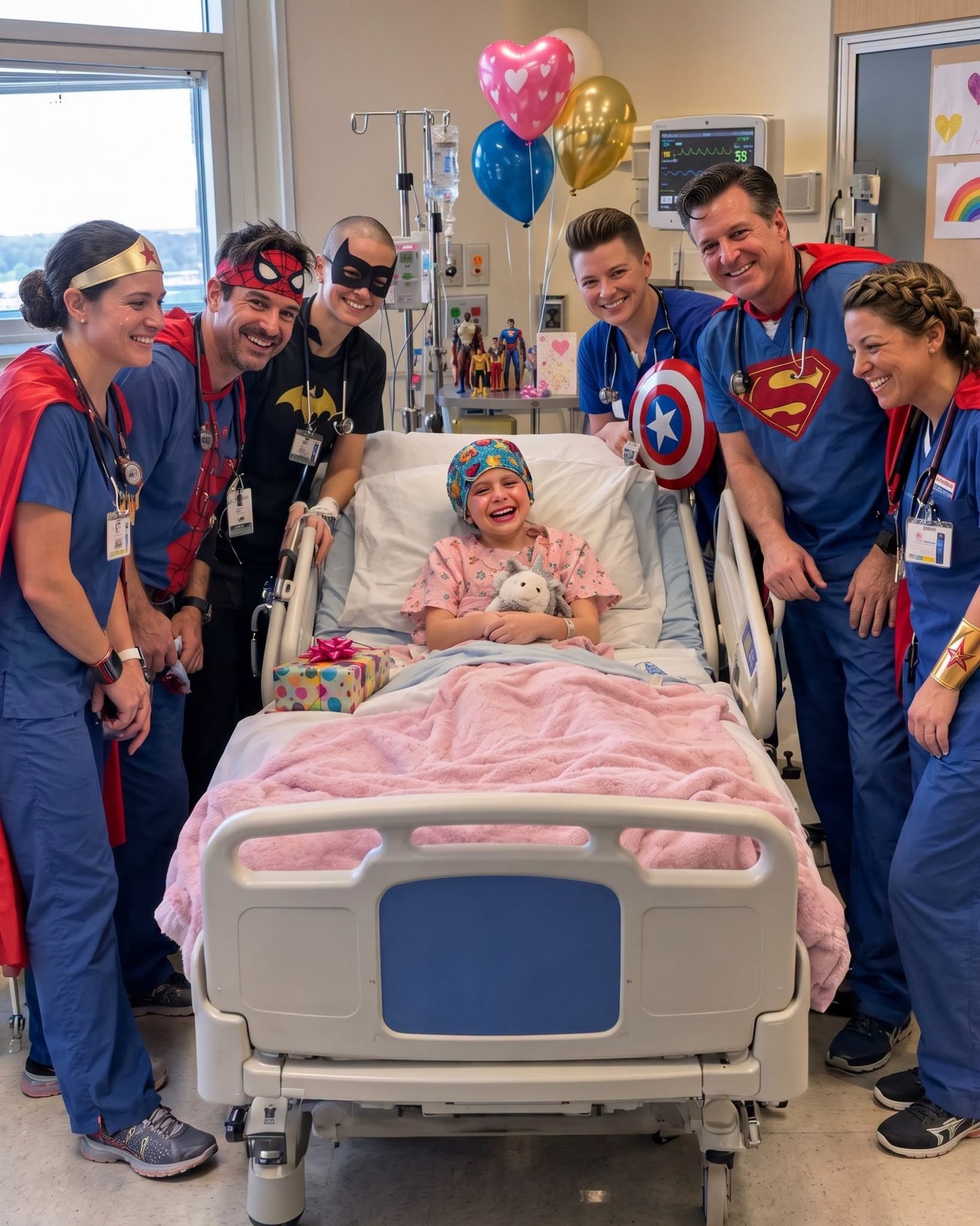
By the time Superman knelt beside my daughter’s hospital bed, Alice was already crying.
So was I.
Wonder Woman stood near the window. Batman was pretending to inspect the IV machine. Spider-Man leaned against the wall beside Captain America.
Underneath every mask was someone Alice knew.
Doctors.
Nurses.
People who had drawn her blood, adjusted her medications, held buckets when she was sick, explained procedures when she was frightened, and spent nearly a year helping my seven-year-old daughter fight leukemia.
Alice wiped both cheeks with the backs of her hands.
“This is the best birthday ever,” she whispered.
I laughed through my own tears.
Only a few minutes earlier, she had been complaining that spending her seventh birthday in the hospital was “extremely unfair.”
Now she was surrounded by superheroes.
Then Superman stepped closer.
Or rather, Dr. Malcolm did.
He had been Alice’s oncologist through most of the year, and even with the cape hanging from his shoulders, I recognized the expression in his eyes immediately.
There was something else.
Something he hadn’t told me.
He rested one hand on the side of Alice’s bed and lowered himself to her level.
“There’s actually one more part of today,” he said gently. “And your mom doesn’t know about this one either.”
Alice turned toward me.
I froze.
Everyone else in the room seemed to know what was happening.
I didn’t.
My fingers closed around the metal bedrail.
“What part?” I asked. “What’s going on?”
Then the question I had trained myself to ask before every other question escaped me.
“Is Alice okay?”
Dr. Malcolm’s face softened.
And just like that, the costumes disappeared.
I no longer saw Superman.
I saw my daughter’s doctor.
And suddenly, I was terrified.
Because for almost a year, I had learned that some of the most important moments of my life began with a doctor asking me to sit down.
Three hours earlier, I had believed my biggest challenge that day would be convincing Alice that a hospital birthday could still feel like a birthday.
I had no idea the day was about to change much more than that.
Part 2 — The Birthday Cancer Hadn’t Taken
Alice had been fighting leukemia for almost a year.
By then, our lives had acquired a language I never wanted to learn.
Blood counts.
Medication schedules.
Infusions.
Needles.
Nausea.
Appointments.
Temperature checks.
Waiting rooms.
There had been mornings when Alice woke up laughing and evenings when she barely had enough energy to sit upright.
There had been nights when I watched her sleep because watching her chest rise and fall was the only thing that quieted the panic inside me.
And somehow, through all of it, she was still Alice.
Still sarcastic.
Still curious.
Still determined to make everyone else laugh.
Still absolutely obsessed with superheroes.
She kept a collection of small superhero figures lined up beside her hospital bed. Before every treatment, she picked one.
“My chemo buddy,” she called them.
That morning, Spider-Man had been clipped to her IV pole.
“He’s good under pressure,” Alice had explained seriously.
I had decorated the room before she woke fully.
Paper stars hung from the wall. A few balloons floated near the window. I had brought a small cake, although whether she would actually feel well enough to eat it was another question.
When Alice looked around, she shook her head.
“Mom.”
“What?”
“You did too much.”
“It’s your birthday.”
“You said that at Christmas, and then you brought candy canes for the whole floor.”
“That was different.”
“How?”
I considered it.
“It was Christmas.”
She smiled.
“You only turn seven once,” I added.
For a moment, she looked happy.
Then her eyes drifted toward the balloon tied beside her bed.
A large silver 7 floated above us.
Alice stared at it for several seconds.
“Mom?”
“Yes?”
“Do you think I’ll have my eighth birthday here too?”
My heart tightened so quickly it almost hurt.
I reached for her blanket and smoothed a wrinkle that didn’t need smoothing.
“One birthday at a time,” I said. “Let’s make seven a good one first.”
She nodded.
Too easily.
That was what frightened me about Alice sometimes.
She had become too good at accepting answers children shouldn’t have needed to understand.
Before she became sick, she had complained constantly about being tired.
I had blamed school.
Then bruises began appearing on her legs.
I blamed the playground.
She stopped finishing dinner.
I thought she was going through a phase.
Individually, none of those things had seemed terrifying.
Until one day, together, they were.
I had never completely forgiven myself for not recognizing the beginning.
It didn’t matter how many times doctors told me I couldn’t have known.
I was her mother.
Some irrational part of me believed I should have known everything.
So once she was diagnosed, I compensated.
I watched.
Constantly.
If Alice rubbed her eyes, I noticed.
If she drank less water, I noticed.
If her skin looked slightly paler under one light than another, I noticed.
If she went quiet for longer than usual, I noticed.
Somewhere along the way, loving my daughter and monitoring my daughter had become almost impossible for me to separate.
That morning, a nurse carried in an enormous card from Alice’s class.
Her face lit up.
The poster-sized card was covered with glitter, stickers, badly drawn superheroes, hearts, and names written in nearly every color imaginable.
Alice read each message.
I read them too.
Then I noticed something.
One name wasn’t there.
Sophie.
Before Alice became sick, Sophie had practically been part of our family.
The girls had sleepovers at our house, traded lunches at school, fought about movies, argued over dinosaurs, and once spent an entire afternoon debating which superhero would win if every hero lost their powers.
Alice searched the card again.
“Maybe Sophie forgot.”
“She wouldn’t forget your birthday.”
Alice shrugged.
“I’ve been gone almost a year, Mom. Maybe she has different friends now.”
There was something painfully adult about the way she said it.
“I could ask your teacher.”
Alice’s head snapped up.
“No.”
“I’d just make sure everything is okay.”
“Please don’t.”
“Honey—”
“I don’t want you to.”
I looked at her.
“All right.”
And I meant it.
For approximately twenty minutes.
Then, while Alice watched television, I took out my phone.
I messaged her teacher.
Is everything okay between Sophie and Alice? Alice noticed Sophie didn’t sign the birthday card.
I stared at the message after I sent it.
Even then, I knew I had broken a promise.
But I told myself the same thing I had told myself about a hundred other decisions that year.
I was her mother.
I was only trying to help.

Part 3 — The Superheroes Arrive
Later that morning, Dr. Malcolm came into the room.
Alice liked him because he always spoke directly to her.
He never discussed her as though she were furniture simply because she was a child.
He checked how she was feeling, asked a few questions, then nodded toward the figures beside her bed.
“Who’s on duty?”
Alice pointed toward the IV pole.
“Spider-Man.”
Dr. Malcolm nodded approvingly.
“Solid choice.”
“He’s my chemo buddy.”
“I feel safer already.”
Then Dr. Malcolm looked at me.
Something changed.
Only slightly.
But I saw it.
“I need to step out for a few minutes.”
Every muscle in my body tightened.
“Why?”
He must have seen the fear on my face.
“Nothing’s wrong, Maggie.”
“Are you sure?”
“Yes.”
He gave me a reassuring smile and left.
I stared after him.
Beside me, Alice sighed.
“You’re doing the face again.”
I looked at her.
“What face?”
“The hospital face.”
“I don’t have a hospital face.”
“You do.”
“What does it look like?”
She scrunched her eyebrows together and widened her eyes dramatically.
“Like you’re waiting for somebody to say something terrible.”
I almost laughed.
Almost.
Then the door opened.
A man in a Superman costume stepped inside.
Alice stared.
Behind Superman came Wonder Woman.
Then Batman.
Spider-Man.
Captain America.
For three full seconds, my daughter didn’t make a sound.
Then she screamed.
“No way!”
The whole room exploded with laughter.
One by one, she recognized the voices and movements beneath the costumes.
These weren’t strangers hired for a hospital party.
These were her people.
The nurse who knew which flavor ice pop she preferred.
The doctor who let her listen through his stethoscope.
The technician who always drew a tiny smiley face on her bandage.
Alice laughed until tears started running down her cheeks.
Then she pointed accusingly toward Batman.
“I know who you are!”
Batman folded his arms.
“You have no evidence.”
“I recognize your voice!”
“Circumstantial.”
Alice laughed even harder.
I instinctively reached for my phone.
For almost a year, I had photographed everything.
Good days.
Bad days.
Hospital bracelets.
Birthday balloons.
Small victories.
Part of me was terrified that if I didn’t capture every moment, something might disappear.
But that morning, I stopped.
I lowered the phone.
For once, I didn’t want to watch my daughter through a screen.
I wanted to be there.
Fully.
That was when Dr. Malcolm—Superman cape and all—knelt beside Alice.
“There’s actually one more part of today,” he said. “And your mom doesn’t know about this one either.”
My stomach dropped.
“What’s happening?” I asked.
He looked at me.
“The results we’ve been waiting for came in this morning.”
I gripped the bedrail.
Alice stopped smiling.
Dr. Malcolm continued carefully.
“They’re encouraging.”
I didn’t breathe.
“They look good, Maggie.”
Hope surged through me so violently that it frightened me.
Dr. Malcolm immediately added, “I want to be very clear. Treatment isn’t finished.”
I nodded quickly.
Alice would still need medication.
Appointments.
Blood work.
Monitoring.
There was still a road ahead.
But the results were strong enough that her medical team felt comfortable moving her toward the next, less intensive phase they had been working toward.
Alice looked at me.
“Is that good?”
I tried to answer normally.
Instead, my voice broke.
“It’s very good.”
Alice smiled.
And I cried all over again.
Then Wonder Woman handed Dr. Malcolm a bright blue backpack.
It was covered with fabric-marker stars, superhero symbols, doodles, and handwritten messages.
Alice immediately sat straighter.
“What’s that?”
“Something your class made.”
He handed it to her.
Inside was a card.
Alice unfolded it.
Whenever you’re ready, your seat is waiting.
She read the sentence twice.
Then she stared at Dr. Malcolm.
“School?”
He nodded.
“Not tomorrow. And definitely not full days immediately. We’ll need a plan, and your school will need medical guidance. But if you’re ready, we can begin talking about a gradual return.”
Alice’s entire face transformed.
Then she turned toward me.
“Mom.”
The excitement in her voice should have made me happy.
Instead, terror spread through my body.
Apparently my face betrayed me, because Alice’s smile slowly disappeared.
That was the moment I realized the biggest surprise of her birthday wasn’t the superheroes.
It was the possibility of normal life returning.
And I wasn’t sure I knew how to let her have it.
Part 4 — The Thing I Was Really Afraid Of
Alice talked nearly the entire drive home.
“Do you think Mr. Pickles is still alive?”
I glanced at her.
“Who?”
“The class hamster.”
“Oh.”
“Mom, you met him.”
“I have met many hamsters.”
“There’s only one Mr. Pickles.”
“Then I hope he’s thriving.”
She continued.
Would she get her old cubby?
Had the classroom changed?
Could she go to recess?
Would she have to do all the homework she had missed?
Would Sophie sit with her?
Then suddenly, Alice stopped talking.
The silence lasted long enough that I looked over.
She was staring out the window.
“What?”
“You don’t want me to go back.”
My chest tightened.
“I never said that.”
“You didn’t say anything.”
“We have to plan carefully.”
“That’s not the same as wanting me to go.”
“Alice—”
“Does planning carefully mean yes?”
“It means we need to talk to your doctor, your teacher, the school nurse—”
She turned toward the window again.
Even at seven, she understood exactly what I was saying.
Not yet.
Because I wasn’t ready.
The following week, I arranged a meeting with her teacher and the school nurse.
I brought three pages of questions.
“What happens if another child comes to school sick?”
“We’ll follow the precautions recommended by Alice’s medical team.”
“What if she suddenly gets tired?”
“She can rest or go home.”
“What if she needs medication?”
“We’ll have the approved plan available.”
“What if someone runs into her?”
Her teacher hesitated.
“Maggie, children sometimes bump into each other.”
Exactly.
That was the problem.
Children bumped into each other.
They sneezed without covering their mouths.
They forgot to wash their hands.
They shared pencils.
They touched everything.
They arrived healthy in the morning and developed fevers by lunchtime.
For almost a year, I had been taught that ordinary things could become dangerous.
How was I supposed to suddenly believe ordinary was safe again?
During the meeting, another parent came into the office to drop off paperwork.
She heard Alice’s name.
“Oh,” she said. “Is Alice coming back?”
“Gradually,” her teacher answered.
The woman hesitated.
Then she asked, “Is it… safe for the other children?”
My chair scraped backward before I even realized I had moved.
The school nurse answered first.
“Cancer isn’t contagious.”
The woman immediately flushed.
“Oh, I know. I didn’t mean—”
Maybe she truly hadn’t.
But it didn’t matter.
Because Alice had been sitting nearby with my mother.
And she had heard enough.
Later, in the car, she asked quietly, “Does that lady think I can give people cancer?”
“She doesn’t understand.”
Alice stared at her hands.
“Everybody’s going to look at me weird.”
My heart broke.
And before I could stop myself, I said the worst possible thing.
“Maybe we should wait a little longer.”
Alice looked up.
The hurt in her face hit me instantly.
I heard what I had done.
Alice had expressed fear.
Instead of helping her walk through it, I had offered to hide her from it.

Part 5 — “It Was Mine”
Two days later, Sophie and her mother came to our house.
The moment Alice saw them through the window, she turned toward me.
“You told.”
“I only asked your teacher whether everything was okay.”
“I asked you not to.”
“I was worried.”
“I know.”
“I was trying to help.”
Alice’s voice became quieter.
“I didn’t ask you to.”
“You were hurt.”
“Yeah.”
She looked directly at me.
“But it was mine.”
I stopped.
It was such a small sentence.
Five words.
But I felt every one.
Her hurt.
Her friendship.
Her question.
Her problem to face.
I had treated all of it as something belonging to me because I was her mother.
Sophie stood awkwardly in our living room until Alice finally asked the question.
“Why didn’t you sign my birthday card?”
Sophie stared at her shoes.
“My mom told me not to talk about cancer unless you talked about it first.”
Alice frowned.
“I didn’t want to talk about cancer.”
“I know.”
“Then why didn’t you talk to me?”
Sophie shrugged helplessly.
“I didn’t know what else we were allowed to talk about.”
Alice stared at her.
Then she said, almost offended, “Dinosaurs?”
Sophie finally looked up.
“You still think a shark could beat a T. rex?”
“Obviously.”
“That doesn’t even make sense.”
“It absolutely does.”
Within minutes, they were arguing exactly the way they had before Alice became sick.
I stood in the kitchen and listened.
No intervention.
No questions.
No fixing.
Alice had handled the situation I had tried to manage for her.
And she had done it better.
Part 6 — Watching Her Breathe
A few weeks later, with approval from Alice’s medical team, we arranged a short classroom visit.
An hour or two.
That was all.
I packed as though we were crossing the country.
Water.
Medication.
Emergency information.
Snacks.
Extra clothes.
Wipes.
Medical supplies.
And the hospital bag.
Alice watched me carry everything toward the door.
“How long are we staying?”
“Maybe two hours.”
She looked at the luggage.
“That looks like two months.”
“We’re prepared.”
“We look like we’re moving into school.”
I ignored her.
At the classroom, I positioned myself where I could see her.
Then I watched.
And watched.
And watched.
Alice talked to classmates.
I watched.
She colored something at her desk.
I watched.
She stood up.
I watched.
Eventually, she turned toward me.
“Mom?”
“Yes?”
“Can you stop?”
“Stop what?”
“Looking at me.”
“I’m checking on you.”
“You’ve been checking on me every minute.”
“I have not.”
She gave me a look.
Then she said something that nearly made me laugh until I realized she was completely serious.
“You’re watching me breathe.”
I opened my mouth.
Nothing came out.
An hour later, her energy dropped.
I saw it before she said anything.
Her shoulders sagged.
The color in her face changed.
“We’re going home.”
“I’m okay.”
“You’re exhausted.”
“I’m tired.”
“You look pale.”
“Mom.”
“We’re leaving.”
Alice’s frustration finally broke through.
“I am tired, Mom. But I’m not dying.”
Everything inside me went still.
Alice immediately looked horrified.
“Mom, I didn’t—”
“It’s okay.”
I didn’t make her apologize.
I gathered our things and took her home.
But her words followed me.
I’m tired, Mom. But I’m not dying.
The problem was that somewhere inside me, those two things had become almost the same.
Tired meant danger.
Pale meant danger.
Quiet meant danger.
Headache meant danger.
Ordinary childhood discomfort had become impossible for me to separate from catastrophe.
At Alice’s next appointment, I told Dr. Malcolm everything.
How quickly she became tired.
How pale she looked.
How little energy she had after the classroom visit.
He examined her carefully.
He reviewed what symptoms should concern me and when I should contact the care team.
Then I asked the question that mattered.
“So you would still let her go back?”
Dr. Malcolm looked at me for a long moment.
“I can tell you what her body can safely attempt.”
I waited.
“But I can’t tell you how afraid you’re allowed to be while she attempts it.”
I looked down.
He continued gently.
“Alice is going to have limitations for some time.”
I nodded.
“But having limitations isn’t the same thing as having no life.”
I knew he was right.
Knowing and accepting were two very different things.

Part 7 — The Notebook
That night, Alice fell asleep with a notebook beside her.
I was repacking the hospital bag when the notebook slipped from the edge of the bed.
It landed open on the floor.
I bent down to pick it up.
Then I saw the heading.
Written in Alice’s large, uneven handwriting were the words:
THINGS I WANT TO DO WHEN MOM STOPS BEING SCARED
My breath caught.
I should have closed it.
I know that.
Instead, I read.
Ride the bus.
Go to recess.
Sleep at Grandma’s.
Eat cake without Mom asking if my stomach hurts.
My eyes blurred.
I kept reading.
Have messy hair in my school picture.
Stop everybody whispering when they think I’m asleep.
Then the last one:
Make Mom laugh without checking if she really means it.
I sat down on the floor.
For months, I had believed I was the one watching Alice.
I watched her color.
Her appetite.
Her energy.
Her breathing.
Her temperature.
Her sleep.
I had never realized that the entire time, she had been watching me too.
She noticed every forced smile.
Every whispered conversation.
Every time I stood too quickly when she coughed.
Every glance at the thermometer.
Every expression I tried to hide.
My fear had not stayed safely inside me.
Alice had been carrying part of it.
And she was only seven.
The next morning, guilt made me reckless in a different direction.
“You can go back to school.”
Alice stopped with her spoon halfway to her mouth.
“Today?”
“No, no. Not today. But soon. We’ll plan everything.”
Her eyes narrowed.
“You read my notebook.”
“It fell open.”
“But you read it.”
“I saw the page.”
“That means you read it.”
I couldn’t argue.
Alice pushed her breakfast away.
“You always fix things I didn’t ask you to fix.”
“I’m your mother.”
“I know.”
She looked down at the table.
“That’s why sometimes I wish you would just be my mom.”
That hurt.
But this time, instead of defending myself, I stayed quiet.
I wanted to explain.
I wanted to tell her about the first blood test.
The diagnosis.
The nights beside her hospital bed.
The terror of imagining a life without her.
I wanted to tell her that checking and packing and planning were the only ways I knew to convince myself I still had some control.
But none of that changed what she needed from me.
Later, I sat beside her.
“What do you want your first real day back to look like?”
Alice studied my face suspiciously.
“You’re asking me?”
“Yes.”
“A half day.”
“Okay.”
“No big welcome party.”
I nodded.
“No telling everybody they have to be careful with me.”
That one was harder.
But I nodded again.
“Okay.”
“And you can’t stand outside my classroom.”
I swallowed.
“You drive a hard bargain.”
“Mom.”
“Okay. I won’t stand outside.”
Her shoulders relaxed.
For the first time, returning to school felt like something we were planning together instead of something I was either permitting or preventing.
Part 8 — The First Day Back
The night before Alice’s first half day, she complained of a headache.
Every alarm inside me activated instantly.
My mind sprinted toward disaster before my feet even reached her room.
I checked her temperature.
I followed the medical guidance we had been given.
And when necessary, I contacted her care team.
What I did not do was invent ten new restrictions because I was afraid.
Nothing suggested an emergency.
By morning, Alice felt better.
I put the hospital bag in the trunk anyway.
Then I stood beside the car staring at it.
That bag had followed us for almost a year.
It represented preparation.
Emergency.
Control.
It told me that if I packed enough things, anticipated enough problems, and stayed alert enough, perhaps nothing terrible could surprise me again.
But something terrible already had surprised me.
And carrying an overnight hospital bag everywhere had never changed that.
I opened the trunk.
I took the bag out.
Alice’s necessary medication and medical information came with us.
The emergency overnight bag stayed home.
It felt ridiculous that such a small action required courage.
But it did.
When we reached school, Alice stopped just outside the entrance.
Suddenly, all the confidence disappeared.
She grabbed my hand.
“What if everybody looks at me?”
“They might.”
“What if it’s weird?”
“It probably will be.”
She looked up at me.
I wanted to promise that nobody would stare.
That nobody would say the wrong thing.
That she wouldn’t get tired.
That nothing would frighten her.
But those promises would have been lies.
So I said, “And if today is terrible, we’ll figure out tomorrow.”
Alice considered that.
Then she squeezed my hand once.
And let go.
She walked through the school entrance without me.
I remained outside for several seconds.
Every part of me wanted to follow her.
I didn’t.
I turned around.
I went home.
Actually home.
The hospital bag sat beside the front door.
I made coffee.
It went cold because I kept checking the time.
At pickup, I arrived fifty minutes early.
I told myself it was forty-three.
It was fifty.
When Alice finally came out, Sophie was beside her.
Alice’s hair was messy.
Her backpack hung crookedly from one shoulder.
She looked tired.
Immediately, my eyes began examining her face.
Color.
Eyes.
Posture.
Energy.
Alice caught me.
“You’re doing it.”
I stopped.
“The hospital face?”
She nodded.
“Sorry.”
“It’s okay.”
She thought for a second.
“I did the school face today.”
I smiled.
“What does the school face look like?”
“Like I’m not scared even when I am.”
My chest tightened.
That sounded painfully familiar.
Alice glanced toward the parking lot.
“You got here early, didn’t you?”
“No.”
She stared at me.
“Mom.”
“Forty-three minutes.”
“Mom.”
I sighed.
“Fine. Fifty.”
She burst out laughing.
A real laugh.
And this time, I didn’t wonder whether mine sounded convincing enough.
I just laughed with her.
Then I reached automatically for her backpack.
Alice pulled it closer.
“I’ve got it.”
I looked at the straps digging slightly into her shoulders.
My first instinct was to tell her it was too heavy.
My second was to take it anyway.
Then I remembered the notebook.
The bus.
Recess.
Messy hair.
Cake without questions.
A mother who could laugh without fear immediately swallowing the sound.
So I lowered my hand.
“Okay.”
Alice adjusted the strap herself.
Then she started toward the car.
I walked beside her.
Close enough if she needed me.
Far enough that she didn’t have to lean on me.
For almost a year, I had believed being a good mother meant carrying everything my daughter possibly could not.
Her medicine.
Her bags.
Her fear.
Her problems.
Her friendships.
Her future.
But that afternoon, walking across a school parking lot beside a seven-year-old girl who had already endured more than I could ever have protected her from, I began to understand something different.
Sometimes loving your child means carrying them.
Sometimes it means standing close enough to catch them.
And sometimes it means trusting them when they say,
“I’ve got it.”
So I let Alice carry her own backpack.
And for the first time in almost a year, I understood that letting go of a little fear did not mean I was giving up on protecting my daughter.
It meant I was finally helping her live.