
Part 1: Twelve Turkeys
“Please. I only need one.”
The old woman’s voice was so quiet I almost missed it over the hum of the refrigerated cases. I had a carton of milk in one hand and my mother’s grocery list in the other. I turned toward the sound.
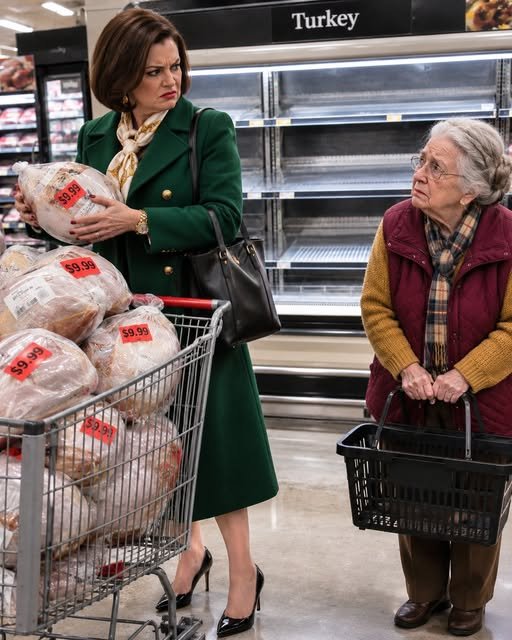
At the end of aisle six, a woman in an emerald wool coat was stacking turkeys into her cart like sandbags before a flood. Every bird wore the same red sticker: $9.99. The shelf behind her was a long, empty strip of metal.
I knew her. Everyone in Maple Ridge knew Beatrice Calloway, even people who had never spoken to her. Her husband’s family owned apartment buildings, three car dealerships, and a house on the hill with its own gatehouse.
Beside her stood a small woman in a burgundy quilted vest and a plaid scarf, gripping a black plastic basket with both hands. Her silver braid was pinned up neatly, and her glasses had slid halfway down her nose. She looked like someone who had practiced a sentence in the car.
“My grandson has the flu,” she said. “I’m raising him on my own. I wanted to make him soup.”
“Then buy chicken,” Beatrice said, not looking up.
“The chicken isn’t on sale.”
“That sounds like a budgeting issue.”
I should explain why my feet stopped moving. Three hours earlier I had been standing in my mother’s kitchen, arguing about a refrigerator.
My name is Rachel. I’m thirty-eight, and I plan events for a living. Or I did, before my mother’s surgery last spring, when I turned down the hotel galas and the corporate retreats and kept only the small weddings that fit between her appointments.
“I can make breakfast, Rachel,” Mom had said that morning, one hand on the counter. She was sixty-six and stubborn as a fence post. “Don’t hover.”
“You tried to move the refrigerator yesterday.”
“I wanted to clean behind it.”
“The dust can wait.”
She laughed and pressed the list into my palm. Her handwriting slanted the way it always had, even on the old index cards she used to tape inside our cupboard door.
“Remember when we couldn’t afford half of this?” I asked.
Her smile softened. “I remember a little girl asking why Mommy sometimes came home from the store with nothing.”
“You always said you’d forgotten your wallet.”
“Well. I couldn’t exactly tell my daughter we were broke.”
I hugged her longer than I needed to. She kept urging me to take bigger contracts again, and I kept finding reasons to wait. I told myself it was about her health. It was also about how comfortable it was to hide behind it.
Now, in aisle six, I looked at the old woman’s basket and thought of those empty grocery bags. My jaw tightened before I decided anything.
The grandmother reached for the last turkey on the shelf. Beatrice’s manicured hand landed on it first.
“Ma’am, please,” the grandmother said. “You already have twelve.”
“And?”
“Could you leave me just one?”
“I got here first.”
I stepped forward. “You’re seriously taking all of them?”
Beatrice looked down at my sneakers, then slowly back up to my face. It was the look people give a stain.
“Absolutely,” she said. “And mind your business.”
The grandmother opened her coin purse with trembling fingers and held out a ten-dollar bill, folded in quarters. “I can pay for it right now. Please.”
Beatrice laughed, a short bright sound with nothing behind it.
“If ten dollars is this difficult for you, maybe turkey soup isn’t what you should be spending money on.”
“My grandson hasn’t eaten properly in two days.”
“That’s not my problem.”
The words landed in the aisle like a dropped tray. A man pushing a cart past us slowed down, then pretended to study a package of ham.
I spotted a store manager in a green vest near the dairy case and waved. “Excuse me! This woman took every discounted turkey and refused to leave one for a sick child.”
He looked at Beatrice. His face did something complicated, a flinch he tried to hide.
“I’ll look into it,” he said, and walked away.
He actually walked away. I stared after him, and Beatrice rolled her eyes.
“Unbelievable. I got here first!”
“And apparently that matters more to you than feeding a sick kid,” I said.
Her cheeks flushed pink beneath her foundation. She seized the cart handle and swung it around so hard the turkeys shifted and thudded against each other.
“Remember who my family is!” she said.
She marched toward the front of the store, heels clicking like a metronome. The grandmother watched her go, her ten-dollar bill still held out in the air as if someone might yet take it.
“I’m so sorry, dear,” she whispered to me. “I didn’t want to cause a scene.”
“You didn’t,” I said. “She did.”
I was about to ask her name when the speakers overhead crackled, a long burst of static like frying oil.
“Attention, shoppers.”
Beatrice kept walking, her chin high. Then a man’s voice, low and perfectly calm, spoke a single word.
“Beatrice.”
Part 2: The Voice on the Intercom
She stopped so suddenly that her cart bumped a display of cranberry sauce and sent two cans rolling across the floor.
“You just told everyone in aisle six to remember who your family is,” the voice continued, unhurried. “That’s actually a very good idea.”
Every shopper within earshot had gone still. A toddler in a cart seat pointed at the ceiling.
Beatrice’s fingers whitened around the handle. “Oh, no,” she whispered.
“Stay exactly where you are.”
“Why?” she shouted at the ceiling, as if it might answer more kindly. Her voice cracked on the word.
“Because I’d hate for you to miss what’s coming.”
I looked at the grandmother. She looked at me. Neither of us understood yet, but something in the air had flipped, the way a room changes when the power comes back on.
Footsteps approached from the front of the store. The manager in the green vest returned, sweating through his collar, and beside him walked a tall older man in a charcoal overcoat. His white hair was combed straight back, and he carried himself like someone who had never needed to raise his voice.
I knew his face from the newspaper, from the ribbon-cutting photos on the front page of the Ridge Gazette. Walter Calloway owned the Calloway Fresh supermarket chain, which included this very store. He also chaired his family’s charitable foundation.
“Walter!” Beatrice pulled her mouth into a smile that looked painful. “What a lovely surprise!”
“Is it?”
She laughed, too high. “Walter, this woman is making a scene. She’s been harassing me for ten minutes.”
“Then explain,” he said, “why twelve discounted turkeys were worth humiliating someone over.”
“She’s exaggerating!”
“Did you tell this lady her sick grandson wasn’t your problem?”
Beatrice hesitated. I watched her search for a door that wasn’t there.
“That’s not exactly what I meant.”
“Actually,” I said, “those were your exact words.”
“She’s lying!”
I turned toward the shoppers who had drifted closer. The man with the ham. A young woman with a baby carrier. A teenager in a hardware store uniform holding a bag of rolls.
“Did anyone else hear that?”
Three hands rose, then a fourth. The teenager raised his so high he nearly dropped the rolls.
Walter exhaled slowly through his nose. “Beatrice, I’m disappointed.”
“Over a turkey?”
“No. This isn’t the first time we’ve had this conversation.”
She went rigid. “What conversation?”
“About how you treat people who can’t do anything for you.”
The grandmother had stepped slightly behind me, her basket pressed to her stomach. Walter noticed and gave her a small, gentle nod, the kind you give someone you want to reassure without crowding.
“My son kept making excuses for you,” he went on. “And I let him.”
“That has nothing to do with this!”
“Last month I told you that running our foundation would require more than hosting expensive parties. You want to lead a charity, yet you couldn’t spare one turkey for a child with a fever.”
“Exactly,” I said. “You had twelve. She needed one.”
Walter turned to the manager. “Please put those turkeys back in the refrigerated section.”
“You can’t!” Beatrice’s voice climbed. “I haven’t even paid for them yet, but I have every right to buy them.”
“And this store has every right to donate its inventory. Those twelve are going to the community food pantry.”
For a second no one moved. Then the teenager started clapping, and the sound spread through the aisle until even the toddler was banging his small hands together.
Beatrice looked at the crowd like someone who had walked onstage into the wrong play.
Walter turned to the grandmother. “What’s your name, ma’am?”
“Margaret,” she said faintly.
“Margaret, we’ll prepare groceries for you and your grandson. No charge.”
She pressed her fingers to her lips. “Thank you,” she said, and the words came out wet and small.
Beatrice folded her arms over her emerald coat. “This is ridiculous. I’m calling my husband.”
“Excellent,” Walter said. “I’ve been meaning to discuss him.”
“Oh, this should be interesting,” I murmured.
Walter let the silence stretch. When he spoke again he kept his voice low, but the aisle was so quiet that every word carried.
“Since you’re so concerned about money, Beatrice, let’s talk about yours. I pay your mortgage. Your cars. Your vacations. Even the losses at your restaurant. That ends today.”
“You can’t discuss our finances in public!”
“You had no trouble discussing Margaret’s.”
Someone near the freezer snorted. I pressed my lips together to keep from smiling.
“But our trip next month!” Beatrice said.
“Cancel it.”
“The cars?”
“Pay for them.”
“And the restaurant?”
“We’ll discuss its books separately. I’m done covering losses without accountability.”
Her face drained of color, from forehead to throat. She looked, for the first time all afternoon, her actual age.
“Well,” I whispered, mostly to myself, “that’s one expensive shopping trip.”
That was when I noticed the glossy brochure sticking out of her cart, tucked beneath the turkeys. A banquet invitation. Her own smiling face filled the cover, and below it, in gold script, was the slogan: Compassion Begins With Us.
An idea arrived all at once, whole, the way my best event ideas always did.
“Walter,” I said quietly. “I have a suggestion.”
He leaned toward me, and I whispered it into his ear. His eyebrows rose slowly. Then, for the first time since he had walked into aisle six, he smiled.
“Now that could be interesting.”
Beatrice stared between us. “What are you two planning?”
“You’ll find out tonight,” I said.
“The banquet will go ahead,” Walter told her. “But Rachel will help organize it.”
“Her? Absolutely not!”
“Then I’ll explain to the board why I withdrew my recommendation for your appointment.”
“You’re blackmailing me!”
“I’m giving you a chance to prove you care about charity.”
She glared at me with a hatred so pure it was almost impressive. “Fine. But no public humiliation.”
“Then you’d better behave,” said Walter.
She stormed toward the exit with her phone already at her ear. Walter watched her go, and for a moment he looked tired in a way that had nothing to do with the hour.
“Trust me,” I told him, as quietly as I could. “Tonight is going to give that slogan a whole new meaning.”

Part 3: The Apron
By two o’clock, Beatrice had posted a photo of herself in a sparkling dress with a caption that read: Tonight, we celebrate generosity, compassion, and exciting new beginnings!
I showed it to Mom while she sat in her armchair with a blanket over her knees and a crossword she wasn’t really doing.
“The turkey woman?” Helen said.
“The very same.”
“And what’s happening tonight?”
“She’s learning humility.”
Mom grinned like a girl handed a secret. “Can I come?”
“Doctor’s orders say rest.”
“Doctors ruin everything.”
I kissed the top of her head and promised to bring her leftovers. She waved me off, but I caught her watching me from the doorway as I climbed into my car, and the look on her face was not worry. It was something closer to hope.
At five, I walked into Beatrice’s restaurant, a sleek place called Calloway & Co. with white tablecloths and a chandelier shaped like a frozen waterfall. Walter had given me written authority to coordinate the charity portion of the evening, and I held the paper like a ticket I still didn’t quite believe was real.
The manager, Daniel, met us near the kitchen. He was in his thirties, with a short beard and a black apron already dusted with flour.
“Beatrice ordered champagne towers and imported desserts,” he told me. “A hundred and eighty guests, mostly donors.”
“And the charity contribution?”
“A percentage of tonight’s proceeds.”
“A percentage of what percentage?”
He winced. “Four.”
I turned to Walter. “Seriously?”
He sighed. “I’m beginning to understand the scale of my problem. Daniel, can your kitchen prepare two hundred hot meals with extra staff?”
“Absolutely,” Daniel said, and I saw relief break across his face.
“We’ll pack grocery boxes too. Rice, pasta, canned vegetables, soup.”
Walter covered the supplies and the delivery trucks without blinking. Within twenty minutes the back dining room was stacked with cardboard boxes, and the kitchen smelled like roasted garlic and onions. Cooks I had never met were pulling steel pans from ovens and calling out orders like a ship’s crew.
“One more thing,” I told Walter. “Introduce me to your biggest donors. I want to raise money for something beyond tonight.”
“I know exactly the people.”
Then I did the part I was most nervous about. I stepped into the pantry and called Margaret on the number the store manager had given me.
“Rachel?” Her voice sounded worried. “Is everything all right, honey?”
“Everything’s fine. Actually, I wanted to ask you a favor.”
“A favor? After what you did for me?”
“It’s a little unusual.”
“Well, now you’ve got me curious.”
I explained what I needed, slowly, so she could change her mind at any point. When I finished, the line went quiet. I could hear a television somewhere behind her, and a boy coughing, and then a thin, scratchy little voice asking if Grandma was all right.
“Will that woman be there?” she asked.
“Yes. But it’s entirely your choice.”
Another pause, longer this time. I stood in the pantry between shelves of flour and olive oil and did not breathe.
“All right, honey,” she said. “I’ll do it.”
“Thank you, Margaret.”
“Just promise me one thing.”
“Anything.”
“Don’t expect me to wear anything fancy.”
I laughed out loud, and a sous-chef looked over at me. “Deal.”
At seven the donors began to arrive, men in tailored suits and women in jewel-toned gowns. Valets carried keys. A string quartet near the stage played something I almost recognized.
Beatrice made her entrance last, wearing a glittering gown the color of champagne. She swept through the room with open arms.
“Welcome!” she announced. “Tonight is about giving back!”
I nearly choked on my water.
She spotted me and floated over, her smile perfectly in place. “Rachel. I hope you’ve finished whatever Walter asked you to organize.”
“Almost. Everything’s coming together.”
“Good. Just make sure nothing interferes with my speech.”
“Wouldn’t dream of it.”
“And please don’t embarrass me in front of my guests.”
I smiled. “I’ll do my best.”
Satisfied, she walked toward the stage with the posture of a woman who had already rehearsed her applause. I felt a small tug of guilt, I’ll admit it. I am not a naturally cruel person.
But then I thought of a folded ten-dollar bill held out in an empty aisle, and the guilt passed.
Walter tapped the microphone, and the quartet fell silent.
“Good evening, everyone.”
He thanked the donors and praised the foundation’s mission in the warm, practiced tone of someone who had given the speech a hundred times. Beatrice stood at the edge of the stage with her hands clasped, glowing, already mouthing words.
Then he smiled. “Tonight, we’re introducing a more hands-on approach to generosity.”
Beatrice straightened, certain her appointment was coming.
“Our wonderful hostess, Beatrice, will personally lead this activity.”
Applause rolled through the room. Her smile flickered, just once, like a lightbulb about to go.
“Rachel,” Walter said, “would you explain?”
I stepped up to the microphone. “After dinner, we’ll assemble two hundred grocery packages and hot meals for local families. Our chefs and volunteers have organized everything, and Beatrice will be leading by example.”
More applause. Her mouth opened.
“Leading what?” she said.
I held up a plain white apron. “Congratulations. You’re our first volunteer.”
She stared at it as if I were holding a live animal. “You’re joking.”
“Not even slightly.”
“This dress costs four thousand dollars!”
“Then it’s fortunate the apron is complimentary.”
The room laughed. It was not cruel laughter, only the surprised kind that comes when a crowd realizes it has been invited in on something. Beatrice looked at the faces around her, and I watched her calculate what refusing would cost.
She tied the apron around her gown with two fingers, like she was handling something contaminated.
“Where are my employees?” she hissed.
“Preparing meals.”
“Then they can pack everything!”
“They’re already working. You’re joining them.”
“I don’t know how!”
“Excellent opportunity to learn.”
I walked her to a long table piled with supplies and demonstrated: a bag of rice, two cans of vegetables, pasta, a carton of soup, tucked in the box like a puzzle. She picked up a can, frowned, and turned it so the label faced outward.
“These should all face the same direction.”
A businessman packing beside her laughed. “Does it matter?”
“Presentation is everything!”
“Actually,” I said, handing her another bag of rice, “food is everything.”
She gave me a look that could have curdled milk. Twenty minutes later she was still at the table, her hair sliding loose from its pins, a smear of flour across the champagne silk. She had packed six boxes.
“I’ve demonstrated enough,” she announced to Walter.
“Have you?”
“I packed six boxes!”
“Wonderful. Only one hundred ninety-four to go.”
“Walter!”
“Fortunately,” he said mildly, “you have help.”
She looked ready to scream. I walked back to the microphone and waited until the room quieted.
“There’s someone I’d like you to meet.”
Beatrice turned toward the entrance. The restaurant doors swung open, and a small figure stepped inside, wearing a worn blue coat.
Part 4: Start With the Turkeys
Margaret wore the same plaid scarf, the same wire glasses, the same mustard cardigan under her coat. She hadn’t dressed up, as promised. She walked into a room of silk and diamonds like it was a church basement, one careful step at a time.
I met her at the door and offered my arm. “Take your time.”
“I feel silly,” she whispered.
“You look exactly right.”
I helped her to the microphone and adjusted the stand to her height. The room had gone so quiet I could hear the ice settling in a champagne bucket.
“My grandson was sick this week,” she began, nervously, her hands folded at her waist. “I wanted to make him soup. That’s all.”
Beatrice stared at the floor.
“Sometimes ten dollars makes a difference,” Margaret said. “Sometimes kindness makes an even bigger one.”
She looked around the room, at the tailored suits and the shining jewelry, and I saw her shoulders settle.
“Needing help doesn’t make somebody less important.”
The applause that followed was different from the earlier applause. It was slower, and a few people stood up before they seemed to realize they had.
I took a finished box from the packing table, set it in Beatrice’s arms, and kept my voice gentle. “Would you give Margaret the first one?”
Beatrice hesitated, her fingers tightening on the cardboard. For a moment I thought she would refuse, and I decided, silently, that I would not push. This part had to be hers.
Then she walked across the floor in her ruined gown and held out the box.
“Here.”
“Thank you,” Margaret said.
Beatrice looked at her, really looked, for what might have been the first time. “I’m sorry about this morning.”
“I appreciate that,” Margaret said, and nothing more.
She did not say it was all right. I noticed, and I think Beatrice did too.
I couldn’t tell whether the apology was real. It sounded like a stone, newly dug up, still covered in dirt. But it had been said out loud in front of two hundred people, and that counted for something.
When the last boxes were loaded into the delivery vans, Walter returned to the microphone. Beatrice sat in a corner with her shoes off, rubbing her arches, and she straightened the moment he began.
“Tonight reminded me what this foundation should represent,” he said. “We need leadership that understands ordinary families and isn’t afraid to work beside them.”
She adjusted her necklace. I saw hope returning to her face, bright and hungry.
“Rachel demonstrated those qualities today.”
The hope stopped.
“I’d like Rachel to lead a new community food assistance program.”
I blinked. That had not been part of our conversation in aisle six. I had only wanted a lesson delivered, not a job handed to me.
“Rachel,” Walter said, “would you consider it?”
“I’d love to discuss it.”
Beatrice shot to her feet. “Excuse me? You’re giving her a job?”
“I’m offering her an opportunity.”
“She’s a complete stranger!”
“She’s an experienced event planner who organized all of tonight in a matter of hours.”
“She stole my position!”
“Nobody stole anything. The board hasn’t appointed anyone.”
“But this is a family foundation!”
“Charity isn’t a family title you inherit,” Walter said.
She pointed at me, her hand shaking. “She was buying milk this morning!”
“True,” I said. “And somehow I still found time to help someone.”
The room made a low sound, half a laugh, half a held breath. Beatrice’s eyes filled, though whether from anger or shame, I couldn’t tell. She pressed her lips together and demanded another chance.
“Volunteer under Rachel’s supervision,” Walter said. “Show consistent commitment, and we’ll discuss your future.”
“Under her?”
I smiled, and I meant it to be kind. “Don’t worry. The apron still fits.”
I assumed she would walk out and never come back. I had seen that look on people before, the tight white line of a mouth that means a door is closing for good.
That night I told Mom everything, sitting on the edge of her bed with a plate of leftover pasta balanced on my knees. She listened with her eyes shining.
“You’re taking it, right?” she asked when I finished.
“I don’t know. What if you need me?”
“Rachel.” She took my hand. “I needed help recovering from surgery. I never asked you to put your entire life on hold.”
I opened my mouth to argue, as I always did. For once, nothing came out.
“You’ve been hiding behind me for a year,” she said, so softly it didn’t sound like an accusation. “I let you, because I liked having you close. But you were born to do more than carry my groceries.”
The next morning I called Walter and said yes.
Three months later, our program was serving more than a hundred families a week out of a converted warehouse behind the Calloway Fresh on Cedar Street. We had volunteers, a delivery schedule, and a whiteboard in my office covered in names. Mom came on Thursdays to fold donation letters, and the doctor had stopped scolding her.
One afternoon Walter stopped by, holding two paper cups of coffee.
“The board is reviewing candidates for foundation director,” he said.
“Good luck finding someone.”
He smiled over the lid of his cup. “Actually, Rachel, your name is on the list.”
I stared at him.
“This time,” he added, “you have three months of results behind you. Think about it.”
I was still thinking about it the following Thursday, when Daniel called from the front desk.
“Rachel, somebody’s here asking about volunteering.”
“Who?”
“You’re going to enjoy this.”
I drove over in twenty minutes. A woman stood beside the supply table, and for a second I didn’t recognize her. No gown. No glittering jewelry. Just jeans, clean white sneakers, and a deeply irritated expression.
Beatrice.
“Walter said I should start somewhere,” she muttered.
“That sounds sensible.”
“Don’t make this difficult.”
“I wouldn’t dream of it.”
She glanced at the shelves of rice and canned beans, the stacked boxes, the whiteboard with its columns of names. “How many families actually get these?”
“Over a hundred every week.”
Her eyebrows lifted. “That many?”
“And the number keeps growing.”
She said nothing for a moment. Behind her, a volunteer in a hairnet was taping a box shut, and a radio somewhere played a song my mother liked. Beatrice pointed at a large delivery crate sitting by the loading door.
“Well? Are you going to show me what to do?”
I took an apron from the hook and held it out. She looked at it for a long second, then took it.
“Of course,” I said. “Let’s start with the turkeys.”
Have you ever seen someone’s kindness change a stranger’s whole day?