
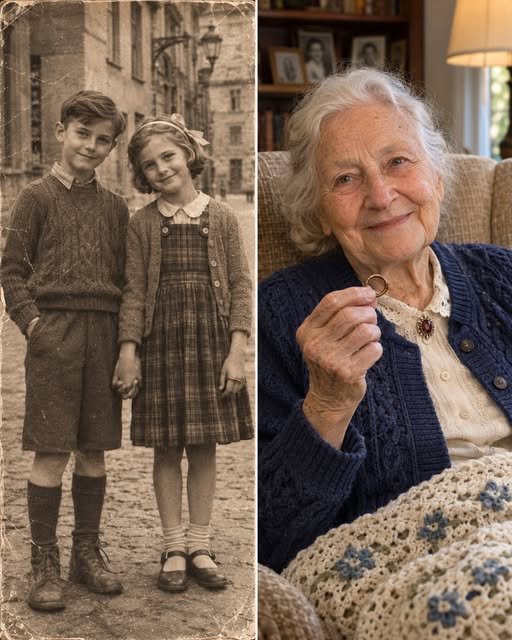
Part 1: The Box Nobody Touches
“Mom, you cannot have chocolate cake for breakfast.”
“Margaret, I’m ninety-five. What exactly am I saving my arteries for?”
My daughter slid the plate out from under my fork the way you take scissors from a toddler. She set it on the top shelf of the refrigerator, behind the almond milk, where she apparently believed I couldn’t reach.
“That’s not funny, Mom.”
“Neither is oatmeal.”
She put the oatmeal in front of me anyway. It had blueberries in it and a little cinnamon, which was her way of apologizing without saying the word. Margaret has never once in sixty-six years said the word sorry without a running start.
My name is Zofia. In America, everyone calls me Zoe, because in 1939 a customs officer at Ellis Island looked at my name and gave up halfway through.
I have lived in this country for eighty-seven years. I have buried a husband, raised a daughter, kept the books for a hardware store on Milwaukee Avenue for thirty-one years, and survived three Chicago blizzards that made the news. Apparently, none of that qualifies me to choose my own breakfast.
After my husband Michael died five years ago, Margaret sold her condo downtown and insisted I move into her house in Oak Park. She said it like a weather report.
“You need someone looking after you, Mom.”
“I need someone to stop looking after me. I still cook. I still walk to the corner. I still play cards every Tuesday with three of the worst cheaters in Cook County.”
Last Tuesday, she canceled my card game. She called Dorothy herself, behind my back, and told her I looked tired.
“That’s my face, darling,” I said when I found out. “It’s ninety-five years old. It’s going to look tired.”
Margaret only pressed her lips together, and I let it go. Arguing over every little thing was like walking uphill in the snow. You arrive, but you’ve spent the whole afternoon getting there.
So I picked my battles. The cake I lost, the card game I lost, but the box I would never lose.
It sits on the second shelf of my closet, behind my winter scarves. It’s a small tin box, once green, now mostly the color of an old penny, with a latch that only opens if you press your thumb on the left corner first.
“What’s inside it, Grandma?” my granddaughter Emma asked me once, when she was nine and still asked everything.
“Things that belonged to another lifetime.”
“Like treasure?”
“Something considerably more troublesome.”
She’s twenty-seven now and works for an architecture firm in the Loop. She stopped asking about the box years ago, but sometimes I catch her looking at the closet shelf as if it might open by itself.
I was born in Warsaw, on a narrow street of tall gray buildings, where the bakery downstairs made the whole stairwell smell like poppy seed. The boy next door was named Stanislaw.
He was two years older than me and two inches shorter, which he found deeply unfair. We walked to school together every morning and argued the entire way about everything: whether horses could swim, whether the moon followed you, and whether girls could whistle.
I could whistle. He could not. This was the great wound of his childhood.
One afternoon in the summer of 1939, we were sitting on the back steps of our building. He had a piece of copper wire from his father’s workshop, and he was twisting it with his small fingers, his tongue poking out of the corner of his mouth.
When he was done, he held it out to me. It was a ring, lopsided and crooked, with a little knot where the ends met.
“Zofia, marry me.”
“You don’t even have a job.”
“I’m ten!”
“Then you’re terribly unprepared.”
“I’ll marry you when we’re grown.”
I took the ring and slid it onto my finger. It was too big, so I wore it on my thumb.
“Fine. But don’t forget.”
“I never forget anything.”
“Except your schoolbooks.”
“Those don’t count!”
Three weeks later, my father came home early from the printing shop. He didn’t take off his hat. He sat down at the kitchen table, put both his hands flat on the wood, and told us we were leaving.
“Where are we going?” I asked.
“America.”
“What about Stanislaw?”
My mother knelt down and held me so tightly that my nose pressed into her collar. “We cannot wait, sweetheart.”
There was no time to explain anything to a child. There was only the packing, the whispering after dark, and the two suitcases by the door.
On our last evening, I knocked on his door. I took the copper ring off my thumb and pressed it into his palm.
“Keep it until I come back.”
“Will you?”
“I’ll try.”
His mother called him inside before I could say anything else. That was it. We never said a proper goodbye.
In Chicago, we lived above a laundromat on West Augusta Boulevard, where the floor was always warm in winter. Every few months, I asked my parents whether anyone had written from Poland.
Nobody had. My father would shake his head and go back to his newspaper, and my mother would find something urgent to do at the sink. Eventually, I understood that the question hurt them, so I stopped asking.
Then, at a church dance in 1955, I met Michael Kowalczyk, who could not dance to save his life. He stepped on my left foot four times during one song and apologized to my right foot by mistake.
“Will you marry me?” he asked on our sixth date.
“Only if you never dance in public again.”
“That’s unreasonable!”
We married anyway. He danced at our wedding, of course. I limped for two days.
“You’re stuck with me now,” he said that night.
“Good. I wouldn’t have it any other way.”
We had fifty-six years of that. Stanislaw became a childhood memory, a boy with a lopsided ring on a street I could no longer picture clearly.
Until one Thursday evening in October, when Emma came home at 6:40, still in her coat, and stood in the kitchen doorway looking pale.
“Grandma, something strange happened today.”
“Did your boss finally realize you’re smarter than him?”
She didn’t smile. That was the first thing that frightened me.
“An old man stopped me outside work. He knew my name. He knew your name.”
Margaret’s head came up from her crossword. “Did he bother you?”
“No. He was very polite.” Emma reached into her bag and set a small package on the table, wrapped in brown paper and tied with a white string.
“He asked me to give you this. And he said one more thing.”
“What did he say?”
She looked straight at me.
“He says you must keep your promise.”
Part 2: Crooked Bends
My teacup stopped halfway to my mouth. I set it down without a sound, which, at my age, is an achievement.
“Exactly what did he say?” I asked. “From the beginning.”
Emma pulled out the chair across from me and sat. “He asked if I was Emma. Then he asked if my grandmother’s name was Zofia, and whether she was originally from Poland.”
“Did he give you his name?”
“No. He just gave me that and said those words.”
Margaret came around the table and stood behind my chair. I could feel her hovering, the way she did when I took the stairs.
“Mom, don’t open it. We don’t know what’s in it.”
“It’s the size of a deck of cards, Margaret. If it’s a bomb, it’s a very modest one.”
I pulled the white string. My fingers are not what they were, so it took longer than I wanted it to, and nobody spoke while I worked the knot loose.
Inside the brown paper was a small cardboard box, the kind cufflinks come in. Inside that, on a bed of cotton, lay a tiny copper ring.
It was lopsided and darkened with age. A small knot still sat where the ends had been twisted together by a ten-year-old boy with his tongue sticking out.
“Grandma? What’s wrong?”
“I know this ring.”
“Are you sure?” Margaret said. “Mom, lots of rings look alike.”
I lifted it out and turned it under the kitchen light. The second bend was sharper than the first, the way it had always been, because he’d run out of patience halfway through.
“I’d recognize those crooked bends anywhere,” I said. “Even after eighty-seven years.”
Emma’s eyes were wide. “Grandma, are you telling me somebody just delivered your childhood engagement ring?”
“Apparently, I’m still very popular.”
Margaret wasn’t amused. “This could be somebody playing a trick. People find things online. They make up stories.”
“Then somebody has an extraordinary memory. There were exactly two people on earth who knew about this ring, and one of them was me.”
“Describe him,” I said to Emma, and my voice came out smaller than I meant it to.
“Tall. White hair, a lot of it. Blue eyes. He had an accent, kind of like Great-Grandpa’s in those old videos.”
There was something else in the box, beneath the cotton. I hadn’t noticed it at first because it was folded flat against the cardboard.
It was an envelope, yellowed and soft as cloth. On the front, in careful slanted handwriting, someone had written my name and an address I hadn’t seen in sixty years.
“Mom, what’s that?”
“Our old apartment,” I said. “On Augusta. Remember? You were four when we moved.”
Margaret leaned closer and adjusted her glasses. “There’s no stamp. And look at the corner.”
Written in the same hand, small and neat: March 1964.
The envelope was sealed. Whatever was inside it, he had never mailed it.
“He found me, Margaret,” I said. “All those years ago, he knew exactly where I was.”
Emma frowned. “Then why didn’t he contact you?”
I had absolutely no answer. The ring had been a kind of miracle, but the envelope felt like a closed door.
Stanislaw had survived the war, crossed an ocean, and found my street. Then, for sixty-two years, he had said nothing at all.
I didn’t open it. I’m not sure why. Perhaps I wanted to hear it from his own mouth, or perhaps I was afraid of what a sealed letter could say.
“We need to look into this before you get involved,” Margaret said. She already had her phone out.
“Margaret, I’m already involved. The ring is on my kitchen table.”
“It’s my kitchen table, and you don’t know this man anymore.”
“Then I’ll find out who he is now.”
“Mom, you’re not listening to me!”
“I am listening. I’m just not agreeing.”
I turned to Emma before Margaret could reload. “Where exactly did he approach you?”
“Outside the coffee shop on Lake Street, by my office. Lindqvist’s.”
“Had you seen him before?”
She hesitated, and I watched her decide whether to tell the truth. That girl has always been a terrible liar, which I consider one of my finest contributions to the family.
“Actually, yes. A few times. He sits by the window with a newspaper. He’s been there maybe three or four mornings in the last two weeks.”
Margaret put down her phone. “He’s been following you?”
“No, Mom. He said he found an old family photo online, from Grandpa’s memorial page. He recognized Grandma, but he couldn’t find our address. He knew where I worked from my profile.”
“Then why didn’t he just ask you?” I said.
“He said he’d been trying to work up the courage.”
Margaret folded her arms across her chest. “That’s disturbing.”
“Possibly,” I said. “Which is why I’m going to ask him about it myself.”
Margaret wanted me to stay home, call a lawyer, and wait. She underestimated how far a ninety-five-year-old woman will go once she smells an unanswered question.
The next morning, I put on my good navy cardigan and my mother’s garnet brooch. I also slipped the copper ring into my coat pocket, where my fingers could find it.
Emma drove. She didn’t ask if I was sure, which I appreciated more than I told her.
Lindqvist’s was a narrow place with brick walls and a chalkboard menu I couldn’t read from the door. The young woman at the counter had a silver ring in her nose and a lovely patient way of leaning forward when old people talked.
“Tall man, white hair, accent, newspaper?” she said. “Oh, sure. Mr. S. He usually comes in around ten.”
“Wonderful. Two coffees, please. One with an ungodly amount of cream.”
At 9:52, my phone buzzed. Margaret.
“Mom, please tell me you’re not actually sitting in that coffee shop.”
“I’m having coffee with Emma.”
“You know what I mean!”
“Then you already know my answer, darling.”
I hung up. Emma raised her eyebrows at me over her cup, and I raised mine right back.
At 10:15, the bell over the door rang. An elderly man came in, tall and a little stooped, in a navy wool coat, with a folded newspaper under his arm.
He took two steps toward the window table. Then he saw me, and he stopped.
His hand tightened around the newspaper until the pages crumpled.
“Zofia?”
I stood up. My knees complained, and I ignored them.
“Stanislaw?”
He nodded once, slowly, as if the movement cost him something.
Emma looked from his face to mine. She picked up her coffee and her bag. “I think you two need a minute. I’ll be in the car.”
The bell rang again behind her, and then it was just the two of us and the hiss of the espresso machine.
I didn’t hug him. I didn’t cry. I had thought about this moment all night, lying awake listening to the furnace, and only one question had survived until morning.
“Why didn’t you come?”
Part 3: The Wrong Promise
He looked at me as though he’d been rehearsing the answer for sixty years and had just forgotten every word.
“Before I explain,” he said, “may I show you something?”
I didn’t say yes. I didn’t say no. He reached into his coat pocket anyway and set something on the table between our cups.
It was a tiny wooden horse, no longer than my thumb, rubbed smooth and dark. It had a mane carved in rough little notches, and only one ear.
My breath caught. “You kept that?”
“You broke its ear.”
“You said it looked better!”
I laughed before I could stop myself. It came out of me sharp and sudden, the way laughter does when you’ve been holding something else.
We had carved it together the spring before I left, with his father’s whittling knife, which we were absolutely not allowed to touch. I had snapped off the left ear on the very last cut, and he had told me, very seriously, that horses with one ear were faster.
There was no longer any doubt. “Sit down, Stanislaw.”
He sat, carefully, unbuttoning his coat with fingers that weren’t entirely steady.
“Now explain.”
He told it plainly, without decoration. His family had stayed in Warsaw. He had survived the war, though his parents had not, and he did not tell me more about those years, and I did not ask.
In 1951, a cousin sponsored him to come to Canada. Later, he moved to Detroit, then Milwaukee, then outside Chicago, working in machine shops until he and his wife started a small company that made precision parts for medical equipment.
“And all those years, I looked for you,” he said. “Letters to the Red Cross. Letters to Polish churches in New York, Pittsburgh, Chicago. Kowalski, Kowalska, every spelling.”
“My name changed when I married.”
“I know that now. A woman at St. Stanislaus Kostka finally found your wedding in their register. I found your address in March of 1964.”
“Then why didn’t you knock?”
“I went there, Zofia.” He pressed his thumb against the table edge. “I took the train down on a Saturday. I stood across the street from the laundromat on Augusta for almost an hour.”
“You saw me?”
“You were outside with a little girl in a red hat. Your husband said something, I couldn’t hear what, and you laughed so hard you had to hold onto the railing.”
I knew that day. Not the date, but the feeling of it. Michael used to do impressions of our landlord, and Margaret wore that red hat until it fell apart.
“Michael,” I said.
“He lifted your daughter onto his shoulders. She grabbed his ears. And you kissed him on the cheek, right there on the sidewalk.”
“We were happy, Stanislaw.”
“I could see that. You had everything.”
“And you decided I didn’t need to know you were alive?”
“I thought appearing would be selfish. A ghost from the old country, showing up on your doorstep with a copper ring.”
I put down my coffee. The cup rattled against the saucer.
“You decided that for me?”
“I was afraid of disrupting your family.”
“You could have written!”
“I did write.” He looked at the envelope-shaped bulge in my handbag. “I just never mailed it.”
“You could have let me know you were alive! Do you know how many years I asked my father if anyone had written from Warsaw? Do you know when I stopped?”
“No.”
“Neither do I. That’s the worst part. I can’t even remember the day I gave up on you.”
For several seconds, neither of us spoke. The girl with the nose ring very carefully wiped a counter that was already clean.
Then he said, so quietly I nearly missed it, “I was wrong.”
I didn’t tell him it was all right. It wasn’t, not yet.
“And why go to my granddaughter? Why not find my door like a grown man?”
“I only had the address on Augusta. That building is a coffee roaster now. When I found Michael’s memorial page and Emma’s photograph, I thought she could help me reach you.”
“You could have simply asked her. Instead, you sat in a window for two weeks like a spy in a bad movie.”
“I know.” He smiled a little. “Apparently, growing old hasn’t made me any braver.”
“You crossed an ocean to find me, and then you decided what was best for me without asking.” I shook my head. “Funny. My family does exactly the same thing.”
He lowered his eyes, and I felt a small pinch of guilt. I had been saving that sentence for Margaret, not for him.
“There’s something else I don’t understand,” I said. “Why send me the ring now? Were you expecting me to marry you?”
He laughed, a real laugh, and for a moment he looked ten.
“Zofia, we’re a little old for that particular arrangement.”
“Speak for yourself.”
“Besides,” he said, and the laughter went out of his face, “you’re remembering the wrong promise.”
I frowned. “What other promise?”
“Do you remember the night my grandfather died?”
Something moved in the back of my mind, like a curtain lifting in a draft. “We sat by your bedroom window. Your mother had covered the mirrors.”
“I was so frightened. Not of him dying. Of growing old, and the house going quiet, and nobody coming. I told you I didn’t want to be old and alone.”
“And I told you we’d both be old someday. That it couldn’t be helped.”
“And then you said something else.”
I closed my eyes. A cold window, a candle, the smell of wool and wax, and a little girl who thought she could fix anything with a good enough rule.
“I promised,” I said slowly, “that if either of us ended up completely alone, the other one wouldn’t let them stay that way.”
“Every word,” he said. “You made me spit and shake on it.”
“I’d forgotten, Stanislaw.”
“I know.”
“I’m sorry.”
“Don’t be. You had a full life to remember instead.” He turned the wooden horse a quarter turn on the table. “My wife died four years ago. Helena. We never had children.”
“She must have meant a great deal to you.”
“She was wonderful. She sang off-key on purpose to annoy me.”
“Michael died five years ago.”
“I know. I saw the page.” He smiled sadly. “So here we are. The two old people we used to make jokes about.”
My eyes filled, and I let them. “So this is the promise you came to collect.”
“I don’t want a wedding, Zofia. I only hoped we might have coffee again. Maybe more than once.”
I reached across the table and put my hand over his. His knuckles were swollen like mine, and warm.
“Then you should have asked for coffee.”
“I wasn’t certain you’d remember me.”
“Next time,” I said, “try using your name.”
When I got home and told Margaret and Emma everything, Emma pressed a napkin to her eyes and said it was the most beautiful thing she’d ever heard. Margaret didn’t say anything for a long time.
She stood at the sink with the water running over a single clean spoon. Then she turned it off.
“Why now?”
“Because we’re old, darling. He explained that.”
“Did he? He knew where you lived in 1964. Dad’s been gone five years. His wife’s been gone four. So why now, right after you inherited Dad’s pension and the savings and half of this house?”
“You think he’s after my money?”
“I think we don’t know. And I think a man who watches your granddaughter for two weeks instead of picking up a phone is a man we should ask some questions.”
I hated that she had a point. I hated even more that the same thought had flickered through my own head on the drive home, and I’d pushed it away.
“You’re all discussing me as though I’m not sitting right here.”
“We’re protecting you, Mom.”
“Then protect my right to make my own decisions.”
Margaret’s chin trembled, just once. I softened my voice.
“I’ll ask him myself. Tomorrow.”
“Promise you’ll be careful?”
“I’ve survived ninety-five years. I know how to ask an uncomfortable question.”
The next afternoon, at the same window table, I didn’t let him talk about the old street or the bakery or the horse. I folded my hands and looked straight at him.
“Why now? And do you know that I have savings?”
He laughed, then saw my face, and stopped.
“You’re serious.”
“Completely.”
He was quiet for a long moment. Then he nodded, as if I’d passed a test he’d been afraid I would fail.
“Tomorrow, let me show you something,” he said. “Afterward, you can decide whether you ever want to see me again.”
Part 4: The Street Where It Began
“You do realize,” I said, “that sentence makes you sound more suspicious, not less?”
“I know.”
“Then I hope whatever it is, it’s worth the trouble.”
Before he came for me the next morning, I did three things. I gave Emma his full name, his phone number, and the license plate of his gray Buick. I also told Margaret exactly where I’d be, which nearly killed her, but she thanked me through her teeth.
He drove like a man who’d once been a very good driver and was now politely negotiating with his eyesight. Twenty-two minutes later, he turned onto a long, tree-lined street in Winnetka and stopped in front of an enormous brick house with white shutters.
“Whose house is this?”
“Mine.”
Inside, everything was quiet and clean, the kind of clean that comes from a housekeeper twice a week and nobody making any mess. On the piano were photographs of a dark-haired woman laughing at something just outside the frame.
“Helena,” he said.
He told me about the company, Halecki Precision, the parts for heart monitors and infusion pumps, and how they’d sold it in 2009 to a firm in Minneapolis. He said it as if he were describing the weather.
“For how much?”
“Enough.”
“Stanislaw.”
He named the figure. I had to put my hand on the back of the sofa.
“You’re considerably wealthier than I am!”
“Does that disappoint you?”
“Only because I was all ready to accuse you of stealing my furniture.”
He laughed so hard he had to sit down. I sat beside him, and for a moment I felt foolish and relieved and a little ashamed, all at once.
Then he got up again, crossed to a small writing desk by the window, and opened the top drawer. He took out a white envelope and handed it to me.
Inside were two airline tickets. Chicago O’Hare to Warsaw Chopin, round trip, dated the second week of November.
I checked the purchase date printed at the bottom. He had bought them nineteen days before Emma ever carried that ring into my kitchen.
“What are these?”
“An invitation.”
“You bought tickets without asking me?”
“I hoped you’d agree. If not, I’d lose the money.”
“That’s rather foolish.”
“I’ve had eighty years of practice.”
“Why Poland?”
He looked at me, and I saw the boy on the back steps with copper wire in his fingers.
“Do you remember what we used to say? When we were angry at our parents, or bored, or scared?”
I swallowed. “That we’d come back to our street someday. When we were grown, and nobody could tell us what to do.”
“Together,” he said.
I touched the tickets. My fingers knew before my head did.
He hadn’t come to take anything out of my present. He had come to hand me back a piece of my past, and he’d been too much of a coward to do it properly, and he had done it anyway.
I took out one ticket and slipped it into my handbag, next to the unopened 1964 envelope.
“I’m keeping this one.”
“And the other?”
“You keep it. On one condition.”
“Anything.”
“No more decisions on my behalf. Not about the past, not about coffee, not about what’s best for me. You ask. I answer.”
He held out his hand, and I shook it, and he spat on his palm first, the old way, and I made a face and did it too.
“Agreed,” he said.
Margaret nearly exploded when I announced it at dinner that night. She actually put down her fork, which in our family is the equivalent of throwing it.
“Poland? At ninety-five?”
“Yes.”
“With a man you barely know anymore?”
“And with my granddaughter, apparently.”
Emma raised her hand like she was in school. “I’d love to come. I have nine vacation days left and nowhere to put them.”
“Mom, please.” Margaret turned her whole body toward me. “We lost Dad five years ago. I was there. I held his hand. What if something happens to you over there and I’m five thousand miles away?”
I looked at my daughter, really looked. She was sixty-six. She had a bad knee and gray roots she was tired of coloring, and she was afraid, and she’d been afraid for five years, and I had been calling it bossiness.
“Darling,” I said, “something could happen to me right here at this table.”
“That doesn’t make me feel better!”
“I’m not asking you to stop worrying. I’m asking you to trust me.”
Emma put her hand on her mother’s arm. “Mom, Grandma isn’t asking for permission. She’s asking us to help her do it safely.”
“And you think this is a good idea?”
“I think she’d regret it forever if she didn’t go.”
Margaret looked at the two of us for a long time. “You’re both impossible.”
“It’s hereditary,” I said.
But I wasn’t reckless. The next week, I sat in Dr. Patel’s office for forty minutes while she listened to my heart and checked my blood pressure twice. She wrote me a letter for the airline and told me to walk the aisle every two hours.
Emma renewed my passport and booked a wheelchair at both airports, which I pretended to resent. Stanislaw called Margaret himself and gave her the name of the hotel, the phone number, and the name of his doctor in Warsaw.
She didn’t say much on that call. But afterward, she stood in my doorway for a while.
“He asked me,” she said. “He asked me if I had any questions. Nobody ever asks me if I have questions.”
The night before we left, I finally opened the 1964 envelope. Inside was a single page in Polish, the handwriting younger and rounder than now.
It said he was alive, and he was glad I was happy, and that he would always keep the ring safe for me. I sat on the edge of my bed and read it four times. Then I folded it back into its envelope and put it in my metal box.
Margaret came in and sat beside me. “Mom, are you absolutely sure?”
I took her hand. “In 1939, my parents put me on a ship I didn’t choose. They saved my life, and I’ll be grateful every day I have left.”
“I know.”
“But this time, I get to decide where I’m going.”
She hugged me so tightly my glasses went crooked. “Just promise you’ll call.”
“Every day.”
“And don’t overdo anything.”
“Margaret, you’re ruining my reputation.”
On the morning we left, I pressed my thumb on the left corner of the old tin box, and the latch gave way. I took out the copper ring.
“Are you wearing it?” Emma asked.
“Yes.”
“Does that mean you’re getting married?”
“Not until I find out whether he snores.”
“I do,” Stanislaw called from the front hall, where he was holding my coat.
“Then absolutely not!”
The ring didn’t fit my finger anymore, of course. It slid down, too loose, just like it had in 1939.
So I wore it on my thumb. Michael’s gold band stayed exactly where it had been for seventy years.
Michael had been the love of my life. Stanislaw was the friend I’d lost before I knew what losing was, and found again when I’d stopped knowing how to look.
As we went down the front steps, Margaret shouted after us, “Don’t forget your medication!”
“Darling, I remembered a promise for eighty-seven years. I can manage my pills.”
Two days later, at 4:10 in the afternoon, we stood on our street in Warsaw. The bakery was a phone repair shop now, and the gray buildings had been painted yellow and pale green, but the back steps were still there.
Emma stood a few yards away, pretending to take pictures of a balcony.
“That’s where you proposed,” I said, pointing.
“And you demanded I get a job.”
“I’m still waiting.”
He laughed and offered me his arm. I took it, the copper ring on my thumb catching the low autumn sun.
“Where to now, Zofia?”
“Anywhere I like.”
“And if I have a suggestion?”
“You may suggest. I’ll decide.”
At ninety-five, I was standing where my story began, wearing a crooked ring made by a ten-year-old boy. This time, the next chapter was mine to choose.