
Part 1: The Princess at the Wrong Door
“Not you.”
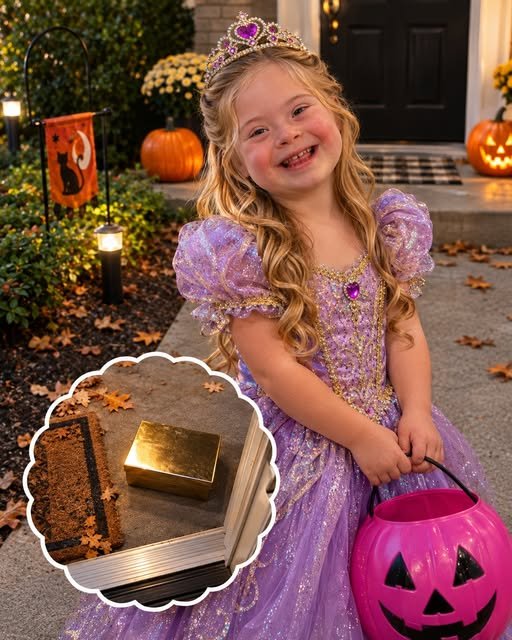
Mr. Harrison didn’t say it to me. He said it straight down to my eight-year-old daughter, his eyes on her pink skirt, the silver stars we’d sewn on one at a time, and the orange pumpkin bucket she was holding up with both hands.
“Trick or treat!” Lily had sung maybe three seconds before. Now the words just hung there on his porch, and I watched her smile start to slip.
“I’m sorry?” I said. With the shrieking from the Delgado yard two houses down, I honestly thought I’d misheard.
“No candy.” He kept one hand flat on the doorframe like he was holding the house shut. “Take her somewhere else.”
A glass bowl of mini Kit Kats sat on the hall table right behind him. Lily could see it. I could see her seeing it.
My name is Daphne Mercer. I’m thirty-six, I clean teeth for a living at a family dental office on Route 9, and for eight years I’ve been teaching my daughter one thing above everything else: she deserves exactly the same kindness as every other kid on the block.
Lily has Down syndrome. It has never once slowed her down on Halloween.
She started the countdown on the first of October with a marker calendar taped to the fridge. It sat right next to the $1,140 transmission estimate for my Corolla, which I’d been pretending not to see for two weeks.
We built the dress over three weekends at the kitchen table. That was $23.60 of pink tulle from the fabric store, a glitter crown hot-glued to a headband, and a whole Sunday afternoon of my mother, Carol, stitching the stars on by hand because Lily wanted “real sparkly ones, not stickers.”
Mom had gone oddly quiet while she sewed. When Lily twirled for her at the end, she’d said something I didn’t think about again until much later.
“Every girl gets her turn on the stage, baby. Every single one.”
Mr. Harrison had lived across Briar Lane since long before we moved in four years ago. He was sixty-seven and a widower who mostly kept to himself. He’d lift two fingers off his mower handle when we pulled in, and that was about it.
Every October, though, he carved pumpkins. Real ones with faces, maybe six of them lined up on his steps. Lily called his house “the pumpkin castle.”
Tonight there were seven, glowing on either side of him. That made it feel worse, somehow.
“She’s eight years old,” I said, working hard to keep my voice level.
“I know how old she is.”
“Then why would you talk to her like that?”
He didn’t answer me. He looked past me, past Lily, across the street at our house, as if the real answer were sitting on my porch.
“Just leave.”
I took Lily’s hand before her chin could start doing the thing it does. “Come on, sweetheart. There are lots of other houses.”
She came without arguing. Her bucket thumped softly against her knee at every step.
We were halfway down his front walk when she asked it.
“Did I do something bad, Mommy?”
“No, honey. Absolutely not.”
“Why didn’t he like my dress?”
I crouched on the sidewalk in front of her, and the cold came right through my jeans. “Your dress is beautiful. Sometimes grown-ups make really unkind choices, and it has nothing to do with you.”
She looked back at the pumpkins. “He didn’t even give me one.”
I hugged her hard enough to crush her crown a little. I’d have given anything to take back the last five minutes.
We did three more houses after that. Mrs. Delgado gave her two full-size Reese’s and told her she was the prettiest princess of the night, and Lily said “thank you” in her careful, polite voice. But the bounce was gone, and I knew it.
At bedtime she set the crown on her nightstand where she could see it.
“Can we wear our matching crowns again next year?” she asked. Mine was the cheap plastic one from the dollar bin.
“Of course we can.”
I kissed her forehead, turned off the light, and went downstairs to stew.
At 10:07 p.m., something gold flashed in the corner of the living room window.
A shoebox was sitting dead center on our porch mat, wrapped in shiny gold paper like a Christmas present that had shown up two months early. I hadn’t heard a car, footsteps, or the creak of our bottom step.
There was no label and no tape from a delivery company. There was only one word across the lid, written in thick black marker.
LILY.
I carried it to the kitchen table and opened it with my heart going fast and hard.
Inside, on a bed of yellowed tissue paper, sat a pair of tiny pink satin shoes, the kind with a little elastic strap. Beside them were a folded photograph and a square of notepaper.
The photo showed a little girl in a princess costume so close to Lily’s that the hair stood up on my arms. She had the same pink tulle and a silver crown, and she wore the same tiny shoes that were lying in the box in front of me.
On the back, in faded blue ink: October 31, 2001.
I unfolded the note. Six words, in careful, old-fashioned cursive.
Ask your mother what she remembers.
I read it twice and looked out the window. Across the street, one curtain in Mr. Harrison’s front room shifted, and then went perfectly still.
Part 2: The Officer Who Knew Her Name
Maybe I overreacted. I’ve asked myself that more than once.
But a man had turned my daughter away four hours earlier, and now a box with her name on it had appeared on my porch in the dark, holding a note about my family that I didn’t understand. My hands were shaking too much to talk myself out of it.
I called the police.
Two officers pulled up at 10:31. The older one was solid and graying at the temples, and his name tag said DOLAN. His partner, Officer Shah, looked barely out of the academy and carried a small notebook she actually wrote in.
I told them everything at the kitchen table, from the porch and the “not you” to the bowl of Kit Kats. Shah read the note under the overhead light. Dolan picked up the photograph.
Then he stopped moving.
“Where did you get this?”
“It was in the box. On my porch.”
He turned it over, read the date, and turned it back. “That’s Anna,” he said quietly, mostly to himself.
“You know her?”
“I grew up four blocks from here.” He set the photo down very gently, as if it might bruise. “That little girl is Walt Harrison’s daughter.”
I stared at him. In four years, I had never seen a single visitor at that house.
“Mr. Harrison has a daughter?”
Dolan nodded. “She has Down syndrome, too.”
Before I could get out another word, he and Shah traded a look I couldn’t read.
“Is Mr. Harrison home tonight?”
Someone knocked on my front door.
I went to the window. Mr. Harrison was standing under my porch light in a navy sweater, his hands empty and his jaw set.
Dolan opened the door before I could decide whether I wanted it opened.
“Evening, Walt.”
Something flickered across Mr. Harrison’s face when he saw the uniforms. “Didn’t expect company.”
“You leave a box on this porch tonight?”
“I did.”
“Why?”
He looked right past the officer and straight at me.
“Because her mother deserves to know what her family did.”
“What are you talking about?” My voice came out much louder than I meant it to. I glanced at the stairs and lowered it. “What did my family do?”
He pointed one finger at the photograph on my table. “Ask your mother about Anna.”
Dolan shifted his weight. “I remember Anna, Walt. And I remember that Halloween party at the rec center.”
Mr. Harrison’s shoulders went rigid. “Then you should remember what they did to her.”
“I remember an argument,” Dolan said carefully. “I was nineteen. I was up a ladder stringing orange lights in the back. I didn’t hear all of it.”

For a second, Mr. Harrison looked like a man who’d been waiting twenty-five years for a witness, and the witness had just let him down.
Nobody said anything. The furnace kicked on somewhere under the floor.
Then he turned back to me. “Your mother ruined my daughter’s Halloween twenty-five years ago. Tonight, I thought you might finally understand how that feels.”
I actually laughed, one ugly sound with no humor in it. “You refused candy to my daughter because of something you think my mother did?”
He didn’t answer right away. When he did, it was flat and quiet.
“Now you know what it’s like.”
Officer Shah stopped writing.
I looked at the tiny shoes on the tissue paper. “Those were your daughter’s?”
“Yes.”
“And you wrapped them up in gold paper to punish an eight-year-old?”
His face closed like a fist. “You don’t understand what happened.”
“Then explain it.”
Dolan stepped between us, not touching either of us. He said there was no threat here he could act on. He told Mr. Harrison, firmly, not to leave anything else at our house, and then he asked me if I felt safe.
I said yes. I meant it. I was too angry to be scared anymore.
The cruiser pulled away at 11:02. I should have gone inside then. Instead I stayed on the porch, because Mr. Harrison hadn’t left the bottom of my steps.
He was looking at the shoebox through my open door.
“Anna was eight,” he said finally. “Same as yours.”
He told it to the dark street more than to me. In 2001 the neighborhood threw a Halloween party at the Millbrook Rec Center, with cider, a haunted hallway, and a children’s costume parade across a little plywood stage.
“She practiced in our living room every night for two weeks,” he said. “Back and forth across the carpet. She wanted everybody to see her dress.”
Then, during the party, somebody decided Anna shouldn’t walk.
“Your mother was one of the organizers.” His voice had gone rough. “I came in from parking the car and found my wife in tears, and your mother standing over her, saying Anna couldn’t keep up. That she should watch from the side.”
He swallowed. “Anna came home believing she wasn’t good enough to be a princess.”
I hurt for that little girl. I really did. But something in the story sat crooked, like a picture hung on one nail.
“My mother sewed the stars on Lily’s dress,” I said. “She has never once treated Lily’s diagnosis like something to hide.”
“People change.”
“Maybe. But why take it out on Lily?”
He looked up at our dark windows. “I’ve watched your mother’s car in your driveway for four years. Birthdays. Christmas. Halloween. Everybody celebrating that little girl.”
His voice soured. “And all I could ever see was Anna standing in our kitchen, crying into her costume.”
Something cold went down my back. “So you knew who we were the whole time?”
“Your mother came over and introduced herself the week you moved in. I knew her before she finished saying her name.”
“And you’ve been sitting on this for four years?”
He nodded once. “Tonight, when your girl came up my steps in that dress, I wanted you to feel what we felt.”
There it was. It wasn’t a bad moment or a confused old man. He had decided to do it.
“You watched her smile at you,” I said. “And you decided to hurt her anyway.”
He looked at the pumpkins across the street, burning down to stubs.
“Go home, Mr. Harrison.”
For once, he did what he was told.
I locked the door, put the box on the counter, and called my mother at 11:12 p.m. She picked up on the fourth ring, thick with sleep.
“Daphne? What’s wrong? Is Lily okay?”
“She’s fine. Mom, do you remember a little girl named Anna? Anna Harrison?”
The silence went on so long I checked whether the call had dropped.
“Of course I remember Anna.”
“He says you kept her out of a costume parade in 2001. He says you humiliated her.”
“He says what?” She sounded fully awake now.
“Daphne, I was the person who fought to get Anna into that contest.”
Part 3: Photograph Number Seven
I sat down on the kitchen floor with my back against the dishwasher.
“Tell me exactly what happened. All of it.”
My mother took a breath, the kind she takes before a story she’s carried a long way.
There had been a volunteer that year named Celia, she said. Celia ran the parade line with a clipboard and a whistle, and she got nervous when she saw Anna in the lineup.
“She said Anna might get confused about where to walk. That she’d hold up the other kids. That it would be ‘kinder’ if she watched from the side.” Mom made a small disgusted sound. “Kinder. I told her absolutely not. There weren’t even prizes, Daph. Every child got a turn. That was the whole point.”
“So why does he think it was you?”
“Because of Mara, his wife. She’d overheard Celia and was sitting in the hallway, just shattered. So I went and knelt down next to her and told her exactly what Celia had said, word for word, so she’d know I wasn’t going to let it stand.”
She paused.
“And that’s when Walt walked in. Halfway through. He heard me saying ‘Anna can’t keep up, she should watch from the side.’ And he saw his wife crying.”
I closed my eyes. I could picture it perfectly.
“Didn’t you tell him?”
“I tried. Mara tried. He wouldn’t hear a word of it. He was too angry, and honestly, I understood why. He thought he’d caught me red-handed.”
“He says Anna went home crying.”
“She was crying earlier, yes. In the hallway. But she walked, honey. I lifted her up onto that stage myself.” Mom’s voice went very soft. “Hold on. I might have something. I’m coming over.”
“Mom, it’s after eleven.”
“I’m not explaining this over the phone.”
She lived twenty minutes away, out past the Kroger on Wayne Avenue. While I waited, I made myself do the thing I’d been avoiding. I picked up the photograph again and actually looked at it.
Anna wasn’t crying in it. Her arms were lifted a little from her sides, like she was about to curtsy or take off. Behind her hung a black curtain pinned with paper stars.
Down in the bottom corner, half-hidden where the photo had been folded, someone had written a small number in pencil.
7.
It looked like a print from a set, the way people used to number drugstore doubles before handing them out.
Sitting there, I felt a guilt I didn’t have a name for yet. I’d known my mother my whole life, and I’d never once asked her what she did before she was my mom, which causes she’d stood up for, or which fights she’d lost.
And worse, for about four seconds on that porch, part of me had wondered if he was right about her.
Mom came through the door at 11:41 with her camel coat buttoned over her nightgown and a fat manila envelope under one arm. In faded marker, it said: HALLOWEEN 2001 – REC CENTER.
She didn’t even take her coat off. She just started laying photos across my dining table in a row.
They were numbered in pencil, one through twelve, exactly like mine.
Except there was no seven.
“I gave that one to Mara,” Mom said, before I could ask. Then she saw the photo in my hand and went still. “Oh. Oh, he kept it.”
She tapped number eight. “There.”
Anna stood on a little plywood stage under the paper-star curtain while a cluster of costumed kids clapped below her. And right beside her, crouched down and fixing the hem of that pink dress, was my mother at thirty-seven, with dark hair in a claw clip, laughing.
In number nine, Anna was holding up a paper ribbon cut in the shape of a star. Glitter letters across it read: OUR HALLOWEEN PRINCESS.
I put my hand over my mouth.
“We made one for every kid,” Mom said. “Celia wasn’t thrilled about that either.”
“Did he ever see these?”
“Mara got copies of all of them. She wrote me afterward.” Mom reached deeper into the envelope and pulled out a square card gone the color of weak tea.
The handwriting inside was round and looping.
Thank you for standing up for Anna when she needed someone. She hasn’t stopped talking about her princess ribbon. – Mara
I read it twice.
“His wife knew. She knew you helped.”
“Of course she knew.”
“Then how does he still believe the exact opposite?”
Mom sank into a chair. “Mara told me he couldn’t let go of what he walked in on. Every time she tried to explain, he went right back to it. After a while she asked me to stop trying to talk to him. She was tired of fighting about it in her own kitchen.”
“Did you know he still blamed you? When you went over there the week we moved in?”
“No.” She looked genuinely stricken. “I thought he’d come around years ago. He shook my hand.”
Then she reached over and touched one of the silver stars in photo number eight, right on Anna’s skirt.
“I sewed Lily’s stars like that because I remembered Anna’s,” she said quietly. “I thought it was a nice thing. I never imagined he’d see it.”

My stomach dropped. He hadn’t just seen a girl in a princess dress coming up his steps. He’d seen his own daughter’s dress, stitched by the hands of the woman he’d spent twenty-five years hating.
“What happened to Anna?” I asked.
“She grew up. Moved out of state for a job, I heard, and did well. Mara and I traded Christmas cards for a long time, then lost touch a couple of years before she passed.”
I looked at the gold shoebox on the counter. I thought about a man watching my mother’s car pull into my driveway for four years and feeding something in the dark the whole time.
He’d been blaming the one person in that building who had defended his little girl.
And somehow, even that wasn’t the part that kept me up until three in the morning.
He’d wanted Lily to hurt. He’d looked at her face and chosen it.
The next morning, Lily padded downstairs in her rainbow pajamas with her crown on, a little crooked.
She stopped when she saw my coat on and the shoebox and envelope stacked by the door. “Are we going somewhere?”
“Just me, sweetheart. Across the street. Grandma’s going to make you pancakes.”
Lily’s eyes went to the window and the pumpkin castle. “Is that man still mad?”
I knelt in front of her. “He was wrong to talk to you the way he did. I’m going to make sure he understands that.”
She thought it over, chewing on the side of her lip.
“Can you tell him I liked his pumpkins?”
Something in my chest folded in half. “I can do that.”
I crossed Briar Lane with the box under one arm and twenty-five years of photographs under the other. I knocked twice.
The door opened. Mr. Harrison looked like he hadn’t slept either, and his eyes went straight to the gold paper.
“Are you bringing it back?” he asked. “Or did your mother send you to lie for her?”
Part 4: What the Ribbon Said
“Neither,” I said. “I’m returning it. And there’s something you need to see first.”
He stood there long enough that I thought he’d close the door. Then he stepped back and let me in.
His living room was spotless in the way rooms get when one person lives in them for too long. One whole wall was covered with framed photographs, and I recognized her instantly in every single one.
Anna as a gap-toothed kindergartner. Anna at maybe fifteen, laughing with her head tipped against a woman with the same round cheeks. Anna grown, in a bright yellow sweater, holding a coffee mug that said WORLD’S OKAYEST EMPLOYEE.
“She’s beautiful,” I said, and meant it.
He glanced at the wall like he hadn’t looked at it in a while. “She lives in Raleigh now. Works at a library.”
“Do you talk?”
“Not much.”
I didn’t push. I set the shoebox on the end table and spread my mother’s photographs across his coffee table in order, from one to twelve, with his number seven in the empty space where it belonged.
He picked up number eight first. His thumb moved slowly over the image of my mother crouched at the hem of Anna’s dress.
“Where did you get these?”
“My mother kept them. For twenty-five years.”
He reached for number nine and held it closer to his glasses. OUR HALLOWEEN PRINCESS.
“She told me they wouldn’t let her walk,” he said.
“Someone tried to stop her. My mother stopped them.”
“That’s not what happened.”
I handed him Mara’s card.
He knew the handwriting before he’d read a word of it. I watched it land on him: his mouth went slack, and then something behind his eyes gave way. When he finished, he turned the card over and looked at the blank back, as if there might be a second, different message written there.
“There has to be some mistake.”
“My mother was helping Anna. Not shutting her out.”
He lowered himself into a brown recliner like his knees had stopped working. “I heard her. I heard her say Anna couldn’t keep up.”
“She was repeating what someone else had said. To your wife. So your wife would know she wasn’t alone.”
His eyes drifted back to the photograph. “Mara tried to tell me something like that.”
I waited.
“I thought she was covering for your mother so we’d stop fighting.”
“So you didn’t believe your own wife.”
He didn’t answer that. A clock on the bookshelf ticked, loud as a dripping faucet.
“She begged me to let it go,” he said finally, barely above a whisper. “Said Anna had the time of her life by the end of the night. But I couldn’t get the picture out of my head. Mara crying in that hallway.”
I pointed at number nine. “You held on to the worst five minutes. And you threw away everyone who tried to give you the rest of the night.”
He stared at the ribbon in his daughter’s hands for a long time.
“I was wrong about your mother.”
“Yes. You were.”
I thought that might be when he apologized. Instead, he started talking about the years after that party. He talked about grocery store aisles where people stared too long, a school that kept trying to put Anna in a room at the end of the hall, and lying awake at night afraid the world would never make room for her.
I let him talk. I didn’t interrupt once. Some of it was true and terrible, and I knew that ache firsthand.
When he finally ran out of words, I leaned forward.
“Mr. Harrison, I need you to hear something.”
He looked up.
“Even if my mother had done every single thing you believed, Lily would still have been innocent.”
“You spent twenty-five years remembering how one person made your daughter feel. Then you stood in your doorway last night and made my daughter feel exactly the same way.”
He looked over at the tiny pink shoes. “I never thought about it like that.”
“But you planned it. You told me so. You wanted me to feel it.”
His head dropped. “Yes.”
“You saw an excited little girl in a dress her grandmother sewed stars onto. You saw her smile at you. And you decided to hurt her.”
His eyes filled. “I know.”
“She asked me why you didn’t like her dress.”
That was the one that broke him. He put both hands over his face, and his shoulders shook without a sound.
I didn’t get up. I didn’t put a hand on his arm or tell him it was okay, because it wasn’t.
When he could talk again, he said, “Anna used to ask me things like that.”
I looked at the yellow sweater on his wall. “Then think about what you’d want a neighbor to do if Anna came home and told you a grown man had done that to her.”
He nodded slowly. “You’re right.”
He asked if he could apologize to Lily. I told him I’d ask her first, and that her answer was her answer.
“And don’t bring her presents to make yourself feel better,” I added. “She doesn’t owe you forgiveness. No candy, no toys.”
“I understand.”
On my way out, I picked up the gold shoebox and put it in his hands.
“These belong to Anna. Maybe she should hear from you what happened last night.”
He held the box against his chest. “I haven’t always been a good father,” he said.
“Then you’ve still got choices to make.”
Back home, Lily was at the kitchen table coloring a purple castle with seven orange pumpkins lined up on its front steps. Mom was at the stove, very carefully not asking.
“Did you talk to him?” Lily asked.
“I did. And I told him you liked his pumpkins.”
“Is he still mean?”
“He knows he did something very wrong. He’d like to say sorry to you, if you want him to.”
She set down her marker and thought about it with her whole face.
“Okay. But I don’t want to go to his house.”
“Then you don’t have to.”
Three days later, we were raking leaves in the front yard when Mr. Harrison came across the street. He stopped at the edge of our grass, a good six feet away, with his hands in his jacket pockets.
“Lily,” he said. “May I tell you something?”
She looked up at me.
For the first time since Halloween, I didn’t answer for her. I just nodded and let her decide.
She nodded too.
“I’m sorry I wouldn’t give you candy on Halloween. You were very polite, and I was unkind. You didn’t deserve that.”
Lily studied him the way she studies a puzzle piece. “You made me sad.”
“I know. I’m very sorry.”
She looked down at her sneakers. “I worked really hard on my princess dress.”
“I heard you made it with your mom.”
“Grandma did the stars.”
His mouth moved into something close to a smile. “I bet they were beautiful.”
Lily didn’t smile back.
“Okay,” she said. Then she went back to her leaf pile.
She didn’t tell him it was fine. He didn’t ask her to.
Before he left, he told me he’d called Anna that Sunday. It was the first real conversation they’d had in months. He’d asked if she remembered the 2001 party at the rec center.
She remembered the pink shoes. She remembered the ribbon. And she remembered my mother.
“She said, ‘Mrs. Carol got me my ribbon, Dad.’” He looked at the ground. “Then she asked why I never listened when she told me that at nine years old.”
“I owe her an apology, too,” he said. “A bigger one.”
In the weeks after that, Mr. Harrison kept his distance. He waved from his driveway and said good morning, and never once tried to win Lily over.
One gray Saturday in late November, I saw him locking his front door with a small overnight bag over his shoulder. Later he told me Anna had invited him down to Raleigh for Thanksgiving.
I hoped he’d listen this time. I hoped he’d do more listening than talking.
Lily kept wearing her crown around the house long after Halloween, to breakfast, to bath time, and once to the dentist, where my coworkers made a fuss over her.
One evening in December, she marched into the kitchen with her orange pumpkin bucket and set it on the counter, right next to the paid transmission receipt I’d finally stuck on the fridge.
“I’m saving it for next year,” she announced. “Are we going trick-or-treating again?”
“Absolutely.”
She grinned. Then she tilted her head. “Even if someone says no?”
I pulled her into a hug, crown and all.
“Even then, sweetheart.”
She ran off to finish another castle. I stood there looking at that empty orange bucket and thought about the gold shoebox, about photograph number seven, and about a man who’d spent twenty-five years blaming the wrong person.
“Not you,” he’d told her on his porch.
He was wrong about that too. My daughter was a princess before she ever climbed his steps, and she didn’t need his candy or his approval to stay one.
If a neighbor deliberately hurt your child to settle an old score with your family, would you ever let him back into your child’s life?