
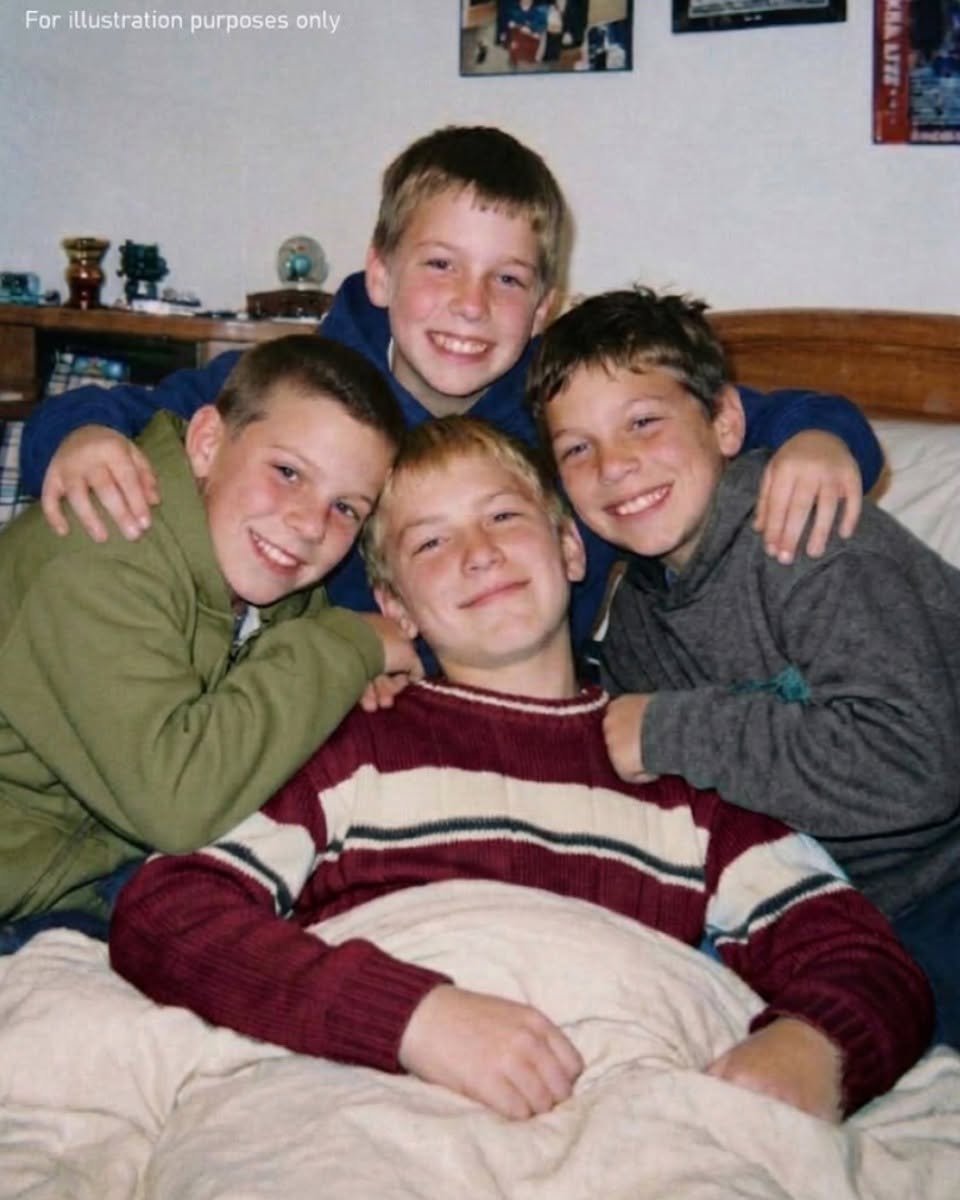
Seventeen years ago, my friends and I shaved our heads to support our classmate during chemotherapy. A few days ago, he invited us to his 30th birthday. When we arrived, there were only four of us, and the reason he’d brought us together left us in tears.
We were just 13 when our classmate Simon was diagnosed with cancer.
Before he got sick, Simon was the kind of boy who could turn an ordinary afternoon into an adventure. He loved baseball, hated math, and always carried extra snacks because he knew somebody would forget their lunch.
But chemotherapy changed him. He missed months of school, grew painfully thin, and eventually lost every strand of his dark brown hair.
His mother, Mrs. Keene, told us he was getting better, but he had started begging her not to send him back to school.
“He thinks the other children will make fun of him,” she explained one afternoon. “He doesn’t want anyone looking at him differently.”
That evening, my two best friends, Duncan and Reid, came over to my house.
We sat on my bedroom floor, trying to figure out how to help Simon feel comfortable coming back.
“We could all wear hats,” I suggested.
Duncan shook his head.
“He’d still know what we were hiding.”
Reid, who had been unusually quiet, suddenly looked up.
“Then let’s shave our heads.”
I thought he was joking until he asked whether my father still had the electric clippers he used to cut his own hair.
Twenty minutes later, we were crowded into our bathroom with an old towel, a wooden chair, and absolutely no idea what we were doing.
Reid insisted on going first.
“Come on, Elliot. Before I change my mind.”
I switched on the clippers and carefully pushed them through his hair.
I noticed something strange near the back of his head. A section had already been cut much shorter than the rest, but Reid quickly turned away when I looked at it.
“Just keep going. You’re taking forever.”
I assumed he’d tried cutting his own hair and made a mess of it.
By the time we finished, all three of us were completely bald.
My mother nearly dropped the laundry basket when she saw us.
After we explained, she stood there for a moment before pulling us into a hug.
The following morning, we walked to Simon’s house together.
Mrs. Keene answered the door wearing her usual floral apron.
“Good morning, boys. What brings you—”
She stopped when she saw our heads.
Her hand flew to her mouth, and her eyes filled with tears.
For a moment, she couldn’t speak. Then she pulled all three of us into her arms.
“You sweet boys,” she whispered. “You have no idea what this means.”
Reid tried to make her laugh.
“Careful, Mrs. Keene. We still need our heads attached.”
She laughed through her tears and led us upstairs.
Simon was sitting on his bed, reading a comic book.
When he looked up, his mouth fell open.
“What happened to your hair?”
Duncan grinned.
“We decided you shouldn’t be the only handsome bald guy in school.”
Simon stared at us before slowly putting his comic book aside.
“You really did that for me?”
“Of course,” Reid replied. “Now hurry up and get better. We need our fourth player back.”
Simon started crying.
We were boys who barely knew what to do when somebody cried, so we just crowded around his bed and hugged him.
Eventually, he began laughing too.
That was the first time in months I’d heard him laugh like his old self.
When Simon finally returned to school, the four of us walked through the front doors together.
A few children stared, and one boy made a rude comment about our heads.
Before Simon could react, Reid stepped forward.
“You’re just jealous because we don’t have to waste time combing our hair.”
The boy walked away, and Simon laughed so hard he had to sit down.
Over the next few years, we became almost impossible to separate.
We spent weekends at each other’s houses, celebrated Simon’s recovery, and somehow survived high school without getting into too much trouble.
Reid was always the funniest of us.
He could make Simon laugh during painful hospital appointments and turn even the most miserable school day into something worth remembering.
Looking back, I realize how little we knew about his life outside school.
Sometimes he arrived wearing the same clothes as the day before. He rarely invited us to his house, and whenever somebody mentioned his stepfather, his expression changed.
But we were children.
We noticed things without understanding what they meant.
After graduation, our lives slowly took different directions.
Duncan moved away for college. Simon eventually became a teacher. Reid found work in another state, and I started a family several hours from our hometown.
At first, we called regularly.
Then our conversations became occasional messages, holiday greetings, and promises to visit that none of us ever managed to keep.
I hadn’t seen all three of them together in almost eight years when Simon’s invitation arrived.
*I’m turning 30 next Saturday. Dinner at seven. I’ve reserved a private room. Please come. It’s important to me.*
I immediately checked my calendar.
Four hours was a long drive, but something about his message made me feel that I shouldn’t miss it.
When I arrived at the restaurant, Duncan and Reid were already waiting.
Duncan stood and hugged me.
Reid looked me up and down.
“Well, look at you. Still got a full head of hair. Some people have all the luck.”
I laughed and hugged him.
Then I noticed the table.
Four chairs. Four plates. Four neatly folded napkins.
“Are we really the only guests?” I asked.
Duncan shrugged.
“That’s what I was wondering.”
Before we could discuss it further, the door opened.
Simon walked in.
He looked older, of course, but I recognized his smile immediately.
He hugged each of us, holding on a little longer than I expected.
“Thank you for coming,” he said quietly.
“Wouldn’t miss your birthday,” I told him.
Simon nodded, but instead of sitting down, he remained standing beside his chair.
“Actually, there’s something I need to tell you.”
His voice sounded strained.
“I didn’t bring you here just to celebrate my birthday.”
He glanced at our faces.
“My mother passed away three months ago.”
Nobody spoke.
I felt a terrible heaviness settle in my chest.
Mrs. Keene had always treated us like her own children. She’d fed us countless dinners, driven us to school, and welcomed us into her home whenever we needed somewhere to go.
“Simon, I’m so sorry,” I whispered. “Why didn’t you tell us?”
“I should have. Everything happened so quickly, and afterward I didn’t know how to talk about it.”
Reid stood and embraced him.
Soon, all four of us were standing together beside the table.
When we finally sat down, Simon reached into his jacket and removed a worn photograph.
It showed four bald boys standing shoulder to shoulder in his mother’s backyard.
I immediately recognized it.
“Good grief. Look at us.”
Duncan laughed softly.
“Your mother made us pose for about twenty pictures that day.”
Simon turned the photograph over.
In his mother’s handwriting were the words, *My four wonderful boys.*
“She kept this on her bedroom dresser for seventeen years,” he said.
He paused before continuing.
“Before she died, she made me promise that I’d bring us together again. She said we’d spent too many years acting as if friendship could wait forever.”
Reid lowered his head.
Simon took a folded letter from his pocket.
“I found this while sorting through her things. She wrote it during her final weeks.”
He hesitated, then began reading.
His mother had written about the morning we arrived at her door with our newly shaved heads.
That morning, she had just returned from an appointment with Simon’s doctor.
His treatment wasn’t producing the results they had hoped for, and the doctors were considering other options.
She’d been terrified.
“I never knew that,” Simon whispered.
He continued reading.
She wrote that she’d spent the drive home wondering how she could explain another frightening medical appointment to her little boy.
Then she’d opened the front door and found three bald teenagers standing on her porch, grinning proudly.
For the first time that morning, she’d felt something other than fear.
I stared at the photograph.
All those years, I’d believed she’d cried because she was touched by our gesture.
I hadn’t understood how desperately she’d needed something hopeful that day.
But Simon hadn’t finished.
“There’s another part,” he said.
He slowly turned toward Reid.
“Mom left something for you, too.”
Reid didn’t look surprised.
Instead, he closed his eyes.
Duncan glanced between them.
“What’s going on?”
Simon reached for a second envelope.
“Reid and I spoke a few days ago. I told him what I’d found, and he agreed we could talk about it tonight.”
Reid rubbed his forehead.
“I almost didn’t come.”
I leaned forward.
“Reid, what is it?”
He took a long breath.
“Do you remember how I insisted on shaving my head first?”
“Of course,” I said.
“There’s something I’ve never told either of you.”
He stared at the photograph.
“My stepfather had cut my hair two days earlier.”
I frowned.
“What do you mean?”
Reid swallowed.
“We had an argument. He was yelling at my mother, and I tried to make him stop. He got angry, grabbed me, and cut a big chunk out of my hair with kitchen scissors.”
My stomach tightened.
“He told me that if I wanted to act like a grown man, I could walk around looking ridiculous like one.”
Duncan stared at him.
“Reid…”
“I wore a baseball cap afterward because I didn’t want anyone seeing it. When you suggested shaving our heads, I realized nobody would notice what he’d done.”
He looked at me.
“That’s why I volunteered first.”
I remembered the uneven patch I’d noticed beneath the clippers.
Seventeen years had passed, but suddenly I could picture it clearly.
“I saw it,” I whispered. “I noticed your hair was uneven.”
Reid gave a small, uncomfortable smile.
“Yeah. I was afraid you would.”
“Why didn’t you tell us?”
“Because I was embarrassed. And because he told me things would get worse for Mom if I talked.”
His voice cracked.
“I wanted to help Simon. I really did. But I also wanted to stop looking in the mirror and remembering what happened.”
Nobody knew what to say.
Then Reid picked up the envelope.
“There’s more. Something I didn’t know until this week.”
He carefully unfolded Mrs. Keene’s letter.
The day after his stepfather cut his hair, Reid had gone to Simon’s house while Simon was resting upstairs.
He’d found Mrs. Keene alone in the kitchen.
For nearly an hour, he’d sat at her table, crying and telling her what had been happening at home.
He was frightened for his mother, who had tried several times to leave but had nowhere safe to go.
“I remember asking her whether she knew somebody who could help us,” Reid said.
“She told me she’d see what she could do.”
A week later, Reid and his mother moved into his aunt’s apartment.
Eventually, his mother found work and rented a small place of their own.
Reid had always believed his aunt had arranged everything.
But the letter revealed something different.
Mrs. Keene had contacted a local family support organization, helped Reid’s mother arrange a meeting with a counselor, and accompanied her while she learned what options were available.
She’d also driven Reid to school while his mother attended appointments.
“I remember those rides,” Duncan said quietly. “I thought she was just helping because your mom was busy.”
“So did I,” Reid answered.
His fingers trembled around the paper.
“She wrote that my mother was terrified, but she kept going to those appointments anyway. She said Mom was the one who made the decision to leave. Mrs. Keene just made sure she didn’t have to figure everything out alone.”
He stopped reading and wiped his eyes.
“I spent years thinking Mom had suddenly found the courage to leave. I never realized how much help she’d needed.”
Simon moved his chair closer.
“There’s one more paragraph, isn’t there?”
Reid nodded.
He tried reading it aloud but couldn’t get past the first sentence.
Finally, he handed the letter to me.
I read Mrs. Keene’s words slowly.
*”Reid, you once told me you weren’t brave because you couldn’t protect your mother. I hope you understand now that coming to my kitchen and asking for help was one of the bravest things a frightened boy could have done.”*
My eyes blurred.
I looked at the man sitting across from me.
For years, I’d remembered Reid as the fearless boy who made everyone laugh.
I had never imagined how much fear he’d been carrying.
“I’m sorry,” I said. “We were your best friends. We should have noticed.”
Reid shook his head.
“We were thirteen, Elliot. You didn’t know what was happening.”
“But you were always taking care of everybody else.”
He looked toward Simon.
“Making you guys laugh was the easiest part of my day.”
Simon reached over and squeezed his shoulder.
“Mom loved you, Reid. She talked about you all the time.”
Reid covered his face.
“I wish I’d known what she did for us. I would’ve thanked her.”
“She knew you were grateful,” Simon said. “That’s why she kept writing to you, even when you stopped visiting.”
For several minutes, we sat quietly.
Then a waiter knocked and entered carrying Simon’s birthday cake.
Thirty candles flickered above the frosting.
The poor man looked confused when he saw our tear-streaked faces.
“Should I come back?”
Simon laughed softly.
“No. I think my mom would’ve wanted us to eat the cake.”
We sang happy birthday badly, just as we used to when we were teenagers.
Afterward, we stayed at the restaurant for almost three hours.
We talked about our families, our jobs, and everything we’d missed in one another’s lives.
Reid told us his mother was doing well. She’d remarried a kind man several years earlier and had recently retired.
“I think I’ll call her tomorrow,” he said. “There’s a lot I never understood.”
When we finally walked outside, Reid stopped beside Simon’s car.
“Could you take us to your mother’s grave?”
Simon nodded.
“Of course.”
The cemetery was only a short drive away.
We walked together through the quiet rows until Simon stopped before a modest headstone.
Reid stepped forward and knelt.
For a long time, he simply looked at Mrs. Keene’s name.
Then he reached out and touched the stone.
“You helped my mom when she had nobody,” he whispered. “And you never made me feel ashamed.”
His shoulders began shaking.
“I wish I could’ve thanked you properly.”
Duncan knelt beside him, and Simon placed a hand on his back.
I stood there remembering the woman who’d opened her front door seventeen years earlier and cried at the sight of three bald boys.
I’d thought those tears belonged entirely to a frightened mother whose sick son had wonderful friends.
Now I understood that she’d also recognized a little boy who was finally able to stop hiding what had been done to him.
After a while, Reid stood.
“I’m glad we came,” he said.
Before leaving, Simon took out his phone.
“One more picture?”
We stood shoulder to shoulder, just as we had seventeen years earlier.
This time, none of us was bald, and our faces showed the years we’d spent apart.
Duncan put his arm around Reid. Simon stood between us, holding the old photograph against his chest.
Later that night, as I drove home, my phone rang.
It was Reid.
“I called my mom,” he said.
I pulled into a rest stop.
“How did it go?”
“She cried. She told me she’d wanted to leave for a long time, but she’d been scared of what would happen to us. Mrs. Keene helped her understand that we had somewhere safe to go.”
He paused.
“Mom said she always meant to tell me the whole story. She just didn’t know how.”
We talked until I noticed the parking lot was nearly empty.
Before hanging up, Reid asked whether we could all meet again next month.
“With our families this time,” he added. “And maybe somewhere closer to your house, because four hours is ridiculous.”
I laughed and promised I’d help arrange it.
The next morning, Simon sent our new photograph to the group chat.
Beside it, he placed the picture his mother had kept on her dresser.
I looked at the two photographs for a long time.
In the first, we were four boys who believed we’d done something extraordinary for a sick friend.
In the second, we were four grown men who finally understood that the woman standing behind the camera had quietly helped save another family while fighting to keep her own son alive.
I wish we’d known sooner.
I wish we’d visited more often, asked better questions, and thanked her while we still could.
But I was grateful Simon had invited us back.
Because seventeen years after we stood together on his mother’s porch, we were finally learning what that day had meant to all of us.