
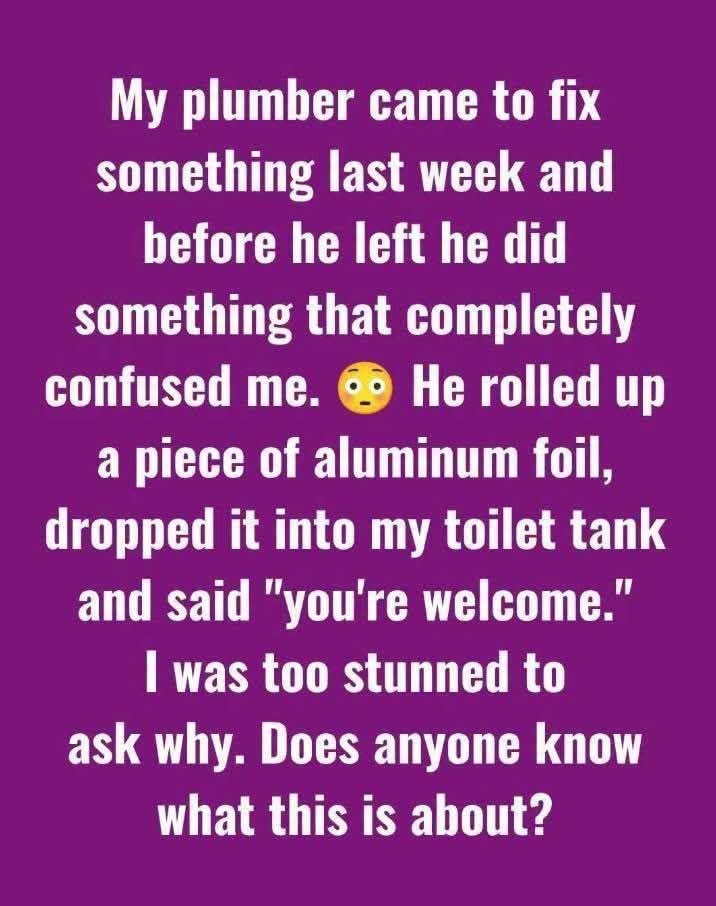
Putting Aluminum Foil in Your Toilet Tank …Does This Viral Household Hack Actually Work?
You’ve probably seen the videos by now. Someone rolls a small piece of aluminum foil into a ball, drops it into a toilet tank, and claims this simple kitchen trick can prevent rust, reduce water bills, stop leaks, and even keep the toilet bowl cleaner.
It sounds almost too good to be true, doesn’t it?
After all, who wouldn’t love a simple household hack that saves money, reduces cleaning time, and keeps the bathroom fresh without spending a fortune on expensive products?
That’s exactly why this unusual trick has attracted so much attention on social media. It’s inexpensive, takes only a few seconds, and is presented as one of those clever household secrets that supposedly makes everyday cleaning easier.
But before you reach for that roll of aluminum foil, there’s something important you should know: there is no reliable evidence that putting aluminum foil inside your toilet tank provides the benefits these viral videos promise.
In fact, placing unnecessary objects inside a toilet tank could interfere with its moving parts or affect how the flushing mechanism operates.
So, what’s really happening? Can aluminum foil prevent rust? Does it actually help reduce water consumption? And can it stop a running toilet?
Let’s separate internet myths from practical plumbing advice and discover what really works.
Why Did the Aluminum Foil Toilet Hack Go Viral?
It’s easy to understand why this trick caught people’s attention.
Aluminum foil is inexpensive, readily available, and useful for numerous household tasks. We use it to wrap food, cover baking dishes, and sometimes help clean certain metal surfaces.
Because aluminum can participate in chemical reactions under specific conditions, some people assume that placing a small ball of foil in toilet tank water could help remove rust or prevent mineral buildup.
Social media also makes unusual household tricks particularly appealing. A short video showing someone dropping foil into a toilet tank is simple to demonstrate and intriguing enough to encourage people to try it themselves.
However, there’s an important difference between using aluminum foil for a particular cleaning application and leaving it submerged in a toilet tank.
The materials, chemical conditions, and intended results are completely different.
Just because a toilet continues flushing after someone adds aluminum foil doesn’t prove that the trick has improved its performance, cleanliness, or efficiency.
To establish those benefits, the method would need proper testing.
What Actually Happens When You Put Aluminum Foil in a Toilet Tank?
The short answer is that it generally doesn’t do anything useful.
A typical toilet tank contains several components that work together to refill the tank and release water into the bowl whenever you flush.
These commonly include:
- Fill valve: Controls the flow of water entering the tank after flushing.
- Float: Helps regulate the water level inside the tank.
- Flush valve: Releases water from the tank into the toilet bowl.
- Flapper or sealing mechanism: Prevents water from escaping when the toilet isn’t being flushed.
- Overflow tube: Helps prevent the tank from overflowing.
Every component has a specific function.
A ball of aluminum foil doesn’t repair these parts, adjust the water level, improve a worn seal, or clean the toilet bowl.
Depending on where it settles, the foil may simply remain at the bottom of the tank or move around when the toilet is flushed.
The concern is that an unnecessary object could become lodged against a moving component or interfere with normal operation.
Although this doesn’t mean every piece of foil will damage your toilet, there’s little reason to introduce something that offers no established maintenance benefit.
Let’s examine the most popular claims individually.
1. Does Aluminum Foil in the Toilet Tank Prevent Rust?
This is one of the claims that makes the trick sound surprisingly scientific.
Some videos suggest that aluminum foil can prevent rust or remove existing rust stains because aluminum behaves differently from iron when exposed to certain chemical conditions.
There is actually some science behind particular aluminum-based cleaning techniques. However, that doesn’t mean dropping a ball of aluminum foil into your toilet tank will prevent corrosion.
Why This Claim Doesn’t Hold Up
Rust forms when iron or steel reacts with oxygen and moisture under suitable conditions.
Aluminum behaves differently because it naturally develops a thin protective oxide layer on its surface.
Under certain circumstances, aluminum can participate in reactions involving other metals. However, the results depend on the materials, environment, and chemical conditions involved.
Simply placing aluminum foil in a tank of water does not create a reliable rust-prevention system.
It won’t repair corroding metal components, remove existing mineral deposits, or stop rust-colored water from entering your toilet.
What Should You Do Instead?
If you notice reddish-brown stains inside your toilet tank or bowl, try to identify their source.
Possible causes include:
- Iron naturally present in the water supply.
- Corrosion in plumbing components.
- Mineral deposits that trap discoloration.
- Deteriorating metal fittings.
Depending on the cause, you may need an appropriate toilet cleaner, water testing, or a plumbing inspection.
If you notice significant corrosion inside the tank, avoid aggressively scrubbing the components or using harsh chemicals without checking their compatibility.
The best solution is to address the actual cause rather than relying on aluminum foil.
2. Can Aluminum Foil Reduce Your Water Bill?
Another popular claim suggests that placing aluminum foil inside the toilet tank can somehow reduce water consumption.
Unfortunately, this is misleading.
Toilets use water according to their design and flushing mechanism. The amount consumed depends on factors such as the toilet’s flush rating, tank configuration, water level, and flush valve operation.
A small ball of aluminum foil doesn’t meaningfully improve the toilet’s water efficiency.
Although an object can physically displace a small amount of water, that doesn’t automatically make it a suitable water-saving solution.
A toilet needs an appropriate volume of water to flush effectively. Reducing that volume without considering the toilet’s design can result in incomplete flushing and additional flushes.
How to Actually Save Water
If you’re looking for practical ways to lower your water bill, these methods are much more effective.
Check for Silent Leaks
A leaking flapper or faulty flush valve can allow water to escape continuously from the tank into the bowl.
One simple way to check for this is to place a few drops of food colouring into the tank without flushing. Wait approximately 10–15 minutes.
If coloured water appears in the bowl, you may have a leak through the flush valve or flapper.
Inspect the Fill Valve
If your toilet keeps refilling even when nobody has flushed, the fill valve or another component may need attention.
A faulty valve can waste considerable amounts of water over time.
Check the Overflow Tube
If water continuously flows into the overflow tube, the tank’s water level may be too high or the fill valve may not be shutting off properly.
Adjusting or replacing the faulty component may resolve the problem.
Consider a Water-Efficient Toilet
Older toilets may use considerably more water per flush than modern water-efficient models.
If you’re planning a bathroom renovation, replacing an outdated toilet with an efficient model could provide long-term savings.
Consider a Suitable Dual-Flush System
Dual-flush toilets offer different flushing volumes for liquid and solid waste, helping reduce unnecessary water consumption.
The important thing is to use a system designed for your toilet rather than placing random objects inside the tank.
3. Can Aluminum Foil Stop a Running Toilet?
Let’s clear this up: aluminum foil cannot repair a running toilet.
If your toilet continues making a filling or trickling sound long after flushing, there’s probably an issue with one of its internal components.
Common causes include:
- A worn or damaged flapper.
- A faulty fill valve.
- An incorrectly adjusted float.
- A damaged flush valve seal.
- Water continuously entering the overflow tube.
One of the most common problems is a deteriorating flapper that no longer creates a proper seal.
When this happens, water slowly escapes from the tank into the bowl, causing the toilet to refill repeatedly.
What Should You Do?
Start by inspecting the visible components inside the tank.
If the flapper appears worn, damaged, or poorly fitted, it may need replacing.
If the water level is too high, the float or fill valve may require adjustment.
For more complicated problems, contacting a qualified plumber is usually the safest approach.
A simple replacement part may be all that’s needed, depending on your toilet model.
4. Does Aluminum Foil Clean the Toilet Bowl Automatically?
This is another attractive promise behind the viral trick.
The idea is that placing foil inside the tank will somehow keep the toilet bowl cleaner without requiring regular scrubbing.
Unfortunately, there is no good evidence that this works.
Aluminum foil isn’t a toilet-cleaning product. It doesn’t contain the cleaning agents, surfactants, acids, or disinfectants found in products specifically formulated to remove stains and deposits.
Simply sitting inside the tank doesn’t give aluminum foil a reliable way to dissolve mineral buildup, remove grime, or disinfect the toilet bowl.
Why Do Toilet Stains Appear?
Different types of toilet stains have different causes.
Hard-Water Deposits
Minerals naturally present in water can gradually accumulate, leaving chalky or crusty marks around the waterline and beneath the rim.
Rust-Coloured Stains
Iron in the water supply or corrosion in plumbing components can create reddish-brown discoloration.
Organic Buildup
Residue and microorganisms can contribute to staining, particularly when cleaning is infrequent.
Persistent Dark Marks
Dark or unusual stains can have several possible causes and may require closer inspection.
Understanding the type of stain is important because different problems require different cleaning methods.
A Better Way to Clean Your Toilet
For routine maintenance, use a toilet cleaner suitable for your toilet and the type of buildup you’re dealing with.
Apply the product according to its instructions, allow the recommended contact time, scrub with a toilet brush, and flush as directed.
For stubborn mineral deposits, choose a product specifically formulated for hard-water buildup.
Always follow the manufacturer’s instructions and never mix bleach with acidic toilet cleaners or other incompatible cleaning products. Such combinations can release dangerous gases.
If stains continue returning quickly, investigate the water supply or plumbing rather than repeatedly treating the visible symptoms.
5. Can Aluminum Foil Keep Your Toilet Fresher for Longer?
Some viral posts suggest that aluminum foil can neutralize unpleasant smells or keep the toilet smelling fresh.
However, aluminum foil isn’t a deodorizer or an air freshener.
It doesn’t absorb bathroom odors in the way certain activated-carbon products can, nor does it provide the cleaning or disinfecting action of a properly formulated toilet cleaner.
If your toilet continues producing unpleasant smells even after cleaning, there may be another underlying problem.
Possible causes include:
- Residue beneath the toilet rim.
- Buildup in hard-to-reach areas.
- Poor bathroom ventilation.
- A damaged toilet seal.
- A plumbing or drainage problem.
What Works Better?
If you want to keep your bathroom smelling fresh, focus on regular maintenance.
- Clean the toilet bowl and the underside of the rim regularly.
- Wipe down the toilet’s exterior, including the base and surrounding floor.
- Keep the bathroom properly ventilated.
- Clean areas where moisture and residue tend to accumulate.
- Investigate persistent unpleasant smells instead of simply masking them with air fresheners.
These straightforward habits are far more useful than relying on an aluminum foil trick.
So, Should You Put Aluminum Foil in Your Toilet Tank?
The simplest answer is no.
Although aluminum foil has several useful household applications, putting it inside a toilet tank has no established benefit for preventing rust, reducing water consumption, repairing leaks, cleaning the bowl, or eliminating unpleasant odors.
Your toilet is a carefully designed plumbing system, and its internal components need to move freely to work properly.
Introducing unnecessary objects into the tank could interfere with those components and potentially create problems that weren’t there before.
If you’re dealing with rust, recurring stains, a running toilet, or unusually high water bills, identifying the actual cause is a much better approach.
Final Thoughts: Don’t Believe Every Viral Household Hack
The aluminum foil toilet trick is a perfect example of how an ordinary household item can become the centre of an impressive social media claim.
It looks simple, costs almost nothing, and promises several benefits at once. Unfortunately, those promises aren’t supported by reliable evidence.
The good news is that maintaining your toilet doesn’t have to be complicated or expensive.
Regular cleaning, checking for leaks, maintaining the flushing mechanism, and addressing plumbing problems promptly are much more effective ways to keep your bathroom in good condition.
Sometimes the smartest household hack isn’t trying something unusual. It’s understanding how things actually work and fixing the problem at its source.