
Part 1: The Clippers After Bedtime
The thing that sent me running wasn’t Henry entering their bedroom. It was what he was holding. On the small screen beside our bed, the black clippers were unmistakable against his pale T-shirt.
I threw back the blanket.
“Henry!”
He couldn’t have heard me from upstairs. By the time I reached the landing, though, both boys were laughing, and that somehow made me angrier. Six hours earlier, Henry had turned an ordinary afternoon into something I still couldn’t quite believe.
I pushed open their door.
“What are you doing?”
Henry startled and tightened his grip on the clippers. Max was sitting in Leo’s bed by the door. Leo was kneeling in Max’s bed beside the window. Their blankets had moved with them, and Pickle, Max’s green dinosaur, was facedown between the pillows.
“Emma. You scared me.”
“Why do you have those?”
Both boys pressed their hands over their mouths. Their shoulders shook with the kind of laughter that usually meant someone had put a sock somewhere a sock did not belong.
Henry looked from one bed to the other.
“They switched.”
“I can see that.”
“No. Not just the beds.”
Max leaned forward, proudly offering the top of his head. I stepped closer. The enormous M that had been sitting above his forehead at dinner was nearly gone. Across the room, Leo’s L had disappeared too.
What remained was uneven stubble, a few longer patches, and two children who apparently believed this was a successful evening.
I turned to Henry.
“You shaved them again?”
“No.”
“Then why—”
“We did!” Leo announced.
The room went very quiet for me, although the boys were still giggling. I crossed to Max and tilted his chin gently toward the lamp, then checked Leo. I saw no cuts, but I kept looking.
“You used Daddy’s clippers?”
Max nodded.
“Leo did mine.”
“Then Max did mine,” Leo added, as though I might be concerned about an unfair division of labor.
I crouched between them.
“Did anything hurt? Did either of you get pinched?”
Two solemn head shakes. Their laughter was fading now that they could hear something different in my voice.
“You must never use those by yourselves. Even if you think you know how. You come and get us.”
“We only did the fuzzy part,” Leo said.
“You still have to get us.”
Henry placed the clippers on the high dresser, well beyond their reach. I watched him do it, then looked back at his face.
“Where did they get them?”
He rubbed his forehead.
“Our bathroom counter. I left them there after cleaning up.”
“They’re four, Henry.”
“I know.”
“We have a cabinet with a latch.”
“I know. I should have put them away.”
There was no argument in his voice. That took some of the force out of mine, though not the anger. The boys could climb onto the bathroom stool without help. Both of us knew that.
I stood.
“When did this happen?”
“Before bedtime, I think. While we were cleaning the kitchen.”
I remembered calling up the stairs to ask whether they were putting on pajamas. Leo had shouted yes. A few minutes later they had come down wearing their pajama tops like hoods, laughing that they were superheroes.
I had told them to stop stretching the necklines. During stories, they had kept the hoods pulled over their heads. I had been too irritated by the original haircuts to investigate another argument.
“I came to check on them,” Henry said. “The clippers were on the floor beside the dresser. I picked them up. Then you came in.”
I looked down. A small dark dusting of hair lay beside the baseboard, where the pale carpet met the wall. The boys must have brought the clippers into their room after using them in the bathroom.
“Nobody,” I said carefully, “is touching another hair on either head tonight.”
Max reached toward a tuft behind his ear.
“But this bit—”
“Can wait.”
Henry made a small sound. I turned toward him.
“Please don’t laugh.”
“I’m not laughing at you.”
“I don’t know what else there is to laugh at.”
His eyes moved toward the boys, and for a second I thought he was going to make another joke about happy customers. Instead, he sat on the edge of Leo’s bed.
That bothered me more. Henry normally filled uncomfortable silences. He made a joke, asked someone about snacks, found a reason to load the dishwasher. Now he looked as if there was nowhere useful to put his hands.
I pulled the little desk chair between the beds.
“Tell me what happened. Start at the beginning.”
Leo glanced at Max. Max picked at the seam of his blanket.
“We didn’t like the letters,” Max said.
“You seemed to like them earlier.”
“We did earlier.”
It was such a perfectly reasonable four-year-old answer that I had to pause. They were allowed to change their minds. Of course they were. But disliking a haircut did not explain sneaking the clippers upstairs.
“Then why didn’t you tell us?”
Leo’s feet stopped swinging.
“Because it was Daddy’s idea.”
Henry looked up.
“Buddy, you can tell me if you don’t like something.”
Max looked at him, then quickly at me. I recognized that look. It was the look he got when he had spilled something and wasn’t sure whether telling us would make the trouble bigger.
I lowered my voice.
“You’re not in trouble for telling the truth.”
Leo leaned toward his brother. Max shook his head once, then changed his mind.
“We had to take them off,” he whispered.
“Why?”
He pulled the blanket tight around his knees.
“Because we heard what Daddy said.”
Part 2: The Joke Everyone Laughed At
Henry went still.
“What did you hear?” I asked.
Leo answered before Max could.
“Daddy said he was bad at being our daddy.”
I looked at my husband. He closed his eyes, and the anger I had carried upstairs suddenly had nowhere simple to go.
Henry and I had been married for seven years. Our sons were four, identical enough that strangers sometimes stopped us in grocery stores to ask how we managed. Usually, I smiled and said we had our ways.
That was true for me. I had learned their differences in hundreds of ordinary moments, not all at once. Max approached a playground like someone checking whether a bridge would hold. Leo ran toward it and called back for us to hurry.
Max wanted the green cup and hated strawberries. Leo loved strawberries but objected to any sandwich crust that survived inspection. Their faces were astonishingly alike. Living with them did not feel like living with the same child twice.
Henry knew those things too. He remembered which bedtime story Max wanted when he was upset. He could tell from Leo’s voice whether a complaint required a bandage or an audience.
But sometimes, when the boys were quiet and standing together, he guessed wrong.
We had made a family joke of it.
“Which one have you got?” I would ask when he carried a sleepy child out of the car.
He would hesitate. I would grin. Eventually one of the boys would announce his name, and everyone would laugh.
I had never stopped to notice who was laughing first and who was joining in.
Once, at preschool pickup, a teacher had smiled and said, “Still can’t tell your own boys apart?” Henry laughed so easily that I thought nothing of it. Later, he asked me whether Max always pushed his sleeve over his hand when he was tired.
I said yes without looking up from my phone.
I could remember that question now with awful clarity.
That Saturday afternoon, I had gone grocery shopping while Henry stayed home with the twins. When I returned, they charged into the entryway before I had put the bags down.
Their chestnut curls were gone.
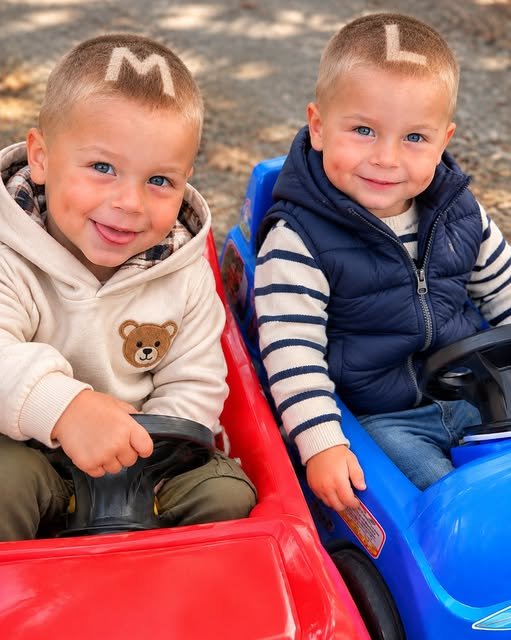
Not shortened. Not tidied. Buzzed close, except for an unmistakable M on Max’s head and an L on Leo’s.
I set a carton of eggs on the floor because I no longer trusted myself to hold it.
“Henry.”
He appeared in the kitchen doorway, smiling too broadly.
“Problem solved.”
“What problem?”
“Nobody can mix them up now.”
Max turned in a circle.
“Mine is M!”
“Mine goes this way!” Leo bent forward so I could admire the L.
They were delighted. That mattered, but it did not erase the fact that Henry and I normally discussed substantial changes involving the boys. Until that afternoon, neither child had ever had more than a simple trim.
“Can I talk to you in the kitchen?” I asked.
Henry’s smile slipped.
“Emma, it’s hair.”
“Then you wouldn’t mind if I made an appointment for someone to shave a letter into yours?”
Leo laughed. I immediately regretted giving him an audience.
I waited until the boys ran outside to their little ride-on cars. Through the open back door, we could hear them arguing cheerfully over who would lead the parade.
“Did they ask for those?” I said.
“I suggested it. They liked the idea.”
“They’re four. You could suggest eating cereal in the bathtub and they’d like that too.”
He folded a dish towel into a smaller and smaller square.
“They wanted short hair for summer.”
“Then we could have talked about short hair.”
For a moment, he looked less defensive than tired.
“I thought it would make something easier.”
I assumed he meant preschool pickup, family pictures, all the occasions when adults asked the boys to identify themselves. I did not ask what he meant. I was too busy imagining the photographs relatives would request.
“We’ll discuss it after bedtime,” I said.
“Fine.”
The boys spent the afternoon admiring each other. I took one photograph outside because they asked me to, sitting in their red and blue cars with their hands on the steering wheels. I remember thinking that someday I might find it funny.
After their bath, Henry handled pajamas while I started dinner. Later, while we washed dishes, the boys went upstairs to play. That was the gap in the evening neither of us had questioned.
At eight-thirty, I read them two stories while their stretched pajama necklines covered their heads. Max took the bed by the window. Leo took the one by the door. Henry kissed them good night after I went downstairs.
By eleven-thirty, I was in bed, still rehearsing the conversation we needed to have. Henry was checking the locks and turning off lights.
On the monitor, Leo climbed out of bed and shook Max awake. Max gathered Pickle and his blanket. They traded beds, whispering, then Leo looked directly toward the camera and put a finger to his mouth.
I assumed they were extending their afternoon identity game.
Then the bedroom door opened, Henry stepped inside, and I saw the clippers.
Now I was sitting between those same beds while Leo watched his father with an expression I had never expected to see on his face: concern for an adult.
Henry leaned forward, elbows on his knees.
“You weren’t supposed to hear that.”
“Hear what, exactly?” I asked.
He swallowed.
“I called Tom after you got home. When you were putting the groceries away.”
His brother. Of course. Tom was usually the person Henry called when he wanted someone to tell him he had not made a complete mess of something.
“I went into the laundry room,” Henry continued. “I thought they were outside.”
Max shook his head.
“We came for the chalk.”
The chalk basket sat on a shelf just outside the laundry room.
Henry looked down at his hands.
“I told him I’d tried to fix something. Then I told him why I thought it needed fixing.”
“The haircuts?”
He shook his head.
“Me.”

Part 3: What the Boys Had Heard
For a moment, the only sound was Leo rubbing his heel against the bed frame.
Henry looked at me.
“I called because I knew you were upset. I wanted Tom to tell me the haircuts weren’t as ridiculous as they looked.”
“Did he?”
“He laughed for a while.”
Under other circumstances, I would have joined him. Now I waited.
“Then he asked why I hadn’t just bought different-colored hats.” Henry gave a brief, unhappy smile. “And I told him it wasn’t really about anyone else.”
Max reached down for Pickle. I picked up the dinosaur and handed it to him.
Henry watched me do it.
“I hate not knowing,” he said. “Sometimes they’re standing right in front of me, and I have to wait for one of them to speak.”
“They’re identical twins.”
“I know.”
“People confuse them all the time.”
“I’m not people, Emma. I’m their father.”
There was no sharpness in it. That made it harder to hear.
He told me about pausing with two plates at a birthday party, terrified of offering strawberries to the wrong child while everyone watched. About studying preschool photographs before opening the family group chat. About laughing when someone tested him because admitting he hated it would make the moment even more awkward.
I remembered the pictures. Sometimes he asked which boy was on the left. Sometimes I answered with a laughing face.
I had thought we were sharing a harmless absurdity.
“Why didn’t you tell me?” I asked.
“Because I thought the explanation sounded worse than the problem.”
Max’s fingers tightened around Pickle’s tail.
“You said bad daddy.”
Henry moved off the bed and crouched in front of him.
“I said I was afraid I wasn’t doing a good job. That isn’t something you have to fix.”
“But you were sad.”
“Yes. And when grown-ups are sad, they need to talk to other grown-ups. You don’t have to make me feel better.”
Leo leaned across the space between the beds.
“We took off the letters.”
Henry nodded slowly.
“I see that.”
“Because you know us,” Max said.
It was not a grand speech. He said it with the stubborn confidence he used when correcting the name of a dinosaur. Something obvious had been misunderstood, and he wanted the record straight.
Henry put a hand over his mouth.
I looked away long enough to steady myself.
“You can’t use the clippers again,” I told them. “Even for a kind reason.”
Leo nodded.
“We won’t.”
“And you don’t need to prove anything to Daddy.”
Max considered that, then climbed out of bed anyway. He stood directly in front of Henry, wearing his brother’s blue pajama bottoms.
“Who am I?”
I started to stop him, but Henry smiled.
“Max.”
“How?”
“You’re holding Pickle.”
Max looked down at the dinosaur as though it had betrayed him. Then he tossed it onto the bed.
Leo scrambled down beside him.
“Again!”
“One more,” I said. “Then sleep.”
It was an optimistic instruction.
Henry turned around while they shuffled noisily behind him. When he faced them again, Leo was pressing his lips together so hard that his cheeks trembled.
Henry pointed gently.
“Leo.”
Leo shrieked with delight.
“You touched your ear,” Henry said. “You do that when you’re trying not to laugh.”
Leo immediately pinned both hands to his sides.
They made him turn around once more. This time he guessed wrong.
I felt myself brace, waiting for the embarrassed glance, the rushed joke, the little withdrawal I suddenly recognized.
Henry looked at the delighted boys and laughed.
“All right. You got me.”
There was no apology inside the laugh. He had made a mistake, and the room had remained perfectly safe.
Max announced that he was Leo.
“No,” Henry said. “You’re Max, enjoying the fact that I just called you Leo.”
Max fell backward onto his mattress, laughing so hard he couldn’t answer.
I watched Henry pull the blanket over him. He knew exactly how far to tuck it: snug at the feet, loose over the knees. Max hated feeling trapped.
“I’m sorry,” I said.
Henry glanced up.
“For what?”
“For turning this into a test. For laughing when other people did.”
“You didn’t know.”
“I knew I was teasing you. I should have paid attention to whether you were enjoying it.”
He smoothed the blanket once.
“I should have told you instead of pretending.”
“Yes.”
I let that sit before adding anything else.
“And you still made a decision about their hair without me. Then you left the clippers where they could reach them.”
“I know. I’m sorry.”
He looked at the boys.
“Tomorrow I’m putting them away properly. Every time. You shouldn’t have been able to get them.”
Leo touched the uneven patch on top of his head.
“Can we fix this tomorrow too?”
“A barber can,” I said. “Not one of you.”
Henry nodded with exaggerated solemnity, and this time I let myself smile.
We returned everyone to the correct bed. Before we left, Max called his father back.
“If you get us wrong, it’s okay.”
Henry’s hand stayed on the doorframe.
Leo added, “We get us wrong in pictures.”
That was true. They had argued over their own toddler photographs more than once.
Henry’s shoulders lowered.
“Then we’ll help each other,” he said.
Downstairs, he locked the clippers in the bathroom cabinet before joining me at the kitchen table. I poured two glasses of water. Neither of us reached for a phone.
I thought we had finally reached the end of what he had been keeping to himself.
Then he said, “There’s something else I should have told you.”
My hand stopped around the glass.
“I went to the eye doctor last month.”
“Why?”
He watched a drop of water slide down the outside of his glass.
“Because it isn’t only the boys.”
Part 4: Learning to Ask
I sat down again.
Henry explained that he sometimes failed to recognize people outside the places where he expected to see them. A coworker in a grocery store. A neighbor without her usual glasses. Someone he had met several times approaching him in an unfamiliar coat.
“I usually work it out when they talk,” he said. “Or they say something that tells me where I know them from.”
“Has this started recently?”
“No. I remember doing it in school. I thought everyone had to work that hard.”
His eye examination had found no problem that explained it. When he described the difficulty, the doctor suggested asking his primary care physician about a specialist evaluation focused on face recognition.
“Nothing’s been diagnosed,” Henry said quickly. “I don’t want to make it sound like I already have an answer.”
“You could have told me while you were still looking for one.”
He nodded.
“I know.”
He had arranged an appointment for January. It was June. There was a waiting list, and because the difficulty was longstanding rather than a sudden change, he had been advised that a routine evaluation was appropriate.
For months, he had been carrying a private question about himself while I made jokes about the most difficult version of that question.
I reached across the table.
“Would you like me to go with you?”
“Yes,” he said, before I finished asking.
The next morning, the boys woke up with no interest in emotional breakthroughs. They wanted pancakes and an answer about whether shaved heads needed shampoo.
At the barbershop, Henry explained that we needed two uneven home haircuts tidied up. He did not blame the children or offer the story as entertainment.
The barber crouched to their level and asked each boy before touching his head. Max wanted to know whether it would tickle. Leo wanted to know how fast the clippers could go.
I watched Henry listen to both answers.
Their hair was very short when we left, but even. There were no letters. Henry had already cleaned the clippers and secured them at home; that afternoon, we checked the other bathroom storage together.
The practical repairs were straightforward. The habits took longer.
At a family cookout two weeks later, someone called across the yard, “Quick, Henry, which one’s that?”
I put down the serving spoon.
“We’re retiring that game,” I said.
The relative looked surprised, then shrugged and asked Henry about work. There was no scene. Henry caught my eye over the picnic table, and I realized how often a small intervention would have been enough.
He made changes too.
When he wasn’t sure, he asked. Not in a panicked whisper to me, but directly and calmly.
“Help me out, buddy. Max or Leo?”
Sometimes they answered. Sometimes they tried to fool him. He learned to say he wasn’t playing when they needed to leave the playground or put on shoes.
We also talked about situations where names were not a game. At appointments, around medicine, with teachers responsible for them, they needed to answer honestly. They could understand that rule without being asked to understand everything behind it.
I began noticing my own mistakes. I sometimes identified the boys by where they were standing, what they were wearing, or which cup they held. When those clues changed, I could get it wrong too.
Once, I delivered a lengthy lecture about wet towels to Leo before Max appeared in the doorway.
“Mommy, I did that.”
Leo had been listening with remarkable patience.
I apologized to him, then found Henry watching from the kitchen.
“Not a word,” I said.
He raised both hands, smiling.
Later, when the boys were asleep, he admitted how much effort it still took not to turn every mistake into evidence against himself. One good night had not erased years of embarrassment.
“Then tell me when it happens,” I said. “Don’t wait until you’re shopping for a solution with blades.”
He laughed, but he also promised.
In January, I went with him to the specialist. The assessment involved a detailed history and face-recognition tasks, not a quick glance at a chart. Henry described relying on voices, movement, hairstyles, and context for as long as he could remember.
The specialist explained that his pattern was consistent with developmental prosopagnosia, often called face blindness. People experience it differently, she said. Henry’s difficulty with faces did not mean he failed to recognize everything about a person.
There was no medicine that would suddenly make identifying faces effortless. The useful work involved understanding his pattern, using reliable strategies, and reducing the shame that kept him from asking for help.
The twins remained a particular challenge. Their similar faces removed many of the visual differences other people relied on.
On the drive home, Henry stared out the window for a while.
“I wish I’d asked about this years ago.”
“I wish I’d made it easier to ask.”
He reached for my hand at the next red light.
By the time kindergarten began the following fall, the boys’ hair had grown back. Max preferred his a little longer. Leo wanted his short enough that he barely needed a comb. We let each choose.
At the classroom visit, their teacher asked whether there was an easy way to tell them apart.
Henry told her about their different haircuts and favorite colors, then added, “Clothes aren’t a guarantee. They enjoy switching.”
The boys exchanged a delighted look.
“If you’re unsure, you can ask,” he said.
It was advice for the teacher, but I heard what it had cost him to believe it.
We still have the photograph from that Saturday: two smiling boys in little red and blue cars, ridiculous initials on their heads, completely pleased with themselves. I no longer look at it and see only an argument waiting to happen.
I remember two children who overheard too much, a father who finally spoke honestly, and how close I came to missing both because I thought I already understood.
Henry still gets their names wrong sometimes. So do I. The boys correct us, and life continues.
Last week, Max called from upstairs after bedtime. Henry paused in the hallway and answered before he could see which bed the voice had come from.
“I’m here.”
That was all our son had needed to know.