
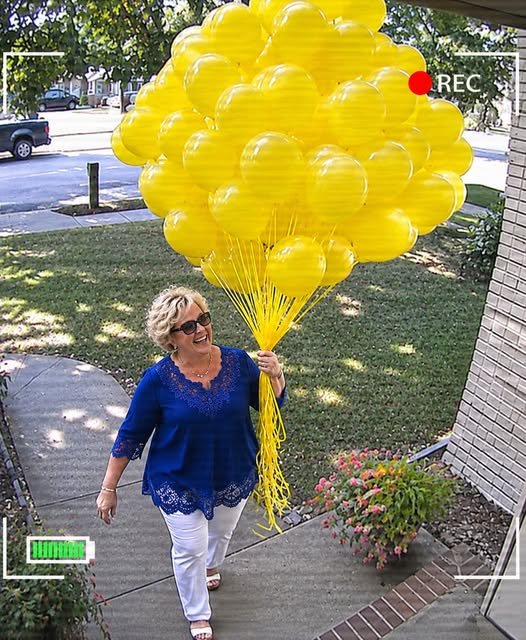
Part 1: The Extra Balloon
I expected my sixty-fifth birthday to be quiet. My husband was away, my sister had promised dinner that weekend, and I had bought a small cake I could freeze in slices. Then sixty-six yellow balloons arrived without a card. Before the afternoon was over, I would call the police, meet a woman from my husband’s past, and discover why he had never minded missing my birthdays.
The delivery driver was already halfway down the walk when I noticed the number on his receipt.
“Sixty-six? There must be a mistake. I’m turning sixty-five.”
He checked the order on his phone.
“Sixty-six yellow balloons for Helen. That’s what they requested.”
He secured the bunch to my porch railing because I couldn’t safely hold the storm of ribbons and sign his delivery screen at the same time. I thanked him, waited until his van pulled away, and reached for my phone.
Robert had called that morning from a conference supposedly eight hundred miles away. He had apologized for missing my birthday, promised dinner when he returned, and reminded me to check the porch. I had assumed he meant flowers. He sometimes sent them when work kept him away.
But Robert knew I disliked yellow. Years earlier, he had brought home yellow roses after I had specifically asked for white ones, and we had argued—not about flowers, really, but about whether he listened. Neither of us had forgotten it.
I called him. The call went to voicemail.
“Your surprise arrived. Did you order an extra year for me?”
I tried to sound amused. After hanging up, I checked the clear sleeve attached to the ribbons. There was my name, our address, and the quantity. No message. The shop couldn’t identify the purchaser when I called; the person who had handled the order was out on another delivery.
As I untangled the ribbons, I noticed six balloons gathered on a separate loop inside the larger bunch. Each had a tiny black dot near its knot. Below the dots, someone had printed letters on narrow paper tags, numbered one through six.
M. A. R. I. A. N.
I laid the tags across my palm and read them again.
Robert’s first wife was named Marian.
I had seen her photograph once, in an old album Robert was sorting for his children. Their marriage had ended thirty-one years earlier, four years before he and I married. He said they maintained civil contact about Daniel and Claire, both now adults. I had never met her.
My grandmother used to give meanings to colors and numbers. Yellow meant jealousy; repeated sixes meant secrets. I didn’t believe any of that. What frightened me was much simpler: someone knew my address, my birthday, and the name of a woman my husband rarely mentioned.
I called Robert again. Then I sent a photograph of the tags.
Who sent these?
No answer.
I carried the cake knife from the counter to the sink, then caught myself staring at it. That small, unreasonable movement told me how frightened I had become. I put it in a drawer and called the local police nonemergency number.
“There hasn’t been a threat,” I explained. “But someone sent an anonymous delivery with a personal message, and I’m alone. I’d like some advice.”
The dispatcher asked what had arrived, whether anyone had tried to enter, and whether I recognized a vehicle outside. She suggested I stay inside while we talked and not confront anyone who made me uncomfortable.
That was when Robert’s gray sedan turned into our driveway.
For one relieved second, I thought he had come home to surprise me. Then the driver’s door opened, and a woman stepped out carrying a brown envelope.
Her hair was longer than in the photograph, threaded with gray now. But I recognized her.
“His first wife is here,” I told the dispatcher. My voice came out much louder than I intended.
The woman stopped at the bottom of the steps.
“Helen? I’m Marian. Please don’t be frightened. Robert is safe.”
The dispatcher asked whether I wanted an officer. Through the locked storm door, I asked Marian why she had come.
“To tell you something I should have told you a long time ago.”
She stayed where she was when I asked her to. There was no threat, no attempt to come closer. I told the dispatcher I would speak to her through the door and call back if I needed help. Only after we ended the call did I notice how hard I was gripping the phone.
“Where is my husband?”
“He’s been staying at my house this week. Right now, he’s visiting our daughter.”
“He’s at a conference.”
Marian looked at the envelope rather than at me.
“No, Helen. He isn’t.”
I pointed at the car. Robert had told me he was driving to the conference.
“How did you get his keys?”
“He borrowed Daniel’s car for two days. I told him I was visiting my cousin overnight, and I drove his here yesterday. He doesn’t know where I really went.”
Eight hundred miles. An overnight bag visible on the back seat. A woman who had planned this carefully enough to have balloons delivered before approaching my door.
“Why today?”
Her mouth trembled, but she didn’t cry.
“Because I couldn’t let you celebrate another birthday without knowing.”
She drew a photograph from the envelope and held it against the storm-door glass.
Robert sat beside her at a dining table, his hand resting on the back of her chair. Daniel and Claire stood behind them. There was a birthday cake in front of Daniel, and Robert was wearing the navy sweater I had folded into his suitcase four days earlier.
“When was that taken?” I asked.
“Tuesday.”
On Tuesday, Robert had called me from an airport. He had complained about a delayed flight after a supposed connection for a client visit.
I unlocked the door. Whatever Marian had brought in that envelope, my husband had already made room for it in our marriage.
Part 2: The Dates in Blue
Marian sat at the end of my couch, holding the envelope with both hands. I remained standing. Letting her inside had been a decision to hear her, not an invitation to make herself comfortable.
“Start at the beginning,” I said.
“Robert and I divorced thirty-one years ago. That part was true.”
“And the part that wasn’t?”
She took a breath.
“We got back together about twenty-four years ago.”
Robert and I had been married for twenty-seven years. I did the subtraction twice, as though the answer might change if I approached it more carefully.
“You’ve been having an affair with my husband since our third year of marriage?”
“At first, yes. He said your marriage was ending. Later, he said it had ended, except for paperwork.”
In our third year of marriage, we had planted the maple tree outside the kitchen window. Robert had held it straight while I stepped back to see whether we had chosen the right spot. We had argued about where its shade would fall when we were old.
I looked through the window at the tree.
“He lives here, Marian.”
“I know that now.”
“How often does he stay with you?”
“Usually every other week. Sometimes longer.”
I sat down because my knees had begun to shake. Robert’s travel had been part of our life from the beginning. He managed regional accounts, attended trade meetings, and visited clients. Even after moving into a less demanding position, he kept finding reasons to go.
I had complained about the absences. I had never imagined checking whether the work existed.
“Does he sleep in your bedroom?”
“Yes.”
I studied a loose thread on the couch cushion until I could ask the next question.
“Do your children know about me?”
“They knew he remarried. He told them that marriage ended years ago. They thought you were his ex-wife.”
Daniel and Claire had been old enough to remember their parents together when Robert and I married, but contact between their household and mine had always gone through him. He said that was easier for everyone. There had been brief holiday calls, a graduation I couldn’t attend because of surgery, invitations that somehow never led to an ordinary shared meal.
I had mistaken a carefully maintained distance for respect.
Marian spread photographs on the coffee table. There were Christmas dinners, a backyard fence Robert had helped paint, a restaurant anniversary, and a kitchen with his coffee mug beside the sink. She also showed me dated messages on her phone. I photographed several with her permission.
Then I opened my calendar. Robert’s business trips were marked in blue.
“March fourteenth last year?”
“Claire’s birthday.”
“June ninth?”
“Our anniversary dinner.”
I looked up.
“Your anniversary?”
“The date we first married. We didn’t remarry legally.”
That June, he had sent me flowers from a convention. I remembered arranging them while we talked on the phone, grateful that he had thought of me.
“Christmas Eve?”
Marian didn’t need to ask which year.
“He was with us.”
I had eaten soup that night because his flight was supposedly canceled and cooking our planned dinner for one seemed unbearable. He had called late, speaking softly because, he said, the airport lounge was crowded.
I closed the calendar.
“How did you know I hated yellow?”
“Robert told me about the roses. He made it sound like a funny argument.”
I looked toward the porch. Even that small hurt had become a story they shared.
“And why sixty-six balloons?”
“Sixty-five for your birthday. One for the woman you didn’t know was still there.”
She winced as she heard herself say it.
“It sounds awful now. I thought the extra one would make you look closely. The marked balloons were supposed to tell you who was coming.”
“You could have knocked.”
“I know. I wrote letters. I kept not sending them. I thought if I arranged something I couldn’t take back, I might finally come.”
“Instead, you frightened me enough to call the police.”
“I’m sorry.”
Her apology stayed between us. I wasn’t ready to do anything with it.
“Why tell me now?”
“He’s retiring next spring. He said he would finally have more time at our house.”
I stared at her. Robert and I had spent months discussing retirement. We had priced a long train journey, talked about taking weekday walks, and promised each other that the years ahead would be different.
“He promised we would travel together.”
Marian’s fingers tightened around an empty corner of the envelope.
“Did he tell you he was leaving me?” I asked.
“He used to. Lately, he talks as though everything can stay as it is.”
For the first time, I understood that Robert might not be approaching a difficult decision at all. He might be looking forward to a future in which neither of us asked him to make one.
“How long have you known we’re still married?”
Marian lowered her eyes.
“Six years.”
I stood so abruptly that she flinched.
“You’ve known for six years?”
“I found a birthday photograph on his phone. He said you were legally married but living separately. He said you knew about me.”
“Did you believe him?”
“At first.”
“And afterward?”
She said nothing.
“You let me keep waiting for him.”
“I was afraid of losing the family we’d put back together.”
“You were protecting something by taking away my right to choose.”
Tears ran down her face. I didn’t move toward her.
I opened the front door.
“I think you should leave.”
Marian collected the photographs slowly. At the doorway, she stopped.
“He told me you preferred being independent. That you were happier when he wasn’t around all the time.”
I remembered asking Robert, only a month earlier, whether he could turn down one last trip before retirement. He had kissed my forehead and told me to be patient.
“He knew how much I wanted him home,” I said.
Marian looked back at me.
“Then he’s been promising us different futures.”
I left my hand on the open door for a moment. Then I closed it.
“Sit down. We’re not finished.”
If Robert had made two women wait for the same man, he was about to discover what happened when we stopped waiting separately.
Part 3: The Bracelet on the Table
I made coffee because I knew the order of the steps. Fill the kettle. Find two cups. Put the spoons on the saucers. There were still ordinary things I could do correctly.
“Does Robert expect you back tonight?” I asked.
“Yes. He thinks I stayed with my cousin last night and will be home for dinner.”
“He’ll notice his car is missing.”
“He knows I borrowed it. He doesn’t know how far I took it.”
I put a cup in front of her and called him again. This time, he answered before the second ring.
“Happy birthday again, sweetheart. I’m between meetings.”
I looked at Marian. She closed her eyes.
“Where are you?”
He named the city from his itinerary.
“At the conference center?”
“Of course. Helen, did the delivery arrive?”
“The balloons did. So did Marian.”
There was a faint sound on his end, as though he had stepped outside or shut a door.
“What do you mean?”
“She’s sitting in our living room.”
“Whatever she’s told you, there’s an explanation.”
“Then you can explain it when you get here.”
“Put Marian on the phone.”
“No.”
“Helen, please. Don’t let her upset you.”
I looked at the photograph beside my coffee.
“She didn’t arrange your schedule, Robert.”
“I’m eight hundred miles away.”
“I know. Take your time.”
I ended the call. My hands were shaking, but I had said what I intended to say.
Marian’s phone rang almost immediately. She asked whether I wanted her to answer. I nodded, and she put it on speaker.
“What have you done?” Robert demanded.
“Told Helen the truth.”
“You need to stop talking until I get there.”
Marian looked across the table at me.
“We’ve already waited long enough.”
She ended the call before he could reply.
I wanted to feel triumphant. Instead, I felt tired and faintly sick. Twenty-seven years of marriage had not disappeared during those calls. My body still expected Robert to be the person I turned to when something terrible happened.
I called my younger sister, Janet. I told her enough that she stopped asking whether I wanted to go out for birthday dinner.
“Do you want me to come?” she asked.
“Not yet. But may I stay with you if I need to?”
“You don’t have to ask that.”
“I need to hear the answer.”
“Then yes. For as long as you need.”
Afterward, I gathered copies of our tax returns, retirement statements, mortgage records, insurance policies, and recent bank statements. Robert handled most of the long-term planning; I paid the monthly bills. I could access our joint accounts, but I had allowed myself to understand less than I should.
I downloaded records without moving money or changing anything. I didn’t know what a separation would involve, and I wasn’t going to make financial decisions in the first hours of shock.
When I reached our most recent retirement estimate, I found Robert’s handwriting in the margin: More time together.
I put that page facedown.
Marian offered to make a list of the weeks he had stayed with her. We compared it with my calendar, stopping whenever either of us needed to check a date. Some trips had been genuine business travel. Others had been partly work and partly visits. Several had been invented entirely.
The mixture made me angrier than a simple pattern would have. He had relied on enough truth to keep the lies from standing out.
Near the bottom of the envelope was a beach photograph. Robert and Marian were barefoot at the water’s edge, holding hands. I turned it over. The date was written on the back in Marian’s careful script.
It was the week of my sixtieth birthday.
Robert had said an important overseas client needed him. He had called at an odd hour and apologized for the time difference. When he came home, he gave me a bracelet in a velvet box.
I was wearing it now.
The clasp caught against my fingernail. I tried again, more slowly, until it opened. I placed the bracelet beside the photograph.
Marian watched me.
“I don’t want you to think every happy memory was false.”
“Then don’t tell me what to think about my memories.”
She drew back.
“You’re right.”
We sat without speaking for a while. Then I asked whether Daniel and Claire knew where she was.
“I told them before I left. Not everything, but that you and Robert were still married and you didn’t know about us.”
“How did they take it?”
“Daniel was furious. Claire asked how many people had known before she did.”
“What did you say?”
“That I should have told the truth years ago. That being afraid didn’t excuse me.”
It was the first answer she had given without trying to soften the edges. I still couldn’t forgive her. But I could recognize that she had come here knowing she would lose things, too.
That evening, she booked another night at her motel. Before leaving, she placed the original photographs back in the envelope and gave it to me.
“Keep these until you’ve made whatever copies you need.”
I didn’t invite her to stay. I did give her a bottle of water for the drive across town.
Robert texted shortly before midnight. He had arranged a rental car and would arrive the following afternoon. He wanted us to speak alone.
I wrote back: Marian will be here. I won’t discuss this in separate versions.
The next morning, I made an appointment with a family-law attorney for the following week. The receptionist told me what documents to bring. Saying “my husband and I may be separating” felt strange enough that I had to repeat it.
At two that afternoon, Marian returned. We sat at the dining table with the photographs, the calendar, and the bracelet between us.
When Robert’s rental car finally pulled into the driveway, I realized I was still hoping he would say something that could save our marriage—and I was afraid of how badly I wanted to believe him.
Part 4: The Birthday I Would Keep
Robert entered carrying his overnight bag. He looked first at me, then at Marian, then at the papers on the table.
“Can we talk privately?”
“No,” I said.
“Helen, this is between us.”
“Apparently, it never was.”
He put down his bag. For a moment, he seemed unsure which chair belonged to him.
“Marian, you had no right to do this.”
“I should have done it six years ago.”
He turned back to me.
“I know how this looks.”
“Then don’t explain how it looks. Tell me when you started sleeping with Marian again.”
His eyes moved toward her.
“Robert.”
“About twenty-four years ago.”
Hearing him confirm it hurt differently from hearing her say it. Until then, some small part of me had been waiting for a correction.
“When were you going to tell me?”
“It wasn’t that simple.”
“You had twenty-four years to find a way.”
He sat down and rubbed his palms together.
“We had children. I wanted to be there for them. I never stopped caring about Marian.”
“You could have been their father without being her partner.”
He said nothing.
I asked about the supposed canceled flights, the holidays, and the weeks he had said he couldn’t refuse a client. He admitted some, tried to explain others, and twice said he couldn’t remember. Each answer left the same fact untouched: he had known where both of us were while neither of us knew where he was.
“What was supposed to happen after retirement?” I asked.
He looked almost relieved to reach a question about the future.
“I thought we could work something out.”
“Who is we?”
“All of us.”
Marian let out a short, disbelieving breath.
Robert leaned forward.
“I love you both. That’s the truth.”
I had imagined an explanation involving confusion, regret, or a desperate wish to stop. Instead, he was asking us to help preserve the arrangement.
“And you thought we would accept that?”
“I didn’t want to lose either of you.”
Marian folded her hands.
“So you let each of us believe whatever kept us waiting.”
“You knew the situation,” he told her.
“I knew enough to be responsible for staying quiet. I didn’t know Helen had been promised the same future.”
She turned toward me.
“I’m sorry. I don’t expect you to forgive me.”
I nodded once. Robert reached across the table for my hand. I moved it into my lap.
“Do you remember my sixtieth birthday?”
He glanced at the bracelet.
“Yes.”
“You weren’t overseas.”
“No.”
“You bought this when you came back.”
“I wanted to make it up to you.”
I pushed the photograph closer to him.
“You let me thank you for being thoughtful.”
His shoulders dropped.
“I made mistakes.”
“You arranged two lives. You booked travel, remembered explanations, and let us plan around them. That took work, Robert.”
For the first time since he arrived, he stopped trying to answer.
I waited. There was still a chance for him to say he understood what he had done without asking anything from me. Instead, he looked toward Marian, then back at me, as though one of us might make the next part easier.
“I want you to stay somewhere else,” I said.
“Don’t decide this while you’re upset.”
“I have an appointment with an attorney. I’m not settling the house or our finances today. I’m telling you I won’t share a bedroom with you, and I’m asking you to leave while I decide what comes next.”
“After twenty-seven years?”
“Yes. After twenty-seven years.”
Marian stood.
“And you’re not coming back to our arrangement, either. We can discuss collecting your things later. Not tonight.”
He stared at her. Then he looked at me for a long moment, waiting for something I no longer had to give.
Eventually, he picked up his bag. He agreed to a hotel and asked whether he could call the next day.
“Email about practical matters,” I said. “I’m not ready for anything else.”
After the door closed, Marian reached for her jacket.
“I should go.”
“Yes.”
At the doorway, she looked out at the yellow balloons, already drooping against the railing.
“I didn’t send them to hurt you.”
“I believe that. But they did.”
She nodded.
“I know.”
“I can’t promise we’ll become friends.”
“I’m not asking.”
I held the door open.
“But I’m glad you finally came.”
After she drove away, I took down the balloons. I brought them inside before cutting them, deflating each one instead of releasing them. The work was awkward and repetitive. For once, repetition helped.
At the bottom of the bunch, I found the tag marked M. I put it in the kitchen drawer, separate from the bracelet.
The months afterward were not clean or easy. Robert asked for counseling. I declined couples counseling and found someone I could speak to alone. He sent long messages about our good years; I asked him to send the missing financial statements instead.
With legal advice, we exchanged records and negotiated a separation. Nothing happened overnight. The house had to be valued, retirement accounts reviewed, and expenses agreed upon. I learned to ask questions before signing documents, even when I worried the questions sounded basic.
Marian contacted me once to check a date for her own records. We exchanged a few careful messages. She did not ask me to reassure her, and I did not offer. That boundary made it possible to answer her kindly.
By my next birthday, Robert and I were living separately under a signed agreement, and the divorce process was moving forward. I had stopped arranging my weeks around his possible return.
Janet came over with white flowers and a cake large enough to require company. We invited two neighbors. When my sister asked whether I wanted balloons, I surprised myself by laughing.
“Not this year.”
Before they arrived, I opened the kitchen drawer for candles and saw the little tag beneath a packet of matches. I left it there. I no longer needed to look at it to remember what had happened.
At dinner, Janet lifted her glass.
“What are you wishing for?”
I looked around the table. Every chair had someone in it who had chosen to be there, and no one was waiting for an explanation from an airport.
“I’ll tell you when I decide,” I said.
Then I leaned forward and blew out the candles, with the whole evening still ahead of me.