
Part 1: The Photograph on the Laundry Room Floor
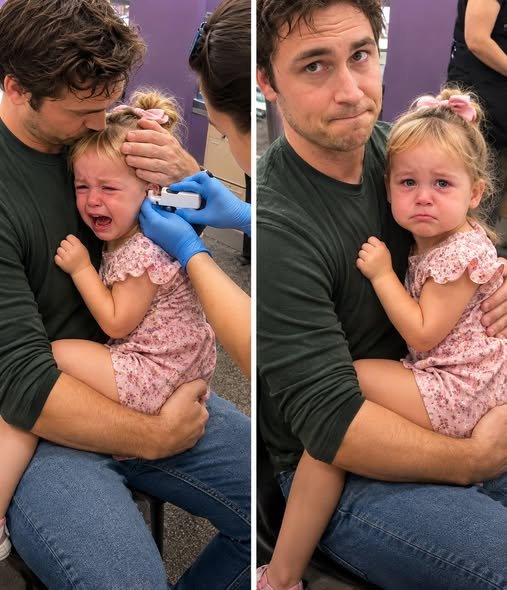
My mother-in-law expected a compliment when she sent the picture. Instead, I noticed my daughter’s fist twisted in her father’s shirt, the tears on her cheeks, and the earrings I had explicitly refused. Linda had wanted those earrings for months. Josh had promised to support me. By dinner, both of them would have a gift to unwrap—and neither would mistake it for gratitude.
One of Ellie’s socks fell from my hand when the photograph appeared. I watched it land beside the laundry basket, then looked back at my phone, trying to make the image mean something else.
My two-year-old sat on my husband’s lap. Her rabbit was trapped between them. Josh had one hand spread over the side of her head, and a stranger wearing blue gloves was beside her ear.
The next picture showed two tiny gold studs.
Linda’s message arrived underneath it.
“See? Now everyone will know she’s a little girl!”
I called Josh. It rang until voicemail answered. Before I could call again, Linda sent another message.
“He held her the whole time. She was very brave.”
Brave. As though Ellie had volunteered for something difficult instead of being taken somewhere she couldn’t understand by the adults she trusted.
An hour earlier, I had kissed her goodbye at our front door. Linda was taking her to the park, and Josh had decided to join them. Ellie had been so excited about the slide that she had tried to put both feet into one shoe.
I had handed Josh her jacket.
“She might need this later.”
“I’ve got everything,” he had said.
Now I couldn’t get him to answer.
For months, Linda had complained that strangers sometimes called Ellie a boy. Ellie’s hair was short because it grew slowly, and because she disliked anyone brushing it for more than thirty seconds. Neither circumstance troubled Ellie.
It troubled Linda enormously.
“A little pair of earrings would settle it,” she had said one Sunday.
Ellie was on the kitchen floor, carefully loading wooden vegetables into a toy dump truck.
“Her name settles it,” I had answered.
Linda had laughed as though I were making a joke.
I wore earrings myself. This wasn’t an argument against jewelry, or against families who made a different choice. I wanted to wait until Ellie could ask for them and understand, in a simple way, what getting them meant.
Josh had agreed—or so I thought.
The previous evening, after Linda mentioned earrings again, I had asked him directly.
“Have you told your mother we’re waiting?”
He had been standing at the refrigerator, examining a jar of mustard.
“I told her you didn’t want them done.”
“That isn’t the same thing.”
He had shut the refrigerator.
“Katie, I don’t have a strong opinion about earrings.”
“Then please have one about us making a decision and keeping it.”
He had nodded.
“Okay. We’ll wait.”
It was such an ordinary conversation. I hadn’t known I would be replaying it less than a day later, down to the click of the refrigerator door.
My second call went unanswered too.
I typed, What have you done? Then I deleted it. The photograph told me what they had done. What I needed was my daughter home, and a husband who would stop avoiding his phone.
Linda sent another message.
“You’re welcome, by the way. A thank-you would be nice.”
For a moment, I could hear her voice perfectly: bright, certain, already preparing the story about how unreasonable I had been until she solved everything.
I opened Josh’s message thread.
“I’ve seen the pictures. Bring Ellie straight home. Call me now.”
Then I answered Linda.
“Come back here with Josh and Ellie. I’ll make an early dinner. I have something for both of you.”
She replied almost immediately.
“Now that’s more like it.”
I didn’t correct her.
Josh called a minute later. There was traffic noise behind him, followed by the sound of a car door closing.
“Katie—”
“Is Ellie all right?”
“She’s stopped crying.”
“That wasn’t what I asked.”
He took a breath.
“She’s sitting with her rabbit. Her ears are sore. We’re coming home.”
“How did this happen?”
“Mom wanted to look at something at the shopping center. Then she said the place took walk-ins, and—”
“Did you tell them you were her father?”
Silence.
“Josh.”
“Yes.”
I pressed my palm against the washing machine. It was still running, vibrating beneath my hand.
“Bring whatever paperwork they gave you.”
“Can we talk when I get there?”
“We are absolutely going to talk.”
After he hung up, I called our pediatric practice’s weekend advice line. I explained that my toddler had just had her ears pierced and that I wanted guidance about discomfort, aftercare, and what we should do next. The nurse taking the message asked whether there was active bleeding or any immediate concern.
I told her I hadn’t seen Ellie in person yet. She arranged a callback and told me what symptoms would require urgent attention rather than waiting.
Only then did I pick up the sock.
In the kitchen drawer, beneath batteries and expired coupons, were two small acrylic frames I had bought for a labeling project. I set them on the counter with a marker and two pieces of paper.
Linda wanted her contribution recognized. Josh deserved equal recognition.
My first attempt was nearly illegible. I threw it away, washed my hands, and tried again.
By the time I heard their car, two wrapped rectangles waited beside the dinner plates.
I opened the front door before anyone rang.
Ellie reached for me immediately.
“Mommy. Ears hurt.”
I took her carefully. Over her shoulder, I saw Josh holding a small shopping bag and a folded form.
He looked at the packages on the table.
For the first time that afternoon, he seemed to understand that coming home wasn’t going to end this.
Part 2: Two Places at the Table
Linda came in behind him, carrying the confidence of someone arriving at a celebration she had organized herself.
“There’s our beautiful girl,” she said.
Ellie tucked her face against my shoulder.
“Let’s give her some space,” I said.
I sat with Ellie on the sofa and looked without touching. Josh put the paperwork on the coffee table. The form had his signature at the bottom.
Seeing it made something settle inside me. Until that moment, a foolish part of me had been searching for a misunderstanding—an impulsive grandmother, a startled father, something he hadn’t quite managed to stop.
He had signed.
The clinician called while Ellie was drinking water. I put the phone on speaker so Josh could hear the instructions himself. We described what had happened, answered questions, and arranged an examination for Monday. We also discussed the options for removing the jewelry rather than leaving it in.
I didn’t make that decision in anger, in the living room, with Linda watching. We followed the immediate guidance and agreed to have Ellie assessed.
Linda began explaining what she had done when her own children were small.
Josh surprised me by raising his hand.
“Mom. We’re listening.”
She stopped, offended enough to go quiet.
Once Ellie was comfortable, I brought her a banana and started the pasta. The familiar work helped. Water, salt, plates. Something that happened in an order I understood.
Josh came into the kitchen.
“What can I do?”
“Set out the food. And don’t tell me this was a misunderstanding.”
He looked down at the colander.
“I wasn’t going to.”
I wanted to believe that. I also remembered how easily I had believed him the night before.
Linda sat at the table and adjusted the wrapped package beside her plate.
“You didn’t need to buy anything.”
“I didn’t.”
She apparently decided not to hear the distinction.
We ate early because Ellie was tired. I cut her pasta, wiped sauce from her fingers, and listened to Linda describe the shopping center as though it had been an entirely ordinary outing.
“She liked looking at the fountain.”
Josh put his fork down.
“We never made it to the park.”
Linda gave him a quick look.
“Well, there wasn’t time after—”
“Slides,” Ellie said.
All three of us turned toward her.
She pointed at the door.
“Slides, Daddy.”
Josh swallowed.
“I know, sweetheart. We didn’t go.”
She considered that, then returned to the stubborn piece of pasta on her fork. The disappointment passed through her quickly. It stayed at the table with the rest of us.
After dinner, Ellie moved to the rug with her blocks. I could see her clearly from my chair.
Linda pulled her package closer.
“Shall I?”
“Please.”
She peeled away the paper without tearing it, a habit I had always found oddly impressive. Then she turned the frame toward herself.
LINDA — GRANDMOTHER. ADVISORY ROLE ONLY.
Her eyes moved across the words twice.
“What is this supposed to mean?”
“You can offer advice. You cannot make decisions that belong to Ellie’s parents.”
She set the frame down sharply.
“You said you had something for me.”
“I do. A clear explanation, since saying no hasn’t worked.”
Josh gave a small, nervous exhale. Not quite a laugh, but close enough.
I pushed his package toward him.
“Yours too.”
He opened it more slowly.
JOSH — FATHER. MUST CONSULT CO-PARENT.
He didn’t smile.
“Katie, do we have to do this like this?”
“I tried doing it in a conversation yesterday.”
Linda folded her arms.
“He is her parent. He agreed. You don’t get the only vote.”
“No,” I said. “I don’t. Neither does he. We had already agreed to wait.”
Josh kept looking at the frame.
I turned toward him.
“Tell her.”
His jaw moved before any words came out.
“We agreed to wait, Mom.”
“You said Katie was being particular.”
The room became very still.
I watched my husband’s face.
“Did you?”
He rubbed both hands over his knees.
“I said I didn’t understand why it mattered so much.”
That hurt in a different place from the photograph. While I had been trying to make a decision with him, he had apparently been discussing how to manage me with his mother.
Linda seized on it.
“Exactly. He didn’t see the harm.”
“Then he should have talked to me,” I said. “Not signed a form while I thought he was taking our daughter to a playground.”
Ellie knocked over her blocks and clapped. I waited until she began building again.
“What did you tell her at the shop?” I asked Josh.
“That it would be quick.”
“And when she cried?”
He looked toward the rug.
“They’d already done the first ear.”
Linda leaned forward.
“Children cry about all sorts of things. She cries when you wash her hair.”
“Washing her hair is necessary care,” I said. “This could have waited.”
Linda pushed her chair back an inch.
“You’re making me sound cruel.”
“I’m describing what happened. You’re responsible for what it sounds like.”
She looked to Josh, expecting him to soften it. I knew that look. I had seen it when she changed holiday plans after we bought tickets, when she gave Ellie food we had asked her not to offer before dinner, when she arrived during nap time and said a happy baby wouldn’t mind.
Usually he translated her actions into harmless intentions. Usually I was left arguing with intentions no one could reasonably oppose.
This time, I waited.
“Mom,” he said, “we shouldn’t have done it.”
“We?” she repeated.
“Yes. We.”
She stood and reached for her bag.
“If I’m no longer welcome, just say so.”
“You can visit,” I said. “But there won’t be any unsupervised outings for now.”
Her hand stopped on the strap.
“Josh, surely you’re not going to let her decide that too.”
He looked at Ellie, then at the form bearing his signature.
And I waited to find out which promise he was going to keep.
Part 3: The Signature Beneath the Promise
“No more outings without one of us there,” Josh said.
Linda stared at him.
“You were there today.”
There it was—the problem none of us could disguise with a neatly worded rule.
Josh’s face changed.
“You’re right,” he said. “And I failed her.”
Linda opened her mouth, but he continued.
“You heard Katie say no. I told Katie we would wait. Then I signed anyway. I’m not going to pretend you tricked me.”
It was the first useful thing he had said all evening. It didn’t repair anything, but it stopped him from breaking it further.
Linda left shortly afterward. She did not take her frame.
At the door, she turned back.
“I hope one day you both understand I was trying to do something nice.”
Josh answered before I could.
“Then you need to understand why it wasn’t.”
She walked to her car without replying.
After she left, Ellie asked for her bath. We followed the care guidance and kept the evening quiet. Josh laid out her pajamas, then reached automatically for the rabbit while he arranged the blanket.
Ellie pulled it against her chest.
“Rabbit stays.”
He stopped.
“Okay. Rabbit stays.”
Such a small exchange. I might not have noticed it yesterday.
When Ellie was asleep, Josh and I sat at the kitchen table. The frames were still there, surrounded by crumbs and torn paper. Without Linda in the room, they looked less clever and more sad.
“I’m angry enough to say things I can’t take back,” I told him. “So I need you to answer plainly.”
He nodded.
“Did you know before you left that she wanted to take Ellie there?”
“No.”
“When did you find out?”
“At the shopping center. She said she’d checked and they could do it that day.”
“And you thought about calling me?”
He looked directly at me.
“Yes.”
I had expected an excuse. The honest answer was worse.
“Why didn’t you?”
“Because you would have said no.”
The refrigerator hummed behind him.
“So this wasn’t you forgetting.”
“No.”
“Or misunderstanding.”
“No.”
I folded the edge of the abandoned wrapping paper until it split.
“You knew the answer, so you made sure I wasn’t there to give it.”
He pressed his palms flat against the table.
“I told myself it was small. That Mom would finally stop talking about it, and you’d be upset for a day, and then it would be over.”
I looked toward the hallway where our daughter was sleeping.
“You used Ellie to buy yourself a quiet afternoon.”
His eyes filled, but he didn’t turn away.
“Yes.”
I needed that admission. I hated needing it.
He apologized without adding that his mother had pressured him, without reminding me that Ellie was fine, without asking me to say we were fine.
I told him I couldn’t offer forgiveness on a schedule.
“And I’m not going to become the supervisor of your parenting. You need to be someone I can leave our daughter with.”
“I know.”
“You knew yesterday too.”
He sat with that.
We agreed on immediate rules. Optional, lasting changes to Ellie’s body required both of us to agree, with her own wishes increasingly central as she grew. If we disagreed, we waited. Urgent medical care was different; either parent could act when necessary and contact the other as soon as possible.
No family member would be allowed to turn one parent’s hesitation into permission from the other.
“And you call your mother,” I said. “I’m not delivering your half of this.”
“I will.”
On Monday, we took Ellie to the pediatric practice together. The clinician examined her ears, found no signs of infection, and discussed our preference not to keep the piercings. We followed the removal and healing instructions provided and watched for the changes we had been told to report.
There was no dramatic medical emergency. Ellie was soon far more interested in a sticker than in either of us.
That didn’t make the decision harmless. It meant we were fortunate that the consequences were limited.
Josh asked the clinician his own questions and wrote the answers down. I didn’t remind him to do it.
In the parking lot, he crouched beside Ellie before putting her into her car seat.
“We’re going home for lunch,” he told her. “And after your nap, I can take you to the park.”
“Slides?”
“Slides. No shopping.”
He looked at me when he said the last part.
At home, he called Linda with me sitting nearby. He told her the outing restriction remained, that visits needed to be arranged, and that undermining either parent would end a visit.
I could hear her voice rising through the phone.
“Katie isn’t making me say this,” he said. “I’m saying it.”
Later that week, he booked an appointment with a couples counselor after asking whether I was willing to go. I was. Not because I believed one appointment would fix us, but because I didn’t want this becoming another family story polished smooth by time.
For several weeks, Linda sent only short messages about Ellie. Josh answered them. I didn’t chase an apology or send reminders about what she owed us.
Then an envelope arrived addressed to me.
Inside was a card in Linda’s careful handwriting.
The first line read, I have been telling myself a version of that Saturday that leaves out what you actually said.
I sat down before reading the rest.
Part 4: What We Chose to Keep
Linda’s letter was one page long.
She wrote that she had wanted the earrings and had treated that wish as more important than our answer. She admitted she had expected Josh to agree because, in her words, he usually did when saying no became uncomfortable.
Then came the sentence I read twice.
“You should not have had to make me understand your reason before I respected your decision.”
It wasn’t perfect. She included a paragraph about how different things had been when she was raising children. But she didn’t use it to erase the apology, and she didn’t ask for an outing in exchange.
I showed Josh.
“What do you think?” he asked.
“I think it’s a beginning.”
“Do you want me to tell her that?”
“No. I’ll answer her myself.”
I thanked her for the letter. I said we could have a short visit the following Sunday, at our house, with both of us there. The arrangement wasn’t a punishment with a secret end date. We needed to see whether she could accept a boundary without immediately testing its edges.
She arrived with a bag containing a cardigan and a book.
At the door, she asked whether it was a good time to give Ellie the presents.
I said yes.
The question itself didn’t restore trust. It did make the visit easier to begin.
Ellie loved the book. She examined the cardigan, announced that it was pink, and allowed Josh to help her put it on. Thirty seconds later, she pulled at a sleeve.
“Off.”
Linda started to say something. I saw the familiar breath, the poised hand.
Then she stopped.
Josh helped Ellie out of the cardigan and folded it beside him.
“Maybe another day,” Linda said.
Ellie had already opened the book.
I didn’t praise either adult for listening to a toddler about a sweater. But I noticed. At that point, noticing was what I could offer.
Our counseling sessions were less tidy than the letter. Some weeks, I arrived ready to discuss the future and ended up talking about the unanswered calls. Josh had initially thought the hardest part would be persuading me that he was sorry.
He learned that the harder part was hearing what his choice had changed without asking me to make the conversation easier.
“When she’s quiet with you, I used to assume she felt safe,” I told him once. “Now sometimes I wonder whether something happened that you’ve decided I don’t need to know.”
He looked down, then back at me.
“I understand why.”
Our counselor helped us distinguish privacy from secrecy, disagreement from disloyalty, and a peaceful family gathering from one where someone was simply swallowing every objection.
Josh began calling his own decisions ours only when they actually were. He also stopped introducing a boundary with my name attached to it.
It mattered at Easter, when Linda suggested giving Ellie a large basket of sweets before lunch.
“We’re saving those for afterward,” he said.
Not Katie wants. Not You know how she is.
We.
There were setbacks. Once, after a tense phone call with Linda, he said he wished everyone could let things settle. I asked whether settle meant rebuilding trust or no longer mentioning why it had broken.
He was quiet for a while.
Then he said he had meant the second one.
We talked again.
I didn’t want a marriage where honesty happened only after I asked exactly the right question. He didn’t become a different person in a month. But he began catching himself sooner, and sometimes without my help.
Linda’s visits continued. Most went well. One afternoon, she asked whether she could take Ellie for ice cream, just the two of them.
My stomach tightened before I answered.
“Not yet.”
She glanced at Josh.
He stayed beside me.
For a second, I thought we were back at the dinner table.
Then Linda nodded.
“All right. We can have it here.”
That was the moment I began to believe her letter—not when she wrote it, but when respecting it cost her something she wanted.
By early summer, Ellie’s ears had healed without complications. The tiny studs remained in the original bag in a drawer, not as evidence or a warning, just something we hadn’t decided what to do with.
The frames disappeared from the dining table much sooner.
I put Linda’s away after her first visit. Leaving it out forever would have turned a useful confrontation into a permanent public sentence.
Josh kept his on his desk, behind a photograph of Ellie holding a pine cone.
“You don’t have to display that,” I told him.
“I know.”
He moved it into a drawer eventually. By then, I no longer needed to see it.
One Saturday, months after the piercing, Josh planned another trip to the park. He checked the time with me, packed water, and found the rabbit without asking where it lived.
Linda was meeting them there. I would join them after finishing an errand. It wasn’t an unsupervised outing with Grandma, and nobody pretended it was.
At the door, Ellie held up her shoes.
“These ones.”
They were her rain boots. The ground was dry.
Josh looked at the boots, then at her determined face.
“Can you climb in those?”
She nodded firmly.
“Okay. We’ll bring your sneakers too.”
He kissed me goodbye. I watched them reach the car without feeling the old need to invent a reason to call.
Later, I found them beside the slide. Linda sat on a bench holding the water bottle while Josh waited at the bottom.
Ellie looked down from the platform.
“Ready?” he asked.
“Not yet.”
He lowered his hands and waited.
A few seconds passed. Then she grinned and pushed herself forward.
He caught her at the bottom, laughing, and she immediately demanded another turn.
Nothing about that afternoon could undo the photograph on my phone. I had never needed it to. What I needed was this: a father who could hear an answer he hadn’t hoped for, a grandmother who could leave a decision alone, and a daughter who didn’t have to hurry because the adults were impatient.
At the top of the slide, Ellie raised one small hand.
“Wait, Daddy.”
And this time, he did.