
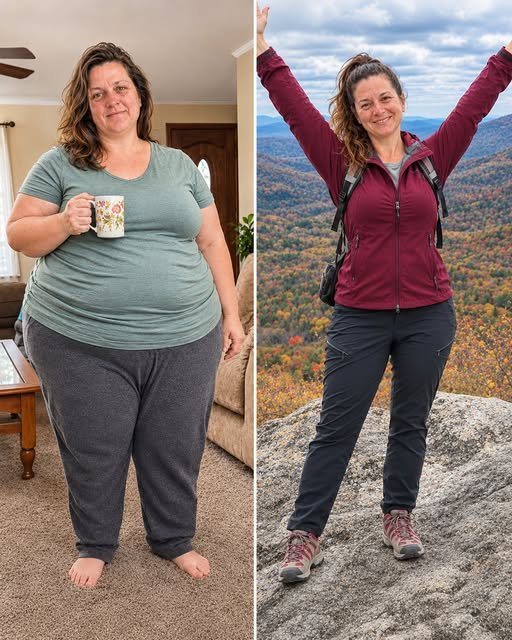
Part 1: Four Figures Beneath a Yellow Sun
For two years, I believed every difficult step was taking me closer to the son I had lost. I changed how I ate, learned to walk without punishing myself, and trained for the mountain he had drawn a hundred times. Only at the summit did I discover that the son beside me had been carrying something far heavier than either backpack.
“Mom, before we take the picture, there’s something you need to read.”
Jacob stood a few feet from the summit marker, holding a folded piece of notebook paper. We had spent nearly six hours climbing, and I was still trying to steady my breathing. I had imagined crying up there. I had imagined saying Oliver’s name into the wind.
I had not imagined the fear on his twin brother’s face.
“Oliver wrote it,” Jacob said. “Before he died.”
My hand tightened around the waterproof pouch containing Oliver’s sketchbook.
“You’ve had it all this time?”
He nodded.
Four years. My surviving son had carried something from his brother for four years, and I had never known.
“There’s something about Dad,” he whispered.
Until that moment, I thought I understood the worst thing that had happened to our family.
Four years earlier, our boys had been twelve, identical until they opened their mouths. Jacob considered every answer. Oliver usually began talking before he knew where the sentence would end.
Oliver drew mountains on spelling worksheets and grocery lists. Jacob calculated how much food a camping trip required. Between them, they could turn an ordinary Saturday into an expedition that involved three sandwiches each and a compass neither actually needed.
Their father, Daniel, liked the practical parts of those outings: checking tires, loading the cooler, choosing the route. I liked the hour when everyone finally stopped moving and we could sit together somewhere without a television.
Oliver’s favorite mountain was in Virginia’s Blue Ridge. He had found a photograph of its rocky summit in a hiking guide and copied it until he knew the outline by heart.
In one drawing, he put four tiny figures beneath a large yellow sun.
“That’s us,” he told me. “You can tell because Dad’s holding all the snacks.”
Daniel promised we would attempt the trail that summer, after building up to it on easier hikes. Oliver taped a calendar beside his bed.
He never reached the first day of summer vacation.
That morning, I found him sitting on the edge of his bed, pale and unusually quiet. He said he felt sick. When he stood, he caught the doorframe.
I thought, for a few confused seconds, that he had caught a virus.
Then he collapsed in the hallway.
Daniel called emergency services while I followed the dispatcher’s instructions. Jacob stood behind his father in his pajamas. I remember wanting someone to take him out of the hallway, and also being unable to spare a single word.
Oliver briefly opened his eyes.
“Mom?”
“I’m here, sweetheart.”
Those were the last words we exchanged.
His heart stopped during the ambulance journey. At the hospital, people worked to bring him back, then someone led us into a small room where a doctor sat down before speaking.
The investigation confirmed sudden cardiac death, but the examinations did not establish a definitive underlying cause. The specialists explained that some dangerous heart conditions leave little obvious evidence afterward. Their uncertainty was honest, and unbearable.
Because Oliver and Jacob were identical twins, Jacob underwent a pediatric cardiac evaluation. There were appointments, an electrocardiogram, an ultrasound of his heart, and further testing the specialist recommended. Nothing then showed a definite problem, but follow-up remained important.
I kept those appointments with the fierce attention I could no longer give anything else.
I did not know that Jacob had questions he was afraid to ask at them.
Daniel became quiet in a different way. He spent evenings in the garage, sorting drawers that did not need sorting. Whenever I mentioned the morning Oliver died, he said we were hurting ourselves by going over it.
I believed he was trying to survive.
Five months after the funeral, he told me he was moving into an apartment across town.
“I can’t breathe in this house,” he said.
I looked toward the stairs, where Jacob was supposed to be doing homework.
“Neither can he.”
Daniel promised he would remain a father. At first, he came every weekend. Then work interfered. Then he canceled because he was tired. Our separation became a divorce the following year, with an agreed parenting schedule he followed inconsistently.
I could handle utility bills and school forms because they had boxes to fill. Dinner was harder. Oliver’s chair was still there.
Food became something I used to get through the evenings. Sometimes I ate standing at the counter because sitting down made the empty places impossible to ignore. I had struggled with my weight before; grief made caring for myself feel irrelevant.
By the time the boys would have turned fourteen, I weighed about 330 pounds. My knees hurt. I avoided invitations, and I stopped appearing in photographs.
Jacob learned to say he had already eaten.
I accepted that answer too easily.
One Saturday, he asked me to help find a school permission slip. While he searched his backpack, I lifted a stack of notebooks from his desk and uncovered Oliver’s sketchbook.
I recognized the pine trees drawn across its cover.
“I can put it away,” Jacob said quickly.
“No. Please don’t.”
We sat on his bedroom floor and turned the pages together. There were tents, badly proportioned squirrels, and a drawing of Daniel dropping a frying pan.
Then came the mountain.
Four little people stood beneath that enormous sun. Below them, in Oliver’s crooked printing, were the words: One day, all of us.
I traced the edge of the page without touching the drawing.
“I want to go,” I said.
Jacob looked at me carefully.
“To the mountain?”
I nodded.
He did not glance at my body or tell me it was impossible. He studied the drawing again, then closed the sketchbook gently.
“Then we should find out what it takes.”
For the first time in two years, we had made a plan that reached beyond the following day. I did not yet understand why, after agreeing, Jacob went upstairs and locked his bedroom door.
Part 2: What We Carried Uphill
The next morning, I walked to the end of our street and back.
It was less than half a mile. My knees ached, and I returned angry with myself for finding something so ordinary difficult.
Jacob was on the porch, putting on his shoes.
“You went without me?”
“I didn’t get far.”
He looked down the street.
“You got home. That seems useful.”
I laughed before I could stop myself. He smiled, surprised, as though he had found something we both thought was lost.
I made an appointment with my doctor. I told her about the mountain, but also about the eating, the sleeplessness, and the way entire weekends could disappear without my opening the curtains.
She did not give me a deadline or a number I had to reach to deserve the trip.
Instead, we discussed my health, knee pain, nutrition, and depression. She referred me to a registered dietitian and a counselor who worked with grief. We built a plan I could sustain rather than another punishment I would eventually abandon.
Progress was inconveniently ordinary.
I planned meals. I learned which foods kept me satisfied. I walked short distances, rested when necessary, and did strengthening exercises beside the couch.
Some weeks my weight changed. Some weeks it did not. My doctor kept asking about stamina, sleep, and pain, which helped me remember that the scale was not the only evidence of a life changing.
Jacob joined some walks, but my counselor gently challenged how much of my recovery I had placed in his hands.
“He can enjoy walking with you,” she said. “He cannot be responsible for keeping you well.”
That evening, when he said he could skip a friend’s birthday to accompany me, I told him no.
“I have a walking route and a charged phone. You have a party.”
He hesitated long enough to tell me the distinction mattered.
I began eating dinner at the table again. Sometimes we talked. Sometimes we watched a ridiculous quiz show afterward. I asked about his friends without turning every answer into a lesson about appreciating life.
Oliver remained part of our home, but gradually he was no longer the only person we were allowed to miss or discuss.
Jacob still went quiet whenever a conversation approached the morning his brother died.
Once, after a cardiology follow-up, he asked whether a person could seem fine and still have something seriously wrong.
I told him what the doctor had told us: some conditions could be difficult to identify, and that was why follow-up and reporting symptoms mattered.
“Is there something you’ve been feeling?” I asked.
He shook his head.
“Just wondering.”
I reminded him that he could speak privately with his doctor, too. He nodded, looking out the car window.
I thought I had answered the question he was asking.
Over two years, I lost 160 pounds, going from approximately 330 to 170. It happened through sustained changes and medical support, not because grief finally made me disciplined enough.
There were setbacks. A knee flare meant several weeks of shorter walks and physical therapy. Around the anniversary of Oliver’s death, I missed counseling twice before calling to admit that I was avoiding it.
This time, I returned.
Jacob and I progressed from neighborhood loops to local trails. Eventually, we completed longer practice hikes carrying the water and layers we would need on the mountain.
On the first outing where I felt truly strong, I reached an overlook ahead of him and turned around, grinning.
He took a photograph before I could object.
“You don’t have to post that,” I said.
“I wasn’t planning to. I wanted one of you happy.”
I stopped reaching for his phone.
By sixteen, Jacob had grown taller than me. He still had Oliver’s eyes, but the older he became, the more clearly I could see that he was becoming someone his brother would never have been.
He liked repairing bicycles. He disliked camping in the rain. He had a dry sense of humor that appeared when I least expected it.
I tried to notice those things aloud.
We planned the mountain trip for a mild autumn weekend, allowing a full day for the hike and choosing a nearby place to stay. Our route was roughly nine miles round trip with a substantial climb. We had practiced on comparable terrain.
We checked forecasts and trail information, packed headlamps and extra food, and left our route with my sister, Anne. We agreed on a turnaround time.
“Even if we’re close,” I told Jacob.
He studied me.
“Even then?”
“The mountain doesn’t get a vote about whether we come home safely.”
The evening before we left, I saw him slip a small envelope into the inner pocket of his backpack.
“Emergency map?” I asked.
His hand remained on the zipper.
“Something like that.”
We started soon after sunrise. I carried Oliver’s sketchbook in a waterproof pouch. Jacob carried a small camera and kept checking whether I wanted him ahead or behind me.
“Wherever you’d rather walk,” I said.
For the first hour, we talked about school. On the steeper stretches, conversation gave way to breathing and the scrape of boots.
We stopped for food before either of us felt depleted. At one difficult section, I sat on a rock and checked the time.
“Still within our plan,” Jacob said.
“I know. I’m deciding whether my legs agree.”
“We can turn around.”
There was no disappointment in his voice. That made it easier to stand and choose another stretch.
Near the top, the trees thinned. The ridges opened around us, blue behind blue, farther than I could make sense of.
We reached the summit with ample daylight left for the descent.
For a moment, I could only stand there.
Then I opened Oliver’s sketchbook.
“We made it, Ollie.”
Beside me, Jacob unzipped his backpack.
Now, holding his brother’s folded note, he looked younger than sixteen.
“Dad knew Oliver was getting dizzy,” he said. “Before that morning. He knew about his heart racing, too.”
The pages of the sketchbook fluttered against my wrist.
“What are you saying?”
Jacob held out the paper.
“I’m saying he knew. And afterward, he made me promise you never would.”
Part 3: The Weight of a Promise
I sat on a broad rock away from the edge before I unfolded the note. Jacob remained standing until I touched the space beside me.
Oliver had written in pencil, pressing hard enough to leave grooves in the paper.
“Jake,
“It happened again after the walk. My heart went really fast even when we stopped, and I got dizzy. I told Dad like you said. He thinks I’m tired, but he said he’ll call the doctor if it happens again.
“Please don’t tell Mom yet. She’ll cancel the mountain. I’ll tell her if it gets worse. Promise.
“Ollie.”
I read it once, then again more slowly.
There was no date.
“When?” I asked.
“A few days before he died. He gave it to me before school because Dad was downstairs.”
Jacob rubbed his palms against his trousers.
“He’d told me about feeling dizzy once before. I said he needed to tell an adult. He said he would, and then he gave me that.”
“And you believed Dad was handling it.”
He nodded.
“I put it in my school notebook. After the funeral, I found it again. I took it to Dad because I thought the doctors should have it.”
My mouth went dry.
“What did he say?”
“He cried. He said he should have made an appointment. Then he said you could hardly get out of bed, and if you thought he’d missed something, it would finish you.”
Jacob stared at his hands.
“He said we couldn’t bring Oliver back. We could only lose you, too.”
For several seconds, I could hear people talking somewhere farther along the summit, ordinary voices in a world that had not changed for them.
Daniel had taken his own fear and handed it to a twelve-year-old.
“Did he ever tell you to show a doctor?”
Jacob shook his head.
“He said they already knew everything important. Later, when he moved out, he said telling you would make you hate him. I didn’t know what to do.”
I wanted to ask a dozen questions. I wanted to call Daniel immediately. More than either, I wanted Jacob to stop watching my face as if my next breath depended on him.
I put the note inside the sketchbook and closed it.
“You did not cause Oliver’s death.”
His face tightened.
“But if I’d told you—”
“You told him to speak to an adult. He told you he had. You were twelve, Jacob.”
He pressed the heels of his hands against his eyes.
“I knew something.”
“You knew your brother had felt unwell and your father knew about it. You did not know what it meant. It was not your job to work that out.”
He bent forward, and I put an arm around him.
For four years, I had wondered why he rarely argued, why he checked whether I had eaten, why he hovered when I climbed stairs. I had called him thoughtful without asking what his thoughtfulness was costing him.
“I’m sorry I made it hard to tell me things,” I said.
“You didn’t make me promise.”
“No. But you should have had more help than you got.”
He cried quietly against my jacket. I held him without asking him to stop.
When he could speak again, he told me he had nearly confessed several times. Each time I began doing better, he feared the truth would undo it.
“And then we had the mountain,” he said. “I kept thinking I’d tell you when we got here. Like once we’d done this, maybe you’d be strong enough.”
“You don’t have to find the right place to give me difficult news.”
He looked toward the ridges.
“I know that now.”
We ate something before descending. I checked our water, our time, and the route, grateful for practical things that still had clear answers.
Jacob asked whether I wanted to call Daniel.
“Not from here. We’re getting down safely first.”
He watched me put the phone away.
On the descent, I stumbled once on loose stones. Jacob reached for my elbow, and I thanked him, then steadied myself with my poles.
We could help each other without making either of us responsible for everything.
Back at our lodging, I asked whether he wanted the note returned.
“Could you keep it?”
“Of course.”
He slept in the next morning. I called Anne from the parking lot and told her enough that she understood why I needed her to listen without making excuses for Daniel.
When we returned home, I contacted Jacob’s cardiology team and explained the newly disclosed symptoms. They arranged a review and asked me to send a copy of the note.
The cardiologist was careful: the information mattered, but it could not establish a retrospective diagnosis or prove whether an earlier appointment would have changed the outcome. Jacob’s own follow-up would be reviewed with the fuller history.
I also asked my counselor for referrals for Jacob. I offered him choices and said he would not have to tell me everything he discussed.
“Even about you?” he asked.
“Especially if it’s something you need help saying about me.”
Two days after we came home, I called Daniel.
“I’ve read Oliver’s note.”
He was silent so long that I checked the screen.
Then he said Jacob’s name with a tired, accusing breath.
“Don’t,” I said. “Do not make this about him telling me.”
Daniel began to cry.
I listened, but I did not rescue him from the silence.
Finally, he said he would answer my questions. There were things, he admitted, he had never told the doctors either.
I took a pen from the kitchen drawer.
“Then this time,” I said, “you’re going to tell the whole truth.”
Part 4: The Son Who Was Beside Me
Daniel told me Oliver had mentioned dizziness twice over roughly two weeks. The second time, he had described a racing heartbeat after exertion.
“I thought he was overdoing it,” Daniel said. “He always wanted to keep going.”
“He was twelve. You were the adult.”
“I know.”
He had promised to call the pediatrician if it happened again. He had not made an appointment before Oliver died several days later.
Afterward, he convinced himself that because the initial investigation had not found a clear cause, those earlier episodes might not have mattered. But when Jacob brought him the note, he understood that he should have disclosed them.
“I was afraid they’d say I could have stopped it.”
I wrote that sentence down because I did not trust myself to remember his exact words.
“So you let me sit through those appointments without the full history. And you let Jacob believe telling the truth could kill his mother.”
“I didn’t say it like that.”
“He was twelve, Daniel. Tell me how he was supposed to hear it.”
For once, he did not answer with an explanation.
I asked him to provide his account to Jacob’s cardiology team and to ask how the information could be added to Oliver’s records. He agreed to contact the appropriate offices and authorize the necessary communication.
I did not ask him to confess to causing a death neither of us could medically explain.
I asked him to take responsibility for what we did know: he had dismissed symptoms without seeking advice, withheld that history afterward, and pressured a grieving child to keep silent.
“I’ve punished myself every day,” he said.
“That hasn’t helped Jacob.”
The line was quiet.
“What can I do?”
“Stop asking him to make you feel better. If he agrees to speak with you, apologize without explaining why he should understand.”
I ended the call without forgiving him.
For years, I had thought forgiveness was another task grief would eventually require. That afternoon, it was enough to tell the truth and make dinner.
Jacob stood in the kitchen doorway while I chopped carrots.
“Was he angry?”
“He was upset. I told him that wasn’t yours to manage.”
“Are you angry?”
I set down the knife.
“Yes. Not with you.”
He nodded, then took two plates from the cupboard.
The following weeks did not turn us into a healed family. I slept badly. Jacob had days when he regretted telling me, followed by days when he said he could finally concentrate in class.
We kept our appointments.
His specialist reviewed the new history and explained the next steps in his follow-up. No one promised that a normal test meant he could ignore future symptoms. Jacob was given clear guidance about when to report concerns and when to seek urgent help.
He asked his own questions this time. I waited until he looked at me before adding mine.
Daniel sent a written apology. Jacob left it unopened on the hall table for three days.
“You don’t have to read it today,” I told him.
On the fourth evening, he took it upstairs.
Eventually, he agreed to meet Daniel with a family counselor present. I drove him and waited outside the office rather than asking to attend a conversation he wanted to have for himself.
Afterward, he climbed into the car and fastened his seat belt.
“He said he thought he was protecting you.”
I kept my hands still on the steering wheel.
“What did you say?”
“That he was protecting himself, too.”
I looked at him.
“He said I was right.”
It was not a repaired relationship. It was one conversation in which Daniel had listened without asking his son to comfort him.
Jacob chose occasional, planned contact after that. Some meetings went better than others. When he declined one, I told Daniel the decision was Jacob’s, not an invitation to argue through me.
Daniel began attending counseling himself. I hoped it would help him become more honest. I did not make that hope a condition of our peace.
One evening, Jacob found me going through Oliver’s sketchbook at the dining table. For a second, his shoulders rose in the old, guarded way.
Then he sat down.
“Do you remember the marshmallows?”
I turned to the drawing of our tent beside a lake.
“The ones your brother dropped?”
“He said dirt was basically seasoning.”
“Your father nearly believed him.”
Jacob laughed, and I did too. We stayed there for an hour, remembering Oliver’s terrible card tricks, his drawings, and how he packed enough snacks for expeditions three times longer than ours.
When Jacob grew quiet, I did not rush to fill the space.
“I miss him,” he said.
“So do I.”
We could say it without either of us having to disappear.
I framed the mountain drawing and hung it beside our summit photograph. In one, four small figures stood beneath a yellow sun. In the other, Jacob and I leaned against each other, tired and windblown.
I kept Oliver’s note in a separate protective sleeve. It mattered, but I did not want his last worried words to become the only thing we remembered about him.
Several months later, I asked Jacob whether he wanted to choose another hike.
“For Oliver?” he asked.
I looked at the guidebook between us.
“Oliver can come in the stories. But I thought you might like to pick somewhere you want to see.”
He turned several pages, then pointed to a trail beside a lake.
“No summit?” I asked.
“There’s a place to swim.”
“That sounds like an excellent reason.”
He marked the page and began telling me what we would need.
I had climbed a mountain hoping to keep a promise to the son I lost. Now, across the table, the son who was still here was planning an ordinary Saturday.
I pulled my chair closer and listened.