
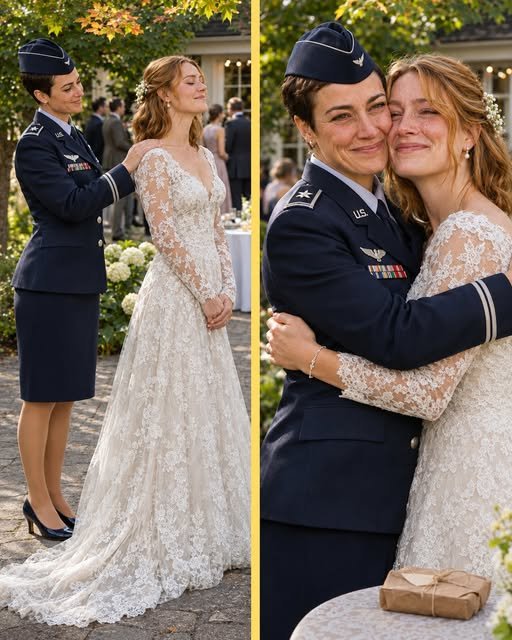
Part 1: The Hand On My Shoulder
On my wedding morning, I put my sister’s place card beside an empty chair because I couldn’t bring myself to remove it. Brooke had called from overseas three days earlier and told me not to plan around her getting home.
“I’m trying,” she had said. “But trying isn’t a boarding pass.”
I told her I understood, then cried in the laundry room where Colin wouldn’t see me. It wasn’t that I doubted she wanted to be there; it was that she had been there for almost everything else.
She signed my permission slips after our father died. She taught me to drive, argued with my guidance counselor, and sat through the school production in which I played a tree with one spoken line.
I was twenty-eight now, and Brooke was thirty-nine. Eleven years separated us, but for fifteen of those years she had stood in the space other people called a parent.
Our father had died in Afghanistan when I was thirteen. Brooke was twenty-four, already in the Army, and suddenly responsible for a teenager who kept insisting she didn’t need anyone.
That Saturday, twenty minutes before the ceremony, the photographer asked me to stand beneath the maple tree behind the reception hall. She said she wanted a picture of me before anyone else saw the dress.
I faced the garden with my hands clasped so tightly that my engagement ring pressed into my finger. Behind me, a door closed.
Then someone touched my shoulder.
“You didn’t really think I’d let you do this without checking his paperwork, did you?”
I knew the voice before I turned.
Brooke stood there in her service uniform, her travel bag still hanging from one hand. She looked tired enough to sleep standing up and pleased enough with herself to be unbearable.
I made a sound I still refuse to call a scream and threw both arms around her.
“You said you couldn’t come.”
“I said not to plan around it.” She hugged me harder. “There’s a difference. A very legally significant difference.”
Later, I learned that her leave had finally been approved, that a delayed connection had nearly stranded her, and that Colin had spent the morning quietly coordinating with her from his phone. At that moment, all I understood was that my sister smelled like airport coffee and familiar soap.
I held on until she said, “Emma, I’m delighted, but I do require oxygen.”
When I stepped back, she looked at my dress and pressed her lips together.
“Don’t,” I said, already crying.
“I haven’t said anything.”
“Your face is saying things.”
She laughed, then looked toward the building as if checking something. For a moment, her expression changed.
“After the ceremony,” she said, “I need a little time with you. Just us.”
“Is something wrong?”
“Not an emergency.” She tightened her grip on the bag. “Something Dad left.”
Before I could ask another question, the coordinator came outside and announced that everyone was ready. Brooke set down her bag, offered me her arm, and waited while I caught my breath.
We had discussed my walking alone when we thought she couldn’t come. I had insisted I was fine with it.
Standing beside her, I realized how much effort I had spent being fine.
“Ready?” she asked.
I tucked my arm through hers. “Now I am.”
* * *
An hour later, after I had married Colin and smiled through more photographs than seemed legally necessary, Brooke led me into a small office beside the reception hall. She put her bag on a chair and took out a brown-paper package.
The corners had softened with age. Clear packing tape crossed the wrapping, and beneath it, in our father’s square handwriting, were both our names.
For a moment, I could hear him telling us to stop leaving cereal bowls in the sink.
“Where did you get that?” I asked.
“He gave it to me before his last deployment.”
I looked from the package to her face. “You’ve had something from Dad for fifteen years?”
Brooke nodded.
Music drifted through the wall. Someone outside laughed, and the ordinary sound made the room feel strangely unreal.
“He told me we were supposed to open it together on your wedding day,” she said. “If you never married, I was supposed to decide when you were ready.”
“And you never thought I was?”
“That’s not what I said.”
“It sounds close.”
She didn’t defend herself. She pulled out the chair opposite mine and sat with the package between us.
I had seen Brooke face angry officers, insurance representatives, and the principal who suggested that my falling grades meant I lacked motivation. I had almost never seen her look afraid of me.
“I haven’t opened it,” she said. “Whatever’s in here, I don’t know.”
“Why give you something that important and make you wait?”
“I’ve asked him that a few thousand times.”
She tried to smile. It failed.
I reached for the tape, then stopped. Part of me wanted to call Colin in, not because I needed permission but because I suddenly wanted another person to witness whatever happened next.
Instead, I sent him a message.
Emma: Brooke has something Dad left us. We need a little time. I’m safe. I’ll explain when I can.
Colin: Take your time. I’ll handle the room. Do you want me nearby?
Emma: Yes. But not in here yet.
Colin: Right outside when you need me.
Brooke watched me set down the phone.
“He’s good,” she said.
“Yes, he is.”
She passed me a letter opener from the desk. I slid it under the old tape while she held the paper steady.
Inside was a small tin, the kind Dad used for spare buttons and coins from places he had been stationed. A piece of tissue paper slipped from the top when Brooke lifted the lid.
A woman’s gold ring rolled across the desk.
I caught it before it reached the edge. There was a tiny diamond set into the band, almost worn smooth around its setting.
“That isn’t Grandma’s,” I said.
Brooke shook her head.
Beneath the tissue lay a photograph. Dad stood outside a house I didn’t recognize, holding a baby wrapped in yellow; beside him, a brown-haired woman rested one hand on the shoulder of a girl of about eleven.
The girl was Brooke. The baby had to be me.
The woman was our mother.
I had seen only two photographs of Anna before that afternoon, both cropped so closely that there was no world around her. In this one, there were grocery bags on the steps and a tricycle tipped over in the grass.
We had once been a family with errands.
Brooke picked up the picture, and her fingers tightened around its edges.
“I remember that house,” she said.
On the back, Dad had written a single sentence.
Our last photograph with all four of us together.
There were envelopes underneath, some addressed to our father, some to Brooke, some to me. One bundle was held together with a faded blue ribbon.
The top envelope was in handwriting neither of us recognized.
For my girls, if they ever want to know me.
I looked at my sister.
“You said you didn’t know.”
“I didn’t.”
“Brooke—”
“Emma, I swear to you.”
Her voice shook, and that frightened me more than anything in the box. Brooke was the person who could tell me the worst thing imaginable and still remember where we had parked.
She found another envelope beneath the bundle. This one bore our father’s handwriting and a date nine days before he left for the last time.
She unfolded the paper.
Brooke, if you’re reading this, I didn’t get home to explain things myself. I’m sorry for leaving you another responsibility when I should have been taking responsibilities off your shoulders.
Brooke stopped and pressed a finger against the page.
“I can read,” I said.
“No. Let me try.”
She took a breath and continued.
You know the story I told you about your mother. She left. That was true. What I did not tell you was how long she had been trying to come back.
Part 2: The Years Between Letters
I waited for Brooke to tell me we had misunderstood. Instead, she lowered the page until it rested flat against the desk.
Our mother had been the unanswered question in our house for as long as I could remember. We knew her name was Anna, that she had left when I was little, and that Dad didn’t want to discuss it.
He never called her cruel or selfish. When I asked why she didn’t want us, he always corrected the question.
“She loved you,” he would say. “She couldn’t take care of you then.”
That answer had comforted me when I was small. By twelve, it felt like a locked door.
“Is she alive?” I had asked once.
“Last I heard.”
“Then why can’t I talk to her?”
Dad had rubbed both hands over his face. “Some answers need to wait until you’re older.”
Then he died, and I stopped getting older in any way that might earn me an answer.
Brooke picked up the letter again.
Anna developed a dependence on prescription pain medication after surgery following Emma’s birth. By the time I understood what was happening, she was hiding how much she took. There were missing bills, unexplained absences, promises she meant when she made them and couldn’t keep.
I looked at the photograph. The woman beside Dad seemed so ordinary.
When Emma was nearly one, Anna drove with both of you after taking medication that made driving unsafe. Nobody was injured. That does not make it a small thing. After that, I stopped leaving you alone in her care.
Brooke’s face had gone still.
“Do you remember?” I asked.
“Pieces. An argument. Dad picking us up somewhere.” She swallowed. “I thought it was about the car breaking down.”
The letter described two attempts at treatment, both ending early, followed by a separation and divorce. Dad obtained custody, and for almost four years, contact was sporadic.
Then Anna wrote to him.
By then, I was five and Brooke was sixteen. Anna said she was in recovery, working regularly, and hoping eventually to rebuild a relationship with us.
I did not agree to a visit. I needed more than a promise. Your lives had become predictable again, and I was frightened of what another disappearance would do.
“That part I understand,” Brooke said.
So did I. Understanding it didn’t make the rest easier to hear.
Anna and Dad began exchanging letters. She sent updates, asked questions about school, and enclosed letters he could give us if and when he believed it was appropriate.
He sent photographs. She sent birthday cards that never reached our hands.
“He let me think she forgot,” I said.
Brooke closed her eyes.
It was the first thing I had said that sounded like an accusation against him. I hated that he wasn’t there to answer it, and hated, briefly, that being dead protected him from having to.
After about two years in recovery, Anna relapsed. Dad wrote that she entered treatment again voluntarily, but the setback confirmed his worst fears.
He and Anna agreed not to attempt a reunion then. He intended to revisit the question as we got older.
“I was eighteen,” Brooke said.
Her voice was quiet, but she pushed her chair back hard enough that its legs scraped the floor.
“At that point, I was eighteen. He didn’t need to decide what I could know.”
She stood and walked to the window. Outside, guests were carrying drinks into the garden.
“Keep going,” I said, though I wasn’t certain I wanted her to.
She returned to the desk without sitting down.
Brooke, you were old enough to hear some of this. I know that. I told myself I was protecting Emma and that the two of you should learn together. Eventually that became an excuse for not admitting how much I had withheld.
A tear fell onto the page. Brooke dabbed it with the edge of her sleeve, then looked annoyed with herself for doing it.
By the time you read this, I hope I will have made things right. As I write, Anna has been continuously sober for six years. I have had reason to believe she is working hard and living steadily. I have also kept finding reasons to wait.
Six years.
When Dad died, I had been thirteen. The last version of my mother that I had carried into adolescence was already six years out of date.
I pictured him at the kitchen table, writing this after we had gone to bed. I wanted to sit down opposite him and ask why a sheet of paper had been allowed to do a conversation’s work.
Fear can look a lot like certainty when you’re a parent. I was afraid, so I convinced myself I was sure.
Brooke read that sentence twice.
Dad explained that the package contained Anna’s letters, her most recent contact details, the photograph, and the wedding ring she had asked him to keep for us. There was also a separate letter for my wedding day.
He did not know whether he would die. He was making arrangements because deployments made him think about all the things he had postponed.
Then came the instructions that had governed fifteen years of my sister’s life.
If I don’t come home, do not put all of this on Emma while she is grieving. Let her have some ground under her feet first. Open it together on her wedding day, if she marries. If she doesn’t, choose a time when she is grown and able to decide for herself.
“Why my wedding?” I asked.
Brooke read the next paragraph.
Perhaps that is sentimental. Weddings make people think about the family they came from and the one they intend to build. I want her to have the truth before she spends the rest of her life thinking our silences were all there was.
I stared at the paper.
“Before,” I said. “He says before. We’re sitting here after.”
“I know.”
“And if I had married at forty?”
“I know.”
“You could have told me at twenty-one. Or twenty-five. You could have told me there was a package and let me decide.”
Brooke sat down.
There was no military explanation that could make that choice simple. No rule she could point to, no officer who had ordered her to keep it in a drawer.
“I thought about it when you graduated,” she said. “I took it out of the lockbox. I even put it in my car.”
I remembered that day. She had driven six hours, watched me cross the stage, and taken me to dinner because I didn’t want a party.
“What happened?”
“You were happy.”
“That isn’t an answer.”
“No,” she said. “It’s the excuse I used.”
For years, I had defended every difficult decision Brooke made because I knew what taking me in had cost her. She had applied for reassignment, used leave she couldn’t spare, and arranged the family care plan that made continuing her career possible.
Dad’s closest friend, Ray, and his wife, Denise, became the approved caregivers when duty took Brooke away. I stayed with them during training and deployments, but Brooke remained the person answering school calls, paying bills, and checking my homework across time zones.
Once, at sixteen, I shouted that she wasn’t my mother because she wouldn’t let me go to a party.
She went silent, left the room, then returned ten minutes later.
“No,” she said. “I’m not. But I’m responsible for you, and you’re still grounded.”
I had spent years feeling guilty about that sentence. Sitting across from her now, I realized gratitude could make its own kind of silence.
“You’re allowed to be angry with me,” Brooke said, as if she had followed the thought.
“I don’t know how to do that without sounding ungrateful.”
“You don’t owe me agreement because I raised you.”
“Then tell me the truth. Not what Dad wanted. Not what you thought was best.”
She looked down at our hands on the desk, close but not touching.
“I was scared.”
“Of what was in it?”
“Yes. And of what would happen after.”
“What did you think would happen?”
Her face crumpled in a way I hadn’t seen since the soldiers came to our door fifteen years earlier.
“I thought you might find her,” she said, “and realize you didn’t need me anymore.”
Part 3: The Dance We Owed
For a moment, I couldn’t answer her. Brooke had been the fixed point in my life for so long that I had never considered how much effort it took her to stand still.
“You thought a woman I barely remembered could replace you?” I asked.
“When you say it like that, it sounds ridiculous.”
“It sounds lonely.”
She wiped her cheeks with both hands.
“You were thirteen when he died. You needed lunch money and new shoes and someone who knew when the nightmares were getting bad. There was always something practical I could do.”
She glanced at the package.
“This wasn’t practical. I couldn’t fix whatever was inside. I could only give it to you and hope you still looked at me the same way.”
I thought about the calls I had ended because I was busy, never wondering whether she sat for a moment afterward with her phone still in her hand. That thought hurt, but it did not erase what she had kept from me.
“I love you,” I said. “I’m also angry.”
Brooke nodded. “Both are fair.”
“And I don’t want you deciding which truths I can handle anymore.”
“I won’t.”
I reached across the table. She took my hand, and neither of us pretended that settled everything.
There was one paragraph left in Dad’s letter.
Brooke, do not make Anna pay forever for who she was at twenty-eight. And do not make Emma forgive her just because she changed. Those are two different things.
I read that part myself.
Dad had put us in a terrible position, but at least somewhere in those pages he had understood that information and forgiveness were not the same gift. Neither required us to promise a reunion.
“I want to read hers,” I said.
Brooke untied the ribbon.
The letter on top had been written when I was six, seven years before Dad died. Anna had been about a year into her first sustained period of recovery; later letters, Brooke discovered, accounted for the relapse and the years that followed.
The oldest page began without any attempt to soften what came next.
Dear Brooke and Emma, I left you. There are explanations for how I became someone who could do that, but none of them change what you lived through.
I leaned closer while Brooke read.
I was ill, and I made choices that put you at risk. Both things are true. Your father was right to protect you when I could not be trusted to protect you myself.
Anna wrote about treatment, about learning to get through an ordinary Tuesday without using medication that had once organized her entire life. She described washing dishes in a restaurant kitchen and being proud of making every shift for a month.
She did not ask us to be proud of her.
There was a paragraph about a photograph Dad had sent: Brooke wearing his old flight jacket, me grinning with two missing front teeth. I remembered that picture because Brooke had spent ten minutes trying to get me to stop sticking my tongue through the gap.
I looked at your faces and realized you were becoming people I did not know. Brooke, I don’t know what music you like. Emma, I don’t know what makes you laugh. Missing those things is a consequence I have to live with. It is not something you should have to comfort me about.
Brooke stopped reading and handed me the page.
I could feel how carefully Anna had written it, how often the pen had paused. I couldn’t tell whether that made me trust her or simply made me want to.
A later letter, written after she returned to treatment, contained the passage that kept us silent longest.
At first, I told myself I stayed away because your father wouldn’t allow contact. He did set limits, and I gave him reasons. But there were also chances to ask harder questions, to seek advice, to write more honestly. Sometimes I hid behind his caution because I was frightened you would reject me.
I put the page down.
“They were both scared,” I said.
“And we got the silence,” Brooke said.
Inside the most recent envelope was an address in Oregon and a phone number. Anna had written that we owed her neither a reply nor a particular name.
You do not have to call me Mom. If you want answers, I will answer as honestly as I can. If you want no contact, I will respect that. I am sorry that those choices are arriving with so much hurt attached to them.
The ring had its own small note.
This was my wedding ring. I stopped wearing it after the divorce, but I could not throw it away. Keep it if it means something to either of you. If it doesn’t, sell it and buy something useful. Your father would probably prefer that to a drawer full of guilt.
A laugh escaped me before I could stop it.
“He would,” Brooke said.
Dad had once tried to repair a toaster three times because he considered replacing it a personal defeat. Sentimentality disguised as thrift had been practically his religion.
I wrapped the ring in tissue again.
“I’m not ready to call her.”
“Then we don’t call.”
“You can, if you want.”
Brooke looked surprised.
“We’re allowed to want different things,” I said.
She nodded slowly. “I’ll try to remember that.”
There was still the envelope addressed only to me. Dad had written my name, then added two words underneath.
Wedding day.
I opened it carefully enough that Brooke smiled through her tears. Dad would have torn straight across the top.
Kiddo, if you are wearing a wedding dress while reading this, I owe you an apology for not being there to complain about the cost.
I laughed, then covered my mouth.
I wish I could meet the person you chose. I wish I could walk beside you and tell an embarrassing story at exactly the wrong moment. Since I can’t, let Brooke stand where I would have stood, if that is what you both want.
Brooke shook her head as though she could disagree with him from a distance of fifteen years.
She has been looking out for you since you were small enough to carry. Do not let her tell you she only did what she had to do. She chose you every day.
I passed the letter to her because I couldn’t see clearly enough to continue.
“Read the rest,” I said.
Her voice broke on the first word, but she did.
Your mother may still be out there. Find her if you want to. Don’t if you don’t. Do not make that decision for me. I have made enough decisions for both of you already.
At the bottom, beneath his signature, was one final line.
Save me a dance.
We were still holding the letter when Colin knocked.
“Would either of you like water?” he asked through the door. “Or an extraction from seventy people asking whether the photographer kidnapped you?”
I opened it.
His smile faded when he saw our faces, but he didn’t crowd the doorway. He simply held out two glasses.
“Dad left letters,” I said. “There’s a lot we didn’t know.”
“Do you want me to stay?”
I nodded and leaned against him while Brooke gathered the papers.
He didn’t pick up a letter or glance into the box. When I offered him Dad’s wedding note, he asked whether I wanted him to read it now.
“Later,” I said.
“Then later.”
I had married a man who understood that being included did not mean being entitled to everything immediately. That afternoon, it felt like the safest thing in the world.
* * *
Half an hour later, Brooke stood at the reception with a microphone she clearly wished belonged to someone else.
She began by explaining that I once backed Dad’s car into our mailbox and attempted to blame the mailbox’s location. Then she told Colin that marriage to me would require patience, spare phone chargers, and an acceptance that arriving early meant arriving exactly on time.
Everyone laughed. I watched her hands stop shaking around the microphone.
“I didn’t prepare a speech,” she said. “Until yesterday, I wasn’t certain I’d be here.”
She looked directly at me.
“I used to worry that I hadn’t done enough. There were school things I missed, birthdays over video calls, dinners Denise cooked because I was somewhere else.”
Across the room, Denise shook her head, already crying.
“But Emma, I need you to know something. Being your sister was never duty.”
Brooke raised her glass, and I couldn’t speak when everyone turned toward me.
Later, the DJ played one of Dad’s favorite songs. Brooke came to my table and held out her hand.
“Did you save him one?”
I nodded.
We danced badly because neither of us could stop laughing and crying long enough to follow the rhythm. I rested my forehead against her shoulder.
“You’re getting makeup on my uniform,” she said.
“Dad would tell you to stop complaining.”
“Dad would send you the cleaning bill.”
For those few minutes, there was nothing to decide.
* * *
Six months after the wedding, Brooke and I finally exhausted the contact details in the box. The number was disconnected, the address belonged to someone else, and the letters sent with a return address had come back unopened.
We had not rushed. We had read the remaining letters, argued twice, apologized properly, and agreed that neither of us would contact Anna on the other’s behalf.
A search of public records and social media eventually led me to a woman in Washington State with Anna’s full name. Her profile mentioned a library, a husband, and a garden that apparently defeated her every spring.
I stared at her photograph for two days.
Then I sent a message.
Emma: My name is Emma. My father was David. I think you may be my mother.
Eighteen minutes later, a reply appeared.
Anna: I am.
Before I could decide whether to breathe or cry, another message arrived.
Anna: Is Brooke okay?
Part 4: A Place At The Table
I called Brooke before I answered. She picked up on the fourth ring and said my name in the careful voice she used when she already knew something important had happened.
“I found her.”
There was a long silence.
“Are you all right?” she asked.
“I don’t know yet.”
“Okay.”
I read the messages aloud. When I reached the question about her, Brooke let out a breath so uneven that I sat down on the kitchen floor.
“What do I tell her?” I asked.
“The truth.”
“Which part?”
Brooke thought about it.
“That I’m here. And I’m not ready to talk yet.”
So that was what I wrote.
Anna answered that she understood. She did not send Brooke a separate request, ask for her number, or tell me to persuade her.
It was a small thing. It was also the first boundary we gave her, and she kept it.
Over the next several weeks, we exchanged short messages. I asked about dates, places, and events from Dad’s letters before I asked anything that felt like a daughter’s question.
Anna answered plainly, sometimes asking for a day before responding because she wanted to check an old document rather than trust her memory. Where she remembered something differently from Dad, she said so without insisting he had lied.
Some answers made me furious.
I learned that there had been a year when she lived less than two hours from us. I learned she once bought train tickets she never used because Dad had not agreed to a visit and she was afraid of causing a confrontation.
I asked whether she had sought legal advice about contact.
She said she had spoken to someone once, then failed to follow through.
Anna: I was ashamed of what I would have to explain. That is not a good reason. It is the reason.
I left that message unanswered for three days.
When I finally replied, I told her that explanations beginning with shame were becoming difficult to hear.
Anna: I understand. You don’t have to make my reasons feel better than they are.
She did not threaten to disappear because I was angry. She also didn’t send repeated apologies until I felt obliged to soothe her.
Gradually, that steadiness mattered.
By the time I found her, she had been continuously sober for about twenty-one years. She had remarried, had no other children, and worked at a public library.
Her husband knew about us. She had told him years earlier that she had two daughters who might never want contact.
I asked why she had not found us after Dad died.
That answer took the longest.
She had learned of his death months afterward through a mutual acquaintance. She wrote to his last address and received the letter back; later, an online search showed Brooke in uniform and me in a school photograph from an awards ceremony.
She told herself we were safe. Then she told herself arriving uninvited would damage the family Brooke had managed to hold together.
“Did you ever think we deserved to make that decision?” I asked during our first telephone conversation.
“Not enough,” she said.
I had expected an argument. The absence of one did not make me less angry, but it let me ask the next question.
Some nights, after we talked, I felt as though someone had rearranged the rooms of my childhood. Dad was still loving, funny, and dependable; he was also a man who had withheld something important long after immediate danger had passed.
Anna was neither the indifferent stranger I had imagined nor a blameless mother waiting outside a locked door. Brooke had protected me, loved me, and made a choice that hurt me.
There was no version in which everyone became simple.
Colin listened without trying to assign a villain. Once, when I apologized for bringing so much old family trouble into our first year of marriage, he looked genuinely puzzled.
“You didn’t pick it up at the airport,” he said. “It was already part of your life.”
I laughed, then cried, then asked whether we could order dinner because I had burned ours while reading a message.
We ordered dinner.
* * *
Three months after my first exchange with Anna, Brooke joined a group conversation. Her first message was not a greeting.
Brooke: I remember waiting on the front steps. I need to know whether you remember that too.
Anna did.
Brooke later told me that the answer mattered more than any apology. For years, she had wondered whether that memory belonged to her or to some story she had assembled from photographs.
They began writing without including me in every exchange. At first, I found that unexpectedly frightening.
Then I recognized the feeling for what it was: the fear of being left outside a relationship that mattered.
I called Brooke and told her.
“I’m not asking you to stop,” I said. “I just don’t want to turn it into something ugly because I’m embarrassed to admit it.”
She was quiet for a moment.
“Thank you,” she said. “I wish I’d done that fifteen years ago.”
It was not forgiveness arriving in one grand moment. It was us practicing the conversation we should have been allowed to have.
When we attempted a video call with Anna, all three of us spent the first minute asking whether the others could hear.
Then the picture steadied.
Anna sat at a kitchen table with both hands wrapped around a mug. She looked older than the woman in the photograph, of course, but the resemblance was there in the way her mouth tightened when she was trying not to cry.
“Hello,” she said.
“Hi,” I said.
Brooke lifted one hand.
Nobody knew what to do next.
Finally, Anna looked at my sister.
“You look so much like your father.”
Brooke turned her face away. I saw her jaw working before she looked back.
“I know,” she said.
Then Anna looked at me, and I knew what she was going to say before she said it.
“And you look like me.”
For most of my life, my face had belonged only to me. Suddenly it was evidence of a connection I had not decided how to feel about.
“I can see it,” I said at last.
That was all I could offer that day. Anna accepted it without asking for more.
* * *
The following Christmas, a little over a year after my wedding, we met in person at a restaurant in Washington State. Not her home, not mine, and not a holiday gathering full of people who might expect an embrace.
We agreed on two hours. Colin traveled with me but stayed at a nearby café, available if I wanted him.
Brooke arrived first and chose a table near the door.
“Escape route?” I asked.
“Good lighting,” she said.
“Liar.”
“Yes.”
Anna arrived five minutes early. She stopped a few feet from the table, holding her coat over one arm.
“Is a hug all right?” she asked.
I stood and hugged her briefly. Brooke stayed seated and offered her hand.
Anna shook it.
That single moment told me more about the afternoon than any promise could have. She did not look wounded, reach again, or ask Brooke to explain.
We ordered food. Anna asked before showing us photographs, and Brooke asked questions that made her set down her fork.
There were silences long enough that the server stopped approaching our table unless one of us caught her eye. There was also a story about Dad attempting to repair a washing machine that made all three of us laugh at once.
For a second, I could see how easily someone might mistake that laughter for everything being healed.
It wasn’t. It was just laughter, and it mattered anyway.
At the two-hour mark, Anna glanced at the clock.
“We said two hours,” she said. “I don’t want you to feel you have to stay.”
Brooke looked at me.
I looked at the dessert menu.
“I’d like coffee,” I said.
We stayed almost four hours.
Before we left, Anna offered me a small envelope. My shoulders tightened before I could help it.
“It’s only copies of photographs,” she said. “You can look later. Or not.”
I took it.
Outside the restaurant, we did not arrange a family vacation or promise to make up for lost time. We agreed that she could call the following week.
I didn’t call her Mom.
Sometimes, even now, I don’t. Her name is Anna in my phone, and she has never asked me to change it.
* * *
In the months after that meeting, I stopped treating forgiveness as a finish line I was failing to reach. There were smaller decisions instead: answering a message, asking a question, telling Anna when a conversation had become too much.
There were decisions with Brooke too.
Once, she started to say she hadn’t told me something because she didn’t want to worry me. She stopped halfway through the sentence, closed her eyes, and began again.
“I have news,” she said. “I’m worried about it. You get to decide how you feel.”
I trusted that correction more than I would have trusted a promise that she would never make another mistake.
The ring stayed in its tissue paper for a long time. Eventually, Brooke and I put it in a small box with the photograph of all four of us.
We made copies of every letter. One set belongs to her, and one belongs to me.
Neither of us has to ask permission to open them.
When people hear about my wedding, they often ask whether I forgave our mother. Sometimes they ask whether I forgave Brooke.
I understand why. Those are easier questions than asking how you love people once you know both what they gave you and what they got wrong.
What I remember most clearly is still my sister’s hand on my shoulder beneath the maple tree. Before the package, before the answers, she had crossed an ocean because I wanted her there.
And later, when I told her I was angry, she stayed.
Last Sunday, Brooke came over for dinner. Colin was in the kitchen, and we were at the table arguing about whether Dad’s famous chili had actually been good or whether grief had improved the recipe.
My phone lit up between us.
Anna: I’ve been asked to speak at the library about rebuilding trust after recovery. I won’t discuss you without permission. Would either of you like to hear what I’ve written before I decide whether to do it?
I read the message twice, then slid the phone toward Brooke.
Here was another piece of our family story, arriving as a question instead of an instruction. We could say no, ask for time, or listen.
“What do you think?” I asked.
Brooke looked at me, then at the screen. Beside our father’s letters and all the years we could not recover, there was still something neither of us knew how to do yet.
She reached for the phone.
Can love and accountability coexist when the person who protected you also kept a truth you deserved to know?