
Part 1: The Dress on the Floor
The first thing my daughter asked me to put away was not her crutches or the hospital paperwork. It was the blue dress hanging on her closet door.
“I don’t want to look at it, Mom.” Emily sat against her pillows with her left leg elevated, watching me as if moving that dress might finally make me understand. “And please stop telling me I can still go.”
Until the previous afternoon, prom had occupied nearly every spare conversation in our house. My eighteen-year-old daughter had paid for her dress with money from Saturday shifts at a bakery, and she had spent three evenings helping her friends decide which photographs they wanted before dinner.
Now the dress lay across the chair where I had placed it, its satin skirt slipping toward the floor. One matching shoe stood underneath it; the other was still wrapped in tissue.
“I’m not saying you have to go,” I said. “I’m saying you don’t have to decide while you’re hurting.”
“Everyone will be dancing while I’m trying to figure out where to put my leg. Someone will keep asking whether I’m okay, and I’ll have to keep being grateful.” She looked away. “I don’t want my whole night to be about this.”
I had no reassuring answer that did not sound suspiciously like an instruction to cheer up. So I pulled the blanket clear of her toes and sat beside her.
* * *
The previous afternoon, Emily had stayed after school to help finish the prom decorations. Harris, the custodian, was carrying a carton of paper stars down the short staircase beside the auditorium when the bottom flap gave way.
He shifted his grip as decorations scattered. His heel slipped off a step, and he reached for the railing without finding it.
Emily was standing on the landing below him. She caught his forearm and steadied him long enough for him to grab the rail, but her own foot slid from the edge of the step.
She fell only a few steps. It was enough.
Harris called the school nurse and stayed beside her until I arrived. When I reached the hallway, he was crouched near the bottom stair, holding Emily’s backpack and looking more frightened than she did.
“Don’t try to get up again,” he told her. Then he looked at me. “She stopped me from falling. I couldn’t catch her.”
“You weren’t supposed to catch me,” Emily said. “You were supposed to hold the railing.”
Even then, she was trying to relieve his guilt. I recognized the effort because she had been making the same small joke whenever the nurse asked about her pain.
At the hospital, an X-ray showed a lower-leg fracture. The orthopedic team stabilized it in a padded splint, gave us careful instructions, and told Emily to keep all weight off that leg until her follow-up appointment.
I asked about prom because she would not. The clinician said a short visit could be reasonable if her pain stayed controlled, she used the wheelchair we arranged, and she kept her leg supported.
“No standing for photographs,” the clinician added. “No testing it because you feel better for a minute.”
Emily nodded with the solemn patience she used when she wanted an adult to finish talking. Only after we were alone did her face change.
“Prom is tomorrow, Mom.”
I took her hand. There were problems I could solve with a phone call, a credit card, or a rearranged workday, and I hated how badly I wanted this to be one of them.
* * *
That evening, Harris called our house. Emily asked me to put him on speaker because she was tired of holding the phone.
“I keep thinking about what could have happened,” he said. “I’m so sorry you got hurt.”
“I’m glad you’re okay,” she told him. “Really.”
“Your mother says you’re going back to the specialist on Monday. Will you let me know what they say?”
“I will. But you have to promise not to carry boxes you can’t see over anymore.”
“That seems like a fair arrangement.”
After the call, she handed me the phone and turned toward the wall. I stayed until her breathing settled, then picked up the blue dress before its hem could reach the floor.
* * *
By late Saturday afternoon, I had stopped suggesting hairstyles and started asking practical questions. Did she want dinner upstairs, and should I tell the other parents not to expect us?
“Tell them I’m sorry,” she said.
“You haven’t done anything wrong.”
“I know. Just… tell them.”
Downstairs, my phone kept lighting up with messages from Noah, one of her closest friends. He had already checked whether the front path had steps and whether our downstairs bathroom door was wide enough for her chair.
Noah: Please don’t cancel anything yet. We’re coming at 5:30 p.m. Emily gets the final say. We just want to ask her ourselves.
I stood in the kitchen reading that last sentence. It was the first plan anyone had offered that did not sound as though Emily’s disappointment was an obstacle to be pushed aside.
At 5:28 p.m., a car door closed outside. Then another did, followed by a burst of laughter and someone saying, “You’re blocking the path, Jack.”
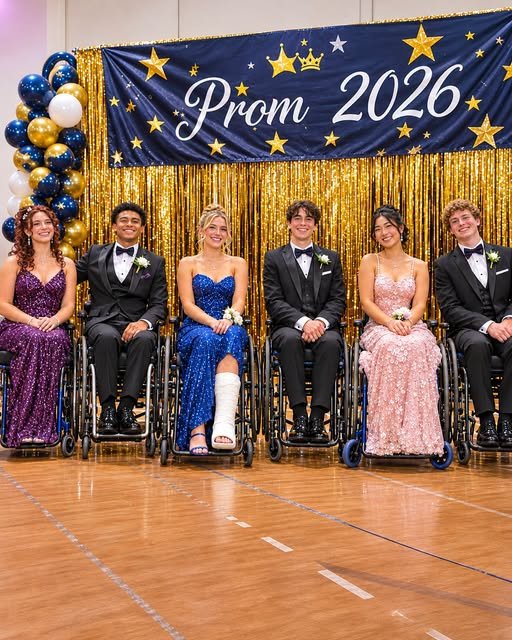
When the bell rang, I opened the door expecting corsages, perhaps a pizza, and seven teenagers trying to pretend they were not worried. Instead, seven classmates looked up at me from seven wheelchairs.
Ben was nearest the path in the fitted chair he used every day. Beside him sat Noah, wearing his dinner jacket and the expression of someone who had rehearsed a speech and forgotten every word.
Behind them were Maya, Chloe, Ava, Luis, and Jack, dressed for prom and arranged carefully enough to leave the doorway clear. A parent waited near the driveway beside a van.
“We’re here to pick up your daughter,” Noah said.
I pressed my hand against my mouth. “What on earth have you done?”
“A lot of phone calls,” Ben said. “And one extremely boring conversation about wheel locks.”
Noah’s smile softened. “Will you ask Emily to come down? She doesn’t have to go anywhere she doesn’t want to.”
I glanced at the seven of them, then at the folded garment bag resting on Maya’s lap. For the first time all day, I thought Emily might change her mind.
Then Noah lowered his voice. “And if she says yes, there’s something else waiting at school—but she can’t know about that yet.”
Part 2: Room for Everyone
Getting Emily downstairs took patience, a handrail, and my determined refusal to hurry her. She used her crutches exactly as the hospital physical therapist had shown her, stopping on the landing to rest.
“If this is a surprise hair appointment,” she said, “I’m going back upstairs.”
“It isn’t.”
“You answered that too quickly.”
Then she reached the front doorway and saw them. Her crutches went still beneath her arms.
For several seconds, nobody spoke. Maya lifted one hand in a small wave, and Emily began laughing and crying so suddenly that I moved closer in case she lost her balance.
“You guys are crazy.”
“That’s what we’ve been telling you for four years,” Noah said.
Ben nodded toward the empty wheelchair I had brought from the living room. “Sit down before the emotional reunion becomes another orthopedic appointment.”
Emily settled carefully, and I raised the leg support. Only then did she look from one friend to the next.
“But why are all of you in wheelchairs?”
Noah started to answer, then glanced at Ben. Ben shrugged as if to say that explaining a questionable idea remained the responsibility of the person who had proposed it.
“You said you didn’t want to be parked beside the dance floor while we disappeared,” Noah said. “So we thought we could start the night together this way.”
“For the entrance and the first dance,” Maya added. “Not as some big performance. If you hate it, we leave the extra chairs here.”
Emily looked at Ben. “Are you okay with this?”
“I helped plan it,” he said. “Although I rejected the original idea of synchronized turns. None of them can steer.”
“I can steer,” Luis said.
Ben looked at the flowerpot beside Luis’s wheel. Luis backed away from it.
Emily laughed again, and something in her shoulders loosened. “Where did you even get them?”
Noah explained that their parents had rented six standard chairs from a medical equipment supplier with stock available. The supplier had adjusted them, explained the brakes and footrests, and made clear that nobody would be doing stunts.
“We didn’t borrow anybody’s personal chair,” he added. “And we’re not pretending we suddenly know what Ben deals with.”
“Good,” Emily said.
“Also,” Ben said, “you can still say no. We can eat the fancy dinner in your kitchen and criticize everybody’s prom pictures from here.”
She looked at the garment bag on Maya’s lap. “What’s that?”
“Emergency sewing kit, flat shoes, and the shawl you left at my house,” Maya said. “I’m prepared for either outcome.”
Emily rubbed at her cheek with the heel of her hand. “You didn’t have to do this.”
“We know,” Noah said. “We wanted to.”
She looked toward me, and I made myself wait. This had to be her choice, not the reward for everyone else’s effort.
“Could we leave early if I need to?” she asked.
“Immediately,” I said. “No explanations required.”
Emily took a breath. “Then I need somebody to rescue my dress.”
* * *
Twenty minutes later, Maya and I helped arrange the blue skirt so it could not catch beneath a wheel. Emily rejected my first attempt at a hairstyle, accepted Maya’s second, and insisted on putting on her own lipstick.
At the mirror, she studied the padded splint extending below the hem. “Do I look okay?”
“You look beautiful, sweetheart.”
Maya leaned into the reflection. “You also look like you’re about to tell me I’ve used too much hairspray.”
“You have.”
It was such an ordinary exchange that I had to turn away for a moment. Downstairs, the boys were arguing about whose jacket had been folded beneath a cushion, and for the first time since the accident, our house sounded like prom night.
Before we left, Ben checked the leg support with Emily’s permission. Noah asked before touching her chair, and she told him she preferred to propel herself on level ground.
“Good,” he said. “Because my first attempt at the driveway was not impressive.”
Transportation had taken more work than the surprise itself. Emily rode in my car with her leg supported as the hospital had advised, while the rented chairs traveled folded in two parents’ vehicles.
Ben used his family’s accessible van. We agreed to meet at the school’s level entrance rather than scatter across the parking lot and try to find one another.
* * *
At school, Principal Carter met us beside the gym doors. She showed Emily the accessible restroom, a quiet place to rest, and the clear route to the dance floor.
“Your mother can stay nearby,” she said. “Or far enough away that you can plausibly deny knowing her.”
“Nearby is fine,” Emily said, surprising me.
Inside the gym, gold stars hung over the dance floor. The photographer had moved the portrait setup off its low riser so nobody needed to climb a step.
Emily noticed. So did Ben.
“I asked yesterday,” he told her. “They should have thought of it earlier, but at least they moved it.”
The eight friends entered together. A few students cheered when they recognized Emily, but within minutes the greetings became the usual compliments, jokes, and complaints about the music.
For the first slow song, they formed a loose circle away from the crowded center. Some held hands; others moved gently to the rhythm, laughing whenever Noah fell half a beat behind.
Afterward, several friends stood and returned their rented chairs to the designated space by the wall. Nobody disappeared on Emily, and nobody acted as if sitting beside her required a medal.
When she needed a break, Ava brought water and asked about the bakery’s newest manager. When she wanted to return to the music, Jack asked which route gave her the most space.
Then Emily spotted Harris near the refreshments. He wore a dark suit, and he was turning a paper cup between both hands.
“Harris! What are you doing here?”
“I was invited,” he said. “Apparently I’m not allowed to spend every school dance collecting empty cups.”
She studied him. “You’re really okay?”
“Really. How are you?”
“Better than yesterday.”
He smiled, but his eyes moved briefly toward the stage. Across the gym, Noah was speaking with Principal Carter and holding a small blue book.
Emily followed his glance. “What are you three planning?”
“Prom stuff,” Noah said when she caught up with him.
“That is not an answer.”
He hesitated. “Remember that activity last fall? The one they put upstairs?”
She frowned. “What about it?”
Before he answered, the music faded. The screen behind the stage lit up, and Ben’s face appeared in a recorded video.
Onscreen, he looked directly into the camera. “Emily, you probably forgot what you said outside that classroom. I didn’t.”
Part 3: What They Remembered
Emily turned toward Ben, who sat beside her looking unusually interested in the edge of his cuff. “You knew about this?”
“I would hope so,” he said. “That’s a fairly convincing video of me.”
A few people nearby laughed, and the tension left her face. Noah stood at the microphone while the recorded Ben began explaining what had happened the previous fall.
The senior class had planned a weekend project to assemble welcome kits for incoming students. Someone had reserved an upstairs room in the old arts annex without checking whether everyone could reach it.
That wing had no elevator. Ben had been told that a teacher could bring supplies downstairs so he could help separately.
“Everyone kept calling it a solution,” he said in the video. “But the point was doing something together, not sitting by myself beside a box of markers.”
Emily looked down at her hands. I remembered her coming home irritated that afternoon, but she had told me only that the school needed to organize things better.
Onscreen, Ben continued. “I said I’d skip it. Emily asked why I was the one who had to leave when I wasn’t the one who picked the room.”
A photograph appeared of students working around long tables in the cafeteria. Emily stood in the background holding a roll of tape between her teeth.
“She didn’t just complain,” Ben said. “She checked whether the cafeteria was available, found a teacher who could supervise there, and helped move the supplies.”
He paused before his next sentence. “Then she asked me whether that plan actually worked for me.”
Beside my daughter, the real Ben lifted his eyes from his cuff. Emily reached across the gap between their chairs and squeezed his hand.
Noah stepped closer to the microphone. “You told us nobody should have to miss out just because changing the plans was inconvenient. Yesterday, we decided it was our turn to remember.”
Emily pressed her fingers beneath her eyes. I reached into my purse for tissues and discovered I had already used the small packet I always carried.
The video moved on to a girl who had transferred to the school during junior year. She described spending her first lunch period pretending to read messages because she did not know where to sit.
“Emily asked whether the seat beside me was taken,” the girl said. “Then she stayed, even though her friends were across the room.”
Another student recalled stumbling over a presentation while classmates whispered. Emily had asked him a thoughtful question afterward and waited while he answered, giving him a chance to finish without being rushed.
These were not stories about someone endlessly cheerful or impossibly generous. Chloe admitted that Emily could become exasperated when people refused to make decisions, and Jack recalled a bitter argument about a group project.
“She made me redo my part,” he said in the recording. “She also stayed after school to help me understand it. Both things were probably necessary.”
The gym laughed. Emily shook her head at him, smiling through tears.
I watched the screen and wondered how many evenings I had asked, “How was school?” and accepted “Fine” without realizing how much life that little word concealed.
Then Principal Carter joined Noah onstage. “There’s someone else who asked to speak,” she said.
Harris approached the microphone with a folded sheet of paper. He opened it, looked at the first line, and folded it again.
“I practiced this in my kitchen,” he said. “The refrigerator was an excellent audience.”
That earned him enough laughter to begin. He explained the accident without exaggerating it, saying that Emily had steadied him when he lost his footing and had been hurt in the fall that followed.
“I’m grateful she was there,” he said. “But I don’t want anyone thinking you need to get hurt to prove you care about somebody.”
Emily nodded immediately. Harris noticed and gave her a small, answering smile.
“And yesterday isn’t the only reason I wanted to say something.” He rested one hand against the microphone stand. “I’ve worked here for almost thirty years. I know how busy these halls get.”
He described students rushing to practice, teachers carrying work home, and the ordinary speed of a school day. He did not accuse anyone of overlooking him; he simply explained how much a familiar greeting could mean.
“Emily always stopped,” he said. “Sometimes just long enough to ask about my garden. Sometimes long enough to help stack chairs after everyone else had gone.”
I remembered collecting her late after a concert and feeling irritated because she had not been waiting outside. She had come out carrying her shoes and said she had needed five more minutes.
“Last year, she remembered my birthday,” Harris continued. “She brought a cupcake and informed me that lunch breaks were not optional.”
I had helped bake those cupcakes. I had assumed they were all for her friends.
He looked directly at Emily. “Yesterday, you caught my arm when I lost my balance. But you’ve made me feel like I mattered for years.”
She covered her mouth. Behind her, Maya was crying without making any attempt to hide it.
“You do matter,” Emily said.
Harris heard her, although the microphone did not catch it. “I know,” he said. “You’ve been very persistent.”
He stepped away to warm applause, and Noah returned with the blue book I had seen earlier. He held it up so Emily could recognize the photographs tucked behind its cover.
“This was supposed to be a graduation present,” he said. “We’ve been collecting pictures and messages for weeks. We moved the surprise forward because apparently waiting until June was a terrible plan.”
That explained the speed of it. They had not assembled an entire tribute overnight; they had already been paying attention long before any of us imagined she would need to see the evidence.
Maya took the microphone from Noah. “Most of us weren’t friends when high school started,” she said. “Emily kept inviting people until saying no became more work than showing up.”
She smiled at Emily, then swallowed. “Sophomore year, I seriously considered transferring. I felt out of place, and I wasn’t especially nice when anyone tried to help.”
Emily shook her head as if she wanted to protect Maya from having to explain. Maya continued anyway.
“You didn’t fix everything. You just kept checking in, and you listened when I finally answered honestly. That helped me stay.”
Noah accepted the microphone again. “You don’t always have to be the person helping everyone else,” he told Emily. “Sometimes, you can let us help you.”
“Thank you,” she said, barely above a whisper.
For a moment, I thought that was the end. The screen faded to a photograph of all eight friends crammed around a picnic table, and people began applauding.
Then Principal Carter returned carrying two sealed envelopes. Noah looked surprised enough that I knew this part had not belonged to his plan.
“Before we resume the music, we have tonight’s election results,” she said. “Voting closed on Thursday, before Emily’s accident on Friday. The student council adviser has kept the results sealed since then.”
Emily glanced at me. Weeks earlier, she had mentioned being nominated for prom queen with the embarrassed air of someone reporting a clerical error.
Principal Carter opened the first envelope and announced Daniel as prom king. He came forward grinning while his friends made enough noise for an entire football team.
Then she picked up the second envelope. Beside me, Emily stopped turning the tissue in her hands.
The principal unfolded the card, looked out across the room, and smiled.
Part 4: The Picture She Chose
“And this year’s prom queen is Emily.”
My daughter stared at the stage as if there must be another Emily waiting behind her. Then Maya grabbed her hand, and the room erupted.
“No,” she said, laughing in disbelief. “You’re kidding.”
“You’re our prom queen,” Noah said.
She looked toward Principal Carter. “But the voting—”
“Finished before your injury,” the principal said gently. “Your classmates made this choice earlier in the week.”
I saw why she repeated it. Emily needed to know that nobody had quietly rearranged an election to compensate for a broken leg, and Principal Carter gave her that certainty without turning it into an awkward explanation.
Daniel came down from the stage with his crown in one hand. He asked Emily whether she wanted the formal photograph now or later, as naturally as if they were deciding which table to visit.
“Later,” she said. “I’m trying to figure out how to react like a normal person.”
“Let me know when you figure it out.” He put on his crown backward, noticed everyone laughing, and corrected it.
Harris approached carrying hers on a small velvet cushion. He stopped beside her chair rather than asking anyone to move her toward the stage.
“May I?” he asked.
Emily nodded, crying too hard to answer. He set the crown carefully over her chestnut curls, then adjusted it when one side caught in her hair.
“You helped me stay on my feet yesterday,” he told her quietly. “I’m glad I get to be here for you tonight.”
She reached up, and he bent to hug her. Around them, friends applauded while a teacher near the refreshments dabbed at her eyes with a paper napkin.
I had imagined this moment differently when she first mentioned the nomination. In that imaginary version, she stood beneath the lights in matching shoes while I took an unobstructed photograph.
The real moment was less orderly. Noah stepped into my frame, someone’s elbow hid half the crown, and Emily’s tissue was crumpled in her fist.
I took the photograph anyway. Later, it would be one of my favorites.
When the applause settled, Principal Carter asked whether the king and queen were ready for their dance. Daniel turned to Emily first.
“We can make it a group song,” he said. “Whatever you want.”
Emily looked across the small circle around her. Then her gaze settled on Harris.
“Would you dance with me?”
He blinked. “Me?”
“Yes, you.”
He gave a startled laugh. “Emily, I haven’t danced in years.”
“That’s okay. I can’t exactly dance the usual way either.”
Harris glanced toward the open floor, considering it seriously rather than brushing her invitation aside. “I can manage sitting and keeping time badly.”
“Perfect. That’s also Noah’s specialty.”
Someone brought a sturdy chair, and Harris sat beside her. The music began softly while Emily took his hand and moved her shoulders to the rhythm, her injured leg still safely supported.
For a few measures, the room gave them space. Then Emily beckoned to her friends.
Ben joined first, followed by Noah and Maya, and soon Daniel was dancing with Ava nearby. Other couples drifted back onto the floor until the special moment became part of an ordinary, happy prom again.
That mattered to Emily more than any speech. She was not an exhibit at the center of the room; she was a girl enjoying a song with people she loved.
I watched her laugh when Harris deliberately missed the beat. Her crown tilted, and she left it that way.
When the song ended, she asked Noah for the microphone. He brought it over and checked that it was switched on before handing it to her.
“I don’t really know what to say,” she began.
“That’s new,” Jack called, earning an elbow from Chloe.
Emily smiled. “Yesterday, I thought my prom was ruined. When these people showed up at my house, I thought they’d completely lost their minds.”
She waited through the laughter, then looked toward the seven friends clustered nearby. “But I also thought they were giving up their own night because of me. I didn’t want to be the reason anyone missed out.”
Noah shook his head. “You weren’t.”
“I know that now.” She looked down briefly, gathering herself. “I was trying to be a good friend. I didn’t realize how many good friends I had.”
She turned toward Harris. “And I’m really glad you’re okay.”
“Likewise,” he said.
She handed back the microphone before anyone could ask her for more. Ben leaned over and said something that made her laugh again, and the music resumed.
* * *
An hour later, Emily admitted that she was tired. There was no dramatic collapse and no disappointed argument about leaving; she simply looked for me and said she had reached her limit.
Her friends helped gather her things while I brought the car around. The rented chairs were folded for their parents to return, and Noah reminded Jack to check beneath the table for his phone.
Before we left, Maya placed the blue scrapbook in Emily’s lap. Its pages bulged with photographs, ticket stubs, handwritten notes, and pieces of school life I had never known they were saving.
There was a picture from freshman orientation, taken before all eight knew one another. Another showed Emily and Ben arguing cheerfully over a poster while Luis stood behind them holding the wrong end of a banner.
Near the back was a photograph of Harris beside Emily after a school cleanup. Both held brooms, and Emily was wearing the sweatshirt I had thought she had lost.
Beneath it, Harris had written a message in careful handwriting.
Thank you for always remembering that I’m part of this school too.
Emily read it twice. Then she closed the book and held it against her dress.
In the car, she set her crown beside the scrapbook. Outside, her friends waved while Noah and Ben debated whether the group photograph required a second attempt at graduation.
“Mom?” she said once we were on our way home.
“Yes, sweetheart?”
“I’m sorry I was so difficult yesterday.”
“You were disappointed. You were allowed to be.”
She traced the corner of the scrapbook with one finger. “I hated thinking everyone would have to change their plans because of me.”
“And now?”
She watched the passing streetlights for a moment. “Now I think that’s what friends do sometimes.”
* * *
At home that night, we took the stairs slowly. Emily was exhausted enough to accept my help without apologizing for it, which felt like its own small change.
In her bedroom, she placed the crown on her dresser and propped the scrapbook beside it. I reached for the comfortable clothes I had laid out earlier, but she stopped me.
“One more picture first.”
I lifted my phone. “Do you want me to frame it above your leg?”
“No. Especially get the leg.”
She arranged the blue skirt herself, leaving the bulky splint visible. The same dress she had asked me to hide that morning now spread across her lap while she smiled into the camera.
I understood then what I would remember about her prom. Not the crown or even the applause, but the moment she stopped treating the help offered to her as something she needed to repay before she could enjoy it.
I held up the phone, ready to capture that smile. Before I could press the button, she glanced at the scrapbook and lifted one finger.
“Wait, Mom. Ben and I started talking about next year’s welcome night. There are a few things the school still needs to change.”
She looked back at me, tired, happy, and already making room for someone she had not met. “Will you help us figure out where to start?”
When someone who always helps others finally needs support, how can we make accepting it feel like belonging rather than becoming a burden?