
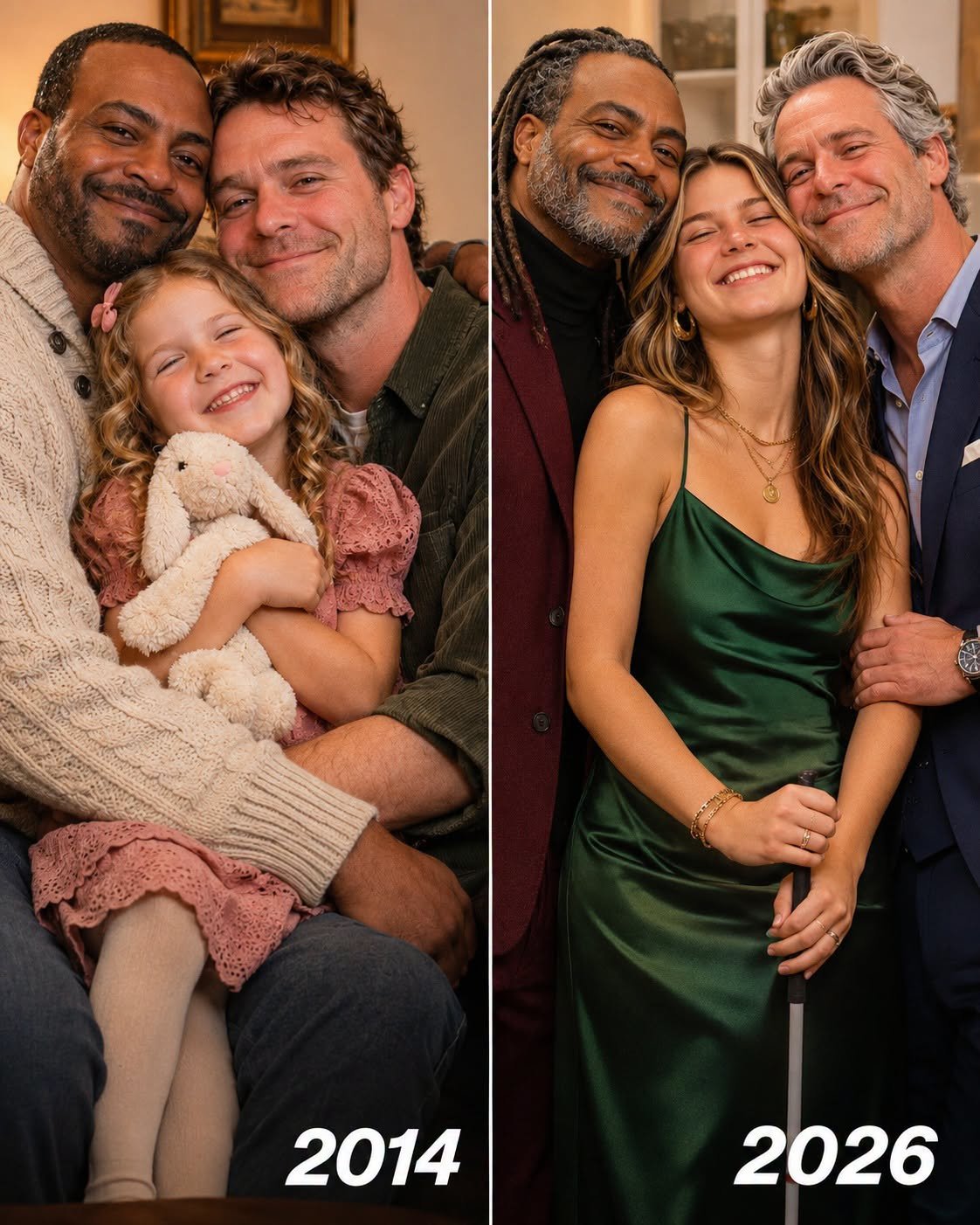
Part 1: The Cup on the Counter
“Dad, can I put this here?”
Willa was four years old, three weeks into her new life with us, and she was holding a yellow plastic cup of water with both hands as if it might shatter. She stood motionless in the middle of our kitchen, waiting for permission to set it down on a counter that belonged to her as much as it belonged to anyone.
Reid looked at me from across the room. Neither of us trusted our voices.
“Anywhere you want, sweetheart,” I finally managed. “It’s your counter.”
She lowered the cup so gently it made no sound at all. Then she smiled, small and uncertain, like someone testing thin ice.
Twelve years later, a stranger would stand in that same kitchen and try to put a price on her. But I’m getting ahead of myself.
By the time Reid and I started the adoption paperwork, we had already lost people for the crime of loving each other. My father stopped inviting me to Thanksgiving after our wedding. The first year, I told myself he just needed time. By the third, I had stopped checking my phone on the fourth Thursday of November.
Reid’s mother was gentler about it, which somehow made it worse. She introduced me to her church friends as his “roommate,” and then as his “good friend Nathan,” while our wedding rings sat right there in the light. When Reid finally corrected her, she patted his arm. “You know what I mean, honey. Let’s not make a scene.”
As if saying the word husband was louder than the silence around it.
But we wanted a family, and we had a house in Dayton, Ohio, with a spare room painted the soft green of new leaves. We also had Harlow Street Bakery, the little corner shop we had built from one rented oven and a lot of stubbornness. We were tired of loving a future that had no one in it.
Then we met Willa.
She was four, blind since birth, and she had already lived in four foster homes. Her caseworker, a tired and kind woman named Ms. Delgado, warned us before the first visit. “She’s quiet,” she said. “She doesn’t ask for things.”
At the visit, Willa sat beside me on a worn couch, rubbing the ear of a stuffed rabbit until the fabric had gone thin and gray. I stood up to get a glass of water. Her hand shot out and caught my sleeve with a grip that shocked me.
“Are you leaving?”
“Just going to the sink, sweetheart.”
She held on until I sat back down. Then she let go slowly, one finger at a time, as though she was checking whether I’d stay.
I looked over at Reid. He was already crying. We hadn’t said a word to each other, but we both knew. She was ours.
Not everyone saw it that way. My sister Colleen cornered me at a family barbecue and lowered her voice. “That child can’t see, Nathan. Now you want her explaining why she has two dads? Hasn’t she been through enough?”
One of Reid’s old college friends suggested, over beers, that we let Willa “have a normal family.” Ms. Delgado, more quietly, told us that ten other couples had read Willa’s file, reached the word blind, and stopped.
That night Reid sat at our kitchen table staring at the yellow cup we had bought for her. “Do they think we haven’t considered what she needs?”
“I don’t think they’ve considered Willa at all,” I said.
We finished the adoption in the spring. When she came home, she didn’t ask about toys or the green bedroom we had spent weeks painting. She asked where we slept. She asked whether she was allowed to wake us. She asked whether we’d be angry if she needed help.
“You can always wake us,” Reid told her.
She apologized anyway.
The first night, I woke to a thin, broken sound. The clock read 2:03. Reid was already out of bed, and we found Willa on her bedroom floor, patting the carpet with flat hands.
“I can’t find him,” she whispered. “Rabbit.”
Reid knelt and reached under the bed for the rabbit. Willa caught his wrist. “Am I in trouble?”
“No, sweetheart. You woke up your dads. That’s allowed.”
She thought about that for a very long time. Then she let him pass her the rabbit and tuck her back in.
It took months before she stopped apologizing. For spilling juice. For asking which drawer held her socks. For needing help. For taking up space. Slowly she learned that she didn’t owe anyone an apology for being our daughter.
Reid taught himself to braid her hair from video tutorials while Willa graded every attempt. “Two out of ten,” she’d announce. “My head has a handle.” I labeled the jars in our kitchen in Braille, flour and sugar and cocoa, and learned how hard it was to step back and let her find them herself.
By sixteen, she borrowed Reid’s hoodies without asking. She negotiated her curfew like a trial attorney. And she had banned me from her baking.
“Dad, I can measure flour without supervision.”
She said it like someone who knew exactly where she belonged.
The bakery, meanwhile, had grown into something people drove across town for. We were comfortable. We were also stuck. For five years we had tried to expand to a second location, and every investor loved our pastries and every investor had a reason to wait.
One man wanted us to drop our accessible baking classes because they “wouldn’t scale.” Reid slid our pitch right back into his briefcase. “Then it isn’t our bakery you’re investing in,” he told the man, and he never raised his voice. I loved him ridiculously that day.
The plans went into a folder labeled SOMEDAY. Willa called it our “expensive recipe for disappointment.” She wasn’t wrong.
On the evening of her sixteenth birthday, Reid and I were making her favorite dinner, lemon chicken and roasted potatoes. She had insisted on baking her own cake and had kicked us out while the frosting cooled. She was upstairs on the phone with her friend Maya, laughing at something.
Then someone knocked.
I wiped my hands on a dish towel and opened the door. The man on the porch looked painfully familiar. We had watched his latest movie that very weekend, and Reid had spent the second half criticizing the plot.
Then I noticed his eyes. His mouth. The shape of his jaw.
It was Willa’s face, almost photocopied, thirty years older.
“Nathan, right?” said Grant Hale, the actor, with a smile that didn’t reach anything. “I’m Willa’s biological father. May I come in?”
Part 2: The Folder With Her Name On It
I should have shut the door. I know that now.
But I had spent twelve years wondering, in the quiet hours, whether this man existed, and whether he would ever knock. So I stepped aside, and he walked into our kitchen like it was a room he’d been scouting for a movie.
Reid came in from the dining room and stopped cold. I watched him recognize the face a second after I had.
“Coffee,” Reid said, because Reid answers shock with hospitality. Grant took the mug and barely touched it.
“I know I’ve missed a great deal,” he began. “I’d like to make that right. College tuition. A bigger house. Whatever she needs.”
“Why now?” I asked.
He leaned forward, hands folded the way people do in interviews. “I want her to come and stay with me. Tell me what that would take. I’ll give anything.”
Reid set his mug down very carefully. “You mean you’d like us to ask whether she wants to meet you?”
Grant’s eyes drifted toward the staircase. “No. I need her to live with me. Starting next month.”
“She doesn’t even know you,” I said.
He opened his leather bag and withdrew a thick folder. “My team put together a proposal. Nothing happens without your cooperation, of course.”
Inside were dates for television interviews. Lists of questions. Answers were typed beneath Willa’s name, answers she had never given. In one of them, she described how her father had taught her to find her way around a kitchen.
I looked across the room at the Braille labels on our jars, at the little raised dots Reid and I had stuck on one by one over a single long weekend.
“She’s never met you,” I said.
“That’s exactly why we’d need time together first.”
Reid turned a page. The script said Reid and I were “family friends who occasionally helped out.” His jaw moved. “You told people you raised her?”
“I mentioned having a daughter in an interview. Things went further than I intended.”
“Then correct it.”
“People want to meet her, Reid.”
Upstairs, Willa burst into laughter at something Maya said. Grant looked up at the ceiling. Something crossed his face, but it was gone before I could name it.
“I can pay for her education,” he said, turning back. “Set her up for life. Surely there’s an arrangement that benefits everyone.”
Reid stood and pushed the folder back across the table. “Leave.”
But I had turned to the last page. One question had no scripted answer beneath it, just white space.
What would you say to people who believe your biological father abandoned you?
I read it twice. Then I closed the folder.
“An interview might be possible,” I said.
Reid stared at me like I had stepped off a cliff. “Nathan?”
“On one condition.” Grant was already reaching for his pen. “We get the full proposal, the producer’s contact information, and every claim you’ve made about Willa. Then she decides whether she wants anything to do with it.”
“Of course,” he said, too quickly.
“And you don’t contact her behind our backs.”
He nodded. Reid knew me well enough to stay quiet. Grant clearly didn’t.
“For context,” Grant said, and drew a second folder from the bag, “this is a major project.” His interview had gone viral, he explained. A production company was discussing a documentary about a famous actor raising a blind daughter while building his career. If it went forward, the deal could earn him millions.
Provided Willa took part. Provided there was footage of the two of them living together.
“You sold them a childhood you weren’t there for,” Reid said.
“It’s still in development. We can shape the story.”
“And why,” I asked, “would we help you do that?”
He slid one more document toward me. My stomach turned over before I even read the heading.
It was our bakery pitch. Not an approximation, not a summary. Our actual pitch, with the projected costs for two locations and our own handwriting in the margins.
“Where did you get this?”
“My adviser knows someone at the firm you approached. He obtained a copy.” Grant tapped the figures. “Three million dollars, from my own funds, the moment we have a signed agreement. Enough to open both locations and launch your accessible classes.”
He had studied our dream the way an actor studies a role. Our setbacks. Our numbers. Everything, I thought, except what kind of cake our daughter liked.
“And in exchange?” Reid asked.
“A temporary residence arrangement. Public cooperation. A consistent story. You’d be well compensated for your discretion.”
Reid didn’t even glance at the number. “No.”
Grant blinked. “You haven’t considered it.”
“I heard you.”
“This would change your business entirely.”
“She’s not inventory,” Reid said.
Grant turned to me. I pushed the second folder back across the table. “Neither of us is selling our daughter.”
“You’re being emotional.”
“Yes,” I said. “That tends to happen when a man offers to buy a child.”
He tried a few more angles. It was only for filming. We would still see her. She would have every advantage money could buy. I stood up.
“Whatever she decides about meeting you, she is not moving in as part of your deal.”
For the first time, Grant seemed to understand that we weren’t negotiating. He set his business card on the table and left without finishing his coffee.
I kept the interview folder. I did not keep the money proposal.
Later I would send a message to the investment firm asking how our private pitch had ended up on an actor’s table. But that night, standing in the sudden quiet, all I could think about was the creak of the floorboards upstairs.
Willa had stopped laughing. The phone call was over.
And somewhere above us, our daughter was walking toward the stairs.
Part 3: Dad Spreadsheet and Dad Frosting
She didn’t come down. Not yet.
We waited until Maya’s mother picked her up. Then Reid and I sat Willa down at the same kitchen table and told her all of it, the way we had always promised ourselves we would, with no softening.
I described Grant’s face. I told her who he was. She went completely quiet.
“The actor?” she said at last. “The one whose movie you two argued about?”
“Reid hated it,” I said. “I mostly slept.”
“Great. My origin story has bad reviews.”
But the joke ran out of air fast. She asked what he had wanted, and we told her. The documentary. The invented answers. The three million dollars.
She stopped smiling. “He offered you money to send me away?”
“We said no,” Reid said at once.
“I know you did.” She took a breath. “Did you even think about it?”
“Not for a second,” I said.
“Good. Because I wasn’t going.”
Then came the harder question, the one I had been dreading since the doorbell. “Did he know I existed? Before you adopted me?”
I told her what our paperwork said. The agency had contacted her biological father years ago, and he had declined to get involved. His parental rights were eventually terminated. His identity had been withheld from us, so until Grant appeared on our porch, we had never known who he was.
“So he knew,” she said.
“Yes.”
“Did he ever send a birthday card?”
I started to shake my head, then remembered she couldn’t see it. “No.”
“A letter? Anything?”
“Nothing that reached us.”
She nodded once, a small, tidy nod, like someone taking inventory of a shelf that turned out to be empty. I hated that I couldn’t hand her a better answer.
“Was it because I’m blind?”
“I don’t know,” I said.
It was the hardest sentence I have ever said to her. I could have invented something kinder. I chose not to lie to a girl who had spent her whole life learning to tell the difference.
Reid scooted his chair closer, then stopped. “Can I sit beside you?”
She nodded. For a while nobody spoke, and the refrigerator hummed, and the birthday cake sat untouched on the counter with its frosting gone dull.
“I want to ask him myself,” Willa said finally.
“You can,” said Reid.
“And I want to hear what these documentary people think happened to me.”
“I made him give us the producer’s contact details,” I said.
She tilted her head toward me. “You were planning something.”
“I was buying time. Not agreeing on your behalf.”
“Good. Send me that script. Accessible copy, please. No dramatic reading by Dad Number One.”
“I’m Dad Number One?”
“You’re Dad Spreadsheet. Reid is Dad Frosting.”
Reid looked offended. Then, slowly, pleased.
The next afternoon, Grant’s assistant emailed the materials. Reid and I checked the production company’s website, found the producer’s name, and called her office ourselves instead of relying on anything Grant had given us. Her name was Claire Whitfield. I sent her a statement saying that we were Willa’s legal parents and that Grant had never raised her.
Claire answered within a day. The company was still verifying the background of the project, she wrote, and she wanted to hear from Willa directly. No cameras. No release forms. Just a conversation.
Willa insisted on writing her own questions. That evening she sat at her desk with her headphones on while her screen reader murmured Grant’s script into her ears, and she snorted out loud at the made-up kitchen memories.
“‘Dad taught me to feel when the bread was done,’” she read back to us, mimicking the flat voice. “I learned that from Reid, and Reid yelled at me for burning my thumb.”
“I did not yell,” Reid protested.
“You yelled lovingly.”
But when the reader reached the blank space after the final question, she lifted the headphones off her ears. “They couldn’t even invent what I’d say about being abandoned.”
I sat on the edge of her bed. “You don’t have to do this.”
“I know.”
“You can still want to know him.”
“I know that too.” She paused. “If I ask him why he left, I’m not promising to forgive him.”
“Nobody is asking you to.”
“And if I want to know him later, that doesn’t mean I love you two less.”
My throat tightened so much I could barely answer. “We know.”
She reached up to the shelf above her desk and took down the stuffed rabbit she had carried since she was four. She rubbed its worn ear between her fingers, exactly as she had on the couch the day I tried to go get water. Then she set it back on the shelf with great care.
“I just don’t want strangers deciding what happened to me.”
The production office was in a glass building downtown, all pale carpet and framed posters. Claire met us in the lobby. She was a composed woman with a black bob and navy blazer, and she introduced herself to Willa before she spoke to either of us. I noticed that. So did Reid.
Grant was waiting in the conference room. He rose to his feet as we entered, arms already half open.
“Willa. I’m so glad you—”
“Please don’t hug me,” she said.
His arms dropped. “Of course.”
We took our seats with Willa between us. Claire explained that the documentary had not been contracted. The company had heard Grant’s version of events, she said, but had not confirmed any of the family history.
“Then maybe I can help,” said Willa.
She unlocked her phone and opened her notes. Her thumb moved across the screen, hearing every word read back to her.
Then she turned her face toward the man who had given her his jaw and said, very evenly, “First question. When did you start raising me?”
Part 4: Out of My Kitchen
Grant shifted in his chair. “It’s complicated.”
“What year?”
“Willa, honey—”
“Don’t call me that.”
The silence that followed was so complete I could hear the air conditioning. Claire looked at Grant for a long moment. “You told us you had been closely involved throughout her childhood.”
“In spirit,” he said.
Willa tilted her head. “That’s a pretty long commute.”
Reid made a strangled noise that he turned into a cough. Grant’s jaw tightened, but Willa had no intention of stopping.
“Your script says you taught me my way around the kitchen. Which house was that in?”
“The details can be revised.”
“The details are my life.”
She told Claire everything. The foster homes. The first time she met us, when she was four, and the stuffed rabbit and the sleeve and the water that I never got. Learning to bake in our kitchen with her fingers in the flour. She did not sound rehearsed. She sounded sixteen. Angry, curious, and very tired of being discussed like weather.
Claire turned to us. “You’re her adoptive parents?”
“Legally and otherwise,” Reid said.
With Willa’s permission, I slid our adoption documents across the table. Claire studied the dates, and when she looked up, her face had cooled by several degrees. “Mr. Hale, why are they described as family friends in your materials?”
“My representatives misunderstood—”
“You approved the script,” I said.
He had no answer for that.
Willa closed her notes. “I have one more question. Just for him.”
“Anything,” Grant said, leaning forward.
“You knew about me before I was adopted. Why didn’t you come?”
Something in his expression shifted. For a moment, he seemed to forget there was a producer in the room, or a camera, or an audience of any kind.
“I was young,” he said. “My career was just beginning. They told me you were blind, and I didn’t believe I could handle everything you’d need.”
Willa nodded slowly. “So when I needed a parent, my blindness was too much.”
“That isn’t what I—”
“But now you can get paid to talk about raising me. Because I’m blind.”
Nobody interrupted her. I thought of Ms. Delgado’s ten families, all those people who had read a single word and decided Willa was too difficult to love. And here was the one man who had walked away from her, now trying to make millions by telling the world he’d stayed.
Grant stared at the tabletop. I thought of the empty space after that last question in his folder. His team hadn’t known what Willa would say about her father’s absence. Now they were hearing it, word for word.
“I made mistakes,” he said, quieter. “I want to know you now.”
“Maybe one day we can talk,” Willa said. “But not while you’re selling stories about me. And not because somebody paid for a camera.”
Claire closed her folder with a soft snap. “We can’t proceed on the account we’ve been given. I’ll need to review this with our legal team.”
Grant started to protest. Willa stood, and the sound of her chair scraping back stopped him.
“Could I at least give you my number?” he asked.
She considered it. “You can leave it with my dads. If I want it, I’ll ask.”
Reid didn’t reach for his phone. Neither did I. For once in sixteen years, there was nothing for us to arrange on her behalf, nothing to carry for her.
“I’m done,” Willa said.
We walked out together, the three of us, past the posters and down the pale hallway. At the elevator, Willa reached for my hand and then for Reid’s, and we stood there, silent, holding on.
Two weeks later, Claire emailed to confirm that the production company had withdrawn from Grant’s documentary. Grant sent one message, asking if Willa might consider a private conversation. She told us she wasn’t ready. We respected that, and we did not argue with her about it.
The firm I had written to admitted that a former contractor had shared files without permission. They apologized and promised an investigation. I didn’t feel better. I did feel less alone.
The SOMEDAY folder still sat on my desk. No miracle investor had appeared, and no one was lining up at our door with three million dollars. I wasn’t sure there ever would be.
One Saturday morning, Willa found me there, flipping through our old projections. She leaned in the doorway with flour already dusting her sleeves.
“What are you working on, Dad?”
“Just looking over the expansion plans again.”
She went quiet. “You could’ve had your new bakeries.”
“Not like that.”
She crossed the room, found the edge of my desk, and rested against it. “I’m glad you didn’t decide for me. Even when he showed up.”
I thought of a four-year-old gripping my sleeve because she couldn’t trust me to walk to the sink and come back. “You make your own decisions,” I told her.
“Except about doing dishes?”
“Especially about doing dishes.”
“Terrible policy.”
She headed for the kitchen, and I followed at a respectful distance. She reached into the cupboard and took down a mixing bowl without hesitating. Her fingers found the Braille label on the flour jar, and she measured the cups exactly, no help, no hovering.
Then she pointed toward the doorway with a floury finger. “Dad. Out of my kitchen.”
I raised my hands and turned to leave.
“And come back in twenty minutes,” she added. “I need someone to taste the frosting.”
I smiled. “I’ll be here.”
On the counter beside her, where it had sat for twelve years, the yellow cup caught the morning light.
If someone offered you everything you ever wanted in exchange for the one thing you’d never sell, how long would it take you to say no?