
Part 1 — The Gift Daniel Left Behind
Six weeks ago, I stood beside my best friend’s grave, holding a wooden box that would change the way I understood the last thirty-two years of my life.
I had no idea what was inside.
All I knew was that Daniel’s wife had pressed it into my hands and whispered something I would never forget.
“Robert, he wanted you to have this today. He’s been working on it for thirty-two years.”
I stood there, stunned.
Thirty-two years.
That was exactly how long I had been blind.
My name is Robert. I’m seventy-three years old, and until six weeks ago, I had two people in my life who knew me better than I knew myself.
Daniel and Michael.
We had been inseparable since second grade.
We learned to ride bicycles on the same cracked neighborhood sidewalks, got into trouble together, and spent more afternoons fishing than our mothers probably approved of.
We stood beside each other at our weddings, celebrated the births of our children, and watched our families grow.
Somehow, three little boys had become three old men without ever learning how to imagine life without one another.
Then Daniel died.
And for the first time in more than sixty years, there were only two of us left.
The funeral was held on a quiet Thursday morning.
I couldn’t see the flowers, the mourners, or the pale autumn sky, but I could hear the wind moving through the trees and the faint rustling of coats as people gathered around the grave.
Michael stood beside me.
Every so often, his hand brushed against my sleeve, as though he needed to reassure himself that I was still there.
He had brought something special to the service.
An old photograph.
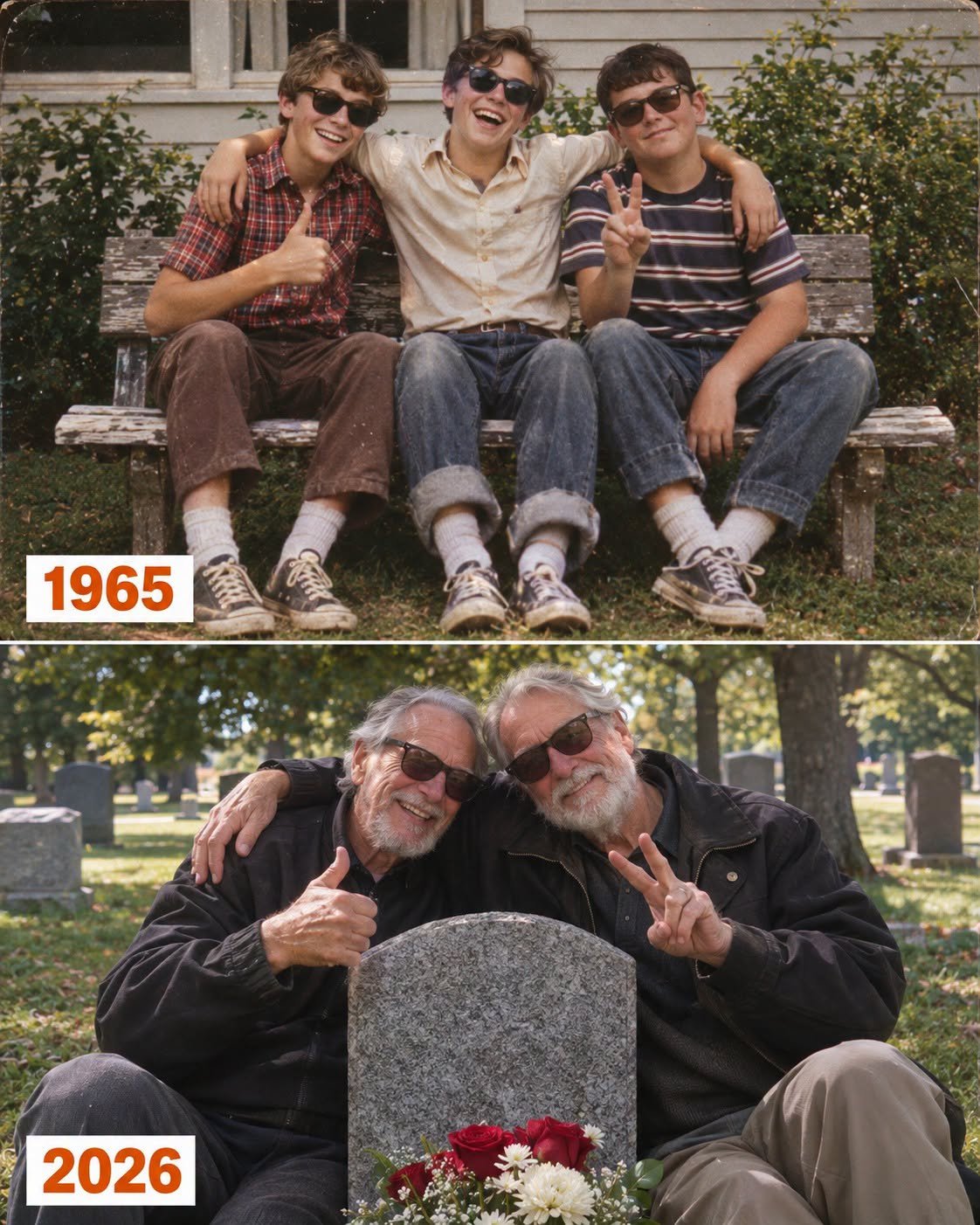
It showed the three of us sitting on a wooden bench when we were twelve.
Daniel was in the middle.
Michael sat on one side.
And I sat on the other.
I hadn’t seen the photograph in more than three decades, but I could still remember it perfectly.
I remembered Daniel’s unruly hair, Michael’s crooked smile, and the way we had squeezed together because the bench was barely wide enough for three growing boys.
During the funeral, Michael held up the photograph.
“Daniel always wanted us to take another picture just like this,” he told everyone.
His voice trembled.
“We talked about it for years. Every time we got together, we’d say we should do it soon.”
He paused.
“Somehow, soon never came.”
Nobody spoke.
I heard Michael take a shaky breath before continuing.
“We thought we had more time.”
After the service, we stood together beside Daniel’s headstone.
Someone suggested taking the photograph he had always wanted.
It wasn’t the picture we had imagined.
There was no wooden bench.
No familiar porch.
And Daniel wasn’t standing between us.
Instead, Michael guided my hand toward the headstone.
My fingertips found the carved letters of Daniel’s name.
I traced them slowly.
The stone was cold.
For a moment, I couldn’t breathe.
I had known Daniel for sixty-six years. I remembered his laugh, the way he cleared his throat before telling a joke, and the cheerful irritation in his voice whenever Michael cheated at cards.
Yet now, the only thing I could physically touch was his name carved into stone.
Beside me, Michael began crying.
I reached toward him.
He caught my hand and wrapped his other arm around my shoulders.
We stood there holding each other, two elderly men trying to understand how a friendship that had always included three people could suddenly continue with only two.
When someone asked whether we were ready for the photograph, neither of us answered.
We simply nodded.
Then, as the other mourners began walking away, Daniel’s wife approached.
I recognized her by her footsteps.
“Robert?”
“Yes?”
She placed something solid into my hands.
A wooden box.
It was heavier than I expected.
“Daniel made me promise you’d receive this after the funeral.”
I ran my fingers along its smooth lid.
“What is it?”
Her voice became unsteady.
“Something he spent thirty-two years putting together.”
I frowned.
“Thirty-two years?”
“Yes.”
She gently squeezed my wrist.
“He wanted you to understand how much you meant to him.”
I tried to speak, but the words wouldn’t come.
She embraced me.
Then she stepped away, leaving me with the box and more questions than I knew how to ask.
Michael drove me home.
Neither of us said much during the journey.
Ordinarily, he would have described the traffic or complained about other drivers. Sometimes he would tell me about something unusual he’d seen along the road.
That afternoon, he barely spoke.
When we reached my house, he offered to make coffee.
I sat at the kitchen table, placed the box in front of me, and carefully lifted the lid.
Inside were envelopes.
Dozens of them.
They were stacked neatly, separated by pieces of thick paper.
I reached for the first envelope.
And the moment my fingertips touched its surface, I froze.
There were raised dots across the front.
Braille.
Daniel had learned Braille shortly after the accident that took my sight.
He used to leave little messages for me on his kitchen table.
Sometimes they were reminders.
Sometimes jokes.
And sometimes ridiculous complaints about Michael.
I smiled faintly at the memory.
Then I opened the envelope.
Inside was a card.
My fingers moved slowly across the raised letters.
The message was short.
But by the time I finished reading it, my entire body had gone cold.
“Robert, there’s something Michael has been afraid to tell you.”
I stopped breathing for a moment.
Michael?
I searched the envelope again and found another card.
“I promised him I would keep his secret until he was ready. He finally agreed that you should know.”
I read those words twice.
Then I turned toward the sound of Michael moving near the kitchen counter.
“Michael?”
“Yes?”
My voice felt unfamiliar.
“What haven’t you told me?”
He didn’t answer.
I heard his chair scrape against the floor.
A moment later, he sat down across from me.
“Michael?”
His breathing was uneven.
Then, in a voice barely above a whisper, he said,
“Please, Robert. Just keep reading.”
And suddenly, I was afraid.
Not of what Daniel had left inside the box.
But of what my last remaining childhood friend had been hiding from me.
Part 2 — The Memories I Had Failed to Notice
I reached into the box and removed another Braille card.
Daniel’s next message read:
“Think carefully about the last few months. You may understand more than you realize.”
I sat quietly, trying to remember.
During Daniel’s final months, our Sunday gatherings had changed.
For thirty-two years, almost every Sunday afternoon had belonged to the three of us.
We met at Daniel’s house.
When the weather was pleasant, we sat outside on his porch, drinking coffee, arguing about old memories, and telling stories we had already told a hundred times.
Daniel usually brought out biscuits.
Michael always insisted they weren’t sweet enough.
And I always accused them both of eating half the plate before I had a chance to reach for one.
Those afternoons had been the one constant in my life after I lost my sight.
When I was forty-one, a terrible accident changed everything.
One day, I could see the faces of the people I loved.
The next, I had to learn how to navigate a world that had suddenly gone dark.
I struggled terribly in the beginning.
I couldn’t bear the thought of becoming dependent on other people.
Simple things became exhausting.
Finding a cup in my own kitchen.
Walking down the hallway without reaching for the wall.
Remembering where someone had moved a chair.
For months, I barely wanted to leave my house.
But Daniel and Michael refused to let me disappear into myself.
They came over, even when I told them not to.
They took me fishing, although I complained that I couldn’t tell whether I had caught a fish or snagged a branch.
They drove me to family celebrations.
They described things they thought I might enjoy imagining.
Daniel would tell me how the light changed over the fields at sunset.
Michael would describe the expressions on our grandchildren’s faces when they opened birthday presents.
And when I became frustrated, one of them would sit beside me until I was ready to try again.
I was grateful.
More grateful than either of them knew.
But beneath that gratitude lived a fear I had never managed to overcome.
I worried that I had become an obligation.
Sometimes, when I heard Michael’s car pull into my driveway, I wondered whether he genuinely wanted to visit.
Or whether he felt guilty leaving an old blind man alone.
Daniel always dismissed those thoughts.
“Robert, stop making decisions about what other people feel,” he once told me.
But I couldn’t help it.
I hated needing things.
And perhaps that was why I had failed to notice how much Michael had begun needing us.
In the months before Daniel died, Michael started behaving differently.
At first, the changes were so small that I barely considered them.
One Sunday, while we were sitting around Daniel’s kitchen table, Michael asked whether my granddaughter had started school yet.
I laughed.
“Michael, she’s fourteen. She’s been going to school for years.”
He laughed too.
“Of course she has. What was I thinking?”
We moved on.
The following Sunday, he asked almost exactly the same question.
I teased him again.
He laughed again.
But Daniel didn’t.
I remembered that now.
I remembered how Daniel had quietly changed the subject.
And how, whenever Michael struggled to recall something, Daniel seemed ready with an answer before the silence became uncomfortable.
There were other moments.
Michael forgot where he had parked his car.
He told me the same story twice in one afternoon.
Once, he started describing a family gathering, then abruptly stopped because he couldn’t remember whose birthday it had been.
I thought nothing of it.
We were seventy-three.
Memory slips seemed like an ordinary part of growing older.
Then, a few weeks before Daniel died, Michael missed our Sunday gathering altogether.
That had never happened.
When I called him, he sounded surprised.
“Robert? Isn’t today Saturday?”
“No, you old fool. It’s Sunday.”
He went quiet.
Then he laughed awkwardly.
“I could have sworn tomorrow was Sunday.”
I assured him it wasn’t a problem.
Daniel, however, barely spoke for the rest of that afternoon.
I remembered asking whether something was bothering him.
He simply said he was tired.
At the time, I believed him.
He was seriously ill, and his strength had been fading.
Now, sitting at my kitchen table, I wondered whether his silence had meant something else.
“Michael,” I said carefully, “is Daniel trying to tell me something about your memory?”
Across the table, his breathing changed.
He didn’t answer directly.
Instead, he whispered,
“There’s another letter. Read that one first.”
I searched through the box until my fingers found a thicker envelope.
On its front, Daniel had written four words.
“Remember the wooden bench.”
I went still.
The bench.
Our childhood photograph.
The one Michael had brought to the funeral.
I knew exactly which memory Daniel wanted me to revisit.
But I hadn’t thought about what happened before that photograph was taken in decades.
And as I began reading the next letter, I was suddenly twelve years old again.
Part 3 — The Promise We Made When We Were Twelve
The wooden bench stood beside a small park near the center of our hometown.
It wasn’t anything remarkable.
Just an old bench with weathered boards and chipped paint.
But for Michael, it had once been the loneliest place in the world.
We were twelve when his mother took him into town one Saturday afternoon.
She told him she needed to run an errand.
Then she asked him to wait on the bench.
Michael obeyed.
He watched people walk past.
He watched shopkeepers arrange their displays.
He waited while the sun moved across the street and the afternoon grew cooler.
An hour passed.
Then another.
His mother didn’t return.
Daniel and I found him sitting there as the shops were beginning to close.
He had his hands folded in his lap and his feet tucked beneath the bench.
“Michael?” I called.
He looked up.
“What are you doing here?”
“Waiting for Mum.”
“Where is she?”
“She went to buy something.”
Daniel glanced toward the shops.
“How long ago?”
Michael shrugged.
“A little while.”
We sat beside him.
I remember offering him the last piece of candy from my pocket.
He shook his head.
“She’ll be back soon,” he said.
So we waited.
Another hour passed.
Eventually, Daniel went to find his father.
By nightfall, the adults had discovered what Michael couldn’t yet understand.
His mother had left town.
She had abandoned him.
She wasn’t coming back.
Michael was taken to live with his aunt, who had a small house only a few streets from ours.
I remember feeling angry.
Not the thoughtful anger of an adult who understands how complicated life can become.
The simple, furious anger of a twelve-year-old boy who cannot understand why a mother would leave her child waiting on a bench.
Michael rarely spoke about it afterward.
But the next morning, something happened that stayed with me for the rest of my life.
The three of us had arranged to meet at that same bench.
Daniel and I arrived a few minutes early.
Michael was already there.
He was standing beside the bench, staring toward the road.
When he heard us approaching, he turned so quickly that he almost lost his balance.
Then he said two words I didn’t understand at the time.
“You came.”
I laughed.
“Of course we came. We said we would.”
He looked at Daniel.
Then back at me.
And suddenly, he began crying.
Not loudly.
He simply stood there, rubbing his eyes with the sleeves of his shirt, trying desperately to stop the tears.
Daniel and I didn’t know what to do.
We had never seen Michael cry like that.
So I reached for his hand.
And because I was twelve and believed every problem could be solved with the right promise, I told him something.
“If one of us ever gets lost, the other two will come looking.”
Daniel nodded immediately.
“That’s right. Even if the lost one tells us to go away.”
Michael gave a watery laugh.
“Even if he’s really annoying?”
“Especially then,” Daniel answered.
We shook hands.
Three boys standing beside an old bench, making a promise none of us fully understood.
A little later, Daniel’s father arrived to take us home.
He happened to have a camera with him.
He asked us to sit together on the bench.
Daniel sat in the middle.
Michael sat on one side.
I sat on the other.
And that’s how the photograph was taken.
For sixty-one years, I remembered that photograph as a picture of three happy boys.
I remembered our smiles.
The sunlight.
Daniel trying to push us both off the bench just before his father took the picture.
But I had never truly understood what Michael’s smile meant.
Until Daniel’s letter reminded me.
Michael wasn’t smiling because life was perfect.
He was smiling because, after being abandoned by someone he loved, two other people had kept their promise to return.
My fingers trembled as I continued reading.
Daniel had written:
“Michael told me recently that he can still remember that morning as clearly as if it happened yesterday.”
I swallowed.
“He remembers hearing our footsteps as we ran toward him. He remembers your voice saying, ‘Of course we came.’”
I smiled through my tears.
That sounded exactly like Michael.
He had always remembered everything.
Teachers’ names.
Childhood adventures.
The birthdays I constantly forgot.
Every foolish thing Daniel and I had ever done.
He could tell a story from fifty years earlier and somehow remember the color of someone’s shoes.
But then I reached the next line.
And my smile disappeared.
“Robert, he’s frightened that one day he may no longer remember who we are.”
For several seconds, I couldn’t move.
I read the sentence again.
Then I turned toward Michael.
“What does that mean?”
He didn’t answer.
I found one final card inside the envelope.
Daniel had written only three words.
“Let him explain.”

I placed the card on the table.
“Michael?”
“I’m here.”
“Please tell me what’s happening.”
He was silent for so long that I wondered whether he was crying.
Then I heard him draw a slow, uneven breath.
“I’ve been seeing a doctor.”
My heart sank.
“What kind of doctor?”
“A specialist.”
“Why?”
He shifted in his chair.
“I started noticing things last year.”
“What things?”
“Forgetfulness. At first, it was ordinary stuff. Losing my keys. Forgetting why I’d gone into a room.”
I tried to reassure him.
“We all do that.”
“I know. That’s what I told myself.”
He paused.
“But then I began forgetting conversations. Sometimes I’d make plans with someone and have no memory of agreeing to them.”
My hands grew cold.
“Michael…”
“Once, I drove into town to buy groceries. When I got there, I couldn’t remember why I’d left the house.”
He let out a shaky breath.
“I sat in the car trying to work it out. I knew where I was. I knew how to get home. But I couldn’t remember what I was supposed to be doing.”
I reached across the table.
“Did you tell Daniel?”
“Yes.”
“He knew?”
“He was the first person I told.”
I felt something tighten inside my chest.
Daniel had been carrying his own illness.
And Michael’s fear.
And somehow, I had noticed neither.
“What did the doctors say?”
Michael took my hand.
His fingers felt unusually cold.
“They did some tests.”
I waited.
The kitchen clock ticked steadily on the wall.
Finally, Michael spoke.
“Robert, I have Alzheimer’s disease.”
The words seemed to empty the room of air.
For a moment, I couldn’t think.
Michael.
The man who remembered every detail of our childhood.
The friend who had spent thirty-two years describing the world to me when I could no longer see it.
The person who knew which memories made me smile, which stories upset me, and which names I sometimes struggled to recall.
Now he was facing an illness that could gradually take those memories from him.
“How long have you known?” I asked.
“Four months.”
“Four months?”
“I wanted to tell you.”
“Then why didn’t you?”
His voice broke.
“Because Daniel was dying.”
I lowered my head.
Michael continued.
“You were already losing him. I couldn’t stand the thought of telling you that you might lose me too.”
“Michael, you’re right here.”
“I know.”
“I’m holding your hand.”
“I know that too.”
He tried to laugh.
But it came out as a sob.
Then he said something that frightened me more than the diagnosis itself.
“The day before Daniel died, I sat beside his bed. He held my hand and talked to me for a long time.”
I listened silently.
“I remember being there. I remember how his hand felt. I even remember crying.”
He paused.
“But I can’t remember what he said.”
My throat tightened.
“I’ve been trying, Robert. Every day since the funeral, I’ve tried to remember his last words to me.”
He began crying openly.
“And I can’t.”
I tightened my grip on his hand.
“Michael…”
“What if that happens to everything?”
His voice trembled.
“What if someday I can’t remember the bench? What if I don’t recognize your voice? What if everything we’ve been to each other just disappears?”
I wanted to reassure him.
I wanted to promise that it wouldn’t happen.
But I knew I couldn’t.
So I sat there holding his hand, listening to my oldest remaining friend cry over a future neither of us could control.
After a while, Michael reached toward the wooden box.
“There’s more,” he whispered.
“More letters?”
“Something else. Daniel wanted you to have all of it.”
And when my fingers found what lay beneath the envelopes, I finally began to understand why Daniel had spent thirty-two years preparing his gift.
Part 4 — Thirty-Two Years of Ordinary Moments
Beneath the stack of letters was a small recording player.
Its buttons were marked with raised labels that I could identify by touch.
Beside it were more Braille cards.
Dozens of them.
Each carried a date and a short description.
I picked up the first card.
June 1994 — Michael’s Birthday.
I smiled immediately.
I remembered that afternoon.
The three of us had gone fishing at a lake outside town.
Michael had worn a ridiculous new fishing hat that Daniel kept threatening to throw into the water.
Eventually, a gust of wind blew the hat off Michael’s head.
Michael leaned over the side of the boat to retrieve it.
And fell straight into the lake.
Daniel laughed so hard he could barely help pull him out.
I laughed just as hard.
Even now, more than thirty years later, I could remember the sound of Michael sputtering in the water.
I carefully pressed the play button.
For a second, there was nothing but a faint hiss.
Then Daniel’s voice filled my kitchen.
“Michael, tell Robert what really happened to your trousers.”
My breath caught.
Daniel.
He sounded younger.
Stronger.
So full of life that, for one impossible second, I forgot he was gone.
Then I heard Michael’s voice.
“I’ve already told you. A fish pulled me into the water!”
Daniel burst out laughing.
“A fish? What kind of fish steals a man’s balance and his dignity?”
Then another voice joined them.
Mine.
I was laughing so hard I could barely speak.
“You’re lucky the fish didn’t keep you!”
All three of us dissolved into laughter.
I pressed my hand against my mouth.
Across the table, Michael let out a surprised chuckle.
“I’d forgotten about that,” he whispered.
I turned toward him.
“Do you remember now?”
“Some of it.”
He paused.
“I remember Daniel laughing.”
We listened until the recording ended.
Then I reached for another card.
This one belonged to my granddaughter’s seventh birthday.
I pressed play.
There were children’s voices in the background.
The clatter of plates.
Someone singing badly.
Daniel was describing the birthday cake to me.
“Robert, she’s got chocolate frosting all over her nose.”
Then came my granddaughter’s delighted laughter.
And Michael’s voice.
“I think Granddad needs some cake on his nose too.”
I smiled.
I remembered that party.
But hearing their voices brought back details I hadn’t thought about in years.
The smell of candles.
The sound of children running through the house.
The way my granddaughter had climbed onto my lap after opening her presents.
I moved on to another recording.
Daniel describing a sunset from his porch.
Then another.
Michael telling an awful joke and laughing before he reached the punch line.
Another.
The three of us arguing over whose memory of a childhood football match was correct.
I couldn’t stop listening.
Each recording opened a small door into a day I had almost forgotten.
Some were celebrations.
Birthdays.
Anniversaries.
Family gatherings.
But many were ordinary afternoons.
Coffee on the porch.
Rain tapping against the windows.
Daniel telling Michael he was terrible at making tea.
Michael complaining about Daniel’s cooking.
Me reminding them both that I might be blind, but I could still tell when they were trying to cheat at cards.
Thirty-two years.
Daniel had recorded pieces of our lives for thirty-two years.
I had known he sometimes made recordings after my accident.
He used to tell me they might help preserve memories I could no longer revisit through photographs.
But I had never realized how much he was saving.
Or how carefully he had organized it.
At some point, I stopped listening and simply held the player in my hands.
Daniel had spent years creating something I could experience without needing anyone to describe it to me.
He had made sure I would never have to depend on someone else’s eyes to revisit the moments that mattered.
For decades, I had worried that my friends kept visiting because they pitied me.
And all that time, one of them had been quietly preparing a gift that required more thought, patience, and love than I could begin to imagine.
Then my fingers touched something beneath the recording player.
Another envelope.
This one was thicker than the others.
It had been placed carefully at the bottom of the box.
I opened it.
Inside was a long Braille letter.
At the top were two simple words.
Dear Robert,
I took a breath and began reading.
“When you lost your sight, you told me something that I never forgot.”
My fingers slowed.
“You said you were afraid that one day you would no longer remember what our faces looked like.”
I felt my throat tighten.
I remembered saying that.
It was only a few months after the accident.
I had been sitting in Daniel’s kitchen, frustrated because I couldn’t picture my daughter’s face as clearly as I once could.
I was terrified that the memories would fade.
Daniel had listened without interrupting.
Then he’d told me not to worry.
I hadn’t understood why he sounded so certain.
Now I did.
I continued reading.
“That was when I started writing things down.”
“At first, I wrote simple descriptions. The color of Michael’s new fishing hat. The way your granddaughter smiled when she lost her first tooth. The changes in our faces as the years went by.”
“Then I started recording our conversations.”
“I wanted you to have something that belonged to you. Something you could return to whenever you missed the world you used to see.”
I stopped.
My fingers rested against the page.
For thirty-two years, Daniel had been collecting memories because he was afraid I might lose mine.
I wiped my cheeks and kept reading.
“But a few months ago, Michael told me about his diagnosis.”
My chest tightened.
“And suddenly, I realized that the reason I started this collection mattered in a different way.”
“For thirty-two years, I had been saving these moments for you.”
“Now there may come a time when Michael needs them too.”
I could barely feel the raised dots beneath my trembling fingers.
“I know you’re frightened of being a burden, Robert.”
I froze.
Daniel had known.
All those years, he had understood the fear I never managed to put into words.
“You’ve never been a burden to us. You were our friend long before you lost your sight, and you remained our friend afterward. Nothing about that changed.”
I covered my mouth.
Then I read on.
“You have always believed Michael and I were the ones helping you.”
“But friendship was never something we kept score of.”
“There were days when you needed us.”
“There were days when we needed you.”
“And there were days when the only thing any of us needed was to sit together and laugh at the same foolish stories.”
I was crying so hard that I had to stop.
Michael remained quiet across the table.
He didn’t interrupt.
After a while, I found my place again.
“I wish I could stay and tell those stories myself.”
“I wish I could sit on the porch with both of you for another thirty years.”
“But I know that isn’t possible.”
“So I’m leaving these memories with someone who knows our lives as well as I do.”
“You, Robert.”
I drew a shaky breath.
The letter continued.
“Remember the promise we made on that wooden bench?”
“If one of us gets lost, the other two come looking.”
“Michael may need someone to come looking for him now.”
“There may be days when he loses track of a conversation. Days when a familiar story feels new. Days when he needs someone to remind him of who we were together.”
“I know that won’t always be easy.”
“But I also know something else.”
“You’re the same boy who reached for Michael’s hand when he thought no one was coming back.”
“And I know you’ll reach for it again.”
My hands fell into my lap.
For a long time, neither of us spoke.
The only sound in the kitchen came from the quiet ticking of the clock.
Then Michael whispered,
“He told me he was working on something for you.”
I nodded.
“But I didn’t know it was all this.”
I reached for the recorder again.
Daniel’s laughter filled the room.
Then Michael’s.
Then mine.
Three voices.
Three boys who had grown old together.
And for the first time since the funeral, the house didn’t feel quite so empty.
Daniel was gone.
But he had left us something extraordinary.
Not money.
Not possessions.
Not some grand statement about friendship.
He had given us back the ordinary afternoons we had once taken for granted.
And he had given me a reason to stop seeing myself as the person who always needed help.
Because now it was my turn to help someone I loved.
Part 5 — If You Forget, I’ll Remember for You
After the final recording ended, Michael sat quietly across from me.
I could hear him shifting his hands against the table.
Finally, he spoke.
“Robert?”
“Yes?”
“Can I ask you something?”
“Of course.”
He hesitated.
“What happens if it gets worse?”
I swallowed.
“Then we’ll deal with what comes.”
He let out a nervous laugh.
“You make it sound simple.”
“I didn’t say it would be simple.”
He was quiet for a moment.
“What if I forget our Sunday gatherings?”
“Then I’ll remind you.”
“What if I ask you the same question ten times?”
“Then I’ll do my best to answer it ten times.”
He gave a weak chuckle.
“You might get tired of that.”
“Michael, I’ve been listening to you tell the same fishing stories for sixty years. I’m already used to repetition.”
He laughed.
A real laugh this time.
For a moment, he sounded like the Michael I had always known.
Then his voice grew serious again.
“What if I forget Daniel?”
The question struck me so deeply that I couldn’t answer immediately.
I thought of the wooden bench.
The fishing trips.
The weddings.
The birthdays.
All those Sunday afternoons.
I thought about how much of my own life was tied to memories of the three of us together.
And I thought about how frightening it must be for Michael to imagine losing even the smallest pieces of them.
I couldn’t promise him that he would always remember Daniel.
I couldn’t promise he would never forget my name.
I couldn’t promise that the recordings would always bring those memories back.
Alzheimer’s doesn’t make those kinds of promises.
And I refused to comfort my friend with something I couldn’t guarantee.
So instead, I told him the truth.
“Michael, I don’t know what your illness will take from you.”
He didn’t speak.
“But I know what it can’t change.”
“What’s that?”
“The fact that you were there for me.”
His breathing became uneven.
“For thirty-two years, you and Daniel helped me find my way through a world I couldn’t see.”
“Robert…”
“No, let me finish.”
I tightened my grip on his hand.
“You described things to me. You helped me get out of the house when I didn’t want to. You reminded me that losing my sight hadn’t made me less of a person.”
He was crying again.
“And now,” I continued, “if there are things you struggle to remember, I’ll help you with them. We’ll use Daniel’s recordings. We’ll tell the stories again. And when the memories don’t come back, we’ll still find a way to spend time together.”
Michael lowered his head.
“When I was twelve, I was terrified nobody would come back for me.”
I felt my own tears returning.
“I know.”
He took a shaky breath.
“And now I’m terrified that one day I won’t remember when they do.”
I reached across the table with my other hand.
“Then you won’t have to remember for both of us.”
He went silent.
“I’ll remember the bench,” I said.
“I’ll remember Daniel.”
“I’ll remember those Sundays.”
“And whenever you want to hear about them, I’ll tell you.”
Michael began sobbing.
I stood carefully, following the edge of the table until I reached his chair.
He rose to meet me.
And we embraced.
Two seventy-three-year-old men holding each other in a quiet kitchen.
Just as we had when we were twelve.
I couldn’t bring Daniel back.
I couldn’t stop Michael’s illness.
And I couldn’t know exactly what the years ahead would bring.
But I could be there.
I could answer the phone.
I could sit beside him when he was afraid.
I could tell him the same story as many times as he wanted to hear it.
For so long, I had mistaken receiving help for being weak.
Now I understood something Daniel and Michael had known all along.
Friendship wasn’t about keeping track of who gave more.
It was about showing up.
Sometimes you helped a friend find his way home.
Sometimes you helped him remember where home had been.
And sometimes you simply sat beside him, because being together was enough.
Last Sunday, Michael and I returned to Daniel’s porch.
His wife had insisted we continue our tradition.
“Daniel would be terribly disappointed if you two stopped coming,” she’d told us.
So we went.
The wooden box sat on a small table between our chairs.
Daniel’s chair was empty.
I could hear the breeze moving through the trees and birds calling from the garden.
For a while, we said nothing.
Then Michael reached for my hand.
“Robert?”
“Yes?”
“Would you tell me about that photograph?”
I smiled.
“The one from the funeral?”
“Yes. The picture of the three of us when we were boys.”
I leaned back in my chair.
“Of course.”
So I told him.
I described the old wooden bench beside the park.
I told him about the Saturday afternoon when his mother had left him waiting there.
I reminded him how Daniel and I found him as the shops were closing.
Then I told him about the following morning.
How he had arrived at the bench before us.
How he’d been standing beside it, watching the road.
How he’d turned when he heard our footsteps.
And how surprised he’d looked when he realized we’d actually come.
“You said something to me that morning,” I told him.
Michael was quiet.
“What did I say?”
“You looked at us and said, ‘You came.’”
He laughed softly.
Then I continued.
“And I told you, ‘Of course we came.’”
Michael squeezed my hand.
I reminded him of the promise we’d made.
How I had said that if one of us ever got lost, the other two would come looking.
How Daniel had insisted we’d come even if the lost one told us to go away.
And how the three of us had shaken hands beside that old bench, believing we had just made the most important promise in the world.
Michael listened without interrupting.
When I finished, he sat quietly for a long time.
Then he said,
“I remember that.”
I smiled.
“I’m glad.”
He took a deep breath.
“Daniel’s father took the picture, didn’t he?”
“Yes, he did.”
“And Daniel sat in the middle.”
“That’s right.”
Michael chuckled.
“He always liked being in the middle.”
I laughed.
“He certainly did.”
For a little while, we were simply two old friends remembering a happy moment from childhood.
Then Michael’s grip tightened.
“Robert?”
“Yes?”
“What if one day I don’t remember any of that?”
I turned toward him.
I thought about the wooden box sitting between us.
About the recordings Daniel had made.
About the promise we’d carried through sixty-one years of friendship.
And about the frightened little boy who had once waited beside a wooden bench, wondering whether anyone would return.
I held Michael’s hand a little tighter.
“Then I’ll tell you the story again.”
He was silent.
“And if I ask the next day?”
“I’ll tell you again.”
“And the day after that?”
I smiled.
“As many times as I can, my friend.”
A long moment passed.
Then Michael leaned back in his chair.
“Good,” he whispered.
We sat together listening to the birds.
Daniel’s chair remained empty.
But the wooden box was beside us, filled with thirty-two years of voices, laughter, and memories.
For the first time, I understood that Daniel hadn’t simply left me a collection of recordings.
He had left us a way to keep our promise.
And I finally understood something about the photograph we had taken as twelve-year-old boys.
It wasn’t special because all three of us were smiling.
It was special because Michael had been afraid of being left behind, and Daniel and I had shown him he wasn’t alone.
Now, sixty-one years later, he was frightened again.
Only this time, he wasn’t waiting on a wooden bench.
He was sitting beside me on our best friend’s porch.
And as long as I could, I would keep reminding him of one simple truth.
He didn’t have to remember every moment of our friendship to deserve the love that had carried us through it.
Because the promise we made when we were twelve had never depended on perfect memories.
It depended on love.
And if one of us ever lost his way, another would come looking.
Just as we had promised all those years ago.Part 1 — The Gift Daniel Left Behind
Six weeks ago, I stood beside my best friend’s grave, holding a wooden box that would change the way I understood the last thirty-two years of my life.
I had no idea what was inside.
All I knew was that Daniel’s wife had pressed it into my hands and whispered something I would never forget.
“Robert, he wanted you to have this today. He’s been working on it for thirty-two years.”
I stood there, stunned.
Thirty-two years.
That was exactly how long I had been blind.
My name is Robert. I’m seventy-three years old, and until six weeks ago, I had two people in my life who knew me better than I knew myself.
Daniel and Michael.
We had been inseparable since second grade.
We learned to ride bicycles on the same cracked neighborhood sidewalks, got into trouble together, and spent more afternoons fishing than our mothers probably approved of.
We stood beside each other at our weddings, celebrated the births of our children, and watched our families grow.
Somehow, three little boys had become three old men without ever learning how to imagine life without one another.
Then Daniel died.
And for the first time in more than sixty years, there were only two of us left.
The funeral was held on a quiet Thursday morning.
I couldn’t see the flowers, the mourners, or the pale autumn sky, but I could hear the wind moving through the trees and the faint rustling of coats as people gathered around the grave.
Michael stood beside me.
Every so often, his hand brushed against my sleeve, as though he needed to reassure himself that I was still there.
He had brought something special to the service.
An old photograph.
It showed the three of us sitting on a wooden bench when we were twelve.
Daniel was in the middle.
Michael sat on one side.
And I sat on the other.
I hadn’t seen the photograph in more than three decades, but I could still remember it perfectly.
I remembered Daniel’s unruly hair, Michael’s crooked smile, and the way we had squeezed together because the bench was barely wide enough for three growing boys.
During the funeral, Michael held up the photograph.
“Daniel always wanted us to take another picture just like this,” he told everyone.
His voice trembled.
“We talked about it for years. Every time we got together, we’d say we should do it soon.”
He paused.
“Somehow, soon never came.”
Nobody spoke.
I heard Michael take a shaky breath before continuing.
“We thought we had more time.”
After the service, we stood together beside Daniel’s headstone.
Someone suggested taking the photograph he had always wanted.
It wasn’t the picture we had imagined.
There was no wooden bench.
No familiar porch.
And Daniel wasn’t standing between us.
Instead, Michael guided my hand toward the headstone.
My fingertips found the carved letters of Daniel’s name.
I traced them slowly.
The stone was cold.
For a moment, I couldn’t breathe.
I had known Daniel for sixty-six years. I remembered his laugh, the way he cleared his throat before telling a joke, and the cheerful irritation in his voice whenever Michael cheated at cards.
Yet now, the only thing I could physically touch was his name carved into stone.
Beside me, Michael began crying.
I reached toward him.
He caught my hand and wrapped his other arm around my shoulders.
We stood there holding each other, two elderly men trying to understand how a friendship that had always included three people could suddenly continue with only two.
When someone asked whether we were ready for the photograph, neither of us answered.
We simply nodded.
Then, as the other mourners began walking away, Daniel’s wife approached.
I recognized her by her footsteps.
“Robert?”
“Yes?”
She placed something solid into my hands.
A wooden box.
It was heavier than I expected.
“Daniel made me promise you’d receive this after the funeral.”
I ran my fingers along its smooth lid.
“What is it?”
Her voice became unsteady.
“Something he spent thirty-two years putting together.”
I frowned.
“Thirty-two years?”
“Yes.”
She gently squeezed my wrist.
“He wanted you to understand how much you meant to him.”
I tried to speak, but the words wouldn’t come.
She embraced me.
Then she stepped away, leaving me with the box and more questions than I knew how to ask.
Michael drove me home.
Neither of us said much during the journey.
Ordinarily, he would have described the traffic or complained about other drivers. Sometimes he would tell me about something unusual he’d seen along the road.
That afternoon, he barely spoke.
When we reached my house, he offered to make coffee.
I sat at the kitchen table, placed the box in front of me, and carefully lifted the lid.
Inside were envelopes.
Dozens of them.
They were stacked neatly, separated by pieces of thick paper.
I reached for the first envelope.
And the moment my fingertips touched its surface, I froze.
There were raised dots across the front.
Braille.
Daniel had learned Braille shortly after the accident that took my sight.
He used to leave little messages for me on his kitchen table.
Sometimes they were reminders.
Sometimes jokes.
And sometimes ridiculous complaints about Michael.
I smiled faintly at the memory.
Then I opened the envelope.
Inside was a card.
My fingers moved slowly across the raised letters.
The message was short.
But by the time I finished reading it, my entire body had gone cold.
“Robert, there’s something Michael has been afraid to tell you.”
I stopped breathing for a moment.
Michael?
I searched the envelope again and found another card.
“I promised him I would keep his secret until he was ready. He finally agreed that you should know.”
I read those words twice.
Then I turned toward the sound of Michael moving near the kitchen counter.
“Michael?”
“Yes?”
My voice felt unfamiliar.
“What haven’t you told me?”
He didn’t answer.
I heard his chair scrape against the floor.
A moment later, he sat down across from me.
“Michael?”
His breathing was uneven.
Then, in a voice barely above a whisper, he said,
“Please, Robert. Just keep reading.”
And suddenly, I was afraid.
Not of what Daniel had left inside the box.
But of what my last remaining childhood friend had been hiding from me.
Part 2 — The Memories I Had Failed to Notice
I reached into the box and removed another Braille card.
Daniel’s next message read:
“Think carefully about the last few months. You may understand more than you realize.”
I sat quietly, trying to remember.
During Daniel’s final months, our Sunday gatherings had changed.
For thirty-two years, almost every Sunday afternoon had belonged to the three of us.
We met at Daniel’s house.
When the weather was pleasant, we sat outside on his porch, drinking coffee, arguing about old memories, and telling stories we had already told a hundred times.
Daniel usually brought out biscuits.
Michael always insisted they weren’t sweet enough.
And I always accused them both of eating half the plate before I had a chance to reach for one.
Those afternoons had been the one constant in my life after I lost my sight.
When I was forty-one, a terrible accident changed everything.
One day, I could see the faces of the people I loved.
The next, I had to learn how to navigate a world that had suddenly gone dark.
I struggled terribly in the beginning.
I couldn’t bear the thought of becoming dependent on other people.
Simple things became exhausting.
Finding a cup in my own kitchen.
Walking down the hallway without reaching for the wall.
Remembering where someone had moved a chair.
For months, I barely wanted to leave my house.
But Daniel and Michael refused to let me disappear into myself.
They came over, even when I told them not to.
They took me fishing, although I complained that I couldn’t tell whether I had caught a fish or snagged a branch.
They drove me to family celebrations.
They described things they thought I might enjoy imagining.
Daniel would tell me how the light changed over the fields at sunset.
Michael would describe the expressions on our grandchildren’s faces when they opened birthday presents.
And when I became frustrated, one of them would sit beside me until I was ready to try again.
I was grateful.
More grateful than either of them knew.
But beneath that gratitude lived a fear I had never managed to overcome.
I worried that I had become an obligation.
Sometimes, when I heard Michael’s car pull into my driveway, I wondered whether he genuinely wanted to visit.
Or whether he felt guilty leaving an old blind man alone.
Daniel always dismissed those thoughts.
“Robert, stop making decisions about what other people feel,” he once told me.
But I couldn’t help it.
I hated needing things.
And perhaps that was why I had failed to notice how much Michael had begun needing us.
In the months before Daniel died, Michael started behaving differently.
At first, the changes were so small that I barely considered them.
One Sunday, while we were sitting around Daniel’s kitchen table, Michael asked whether my granddaughter had started school yet.
I laughed.
“Michael, she’s fourteen. She’s been going to school for years.”
He laughed too.
“Of course she has. What was I thinking?”
We moved on.
The following Sunday, he asked almost exactly the same question.
I teased him again.
He laughed again.
But Daniel didn’t.
I remembered that now.
I remembered how Daniel had quietly changed the subject.
And how, whenever Michael struggled to recall something, Daniel seemed ready with an answer before the silence became uncomfortable.
There were other moments.
Michael forgot where he had parked his car.
He told me the same story twice in one afternoon.
Once, he started describing a family gathering, then abruptly stopped because he couldn’t remember whose birthday it had been.
I thought nothing of it.
We were seventy-three.
Memory slips seemed like an ordinary part of growing older.
Then, a few weeks before Daniel died, Michael missed our Sunday gathering altogether.
That had never happened.
When I called him, he sounded surprised.
“Robert? Isn’t today Saturday?”
“No, you old fool. It’s Sunday.”
He went quiet.
Then he laughed awkwardly.
“I could have sworn tomorrow was Sunday.”
I assured him it wasn’t a problem.
Daniel, however, barely spoke for the rest of that afternoon.
I remembered asking whether something was bothering him.
He simply said he was tired.
At the time, I believed him.
He was seriously ill, and his strength had been fading.
Now, sitting at my kitchen table, I wondered whether his silence had meant something else.
“Michael,” I said carefully, “is Daniel trying to tell me something about your memory?”
Across the table, his breathing changed.
He didn’t answer directly.
Instead, he whispered,
“There’s another letter. Read that one first.”
I searched through the box until my fingers found a thicker envelope.
On its front, Daniel had written four words.
“Remember the wooden bench.”
I went still.
The bench.
Our childhood photograph.
The one Michael had brought to the funeral.
I knew exactly which memory Daniel wanted me to revisit.
But I hadn’t thought about what happened before that photograph was taken in decades.
And as I began reading the next letter, I was suddenly twelve years old again.
Part 3 — The Promise We Made When We Were Twelve
The wooden bench stood beside a small park near the center of our hometown.
It wasn’t anything remarkable.
Just an old bench with weathered boards and chipped paint.
But for Michael, it had once been the loneliest place in the world.
We were twelve when his mother took him into town one Saturday afternoon.
She told him she needed to run an errand.
Then she asked him to wait on the bench.
Michael obeyed.
He watched people walk past.
He watched shopkeepers arrange their displays.
He waited while the sun moved across the street and the afternoon grew cooler.
An hour passed.
Then another.
His mother didn’t return.
Daniel and I found him sitting there as the shops were beginning to close.
He had his hands folded in his lap and his feet tucked beneath the bench.
“Michael?” I called.
He looked up.
“What are you doing here?”
“Waiting for Mum.”
“Where is she?”
“She went to buy something.”
Daniel glanced toward the shops.
“How long ago?”
Michael shrugged.
“A little while.”
We sat beside him.
I remember offering him the last piece of candy from my pocket.
He shook his head.
“She’ll be back soon,” he said.
So we waited.
Another hour passed.
Eventually, Daniel went to find his father.
By nightfall, the adults had discovered what Michael couldn’t yet understand.
His mother had left town.
She had abandoned him.
She wasn’t coming back.
Michael was taken to live with his aunt, who had a small house only a few streets from ours.
I remember feeling angry.
Not the thoughtful anger of an adult who understands how complicated life can become.
The simple, furious anger of a twelve-year-old boy who cannot understand why a mother would leave her child waiting on a bench.
Michael rarely spoke about it afterward.
But the next morning, something happened that stayed with me for the rest of my life.
The three of us had arranged to meet at that same bench.
Daniel and I arrived a few minutes early.
Michael was already there.
He was standing beside the bench, staring toward the road.
When he heard us approaching, he turned so quickly that he almost lost his balance.
Then he said two words I didn’t understand at the time.
“You came.”
I laughed.
“Of course we came. We said we would.”
He looked at Daniel.
Then back at me.
And suddenly, he began crying.
Not loudly.
He simply stood there, rubbing his eyes with the sleeves of his shirt, trying desperately to stop the tears.
Daniel and I didn’t know what to do.
We had never seen Michael cry like that.
So I reached for his hand.
And because I was twelve and believed every problem could be solved with the right promise, I told him something.
“If one of us ever gets lost, the other two will come looking.”
Daniel nodded immediately.
“That’s right. Even if the lost one tells us to go away.”
Michael gave a watery laugh.
“Even if he’s really annoying?”
“Especially then,” Daniel answered.
We shook hands.
Three boys standing beside an old bench, making a promise none of us fully understood.
A little later, Daniel’s father arrived to take us home.
He happened to have a camera with him.
He asked us to sit together on the bench.
Daniel sat in the middle.
Michael sat on one side.
I sat on the other.
And that’s how the photograph was taken.
For sixty-one years, I remembered that photograph as a picture of three happy boys.
I remembered our smiles.
The sunlight.
Daniel trying to push us both off the bench just before his father took the picture.
But I had never truly understood what Michael’s smile meant.
Until Daniel’s letter reminded me.
Michael wasn’t smiling because life was perfect.
He was smiling because, after being abandoned by someone he loved, two other people had kept their promise to return.
My fingers trembled as I continued reading.
Daniel had written:
“Michael told me recently that he can still remember that morning as clearly as if it happened yesterday.”
I swallowed.
“He remembers hearing our footsteps as we ran toward him. He remembers your voice saying, ‘Of course we came.’”
I smiled through my tears.
That sounded exactly like Michael.
He had always remembered everything.
Teachers’ names.
Childhood adventures.
The birthdays I constantly forgot.
Every foolish thing Daniel and I had ever done.
He could tell a story from fifty years earlier and somehow remember the color of someone’s shoes.
But then I reached the next line.
And my smile disappeared.
“Robert, he’s frightened that one day he may no longer remember who we are.”
For several seconds, I couldn’t move.
I read the sentence again.
Then I turned toward Michael.
“What does that mean?”
He didn’t answer.
I found one final card inside the envelope.
Daniel had written only three words.
“Let him explain.”
I placed the card on the table.
“Michael?”
“I’m here.”
“Please tell me what’s happening.”
He was silent for so long that I wondered whether he was crying.
Then I heard him draw a slow, uneven breath.
“I’ve been seeing a doctor.”
My heart sank.
“What kind of doctor?”
“A specialist.”
“Why?”
He shifted in his chair.
“I started noticing things last year.”
“What things?”
“Forgetfulness. At first, it was ordinary stuff. Losing my keys. Forgetting why I’d gone into a room.”
I tried to reassure him.
“We all do that.”
“I know. That’s what I told myself.”
He paused.
“But then I began forgetting conversations. Sometimes I’d make plans with someone and have no memory of agreeing to them.”
My hands grew cold.
“Michael…”
“Once, I drove into town to buy groceries. When I got there, I couldn’t remember why I’d left the house.”
He let out a shaky breath.
“I sat in the car trying to work it out. I knew where I was. I knew how to get home. But I couldn’t remember what I was supposed to be doing.”
I reached across the table.
“Did you tell Daniel?”
“Yes.”
“He knew?”
“He was the first person I told.”
I felt something tighten inside my chest.
Daniel had been carrying his own illness.
And Michael’s fear.
And somehow, I had noticed neither.
“What did the doctors say?”
Michael took my hand.
His fingers felt unusually cold.
“They did some tests.”
I waited.
The kitchen clock ticked steadily on the wall.
Finally, Michael spoke.
“Robert, I have Alzheimer’s disease.”
The words seemed to empty the room of air.
For a moment, I couldn’t think.
Michael.
The man who remembered every detail of our childhood.
The friend who had spent thirty-two years describing the world to me when I could no longer see it.
The person who knew which memories made me smile, which stories upset me, and which names I sometimes struggled to recall.
Now he was facing an illness that could gradually take those memories from him.
“How long have you known?” I asked.
“Four months.”
“Four months?”
“I wanted to tell you.”
“Then why didn’t you?”
His voice broke.
“Because Daniel was dying.”
I lowered my head.
Michael continued.
“You were already losing him. I couldn’t stand the thought of telling you that you might lose me too.”
“Michael, you’re right here.”
“I know.”
“I’m holding your hand.”
“I know that too.”
He tried to laugh.
But it came out as a sob.
Then he said something that frightened me more than the diagnosis itself.
“The day before Daniel died, I sat beside his bed. He held my hand and talked to me for a long time.”
I listened silently.
“I remember being there. I remember how his hand felt. I even remember crying.”
He paused.
“But I can’t remember what he said.”
My throat tightened.
“I’ve been trying, Robert. Every day since the funeral, I’ve tried to remember his last words to me.”
He began crying openly.
“And I can’t.”
I tightened my grip on his hand.
“Michael…”
“What if that happens to everything?”
His voice trembled.
“What if someday I can’t remember the bench? What if I don’t recognize your voice? What if everything we’ve been to each other just disappears?”
I wanted to reassure him.
I wanted to promise that it wouldn’t happen.
But I knew I couldn’t.
So I sat there holding his hand, listening to my oldest remaining friend cry over a future neither of us could control.
After a while, Michael reached toward the wooden box.
“There’s more,” he whispered.
“More letters?”
“Something else. Daniel wanted you to have all of it.”
And when my fingers found what lay beneath the envelopes, I finally began to understand why Daniel had spent thirty-two years preparing his gift.
Part 4 — Thirty-Two Years of Ordinary Moments
Beneath the stack of letters was a small recording player.
Its buttons were marked with raised labels that I could identify by touch.
Beside it were more Braille cards.
Dozens of them.
Each carried a date and a short description.
I picked up the first card.
June 1994 — Michael’s Birthday.
I smiled immediately.
I remembered that afternoon.
The three of us had gone fishing at a lake outside town.
Michael had worn a ridiculous new fishing hat that Daniel kept threatening to throw into the water.
Eventually, a gust of wind blew the hat off Michael’s head.
Michael leaned over the side of the boat to retrieve it.
And fell straight into the lake.
Daniel laughed so hard he could barely help pull him out.
I laughed just as hard.
Even now, more than thirty years later, I could remember the sound of Michael sputtering in the water.
I carefully pressed the play button.
For a second, there was nothing but a faint hiss.
Then Daniel’s voice filled my kitchen.
“Michael, tell Robert what really happened to your trousers.”
My breath caught.
Daniel.
He sounded younger.
Stronger.
So full of life that, for one impossible second, I forgot he was gone.
Then I heard Michael’s voice.
“I’ve already told you. A fish pulled me into the water!”
Daniel burst out laughing.
“A fish? What kind of fish steals a man’s balance and his dignity?”
Then another voice joined them.
Mine.
I was laughing so hard I could barely speak.
“You’re lucky the fish didn’t keep you!”
All three of us dissolved into laughter.
I pressed my hand against my mouth.
Across the table, Michael let out a surprised chuckle.
“I’d forgotten about that,” he whispered.
I turned toward him.
“Do you remember now?”
“Some of it.”
He paused.
“I remember Daniel laughing.”
We listened until the recording ended.
Then I reached for another card.
This one belonged to my granddaughter’s seventh birthday.
I pressed play.
There were children’s voices in the background.
The clatter of plates.
Someone singing badly.
Daniel was describing the birthday cake to me.
“Robert, she’s got chocolate frosting all over her nose.”
Then came my granddaughter’s delighted laughter.
And Michael’s voice.
“I think Granddad needs some cake on his nose too.”
I smiled.
I remembered that party.
But hearing their voices brought back details I hadn’t thought about in years.
The smell of candles.
The sound of children running through the house.
The way my granddaughter had climbed onto my lap after opening her presents.
I moved on to another recording.
Daniel describing a sunset from his porch.
Then another.
Michael telling an awful joke and laughing before he reached the punch line.
Another.
The three of us arguing over whose memory of a childhood football match was correct.
I couldn’t stop listening.
Each recording opened a small door into a day I had almost forgotten.
Some were celebrations.
Birthdays.
Anniversaries.
Family gatherings.
But many were ordinary afternoons.
Coffee on the porch.
Rain tapping against the windows.
Daniel telling Michael he was terrible at making tea.
Michael complaining about Daniel’s cooking.
Me reminding them both that I might be blind, but I could still tell when they were trying to cheat at cards.
Thirty-two years.
Daniel had recorded pieces of our lives for thirty-two years.
I had known he sometimes made recordings after my accident.
He used to tell me they might help preserve memories I could no longer revisit through photographs.
But I had never realized how much he was saving.
Or how carefully he had organized it.
At some point, I stopped listening and simply held the player in my hands.
Daniel had spent years creating something I could experience without needing anyone to describe it to me.
He had made sure I would never have to depend on someone else’s eyes to revisit the moments that mattered.
For decades, I had worried that my friends kept visiting because they pitied me.
And all that time, one of them had been quietly preparing a gift that required more thought, patience, and love than I could begin to imagine.
Then my fingers touched something beneath the recording player.
Another envelope.
This one was thicker than the others.
It had been placed carefully at the bottom of the box.
I opened it.
Inside was a long Braille letter.
At the top were two simple words.
Dear Robert,
I took a breath and began reading.
“When you lost your sight, you told me something that I never forgot.”
My fingers slowed.
“You said you were afraid that one day you would no longer remember what our faces looked like.”
I felt my throat tighten.
I remembered saying that.
It was only a few months after the accident.
I had been sitting in Daniel’s kitchen, frustrated because I couldn’t picture my daughter’s face as clearly as I once could.
I was terrified that the memories would fade.
Daniel had listened without interrupting.
Then he’d told me not to worry.
I hadn’t understood why he sounded so certain.
Now I did.
I continued reading.
“That was when I started writing things down.”
“At first, I wrote simple descriptions. The color of Michael’s new fishing hat. The way your granddaughter smiled when she lost her first tooth. The changes in our faces as the years went by.”
“Then I started recording our conversations.”
“I wanted you to have something that belonged to you. Something you could return to whenever you missed the world you used to see.”
I stopped.
My fingers rested against the page.
For thirty-two years, Daniel had been collecting memories because he was afraid I might lose mine.
I wiped my cheeks and kept reading.
“But a few months ago, Michael told me about his diagnosis.”
My chest tightened.
“And suddenly, I realized that the reason I started this collection mattered in a different way.”
“For thirty-two years, I had been saving these moments for you.”
“Now there may come a time when Michael needs them too.”
I could barely feel the raised dots beneath my trembling fingers.
“I know you’re frightened of being a burden, Robert.”
I froze.
Daniel had known.
All those years, he had understood the fear I never managed to put into words.
“You’ve never been a burden to us. You were our friend long before you lost your sight, and you remained our friend afterward. Nothing about that changed.”
I covered my mouth.
Then I read on.
“You have always believed Michael and I were the ones helping you.”
“But friendship was never something we kept score of.”
“There were days when you needed us.”
“There were days when we needed you.”
“And there were days when the only thing any of us needed was to sit together and laugh at the same foolish stories.”
I was crying so hard that I had to stop.
Michael remained quiet across the table.
He didn’t interrupt.
After a while, I found my place again.
“I wish I could stay and tell those stories myself.”
“I wish I could sit on the porch with both of you for another thirty years.”
“But I know that isn’t possible.”
“So I’m leaving these memories with someone who knows our lives as well as I do.”
“You, Robert.”
I drew a shaky breath.
The letter continued.
“Remember the promise we made on that wooden bench?”
“If one of us gets lost, the other two come looking.”
“Michael may need someone to come looking for him now.”
“There may be days when he loses track of a conversation. Days when a familiar story feels new. Days when he needs someone to remind him of who we were together.”
“I know that won’t always be easy.”
“But I also know something else.”
“You’re the same boy who reached for Michael’s hand when he thought no one was coming back.”
“And I know you’ll reach for it again.”
My hands fell into my lap.
For a long time, neither of us spoke.
The only sound in the kitchen came from the quiet ticking of the clock.
Then Michael whispered,
“He told me he was working on something for you.”
I nodded.
“But I didn’t know it was all this.”
I reached for the recorder again.
Daniel’s laughter filled the room.
Then Michael’s.
Then mine.
Three voices.
Three boys who had grown old together.
And for the first time since the funeral, the house didn’t feel quite so empty.
Daniel was gone.
But he had left us something extraordinary.
Not money.
Not possessions.
Not some grand statement about friendship.
He had given us back the ordinary afternoons we had once taken for granted.
And he had given me a reason to stop seeing myself as the person who always needed help.
Because now it was my turn to help someone I loved.
Part 5 — If You Forget, I’ll Remember for You
After the final recording ended, Michael sat quietly across from me.
I could hear him shifting his hands against the table.
Finally, he spoke.
“Robert?”
“Yes?”
“Can I ask you something?”
“Of course.”
He hesitated.
“What happens if it gets worse?”
I swallowed.
“Then we’ll deal with what comes.”
He let out a nervous laugh.
“You make it sound simple.”
“I didn’t say it would be simple.”
He was quiet for a moment.
“What if I forget our Sunday gatherings?”
“Then I’ll remind you.”
“What if I ask you the same question ten times?”
“Then I’ll do my best to answer it ten times.”
He gave a weak chuckle.
“You might get tired of that.”
“Michael, I’ve been listening to you tell the same fishing stories for sixty years. I’m already used to repetition.”
He laughed.
A real laugh this time.
For a moment, he sounded like the Michael I had always known.
Then his voice grew serious again.
“What if I forget Daniel?”
The question struck me so deeply that I couldn’t answer immediately.
I thought of the wooden bench.
The fishing trips.
The weddings.
The birthdays.
All those Sunday afternoons.
I thought about how much of my own life was tied to memories of the three of us together.
And I thought about how frightening it must be for Michael to imagine losing even the smallest pieces of them.
I couldn’t promise him that he would always remember Daniel.
I couldn’t promise he would never forget my name.
I couldn’t promise that the recordings would always bring those memories back.
Alzheimer’s doesn’t make those kinds of promises.
And I refused to comfort my friend with something I couldn’t guarantee.
So instead, I told him the truth.
“Michael, I don’t know what your illness will take from you.”
He didn’t speak.
“But I know what it can’t change.”
“What’s that?”
“The fact that you were there for me.”
His breathing became uneven.
“For thirty-two years, you and Daniel helped me find my way through a world I couldn’t see.”
“Robert…”
“No, let me finish.”
I tightened my grip on his hand.
“You described things to me. You helped me get out of the house when I didn’t want to. You reminded me that losing my sight hadn’t made me less of a person.”
He was crying again.
“And now,” I continued, “if there are things you struggle to remember, I’ll help you with them. We’ll use Daniel’s recordings. We’ll tell the stories again. And when the memories don’t come back, we’ll still find a way to spend time together.”
Michael lowered his head.
“When I was twelve, I was terrified nobody would come back for me.”
I felt my own tears returning.
“I know.”
He took a shaky breath.
“And now I’m terrified that one day I won’t remember when they do.”
I reached across the table with my other hand.
“Then you won’t have to remember for both of us.”
He went silent.
“I’ll remember the bench,” I said.
“I’ll remember Daniel.”
“I’ll remember those Sundays.”
“And whenever you want to hear about them, I’ll tell you.”
Michael began sobbing.
I stood carefully, following the edge of the table until I reached his chair.
He rose to meet me.
And we embraced.
Two seventy-three-year-old men holding each other in a quiet kitchen.
Just as we had when we were twelve.
I couldn’t bring Daniel back.
I couldn’t stop Michael’s illness.
And I couldn’t know exactly what the years ahead would bring.
But I could be there.
I could answer the phone.
I could sit beside him when he was afraid.
I could tell him the same story as many times as he wanted to hear it.
For so long, I had mistaken receiving help for being weak.
Now I understood something Daniel and Michael had known all along.
Friendship wasn’t about keeping track of who gave more.
It was about showing up.
Sometimes you helped a friend find his way home.
Sometimes you helped him remember where home had been.
And sometimes you simply sat beside him, because being together was enough.
Last Sunday, Michael and I returned to Daniel’s porch.
His wife had insisted we continue our tradition.
“Daniel would be terribly disappointed if you two stopped coming,” she’d told us.
So we went.
The wooden box sat on a small table between our chairs.
Daniel’s chair was empty.
I could hear the breeze moving through the trees and birds calling from the garden.
For a while, we said nothing.
Then Michael reached for my hand.
“Robert?”
“Yes?”
“Would you tell me about that photograph?”
I smiled.
“The one from the funeral?”
“Yes. The picture of the three of us when we were boys.”
I leaned back in my chair.
“Of course.”
So I told him.
I described the old wooden bench beside the park.
I told him about the Saturday afternoon when his mother had left him waiting there.
I reminded him how Daniel and I found him as the shops were closing.
Then I told him about the following morning.
How he had arrived at the bench before us.
How he’d been standing beside it, watching the road.
How he’d turned when he heard our footsteps.
And how surprised he’d looked when he realized we’d actually come.
“You said something to me that morning,” I told him.
Michael was quiet.
“What did I say?”
“You looked at us and said, ‘You came.’”
He laughed softly.
Then I continued.
“And I told you, ‘Of course we came.’”
Michael squeezed my hand.
I reminded him of the promise we’d made.
How I had said that if one of us ever got lost, the other two would come looking.
How Daniel had insisted we’d come even if the lost one told us to go away.
And how the three of us had shaken hands beside that old bench, believing we had just made the most important promise in the world.
Michael listened without interrupting.
When I finished, he sat quietly for a long time.
Then he said,
“I remember that.”
I smiled.
“I’m glad.”
He took a deep breath.
“Daniel’s father took the picture, didn’t he?”
“Yes, he did.”
“And Daniel sat in the middle.”
“That’s right.”
Michael chuckled.
“He always liked being in the middle.”
I laughed.
“He certainly did.”
For a little while, we were simply two old friends remembering a happy moment from childhood.
Then Michael’s grip tightened.
“Robert?”
“Yes?”
“What if one day I don’t remember any of that?”
I turned toward him.
I thought about the wooden box sitting between us.
About the recordings Daniel had made.
About the promise we’d carried through sixty-one years of friendship.
And about the frightened little boy who had once waited beside a wooden bench, wondering whether anyone would return.
I held Michael’s hand a little tighter.
“Then I’ll tell you the story again.”
He was silent.
“And if I ask the next day?”
“I’ll tell you again.”
“And the day after that?”
I smiled.
“As many times as I can, my friend.”
A long moment passed.
Then Michael leaned back in his chair.
“Good,” he whispered.
We sat together listening to the birds.
Daniel’s chair remained empty.
But the wooden box was beside us, filled with thirty-two years of voices, laughter, and memories.
For the first time, I understood that Daniel hadn’t simply left me a collection of recordings.
He had left us a way to keep our promise.
And I finally understood something about the photograph we had taken as twelve-year-old boys.
It wasn’t special because all three of us were smiling.
It was special because Michael had been afraid of being left behind, and Daniel and I had shown him he wasn’t alone.
Now, sixty-one years later, he was frightened again.
Only this time, he wasn’t waiting on a wooden bench.
He was sitting beside me on our best friend’s porch.
And as long as I could, I would keep reminding him of one simple truth.
He didn’t have to remember every moment of our friendship to deserve the love that had carried us through it.
Because the promise we made when we were twelve had never depended on perfect memories.
It depended on love.
And if one of us ever lost his way, another would come looking.
Just as we had promised all those years ago.