
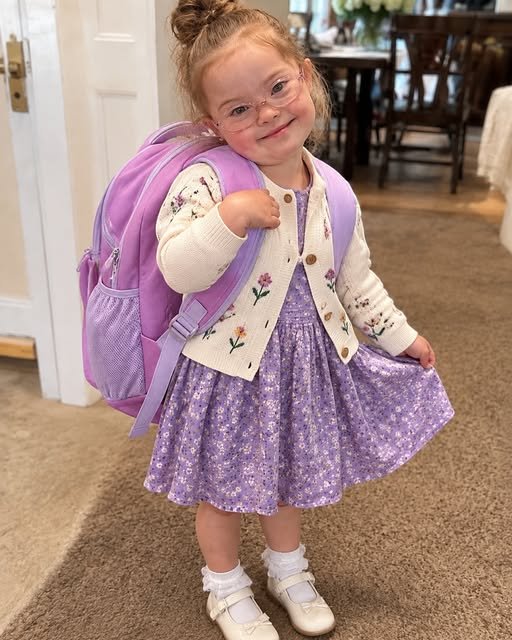
Part 1: The Things We Choose
I went to my daughter’s school prepared to demand an explanation. I thought the hardest part would be hearing what her teacher had said, not discovering what Victoria had been afraid to tell me.
Victoria was six when she started first grade. She had Down syndrome, an excellent memory for promises, and a firm belief that every dinosaur deserved a name, even the small plastic ones that came free with cereal.
She could pack her lunch if I opened the stubborn containers. She remembered which neighbors had dogs, which library books were overdue, and precisely how many sleeps remained before her birthday.
Still, on the first morning of school, I checked the fastenings on her backpack three times. Victoria finally put her hands over mine.
“Mommy, it’s closed.”
“I know, sweetheart.”
“Then you can let go.”
For the first two weeks, she came home with drawings, new songs, and detailed reports about the classroom guinea pig. I listened, then asked the questions that mattered most to my frightened heart.
“Did anyone tease you today?”
“No.”
“Was everybody nice?”
“Yes, Mommy.”
“You’d tell me if someone wasn’t, wouldn’t you?”
“I promise.”
I believed I was keeping the door open. Looking back, I wonder how often I made her feel that I was waiting for something to go wrong.
One Tuesday afternoon, she climbed into the car without telling me who had fed the guinea pig. At home, she sat on the bottom stair and worked at the laces of her bright yellow sneakers.
“How was school?” I asked.
“Good.”
“Did you play with Lily?”
She nodded, pulling one lace completely out of its top hole.
“And Emma?”
“Emma said my shoes were funny.”
I sat beside her. “Funny how?”
“Nobody else has yellow ones.”
Those shoes had been her choice, selected after an energetic inspection of every pair in the store. She had marched down the aisle in them and announced that they were fast enough to escape a tyrannosaurus.
“Did that hurt your feelings?” I asked.
“A little. Emma said princesses don’t wear yellow shoes.”
“Princesses can wear anything they want.”
Victoria looked up. “Even dinosaurs?”
“Especially dinosaurs.”
She smiled, but her fingers stayed tangled in the lace. “Will she still play with me?”
I could have told her that friendship shouldn’t depend on shoes. I could have helped her decide what to say if Emma brought it up again.
Instead, I glanced toward the white sneakers by the door. “Maybe wear those tomorrow, just until everybody gets to know you better.”
“But these are my favorites.”
“I know. Just for a little while.”
The next morning, she brought me the white pair. I tied them, kissed her forehead, and congratulated myself on making her day easier.
I didn’t notice that the yellow shoes stayed under the bench after that.
* * *
The following Thursday, Victoria brought home a flyer for the school’s autumn festival. There would be games, a book exchange, and face painting during the final hour before dismissal.
“Lily and Emma are getting butterflies,” she said.
“Would you like one, too?”
She traced the edge of the flyer. “Maybe.”
“Butterflies are lovely. You could have a purple one.”
“Okay, Mommy.”
That should have been a conversation. I treated it as a decision.
On festival morning, I put a new face-painting kit in my trunk before dropping her off. I had promised to demonstrate a few designs at the library’s family craft session that Saturday, and I planned to stop there after running errands.
Years earlier, I had painted faces professionally. Now I worked from home as a graphic designer, and the unopened kit had made me unexpectedly happy when it arrived.
I had barely finished lunch when my phone rang.
“Mrs. Parker? It’s Principal Harris. Victoria is with us in the office.”
My hand tightened around the phone. “Is she hurt?”
“She isn’t physically injured. She’s very upset, though, and she’s asking for you. Could you come in?”
“What happened?”
“Something at the face-painting table. We’re still sorting it out.”
I left my sandwich untouched.
* * *
Twenty minutes later, I stepped into a hallway filled with children wearing painted stars, flowers, and animal noses. A boy with tiger stripes held the door for me.
Victoria stood beside the secretary’s desk with a crumpled tissue in her fist. When she saw me, she ran forward so quickly that Mrs. Alvarez rose behind her.
“Mommy!”
I knelt and held her until her breathing slowed. Her face was bare.
“Tell me what happened.”
She pointed toward the open gym doors. “The painting teacher wouldn’t give me a butterfly.”
“Did she say why?”
Victoria rubbed her cheek. “She said makeup won’t make girls like me pretty.”
For a moment, I couldn’t hear the festival around us.
“What do you mean, sweetheart?”
“I said I wanted to look like Lily. She said paint wouldn’t change my face.” Victoria searched mine. “Am I not pretty? Please don’t lie.”
“You’re beautiful.”
“But she’s a teacher.”
I understood what she meant. Teachers explained how seeds grew and why ten came after nine; they were supposed to know things.
Through the gym doors, I could see a young woman painting pink wings around another child’s eyes. She smiled at something the child said.
“Is that her?” I asked.
Victoria nodded.
I wanted to cross the hallway immediately. Instead, I asked Mrs. Alvarez whether Victoria could stay with her for a few minutes.
“We were going to find the hidden animals in this book,” the secretary said, holding it up for Victoria to see.
“Are we going home?” Victoria asked me.
“Soon. Then the movies, if you still want to go.”
“And ice cream?”
“With sprinkles.”
She pressed her forehead against mine, then let Mrs. Alvarez guide her back to the chair.
Principal Harris came out of her office. I told her what Victoria had said, using my daughter’s words as carefully as I could.
“That is a serious concern,” she said. “I need to speak with Ms. Collins.”
“I agree. But I’d like to ask her what happened, too.”
We agreed that the principal would join us at the painting table after arranging for another staff member to supervise the waiting children. I wouldn’t confront Ms. Collins in front of her class.
When I approached, she had just finished a butterfly. The next child was still choosing a design with a parent several feet away.
“Excuse me,” I said. “Could you paint a little crown on my cheek?”
She smiled apologetically. “I’m afraid this station is for children.”
“That’s a shame. I’ve been practicing my royal wave.”
She laughed, and for one strange second I could imagine meeting her under entirely different circumstances.
“Do the children choose their designs?” I asked.
“Of course.”
“And every child gets a turn?”
“As long as we have time.”
I set my purse against my hip to stop my hands from shaking. “Then can you explain why Victoria Parker was turned away?”
Her expression changed.
“Victoria was having difficulty understanding something.”
“What was that?”
“She wanted to look like the other girls.”
“She wanted a butterfly.”
Ms. Collins glanced toward the hallway. “There’s more to it than that.”
Principal Harris had reached the edge of the table. I kept my voice low.
“Then tell us what you said.”
Ms. Collins put down her brush. “I was trying not to give her false hope.”
Part 2: What Adults Must Answer
“False hope about what?” I asked.
Ms. Collins noticed the principal behind me and straightened. “I think this conversation has become confused.”
“Then let’s make it clear,” Principal Harris said. “What happened when Victoria came to your table?”
“She asked for a butterfly like her friends. Then she kept asking whether she would look like them.”
“What did you tell her?”
“That face paint doesn’t change what someone looks like underneath.”
I stared at the neat rows of colors beside her hand. Every other child had been allowed to treat them as paint.
“Why did she need that explained before she could have a butterfly?” I asked.
“I was trying to manage her expectations.”
“She’s six. She wasn’t asking you to change her life. She was asking you to paint her face.”
Ms. Collins folded her arms. “Are you her mother?”
“Yes.”
“Then I’m sorry she was upset. Children sometimes misunderstand—”
“Please don’t finish that sentence until you’ve answered the question,” Principal Harris said.
A parent approached with a little boy, and the principal asked them to wait by the game tables. She pulled a folding screen partway across the station, giving us a little privacy without leaving the area unsupervised.
“Did you tell Victoria that makeup wouldn’t make girls like her pretty?” she asked.
Ms. Collins looked down. “I may have phrased it poorly.”
“Did you say it?”
There was a long pause.
“Yes. But not in the way she seems to have taken it.”
I had imagined shouting on the drive over. Now that she had admitted it, I felt painfully quiet.
“How was she supposed to take it?” I asked.
“I meant that appearance isn’t everything.”
“Then you could have painted the butterfly and treated her kindly. You could have shown her that.”
Ms. Collins opened her mouth, but Principal Harris interrupted.
“We’re stopping here. You’ll come to my office, and we’ll document what happened. Another adult will supervise this station.”
“Am I being removed over one badly worded comment?”
“You are being removed from this activity while we review a serious incident involving a child.”
The distinction mattered. I wanted accountability, but I didn’t want a promise made in anger that the school couldn’t honestly keep.
Before they left, I asked Principal Harris for a moment.
“Please don’t ask Victoria to hear an apology today,” I said. “She shouldn’t have to make anyone feel better.”
“Understood.”
“And I want a written account of what happens next.”
“You’ll have one. We’ll also speak with the adults who were nearby.”
Ms. Collins looked at me. “I didn’t intend to hurt her.”
“Then I hope you’ll think about why you did.”
I stepped aside so they could pass.
For perhaps thirty seconds, I thought the difficult part was over.
* * *
A few minutes later, a staff member stood behind the abandoned painting table, apologizing to a line of disappointed children. She could supervise the supplies, but she didn’t know how to use them.
“Can’t you just do a small butterfly?” one girl asked.
“I’m sorry, sweetheart. We’re trying to find someone.”
Victoria appeared in the gym doorway holding Mrs. Alvarez’s hand. She had heard the disappointment before I could get back to her.
Another girl spotted her. “Victoria, did the painting lady leave because you cried?”
Victoria stopped.
“No,” I said, moving beside her. “An adult needed to speak with the principal. Victoria didn’t do anything wrong.”
The girl looked uncertain rather than unkind. “But now nobody gets painted.”
The staff member called her over to help choose stickers, and Mrs. Alvarez rested a hand lightly on Victoria’s shoulder.
My daughter watched the line unravel. One child complained to his father; another rubbed at the unpainted cheek she had been saving for a flower.
“Mommy,” Victoria said, “I didn’t want everybody to lose their butterflies.”
“That isn’t your fault.”
“They were happy before.”
I looked at the empty chair, and an old question returned to me so clearly that I could almost hear myself asking it.
Who do you want to be today?
* * *
Nine years earlier, I had carried folding chairs, paint cases, and a mirror into birthday parties nearly every weekend. Some children arrived knowing exactly what they wanted; others needed to study the choices.
Their parents were often more certain.
At one party, a girl in a lace-trimmed dress climbed into my chair and asked for a green dragon with frightening teeth.
Her mother stepped forward. “She’s supposed to be a princess. We have photographs afterward.”
The girl’s shoulders dropped.
“Could we try the dragon?” I asked.
Her mother sighed. “Fine. Just make it cute.”
I gave the dragon impressive teeth and one slightly silly eyebrow. When the girl saw herself, she roared so enthusiastically that the next three children wanted dragons, too.
I remembered her grin long after I forgot the family’s name.
After Victoria was born, I gradually stopped working parties. Graphic design gave me steadier hours, and eventually my old supplies were packed away.
Apparently, I had packed away something else with them.
Before school started, Victoria and I had gone shopping for a backpack. She found a green one with soft spikes down the back and carried it around the store against her chest.
“He can hold my lunch,” she told me.
I pointed out a pink bag with silver stars. “This one has easier pockets. And lots of girls will have something like it.”
“But this one has teeth.”
“Wouldn’t you rather have the pretty pink one?”
She had looked from one to the other, then handed me the pink bag.
A week later, I ordered the dinosaur backpack anyway. I told myself it could be for outings, but when it arrived, I put it on the upper shelf of her closet.
She asked about it twice. Both times, I said we should save it.
Standing beside the painting table, I could remember defending a stranger’s daughter’s choice. I could also remember persuading my own daughter to abandon hers.
* * *
Back in the gym, I asked the supervising staff member whether she could stay while I found Principal Harris.
The principal stepped out of her office when she saw me. “Is Victoria all right?”
“She’s worried this is her fault. I’ve told her it isn’t, but the other children are disappointed.”
Principal Harris closed her eyes briefly. “I should have arranged the replacement before removing Ms. Collins.”
“You needed to stop what was happening. We can still fix the table.”
I explained my old job and the unopened kit in my car. Her relief was immediate, but she still asked sensible questions about the supplies and whether I felt able to stay.
“Only if Victoria wants to,” I said.
When I asked my daughter, she considered it carefully.
“Will we miss the movie?”
I checked the time. “There’s a later showing. We can paint for a little while and still go.”
“Mrs. Alvarez can help me find the last owl.”
The secretary lifted their book. “It’s proving very elusive.”
“Then I’ll stay,” Victoria said.
Ten minutes later, I had wiped down the table and set out fresh paints, clean brushes, and single-use sponges. The staff member managed the queue and checked with parents while I made a small practice stroke on my wrist.
My hand remembered.
“Come here, sweetheart,” I called. “You can have the first turn.”
Victoria approached, but she didn’t sit.
“I can make you a wonderful butterfly,” I said. “Any colors you want.”
She shook her head.
“Are you worried about Ms. Collins? She won’t be coming back to this table.”
“No.”
I put down the brush. “Then what is it?”
Victoria looked at the waiting children, then at me.
“I don’t want to be pretty anymore, Mommy.”
Part 3: Room for Something Different
I pulled a second chair close instead of asking her to sit in the painting chair.
“Tell me what you mean.”
Victoria pressed the damp tissue into a little ball. “Pretty makes everybody fight.”
“Oh, sweetheart.”
“Teacher said I wasn’t. You got mad. Then she went away, and the other kids got sad.”
I wanted to tell her again that she was beautiful, but she needed an answer to what she had actually said.
“You didn’t make the adults argue,” I told her. “An adult said something hurtful, and another adult had to deal with it. That was our job, not yours.”
“But the butterflies stopped.”
“And the adults found another way to do them. You didn’t have to fix that, either.”
She studied the clean brushes.
“You never have to earn kindness by looking a certain way,” I said. “Not from a teacher. Not from anyone.”
Victoria leaned against me for a moment. Then she asked whether we were still having sprinkles.
“Extra sprinkles. A promise is a promise.”
She returned to Mrs. Alvarez, who had brought the book and two chairs into the gym. I let her go without asking her to smile.
A little boy approached the table. “Can you do a tiger?”
“A reasonably fierce one,” I said. “Although I’ll need to check whether you have the proper roar.”
He demonstrated, startling his father into a laugh.
“Excellent qualifications. Stripes or spots?”
“Tigers have stripes!”
“Good. You’re ready for the advanced course.”
As I painted, my shoulders loosened. I knew how to keep a brush away from a moving eye, how to turn a wiggle into a joke, and how to ask a child whether the sponge felt ticklish.
For the first time since the phone call, there was something useful I could do with my anger.
The next child wanted a silver robot. The one after that asked for a flower on her hand instead of her cheek.
“My face is itchy today,” she explained.
“Your hand it is.”
Victoria looked up from the book when the girl left.
“She didn’t have to do her face?”
“No. It’s her choice.”
My daughter nodded slowly and went back to searching for the owl.
After a few more children, a girl with two loose braids climbed into the chair.
“A butterfly like Emma’s,” she said.
“Which colors do you like?”
“Emma’s is pink.”
“That tells me what Emma likes.” I moved the palette where she could see it. “What about you?”
She considered the colors for so long that her father started to answer. Then he stopped himself and waited.
“Orange,” she said at last. “With blue dots.”
“Excellent.”
“Will that look strange?”
“It’ll look like the butterfly you chose.”
She watched herself in the mirror while I added the dots. When she climbed down, she ran toward her friends calling, “Look! I picked orange!”
Victoria had stopped looking at the book.
“Mommy, hers wasn’t pink.”
“No.”
“And she liked it.”
“She did.”
My daughter stood, walked to the table, and rested two fingers on the edge.
“Can I choose something different?”
“Of course.”
“Even if nobody else has it?”
“Even then.”
She glanced at the children waiting behind her, then leaned close enough that her glasses brushed my hair.
“I want a green dinosaur.”
I smiled. “With teeth?”
“Really big teeth.”
I reached for the green paint, then stopped. “Did you change your mind about the butterfly?”
Victoria looked down.
“I didn’t want one.”
Her answer was quiet enough that only I heard it.
“But when we talked about the festival—”
“Lily wanted one. And Emma. You said I would look pretty.”
The girl at the birthday party came back to me: lace dress, green dragon, shoulders dropping when her mother spoke.
I set the paint down again.
“I’m sorry, sweetheart.”
Victoria frowned. “For what?”
“For forgetting to ask what you wanted.”
“I thought you wanted me to like butterflies.”
“You don’t have to like something because I like it.”
She picked at the cuff of her sleeve. “I didn’t want you to be sad.”
Behind her, the supervising staff member quietly led the waiting children toward the sticker basket. Nobody hurried us.
“You are not responsible for keeping me happy by agreeing with me,” I said. “I’m your mom. You can tell me no.”
Victoria looked uncertain, so I tried again.
“If I suggest a butterfly and you want a dinosaur, you can say, ‘I want a dinosaur.’ I’ll listen.”
“Even a scary one?”
“Especially if that’s the one you want.”
“And you won’t be sad?”
“Not about your dinosaur.”
She considered this distinction with great seriousness.
“Can I still have him?”
I picked up the clean brush. “Absolutely. How scary?”
“Very scary.”
“Then I’d better get the larger brush.”
Victoria laughed, and the sound made my eyes sting. I waited until my hand was steady before I began.
The dinosaur stretched along her cheek in bright green, with a curling tail and eyebrows that made him look mildly annoyed about something. His teeth were enormous.
She held still through most of it, although her feet kept tapping the chair legs.
When I handed her the mirror, she turned it one way, then the other.
“He’s awesome.”
“Does he have a name?”
“Mr. Chompy.”
“A distinguished name.”
She opened her mouth and gave the mirror a careful roar.
A girl waiting nearby leaned forward. “Victoria, what is that?”
Victoria’s smile faltered for half a second. I saw her grip tighten on the mirror, and I made myself wait.
“My dinosaur,” she said. “His name is Mr. Chompy.”
The girl examined him. “Can I have one with purple teeth?”
Victoria turned toward me, astonished.
“That sounds possible,” I said.
“Mine will be his cousin,” the girl announced.
Soon, three children were waiting for dinosaurs. One wanted tiny wings, which led to a detailed discussion about whether he was actually requesting a dragon.
Victoria stayed beside the table to hear the answer.
“They liked my idea,” she said when there was a pause.
“They did.”
I nearly added that this proved she should always be herself. Then I stopped, because her choice would still have mattered if nobody else had wanted it.
“And you liked it first,” I said.
She smiled at her reflection again.
Principal Harris came by to thank the staff member for managing the line. Victoria watched her for a moment, then stepped forward.
“I wanted a dinosaur before,” she told her.
The principal bent slightly to hear. “I’m glad you got to choose one.”
“Next time, can the paper have dinosaurs, too?”
She pointed at the sample sheet taped to the table. It showed butterflies, flowers, and two superhero masks.
“Yes,” Principal Harris said. “That’s a good suggestion.”
Victoria returned looking pleased, as though she had completed an important piece of school business. She had.
A little later, she examined my bare cheek.
“Mommy, what do you want to be?”
I remembered my opening request to Ms. Collins. “How about a queen?”
“Then you need a crown.”
With my hand lightly guiding hers, she painted a crooked gold shape beside my eye. We used a fresh brush, and she insisted that I look in the mirror before she declared it finished.
“Now we’re both pretty,” she said.
“We always were, sweetheart.”
She touched the air near Mr. Chompy, careful not to smudge him. Then her expression grew serious again.
“Mommy, there’s something else.”
“What is it?”
She glanced toward the gym doors, as if checking whether anyone might hear.
“Can I ask for something you put away?”
Part 4: The Next Morning’s Promise
I knew before she explained, but I let her tell me.
“My dinosaur backpack,” she said. “The one on the high shelf.”
For weeks, it had sat in its delivery bag above the winter blankets. I had bought it because I knew she loved it, then kept finding reasons not to let her use it.
“Of course you can have it.”
“For school?”
“For school.”
“Not just a trip?”
“Not just a trip.”
Victoria searched my face. “Are you sure?”
I moved my chair so we were facing each other.
“I was wrong to make you hide the things you love,” I said. “I thought I was helping, but I should have listened.”
“Because of Emma?”
“Because I was worried someone might be unkind. But choosing your backpack for you didn’t teach anyone to be kinder.”
She thought about that, then nodded toward the table. “Can we finish the dinosaurs?”
“We certainly can.”
There were still children waiting, and Victoria had not forgotten them. She helped by holding the sample sheet while each child chose, although she occasionally offered an unsolicited recommendation for larger teeth.
When one boy wanted a butterfly, she pointed out the orange paint.
“You can have any kind,” she told him.
I kept my eyes on the brush until I trusted myself to speak.
* * *
Half an hour later, the last child left the table, and we began packing up. The staff member carried the used supplies to a separate bag while Victoria collected the unopened sponges.
Principal Harris returned with a sheet of paper and asked whether I had a few minutes before we left.
Mrs. Alvarez offered to show Victoria the office’s collection of animal bookmarks. My daughter agreed after making the principal promise that nobody would wash off Mr. Chompy.
“He can stay,” Principal Harris said.
Once Victoria was out of earshot, the principal handed me a written summary of our conversation and the next steps. It wasn’t a finished investigation, and she didn’t pretend otherwise.
“Ms. Collins has acknowledged making the remark,” she said. “We’ll speak with the nearby adults and follow our personnel process. She won’t return to classroom duties while the incident is being reviewed.”
“I understand there are things you can’t discuss with me.”
“There are. But you will be told how we’re protecting Victoria and who will be working with her.”
I read the page before folding it into my bag.
“I don’t want this treated as a problem with Victoria’s sensitivity,” I said.
“It won’t be.”
“And I don’t want her expected to accept an apology just because an adult offers one.”
Principal Harris nodded. “Any conversation involving Victoria will be discussed with you first.”
I asked about the question another child had asked in the gym. The principal made a note to have staff address rumors without identifying Victoria as the cause of the change.
“The message can be simple,” she said. “Adults are responsible for making activities welcoming. Children are allowed to ask for help.”
That was the message I wanted Victoria to hear, too.
Before leaving, I asked whether she could check in with my daughter the next morning without making it feel like another interview.
“I can greet her at the door,” Principal Harris said. “Then she can tell me whether she needs anything.”
There was no grand announcement, no instant guarantee that school would never hurt again. There were names, responsibilities, and a time for a follow-up call.
For that afternoon, it was enough to let us leave.
* * *
Outside, Victoria stepped around a puddle and took my hand.
“Mommy, can I wear my yellow shoes tomorrow?”
I looked at the white sneakers I had encouraged her to choose. One toe was scuffed from the playground.
“Of course.”
“Even if Emma laughs?”
My first impulse was to promise that she wouldn’t. I had made too many promises about things I couldn’t control.
“Do you like your yellow shoes?” I asked.
“They’re my favorites.”
“Then you can wear them. If someone says something unkind, you can say, ‘I like them.’ And if you need help, you can ask your teacher or Principal Harris.”
“Or you?”
“Always me.”
She walked a few steps in silence.
“You said the white ones before.”
“I did. I’m sorry.”
“You can change your mind?”
“Yes. Especially when I’ve made a mistake.”
She accepted that more easily than I deserved. At the car, she tilted her head to inspect my gold crown.
“You’re different, too, Mommy.”
“Am I?”
“You have paint on your nose.”
I checked the rearview mirror. A bright green fingerprint sat directly above my nostril.
“A royal decoration,” I said.
Victoria laughed so hard that I had to wait before fastening her seat belt.
* * *
At the movie theater later that afternoon, I offered her the choice between two films. She studied the posters instead of looking at me for the right answer.
“The space one,” she decided.
“The space one it is.”
Halfway through, a creature with enormous eyes appeared on the screen. Victoria leaned toward me and whispered that he needed better teeth.
I whispered back that not everyone could have Mr. Chompy’s excellent dentist.
She covered her mouth to keep from laughing too loudly. Then she settled against my arm, and for the first time all day I stopped rehearsing the conversation at school.
Afterward, we went for ice cream. She chose strawberry, then asked whether she could have rainbow sprinkles and chocolate ones.
“Both,” I said.
“Because I had a bad day?”
The question caught me.
“Because I promised extra sprinkles.”
“Oh. Good.”
She carried her cup to a window table with the concentration normally reserved for transporting something breakable and royal. Mr. Chompy had begun to fade near her mouth, but his eyebrows remained impressively stern.
My phone vibrated while she was arranging her spoon on a napkin. It was Principal Harris, calling as promised.
She confirmed the temporary classroom arrangements for the next day and the time we would speak again. I wrote both down on a receipt.
“How is Victoria?” she asked.
I watched my daughter turn toward the window to admire her dinosaur in the reflection.
“She’s enjoying her ice cream,” I said. “We’re taking the rest one step at a time.”
After I ended the call, Victoria pointed at my cup.
“You always get vanilla.”
“I like vanilla.”
She nodded, satisfied. She wasn’t asking me to choose differently, only noticing that I had chosen.
We ate quietly for a while. At another table, a little boy noticed her cheek and asked his father whether he could have a dinosaur.
Victoria smiled but didn’t get up to explain him. Mr. Chompy belonged to her whether anyone else admired him or not.
“Mommy?”
“Yes?”
She touched the edge of her glasses. “Am I pretty now?”
The question still hurt, but I didn’t rush past it.
“You were beautiful before the paint, sweetheart. You’re beautiful with it. And you can wash it off tonight and still be exactly Victoria.”
She scooped up a spoonful of melting strawberry ice cream.
“Good. Because tomorrow I want to be a purple monster.”
I laughed. “Then we’ll need purple paint.”
This time, I didn’t suggest a butterfly.
* * *
That evening, Victoria stood beneath her closet shelf while I brought down the dinosaur backpack. She brushed a hand over its soft green spikes as though greeting an animal that had been waiting patiently for her.
We adjusted the straps together. The bag had room for her folder, lunch, and the library book she needed to return.
I almost asked whether she wanted to keep the pink one ready, just in case. Instead, I put it beside the other spare bags and let her finish packing.
At the front door, she set out her yellow sneakers.
“You’ll help with the knot?” she asked.
“Until you’ve got it.”
She practiced once before bed, making one uneven loop and a second that collapsed. I waited while she tried again.
The second knot held.
After her bath, Mr. Chompy was gone, but Victoria checked her cheek in the mirror and gave one last roar anyway.
I tucked her in with the dinosaur encyclopedia she liked me to read aloud. She stopped me on a page about a creature whose name neither of us could pronounce.
“Tomorrow, I have something to tell my class.”
I rested a finger between the pages. “Do you want help deciding what to say?”
“No. I know.”
“Will you tell me?”
Victoria pulled the blanket to her chin, wearing the small, pleased smile I used to see whenever she had planned a surprise.
“You’ll find out tomorrow.”
What would change if protecting someone meant helping them choose, rather than choosing for them?