
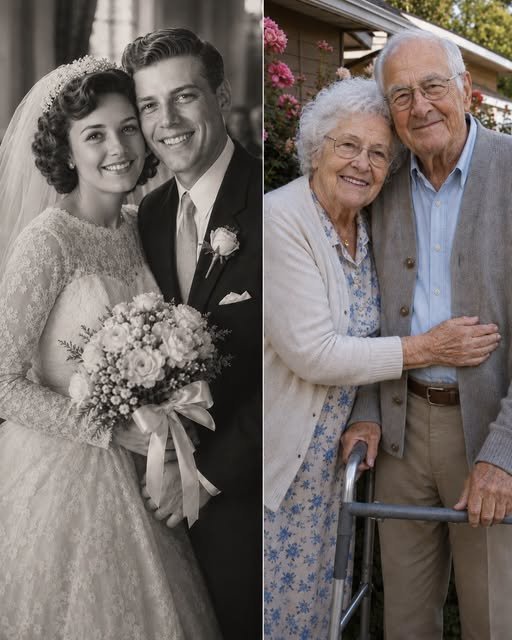
Part 1 — The Sentence That Broke My Heart
After sixty-nine years of marriage, I thought I knew every secret my husband had.
I knew Walter hated mayonnaise but pretended to like my potato salad for the first ten years of our marriage because he didn’t want to hurt my feelings.
I knew he kept emergency cash inside an old coffee tin in the garage.
I knew he cried every time he watched It’s a Wonderful Life, though he always blamed his watery eyes on “dust.”
And I knew that whenever he was worried, he rubbed the gold wedding band on his left hand with his thumb.
For nearly seven decades, I had watched that thumb circle that ring through births, funerals, graduations, layoffs, surgeries, arguments, reconciliations, Christmas mornings, and ordinary Tuesday nights.
I thought there was nothing left about Walter Hale that could surprise me.
Then he died.
And three weeks later, I learned how wrong I was.
Walter was ninety-one when his heart finally gave out. I was ninety.
We had met in college in 1955 when he accidentally took my seat in an American history lecture. I told him to move. He smiled and said, “You can sit next to me.”
I thought he was arrogant.
He thought I was beautiful.
Apparently, he was right about one of those things.
We married two years later.
We raised three children—Michael, Susan, and David—in a modest two-story house outside Columbus, Ohio. We survived lean years when Walter’s paycheck barely covered the mortgage and better years when we could finally take the children to the ocean.
We had five grandchildren.
We buried our parents.
We danced at our children’s weddings.
And in the final months of his life, when Walter became too weak to climb the stairs, I moved a bed into our downstairs study and slept on the couch beside him.
The night before he died, he woke around two in the morning and called my name.
“Eleanor?”
“I’m here.”
He reached for my hand.
“Did I give you a good life?”
I remember laughing softly.
“What kind of question is that after sixty-nine years?”
“Answer me.”
I squeezed his fingers.
“You gave me a life I would choose again.”
His eyes filled with tears.
Then he said something I didn’t understand.
“I hope you still feel that way when you know everything.”
I assumed the medication was making him confused.
By sunrise, he was gone.
Three weeks later, our family gathered in the conference room of Walter’s longtime attorney, Daniel Mercer, for the reading of his will.
I almost didn’t go.
At ninety, I had no interest in discussing money. Walter and I had always lived comfortably but simply. Our home was paid off. We had retirement savings. I assumed everything would pass to me, and whatever remained after I was gone would go to the children.
That was what married couples did.
Or so I thought.
Daniel sat at the end of a polished oak table with a folder in front of him.
Michael sat beside me. Susan held my hand. David and his wife sat across from us. Our grandchildren were scattered around the room.
Walter’s younger sister, Margaret, sat near the window.
Margaret was eighty-four, impeccably dressed as always, wearing pearls and a navy-blue jacket. Walter had loved her, although their relationship had grown strangely distant over the last fifteen years.
I had never understood why.
Whenever I asked, Walter would say only, “Margaret and I see some things differently.”
Daniel began reading.
Walter left generous donations to two local charities.
He left small personal items to the grandchildren.
His investments were divided among our children and grandchildren.
Then Daniel read that Walter’s cabin near Hocking Hills—the little wooden place his parents had owned when Walter and Margaret were young—would go entirely to Margaret.
Margaret smiled.
Not a grieving smile.
A satisfied one.
I noticed it, but before I could think much about it, Daniel turned a page.
Then he read the sentence that I would remember word for word for the rest of my life.
“To my wife, Eleanor Hale, I leave no assets under this will.”
The room went completely silent.
I thought I had misheard him.
“I’m sorry,” I said. “What?”
Daniel looked at me, but his expression gave nothing away.
He repeated it.
“To my wife, Eleanor Hale, I leave no assets under this will.”
Susan’s hand jerked away from mine.
“That can’t be right.”
Michael leaned forward. “Dad left Mom nothing?”
David stared at Daniel.
“After sixty-nine years?”
My face grew hot.
I felt as if everyone in the room were looking at me, wondering what I had done to make my husband punish me from the grave.
Margaret lowered her eyes.
But I saw the corner of her mouth move.
Almost like she had expected it.
I didn’t cry.
Maybe I was too shocked.
I simply sat there while Daniel finished reading words that no longer meant anything to me.
When it was over, my children surrounded me.
“We’re going to fight this,” Michael said.
“I don’t want to fight anyone.”
“Mom, this makes no sense.”
Susan’s eyes were wet. “Dad adored you.”
“So I thought.”
That was the first time I said those words.
And saying them hurt more than I expected.
Margaret approached us near the door.
She touched my arm.
“Walter was complicated, Eleanor.”
I looked at her.
“What does that mean?”
She hesitated.
Then she gave me a look I had never seen before.
Almost pitying.
“There were things about my brother you didn’t know.”
My stomach tightened.
Before I could ask what she meant, Daniel called from behind me.
“Mrs. Hale?”
I turned.
“Could you stay for a few minutes?”
Margaret stopped walking.
For the first time all afternoon, the satisfaction disappeared from her face.
Daniel looked directly at me.
“There’s something Walter instructed me to give you privately.”
Part 2 — The Letter
After everyone left, Daniel closed the conference-room door.
He did not immediately sit down.
Instead, he walked to a locked cabinet, opened it, and removed a cream-colored envelope.
My name was written across the front in Walter’s handwriting.
Eleanor.
Just seeing those familiar letters nearly broke me.
Walter’s handwriting had become shaky during his last year, but I would have recognized it anywhere.
Daniel placed the envelope in front of me.
“Your husband wrote this six months ago.”
“Why wasn’t it with the will?”
“Because he specifically instructed me not to give it to you until after the will had been read in front of the family.”
I stared at him.
“Why?”
Daniel took a breath.
“Read it.”
My fingers trembled as I opened the envelope.
Inside were eight handwritten pages.
The first lines stopped me cold.
My love,
If you’re reading this, then everyone now believes I left you nothing. That’s exactly what I needed everyone to believe.
I looked up.
Daniel remained silent.
I kept reading.
I know you are hurt. I know you are probably angry. You have every right to be. Before I explain the will, I need to tell you something I should have told you many years ago.
You need to know the truth about me.
All my life, I carried a secret I was ashamed of—not because of what I had done, but because I was afraid that once the truth entered our home, it would never leave us in peace.
I told myself I was protecting you. Sometimes I was. Sometimes I was simply afraid.
Please don’t trust Margaret until you finish this letter.
My eyes moved faster.
Walter wrote that when he was nineteen, two years before we met, his mother had become seriously ill.
Before she died, she told him something that changed his life.
The man Walter had always called his father was not his biological father.
Walter’s biological father was a man named Charles Bellamy.
I knew the name.
Anyone in central Ohio our age would have.
Bellamy Manufacturing had once been one of the largest privately held industrial companies in the state.
Charles Bellamy had died in the 1970s.
According to Walter’s letter, Charles and Walter’s mother had known each other when they were young. Their relationship ended before she realized she was pregnant. She later married the man Walter grew up calling Dad.
Only four people ever knew the truth.
Walter’s mother.
Charles Bellamy.
Walter.
And Margaret.
I stopped reading.
“Margaret knew?”
Daniel nodded.
I returned to the letter.
Walter’s mother had begged him never to confront the man who had raised him.
He was my father in every way that mattered, Ellie. I loved him. He loved me. I never wanted blood to become more important than the man who taught me how to ride a bicycle and sat beside my hospital bed when I had pneumonia.
Walter never contacted Charles Bellamy.
But Charles apparently knew about Walter.
When Bellamy died, he left instructions with an attorney.
Walter was quietly contacted.
A trust had been established for him.
Not a small one.
Walter wrote that when he first learned the amount, he felt physically sick.
At the time, Walter and I had three children and were still worrying about grocery bills.
He could have changed our lives overnight.
Instead, he told me nothing.
I lowered the pages.
“Why?” I whispered.
Daniel gestured toward the letter.
Walter had answered the question before I could ask it.
This is the part you may never forgive me for.
I didn’t tell you.
At first, I wanted to. I came home carrying the paperwork in my briefcase. You were in the kitchen helping Susan with a school project. Michael and David were arguing over a baseball glove. You looked tired, happy, irritated, and completely yourself.
And I became terrified.
Charles Bellamy’s attorneys warned me that other members of the Bellamy family might challenge the trust if my identity became public. Margaret had already found one of Mother’s old letters and knew everything. She believed that because she was my sister, she should receive half of anything I received.
When I refused, she told me she would make sure everyone knew whose son I really was.
I was afraid of newspaper stories. Lawsuits. People approaching our children. I was afraid money would enter our marriage like a stranger and sit between us forever.
So I made the worst decision of my life.
I kept quiet.
I sat back in the chair.
For sixty-nine years, Walter and I had shared almost everything.
Or I had believed we had.
Yet for more than forty years, my husband had been carrying a secret fortune.
I was furious.
Even now, I can admit that.
Love does not erase anger.
Death does not make every mistake forgivable.
I wanted Walter sitting across from me so I could demand an explanation.
I wanted to tell him he had no right to decide what I could handle.
But there were still several pages left.
And Walter had written one sentence in capital letters.
THE MONEY IS NOT THE REAL SECRET.

Part 3 — What Walter Had Done With It
Walter explained that he never lived on the principal.
Instead, he quietly invested it.
Over the decades, the trust grew.
But he also used part of the income every year.
Not for cars.
Not for vacations.
Not for another woman.
For people.
Walter had spent more than thirty years anonymously paying college tuition for students whose parents could not afford it.
He had helped families facing medical bills.
He had paid off the mortgage of a retired teacher after her husband died.
He had funded a food pantry.
He had contributed to a shelter for women and children.
And he had done almost all of it under one name.
The Eleanor Fund.
My hand flew to my mouth.
I read the paragraph twice.
Then a third time.
I called it that because every good thing I ever learned about generosity, I learned from you.
Do you remember Mrs. Campbell from our old neighborhood? When her husband lost his job, you left groceries on her porch and pretended you didn’t know who had done it.
I remembered.
Do you remember the winter Michael was eleven and we barely had enough money for Christmas? You still bought a coat for the little boy in Susan’s class because you noticed his sleeves stopped halfway up his arms.
I remembered that too.
You always gave when nobody was watching.
So when I suddenly had more money than I believed any one person needed, I asked myself what Eleanor would do.
Tears dropped onto the page.
Walter had kept records.
Hundreds of people had received help.
Most never knew where it came from.
But there was something else.
Twenty-eight years earlier, Walter had created a second trust.
Not in his name.
In mine.
He had transferred part of his inheritance into it gradually and legally, with independent trustees and detailed documentation.
I was the beneficiary.
The trust would become fully available to me when Walter died.
That money was never part of his estate.
Which meant it was never part of his will.
I stared at Daniel.
“How much?”
He hesitated.
“Would you like the exact figure?”
“I think after sixty-nine years of marriage, I’ve earned the exact figure.”
A faint smile crossed his face.
“As of this morning, the Eleanor Hale Trust holds approximately eleven point eight million dollars in investments and cash equivalents.”
I actually laughed.
Not because it was funny.
Because sometimes the human body has no idea what else to do with shock.
“Eleven million?”
“Eleven point eight.”
“My Walter?”
Daniel nodded.
“The man who spent three weeks comparing prices before buying a new lawn mower?”
“The same man.”
I looked back at the letter.
There was still more.
Now you understand why the will had to say I left you nothing.
Margaret knows about Charles Bellamy. She knows there was money. What she does not know is what became of it.
For years, she believed I still controlled everything personally. She repeatedly asked me for larger and larger amounts. I helped her when she genuinely needed help, but I refused to give her control over money that was never hers.
Over the last few years, she became convinced she could challenge my estate after my death.
If I had named you as the primary heir in my will, she would have aimed everything at you.
So I removed the target.
I left you nothing under the will because, legally, the most important things had already been placed beyond the will years ago.
Daniel explained that Walter’s planning had not happened during his final illness.
It had been structured over decades.
There were medical records confirming his competence, independent financial advisers, trustees, tax records, signed documents—an entire paper trail.
“It wasn’t a last-minute trick,” Daniel said. “Walter designed this years ago.”
“Why leave Margaret the cabin?”
Daniel gave me a long look.
“That answer is on the last page.”
I turned it over.
Walter’s handwriting became shakier near the end.
Margaret always believed the cabin was worth more than it was. She believed Mother hid documents there. She has spent years asking me to sign it over to her.
So I did.
The cabin belongs to her now. Let her have it. There is nothing hidden there. There never was.
Despite myself, I smiled.
That sounded exactly like Walter.
Then I reached the final paragraphs.
And my smile disappeared.
There is one more thing, Ellie.
Something I need you to do.
There is a woman named Rebecca Lawson.
You have never met her.
But she knows who you are.
My heartbeat suddenly felt loud inside my chest.
Walter included an address in Cincinnati.
Then came the sentence that made my blood run cold.
Rebecca is Charles Bellamy’s granddaughter.
And she is the reason Margaret has been so desperate to find the money.
Part 4 — Margaret Came to My House
I barely slept that night.
I was angry with Walter.
Grateful to Walter.
Proud of him.
Furious with him.
Heartbroken all over again.
You can love someone for almost seventy years and still discover there are rooms inside them you were never invited to enter.
The next morning, Margaret came to my house.
I hadn’t called her.
She arrived at nine-thirty wearing sunglasses and carrying a bakery box.
“I thought you shouldn’t be alone.”
“That hasn’t bothered you for the last three weeks.”
She paused.
Then she smiled.
“Grief makes people sharp.”
“So does being left nothing by one’s husband.”
I watched her carefully.
Walter’s warning echoed in my head.
Don’t trust Margaret.
She followed me into the kitchen.
For several minutes, she talked about ordinary things.
Then she finally asked, “What did Daniel want yesterday?”
There it was.
I poured coffee.
“He gave me a letter from Walter.”
Her fingers tightened around the handle of her cup.
“What kind of letter?”
“A personal one.”
“What did it say?”
“Personal things.”
For the first time since I had known Margaret, she lost control of her expression.
“Eleanor, my brother kept things from you.”
“So you’ve told me.”
“There may be accounts. Property. Investments.”
I looked at her.
“How would you know?”
Silence.
Then Margaret leaned closer.
“Walter wasn’t who you thought he was.”
“Who was he?”
She glanced away.
“I can’t explain everything.”
“Then don’t.”
I stood.
Her voice hardened.
“If Daniel gave you paperwork, you should let me see it.”
“No.”
“Eleanor, you don’t understand what you’re dealing with.”
“Perhaps not.”
I opened the kitchen door.
“But I’m beginning to understand you.”
Margaret stared at me.
Something cold passed between us.
Then she picked up her purse.
At the doorway, she turned.
“Walter owed me.”
I shook my head.
“No, Margaret. Walter loved you. Those aren’t the same thing.”
She left without answering.
That afternoon, I called Rebecca Lawson.
Part 5 — The Woman in Cincinnati
Rebecca asked if we could meet somewhere public.
Two days later, Susan drove me to Cincinnati.
I didn’t tell her everything. Not yet.
Rebecca chose a quiet café near a park.
I recognized her immediately, although I had never seen her before.
She was perhaps fifty-five, with silver beginning to show in her dark hair.
She stood when I approached.
“Mrs. Hale?”
“Eleanor.”
Her eyes filled with tears.
“I’ve wanted to meet you for years.”
That was not what I expected.
We sat down.
Then Rebecca placed an old photograph on the table.
It showed Walter at approximately seventy, standing beside a group of young people holding college certificates.
I touched the photograph.
“When was this?”
“About twenty years ago.”
I looked at her.
Rebecca explained.
Her grandfather, Charles Bellamy’s only acknowledged son, had inherited the Bellamy company but lost much of the family’s wealth through bad business decisions.
Rebecca grew up hearing rumors that Charles had another son.
Walter.
When Rebecca was in her thirties, she began searching.
Eventually, she found him.
“I wasn’t looking for money,” she said quickly. “I wanted to know if the story was true.”
Walter agreed to meet her once.
Then again.
Over the years they became friends.
Rebecca learned about the charitable fund.
Eventually, she began helping him administer scholarship applications.
“He talked about you constantly,” she said.
I looked up.
“Me?”
Rebecca smiled.
“He called you his compass.”
That almost undid me.
She pulled a folder from her bag.
Inside were letters from students who had received scholarships.
A nursing student who became the first person in her family to graduate from college.
A young man who became a teacher.
A single mother who earned an accounting degree at thirty-seven.
A boy who had spent part of his childhood in foster care and later became a social worker.
There were photographs.
Graduation announcements.
Wedding invitations.
Christmas cards.
All addressed simply to The Eleanor Fund.
“I didn’t know,” I whispered.
“That was the point.”
“Why didn’t Walter tell me?”
Rebecca’s expression softened.
“I asked him that once.”
“And?”
“He said he had waited so long that every year made telling you harder. Eventually, he was afraid the secret itself would hurt you more than the truth.”
“He was right.”
“I’m sorry.”
“So am I.”
Then I asked the question that had brought me there.
“Why was Margaret looking for the money?”
Rebecca looked down.
“Because she thought my family wanted it.”
Apparently, Margaret had contacted Rebecca several times.
She told Rebecca that Walter had stolen a Bellamy inheritance that should have belonged to the “legitimate family.”
Rebecca corrected her.
Charles Bellamy’s trust had been explicit. Walter was the beneficiary.
But Margaret kept searching for records.
“She believed if she could prove Walter still held everything personally when he died, she could pressure both sides into a settlement.”
“Both sides?”
“You and us.”
I understood.
Margaret had imagined a fortune trapped inside Walter’s estate.
She thought she could frighten me with the Bellamy secret and frighten Rebecca’s family with the threat of public embarrassment.
Walter had solved the problem by ensuring the fortune wasn’t in his estate at all.
I laughed quietly.
Rebecca smiled.
“He was clever.”
“He was impossible.”
“He said you would say that.”
I looked at her sharply.
Rebecca reached into her folder.
“There is one more letter.”
My name was written on it.
Again.
Walter.
I closed my eyes.
“That man certainly had a lot to say after he died.”
Rebecca laughed.
“He said there was one final question only you could answer.”
I opened the letter.
It was much shorter than the first.
Ellie,
If you’ve made it this far, you’re probably furious enough to dig me up and argue with me.
I laughed through my tears.
That sounded like him.
I deserve some of that anger.
But now you know what the money became.
And I have one last request.
Don’t spend the rest of your life protecting my secret.
Use it.
Tell the children. Tell the grandchildren. Tell them where it came from, including the parts I’m not proud of. I don’t want our family to learn that love means never making mistakes. I want them to learn that love means telling the truth, even when the truth arrives late.
Then came the final line.
And if you can forgive an old fool, take the Eleanor Fund and make it truly yours.

Part 6 — I Told My Children Everything
The following Sunday, I asked all three of my children to come home.
We sat around the same dining table where Walter had carved Thanksgiving turkeys for nearly fifty years.
His chair was empty.
For the first time, I did not avoid looking at it.
“I have something to tell you about your father.”
They listened.
I told them everything.
About Charles Bellamy.
The inheritance.
The trust.
Margaret.
Rebecca.
The scholarships.
The eleven point eight million dollars.
Michael stared at me.
Susan cried.
David asked, “Dad had almost twelve million dollars?”
“Technically,” I said, “I apparently have almost twelve million dollars.”
For several seconds nobody spoke.
Then Michael started laughing.
“Mom, Dad made me pay him back twenty-eight dollars for a broken garage window when I was sixteen.”
“With interest,” David added.
“Two percent,” I said.
All three burst out laughing.
And suddenly I was laughing too.
It was the first time our house had sounded alive since Walter died.
Then Susan grew serious.
“Are you angry?”
“Yes.”
“At Dad?”
“Yes.”
“Do you forgive him?”
That question took longer.
Finally, I said, “I’m working on it.”
I looked at Walter’s empty chair.
“Your father made a mistake by deciding for me what truth I could handle. He should have trusted me with it.”
They nodded.
“But he also spent decades turning something he never asked for into something that helped people. Both things can be true.”
That became important to me.
Walter didn’t become a saint because he died.
He was still the man who left wet towels on the bathroom floor.
The man who once forgot our anniversary.
The man who could hold a grudge over a card game for three days.
And yes—the man who kept an enormous secret from his wife.
But he was also the man who got up early every winter morning to warm my car before work.
The man who sat beside our daughter all night after her first heartbreak.
The man who quietly paid for strangers to attend college and never asked anyone to thank him.
People are complicated.
Marriage is complicated.
Love is not the absence of disappointment.
Sometimes love is what survives after disappointment enters the room.
Two weeks later, Margaret called me.
I agreed to meet her.
She came to the house looking older than I remembered.
She knew.
Daniel had apparently informed her that Walter’s residual estate did not include the Bellamy assets she expected.
“He gave it all to you,” she said.
“No.”
Her eyes narrowed.
“No?”
“He spent a great deal helping other people. The rest was placed in a trust years ago.”
“For you.”
“Yes.”
Her face tightened.
“I was his sister.”
“You were.”
“Our mother carried that secret. I carried it. Do you know what it was like knowing Walter had another father? Knowing some wealthy man had left him millions while I got nothing?”
I studied her.
For the first time, I saw something beneath the bitterness.
A little girl who had once looked at her brother and decided life had chosen him over her.
“I’m sorry that hurt you,” I said.
She blinked.
“But the money was never yours.”
Her jaw stiffened.
“I deserved something.”
“Walter left you the cabin.”
She gave a humorless laugh.
“That falling-down place?”
“The falling-down place you’ve asked him for since 1983.”
That silenced her.
Then I said something I had been thinking about for days.
“Margaret, Walter spent half his life being afraid money would destroy his family. Don’t prove him right.”
Her eyes filled.
She looked away.
When she left, we did not hug.
Some endings are not that neat.
But six months later, she mailed me a photograph.
It showed the old cabin with a newly repaired porch.
On the back she had written:
You were right. I wanted this place more than I remembered.
That was the beginning of something.
Not reconciliation.
Not yet.
But a beginning.
Part 7 — What Walter Really Left Me
I did not buy a mansion.
I did not buy a yacht.
At ninety, I had nowhere I needed to sail.
I did replace my twenty-year-old furnace.
Walter would have approved.
Then I met with Rebecca, Daniel, my children, and several financial advisers.
Together, we expanded the Eleanor Fund.
We established permanent scholarships for students who had lost a parent.
We funded emergency housing for older women living alone.
We created grants for community college students returning to school later in life.
And I added one rule.
Every recipient would receive a letter.
Not Walter’s whole story.
Just a message.
It said:
Someone you never met believed your future was worth investing in. When you are able, do the same for someone else.
A year after Walter died, our family held a small gathering at the college where he and I had met.
A scholarship recipient named Jasmine spoke.
She was twenty-two and studying nursing.
Her mother had died when she was sixteen. Her father worked two jobs.
Without the scholarship, Jasmine told us, she would probably have dropped out.
Then she said something I will never forget.
“I don’t know who started this fund. But whoever they were, they believed people shouldn’t be judged only by what they have today. They should be given a chance to become who they might be tomorrow.”
I cried.
My grandchildren cried.
Even Michael cried, though he pretended he had something in his eye.
Afterward, I walked alone across campus.
The buildings had changed.
The trees were taller.
The students passing me were young enough to be my great-grandchildren.
Eventually, I found the lecture hall where Walter and I had met almost seventy years earlier.
The door was unlocked.
I stepped inside.
For a moment, I could see us again.
Twenty-year-old Eleanor with books pressed against her chest.
Twenty-one-year-old Walter sitting in her seat with that ridiculous grin.
“You’re in my place,” I had told him.
“You can sit next to me.”
If I could return to that room and warn the young woman I once was, what would I tell her?
That the boy smiling at her would someday break her heart?
Yes.
More than once.
That he would frustrate her?
Absolutely.
That he would keep a secret so large she would question whether she had ever truly known him?
Yes.
But I would tell her something else too.
Sit down.
Take the seat beside him.
Because a life does not have to be perfect to be worth choosing.
Walter’s final letter remains in the top drawer of my bedside table.
Sometimes I still read it.
One paragraph matters more to me now than the millions, the trust, or the Bellamy secret.
Near the end, Walter wrote:
You may think I left you nothing because that’s what the will says. But a will can only list things a person still owns.
The truth is, Ellie, the most important things stopped belonging to me a long time ago.
My best years belonged to you.
My favorite memories belonged to you.
Every version of home I ever knew had you standing somewhere inside it.
And the money? I hope you’ll use it well.
But please don’t mistake it for my inheritance to you.
My inheritance is the family sitting around your table, the people who were helped without knowing our names, and sixty-nine years of mornings when I woke up beside the woman I loved.
I know I should have trusted you with the truth sooner.
I’m sorry.
If I could do our life again, I would tell you.
But I would still choose you. Every single time.
For weeks after Walter died, I believed his will contained the cruelest sentence I had ever heard:
“To my wife, Eleanor, I leave no assets under this will.”
Now I understand why.
Walter had left me nothing in his will because the will was only the smallest part of what he left behind.
He left me enough money to change thousands of lives.
He left our children a story about the danger of secrets.
He left his sister an opportunity to release decades of resentment.
He left strangers opportunities they might never otherwise have received.
And after sixty-nine years, he left me one final lesson.
Love isn’t proven by what someone’s name receives on a piece of paper after you’re gone.
It’s proven by what you built while you were here.
I still wish Walter had told me the truth himself.
I wish he had sat across from me at our kitchen table, rubbed his wedding ring with his thumb, and said, “Ellie, there’s something I need to tell you.”
I would have been angry.
I would have asked a hundred questions.
I probably would have made him sleep on the couch.
But eventually, I would have reached across that table and taken his hand.
Because after all those years, there was one thing Walter never needed to hide from me.
He was imperfect.
So was I.
And somehow, through nearly seven decades of imperfect choices, ordinary days, hard seasons, small kindnesses, laughter, mistakes, forgiveness, children, grandchildren, and love, we had built a life neither one of us could have created alone.
Walter thought his greatest secret was hidden inside that letter.
He was wrong.
The greatest truth was much simpler.
After sixty-nine years, my husband did leave me something.
He left me a reason to keep giving.
And in the end, that was worth far more than anything he could have written into a will.