
Part 1 – The Phone Call That Changed Everything
The first sound I remembered after the crash was metal bending somewhere beyond the windshield.
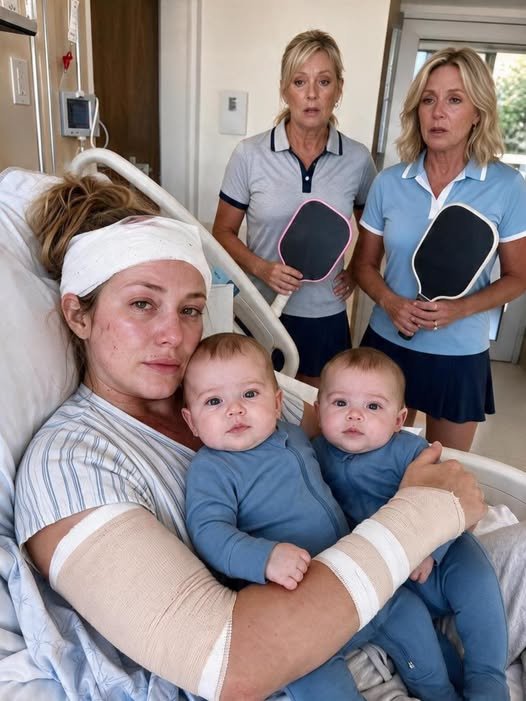
The second was my mother’s voice telling me her pickleball game mattered more than helping my children.
I was thirty-eight years old, newly widowed, and lying beneath the white lights of St. Anne’s Hospital with a fractured pelvis, two broken ribs, and a doctor telling me I would need help standing for at least twelve weeks.
But none of that frightened me as much as the two empty spaces beside my bed.
“Where are my babies?” I asked.
Noah and Lily had turned one exactly nine days earlier. Their birthday balloons were still tied to the back of a dining chair at home, slowly losing air. That morning, I had buckled them into their rear-facing car seats before driving to a pediatric appointment. A delivery van went through a red light three blocks from the clinic.
The twins had been protected by their car seats. They had bruises and were frightened, but the pediatric team found no serious injuries.
“They’re safe in the family nursery,” a nurse told me. “We’ll bring them in as soon as you’re settled.”
Safe.
I held on to that word until the doctor explained everything else.
I could not lift either child. I could not carry them up the six steps to my front porch. For a while, I would not even be able to get from my bed to the bathroom without assistance.
The hospital could supervise the twins until the next afternoon. After that, I needed a childcare plan.
Eleven months earlier, my husband, Ben, had passed away unexpectedly. Since losing him, I had learned to manage midnight fevers, my small accounting firm, and the lonely hour after the twins fell asleep.
But I could not do this alone.
So, at 2:17 that afternoon, with an IV taped to my hand and both legs feeling impossibly heavy, I called my mother.
She answered on the fourth ring.
“Mom,” I said. “There’s been an accident.”
“What kind of accident?”
“A van hit us. The babies are all right, but I’m in the hospital. I can’t walk without help.”
There was a brief pause. In the background, I heard cupboard doors and the steady tap of something against a countertop.
“I need you and Dad to take Noah and Lily for a few weeks,” I continued. “Or stay at my house with them. Just until we arrange something longer-term.”
My mother sighed.
It was not the sound of a woman frightened for her daughter. It was the sound she made when a restaurant server brought the wrong salad dressing.
“Mara, I have pickleball at four.”
I thought the medication had made me misunderstand her.
“Mom, I could have lost my life. I can’t get out of bed.”
“And what exactly do you expect me to do with two one-year-olds? Your father and I have our own lives.”
“They’re your grandchildren.”
Her voice hardened. “Your sister never brings this kind of trouble to our door.”
That sentence hurt in a place no scan could show.
Claire was three years younger than I was. When her boutique had a slow month, I paid the lease. When she needed a new point-of-sale system, I bought it. When she took a ten-day trip to Scottsdale to “clear her head,” I covered the salary of the employee she left behind.
But in my mother’s version of our family, Claire never caused trouble.
I did—by needing help once.
“Please,” I whispered. “I don’t have anyone else who can take them tonight.”
“We’re not full-time babysitters. You always figure things out, Mara. Figure this out.”
Then she ended the call.
I kept the phone against my ear and remembered eight years of bank transfers.
I had paid $2,350 toward my parents’ mortgage every month. I also covered their $860 SUV payment, their $440 country club membership, and the family phone plan. During the previous three years, I had put $92,400 into Claire’s boutique.
Whenever one of them called, I solved the problem before they had to feel uncomfortable.
Whenever I needed something, they reminded me how capable I was.
I had confused being useful with being loved.
A baby cried in the hallway.
Lily.
I tried to sit up. Pain stopped me after barely an inch, and the helplessness of not being able to reach my daughter broke whatever composure I had left.
A nurse named Elena Ramirez came into the room. She was perhaps fifty, with silver threads in her dark braid and tiny sunflower earrings. She lowered the rail, adjusted my pillow, and waited without asking me to stop crying.
“Is there someone else we can call?” she asked.
Through the nursery window across the hall, I could see the tops of two clear bassinets.
My children deserved adults who did not consider them an interruption.
In that moment, my panic settled into something quieter and stronger.
“Yes,” I said. “Please call Daniel Cho. He’s my attorney.”
Part 2 – The Decision
Daniel answered before the second ring ended.
He had been Ben’s college roommate before becoming the attorney for our business and estate. Calm was his natural state.
But when he heard my voice, his voice changed.
“Mara? What happened?”
I told him about the collision, the twins, the twelve-week estimate, and my mother’s refusal. He did not interrupt. When I finished, he asked one question.
“What do you need me to do first?”
I looked at the phone in my hand. For years, I had assumed asking for help made me difficult. Daniel’s question made help sound ordinary.
“I need safe care for Noah and Lily,” I said. “Then I need you to stop every voluntary payment I’m making to my family.”
There was a pause, but it was nothing like my mother’s.
“All of them?”
“All of them.”
“I’ll review the accounts and make sure we don’t touch anything that could damage your credit or violate an agreement. But the gifts and recurring transfers can stop today.”
“Cancel the club charge and the phone plan after proper notice. Don’t pay next month’s boutique lease. Stop the mortgage transfers.”
My voice trembled, yet the words did not.
“And Daniel? My parents are named as guardians in my will. I want that changed.”
“We’ll change it when you’re medically able to review the documents. For tonight, let’s protect the children and get you through the next twenty-four hours.”
Daniel contacted the hospital social worker, and together we made a plan that was far more practical than the disaster I had imagined.
My insurance covered part of my in-home rehabilitation. My savings could pay for a home-health aide and a licensed childcare agency that completed background checks and required infant CPR certification. It would cost $7,180 for the first full month.
Then Daniel read aloud the total of my average monthly support to my parents and sister.
“Seven thousand three hundred and ten dollars,” he said.
For $130 less than I had been spending to keep three healthy adults comfortable, I could keep my own children safe while I learned to walk again.
At 6:40 that evening, Daniel arrived with my closest friend, Tessa Morgan. She lived forty-five minutes away with her husband, Mark, and their two teenagers. She had been in Denver that morning. I had not called because she was traveling—and because some ashamed part of me believed family trouble should remain inside the family.
Daniel had called her anyway.
She entered my room carrying a suitcase in one hand and a grocery bag full of diapers in the other.
“You should have called me first,” she said.
“You were in Colorado.”
“Airplanes fly both directions.”
She stayed with the twins that night while the agency completed its emergency placement process. She sang the same three lines of an old nursery rhyme until Noah finally slept. When Lily threw a spoon onto the floor seventeen times at breakfast, Tessa picked it up seventeen times.
The next morning, a caregiver named Denise Parker arrived. She was forty-six, had worked with infants for nineteen years, and carried a binder containing her certifications, references, feeding logs, and emergency numbers. She asked permission before touching either child.
By noon, Noah was offering her a damp cracker, which was his highest form of trust.
For the first time since the accident, I took a full breath.
Then my phone began to ring.

Part 3 – What Happened When the Money Stopped
My mother called six times that afternoon.
I did not answer until Elena helped me sit upright for dinner.
“What did you do?” my mother demanded.
Not “How are you?”
Not “Where are the babies?”
“What did you do?”
Daniel had canceled the country club charge on my credit card. He had also sent my parents a clear letter explaining that voluntary financial support would end after the current billing cycle.
“I stopped paying bills that aren’t mine,” I said.
“Your father got an email about the SUV insurance. Claire says her landlord hasn’t received next month’s rent.”
“That’s correct.”
“You’re punishing us because I couldn’t drop everything without notice?”
I looked across the room at the twins. Denise had brought them for an evening visit. Lily was asleep against her shoulder, and Noah was trying to remove his own sock.
“No, Mom. I’m taking responsibility for my household. I asked you for help during the biggest emergency of my life. You told me to figure it out. I did.”
“After everything we’ve done for you—”
“Name one thing you have done for me since Ben died.”
The silence lasted nine seconds. I know because I watched the second hand move around the wall clock.
Then she said, “You’re being emotional,” and hung up.
The next day, Claire came to the hospital.
For one foolish second, when I saw her through the doorway holding a paper bag, I thought she had brought lunch. She had brought three boutique invoices and a lease notice.
“Daniel says you’re cutting me off,” she said.
She did not look at my hospital bracelet. She did not ask about the twins.
“I’m not cutting you off,” I replied. “I’m no longer funding your business.”
“That’s the same thing.”
“It shouldn’t be.”
Claire lowered her voice. “The fall collection arrives in two weeks. I have payroll on Friday.”
“How much is in your business account?”
She looked away.
“Claire?”
“Eight hundred and twelve dollars.”
I had built financial plans for sixty-three small businesses. Claire’s boutique had survived because I quietly filled every gap.
“I’ll pay your two employees for the hours they’ve already worked,” I said. “They shouldn’t be hurt by our family problem. Daniel can help you speak with the landlord and create a lawful plan for the remaining obligations. But I won’t send another blank check.”
Her eyes filled, more from fear than sorrow.
“Mom said you’d calm down.”
“Did Mom tell you why I’m here?”
“She said you had a car accident.”
“Did she tell you I can’t stand? Did she tell you I asked her to care for Noah and Lily?”
Claire hesitated.
“She said you were being dramatic and that the hospital had people.”
I studied my sister’s face. She was not cruel in the deliberate way I had imagined during sleepless nights. She was comfortable. I had made her so comfortable that she had never needed to examine what her comfort cost me.
“The hospital had people for twenty-four hours,” I said. “What did you do when she told you?”
Claire stared at the invoices in her lap.
“I assumed you would handle it.”
There it was. The family rule in seven words.
Mara will handle it.
“I am handling it,” I said. “But not for you anymore.”
She left the bag of invoices on the chair and walked out without saying goodbye.
I cried after she left. Setting a boundary did not feel victorious. It felt necessary, painful, and long overdue.
Elena came in with a cup of ice chips.
“Was that your sister?” she asked.
I nodded.
“You did not lose a family today,” she said gently. “You stopped doing all the work required to pretend you had one.”
I wrote those words in the notes app on my phone.
Part 4 – Learning to Receive
I spent eighteen days in the hospital and rehabilitation center.
Progress arrived in numbers small enough to sound meaningless to anyone else.
Eleven seconds standing between parallel bars.
Four steps on a Tuesday.
Nine steps on a Friday.
The first time I transferred from the bed to a wheelchair without panicking.
The first time I held both children with a wide support pillow while Denise sat beside us.
During those weeks, people I had never considered family appeared with exactly what we needed. My office manager, Keisha, organized a meal calendar with fourteen clients. Mark installed a temporary ramp. Tessa washed thirty-two tiny socks and returned them as sixteen matching pairs. My neighbor, Mr. Alvarez, rolled my trash bins to the curb every Wednesday.
No one sent an invoice.
No one compared me to Claire.
No one acted as though kindness had to be earned.
Daniel brought the revised estate documents to the rehabilitation center. I named Tessa and Mark as the twins’ guardians, with funds placed in a protected trust for the children’s care and education. They took two days to discuss it before saying yes, which made me trust them even more.
“We hope the documents are never needed,” Tessa said. “But they’ll always have a home with us.”
I signed my name slowly.
That was the decision that changed my life—not simply canceling payments, but finally placing my children’s security ahead of my fear of disappointing my parents.
My mother continued calling. Her messages moved from anger, to guilt, to warnings about what relatives might think. On day twelve, she said my father might have to sell the SUV.
I replied, “A less expensive car sounds reasonable.”
On day seventeen, she wrote, “I don’t recognize the daughter I raised.”
I answered, “You raised me to believe my value came from solving everyone’s problems. I’m trying to recognize myself without that job.”
She did not respond.
When I returned home, the ramp led to a front door covered with paper stars. Tessa’s teenagers had cut out forty-seven of them. Each carried a message from someone in our small circle.
You are allowed to heal.
We’ve got the grocery run.
One day at a time.
Noah tore down the lowest star and tried to eat it.
I laughed so hard my ribs protested.
For the next six weeks, my world became a careful routine. Patricia, my home-health aide, arrived at 7:30 each morning. Denise came at eight. Physical therapy was Monday, Wednesday, and Friday. It was expensive, but it was peaceful.
For the first time, the money I earned was supporting the home where I actually lived.

Part 5 – The Knock at the Door
Seven weeks after the accident, my parents came to my house without calling.
I saw them through the front window. Dad looked older than he had in the family photos on my mantel. Mom held her purse with both hands, as though she needed something solid between us.
I almost did not open the door.
Then I remembered that a boundary was not a locked gate. It was a door I controlled.
Patricia stayed in the kitchen while I let them in.
My father’s eyes moved from my walker to the ramp outside, then to the medical equipment beside the couch.
“Carol said you were recovering well,” he murmured.
“I am recovering well. That doesn’t mean it has been easy.”
He sat down slowly. My mother remained standing.
They had sold the SUV, canceled the club membership, and bought a six-year-old sedan. Dad had taken a bookkeeping job two mornings a week at a hardware store.
Nothing terrible had happened to them.
They were simply living within their means for the first time in years.
“We came to ask when this ends,” Mom said.
“What ends?”
“This punishment.”
“The payments are not coming back,” I said. “That part is permanent.”
She flinched.
“If you want a relationship with me and the twins, it cannot depend on money. It will require honesty, respect, and time.”
Dad rubbed both hands over his face.
“I should have called you myself,” he said. “Your mother said the babies were fine and the hospital had arranged everything. I chose to believe the easiest version because I didn’t want my afternoon disrupted either.”
It was not a perfect apology. But it contained something rare in my family: responsibility.
“Why didn’t either of you come?” I asked.
Mom finally sat down.
For a while, she looked toward the play mat where Noah and Lily were stacking soft blocks with Denise.
“When Ben died, you handled everything,” she said. “The service, the insurance, the babies, the business. I told myself you preferred being in charge.”
“I handled it because no one stepped forward.”
Her mouth tightened.
“When you called after the accident, I was frightened. And instead of admitting that, I became irritated. Then I said something unforgivable because comparing you to Claire has always been the fastest way to make you stop asking.”
The room became very quiet.
My mother had never described our family pattern so plainly.
“Fear explains why you froze,” I said. “It does not explain eight years of taking from me.”
“No,” she said. “It doesn’t.”
I did not forgive her that afternoon. An apology could not erase the moment my child cried in a hallway and my mother chose a game.
But I gave my parents a path.
They could visit once a week at an agreed time. There would be no money requests, criticism of my childcare, or comparisons between Claire and me.
“And before either of you watches the twins alone,” I added, “you’ll take the infant safety course Denise recommended.”
Dad nodded immediately.
Mom hesitated for three seconds.
Then she nodded too.
Part 6 – Claire’s Choice
Claire stayed away longer.
Her boutique closed at the end of October. She negotiated an exit from the lease, sold the remaining inventory, and found a job managing an accessories department.
I knew these details because she sent them in short, careful text messages. She never asked for money.
Four months after the accident, she appeared at my door on a rainy Sunday carrying a cardboard box.
Inside were twenty-eight baby outfits from her remaining inventory, all in the twins’ next size.
“I paid the business for these,” she said quickly. “They’re not leftovers I’m dumping on you. I have the receipt.”
That small clarification told me she was beginning to understand.
We sat at the kitchen table while the twins ate banana slices in their high chairs.
“I was angry with you,” Claire said. “Then I reviewed the records. You paid the rent twenty-one times, covered payroll seven times, and even paid for that Scottsdale trip I called a buying trip.”
“I knew what it was.”
“Why didn’t you say no?”
“Because Mom praised me when I rescued everyone,” I said. “And because you were kinder to me for a few weeks after every check.”
Claire’s face crumpled, but I did not rush to comfort her. Some truths need space.
“I liked being the favorite,” she admitted. “You did the work, and I got the forgiveness. I told myself that was just how our family was.”
“It was how our family was. It doesn’t have to be how it stays.”
She apologized without asking me to say it was all right.
Then she did something more meaningful than crying. She changed her behavior. Claire visited every other Saturday, brought groceries, learned the twins’ routine, and texted if she was late. After a small-business class, she began selling a limited collection online—twelve items, purchased only after customers ordered them.
Her new business was smaller.
It was also truly hers.

Part 7 – The Things Money Could Not Buy
My recovery took five months and six days.
That was the day I walked from my front door to the mailbox without a walker.
It was only thirty-four steps. Tessa stood behind me, Denise held Noah, and Patricia held Lily. Dad waited near the mailbox in case I needed the folding chair he had carried from the garage.
Mom did not tell me to be careful or hurry. She simply walked beside me at my pace.
When I touched the blue metal box, everyone cheered. Mr. Alvarez came out of his house holding a garden hose and cheered too, though he had no idea what the occasion was.
I laughed, then cried, then laughed again.
My parents never received another monthly payment from me.
Dad kept the hardware-store job. Mom joined a free walking group at the public library and attended counseling for nearly a year.
She did not transform overnight. Twice, she compared me with Claire. Both times, I ended the visit. Both times, she returned the next week and apologized without defending herself.
Trust came back in teaspoons, not buckets.
One evening, while helping me fold the twins’ pajamas, Mom said, “I taught you that usefulness was the price of belonging.”
I stopped folding.
“Yes,” I said.
“I’m sorry.”
She placed a pair of Noah’s striped pajamas into the drawer.
“I want to learn how to love you when you are not doing anything for me.”
That was the first apology that reached the deepest part of the wound.
I still did not hand her my credit card.
Love did not require me to forget what I had learned.
On the twins’ second birthday, we held a backyard party with eighteen guests, two cakes, one bubble machine, and a plastic pool filled with balls. Claire arrived early to hang lanterns. Dad brought a wooden wagon he had built.
Mom brought a photo album covering the twins’ first two years, including the difficult months I had barely remembered to photograph.
On the final page, she had placed a picture Tessa took the day I reached the mailbox. Under it, she had written one sentence:
The day Mara learned she never had to earn her place in the family.
I looked across the yard.
Noah was pushing the new wagon while Lily filled it with napkins. Daniel was explaining the bubble machine to Dad as if it were complicated machinery. Denise stood beside the cake, laughing with Elena, who had accepted my invitation after leaving St. Anne’s for the day.
My mother was on the grass, letting both twins cover her arms with crooked animal stickers.
For most of my life, I had thought family was a debt ledger.
I gave, so they stayed.
I solved, so they approved.
I paid, so I belonged.
The accident took away my ability to stand for a while, but it also took away the illusion that had kept me kneeling to people who should have met me halfway.
The night I called Daniel, I believed I was ending my family.
In truth, I was ending an arrangement that had been pretending to be love.
What grew in its place was smaller, slower, and imperfect. It had rules and required apologies. It included friends and relatives who finally learned that access to my heart could not be purchased with my exhaustion.
Most importantly, it gave Noah and Lily a different inheritance. They would know that help is not weakness, love is not a reward for usefulness, and saying no can protect the people who matter most. When someone you love calls from a hospital and says, “I need you,” the right response is not to remind them how capable they are.
It is to ask one simple question.
“What do you need me to do first?”