
E
Part One: The Door That Would Not Open
My mother locked my bedroom door on the night of my senior prom.
That was when I stopped thinking something was merely unusual and began to understand that something was seriously wrong.
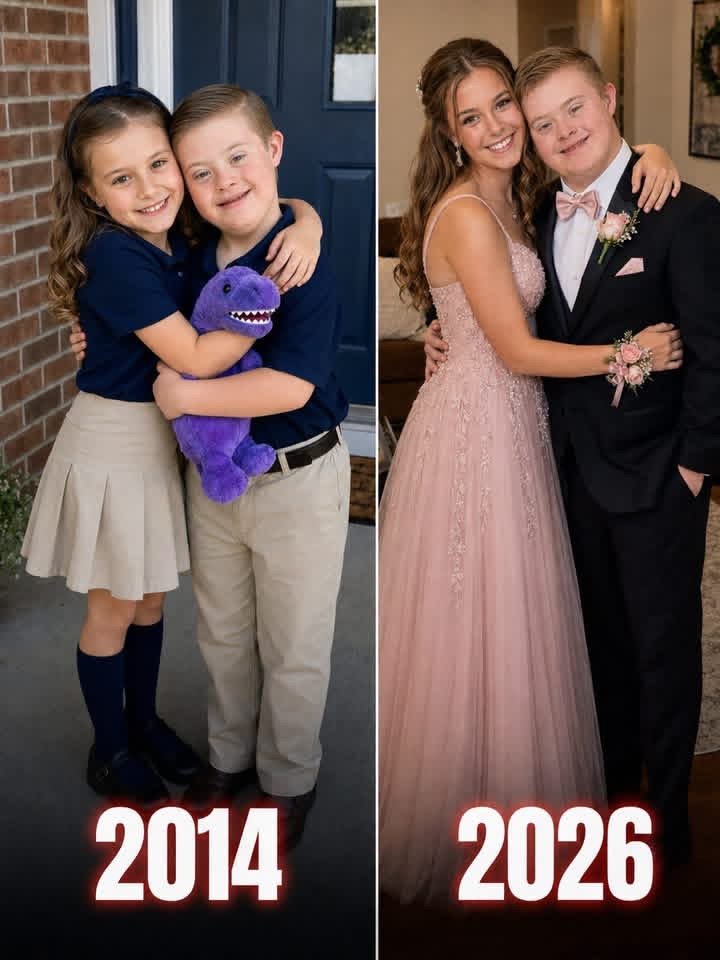
Downstairs, Noah was waiting for me in a navy suit, a crisp white shirt, and the bow tie he had bought months before the dance. I could hear him talking with my aunt through the floorboards, his voice bright with the kind of excitement he had been carrying since November.
I had just finished fighting with one stubborn earring when Mom appeared in the doorway.
“You can go with Noah tonight, Chrissy,” she said. “But only if you promise me one thing.”
I tried to smile. “I know. That is usually how a date works. Let me guess – I need to be home by midnight?”
“No.”
“Eleven-thirty?”
“Christina.”
Hearing my full name erased the joke from my face. Mom did not use it unless she was frightened, furious, or trying very hard not to show either one.
Her hands were shaking.
“You need to hear something first,” she said.
“About what?”
She glanced at the closed door as if the truth were standing on the other side of it. “About Noah.”
My stomach tightened. “What about him?”
“And about me.”
She sat on the edge of my bed. For a few seconds, she looked less like my mother and more like a woman who had been carrying a heavy box for years and had finally realized she could not hold it alone.
Then she whispered, “I owe both of you the truth.”
Twelve years earlier, Noah and I had made a promise over raisins, dinosaurs, and the certainty of two six-year-olds that being almost grown-up was the most important thing in the world.
I had forgotten the promise by dinner that night.
Noah had not.
Part Two: Old Grapes and a Pinkie Promise
Noah and I became friends because neither of us wanted the raisins our first-grade teacher handed out at snack time.
I was hiding my little red box beneath a napkin when the boy beside me leaned close and said, ‘Good idea.’ He was hiding his too.
“You do not like them?” I asked.
“They are old grapes,” he replied.
I considered the argument. “They are.”
“Old grapes are disgusting.”
That settled everything. By lunchtime, we were inseparable.
Dinosaurs made the friendship permanent. Noah knew an astonishing amount about them and had firm opinions about which species would win every imaginary battle. I drew dinosaurs for him, though my drawings looked less like prehistoric predators and more like vegetables with teeth.
The first time I showed him my Tyrannosaurus rex, he stared at the page for so long that I thought he was being polite.
Finally, he said, “What is that? It looks like a potato with arms.”
I shoved his shoulder. He laughed so loudly our teacher moved us to opposite sides of the room.
Noah had Down syndrome. At six, that was simply one fact about him. The things I noticed first were his honesty, his enormous laugh, and the way he never pretended to like something just because everyone else did.
Our friendship was easy until another child decided to make it cruel.
One afternoon, our teacher told us she was getting married. The classroom erupted into arguments about cake, flowers, music, and whether a wedding should include a trampoline.
Noah raised his hand. “My wedding will have chocolate cake.”
“Excellent choice,” our teacher said.
“And no slow songs, Miss Veronica. Slow songs are boring.”
A boy named Roger snickered from across the table.
“You are not getting married, dude.”
Noah looked at him. “Yes, I am.”
“To whom?”
“I do not know yet.”
Roger laughed. “Nobody will marry you.”
I remember the exact moment Noah’s smile vanished. His shoulders lowered, and he stared at his hands as though they had suddenly become the most interesting thing in the room.
I turned on Roger. “That was mean.”
He shrugged. “Then you marry him.”
A few children giggled. The teacher silenced them, but the damage had already been done.
After class, Noah waited until we were alone. His eyes were serious.
“Chrissy,” he said carefully, “would you love me?”
I was six years old. I did not understand romance, marriage, or the difference between a promise and a possibility. I only knew that Noah looked hurt, and I wanted the hurt to stop.
“Maybe,” I answered.
His face brightened. “Really?”
“Maybe,” I repeated, suddenly aware that I had stepped into a very important conversation.
Then I remembered my older cousin talking about prom – a dance for people who were almost adults.
“But first, we have to go to prom together,” I added.
“What is prom?”
“A very big dance when we are almost grown-ups.”
Noah held out his pinkie. “Promise?”
I wrapped my pinkie around his. “Promise.”
I forgot all about it before dinner.
Noah carried it with him.

Part Three: The Years We Kept Showing Up
Twelve years is a long time for a childhood friendship to survive. People change. Schedules separate. New friends arrive, old interests disappear, and the promises made by children are usually buried beneath everything adulthood brings.
Somehow, Noah and I kept finding our way back to each other.
We did not share every class. We did not like all the same things. Noah became devoted to baseball, complete with statistics, rankings, and detailed explanations I understood only in fragments. I became obsessed with art and dragged him through museums where he spent more time searching for the nearest exit than admiring the paintings.
Neither of us converted the other. We simply learned to make room.
When we were twelve, my parents divorced. The change came quietly at first. Dad moved into an apartment twenty minutes away. The rooms in our house became too still. Mom began wiping her eyes before I could see her, and I learned to look away before she noticed I had noticed.
I stopped eating much at school. I had no words for what was happening inside me, so I gave everyone silence instead.
Noah never demanded an explanation. He just sat beside me.
Sometimes he talked. Sometimes he let the quiet remain. Once, he spent fifteen minutes explaining why our baseball team desperately needed a better relief pitcher. I understood almost none of it, but by the time he finished, the tightness in my chest had loosened.
Years later, after I failed my first driving test, Noah arrived at our house carrying two ice creams.
“Why did you bring two?” I asked.
“One because you tried,” he said. “The other because you drove badly.”
I threw a pillow at him. He laughed and handed me the chocolate one.
At sixteen, I told him I wanted to quit art after a girl in my class mocked one of my paintings. The next morning, I found the ugliest dinosaur I had ever drawn taped inside Noah’s locker.
“Why is that there?” I demanded.
He studied it. “It still looks like a potato with arms.”
“Then take it down.”
“No.”
“Why not?”
“Because you cannot quit yet. The dinosaurs have not improved.”
I laughed when I wanted to cry. That was Noah’s gift. He did not give speeches about resilience. He stayed until the pain became light enough to carry.
When my first boyfriend broke up with me three weeks before homecoming, Noah sat beside me on the porch with two tubs of ice cream. He let me cry for ten full minutes before speaking.
“I told you he was an idiot,” he said.
“No, you did not.”
“I thought it.”
“Thinking it does not count.”
“It should.”
I laughed so hard I nearly choked. Noah still tells that story whenever he wants to embarrass me, and I still threaten him whenever he does.
Looking back, I understand that our friendship was never built on one person saving the other. It was built from small, ordinary acts of attention – a seat at lunch, a shared ice cream, a terrible drawing taped to a locker, a friend who stayed when there was nothing useful to say.
Part Four: The Bow Tie and the Rosemary
So when senior prom approached, I never seriously wondered who would be standing beside me.
Noah, apparently, was not so sure.
One February afternoon, he found me at my locker. He looked unusually nervous, which was strange because Noah could discuss baseball with a room full of strangers without blinking.
“Chrissy,” he said.
“Yes?”
“Do you remember first grade?”
I pretended to search my memory. “Not really.”
His expression fell so quickly that I could not keep the joke going.
“I am kidding,” I said.
“That is not funny.”
“It was a little funny.”
“No.”
Then he held out his pinkie.
The sight of it pulled me backward through time: the red raisin box, the dinosaur with potato-shaped legs, Roger’s cruel laugh, and a promise I had forgotten that afternoon but had somehow spent twelve years keeping.
I hooked my pinkie around his. “Prom?”
He nodded. “Prom.”
His whole face brightened.
“I bought the bow tie already.”
“When?”
“November.”
“Noah, it was November.”
“Exactly. Stores run out of things.”
“They were not going to run out of bow ties.”
He gave me a solemn look. “You do not know that.”
That was Noah’s official invitation.
On prom night, my aunt had spent nearly an hour curling my hair and helping me with makeup. I wore a dress I had chosen after trying on too many, and I kept touching one earring because I was afraid it would come loose.
I was not nervous about going with Noah. I was nervous because prom had always belonged to some future version of me – an older girl, a more confident girl, a girl who knew exactly what she was doing. Suddenly that girl was supposed to walk downstairs in heels.
The doorbell rang.
My aunt called, “Chrissy, he is here!”
“Tell him I need two minutes!”
From the entryway came Noah’s voice. “She said that fifteen minutes ago.”
Traitor.
I grabbed my purse and reached the landing. Then I heard Mom open the front door.
The house went quiet.
Not ordinary quiet. The kind that makes your body stop before your mind understands why.
I looked down.
Noah stood in the entryway in his navy suit. His bow tie was perfectly straight. In his hand was a small corsage with a sprig of rosemary tucked among the flowers.
He was smiling.
Mom was staring at him as if she had seen someone from a dream she had tried to forget.
“Mrs. Jane?” Noah asked. “Are you okay?”
Mom blinked. “Yes. Of course.”
But she was not okay. Her eyes moved from the corsage to the bow tie, then back to Noah’s face.
“Chrissy is almost ready,” she said too quickly.
“I am ready,” I called from the stairs.
Mom looked up. “Come upstairs with me.”
“What? Noah is waiting.”
“I know.”
Noah lifted the corsage. “I brought this.”
“I can see that,” I said.
“It has rosemary. The florist said rosemary means remembering. I remember promises.”
Something inside me sank.
Behind me, Mom made a small, broken sound. When I turned, her eyes were full of tears.
“Mom?”
“Upstairs, Chrissy.”
This time it was not a request.

Part Five: The Promise I Never Knew About
The moment we entered my room, Mom closed the door and locked it.
“You are frightening me,” I said.
She turned to me. “You can go with Noah tonight. But only after you promise me one thing.”
Anger rose before fear had time to settle. “If this is about him having Down syndrome, I swear -“
“It is not.”
“I am eighteen, Mom. Noah is my best friend.”
“I know.”
“Then what is this?”
She pressed her lips together, trying to force the words into a shape she could survive saying aloud.
Finally, she asked, “Do you remember the year your father left?”
I stared at her. “What does Dad have to do with prom?”
“There is something you never knew about that year.”
I folded my arms, but the defensiveness was already leaving me. Mom knew things about that period of my life that I had pushed so far away I could barely recognize them.
“You were twelve,” she said. “You stopped eating at school. You barely spoke. You would come home and disappear into your room.”
“How do you know what I did at lunch?”
Mom looked down. “Noah told me.”
The answer made no sense. “When?”
“One afternoon, he found me sitting in my car in the school parking lot.”
The room seemed to shrink around us.
“He caught you crying?”
Mom nodded. “I thought no one had seen me. I was trying to pull myself together before I came inside. But Noah stood beside the car and asked if you were broken.”
My breath caught. “Why would he ask that?”
“Because you were not eating. You were not laughing. You were sitting by yourself. He noticed everything.”
Downstairs, Noah laughed at something my aunt said. The familiar sound reached us through the floor, and Mom closed her eyes for a moment.
“What did you tell him?” I asked.
“I told him you were not broken.” She rubbed her hands together. “Then I told him I did not know how to help you.”
“What did he say?”
A tear slipped down her cheek. “He said he did not know how to repair people either. He only knew how to remain beside them.”
I could not speak.
Mom took my hands. “I asked Noah to promise he would look after you.”
I pulled back. “You asked him that?”
“I was falling apart, Chrissy. Your father had left, you were disappearing inside yourself, and Noah was the only person who could still make you look up.”
“And he said yes?”
“Immediately.”
I heard Noah’s laugh again, and suddenly years of memories rearranged themselves in my mind.
The ice cream after my driving test. The dinosaur in his locker. The lunches when I could not explain my sadness. The porch where he let me cry about a boy who did not deserve me. Noah had never been waiting for me to repay him. He had simply kept showing up.
Mom continued, “For six years, I have been afraid you were giving up pieces of your life because you felt responsible for him.”
“Mom…”
“Every time you waited for Noah, defended him, or changed plans so he would not be left out, I wondered if you were carrying him instead of walking beside him.” Her voice trembled. “I kept judging the friendship by what he might need from you. I never stopped to ask what he gave you.”
The truth hurt because it was not cruel. It was fear wearing the clothes of protection.
Mom had seen my devotion and worried it was a burden. She had not understood that some of the strongest people in my life had been beside me in quiet ways, and Noah was one of them.
“So what is the condition?” I asked softly.
Mom smiled through her tears. “Do not go tonight only because a six-year-old girl promised him. Go because the eighteen-year-old woman you are chooses him.”
A laugh escaped me.
“Mom, I was not going because of a childhood promise.”
“I know that now.”
“The promise only explains why Noah bought a bow tie four months early.”
For the first time that night, Mom laughed too.
Then she unlocked the door.
Part Six: The Dance We Chose
We went downstairs together.
Noah looked from Mom to me and back again.
“You took a long time,” he said.
Mom walked straight toward him. “Noah, may I have the first dance?”
His eyebrows rose.
“Mrs. Jane, this is not prom.”
I laughed so hard I had to hold the banister.
Mom turned on some music anyway. For thirty awkward seconds, Noah counted the steps while she repeatedly moved in the wrong direction.
At last, he sighed. “Mrs. Jane, Chrissy dances better.”
“That is why she is your date,” Mom replied. Then her voice softened. “Thank you for staying.”
Noah frowned, as if she had thanked him for doing something as ordinary as breathing.
“She stays too,” he said.
Mom closed her eyes.
It was the answer she had needed for six years. Not that Noah had rescued me. Not that I had rescued him. Only that we had chosen one another again and again, and neither of us had been alone in the choosing.
At prom, the first slow song began just as we reached the dance floor. Noah held out his hand.
“Chrissy,” he said, “you owe me.”
“For what?”
“Twelve years.”
“That is a long time to keep score.”
“I am very good at statistics.”
Five seconds into the song, he stepped on my shoe.
“You are terrible at this,” I told him.
“Your dress is badly designed,” he answered.
We laughed until people began looking over, and then we laughed harder because being watched made the whole thing even more ridiculous.
Nothing extraordinary happened that night. There was no applause, no grand announcement, no magical moment that made the room stop. We were simply two eighteen-year-olds trying to dance without falling, teasing each other under a ceiling of paper decorations.
And somehow, it was perfect.
Afterward, Mom waited outside by the car. Noah carried my heels because my feet were aching. I carried his jacket because he was warm. When we reached the car, he opened my door.
I climbed in, leaned across the seat, and opened his.
Mom watched us in the rearview mirror.
For years, she had looked at Noah and me and assumed one of us must be taking care of the other. That night, she finally saw what I had always known.
No one was being rescued.
No one was paying back an old debt.
We were two people who had learned, at six years old, something many adults spend decades trying to understand: love is not always loud, impressive, or easy to explain.
Sometimes it is a seat beside you when you cannot talk.
Sometimes it is chocolate ice cream after failure, an ugly dinosaur taped to a locker, a rosemary corsage, or a hand held out on a crowded dance floor.
Sometimes it is simply staying.
And if life is kind, the person who matters to you stays too.