
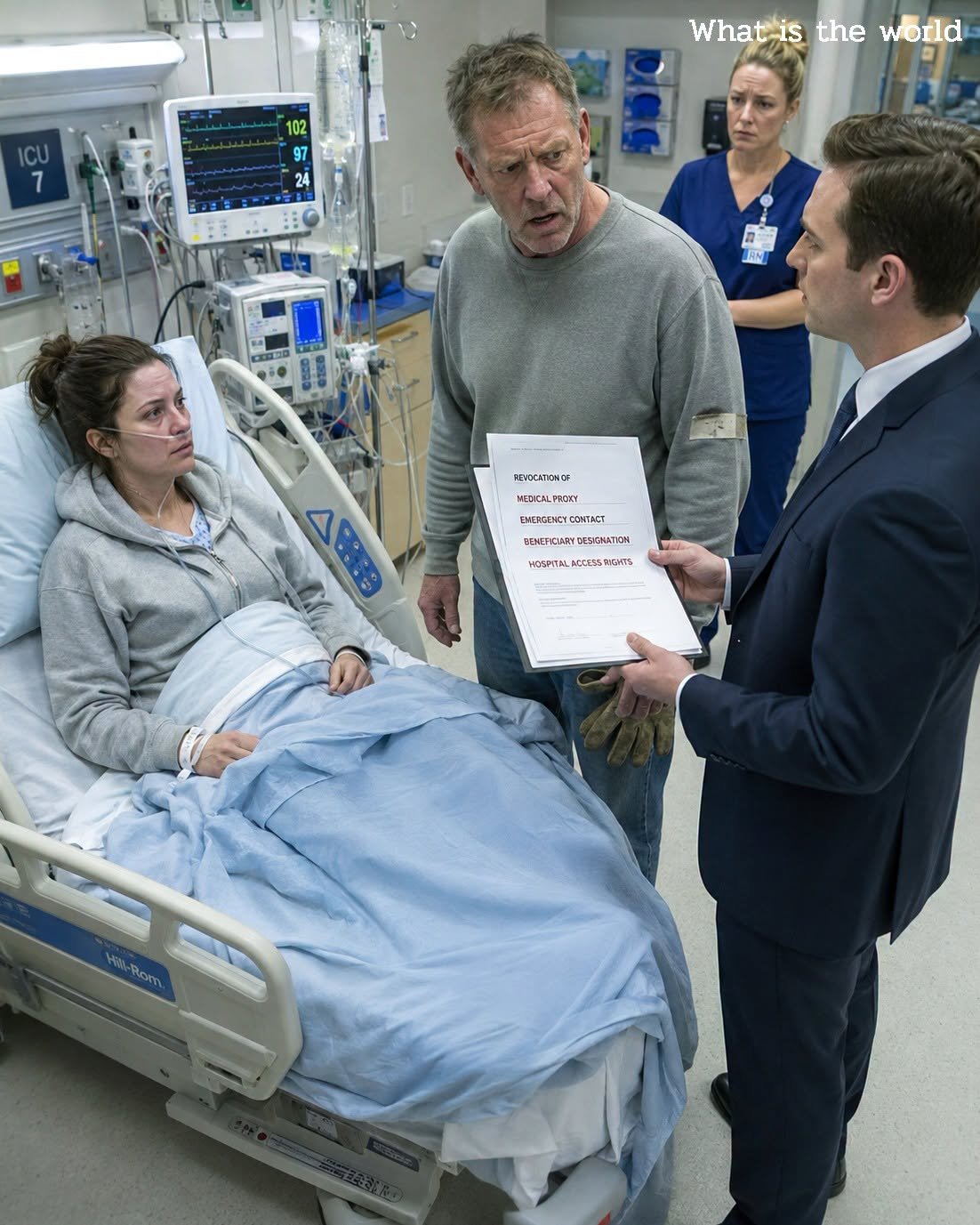
Daniel broke the seal while my father stood at the foot of my ICU bed with moving gloves still tucked into his back pocket.
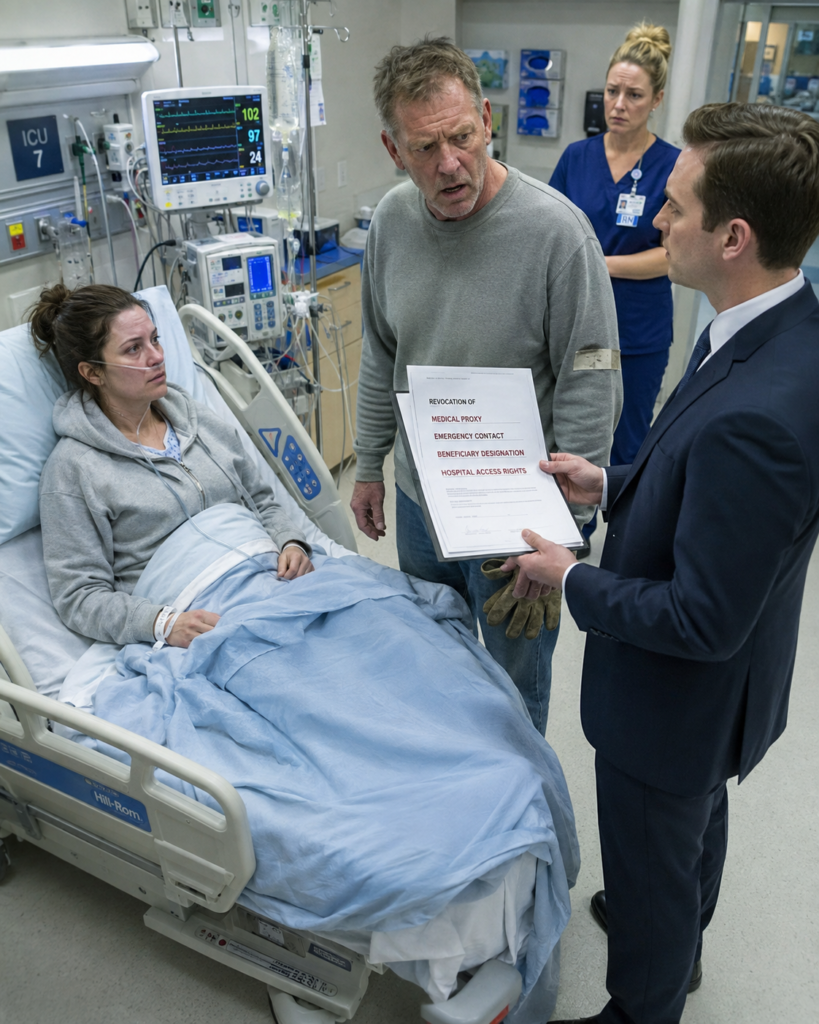
For several seconds, nobody spoke.
The only sound came from the monitor beside me, a steady electronic rhythm that seemed impossibly calm compared with the tension in the room.
Dad stared at the paper in Daniel’s hands.
“Don’t,” he said again.
It was the first time that night I heard fear in his voice.
Daniel looked at me rather than him.
“Emily, do you want me to continue?”
I nodded.
My throat hurt too much to manage more than a whisper.
“Read it.”
Dad stepped closer.
“Emily, this is ridiculous.
You’re exhausted.
You’re medicated.
Whatever you’ve signed tonight, we can talk about it tomorrow.”
The ICU nurse moved quietly between him and the side of my bed.
“Mr.Carter, please stay behind the line.”
He looked offended by the instruction, as though the room should still rearrange itself around the fact that he was my father.
That had been the pattern for most of my life.
Dad did not think of himself as unreliable.
He thought of himself as necessary.
There was a difference, and I had spent years confusing the second for the first.
After Mom died, I had made him my emergency contact because it felt obvious.
I made him my medical proxy because he said families took care of one another.
When my lawyer asked whom I wanted listed as beneficiary on several accounts and policies, I chose Dad because I trusted him to handle things responsibly if something ever happened to me.
None of those decisions had seemed dramatic when I made them.
They were boxes on forms.
Names on lines.
Signatures made during ordinary afternoons.
Then came the night those signatures suddenly mattered.
Daniel unfolded the document.
It wasn’t mysterious.
It wasn’t a secret inheritance or some hidden fortune.
It was more personal than that: the updated estate instruction I had signed after waking from surgery, confirming that Dad would no longer control or automatically receive the things I had once placed in his hands.
Daniel read the operative language carefully, then set it beside the medical proxy revocation and beneficiary-change forms.
Dad’s face hardened.
“You’re punishing me.”
I looked at the strip of packing tape still stuck to his sleeve.
“No,” I whispered.
“I’m protecting myself.”
He laughed once, but there was no humor in it.
“From me?”
That was when Daniel reached for the hospital call log.
Three attempts had been highlighted.
6:12 p.m.
6:43 p.m.
7:18 p.m.
Beside the last entry, the nurse had documented the conversation.
Patient in critical condition.
Family contact informed immediate presence requested.
Contact states assisting other daughter with move and will arrive when able.
Dad read the line once.
Then again.
“That’s not what I meant.”
The nurse who had made the call was still on the unit.
Daniel hadn’t summoned her; she happened to walk past the room just as Dad raised his voice.
He pointed at the paper.
“You made it sound like I refused to come.”
She stopped.
Her expression stayed professional.
“I told you your daughter was in critical condition and being prepared for surgery.”
“You said she had appendicitis.”
“I said her appendix had ruptured and that the infection had spread.”
Dad opened his mouth.
The nurse continued before he could interrupt.
“I told you we needed you here immediately.”
Silence.
The monitor kept beeping.
I watched my father’s shoulders drop by perhaps half an inch.
It was a tiny movement, but I knew him well enough to recognize it.
He was replaying the conversation and realizing there was no version of it that made him look the way he wanted to look.
He turned back to me.
“Olivia had nobody else.”
I stared at him.
That sentence almost made me laugh.
Olivia had movers.
She had friends.
She had a new townhouse full of people opening champagne and carrying lamps through a front door.
I had surgeons.
And for a terrifying stretch of that evening, I had no family member in the building at all.
“She had movers,” I said.
Dad rubbed both hands over his face.
“It was chaos.
Her closing ran late.
The truck was charging by the hour.
Her couch wouldn’t fit through the stairwell.
I thought you were already with doctors.”
“I was.”
“Exactly.
You were in a hospital.
You had professionals around you.
Olivia needed me physically there.”
Something in me went very still.
I had spent the hours before surgery asking myself whether I was being unfair.
Fever can distort time.
Fear can magnify things.
I had wondered whether Dad had misunderstood the seriousness, whether the nurse had failed to explain, whether some reasonable detail existed that would make his decision hurt less.
Now he was standing in front of me explaining it himself.
He had understood that I was in the hospital.
He had understood that Olivia was moving furniture.
And he still believed the furniture had created the more urgent claim on him.
Daniel closed the folder halfway.
“Mr.Carter, Emily needs rest.”
Dad ignored him.
“This is between me and my daughter.”
“Legally, several parts of it are now between Emily and the institutions honoring the documents she signed.”
Dad’s head snapped toward him.
“Don’t talk to me like that.”
Daniel did not raise his voice.
“Then don’t attempt to override my client’s decisions.”
The phrase my client changed something in the room.
Dad was accustomed to seeing Daniel as the man who handled paperwork for my small accounting business.
He had never seemed to grasp that a lawyer’s usefulness wasn’t measured by how loudly he spoke.
Daniel had arrived at my bedside, asked clear questions, confirmed my capacity with hospital staff, and recorded every change properly.
Dad had arrived four hours after the first emergency call with dust on his jeans.
For once, confidence was not the same thing as authority.
Dad looked at me again.
“You called a lawyer before you called me?”
“The hospital called you.”
He flinched.
“Three times,” Daniel added.
Dad pointed at him.
“Stay out of this.”
The nurse stepped forward.
“Mr.Carter, if you continue raising your voice, you’ll have to leave.”
He stared at her as though she had betrayed him too.
That expression told me more than any apology could have.
He still thought the problem was everyone else’s response to what he had done.
Not what he had done.
His phone buzzed in his pocket.
He pulled it out instinctively.
Olivia’s name lit the screen.
For half a second, nobody moved.
Then Dad silenced the call.
It was a tiny gesture, almost absurdly late.
Four hours earlier, it might have meant something.
Now it only made the room sadder.
“Emily,” he said, softer this time.
“I made a bad call.
Fine.
I made a bad call.
But you don’t tear apart a family over one mistake.”
I wanted to believe him.
That was the difficult part.
Anger would have been easier if I hated my father.
I didn’t.
I remembered him teaching me to ride a bicycle.
I remembered him sitting beside Mom’s hospice bed with his hand wrapped around hers.
I remembered the weeks after her funeral when he called every evening because he knew silence frightened me.
People are rarely only the worst thing they have done to us.
But sometimes the worst thing reveals something the good memories allowed us not to see.
Olivia had always required more attention.
There was always a crisis around her—a delayed flight, a difficult landlord, a breakup, a car problem, a job interview, a decorating emergency that somehow became a family emergency.
Dad liked being needed, and Olivia was very good at needing him loudly.
I had become the easy daughter.
The dependable one.
The one who understood.
If Dad canceled dinner because Olivia needed help, I understood.
If he left my birthday early because Olivia was upset, I understood.
If he forgot something important to me because Olivia had called first, I understood.
Eventually, people stop noticing the cost of your understanding.
The hospital was simply the first time that cost could have been my life.
“I’m not tearing apart the family,” I said.
“I’m changing paperwork.”
Dad shook his head.
“You know that’s not all this means.”
He was right.
Paperwork is rarely just paperwork when trust is involved.
A medical proxy means: I believe you will put my needs before your convenience when I cannot speak.
An emergency contact means: I believe you will answer.
A beneficiary designation means: I believe that if I am gone, I want you connected to what remains.
I had treated those choices as expressions of love.
Dad had treated them as permanent privileges.
Daniel slid the documents back into order.
“The hospital has already updated the proxy and access restrictions,” he said.
“The remaining beneficiary and estate changes will be processed according to the normal procedures.”
Dad looked at me.
“Access restrictions?”
The nurse answered.
“Emily determines who may visit her.”
“I’m standing right here.”
“Because she allowed you in long enough for this conversation.”
That seemed to hit him harder than the other documents.
Until then, he had assumed that being my father guaranteed proximity.
Now he understood that even standing beside my hospital bed required my consent.
He pulled the moving gloves from his pocket and stared down at them.
His face changed.
Maybe he finally saw what I had seen the instant he entered: physical evidence of the choice he had made.
He set the gloves on the windowsill.
“I should have come.”
No one answered.
He swallowed.
“I should have come when they called.”
It wasn’t enough to repair anything, but it was the first sentence he had spoken that didn’t contain an excuse.
Tears filled his eyes.
“I thought you were safe because you were at the hospital.
I thought Olivia would fall apart if I left.”
“So you let me be the one who could handle it,” I said.
Dad looked confused.
“Because I always handle it.
That’s what you mean.”
His mouth opened, then closed.
I continued slowly, each sentence costing me energy.
“You knew she’d make you feel guilty if you left.
You knew I wouldn’t.
So you stayed with the person who demanded more.”
That landed.
His gaze dropped.
The nurse adjusted the line at my wrist and glanced toward Daniel.
I could tell she wanted the conversation over.
My body had survived surgery; it did not need a family trial at midnight.
Daniel understood too.
“Emily, that’s enough for tonight.”
Dad immediately stepped forward.
“I can stay.”
I looked at him.
For years, those three words would have been everything I wanted.
That night they came too late.
“No.”
His face crumpled in a way that nearly broke my resolve.
“Emily—”
“I need to sleep.”
He looked at Daniel, then the nurse, as if hoping one of them would overrule me.
Neither did.
Finally, he picked up the gloves from the windowsill.
He stopped at the doorway.
“I love you.”
I believed him.
That was another difficult truth.
Love had not been the missing ingredient.
Reliability was.
“Good night, Dad,” I said.
He left.
The doors closed behind him with a soft mechanical click.
I expected to feel triumphant.
Instead, I cried.
Not loudly.
I didn’t have the strength for that.
Tears simply slid toward my ears while I stared at the ceiling and tried to understand how one evening could make a relationship look completely different without changing a single fact from the twenty-nine years before it.
Daniel waited until I was calmer.
“Do you want me to undo anything?” he asked.
I appreciated him for asking.
Not because I was uncertain, but because real control includes the ability to change your mind.
I shook my head.
“No.”
“All right.”
He packed the folder into his briefcase.
Before leaving, he placed my phone on the bedside table where I could reach it and made sure the nurse had the updated contact information.
A close friend was now listed first.
Someone who had answered on the second ring when I called from recovery.
The next morning, Olivia sent me six messages.
The first four were defensive.
Dad didn’t understand how serious it was.
The move had been a disaster.
She hadn’t asked him to ignore the hospital.
I was being extreme.
The fifth message said, “He feels terrible.”
The sixth arrived almost an hour later.
“I didn’t know they told him to come immediately.”
That was the only one I answered.
“They did.”
She didn’t respond for the rest of the day.
Dad tried to visit that afternoon.
The hospital called my room first.
That detail mattered more than I expected.
A staff member didn’t assume that he belonged beside me because he shared my last name.
They asked me.
“Your father is downstairs.
Would you like him admitted?”
I thought about it.
Then I said, “Not today.”
There was no scene.
No security confrontation.
No shouting in the hallway.
He simply wasn’t allowed up.
Consequences are not always dramatic.
Sometimes they are a locked ICU door and the realization that the person on the other side finally gets to choose.
Over the next several days, my condition improved.
The antibiotics began working.
My fever dropped.
I progressed from ice chips to broth and eventually to food that tasted like actual food.
Daniel completed the remaining paperwork after confirming again that I wanted the changes to stand.
I did.
I didn’t cut Dad out of my life completely.
That wasn’t what I wanted.
But I stopped giving him authority that his behavior had shown he couldn’t responsibly hold.
He was no longer my medical proxy.
He was no longer my primary emergency contact.
The beneficiary designations I had changed stayed changed.
My estate instructions remained updated.
Hospital staff were told that access depended on my consent.
Those weren’t revenge measures.
They were boundaries translated into documents.
Dad visited three days later after asking first.
This time, there were no gloves in his pocket.
He brought no flowers and no elaborate apology.
He sat in the chair Daniel had occupied and looked older than he had a week earlier.
“Olivia told me I should explain,” he said.
I waited.
He shook his head.
“But I think explaining is what got me in trouble the first night.”
That almost made me smile.
He stared at his hands.
“I kept thinking you were the strong one.”
“I was septic, Dad.”
He winced.
“I know.”
“Strong people still need someone to show up.”
“I know that now.”
I studied him for a moment.
“You should have known it then.”
He nodded.
No defense.
No mention of Olivia’s couch.
No moving truck.
No closing delay.
Just a nod.
“Yes.”
That was the beginning of whatever relationship we would have afterward.
Not forgiveness all at once.
Not a dramatic reconciliation.
A beginning.
Trust did not return because he cried beside my bed.
It didn’t return because he said he loved me.
Trust had to become behavioral now.
He started calling when he said he would call.
He asked before assuming he was included.
He stopped volunteering me to be the understanding one whenever Olivia’s needs collided with mine.
And when he apologized, I learned to listen for the absence of the word but.
Olivia and I eventually spoke too.
She admitted that Dad had told her the hospital wanted him there.
She had said, “Go if you need to,” but neither of them had treated it like the emergency it was.
She had been focused on her move; he had been focused on rescuing her from it.
I didn’t blame her for Dad’s decision.
He was an adult.
The nurse had told him exactly what was happening.
But I stopped participating in the family habit of treating Olivia’s urgency as automatically more important than everyone else’s needs.
Months later, I saw the old moving photo again while scrolling through my phone.
Olivia beside the white kitchen island.
Champagne.
Cardboard boxes.
Dad smiling in his work gloves.
Once, the picture had made me furious.
This time, I studied it for a few seconds and then kept scrolling.
The image no longer controlled the story.
The part that mattered happened later, in an ICU room under cold fluorescent light, when my father arrived believing his title gave him permanent rights to my trust.
Daniel had turned a page toward him.
A timestamp sat beneath my shaking signature.
And Dad learned that love may be given freely, but authority is something another person allows you to hold.
He had been my emergency contact because I trusted him to answer.
He had been my proxy because I trusted him to come.
When the real emergency finally happened, he chose a moving day over my bedside.
So I chose differently too.
I survived the infection.
I survived the surgery.
And I survived the uncomfortable realization that protecting a relationship sometimes means removing the power you once confused with love.
My father did not lose a daughter that night.
He lost automatic access to the parts of my life he had assumed would always carry his name.
What happened afterward depended not on what he called himself, but on whether he was willing to become someone I could trust again.