
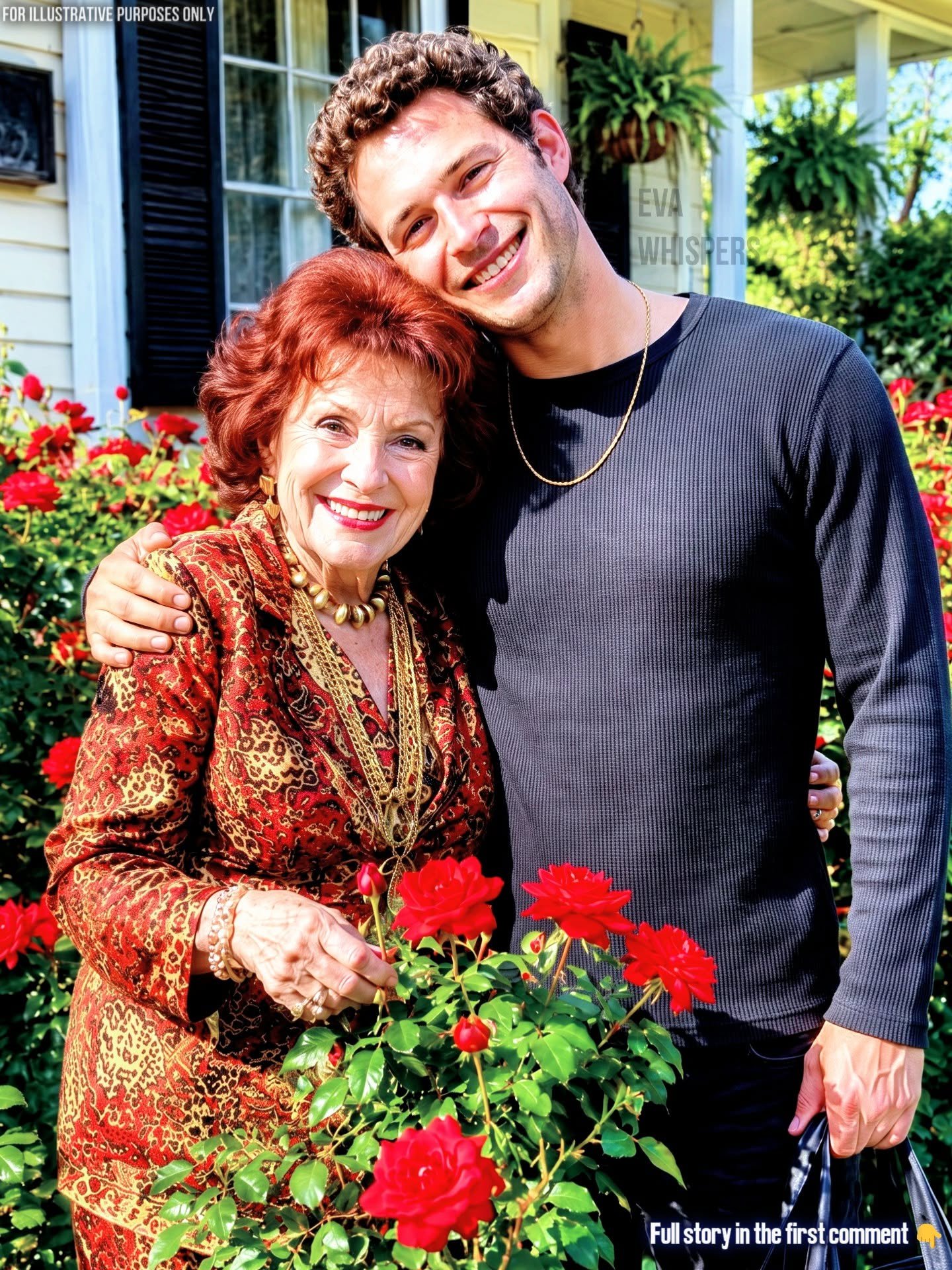
Part 1: The Woman Next Door
For as long as I could remember, my 83-year-old neighbor, Marjorie, had lived alone in the small white house beside mine.
We lived on one of those quiet streets where people noticed everything—not because we were nosy, but because our lives had slowly become woven together.
We noticed when someone’s porch light remained on until morning. We noticed when a newspaper sat untouched near the curb. We noticed when the smell of Sunday cooking disappeared from an open window.
Marjorie had always been part of the neighborhood’s familiar rhythm.
Every Sunday morning, she baked a peach pie. Before the church bells began ringing, the warm scent of peaches, cinnamon, and buttery pastry would drift through my kitchen window.
At sunrise, she watered her roses in a faded blue robe and rubber gardening shoes. Even during the colder months, she inspected the soil with great seriousness, as though each flower had personally trusted her with its survival.
And every weekday morning, when I left for work, she would be sitting or standing near her porch.
“Good morning, Ariel!” she would call.
“Morning, Marjorie. Don’t tire yourself out with those roses.”
She would raise her watering can and smile.
“I was about to tell you the same thing.”
Those conversations rarely lasted more than a minute, yet they became an important part of my life.
My own mother lived several states away. Marjorie never tried to replace her, but somehow, without either of us realizing it, she filled a small, lonely space inside me.
Sometimes she left a slice of peach pie on my doorstep.
Sometimes I brought her trash bin back from the street, changed a lightbulb she could no longer reach, or replaced the batteries in her smoke detectors.
She always thanked me as if I had rebuilt her entire house.
That was why I immediately noticed when a stranger began visiting her every afternoon.
He usually arrived around three o’clock in a spotless dark sedan. He looked to be in his late twenties, and he always carried something into Marjorie’s house—groceries, medicine, flowers, or neatly folded paper bags.
The first time we spoke, I was checking my mailbox while he lifted two bags from his trunk.
“You must be Ariel,” he said.
I stopped and looked at him.
“That depends on who’s asking.”
He gave me a friendly smile.
“I’m Owen. Marjorie has told me about you. She says you keep an eye on everyone around here.”
“Someone has to,” I replied. “Are you a relative?”
For the briefest moment, his smile tightened.
“I’m helping her with a few things.”
Before I could ask what that meant, Marjorie opened her front door.
“Owen, don’t try carrying all of that at once,” she called.
“I’ve got it,” he assured her.
Then Marjorie noticed me and lifted one hand in greeting.
She smiled, but something about it seemed different.
Smaller.
Less certain.
I told myself I was imagining it.
Within a few weeks, the entire neighborhood had grown fond of Owen.
Mrs. Bell, who lived across the street, called him “the perfect grandson,” even though Marjorie had once told me she had never had children.
People admired the way he swept her porch, collected her mail, and carried heavy groceries into the kitchen.
“It’s good to know she isn’t alone anymore,” Mrs. Bell said one afternoon. “Most young people are too busy to care for someone her age. That boy was raised properly.”
I wanted to agree.
At first, I almost did.

Part 2: The Empty Porch
When I asked Marjorie about Owen, she gave me a vague smile.
“He’s helping me organize a few things.”
That should have been enough.
Marjorie was an adult who had lived independently for decades. Sharing a fence and exchanging pie plates did not give me the right to question every visitor who entered her home.
So I tried to ignore my uneasiness.
Then the curtains closed.
Marjorie had always loved sunlight. She used to open every window on warm days and say that a dark house would eventually “begin feeling sorry for itself.”
Now every curtain remained tightly drawn, even in the middle of the afternoon.
Her porch chair sat empty.
At first, I blamed the heat. Then I blamed the wind. When the weather became mild and pleasant, the chair remained untouched.
Sometimes I would see movement behind the front window and wave.
Almost immediately, Owen would reach across and pull the curtain closed.
He never frowned at me. He never made a threatening gesture.
He simply shut me out.
The calmness of that movement disturbed me more than anger would have.
One evening, I saw him carrying a sealed cardboard box toward his car.
“Doing some spring cleaning?” I asked.
He shifted the box in his arms.
“Marjorie has collected too many things over the years.”
“She’s attached to those things.”
“She gets overwhelmed easily now,” he said.
His voice remained polite, but it was clear the conversation was over.
Before I could move closer, he placed the box in his trunk and shut it.
A few days later, I finally saw Marjorie outside.
She stood beside her rose bushes in a thin nightgown, even though the morning air was cold enough to make me pull my sweater tighter.
I almost did not recognize her.
She looked smaller than before.
Her cheeks had hollowed, her skin appeared pale, and her shoulders curved forward as though remaining upright required all the strength she had.
The garden hose slipped from my hand.
“Marjorie?”
She slowly turned toward me.
For one hopeful second, I believed she might come across the yard.
Then Owen appeared behind her.
He rested one hand on her arm and guided her toward the house.
“She needs to lie down,” he said.
I stepped closer to the fence.
“Marjorie, are you feeling all right?”
She glanced over her shoulder.
Our eyes met for only a moment.
The smile she had been trying to hold disappeared completely.
Then Owen led her inside and closed the door.
She never answered me.
That night, I lay awake replaying her expression.
I tried to be reasonable.
Elderly people became tired. Their health could change quickly. Sometimes they needed more help than they wished to admit.
Owen had never shouted at her. I had never seen him behave violently. Accusing someone of wrongdoing because of closed curtains and a worried glance would have been irresponsible.
But I could not forget the fear in her eyes.
Part 3: The Phone Call
Two days later, my phone rang while I was preparing dinner.
“Hello, is this Marjorie’s emergency contact?” a woman asked.
“No. This is Ariel. I live next door.”
The caller explained that Marjorie’s prescription was ready to be collected.
When I said they had reached the wrong person, the pharmacist apologized.
Then she added something that made me set down the knife I had been holding.
“It looks like Owen recently changed the emergency contact information.”
My fingers tightened around the phone.
“Changed it from whom?”
“I’m sorry, but I’m not permitted to discuss details from her records.”
“Then why is my number still attached to the file?”
There was a pause.
“It may have remained in an older section of the account.”
After the call ended, I stood alone in my kitchen, staring through the window at Marjorie’s dark house.
Three years earlier, she had given me a spare key.
She had accidentally locked herself outside while taking out the trash. After I helped her climb through a partially opened window, she pressed a key into my hand.
“You’re the most dependable person on this street,” she had insisted. “Keep this in case something happens.”
I had never used it.
Until that afternoon.
Owen’s car was gone when I crossed the yard.
I knocked on Marjorie’s door.
No response.
I knocked again, harder this time.
“Marjorie? It’s Ariel.”
The house remained silent.
“Owen?”
Nothing.
I knew entering without permission could destroy Marjorie’s trust in me. But as I stood there, remembering her pale face and frightened eyes, another thought became stronger.
What if she needed help and I walked away?
I unlocked the door.
The silence inside felt unnatural.
The house was almost painfully clean.
Marjorie’s floral cushions had disappeared from the sofa. The old magazines beside her chair were gone. Even the ceramic bowl filled with peppermints had vanished from the end table.
The framed photographs that once covered the walls had been removed.
Pale rectangles remained where they had hung.
It did not look as though someone had cleaned the house.
It looked as though someone was slowly erasing the person who lived there.
“Marjorie?” I called.
My voice echoed through the empty rooms.
For several seconds, I heard nothing.
Then a faint sound drifted from upstairs.
It was so quiet that I nearly missed it.
“Ariel?”
I ran toward the staircase.
The voice had come from Marjorie’s bedroom.
When I reached the top floor, her door was nearly closed. I wrapped my hand around the knob and pushed it open.
The scene inside stopped me cold.
Marjorie sat propped against the headboard, wearing the same thin nightgown I had seen in the garden.
A tray rested across her lap. The bowl of soup on it appeared untouched.
Her hands trembled around a folded document.
The room carried the sharp scent of medicine and antiseptic.
When she saw me, her eyes widened.
“Ariel?”
I rushed to the bed.
“Marjorie, what happened? Are you injured? Has Owen done something to you?”
Tears filled her eyes, but she shook her head.
Then she looked anxiously toward the hallway.
“You shouldn’t have come inside.”
Her words were barely more than a whisper.
“Why not?”
Her cold fingers closed around my wrist.
“Because Owen will be back soon.”

Part 4: Behind the Bedroom Door
Before I could answer, the front door opened downstairs.
Marjorie froze.
Footsteps crossed the entrance hall.
“Ariel,” she whispered urgently. “Please hide.”
My first instinct was to call the police.
Then I remembered that I had left my phone on the kitchen counter after rushing upstairs.
The footsteps began climbing the staircase.
I stepped behind the bedroom door just as Owen entered.
He paused when he saw Marjorie sitting upright.
“What are you doing?” he asked.
His voice was still quiet, but the kindness I had once heard in it was gone.
“I needed a drink,” Marjorie replied.
“There’s water beside you.”
He crossed the room and lifted the full glass from her nightstand. Then his attention moved to the folded paper clutched in her hands.
“What is that?”
Marjorie pulled it against her chest.
“Give it to me,” he said.
“No.”
His jaw tightened.
“Marjorie.”
I stepped out from behind the door.
“She told you no.”
Owen spun around.
For the first time since he had begun visiting, his calm expression collapsed.
“What are you doing here?”
“I have a key.”
“You had no right to enter.”
“And you have no right to isolate her.”
His face hardened.
“You don’t understand what’s happening.”
“Then explain it.”
Marjorie began to cry.
The sound changed Owen instantly.
His anger disappeared. He sank into the chair beside the window and covered his face with both hands.
“I told you someone would discover the truth,” he murmured.
Marjorie wiped her cheeks.
“I couldn’t continue pretending.”
I looked from one of them to the other.
“Pretending about what?”
Neither answered.
Finally, Marjorie held the folded document toward me.
It was a legal document.
Across the top, in dark printed letters, were the words:
Last Will and Testament.
I read through the first pages.
Marjorie had left her house, her savings, and nearly all of her possessions to Owen.
I looked at her.
“Did he pressure you to sign this?”
“No,” she answered immediately. “I made the decision myself.”
That was not what I expected.
“Then why are you afraid of him?”
“I’m not afraid of Owen.”
“You looked terrified when I entered.”
Marjorie lowered her eyes.
“I was afraid you would learn the truth.”
The room suddenly felt smaller.
“What truth?”
She looked toward Owen.
He remained seated, staring at the floor.
At last, Marjorie took a shaking breath.
“His mother was my daughter.”
For several seconds, I could not speak.
“You told me you never had children.”
“I told everyone that.”
Owen stood and pulled one side of the curtain open.
A thin beam of sunlight stretched across the floor.
Marjorie stared at it as she continued.
“I was seventeen when Ruth was born. My parents sent me away before anyone could discover I was pregnant. They told our neighbors I was visiting distant relatives.”
Her voice cracked.
“After the delivery, they arranged the adoption. They barely allowed me to see her. I remember touching the side of her face, but then they carried her away.”
I sat slowly on the edge of the bed.
Marjorie closed her eyes.
“I spent years trying to learn where she had gone. My parents refused to help. They said speaking about her would bring shame to the family.”
Owen stood near the window, his back to us.
“My mother died last year,” he said.
His voice broke on the final word.
I looked at him differently then.
For the first time, I saw the grief beneath his controlled expression.
“Before she died, she gave me Marjorie’s name. She told me not to contact her.”
“But you came anyway,” I said.
“Yes.”
Marjorie reached toward him.
“And I’m grateful that he did.”
Part 5: The Truth Behind the Curtains
I looked around the stripped bedroom and remembered the empty walls downstairs.
“What happened to the photographs?”
Owen turned from the window.
“They were photographs of my mother.”
Marjorie nodded.
“I collected every picture of Ruth I could find over the years. School photographs, newspaper announcements, community newsletters—even a copy of her wedding announcement.”
“You watched her life from a distance?”
“I did,” Marjorie admitted. “I was afraid that approaching her would cause more pain.”
Owen’s expression tightened.
“When I first found the photographs, I thought she had chosen to remain silent. I thought she had known where my mother was all those years and simply stayed away.”
“I wanted to explain,” Marjorie said, “but he had every right to be angry.”
Owen shook his head.
“Then I found the letters.”
“What letters?” I asked.
“Letters she had written to adoption agencies, hospitals, lawyers, and churches. She had spent decades searching. Her parents threatened to leave her homeless if she refused the adoption. Later, when she tried to find my mother, they used every connection they had to stop her.”
His voice softened.
“She hadn’t forgotten my mother. She had never stopped loving her.”
I glanced toward the medical tray beside the bed.
“Why did you stop going outside, Marjorie?”
She looked at the untouched soup.
“Because I’m sick.”
Owen lifted a thick folder from the dresser and handed it to me.
Inside were hospital records, appointment schedules, treatment information, and test results.
Then I saw the diagnosis.
Advanced pancreatic cancer.
I read the words several times before they felt real.
Marjorie watched me carefully.
“I didn’t want anyone in the neighborhood to know.”
My throat tightened.
“Why would you keep something like this secret?”
“Because I didn’t want to become the dying woman at the end of the street.”
A sad smile touched her lips.
“I wanted people to remember me as the woman who baked peach pies and argued with her roses.”
I looked at Owen.
“The curtains?”
“Her treatments made her sensitive to light,” he explained. “She also didn’t want anyone seeing how much weight she had lost.”
“And the pharmacy contact?”
“She asked me to change it.”
Shame rose inside me.
Every suspicious detail had an explanation.
The groceries.
The medicine.
The boxes.
The closed curtains.
Even the empty porch.
Still, one question troubled me.
“Why did you close the curtain every time I waved?”
Owen looked at Marjorie.
His expression softened.
“Because she cried whenever she saw you.”
Marjorie covered her mouth with one hand.
“I knew I had lied to you,” she said. “You had treated me with more kindness than many people in my own family. Every time I saw you, I wanted to tell you everything.”
I reached for her hand.
“You didn’t owe me an explanation about your past.”
“I owed you honesty.”
Outside, a lawn mower started somewhere down the street.
The ordinary noise felt strangely cruel. The world continued as though nothing inside that bedroom had changed.
Owen sat across from us.
“I wasn’t stealing her belongings,” he said. “She asked me to pack them. She’s preparing to move into hospice care.”
I looked at the will again.
“And she wants you to inherit everything.”
“I’ve told her I don’t want it.”
Marjorie gave a weak laugh.
“He argues with me about it every day.”
“I didn’t come here for her house,” Owen said. “I came because I needed answers.”
Marjorie looked at him with a tenderness that made my eyes burn.
“You came because part of you needed to know that your mother had been loved.”
Owen’s eyes filled with tears.
“She was,” Marjorie whispered. “Every day. Every hour. Even when she believed otherwise.”
Owen bowed his head and quietly began to cry.

Part 6: The Stories She Had Buried
I moved closer and wrapped my arms carefully around Marjorie.
She felt frighteningly fragile, but when she returned the embrace, there was surprising strength in her thin arms.
“I’m sorry I entered without asking,” I whispered.
She rested her cheek against mine.
“No. I gave you that key because I trusted you to come in when something felt wrong.”
Over the following weeks, the truth spread only as far as Marjorie allowed.
Mrs. Bell brought casseroles without asking questions. The pharmacy corrected its records. Owen opened the curtains each morning, but only halfway, so the sunlight would not hurt Marjorie’s eyes.
She never returned to her porch.
Instead, I visited her bedroom after work.
Some evenings, I read aloud while she rested. On others, she told Owen and me stories she had kept hidden for more than sixty years.
She told us about the day Ruth was born.
She remembered the tiny sound her daughter made. She remembered a nurse briefly placing the baby near her shoulder. She remembered counting Ruth’s fingers before someone carried her away.
She told Owen about the birthday cards she had written but never mailed.
“I bought one every year,” she said. “I kept them in a box because I didn’t know where to send them.”
Owen found the box in the attic.
There were cards for Ruth’s first birthday, her tenth, her sixteenth, her twenty-first, and every year after.
Some contained only a few lines. Others held pages of apologies, hopes, and love.
Owen read every one.
Sometimes he asked questions.
Sometimes he sat silently beside Marjorie’s bed, holding a photograph of his mother.
Other times he left the room because his grief had become too heavy to hide.
Marjorie never asked him to forgive her.
She only answered him honestly.
Gradually, the tension between them softened.
Owen began bringing stories of his own.
He told Marjorie that Ruth had loved gardening but could never keep roses alive.
He told her that she had laughed loudly in movie theaters, burned nearly everything she attempted to bake, and sang old songs while washing dishes.
“She loved peach pie,” he added one evening.
Marjorie looked toward the window.
“So did my mother.”
Owen smiled through his tears.
“Maybe that’s where she got it.”
In those final weeks, they rebuilt a relationship that should have begun decades earlier.
It was painfully late.
But it was not meaningless.
Part 7: One Final Peach Pie
On her last Sunday, Marjorie woke with more energy than she had shown in days.
She looked at Owen and me and said, “I want peach pie.”
Owen immediately reached for his car keys.
“I’ll buy one.”
Marjorie frowned.
“I didn’t say I wanted a store-bought disappointment.”
Despite everything, I laughed.
She pointed toward the kitchen.
“My recipe is inside the old green tin. You two are going to make it.”
Owen stared at her.
“I don’t know how to bake.”
“That has never stopped most people.”
With Marjorie calling instructions from her bed, Owen and I attempted to recreate the pie that had scented our street for years.
He rolled the dough too thin and tore it while lifting it into the dish.
I added too much cinnamon to the peaches.
We argued about the amount of sugar, spilled flour across the counter, and nearly forgot to preheat the oven.
When the pie finally emerged, the crust leaned to one side and the filling had bubbled over the edges.
We carried a slice upstairs.
Marjorie studied it with the seriousness of a professional judge.
Then she took one small bite.
Owen and I waited nervously.
Her face remained perfectly straight.
“Awful,” she announced.
Owen looked offended.
“You told us exactly what to do.”
“And you clearly ignored me.”
I began laughing.
Owen laughed next.
Then Marjorie started laughing too.
Within moments, all three of us were laughing and crying at the same time.
It was the last sound of pure happiness I ever heard from her.
Two nights later, Marjorie died peacefully in her bedroom.
Owen held one of her hands.
I held the other.
The curtains were open halfway, allowing a narrow ribbon of moonlight to stretch across the blankets.
After the funeral, I expected Owen to sell the house.
Instead, he moved into it.
He returned Marjorie’s photographs to the walls. Ruth’s pictures remained among them, no longer hidden in boxes or treated as evidence of a shameful secret.
He placed the peppermint bowl back on the end table.
He uncovered the floral cushions.
And on Sundays, he began baking peach pies from Marjorie’s handwritten recipe.
His crusts were still uneven. Sometimes the filling was too sweet, and once he forgot the cinnamon completely.
But just before noon, the familiar scent always drifted through my kitchen window.
Every weekday morning, when I leave for work, Owen stands on the porch near Marjorie’s empty chair.
He raises one hand.
“Morning, Ariel.”
“Morning, Owen.”
I always wave back.
For years, I believed watching over someone meant noticing danger and stepping in before it was too late.
Marjorie taught me that care could also mean listening without judgment, protecting someone’s dignity, and understanding that a closed curtain might conceal something entirely different from what we fear.
Sometimes it hides cruelty.
Sometimes it hides grief.
And sometimes, behind it, a family is trying to recover sixty years of lost love before time finally runs out.