
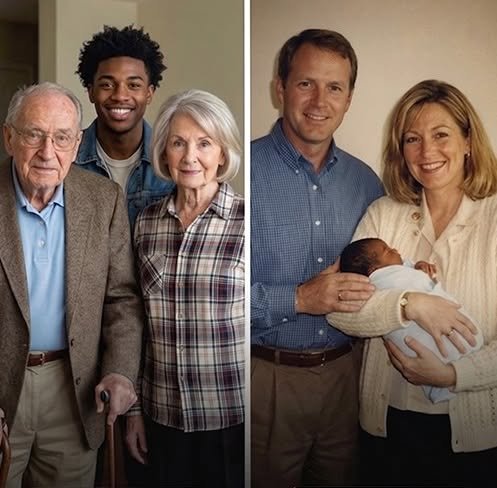
I used to believe that the season of surprises in my life had ended by the time I turned 50. My husband, Frank, and I had already endured illness, financial hardship, and the quiet sorrow of accepting that we would never have children.
My name is Rose Carter. I am 79 now, and Frank is 81. But this story began 23 years ago, on the morning after my 56th birthday.
Frank and I married young in a courthouse with 2 borrowed witnesses. We celebrated with dinner at a small diner because that was all we could afford. Children were always part of our plan, but money was tight.
“Later,” Frank would say. “When we’re more stable.”
Then, in my early 30s, I became seriously ill. The treatment saved my life, but it left me unable to carry a child.
We considered adoption, but Frank’s job was unstable, and we were caring for his sick mother. By the time our lives became secure enough, we were approaching 50, and several agencies warned us that our age would make the process difficult.
Eventually, we stopped applying.
We bought a modest house in a quiet town and built a peaceful life together. Our neighbors assumed we had chosen not to have children. It was easier to let them believe that than to explain the truth.
On my 56th birthday, a powerful snowstorm buried our town. The following morning, I woke before dawn to a strange sound.
At first, I thought it was the wind.
Then I heard it again—a thin, trembling cry.
“Frank,” I whispered. “Do you hear that?”
The sound was coming from the front porch.
When I opened the door, freezing air rushed inside. On our doormat sat a covered infant carrier dusted with snow.
Inside was a baby boy.
His cheeks were red from the cold, and his tiny fists moved weakly beneath a blue blanket.
“Call emergency services!” I shouted.
I carried him inside and wrapped him in the quilt from our couch. Frank held him against his chest while I tried to keep him awake.
Paramedics arrived within minutes. Judging by his condition and the amount of snow on the carrier, they believed he had been outside for less than 20 minutes. He had mild hypothermia, but we had found him in time.
The police searched the neighborhood, but the storm had already covered the tire tracks. Our doorbell had stopped working during the night, so if whoever left him had rung it, we had not heard.
There was no note or identification.
A hospital social worker named Diane Miller gave me her number and said I could call for an update.
I called that afternoon.
“He’s stable,” she told me. “He’s responding well.”
I called again the following day.
And the day after that.
No one came forward. The local hospitals had no matching birth record, and every lead the police received went nowhere.
Several weeks later, Diane explained that he would remain in foster care until the authorities finished searching for relatives.
That night, Frank and I sat at our kitchen table long after dinner.
“We could apply to foster him,” I said.
Frank looked down at his hands. “We’re nearly 60.”
“I know.”
“We’ll be in our 70s when he starts college.”
“I know.”
After a long silence, he looked at me with tears in his eyes.
“I don’t want him growing up believing no one chose him.”
Neither did I.
We completed background checks, medical examinations, parenting classes, and home inspections. Because of our age, the agency examined our health and support system carefully. We named my younger sister and her husband as legal guardians if anything happened to us and adjusted our finances to provide for the child’s future.
Several months later, we brought him home as foster parents.
It took more than a year for the authorities to exhaust every lead and terminate the unknown parents’ rights. We lived with the fear that someone might appear and take him away, but no one ever did.
When the adoption was finalized, we named him Owen Carter. Because his exact birth date was unknown, the court designated the morning we found him as his legal birthday.
Raising a baby in our late 50s was exhausting. My back ached from rocking him at night, and Frank once fell asleep upright in the nursery chair. At school events, people often assumed we were Owen’s grandparents.
He always corrected them.
“They’re my parents,” he would say. “They’re just vintage.”
We never hid the truth from him. As he grew older, we explained more about how he had entered our lives.
“You were left at our door,” I told him. “But we chose you, and we will always choose you.”
When he was 11, he asked why his biological parents had abandoned him.
“I don’t know,” I answered honestly. “But whatever their reason was, it had nothing to do with your worth.”
Owen grew into a thoughtful, compassionate young man. He defended children who were bullied, helped Frank repair old radios, and asked questions about everything.
Sometimes he wondered whether his biological parents ever thought about him.
“I hope they do,” I would say. “But I know we do. Every single day.”
After high school, Owen received a scholarship to study information technology. The house felt painfully empty after he left, but he called every week and returned regularly for Sunday dinner.
Shortly after Owen turned 20, his biological parents passed away in a car accident.
We knew nothing about them or what had happened.
Nearly 3 years later, on the evening before Owen’s 23rd birthday, he called and asked Frank and me to be home the following morning.
“There’s something I need to tell you,” he said. “An attorney will be with me because it’s complicated.”
The next morning, a woman named Laura Patel arrived first. She explained that Owen had authorized her to discuss a private family matter. He joined us a few minutes later, looking more nervous than I had seen him in years.
We gathered in the living room. Laura opened a document case and placed a photograph on the coffee table. It showed an elegantly dressed couple standing in front of a stone mansion.
“These were Owen’s biological parents,” she said. “Charles and Isabelle Sterling.”
They had been wealthy property developers whose family name appeared on buildings throughout the state. Publicly, they had never acknowledged having a child.
Privately, they had known exactly where Owen was.
Isabelle had concealed her pregnancy and given birth at a small private clinic in another county using her maiden name. Shortly before Owen’s birth, doctors warned that he might have a congenital condition. The diagnosis was uncertain, but Charles and Isabelle panicked. They were frightened by the possibility of raising a medically vulnerable child and obsessed with protecting their reputation.
Several days after his birth, they decided to surrender him anonymously at a safe-haven hospital. Charles drove while Isabelle sat in the back with Owen.
The snowstorm worsened during the journey. A fallen tree blocked the main road to the hospital, forcing them into a residential neighborhood while they searched for another route.
They saw the lights in our house.
Charles placed Owen on our porch and rang the bell several times, unaware that it was broken. According to letters they later wrote, they waited inside their car until they saw our bedroom light come on. Only then did they drive away.
When the story appeared on the local news, they knew Owen had survived.
Years later, guilt led them to hire a private investigator. They discovered that Frank and I had adopted him and quietly followed his life from a distance. They saw school photographs, academic records, and newspaper articles but never contacted him.
“Why not?” Frank asked.
“Shame at first,” Laura replied. “Later, they convinced themselves that entering his life would only hurt him. Whether that was concern or cowardice is impossible to say.”
Before their deaths, Charles and Isabelle amended their wills. They named Owen by his adopted name and included his address and the circumstances of his birth. The inheritance required DNA confirmation.
After they passed away, Laura contacted Owen. The DNA test proved he was their son, but several relatives challenged the amended will. They claimed the documents were fraudulent and that Charles and Isabelle had been pressured into signing them.
For nearly 3 years, attorneys examined signatures, medical records, witness statements, and reports from the private investigator. The court eventually ruled that the amendment was valid.
Owen had inherited nearly everything—properties, investments, business shares, and millions of dollars.
“Why didn’t you tell us?” I asked him.
“I didn’t know if the court would uphold the will,” he said. “I didn’t want their conflict entering our home until I had a definite answer. And I was afraid you’d think I was searching for different parents.”
I took his hand.
“Wanting to know where you came from does not mean you love us less.”
Owen looked at the photograph.
“They left letters saying they regretted what they did. They wrote that they watched me grow up and were grateful to you. But they knew where I was for years and still chose to remain strangers.”
“No letter can undo that,” Frank said. “But nothing they did can change who your parents are.”
Owen admitted that he was considering refusing the inheritance.
“Keeping their money feels like accepting payment for being abandoned.”
“You don’t prove anything by making your life harder,” I told him. “Their money cannot make them your parents, and accepting it cannot erase us.”
Frank nodded. “Decide what you want the money to accomplish. That matters more than where it came from.”
Owen eventually accepted the inheritance so it would not pass to the relatives who had challenged him. He kept enough to buy a modest home, secure his future, and ensure Frank and I would never struggle with medical or retirement expenses.
He used most of the estate to establish a foundation supporting families facing frightening prenatal and infant diagnoses. It provided medical assistance, counseling, and practical support so fear would not drive another family to make the choice his biological parents had made.
He also created scholarships for children raised in foster care or adoptive homes.
He named it the New Beginnings Foundation.
I am 79 now, and I still sit at the kitchen table where Frank and I first decided to become Owen’s parents. On the wall hangs a photograph of him standing between us at the opening of the foundation’s first support center.
Sometimes I think about that winter morning—the snow on the porch, the broken doorbell, and the fragile cry that woke me.
For years, I believed my body had failed me because I could not give birth. But motherhood, I eventually learned, is not defined by biology alone.
Sometimes it begins when you hear someone crying beyond a closed door and choose to open it.
Charles and Isabelle left Owen their fortune. Frank and I gave him our ordinary days—bedtime stories, school lunches, scraped knees, difficult conversations, and a home he never had to earn.
And 23 years after we carried him in from the cold, our son chose us in return—not out of obligation, but out of love.
That choice has warmed my heart longer than any winter ever could.