
The Face I Thought I Would Never See Again
Ten years after I buried my nine-year-old son, a moving truck pulled into the empty house next door.
I thought the arrival of new neighbors might bring a little life back to our quiet street. I baked an apple pie, carried it across the lawn, and knocked on their front door.
A teenage boy answered.
The moment I saw his face, the pie slipped from my hands and shattered across the porch.
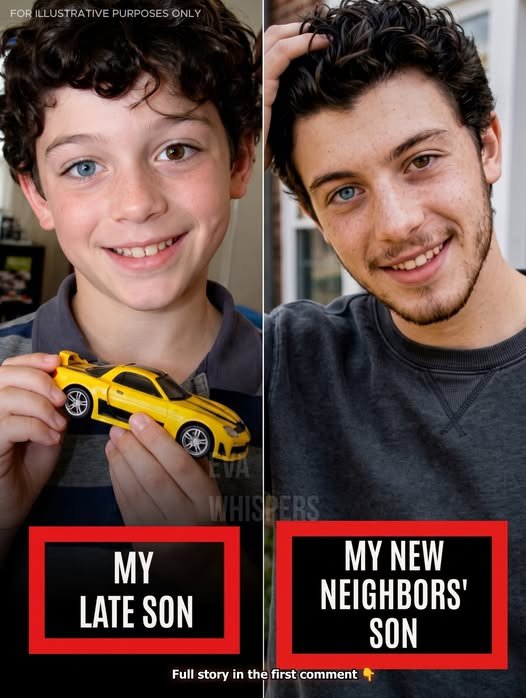
He had my son’s dark curls.
My son’s sharp chin.
And most unmistakably, he had Daniel’s eyes—one blue and one brown.
The boy was nineteen years old.
Exactly the age my son would have been.
When I ran home and told my husband what I had seen, he didn’t laugh or tell me grief was playing tricks on me.
Instead, he lowered his head and whispered,
“I thought this secret had been buried with Daniel.”
And in that moment, the life I thought I understood began to fall apart.
The Day My World Went Silent
My son Daniel died when he was nine.
Even after all these years, writing those words still feels unnatural. A mother should never have to speak about her child in the past tense.
Daniel had been playing with a ball near the school gate. He loved that old red ball. It was scuffed, faded, and slightly soft on one side, but he refused to replace it.
A car came around the corner too quickly.
One moment, Daniel was laughing.
The next, the world I knew was gone.
People often say that time heals grief.
It doesn’t.
Time simply teaches you how to carry it without collapsing every time you take a breath.
For years, I turned whenever I heard a child laughing outside. I would pause in the kitchen when I imagined the faint bounce of a ball against the driveway.
Sometimes, just before waking, I would hear Daniel calling, “Mom!”
For half a second, I would believe he was still down the hall.
Then I would open my eyes and remember.
Friends encouraged Carl and me to have another child.
“It might help fill the emptiness,” one person said gently.
But Daniel had not left an empty space that another child could fill. He had left a Daniel-shaped absence, and no one else could ever belong there.
So Carl and I became quieter.
Our house became quieter too.
We still loved each other, but grief settled between us like a third person—always present, rarely mentioned.
Over time, we learned to live around it.
At least, I thought we had.
New Neighbors
The house beside ours had been empty for nearly a year when the moving truck finally arrived.
Carl stood at the living room window with his arms crossed, watching strangers carry boxes and furniture up the driveway.
“Looks like we have neighbors again,” he said.
I looked up from the kitchen.
There was no excitement in his voice, but no annoyance either. That was how most things felt in our house—muted and carefully controlled.
“I should bake something,” I said. “To welcome them.”
It was what the old version of me would have done.
Before Daniel died, I was the woman who remembered birthdays, organized block parties, and showed up at every new neighbor’s door with something warm from the oven.
I wanted to believe a small part of that woman still existed.
That afternoon, I baked an apple pie.
The cinnamon filled the kitchen with a comforting sweetness. For a moment, I remembered Daniel sitting at the table, swinging his legs and asking every thirty seconds if the pie was ready.
I closed my eyes.
Then I pushed the memory away, waited for the pie to cool, and carried it next door.
I had no idea that the person waiting behind that door would reopen every wound I had spent ten years learning to survive.

The Pie on the Porch
I knocked twice.
The door opened almost immediately.
A young man stood in front of me.
He was tall, with slightly curly brown hair falling across his forehead. His face was older and more defined than Daniel’s had ever been, but the resemblance was so powerful that my body reacted before my mind could understand it.
My fingers went numb.
The plate slipped from my hands.
It struck the porch and broke into several pieces. Apple filling spread across the wooden boards.
“Oh my God!” the boy exclaimed, stepping forward. “Are you hurt?”
I barely heard him.
I was staring into his eyes.
One was blue.
The other was brown.
Daniel had been born with the same rare coloring. His grandmother had it too, and the doctors had called it heterochromia.
I had spent nine years looking into those mismatched eyes.
Now they were looking back at me from the face of a stranger.
“Daniel?” I whispered.
The young man frowned.
“Ma’am?”
He carefully stepped around the broken plate.
“Did the pie burn you? Do you need me to call someone?”
His concern sounded so much like Daniel’s that my knees nearly gave way.
I grabbed the railing to steady myself.
There was one question I had to ask.
“How old are you?”
He blinked, clearly confused.
“I’m nineteen.”
Nineteen.
The number struck me harder than the sight of his face.
Daniel would have turned nineteen that year.
From somewhere inside the house, a woman called, “Tyler? Is everything all right? I heard something break.”
The boy glanced over his shoulder.
“I’m fine, Mom. A woman dropped a pie.”
Mom.
The word felt like a hand pressing against my chest.
A woman appeared behind him. She looked tired from moving, with her hair loosely tied back and dust on one sleeve.
Her expression was friendly at first.
Then she looked at me.
She looked at Tyler.
Finally, she looked at his eyes.
Something in her face changed.
It was not curiosity.
It was fear.
The Mother Who Knew Something
“I’m so sorry about the mess,” I managed to say. “I live next door. I brought the pie to welcome you.”
Tyler crouched to gather the broken pieces.
“It’s okay,” he said. “We can clean it up.”
I should have left.
Instead, I looked at the woman and said the truth that was pressing against my ribs.
“My son died ten years ago. He was nine.”
Tyler stopped moving.
I swallowed hard.
“If he had lived, I think he would have looked very much like your son.”
Tyler’s expression softened.
“I’m sorry,” he said quietly.
But his mother went completely still.
Her hand tightened around the edge of the door.
“You need to leave,” she said.
Her tone was so sudden and sharp that even Tyler turned toward her.
“Mom?”
“We have a lot of unpacking to do.”
She stepped forward, pulled Tyler back into the house, and closed the door.
Not gently.
The door shut directly in my face.
For several seconds, I remained on the porch, surrounded by broken ceramic and the smell of cinnamon.
Muted voices rose behind the door.
I could not make out the words, but they sounded tense.
That woman had not reacted like someone hearing a sad coincidence.
She had reacted like someone seeing a secret she had always feared would find her.
I turned and hurried home.
Carl’s Terrifying Silence
Carl was sitting in the living room with a book when I came through the door.
He glanced up.
“You’re back already?”
I sat beside him, breathing too quickly.
“Carl, the boy next door…”
He closed the book halfway.
“What about him?”
“He looks like Daniel.”
The book closed completely.
Carl said nothing.
“The same hair,” I continued. “The same face. He even has Daniel’s eyes, Carl. One blue and one brown.”
Still, he remained silent.
“He’s nineteen. The exact age Daniel would be now.”
Carl’s skin seemed to lose its color.
His hands tightened around the book.
I had known my husband for more than twenty years. I had watched him mourn our son, sit beside hospital beds, attend a funeral, and return night after night to a silent house.
But I had never seen the expression he wore then.
It was not surprise.
It was guilt.
“Carl?”
He lowered his head.
“I thought it was over,” he whispered.
“What was over?”
“I thought it had all been buried.”
A cold feeling spread through me.
“What are you talking about?”
Carl covered his face with both hands.
When he looked up again, tears were running down his cheeks.
In all our years together, I had almost never seen him cry.
“I wanted to protect you,” he said. “But you deserve to know the truth.”
My heart began pounding.
“What truth?”
Carl struggled to speak.
“When Daniel was born, he wasn’t alone.”
I stared at him.
“What do you mean?”
His voice broke.
“Daniel had a twin.”
The Son I Never Knew Existed
For a moment, I couldn’t understand the words.
“A twin?”
Carl nodded.
“The other baby was much weaker. He wasn’t breathing properly, so the doctors rushed him to the neonatal intensive care unit.”
“No,” I whispered. “There was only Daniel.”
“You were unconscious,” Carl said. “You had lost a lot of blood. The doctors were trying to stabilize you.”
My mind filled with scattered memories of that night—bright hospital lights, distant voices, the crushing exhaustion, and then waking to Carl beside me.
I remembered asking about the baby.
He had placed Daniel in my arms and told me our son had survived.
Our son.
Singular.
“You told me there was only one baby.”
“At first, I didn’t know if the other boy would survive. Everyone was asking me to sign forms. Doctors, nurses, a social worker—I couldn’t think clearly.”
“What social worker?”
Carl wiped his face.
“She told me about a placement program for critically ill newborns. She said some families chose adoption when a child’s condition was uncertain, especially when the parents were overwhelmed or unable to provide the care the child might need.”
“And you agreed?”
“I signed what they put in front of me.”
“You gave away our son?”
His shoulders shook.
“I thought he was dying.”
My entire body felt cold.
“But he didn’t die.”
“A week later, the hospital called me. They said he was still alive, but he remained very fragile. The couple who had agreed to take him wanted to continue with the adoption.”
“You went back to the hospital?”
“Yes.”
“Without telling me?”
Carl nodded.
“Why?”
“Because I couldn’t bear to watch you lose another child.”
I stood so quickly that the room tilted.
“You had no right to make that decision for me.”
“I know.”
“No, you don’t know. You let me wake up believing I had given birth to one child. You let me hold Daniel while his brother was somewhere else fighting to live.”
“I thought if I told you, and the baby died, it would destroy you.”
“So you erased him instead?”
Carl looked down.
His silence was an answer.
“And after Daniel died?” I asked. “Why didn’t you tell me then?”
His voice dropped to almost nothing.
“Because I was ashamed. By then, too much time had passed. I convinced myself the adoption was final and that telling you would only cause more pain.”
“You didn’t protect me, Carl. You protected yourself from having to face what you had done.”
He began crying again, but my own tears would not come.
I felt too shocked to cry.
“The boy next door,” I said. “Do you think he could be the baby?”
Carl nodded slowly.
“The age, his appearance, his eyes… I don’t know how else to explain it.”
I headed toward the front door.
“Where are you going?”
“Next door.”
“Sue—”
“You can come with me, or you can stay here. But I am not spending another minute wondering whether my son is standing twenty yards away.”

The Truth Behind the Door
Carl followed me across the lawn.
This time, I did not knock politely.
I struck the door hard enough that the sound echoed inside.
Tyler’s mother opened it.
The moment she saw us together, she seemed to understand.
“Nineteen years ago,” I said, “did you adopt a newborn boy through a hospital placement program?”
She gripped the door.
Behind her, Tyler appeared in the hallway with a dish towel over his shoulder.
“What’s happening?” he asked.
Carl stepped forward.
“When is your birthday?”
Tyler told us.
It was the same day Daniel had been born.
The same day I had apparently become the mother of two sons without ever knowing it.
An older man entered the hallway. He looked at his wife, then at us, and released a long breath.
“We always knew this day might come,” he said.
Tyler’s eyes moved from one adult to another.
“What day? What are you all talking about?”
His parents invited us inside.
We sat in a living room crowded with unopened boxes.
Then they told us everything.
Tyler had spent months receiving neonatal care. His chances had initially been poor, but he had been stronger than anyone expected.
His adoptive parents had been told that his biological family believed they could not care for a critically ill baby. They had also been told that the placement had been approved voluntarily.
They had raised him, loved him, and never hidden the fact that he was adopted. But they knew very little about his biological parents.
They had not known he had a twin.
Tyler sat silently throughout the explanation.
His face had gone pale.
Finally, he looked at me.
“So I had a brother?”
My throat tightened.
“Yes.”
“What was his name?”
“Daniel.”
“What happened to him?”
“He died when he was nine.”
Tyler lowered his eyes.
“I’m sorry.”
Those two words, spoken in Daniel’s voice by the brother he had never met, finally broke through my shock.
The tears came.
For myself.
For Daniel.
For Tyler.
For the nineteen years we had lost.
After a long silence, Tyler said, “It seems unfair.”
“What does?”
“He was born healthy, and I wasn’t. But I’m the one who’s still here.”
His adoptive mother immediately moved closer and wrapped an arm around his shoulders.
Tyler leaned into her.
Watching them hurt in a way I had not expected.
He was my biological son.
But she was his mother.
She had sat beside him when he was sick, comforted him after nightmares, celebrated his birthdays, helped with homework, and watched him become the young man sitting before me.
I had lost Tyler, but she had not stolen him.
The truth was far more complicated than that.
A Marriage Changed Forever
When Carl and I returned home, we stood on the lawn between the two houses.
“I’m sorry,” he said. “I truly believed I was protecting you.”
I looked at the man I had loved for most of my adult life.
Part of me understood the terrified young father he had been—alone in a hospital, believing his wife and newborn child might die.
But understanding his fear did not erase what he had done afterward.
“You were frightened,” I said. “And you made a terrible decision while you were frightened. Maybe someday I can understand that part.”
Carl looked at me hopefully.
“But you had nineteen years to tell me.”
His face fell.
“You kept silent because speaking the truth would have forced you to face my anger and your guilt. That wasn’t protection.”
“Can you forgive me?”
I looked toward the house next door.
“I don’t know.”
It was the most honest answer I could give him.
Some wounds cannot be repaired by a single apology.
Some truths divide life into two parts: everything before you knew, and everything after.
The Knock That Evening
Just after sunset, someone knocked on our door.
Carl was upstairs, so I answered it alone.
Tyler stood on the porch with his hands tucked into the pockets of his jacket.
He looked nervous.
Young.
Overwhelmed.
And so much like Daniel that my heart ached.
“I wasn’t sure whether I should come,” he said.
“I’m glad you did.”
He shifted his weight.
“I don’t know what I’m supposed to call you.”
I wiped at my eyes.
“You can call me Sue. I haven’t earned the right to ask for anything else.”
He looked down.
“This is complicated, isn’t it?”
“Yes,” I said. “Very complicated.”
“Do you think it will ever stop feeling strange?”
“I hope so. Maybe it won’t become simple, but it might become easier.”
Tyler nodded.
Then he looked directly into my eyes—one blue eye and one brown eye meeting mine.
“Can you tell me about Daniel?”
For a moment, I could not speak.
Then I stepped aside.
“Come in.”
The Brother He Never Met
I led Tyler into the living room and opened the cabinet I had avoided for years.
Inside were Daniel’s photographs, drawings, school certificates, and small pieces of an ordinary childhood that had become priceless after he was gone.
I showed Tyler a picture of Daniel at five years old, covered in flour after trying to help me bake cookies.
I showed him the drawing Daniel had made in kindergarten of our family standing beneath an enormous yellow sun.
I showed him the ribbon from his first spelling competition and the photograph taken the day he lost his two front teeth.
Tyler smiled.
“He looks happy.”
“He was.”
“What was he like?”
I told him Daniel was curious and stubborn. He hated peas, loved thunderstorms, and once tried to build a birdhouse from a cardboard cereal box.
I told him Daniel laughed with his entire body and never entered a room quietly.
“He would have loved having a brother,” I said.
Tyler looked at the photographs for a long time.
“I think I would have loved him too.”
The words brought fresh tears to my eyes.
But they were different from the tears I had cried for the past ten years.
They were not only tears of loss.
They carried relief, love, and the fragile beginning of something I had not believed possible.
Hope.
A Different Kind of Healing
Tyler did not return to me as the child I had lost.
He already had parents who loved him and a life that had unfolded without me.
I could not reclaim his childhood.
I could not undo Carl’s choice.
And nothing could bring Daniel back.
But that evening, as Tyler sat beside me holding his brother’s photographs, I realized that healing did not always mean recovering what had been taken.
Sometimes, healing meant making room for a truth that was both painful and beautiful.
For ten years, speaking about Daniel had felt like reopening a wound.
That night, telling his story felt like keeping a light alive.
I had buried one son.
I had unknowingly lost another.
But when Tyler knocked on my door and asked about his brother, something inside me finally began to mend.
Not because the past had changed.
Not because the pain had disappeared.
But because, after years of silence, Daniel’s story was no longer mine to carry alone.