
Part 1 — The Words I Will Never Forget
The first time my sister rejected her own daughter, the baby was less than an hour old.
I was still shaking from delivery.
My hair was damp against my forehead, my hospital gown clung to my back, and every muscle in my body felt as though I had run a marathon.
But none of that mattered.
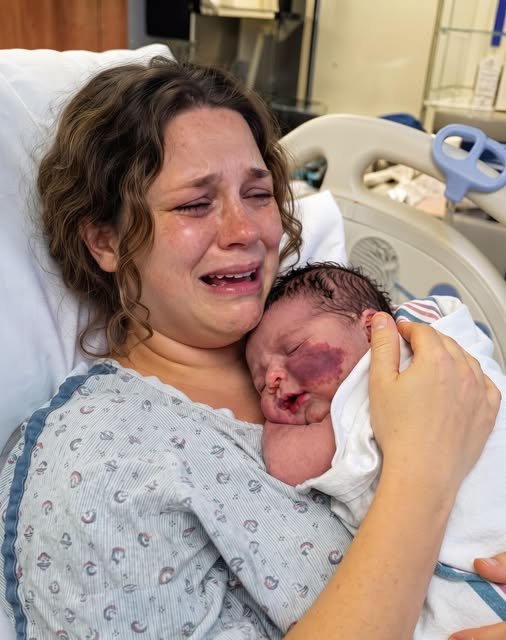
Because tucked against my chest was a tiny baby girl with dark hair, curled fists, and the softest little breaths I had ever heard.
She weighed seven pounds, one ounce.
Ten fingers.
Ten toes.
A strong heartbeat.
A furious little cry that had filled the delivery room seconds after she was born.
And on the left side of her face, stretching across part of her cheek, was a deep reddish-purple vascular birthmark.
The pediatrician had examined her carefully.
“She’s stable,” he told us. “We’ll want specialists to evaluate the birthmark and monitor her, but right now she’s doing beautifully.”
Beautifully.
That was the word I heard.
Beautiful.
Because she was.
I had carried that baby for nine months, but biologically she was not mine.
She had been created from my sister Claire’s egg and her husband Evan’s sperm. I had been their gestational carrier because Claire could not safely carry a pregnancy herself.
For months, Claire had called the baby her miracle.
Her answered prayer.
Her little girl.
Yet when she and Evan finally walked into my hospital room, neither of them reached for her.
Claire stopped three feet from my bed.
Evan leaned forward and looked into the blanket.
Then his face changed.
I watched the joy disappear from him as if someone had flipped a switch.
“No,” he whispered.
I frowned.
“What?”
He looked again.
Then he stepped backward.
“No. No, this is wrong.”
Claire stared at the baby’s face.
Her hand flew to her mouth.
I saw horror where I had expected tears of joy.
“Claire?”
She didn’t answer.
The baby stirred against my chest, making a tiny squeaking sound.
I instinctively tightened my arms around her.
“What is wrong with you two?”
Claire finally looked at me.
Her eyes filled with tears.
But they weren’t the tears I had imagined.
“This is not the baby we wanted.”
For a moment, I thought I had misunderstood her.
“What did you say?”
“We were told everything was normal,” Evan said quickly. “Every test. Every scan.”
“She is normal,” I said.
“That,” he said, pointing toward the baby’s cheek, “wasn’t supposed to happen.”
Something inside me went cold.
Claire shook her head.
“We weren’t prepared for this.”
I stared at my sister.
The same sister who had held my hand through every appointment.
The same woman who had kissed my stomach when the baby kicked.
The same woman who had whispered, I don’t care what she looks like. I just want to hold my daughter.
Now she wouldn’t even touch her.
“What exactly are you saying?” I asked.
Claire looked at Evan.
Evan looked at Claire.
Then she said the sentence that changed all of our lives.
“We don’t want to take her home.”
The room became so quiet that I could hear the air conditioner humming above us.
The baby moved again.
Her tiny hand opened against my chest.
And as I looked down at her, one thought settled into me with absolute clarity.
If they could look at this child and see a disappointment, then they did not deserve to decide her worth.
I kissed the top of her head.
Then I looked at my sister.
“All right,” I said.
Claire blinked.
“What?”
“You don’t want her?”
My voice was strangely calm.
“Then you’re going to understand exactly what that decision means.”
And right there in that hospital bed, with their daughter sleeping against my heart, I decided I was going to teach them a lesson they would never forget.
Part 2 — The Promise
To understand how we reached that hospital room, you have to understand Claire and me.
She was four years younger than I was.
Growing up, I was the fearless one.
Claire was the cautious one.
When thunderstorms shook our childhood home, she climbed into my bed.
When she broke her arm falling from a swing at eight, I sat beside her in the emergency room telling ridiculous jokes until she stopped crying.
When our parents divorced, we made a promise that no matter how complicated life became, we would always remain sisters first.
And for years, we did.
At thirty-two, Claire married Evan.
He was polished, ambitious, successful, and charming.
He worked in commercial real estate. Claire managed events for a luxury hotel.
They bought a beautiful house outside Philadelphia and immediately began talking about filling it with children.
But life didn’t cooperate.
After years of appointments, treatments, procedures, and disappointment, doctors finally told Claire that carrying a pregnancy herself would be medically unsafe.
I watched the news hollow her out.
She stopped attending baby showers.
She stopped walking through the children’s section of department stores.
At Christmas, she smiled when relatives brought their babies over, then disappeared into the bathroom afterward.
For nearly two years, she asked me to consider carrying a child for her.
I said no at first.
Not because I didn’t love her.
Because I understood the magnitude of what she was asking.
I was thirty-eight. I’d had my children young, and both were now practically adults. Pregnancy was a chapter of my life I thought I had closed.
But Claire kept asking.
Then one evening she sat at my kitchen table and took both my hands.
“Please, Marianne,” she whispered. “You’re the only person I trust with my whole heart.”
Evan sat beside her.
His eyes were wet.
“We’ll love this baby more than anything,” he said.
I looked at my sister.
And I remembered every storm we had survived together.
So I said yes.
We did everything properly.
Doctors.
Counseling.
Attorneys.
Contracts.
Medical screenings.
Nothing was rushed.
When the embryo transfer worked, Claire cried so hard she could barely speak.
At six weeks, she framed the first ultrasound.
At twelve weeks, she bought a stuffed rabbit.
At twenty weeks, when we learned the baby was a girl, she stood in the parking lot hugging me.
“A daughter,” she whispered. “I’m going to have a daughter.”
During the pregnancy, I saw no sign that her love came with conditions.
Or maybe I simply didn’t want to see them.
Looking back, there were little moments.
Claire talked constantly about the nursery.
About newborn photographs.
About matching dresses.
About the family Christmas card.
Evan joked that his daughter would have Claire’s eyes and his “perfect nose.”
At a baby shower, someone asked what mattered most to them.
Claire smiled.
“A healthy baby.”
And Evan added, laughing, “Preferably one who looks good in pictures.”
Everyone laughed.
Including me.
I wish I hadn’t.
Because sometimes a joke is only funny until life tests whether you meant it.

Part 3 — “Maybe Someone Else Could Take Her”
Back in the hospital, I asked Claire one more time.
“Are you saying you’re refusing to take your daughter home because of a birthmark?”
Claire started crying.
“Stop saying it like that.”
“How should I say it?”
“We don’t know what this means.”
“The doctor just spoke to us.”
“He said she needs specialists!”
“He said she needs evaluation. Babies need doctors, Claire. Children get sick. They fall down. They need braces, glasses, stitches, therapy, help in school. That’s what becoming a parent means.”
Evan crossed his arms.
“We were promised a healthy child.”
I almost laughed from disbelief.
“Promised?”
“Our screenings were clear.”
“A prenatal screening isn’t a catalog guarantee.”
His jaw tightened.
“That’s not what I meant.”
“Then tell me what you meant.”
Claire sat down.
She wouldn’t look at the baby.
After several seconds, she whispered, “Maybe someone else could take her.”
That sentence hurt worse than anything she’d said before.
Someone else.
As though the little girl were a package delivered to the wrong address.
I looked down.
The baby had fallen asleep again.
Her face was turned toward me.
She did not know that the two people who had spent years asking for her were discussing where else she could go.
Something fierce rose inside me.
“No,” I said.
Claire looked up.
“No what?”
“You don’t get to casually say someone else can take her and walk away.”
“We’re overwhelmed.”
“You’re allowed to be scared. You’re allowed to cry. You’re allowed to ask questions. You’re even allowed to grieve the picture you had in your head.”
I paused.
“But you are not allowed to treat a human being like a defective purchase.”
Evan’s face reddened.
“That’s not fair.”
“Fair?”
I stared at him.
“She has been alive for less than an hour, Evan. Tell me what part of this has been unfair to you.”
He didn’t answer.
I pressed the call button.
A nurse came in.
I asked for the hospital social worker.
Then I asked that our attorneys be contacted.
Claire looked alarmed.
“Why are you calling lawyers?”
“Because if you’re serious, we’re going to make this serious.”
“Marianne—”
“No.”
It was the first time in my life I had ever stopped my sister with one word.
“You begged me for two years. I put my body through months of pregnancy because you told me you would love this child more than anything.”
My voice cracked.
“You don’t get to make a decision like this during a five-minute panic attack and then show up next Tuesday when you’ve changed your mind.”
Claire started sobbing.
But I didn’t take it back.
“If you need time to understand the medical information, take it. If you need counseling, get it. But if you choose to abandon her, you are going to do it legally, deliberately, and with full knowledge of what you are giving up.”
Evan muttered something under his breath.
Then he said, “We need to leave.”
Claire stood.
She looked at the baby one final time.
For one second, I thought she might cross the room.
She didn’t.
She followed her husband out.
And the door clicked shut behind them.
I looked down at the little girl.
Her tiny fingers curled around mine.
That’s when I cried.
Not quiet tears.
I sobbed.
For her.
For my sister.
For every promise I had believed.
The nurse stood beside me and placed one hand on my shoulder.
And I whispered to the sleeping baby,
“I don’t know what’s going to happen yet, sweetheart.”
I kissed her forehead.
“But you’re not going anywhere alone.”
Part 4 — The Box
The next twenty-four hours were chaos.
Social workers came.
Attorneys called.
Doctors spoke with Claire and Evan separately.
The pediatric specialist explained that the mark appeared to be a vascular birthmark and that the baby would need follow-up care. He made no predictions he couldn’t support.
She was feeding well.
Breathing normally.
Responding normally.
She was a newborn who needed monitoring and love.
Claire and Evan still refused to assume care.
My attorney, Dana, was furious but professional.
“Don’t make promises yet,” she warned me. “This may become complicated.”
“I want her.”
“Marianne—”
“I carried her for nine months. I’m not watching her enter the system because two adults decided motherhood and fatherhood required a flawless face.”
She sighed.
“I know.”
Arrangements were eventually made for me to remain with the baby while emergency guardianship and longer-term legal steps were discussed.
The process took weeks, not hours.
Nothing happened magically.
There were court filings, assessments, meetings, signatures, and more meetings.
Through all of it, Claire barely spoke to me.
Evan didn’t speak to me at all.
Then, three weeks after the birth, we met with attorneys to discuss permanent relinquishment and my petition to become the baby’s legal parent.
Before I left home that morning, I went into my closet.
On the top shelf was a pale pink box.
Claire had given it to me during the seventh month of pregnancy.
“For the hospital,” she’d said.
Inside were keepsakes.
Ultrasound photographs.
A tiny knitted hat.
A photograph from the baby shower.
And letters.
One from Claire.
One from Evan.
They had written them to their unborn daughter.
I brought the box with me.
At the attorney’s office, Claire looked exhausted.
Evan looked impatient.
Papers covered the conference table.
Dana began explaining the consequences of what they were signing.
Permanent consequences.
Claire stared at the documents.
Evan asked where to initial.
I said nothing until Dana finished.
Then I placed the pink box on the table.
Claire’s eyes widened.
“Why did you bring that?”
“Because before you sign anything, you’re going to remember who you were nine months ago.”
Evan leaned back.
“We don’t need theatrics.”
“This isn’t theater.”
I opened the box.
I removed Claire’s letter.
She reached for it.
I held it out to her.
“Read it.”
“No.”
“Then I will.”
“Marianne, please.”
I unfolded the paper.
Her handwriting covered two pages.
I didn’t read all of it.
I only read the lines I had never forgotten.
“Dear little girl,” I began, “I haven’t met you yet, but I already know one thing. There is nothing you could ever do, nothing you could ever become, and nothing life could ever put in your path that would make me stop loving you.”
Claire covered her face.
I continued.
“I don’t need you to be perfect. I just need you to be you.”
Silence.
Evan stared at the table.
I folded the letter.
“This is the lesson I need both of you to understand.”
My hands trembled.
“A child does not arrive under warranty.”
Neither of them spoke.
“You don’t order blue eyes. You don’t order straight A’s. You don’t order perfect health, perfect behavior, perfect skin, or a perfect future.”
I looked directly at Claire.
“You asked for a daughter.”
My throat tightened.
“You got one.”
Tears poured down her cheeks.
For a moment, I hoped she would stand up.
I hoped she would say she had made a horrible mistake.
Instead she whispered,
“I can’t.”
Three words.
That was all.
Evan signed first.
Claire signed after him.
And when she put down the pen, something ended between us.
Not our entire relationship.
But the version of sisterhood I had believed was unbreakable.
That version was gone.

Part 5 — Sophie
I named her Sophie.
The name meant wisdom.
It felt right.
Taking Sophie home was beautiful and terrifying.
At thirty-eight, I found myself buying diapers again.
Waking at 2:00 a.m.
Warming bottles.
Walking through the living room with a crying baby pressed against my shoulder.
My daughter Emily, who was twenty, came home from college every weekend she could.
My nineteen-year-old son Ben learned how to make bottles with military precision.
The first time Sophie smiled at him, he sent the video to everyone he knew.
“She likes me best,” he announced.
“She has gas,” Emily said.
“I don’t care. We’re bonding.”
Slowly, the house changed.
There were burp cloths on the couch.
Bottles beside the sink.
A stroller in the hallway.
And laughter I hadn’t realized my home was missing.
Sophie’s medical appointments became part of our routine.
Specialists monitored the birthmark and explained options for treatment as she grew.
Some appointments were easy.
Some made me anxious.
But never once did I look at Sophie and think I had been cheated.
I thought only:
What does she need?
That is one of the simplest definitions of parenthood I know.
Not:
Is this what I expected?
But:
What do you need from me now?
The first few months, Claire disappeared almost completely.
Our mother begged me to forgive her.
“I do forgive her,” I said.
“Then let her come see Sophie.”
“Forgiveness doesn’t erase consequences.”
Mom didn’t like that answer.
But it was true.
I wasn’t keeping Sophie away to punish Claire.
I was protecting a child from adults who had already proven that their love could vanish when reality became inconvenient.
Then, when Sophie was five months old, something changed.
A friend of Emily’s took photographs of us for free.
In one picture, Sophie was sitting in my lap wearing yellow overalls.
She had one hand wrapped around my finger and the biggest toothless grin on her face.
Her birthmark was clearly visible.
So was her joy.
Emily posted the photograph online with my permission.
She wrote:
“Five months of Sophie. Five months of learning that love doesn’t ask a baby to be anything except loved.”
Friends shared it.
Then their friends shared it.
I hadn’t expected that.
Messages began arriving from parents whose children had visible birthmarks, scars, limb differences, hearing aids, feeding tubes, and all sorts of conditions that had once terrified them.
One mother wrote:
“I spent the first week after my son’s diagnosis grieving the child I thought I would have. Then I realized the child in front of me wasn’t asking me to grieve him. He was asking me to know him.”
I cried reading that.
And somehow Claire saw the photograph too.
Three days later, my doorbell rang.
When I opened the door, she was standing there.
Alone.
Part 6 — “I Want My Daughter Back”
For several seconds, neither of us spoke.
Claire looked thinner.
Older somehow.
“Can I come in?”
I stepped onto the porch and closed the door behind me.
“What do you need?”
She flinched.
“I deserve that.”
I folded my arms.
She looked toward the front window.
“Is Sophie inside?”
“Yes.”
“Can I see her?”
“Why?”
Tears immediately filled her eyes.
“Because she’s my daughter.”
I felt something hot move through my chest.
“No.”
“Marianne—”
“You signed away that role.”
“I made a mistake.”
“You made a decision.”
“I was terrified!”
“So was I.”
“You didn’t understand what I was feeling.”
“Then explain it.”
She wiped her cheeks.
“I had spent years imagining her. I had this whole picture in my head. I thought after everything we’d been through, when she finally arrived, everything would be perfect.”
Her voice shook.
“Then I saw her face, and all I could think was something was wrong. What would people say? Would kids make fun of her? Would she need treatments? Would she suffer? Would everyone stare?”
I studied my sister.
Finally, she had said it.
The truth.
Not medical uncertainty.
Fear.
Appearance.
Judgment.
The loss of the picture in her imagination.
“You were scared other people might reject her,” I said quietly, “so you rejected her first.”
Claire closed her eyes.
She cried harder.
“I know.”
Those words mattered.
But they didn’t erase the past.
“I’ve dreamed about that hospital room every night,” she whispered. “I hear myself saying I don’t want her. I see you holding her.”
She looked at me.
“I hate who I was.”
I wanted to embrace my sister.
A piece of me still remembered the little girl who crawled into my bed during thunderstorms.
But there was another little girl inside my house now.
And she needed me to be stronger than nostalgia.
“What happened with Evan?”
Claire looked away.
“He thinks we should move on.”
That told me everything.
“And you?”
“I can’t.”
She took a breath.
“I want my daughter back.”
There it was.
The sentence I had known might eventually come.
I didn’t yell.
I didn’t smile.
I didn’t produce the court papers and wave them in her face.
I simply said,
“No.”
Claire stared at me.
“She’s biologically mine.”
“And you surrendered your parental rights through a legal process you had weeks to reconsider.”
“I wasn’t thinking clearly.”
“You had lawyers. Counseling. Doctors. Time. People begged you to reconsider.”
“I know.”
“And every time, you chose the same thing.”
She broke down.
“So you’re punishing me forever?”
“No.”
I stepped closer.
“This is the part you still don’t understand. This isn’t about you anymore.”
She went silent.
“Sophie is not the object in the middle of a fight between two sisters. She is a child. She has a home. She has stability. She has people who have shown up every day of her life.”
I softened my voice.
“You don’t get to become her mother again because regret finally became more painful than fear.”
Claire covered her mouth.
I continued.
“But if you truly love her now, there may someday be a place for you in her life.”
She lowered her hands.
“What kind of place?”
“Her aunt.”
Her face crumpled.
I knew it hurt.
But sometimes consequences are not cruelty.
Sometimes they are the only honest shape love can take.
Part 7 — The Hardest Kind of Forgiveness
Claire did not disappear again.
That surprised me.
She started therapy.
She separated from Evan several months later.
Not because I demanded it.
Not because doing so earned her Sophie back.
Claire told me later that the marriage had begun breaking the moment they left the hospital.
She could not stop replaying what they had done.
Evan wanted to forget.
Claire eventually realized forgetting was exactly what she could not allow herself to do.
For Sophie’s first birthday, Claire sent a gift.
She didn’t show up unexpectedly.
She didn’t demand access.
She asked.
That mattered.
We arranged for her to visit while I was present.
When Claire walked into my living room and saw Sophie crawling across the rug, she froze.
Sophie looked up.
Claire knelt slowly.
“Hi,” she whispered.
Sophie stared at her.
Then she grabbed a plastic block and threw it.
It landed near Claire’s knee.
Ben laughed from the kitchen.
“That’s basically a marriage proposal from her.”
Claire laughed through her tears.
For the next hour, she sat on the floor.
She didn’t try to force affection.
She didn’t call herself Mommy.
She didn’t make promises.
She simply played.
Before leaving, she looked at me.
“Thank you.”
It took nearly another year before I trusted her enough for regular visits.
Trust, I learned, returns differently than love.
Love can survive terrible things.
Trust has to be rebuilt plank by plank.
Claire did the work.
She never once again asked me to reverse the adoption.
She stopped telling people Sophie was “the baby she lost.”
Instead she said,
“Sophie is my niece, and Marianne is her mother.”
The first time I heard her say that, I had to leave the room because I cried.
Evan never became part of Sophie’s life.
He sent one birthday card when she turned two.
I put it away for her to decide what to do with when she was old enough.
I refused to rewrite history.
But I also refused to build Sophie’s identity around somebody else’s failure.
She deserved more than that.

Part 8 — The Letter on Her Eighth Birthday
Sophie is eight now.
Her birthmark is lighter in some areas than it was when she was born, though it is still part of her face.
And she is spectacular.
Not because she overcame anything.
Not because she learned to be beautiful “despite” her birthmark.
She is spectacular because she is Sophie.
She loves astronomy.
She hates tomatoes.
She reads books under her blankets after bedtime.
She once announced at school that she plans to become “either a veterinarian or the first person to own a bakery on Mars.”
Her laugh is loud.
Her opinions are louder.
And Claire loves her.
Not as the mother she once expected to become.
As Aunt Claire.
It has not always been easy.
When Sophie was six, she asked why Aunt Claire cried sometimes when looking at her baby pictures.
I told Claire that eventually Sophie deserved the truth in an age-appropriate way.
Claire agreed.
No excuses.
No lies.
“She should hear it from me when she’s ready,” Claire said.
That day has not come yet.
But something else happened on Sophie’s eighth birthday.
After the cake, Claire handed me an envelope.
“This is for you,” she said.
Inside was a copy of the letter she had written before Sophie was born.
The same letter I’d read in the attorney’s office.
But underneath the old words, Claire had added something new.
Marianne,
Eight years ago, you made me listen to my own promise. At the time, I thought you were trying to hurt me. Now I understand you were forcing me to look at the person I had become.
I said I would love my daughter no matter what, then I abandoned that promise the first time love frightened me.
You taught me something I should have known already: children are not dreams we manufacture. They are people we receive.
You did not steal motherhood from me. I walked away from it.
And you did not punish me when you refused to give Sophie back. You protected her.
Thank you for loving her when I failed to.
Thank you for allowing me to become someone better without pretending that being better erased what I did.
And thank you for being her mother.
I read the letter twice.
Then I walked outside.
Claire was sitting on the porch steps.
I sat beside her.
For a while, neither of us spoke.
Then I took her hand.
It was the first time in eight years that holding my sister’s hand felt the way it had when we were girls.
“I forgive you,” I said.
She started crying.
“I don’t know if I’ll ever forgive myself.”
I squeezed her fingers.
“Then maybe that’s the next thing you need to learn.”
She looked at me.
“What’s that?”
“That regret is supposed to teach you, not imprison you.”
She leaned her head against my shoulder.
Behind us, through the open window, we could hear Sophie laughing with Emily and Ben.
Claire smiled.
“She sounds happy.”
“She is.”
“You did that.”
I shook my head.
“No. We all help. But Sophie does a pretty good job of making her own happiness.”
Claire laughed.
Then she said something I’ll never forget.
“I spent years asking God for a miracle.”
She looked through the window toward Sophie.
“And when the miracle didn’t look the way I imagined, I almost missed her completely.”
Part 9 — What They Never Understood That Day
People sometimes ask me whether carrying Sophie for Claire was the biggest sacrifice I ever made.
It wasn’t.
Pregnancy was difficult.
Labor was difficult.
Starting over with a newborn at thirty-eight was exhausting.
But none of those things were the hardest part.
The hardest part was accepting that someone I loved could fail so completely at the exact moment I expected her to become her best self.
We like to believe people reveal their character during grand moments.
Weddings.
Funerals.
Births.
Emergencies.
Sometimes they do.
But character isn’t always fixed.
Sometimes people reveal the worst version of themselves first.
Then spend years deciding whether they are willing to become better.
Claire did something I will never excuse.
But eventually, she stopped making excuses for herself.
That is why she is still in our lives.
As for the unforgettable lesson I promised myself I would teach her in that hospital room?
For years, I thought the lesson was the pink box.
The letter.
The legal papers.
The moment I made Claire confront her own words before signing away her child.
It wasn’t.
The real lesson was Sophie.
Every birthday.
Every laugh.
Every school picture.
Every scraped knee.
Every bedtime story.
Every ordinary Tuesday morning when a sleepy little girl walks downstairs with wild hair and asks for pancakes.
Claire learned that what she rejected wasn’t an imperfect baby.
She rejected all of that.
A person.
A childhood.
A thousand small moments she could never reclaim.
And I learned something too.
Family isn’t proven by what you promise when everything looks beautiful.
Family is proven by what you do when life hands you something you didn’t expect.
That newborn baby never needed to earn anyone’s love.
She didn’t need a different face.
She didn’t need a different beginning.
She didn’t need to become easier to accept.
The adults around her needed to become better.
And on the morning Sophie was born, when my sister stepped backward instead of forward, I made a promise of my own.
I would never let that little girl grow up believing she had been rejected because there was something wrong with her.
One day, when she’s old enough, she will know the whole story.
She will know Claire’s failure.
She will know my anger.
She will know how complicated the legal process was and how many tears were shed.
But more than anything, she will know this:
The moment two people looked at her and said,
“This is not the child we wanted,”
someone else looked down at the exact same little face and thought,
Then perhaps you never understood what it meant to want a child at all.
I held her closer that day.
And I chose her.
Not because she needed rescuing from who she was.
But because she deserved to be loved exactly as she arrived.
And eight years later, if Sophie ever asks me whether I regret saying yes to carrying her, I already know my answer.
Not for one second.
Because sometimes the miracle you think you’re giving someone else turns out to be the miracle that changes your own life.
And sometimes the most unforgettable lesson is not revenge.
It is making people live long enough to understand the value of what they were once willing to throw away.