
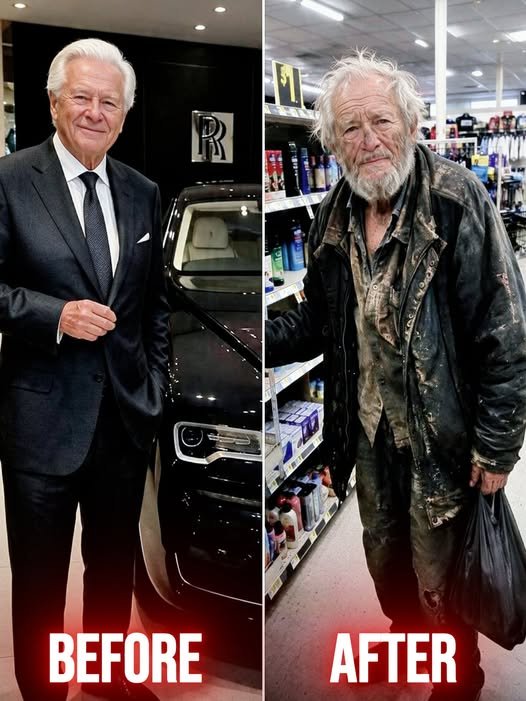
Part One: A Mansion Filled With Silence
The mansion had never felt so enormous.
On that gray Tuesday morning, sunlight spilled through the tall windows and stretched across the marble floors, yet the house still seemed cold and lifeless. Every surface gleamed. Every room was perfectly arranged. Not a single cushion was out of place.
But there was no laughter.
No footsteps.
No one calling my name.
The only sound was the slow, steady ticking of the grandfather clock in the entrance hall—the clock my wife, Anna, had chosen more than forty years earlier.
I was seventy-nine years old, and I had gone three full days without hearing another human voice inside my home.
There were people who came and went, of course. Nurses checked my medication. Assistants delivered documents. Gardeners trimmed hedges I rarely saw, and housekeepers cleaned rooms I never entered.
But none of them stayed.
None of them belonged there.
And neither, I sometimes thought, did I.
In the 1970s, I had opened a small grocery store in Texas with one simple promise: working families should be able to afford decent food without choosing between groceries and rent.
That single store became ten. Then fifty. Eventually, my company spread across six states.
My name appeared on storefronts, warehouses, delivery trucks, and corporate buildings. Business magazines called me a visionary. Bankers returned my calls before I finished leaving messages. Politicians smiled beside me at charity events.
By the time I turned sixty, I possessed more wealth than I could have spent in several lifetimes.
Yet every evening, I ate alone.
Anna had died in 1989 after a terrible accident on a rain-covered highway. We had never been blessed with children, though we had wanted them desperately. After losing her, I buried myself in work because numbers were easier to face than grief.
Numbers did not ask why I had survived.
Numbers did not leave an empty chair across the dinner table.
For thirty years, I expanded the company, funded scholarships, opened community food programs, and convinced myself that usefulness was the same thing as happiness.
Then the doctors told me I had Stage IV cancer.
Six months, they estimated.
Perhaps less.
Cancer was not impressed by my bank accounts. It did not care how many employees depended on my decisions or how many buildings carried my name.
For the first time in decades, I was forced to stop building and consider what would happen after I was gone.
That was when I began noticing the looks.
Board members spoke more carefully around me. Executives appeared at the mansion with folders labeled “transition,” “continuity,” and “future leadership.” Relatives I had not heard from in years suddenly remembered my birthday.
They asked about my health, but their eyes drifted toward the walls, the paintings, and the locked study where they assumed I kept my will.
To them, I was no longer a man approaching the end of his life.
I was an estate waiting to be divided.
The greatest disappointment came from Derek.
I had mentored him for twelve years. He had started as a store supervisor and risen to regional manager because I believed he possessed discipline, intelligence, and loyalty.
I had once considered placing the entire company in his hands.
One morning, he entered the sitting room carrying a leather folder.
“You seem stronger today, sir,” he said with a polished smile.
I looked at him over the rim of my glasses.
“I’m dying, Derek. There’s no need to flatter me.”
His expression tightened for only a moment.
“I was trying to be encouraging.”
His gaze shifted toward the prescription bottles on the side table. He studied them a second too long, almost as if he were calculating how quickly they were disappearing.
“I brought some preliminary transition documents,” he continued. “Nothing urgent. They’re simply here for whenever you feel ready.”
“For when I’m dead, you mean.”
“Sir, that isn’t what I—”
His phone vibrated inside his jacket.
“Take your call,” I said. “I need a moment alone.”
He excused himself and stepped into the hallway.
Something in his manner disturbed me. Perhaps it was the way his hand had rested protectively on the folder. Perhaps it was the eagerness he tried to conceal.
I rose, gripped my cane, and followed him.
The thick carpet swallowed my footsteps.
Derek stood inside the study with his back toward the door.
“No, listen to me,” he whispered into the phone. “The old man is fading quickly. Six months at most.”
He paused, then laughed softly.
“He’s basically a walking bag of money. Once he’s gone, the board is mine.”
I froze in the hallway.
For several seconds, I forgot how to breathe.
I had built a company that provided affordable food to thousands of families. I had trained Derek, defended him, rewarded him, and trusted him.
And in his mind, I was nothing more than a bag of money with a failing heartbeat.
An hour later, he left the mansion after shaking my hand and promising to visit the following week.
I smiled until the door closed.
Then I returned to the silent sitting room and stared at Anna’s photograph.
“There must still be one,” I whispered. “One person who would help a stranger without expecting a reward.”
That was when the idea came to me.
I would not choose my heir from a list of relatives, executives, or professional advisers.
I would find someone whose character could not be purchased.
Someone who would show kindness to a person who appeared to have absolutely nothing.
And I would test them myself.
Part Two: Making the Billionaire Disappear
The man in the bedroom mirror still looked wealthy.
His silver hair was neatly combed. His shirt had been made by hand. Even his posture, weakened by illness, carried the confidence of someone accustomed to being obeyed.
No one would reveal their true nature to that man.
They would hold doors for him, laugh at his jokes, and pretend to care about his opinions because they knew his name.
If I wanted honesty, I had to remove everything that inspired politeness.
I picked up a pair of scissors.
“The billionaire must disappear,” I murmured, “before the truth can reveal itself.”
I cut my hair unevenly until it stuck out in rough, silver clumps. I attached an unkempt artificial beard to my face and rubbed dark makeup into the lines around my eyes.
From an old storage room, I found torn trousers, worn shoes, and a heavy coat that smelled of damp cardboard.
Then, to make the disguise more convincing, I poured a small amount of spoiled milk down the front.
The odor was immediate and terrible.
Underneath it, however, I had forgotten—or perhaps deliberately chosen not—to remove my usual cologne. The faint trace of luxury beneath the sour smell amused me.
It reminded me that appearances could hide almost anything.
When I faced the mirror again, the businessman was gone.
In his place stood a frail, unwashed old man whom most people would avoid before he had the chance to speak.
I leaned heavily on an old wooden cane and left the mansion through the service entrance.
My driver had been instructed not to follow.
For once, I wanted to enter my own world without protection.

Part Three: Invisible in My Own Store
I chose the company’s flagship grocery store.
I had personally approved its design years earlier. I knew the width of its aisles, the location of its bakery, and the precise shade of green used on the signs.
The automatic doors opened, and cold air rushed over me.
For forty years, I had walked into stores where employees straightened their backs the moment they recognized me.
That day, no one did.
Customers moved around me as though I were an unpleasant obstacle.
Near the produce section, a woman stood examining a bag of oranges.
I approached slowly.
“Excuse me, ma’am,” I said. “Could you possibly spare a dollar so I could buy something to eat?”
She turned, took one look at my coat, and immediately covered her nose.
“What is that smell?”
Her face twisted with disgust.
“You smell like something rotten.”
She hurried away without waiting for an answer.
I told myself not to judge the entire world by one person.
Near the bakery, I approached a middle-aged man standing beside his wife.
Before I could finish my first sentence, he stepped back.
“People like that shouldn’t be allowed inside,” he muttered. “Where is security?”
His wife looked away.
Neither of them asked whether I was hungry.
I continued toward the canned-food aisle.
A teenage boy in a varsity jacket leaned against a shelf, scrolling through his phone. He looked clean, confident, and well cared for.
I stopped several feet from him.
“Son,” I said gently, “would you be willing to buy an old man one can of beef stew?”
For a moment, his face brightened.
I thought I had finally found compassion.
Instead, he raised his phone and pointed the camera at me.
“This is unbelievable,” he said, laughing. “Hold on. I’m recording this.”
He moved closer.
“I’m putting you online. People are going to love this. Say something sad.”
I stared at the glowing screen.
To him, my suffering was not real. I was merely content—something strange and humiliating that might earn him attention.
I lowered my head and walked away.
He followed for a few steps, still filming, before becoming bored and turning back to his phone.
By then, the disguise had begun to feel heavier than the coat itself.
I passed three more aisles before a young employee approached. His polo shirt was spotless, and the badge on his chest identified him as an assistant manager.
He looked at me with visible discomfort.
“Sir, several customers have complained about the smell.”
“I understand,” I said. “I only need a little food.”
“There’s a shelter on Eighth Street.”
“I’m asking for one can of stew.”
He folded his arms.
“We can’t have you disturbing customers. I’m going to need you to leave.”
He lifted his hand and signaled to a security guard standing near the entrance.
The guard began walking toward us.
I looked around at the shelves, the bright signs, and the neatly stacked products bearing my company’s name.
I had founded those stores to serve ordinary people.
Yet inside one of them, a hungry old man was not treated as an ordinary person at all.
He was treated as a stain.
The guard stopped beside me.
“Let’s go, sir.”
I turned toward the exit.
Each step felt heavier than the one before it.
Perhaps Derek was not unusual. Perhaps greed, cruelty, and indifference were simply what remained when there was no advantage in being kind.
The doors were six steps away.
Then four.
Then two.
I had almost reached them when a small hand suddenly closed around my sleeve.
The unexpected pull threw me off balance.
“Sir?”
The voice was soft and frightened.
I turned.
A thin girl stood behind me in a faded school uniform. Her shoes were scuffed, and the cuffs of her sweater had been carefully repaired with mismatched thread.
In one hand, she held a can of beef stew.
In the other, she clutched a crumpled bill.
“I’m sorry I grabbed you,” she said. “I was afraid you would leave before I caught up.”
I stared at her.
She could not have been older than twelve.
She placed the can in my hands.
“This is for you.”
I looked down at it, unable to speak.
“It’s beef stew,” she explained. “I heard you asking for it.”
Then she unfolded the bill. It was only a few dollars, worn soft from being carried.
“You can have this too,” she said. “It’s all I have, but you probably need it more than I do.”
My throat tightened.
“Is this your lunch money?”
She looked down at her shoes and nodded.
“I saved it during the week.”
“Then you should keep it.”
“My mom says we should share what we have,” she replied, “even when what we have isn’t much.”
Something inside me gave way.
It was not pity.
It was not even gratitude.
It was the sudden breaking of a wall I had unknowingly built after Anna’s death.
All morning, adults with full shopping carts had turned away from me.
The only person who stopped was a child who could barely afford her own lunch.
“What is your name?” I asked.
“Lily.”
The security guard was still nearby, but his posture had changed. He looked embarrassed.
Lily slipped one arm beneath mine and carefully guided me to a bench outside the store.
She handled me as though I were fragile and valuable.
Then she ran back inside and returned with a paper cup of water.
“Drink slowly,” she said.
I pretended to sip while studying the embroidered crest on her uniform.
“Where is your mother, Lily?”
“At work. She cleans offices.”
“During the day?”
“Sometimes. Mostly at night. She takes extra shifts whenever they let her.”
“And your father?”
Her voice became quieter.
“It’s only me and Mom.”
We sat together for several minutes.
She did not ask my name.
She did not ask why I was homeless.
She did not offer advice or demand gratitude.
She simply stayed beside me because she did not want me to be alone.
Eventually, I told her I had somewhere to go.
From a careful distance, I watched her walk home to a small apartment above a laundromat near the bus station.
That evening, I called my lawyer.
“I’ve found her,” I said.
“Found whom?”
“My heir.”
Part Four: The File Against Lily’s Mother
My lawyer was silent for a moment.
Then his professional instincts returned.
“I’ll need more information.”
“Her name is Lily. She’s twelve years old. She attends the academy near the flagship store and lives with her mother above the laundromat by the bus depot.”
“You understand we need to investigate carefully.”
“I want everything done legally,” I said. “No surprises. No hidden claims. Find out who they are and whether they need protection.”
He called the following morning.
His voice was tense.
“There’s a complication.”
“What kind?”
“Lily’s mother is named Marisol. She works as a night cleaner at your corporate headquarters.”
I straightened.
“I’ve never met her.”
“That isn’t the problem.”
“Then what is?”
“Derek has been creating a disciplinary file against her.”
My grip tightened around the phone.
“For what?”
“She has taken expired snacks and packaged food that had already been marked for disposal. She brought them home for Lily.”
“That food was going into the trash.”
“I know. But Derek has recorded six separate incidents and classified them as theft. It appears he is preparing to terminate her for cause.”
Anger burned through the exhaustion in my body.
Derek was not merely impatient for my death. He was willing to destroy a struggling woman over food the company had already discarded.
“Does he know about Lily?” I asked.
“He knows Marisol has a daughter. He doesn’t know the child has any connection to you.”
“He must not learn yet.”
After ending the call, I sat alone for several minutes.
Then I returned to the bedroom, attached the ragged beard, put on the torn coat, and became invisible once more.
Part Five: A Second Test
The entrance to my corporate headquarters was built from glass and steel. My name stood above the doors in letters taller than a man.
When I entered dressed as the homeless stranger, the receptionist froze.
Two security officers moved toward me before I reached the elevators.
“Sir, you are not permitted to be here.”
“I need to speak with Derek,” I rasped.
The receptionist frowned.
“Do you have an appointment?”
“Tell him it concerns the night cleaning staff.”
That made her hesitate.
She lifted the phone and spoke quietly. As she listened, her eyes moved from the receiver to my coat.
A minute later, Derek appeared at the top of the wide staircase.
For one irrational second, I wondered whether he would recognize my eyes or the way I held the cane.
He did not.
He saw only dirt, age, and poverty.
His face hardened.
“Get him out of here,” he said.
The receptionist tried to explain.
“He asked for you by name. He said it involved—”
“I heard what he said.”
Derek pointed toward the entrance.
“Remove him. Then review the security footage. I want to know who allowed him inside and who gave him my name.”
The guards took my arms.
They were not rough, perhaps because I was old, but the humiliation was still sharp.
Derek turned away before I reached the door.
He did not ask whether I needed help.
He did not ask what I knew about the cleaning staff.
He did not even look at me long enough to remember my face.
That evening, my lawyer arrived at the mansion carrying a thick stack of records.
I asked for Marisol’s personnel file first.
After reviewing it, I opened the family-background documents.
A familiar surname appeared on the first page.
I stopped breathing.
Anna had once had a younger sister.
Their relationship had ended after a bitter family conflict long before Anna and I were married. Her sister had disappeared with a baby daughter and refused every attempt at contact.
Anna had grieved that separation privately. Some nights, I had awakened to find her holding an old photograph and crying.
She had always wondered what became of the little girl she was never allowed to meet.
According to the records in my hands, that baby had grown into Marisol’s mother.
Marisol was Anna’s niece.
Lily was the last surviving child of Anna’s family line.
I leaned back in my chair, stunned by the impossible shape of it all.
Of the hundreds of people in the store, the one person who had shown me compassion was connected to the woman I had loved most in the world.
But blood alone was not why I had chosen Lily.
She had already earned a place in my life before I knew who she was.
The family connection did not create the miracle.
It only completed it.
The following morning, I prepared to enter the boardroom one final time.
This time, I would not be wearing a disguise.

Part Six: The Boardroom Reckoning
I arrived at headquarters in a charcoal suit.
My silver hair was neatly combed. The beard was gone. I carried no old cane, though every step required more strength than anyone knew.
Employees stopped speaking as I crossed the lobby.
The same receptionist who had watched me thrown out the previous day stood slowly from her chair.
Recognition dawned across her face.
Her hand flew to her mouth.
I offered her a slight nod and continued toward the boardroom.
Behind the closed doors, Derek was already presenting a slide titled “Succession Proposal.”
He stood at the front of the room, speaking confidently about stability, leadership, and the future of the company.
Then the doors opened.
Every head turned.
Derek’s face lost its color.
“Sir,” he stammered. “We weren’t expecting you.”
“That has become clear.”
I walked to the head of the table and sat in the chair he had apparently expected to inherit.
Then I placed a folder on the polished wood.
“This contains security footage from the flagship store,” I said. “It also contains a recording from the dictation system in my study.”
Derek’s eyes widened.
I continued.
“The system captured your phone conversation last Thursday. Every word.”
No one moved.
I looked directly at him.
“You called me a walking bag of money.”
“Sir, I can explain—”
“You believed I was dying too quickly to hear you.”
His mouth opened, but no sound emerged.
I placed another file beside the first.
“This contains the disciplinary records you created against a member of the night cleaning staff. A woman named Marisol.”
Derek recovered enough to speak.
“She repeatedly removed company property.”
“She took expired food that had been authorized for disposal.”
“It was still against policy.”
“Then the policy should have been corrected,” I said, “not used as a weapon against a mother trying to feed her child.”
Several board members lowered their eyes.
I opened Marisol’s personnel file.
“Nineteen months of employment. Perfect attendance. Strong performance reviews. No disciplinary issues until your signature began appearing on her record.”
“I was protecting the company.”
“No. You were proving what kind of leader you would become once you believed I could no longer stop you.”
Derek’s expression changed.
The polished confidence disappeared, revealing the fear beneath it.
I leaned forward.
“You did not recognize me yesterday.”
Silence spread through the room.
“I was the old man in the torn coat.”
One board member inhaled sharply.
Derek stared at me.
“I stood in the lobby three feet from you,” I continued. “You ordered security to remove me without asking why I had come.”
“Sir, I couldn’t have known—”
“That is precisely the point. You believed I was nobody.”
He looked around the table, searching for support.
No one offered it.
“You are terminated,” I said. “Effective immediately. Legal counsel will review the falsified disciplinary reports and every decision you have made involving employee dismissals.”
“After twelve years?”
“After twelve years, I finally saw you clearly.”
He gathered nothing from the table.
He simply walked out.
For once, no one followed him.
Part Seven: The Truth About Anna
After the meeting, I asked my assistant to bring Marisol and Lily upstairs.
They entered holding hands.
Marisol wore a plain blouse and looked terrified. Lily was still dressed in her faded school uniform.
When she saw me, she stopped.
Her eyes narrowed as she studied my face.
“Sir?” she whispered.
I smiled.
“Do I look familiar?”
She tilted her head.
Then her eyes widened.
“You’re the man from the store.”
Marisol looked from her daughter to me in confusion.
I slowly lowered myself until I was closer to Lily’s height.
“Yes,” I said. “I was the man from the store.”
“But you look…”
“Different?”
She nodded.
“My name is on the building outside.”
Lily’s mouth fell open.
Marisol gripped the back of a chair.
“I don’t understand,” she said.
“I needed to discover how people behaved when they believed I had nothing to offer them.”
I looked at Lily.
“Your daughter was the only person who stopped.”
Marisol’s eyes filled with tears, but she placed a protective hand on Lily’s shoulder.
“We don’t want trouble.”
“You are not in trouble.”
I gestured for them to sit.
“There is something else you should know.”
I opened the family file and placed an old photograph on the table.
It showed Anna as a young woman standing beside her younger sister.
Marisol reached for it with trembling fingers.
“That’s my grandmother,” she whispered. “And the other woman…”
“Was my wife.”
She looked up.
“Anna?”
I nodded.
“Anna was my aunt,” Marisol said. “My grandmother kept one photograph of her, but she never explained what happened between them.”
“Anna never stopped missing your family.”
Marisol pressed both hands over her mouth. Her knees weakened, and she sank into the chair.
For several moments, none of us spoke.
Years of separation, misunderstanding, and regret seemed to gather around that small photograph.
“I searched for meaning in the wrong places,” I said quietly. “I thought the company was the only family I had left. Then Lily gave away her lunch money to a stranger.”
Lily looked embarrassed.
“It was only a few dollars.”
“No,” I told her. “It was everything you had.”
I turned to Marisol.
“I am not simply handing you a fortune. Money without guidance can become another kind of burden.”
Her expression remained cautious.
“What are you saying?”
“I am creating a foundation in Anna’s name. It will support food programs, employee assistance, scholarships, and families in crisis. You and Lily will be protected, educated, and given the opportunity to help shape its future.”
Marisol shook her head slowly.
“Why us?”
“Because your daughter reminded me what the company was supposed to stand for.”
I looked at Lily.
“And because, whether by blood or by grace, you are the closest thing to family I have left.”
My voice became unsteady.
“I cannot promise you many years. The doctors have made that clear. But I can offer the time I have.”
I swallowed.
“If you are willing to share it with me.”
Lily stepped forward.
For a second, she simply looked at me.
Then she wrapped her arms around my neck.
The force of the embrace nearly unbalanced me.
I held her tightly.
She did not hug me like a billionaire.
She hugged me like a lonely old man who had finally come home.
Part Eight: The Richest Meal of My Life
That evening, I did not return immediately to the mansion.
Instead, I went home with Marisol and Lily.
Their apartment above the laundromat was small. The walls were thin, the kitchen table was scratched, and one of the chairs wobbled.
Yet the rooms felt warmer than every hall in my mansion.
Marisol heated beef stew on the stove.
When she apologized for the simple meal, I asked her not to.
She served it in chipped bowls and placed a loaf of bread in the center of the table.
Lily sat across from me, telling me about school, her favorite books, and the stray cat that slept behind the laundromat.
Marisol listened with a tired but peaceful smile.
No one discussed stock prices.
No one asked about my will.
No one watched the clock, waiting for an appropriate moment to leave.
For the first time in decades, I heard laughter while eating dinner.
The stew was ordinary.
The bowl was chipped.
The table was too small.
And it was the richest meal I had ever tasted.
I had entered the grocery store believing I was searching for someone worthy of inheriting my fortune.
Instead, I found a child who gave away everything she had without knowing anyone was watching.
Lily did not merely change my will.
She changed the final chapter of my life.
That night, surrounded by the family I had thought was lost forever, I realized something wealth had never taught me:
A person is not rich because of what remains after they are gone.
A person is rich because of the love they are able to give while they are still here.
And for the first time since Anna died, I was no longer the loneliest man in Texas.