
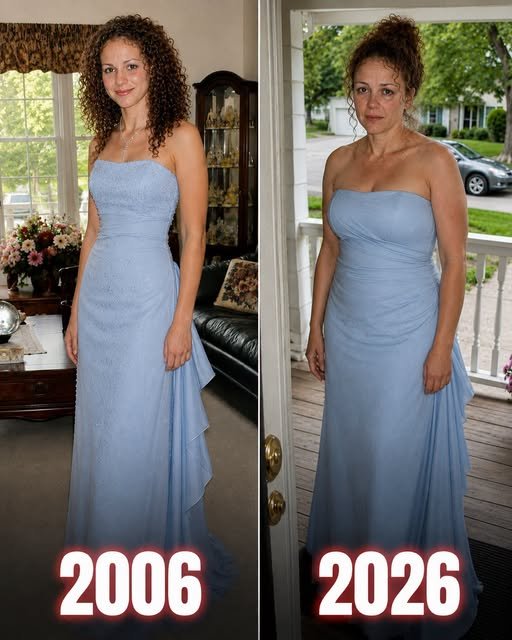
Twenty years after I buried an empty casket, I thought I had finally learned to live with the questions left by my daughter’s death. Then, a stranger brought something from Teresa’s past to my door, and the truth forced me to remember her in a way I never had before.
Part 1 — The Dress on My Doorstep
“Take it off.”
The words left my mouth before I even understood I was saying them.
The woman standing on my porch went completely still. One hand remained curled around the pale blue fabric at her hip.
“I’m sorry?” she asked.
My fingers tightened around the edge of the door.
“That dress,” I whispered. “It belonged to my daughter.”
Her expression changed from confusion to alarm.
But I barely noticed.
All I could see were the five pearls stitched unevenly along the left shoulder.
Five imperfect little pearls.
Twenty years disappeared in an instant.
I remembered Teresa standing in a department store fitting room while I bent over that same shoulder with a needle because she’d caught the gown on a zipper. I had resewn the pearls quickly, and they had never formed a perfectly straight line afterward.
There could not possibly be another dress with that exact crooked repair.
The stranger reached behind her neck.
“I can take it off,” she said carefully. “I can change in my car.”
“No.”
She stopped.
I didn’t want her stripping on my porch. I didn’t want her throwing the gown over the back seat of a car as though it were just an old piece of fabric.
The truth was, I didn’t know what I wanted.
Twenty years earlier, my sixteen-year-old daughter had died the day before her high school prom.
Four years after losing her, I had finally placed that gown inside a donation box.
I remembered smoothing the skirt one last time before closing the cardboard flaps.
I had thought I was saying goodbye.
And now a stranger was wearing it.
“My name is Madeline,” the woman said softly. “I found the dress at a clothing sale. My daughter is getting married next week. I was planning to wear it.”
I stared at her.
“You came to my house wearing it?”
“I hadn’t planned to.”
She lifted the small purse hanging from her wrist.
“I was trying the dress on this morning when something fell out from inside the lining.”
She reached into the purse.
Then she pulled out a yellowed envelope.
My knees almost failed me.
I recognized the handwriting before I even saw the name.
Mine.
My name and address were written across the front.
Madeline held the envelope toward me.
“I thought this belonged with you.”
My hand trembled as I took it.
“I wrote this.”
“I know.”
My eyes lifted sharply to hers.
“How could you possibly know that?”
She hesitated.
“Because it’s addressed to Teresa.”
The sound of my daughter’s name coming from a stranger’s lips hit me harder than I expected.
For a moment, I couldn’t breathe.
“You read it?”
Madeline looked ashamed.
“The first page.”
Anger rushed through me.
“You had no right.”
“I know.”
No explanation.
No attempt to defend herself.
Somehow, that made it more difficult to stay furious.
She stepped away from the door.
“I stopped as soon as I realized what it was. Your address was on the envelope. I didn’t know if you still lived here, but I couldn’t throw it away.”
“You could have mailed it.”
“Yes.”
“Then why didn’t you?”
Madeline glanced down at the blue skirt surrounding her legs.
“Because you wrote that you had never seen your daughter wear this dress.”
I pressed the envelope against my chest.
“The dress survived,” I said. “My daughter didn’t.”
Pain crossed Madeline’s face.
“You’re right. I’m sorry.”
Her hand moved toward the clasp again.
“I’ll leave it here.”
I should have accepted.
I should have taken the gown, closed the door, and disappeared into the life I had spent twenty years carefully rebuilding.
Instead, my gaze returned to those crooked pearls.
“Were you planning to replace those?”
Madeline touched them.
“No. I like them the way they are.”
Something inside me loosened.
Not enough to invite her in.
Not enough to stop hurting.
But enough.
“Keep it on,” I said quietly. “Just… please go.”
Before leaving, Madeline placed a card on the porch railing.
“My daughter, Penelope, is having tea tomorrow before the wedding week gets hectic. You’re welcome to come.”
“I won’t.”
She nodded as if she had expected that answer.
Then she walked away wearing my dead daughter’s prom dress.
I shut the door.
For several seconds, I simply stood there with my back against it, clutching a letter I had written sixteen years earlier.
I told myself I would not open it.
I lasted less than a minute.

Part 2 — The Night Teresa Never Had
Teresa had searched for that dress for six months.
Nearly forty gowns had failed the test.
Some were too formal.
Some were too childish.
One was, according to Teresa, “the exact color of cafeteria pudding.”
Then she stepped from a fitting room in pale blue.
She looked at herself in the mirror and stopped.
So did I.
The dress fell softly around her, simple enough to let her shine instead of overpowering her.
Her entire face changed.
“This is the one, Mom.”
She turned slowly in front of the mirror.
Then she caught my sleeve and gave it the little tug she had used since childhood whenever she desperately wanted something.
“Promise you’ll keep it forever.”
I laughed.
“You haven’t even worn it yet, Teresa.”
“Promise.”
So I did.
“I promise.”
The next morning, Teresa left with her friends Tanya, Phoebe, and another classmate for a hike.
It was supposed to be one last carefree outing before prom and graduation.
Her friend Holly had planned to go too, but she’d woken with a fever.
“Take pictures of everything,” Holly told Teresa over the phone.
“Even boring trees?”
“Especially boring trees.”
I stood by the front door holding out Teresa’s jacket.
“The forecast says rain.”
“We’ll be back before it gets bad.”
She slipped into the jacket, kissed me on the cheek, and smiled.
“I’ll be home for dinner.”
Those became the last words I ever heard my daughter speak.
On the drive home, the weather turned violent.
Rain came down so heavily that the road nearly disappeared.
Tanya was driving.
Phoebe and Teresa were in the back.
They were less than twenty minutes from home when part of the hillside collapsed.
Mud and water slammed into the car, forcing it through the guardrail and into a flooded ravine below.
Tanya survived.
Phoebe survived.
Another girl’s body was recovered the following morning.
Teresa was never found.
Sheriff Kahn told me the river had most likely carried her downstream.
For two weeks, search teams looked for her.
Then the water became too dangerous.
Eventually, Teresa was legally declared dead.
And I buried an empty casket.
But strangely, the funeral wasn’t the memory that haunted me most.
It was the prom dress.
I came home after burying my daughter and found it still hanging from her bedroom door.
Waiting.
Ready for the night she had spent months imagining.
For years afterward, spring became unbearable.
Every time prom season arrived, I stood outside Teresa’s room and imagined things that would never happen.
How she might have worn her hair.
Whether she would have danced.
Whether her date would have arrived nervous and awkward at our front door.
Whether I would have cried while taking photographs.
I couldn’t change what had happened.
So my mind tortured me with everything that hadn’t.
Four years after the accident, my therapist, Dr. Kim, gave me an assignment.
“Write Teresa a letter.”
“I write in a journal.”
“No,” she said gently. “Not about Teresa. To Teresa.”
That night, I tried.
And once I began, everything came out.
I told Teresa I loved her.
I told her I would have gone into that water myself if I had known where she was.
I told her I would have surrendered every year of my remaining life for one more minute with her.
And then I wrote the words that had lived inside me since the day she disappeared.
I was sorry.
Sorry I hadn’t been there.
Sorry I had been safely at home while she was terrified.
Sorry that my child had died alone, waiting for a mother who never came.
A week later, I finally packed away the prom dress.
I placed the letter against the gown before folding it into the donation box.
At some point, the envelope must have slipped beneath the lining.
And now, sixteen years later, it had come home.
I sat alone at my kitchen table and read every word.
By the end, tears had fallen across the paper.
So I did something I hadn’t expected to do.
I called Dr. Kim.
“A woman came to my house today,” I said. “She found the letter inside Teresa’s dress.”
“How much did she read?”
“Enough to find me.”
Silence.
Then I stared at one sentence on the page.
“I wrote that Teresa died waiting for me.”
Dr. Kim’s voice became careful.
“You wrote what you believed at the time.”
Something about her tone made me uneasy.
“What does that mean?”
“Grief fills empty spaces, Olivia. Sometimes we fill those spaces with the worst thing we can imagine.”
I looked at the letter again.
“Why are you saying it like that?”
“Because perhaps you need to ask yourself what you still don’t know.”
After hanging up, I sat motionless for a long time.
Then I called Tanya.
Phoebe.
And Holly.
All three arrived within an hour.
I didn’t yet understand why I had called them.
Some part of me simply knew I needed them in that room.
Part 3 — The Look Across My Kitchen Table
Holly hugged me the moment she arrived.
Tanya lingered near the counter.
Phoebe didn’t even remove her coat.
I placed the letter in the middle of the table.
“A woman came here wearing Teresa’s prom dress.”
All three stared at me.
“She found this sewn—or trapped—inside the lining.”
Holly picked up the envelope.
“You wrote Teresa a letter?”
“Four years after the accident. Dr. Kim suggested it.”
Tanya glanced at Phoebe.
It lasted perhaps one second.
Maybe less.
But I saw it.
“What was that?”
Tanya blinked.
“What?”
“That look.”
“I don’t know what you’re—”
“Don’t.”
My voice stopped her.
Phoebe slowly removed her coat.
“What did you write?”
I slid the pages toward her.
“Read it.”
She hesitated, then unfolded the letter.
The kitchen became painfully quiet.
Phoebe read.
Tanya stared at the floor.
Holly looked from one woman to the other.
Then Phoebe reached the sentence about Teresa dying alone.
Her hand began trembling.
She raised her head.
“Why did you write this?”
I stared at her.
“Because that’s what happened.”
“No.”
One word.
Barely louder than a whisper.
But it shattered twenty years of certainty.
Tanya pushed back from the table so suddenly that her chair scraped hard across the floor.
“Phoebe, don’t.”
Phoebe turned on her.
“Don’t what? Olivia has blamed herself for twenty years.”
“This isn’t how she was supposed to find out.”
I stood.
My heart pounded so violently I could feel it in my throat.
“Find out what?”
Neither woman answered.
“Where was Teresa when you last saw her?”
Tanya’s face crumpled.
“Olivia…”
“Was my daughter inside that car?”
Phoebe covered her mouth.
Then she shook her head.
“No.”
The room seemed to tilt.
I grabbed the back of the nearest chair.
“Then where was she?”
Tanya’s voice broke.
“On the riverbank.”
I stared at her.
“With me.”
I sat down because my legs no longer felt capable of holding me.
“She got out?”
Phoebe nodded through tears.
“Yes.”
“She was safe?”
“Yes.”
For twenty years, I had pictured Teresa trapped inside that car as floodwater rose around her.
For twenty years, I had imagined her terrified, screaming for me.
And now they were telling me she had escaped.
“Then how did she disappear?”
Phoebe finally sat across from me.
“I was trapped.”
Her voice shook.
“My seat belt jammed, and part of the seat pinned my leg. Water was pouring through the windows. I couldn’t move.”
Tanya continued.
“I was out. Teresa was out. I kept telling Phoebe that rescuers were coming.”
“But they weren’t coming quickly enough,” Phoebe whispered.
I already knew the rest before they said it.
“Teresa heard you.”
Phoebe’s eyes filled.
“I screamed her name.”
Tanya pressed a hand over her face.
“I grabbed Teresa’s wrist. I begged her not to go back.”
My voice was barely audible.
“What did she say?”
Tanya lowered her hand.
“She looked at me and said, ‘Phoebe doesn’t have time.’”
For a few seconds, I couldn’t understand the sentence.
Not because I hadn’t heard it.
Because it changed everything.
Phoebe wiped her cheeks.
“Teresa climbed back down to the car. She found a sharp piece of broken metal and cut through my belt.”
Tanya continued softly.
“She freed Phoebe’s leg.”
“Then she pushed me toward the window,” Phoebe said. “I got out. Tanya pulled me up the bank.”
I gripped the edge of the table.
“And Teresa?”
Phoebe closed her eyes.
“I looked back. She was still inside.”
Tanya’s next words came out almost soundlessly.
“Another surge of water hit the car before Teresa could climb out.”
The car moved.
The river took it.
And Teresa went with it.
I looked down at the letter I had written.
For twenty years, I had mourned a helpless girl.
A child trapped in darkness.
A daughter waiting for her mother.
But that girl had never existed.
Teresa had escaped.
Teresa had reached safety.
Teresa had been standing on solid ground.
Then she heard her friend crying for help.
And my sixteen-year-old daughter turned around.
A strange sound came from my throat.
Half sob.
Half laugh.
Half something I had no name for.
I looked at Tanya.
“Did Sheriff Kahn know?”
She looked away.
That was answer enough.

Part 4 — The Truth They Buried
“We told him that night,” Phoebe said.
I stared at her.
“He knew?”
“Yes.”
“And he told me Teresa had probably been swept away with the car.”
Tanya’s shoulders shook.
“He said he would talk to you.”
“But he didn’t.”
“No.”
I stood.
“And none of you corrected him.”
“We thought he had told you,” Tanya said quickly. “At first, we truly did. We were kids, Olivia. Everything was chaos.”
“At first,” I repeated.
Tanya went silent.
“Then what?”
Phoebe began crying harder.
“Later we realized you didn’t know.”
“And you still said nothing.”
“We were ashamed.”
I looked from one face to the other.
“You were teenagers when Teresa died.”
Neither spoke.
“You weren’t teenagers for the next twenty years.”
Phoebe flinched as though I’d struck her.
Holly reached for my arm.
I stepped away.
“I need to go.”
“Where?” Holly asked.
I picked up the letter.
“To hear him say it.”
Sheriff Kahn had retired years earlier.
But I knew exactly where he lived.
When he opened the door, he wore an old sweater and house shoes.
For one second, he looked like an ordinary aging man.
Then he recognized me.
His expression told me everything.
“Olivia.”
“You knew Teresa escaped the car.”
He didn’t ask what I meant.
He didn’t pretend.
“Yes.”
“You knew she went back for Phoebe.”
“Yes.”
My hands began shaking.
“You let me believe my daughter died trapped and terrified.”
His shoulders dropped.
“I told you the car was swept away.”
“You left out the only part that mattered.”
“Olivia—”
“Why?”
He looked older than I remembered.
“You had just buried an empty coffin. You hadn’t slept. You barely ate. I thought if I told you she’d gotten out safely and then gone back…”
He stopped.
“You thought what?”
“I thought it would destroy you.”
I stared at him.
“That wasn’t your decision to make.”
“I know.”
“No.”
My voice rose.
“You know now because I’m standing in your doorway forcing you to look at what you did.”
He said nothing.
“I spent twenty years believing Teresa died afraid.”
“I’m sorry.”
“I spent twenty years apologizing to my daughter because I thought she had been waiting for me.”
His face tightened.
“I meant to tell you later.”
“When?”
Silence.
“After a week? A month? A year? Her tenth anniversary? Her twentieth?”
He couldn’t answer.
“You didn’t protect me,” I said. “You gave the lie time to become my memory.”
“I believed I was helping.”
“You mistook grief for weakness.”
He lowered his eyes.
I placed my old letter on the table inside his doorway.
“Because you kept quiet, I wrote this.”
He looked at the pages but didn’t touch them.
“I need the record corrected.”
“What do you want me to do?”
“Write a signed statement. Tanya and Phoebe will do the same. Every detail goes into it. Teresa reached the bank. Teresa heard Phoebe. Teresa went back voluntarily. Teresa freed her.”
I paused.
“And I want copies kept with the old case documents and with Teresa’s belongings.”
He nodded.
“I can arrange that.”
“No vague language.”
“You have my word.”
I looked directly into his eyes.
“Your word is exactly why I’m standing here.”
His face fell.
Then he nodded again.
“You’ll have it in writing.”
When I returned home, Tanya, Phoebe, and Holly were still sitting in my kitchen.
Phoebe stood immediately.
“I’ll write everything.”
Tanya nodded.
“So will I.”
I didn’t forgive them that evening.
Perhaps forgiveness wasn’t supposed to arrive that quickly.
But for the first time in twenty years, I possessed something more important than the version of events that had haunted me.
I possessed the truth.
“That’s where we begin,” I said. “Write it all down.”
Part 5 — The Woman in Teresa’s Dress
The next morning, Madeline’s card was still resting on my porch railing.
I brought it inside.
For several minutes, I simply stared at her phone number.
Then I called.
“Hello?”
“Madeline? It’s Olivia.”
There was a pause.
“Olivia.”
“I’m sorry about yesterday.”
“You don’t owe me an apology.”
“I sent you away as though you’d done something terrible. You hadn’t. You couldn’t have known what that dress meant.”
“I still should have mailed the letter.”
“Maybe.”
I looked toward Teresa’s photograph.
“But if you’d mailed it, I might have read it alone and put it away again.”
Madeline said nothing.
“Yesterday forced me to ask questions I should have asked years ago.”
“Did you find answers?”
“Yes.”
I breathed slowly.
“My daughter escaped the car.”
Madeline remained silent.
“She got to safety. Then she heard her friend trapped inside and went back.”
I heard Madeline inhale.
“Oh, Olivia.”
“For twenty years, I thought she died helpless.”
My voice cracked.
“She wasn’t.”
“No,” Madeline said softly. “She wasn’t.”
I picked up the card.
“Is your invitation still open?”
“For tea?”
A tiny laugh escaped me through my tears.
“For whatever comes after tea.”
Madeline exhaled.
“Yes. Please come.”
Penelope answered the door when I arrived.
She was younger than Teresa would have been now, but old enough that looking at her didn’t hurt in quite the same way looking at teenagers once had.
Behind her, Teresa’s dress hung inside a clear garment bag.
“Olivia,” Madeline said as she came into the room. “This is my daughter, Penelope.”
Penelope smiled gently.
“I’m really glad you came.”
Madeline glanced toward the gown.
“I almost called you last night. I wondered if I should bring it back.”
“I don’t want it back.”
Her eyes widened slightly.
I walked toward the garment bag and rested my fingers against the plastic.
“I spent twenty years seeing this dress as proof of everything Teresa lost.”
The prom.
Graduation.
Adulthood.
Marriage.
Children.
Years I never got to witness.
“But now I know something I didn’t know yesterday.”
Madeline waited.
“Teresa wasn’t waiting for someone to save her.”
My throat tightened.
“She was the one trying to save someone else.”
Madeline’s eyes filled.
I continued.
“I don’t want this dress carrying the old story anymore.”
“I can still return it.”
“No.”
I looked at her.
“Wear it.”
“Are you sure?”
“No.”
That surprised a laugh out of both of us.
Then I smiled through tears.
“But I’m ready to try.”
A few minutes later, Madeline changed into the gown.
When she returned, I immediately noticed something.
“One of the pearls is loose.”
She touched the left shoulder.
“I saw that this morning. I didn’t want to repair it without asking.”
Penelope looked at me.
“Want me to get Mom’s sewing kit?”
I nodded.
“Please, honey.”
She disappeared and returned carrying a small tin filled with buttons, needles, thread, and loose beads.
“Mom keeps everything,” Penelope said.
Madeline rolled her eyes affectionately.
“You never know when you’ll need something.”
I threaded a needle.
My hands remembered the motion instantly.
For one moment, I was back in the dressing room beside Teresa.
Sixteen years old.
Laughing.
Impatient.
Alive.
Madeline watched me.
“Are you sure you want to do this?”
I looked at the pearl between my fingers.
“No.”
Then I pushed the needle through the fabric.
“But I want to be able to.”
Slowly, I secured the loose pearl beside the five crooked ones I had stitched so many years ago.
When I finished, Madeline touched the shoulder.
“Now there are two repairs.”
I looked at the imperfect line.
And for once, imperfect didn’t feel tragic.
“Then maybe it belongs to more than one story now.”

Part 6 — The Wedding
I almost didn’t attend Penelope’s wedding.
Three times that morning, I told myself I was making a terrible mistake.
What kind of mother voluntarily watches another woman wear the dress her daughter never lived long enough to wear?
By the time I reached the venue, my hands were cold.
I sat near the aisle and considered leaving before anyone noticed me.
Then Madeline appeared.
Pale blue.
Crooked pearls.
One new repair.
“You came,” she said.
“I nearly didn’t.”
“Do you want to leave?”
My first instinct was yes.
Then I thought about the last twenty years.
The bedroom door I avoided.
The prom photographs I couldn’t look at.
The conversations I refused.
The memories I froze because moving forward felt like leaving Teresa behind.
I shook my head.
“No.”
Madeline waited.
“Leaving is what I’ve been doing for twenty years.”
She offered me her arm.
After a moment, I took it.
During the reception, I watched the pale blue skirt move across the room.
For so long, the gown had existed in my memory as something lifeless.
Hanging from Teresa’s bedroom door.
Sealed inside a donation box.
Frozen in the last spring of her life.
But now it moved.
It turned.
It caught the light.
It danced.
That hurt more than I expected.
And somehow, it helped too.
Later, Penelope came to sit beside me.
“Thank you for letting Mom wear it.”
I looked toward Madeline.
She was laughing with relatives across the room.
“I didn’t let her.”
Penelope looked confused.
I smiled.
“She found it. She loved it. She gave it another life. Your mother deserved to feel beautiful in it.”
Penelope’s face softened.
“She does look beautiful.”
“She does.”
Then Penelope said something that almost undid me.
“I’m glad you and Mom found each other.”
Madeline joined us a few minutes later.
Her fingers moved instinctively toward the uneven pearls.
“One picture?” she asked.
Every part of me wanted to refuse.
Photographs had always felt dangerous after Teresa.
They proved what once existed.
They also proved what no longer did.
Then I remembered my daughter in that fitting room, turning slowly before the mirror.
Promise you’ll keep it forever.
Back then, I had thought she meant the dress.
Maybe she hadn’t.
Maybe keeping something forever didn’t require locking it away.
“Yes,” I said.
Madeline smiled.
We stood together for the photograph.
Part 7 — A New Last Memory
That evening, I returned to a quiet house.
The signed statements were waiting on my kitchen table.
Tanya’s.
Phoebe’s.
Sheriff Kahn’s.
For the first time, the full story of Teresa’s final minutes existed in writing.
Not as rumor.
Not as an assumption.
Not as the tortured invention of a grieving mother.
The truth.
I placed the statements beside Teresa’s photograph.
She was sixteen in the picture.
She would always be sixteen in every photograph I owned.
But somehow she looked different to me now.
Not younger.
Not older.
Just clearer.
I opened the letter Madeline had returned.
The pages were still stained by tears.
I found the sentence that had punished me for sixteen years.
The line where I had apologized for not reaching Teresa while she waited for me.
I picked up a pen.
Slowly, I crossed the sentence out.
Then beneath it, I wrote something new.
You weren’t waiting for someone to save you. You were the one who went back.
I stared at those words for a long time.
For twenty years, whenever I imagined the final moments of Teresa’s life, I saw fear.
A frightened girl trapped in a car.
A child calling for her mother.
Someone helpless against the water.
Now, for the first time, the picture changed.
I saw Teresa standing on the bank.
Safe.
Breathing.
Rain on her face.
Someone holding her wrist.
And then I heard Phoebe screaming.
I saw my daughter turn her head toward the sound.
I imagined Tanya telling her not to go.
I imagined Teresa answering with the certainty only a sixteen-year-old who loved fiercely could have possessed.
Phoebe doesn’t have time.
Then I saw her turn around.
Not because she wanted to die.
Not because she wasn’t afraid.
But because someone needed her.
That was my daughter’s final choice.
And suddenly, the dress no longer represented the future Teresa had lost.
It represented the girl she had already been.
Brave.
Loving.
Imperfect.
Determined.
The next morning, sunlight fell across Teresa’s photograph and the signed statements beside it.
For years, I had believed healing meant learning how to live with the worst version of what happened.
I had been wrong.
Sometimes healing begins when the story you’ve carried for years finally changes.
Not because the loss becomes smaller.
Not because grief disappears.
But because truth gives love somewhere new to stand.
I still missed Teresa.
I always would.
There would always be an empty chair somewhere in my heart.
There would always be years I wished I could have watched her live.
But I no longer imagined my daughter waiting helplessly for me.
When I thought of Teresa now, I saw her standing safely on that riverbank.
And then I saw her turn back.
Not as a girl waiting to be rescued.
But as the girl who went back for someone else.
And after twenty years, that finally became the last memory I chose to carry.