
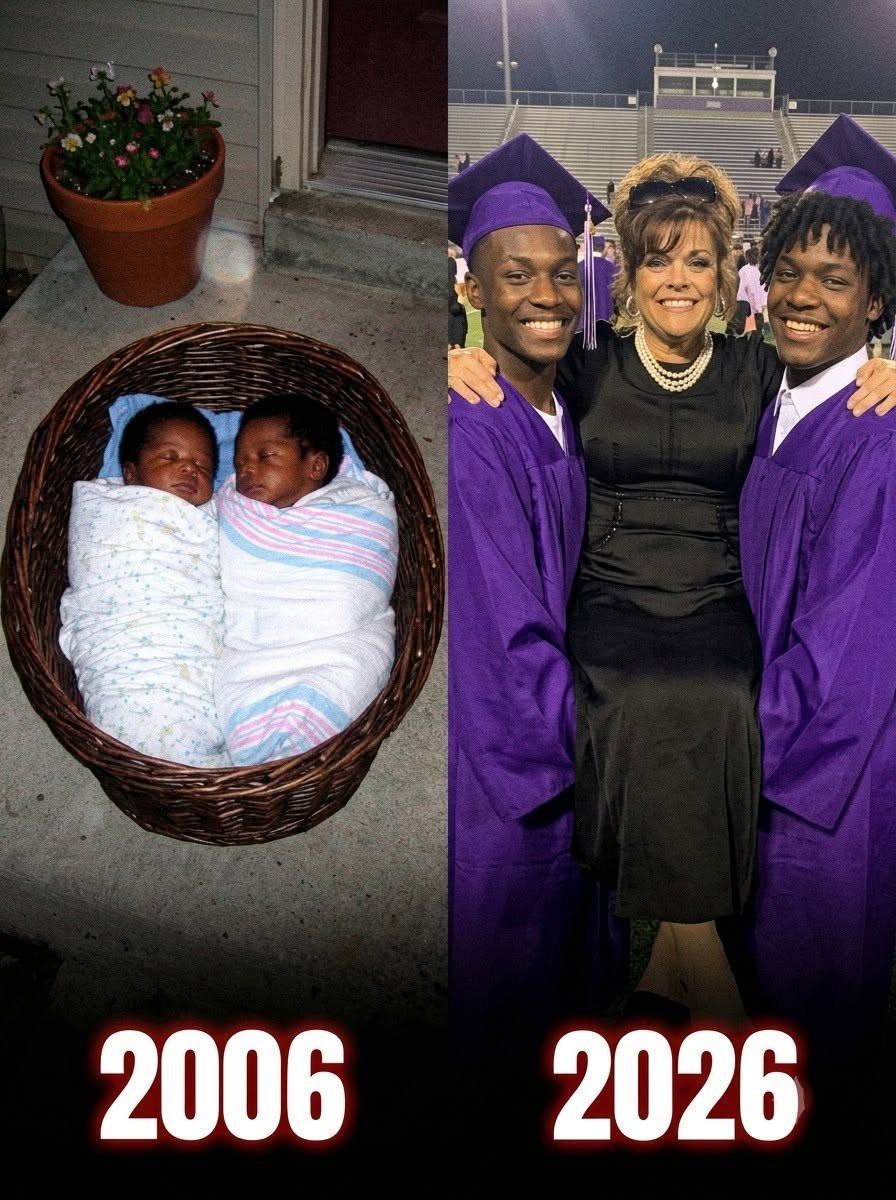
The basket sat on my dining table as if it had fallen straight through time that Friday evening. Woven wicker, one broken reed near the handle, the same faded blue lining I hadn’t laid eyes on in twenty years. My grown sons watched me from across the table, their dinner plates barely touched, and I found I couldn’t move my hands at all.
“Mom?” Caleb’s voice sounded far away, like it was reaching me through water.
I was in my early fifties, but in that exact moment I felt thirty two again, standing barefoot on a porch, staring down at two tiny faces I had never once seen before in my life.
The Diagnosis and the Duffel Bag
The official diagnosis had come on a Monday, all those years earlier. I remember the day specifically because Ben and I had tickets to a concert that same Friday, and I spent the entire drive home from the doctor’s office wondering whether we should still go. We didn’t.
A few weeks after that, my husband stood in our front hallway with a duffel bag already sitting at his feet. “You can’t give me the family I want,” he muttered, refusing to look at me directly. He kept his eyes fixed on the light switch by the door instead, like staring at it might somehow soften what he was about to do.
“So that’s it,” I said.
“Kim, don’t make this harder.”
“Harder for whom? You knew infertility was a possibility. I mean, look at me?”
He left before I could even finish answering my own question, the door clicking shut behind him with a quiet, final sound that somehow felt louder than slamming ever could have.

The Man on My Porch With Two Pizzas
Raymond showed up that same night carrying two pizzas. I hadn’t called him. I hadn’t called anyone at all. But there he was on my porch in his beat up jacket, looking at me the exact same way he’d looked at me since college, like I was something worth showing up for without being asked.
“What’s wrong, Kimberley? Where’s Ben?” he asked, taking in the tears and my puffy, exhausted face.
“Raymond, Ben left. I couldn’t give him children because of my dwarfism.” Then I just cried, standing there in my own doorway with a stranger’s dinner in his hands and my whole life rearranging itself behind me.
My friend boxed up my husband’s remaining records while I sat on the kitchen floor eating cold pizza straight from the box. Neither of us said the word divorce out loud until sunrise finally broke through the kitchen window. I was thirty one years old.
That’s roughly how the following year went. I built a quiet little life out of what was left. A small graphic design job I ran out of my dining room. Sunday coffee with Raymond at the same diner every week, where the waitress, Denise, eventually stopped asking if we were together after the third or fourth time we both said no in the same breath.
“Why don’t you date, Ray?” I teased him once, stirring my tea slowly. “You’re not hideous.”
“High praise.”
“I’m serious. You’d be a catch for somebody.”
He shrugged, that slow, easy shrug of his that never quite committed to anything. “I’m picky, Kim.”
“How picky?”
“Ruinously.”
I laughed and let it go, the way I let most things go with Raymond back then, without ever thinking too hard about why.
Looking back now, the signs were scattered everywhere, obvious in a way I refused to see at the time. Raymond remembered the anniversary of my diagnosis every single year and always found some excuse to be around that particular week. He remembered both boys’ birthdays without being reminded. He drove three hours through a snowstorm the year Caleb broke his wrist at hockey camp, arriving before I’d even finished packing an overnight bag.
I called it friendship. I called it luck. I called it anything except what it actually was, because thinking too hard about it felt disloyal to a version of my life I’d worked so hard to make peace with.
Then the boys grew up and moved out, and my house went quiet again, and I told myself I was fine with that too.
Which brings me back, finally, to that Friday.
The Basket Returns
Both of my adult sons had shown up without any warning at all. Neither one had eaten more than a few bites of dinner. Something was clearly off between them, that careful, guarded expression grown children wear right before they say something you won’t want to hear.
Eventually Caleb set his fork down against the plate.
“Mom, we’ve spent months trying to figure out how to tell you this.”
My hand froze in midair. “What’s going on?”
“Wait,” Noah said, and slipped quietly out of the room into the hallway before I could ask anything further.
Caleb just sat there staring down at his own hands.
Then Noah came back carrying the basket, lowering it carefully between the water pitcher and the salt shaker like it was any ordinary object you might set on a dinner table. My whole body went cold the instant I saw it.
I recognized it before he’d even fully let go of the handle. It was the exact same basket the two of them had been lying in the day they first appeared on my porch, twenty years earlier, wrapped in a soft blanket and crying into an otherwise silent morning.

The Morning I Found Them
The memory came back so vividly I could almost feel the chill of that particular morning against my skin. I had been standing on a stool at the counter, buttering toast, when a sharp rapping at the front door pulled me straight out of my thoughts.
I remember wiping my hands on a dish towel, expecting a delivery driver, or maybe Raymond dropping off some book he’d promised me weeks earlier. But when I opened the door, the porch was completely empty.
Then I heard it. A faint sound. A baby crying, close by.
I glanced down, and my entire world simply stopped turning. Two little boys lay curled together inside a large wicker basket by my front steps, wrapped in a soft blanket that smelled faintly of lavender.
“Oh, my God. Oh, my God, oh my God,” I whispered, dropping to my knees right there on the porch boards.
I grabbed the basket and managed to drag it carefully inside, my hands shaking so badly that when I reached for the phone to call the police, I dropped it twice before I could even dial.
“Please,” I told the dispatcher, my voice cracking apart mid sentence, “there are two babies on my porch. I don’t know whose they are. Please, just come.”
The officers arrived within minutes. A woman named Officer Delaney took my statement while another officer wrapped the boys in warmer blankets from the trunk of her cruiser.
“Any note? Any sign of the mother?” she asked me gently.
“Nothing. I didn’t see anyone. I swear.”
They searched the neighborhood and knocked on every door for blocks in every direction. No one had seen a woman with twins. No one had heard a car idling, or a door closing, or footsteps on a porch. Their mother was never found, not that day and not in any of the days that followed.
Choosing Them
The babies were placed into foster care afterward, and I told myself, firmly, that this was the end of my involvement.
It wasn’t.
I couldn’t stop thinking about them. Their tiny fingers. The way one of them had gripped my thumb the moment I first lifted the blanket back to look at their faces. I started visiting every week. Then twice a week. Then I called Raymond.
“I want to adopt them,” I said, pacing my own kitchen in tight, restless circles. “Both of them. I know it’s crazy. Tell me it’s crazy.”
“It’s not crazy,” Raymond said, without a single beat of hesitation.
“Ray, I’m a divorced woman with a home office and a diagnosis that says I can’t carry a child. What judge is going to hand me two babies?”
“The right one,” he said simply. “Let me help you with the paperwork.”
My best friend came over that same weekend with a stack of legal pads and a bag of takeout, sitting across from me at my kitchen table late into the night, helping me draft every single answer we could anticipate.
“You’re going to fumble this question about your support system,” he said, tapping a line on the page. “Put me down. Aunt, uncle, whatever you want to call it. I’m not going anywhere.”
“You barely date, Ray. Don’t you want your own life?”
He’d only smiled at that. “This is my life.”
I laughed it off at the time, the way you laugh off something you’re not ready to actually examine. But Raymond drove me to every single court date without exception. He sat beside me in the hallway outside the judge’s chambers, holding my hand steady when my knee wouldn’t stop bouncing against the floor.
Months later, Judge Marsh looked up from the papers spread across her desk, and I’ll never forget the softness that had crept into her voice by then.
“They’re yours, Kim. Congratulations.”
I named them Caleb and Noah, and I cried the entire drive home, gripping the steering wheel with both hands like it was the only solid thing left in the world.
Twenty Years, Compressed
The years didn’t ask permission before flying by the way they did. Caleb learned to walk first, but Noah was the one who wouldn’t stop climbing furniture the second nobody was watching him closely enough. Christmas mornings blurred together into wrapping paper and hot chocolate, one year folding into the next almost seamlessly.
There were scraped knees I bandaged right there in the driveway. School plays where I clapped too loudly and didn’t care who noticed. Teenage arguments about curfews that ended in slammed doors and, eventually, quiet apologies whispered through them once the anger burned itself out.
And Raymond. Always Raymond, present in nearly every frame of it without ever once asking for anything in return.
Sitting in the front row at every single recital. Teaching Noah to drive after I admitted I couldn’t stomach doing it myself. Standing behind me in the kitchen the night both college acceptance letters arrived at once, resting a steady hand on my shoulder as I read them out loud with my voice shaking.
“You did it,” he said quietly that night.
“We did it,” I corrected him, realizing, even as I said it, just how completely those two boys had become the best part of my entire life.
He didn’t answer that. He just smiled and let it sit there between us.
What the Basket Held
Twenty years. That’s how long I lived comfortably inside the story I thought I already knew by heart. Until that Friday, when both boys showed up at my door without warning and neither one could quite look me in the eye through an entire dinner.
I stared at the basket sitting on my table. The weave, the frayed edge on the left handle, the small stain near the base I’d never quite managed to scrub out. I knew every single inch of it.
“Where did you get that?” I whispered.
Noah couldn’t look at me. “Mom. Please. Just let us get through this.”
“Where did you get that basket, Noah?”
He sat down beside his brother and folded his hands together like a little boy caught doing something wrong. He was twenty years old in that moment, and he looked about six.
“Raymond gave it to us,” Noah said.
The name landed in the room like a dropped plate shattering against tile.
“Raymond gave you what?”
“The basket. And the truth.”
Caleb blinked hard, staring down at his own hands again. “Mom, promise you won’t hate us for what we hid from you.”
I stared at both of them and couldn’t find a single word to offer back.
“A few months ago, Raymond sat us down at his place,” Caleb finally said. “He said he’d been carrying something for twenty years, and we deserved to know before he got any older.”
I felt my hands go completely cold against the tablecloth.
“There was no mother who left us on the porch, Mom. There was a surrogate. Raymond arranged the whole thing. Privately. He paid for everything.”
I heard myself make a sound that wasn’t quite a word at all, something caught halfway between a gasp and a question I didn’t have language for yet.
“He said you’d been told you couldn’t have kids,” Noah went on quietly. “And he knew you’d never accept help if it looked like charity. So he, he staged it.”
“Staged it?”
“The basket. The porch. The anonymous drop. He made sure the paperwork trail led to foster care, so you could choose us on your own. Without ever knowing he’d had anything to do with it.”
I couldn’t quite breathe right. Twenty years of Christmas mornings folded themselves up all at once inside my chest and pressed hard against something soft I hadn’t braced for.
“Raymond watched,” Caleb said. “He knew you’d want us and that you’d visit us. He knew you’d fall in love. He said he trusted your heart.”
“He trusted my heart,” I repeated, the words feeling foreign in my own mouth.
“Please don’t hate him, Mom,” Caleb said.
“How long?” I asked. My voice didn’t sound like mine at all.
“He told us two months ago.”
“We didn’t know how to say it,” Noah confessed. “We tried. Every visit. Every phone call. We couldn’t.”
The Phone Call
I stood up too fast, my chair scraping loudly behind me. I walked into the kitchen because I needed a wall between me and that basket, something solid to hold onto while my mind rearranged everything it thought it knew. I put both hands flat against the counter and tried to remember what breathing was supposed to feel like.
Raymond. My best friend.
Raymond, who had driven me to every single court date without ever once complaining about the distance. Raymond, who had sat outside Judge Marsh’s chambers holding two cold coffees while I fell apart quietly beside him. Raymond, who never dated, never married, and never said a single word about wanting anything for himself in twenty full years.
Raymond, who had laughed along every single time I teased him about being alone.
Oh God.
“Mom,” Caleb said from the doorway. “Please say something.”
“You knew this for a while, but you sat at my table on the Fourth of July, and you didn’t tell me,” I said, wiping angrily at my own tears.
“We were scared.”
“Of what?”
“Of exactly this. Of you standing in the kitchen like you can’t even look at us.”
I turned around to face them both. My beautiful boys. Nothing about either of them had changed in the last ten minutes, and at the exact same time, everything had.
“I’m not angry at you,” I said, my voice breaking apart on the last word. “I don’t know what I am. But it isn’t that.”
Noah came up quietly behind his brother. “What are you going to do?”
I climbed onto a stool and picked up my phone from the counter. My hands shook exactly as badly as they had twenty years earlier in that same kitchen, and I dropped it once before I managed to find his name in my contacts.
I had rehearsed this exact call in my head for exactly zero seconds, and I already knew, somehow, precisely what I wanted to say. I wanted to tell him our friendship was over. I wanted to tell him he had no right to do what he’d done. I wanted to tell him that love without permission is just another, quieter version of leaving, and I had already had enough of being left by people who claimed to love me.
Raymond picked up on the second ring.
“Kim.”
He already knew. I could hear the whole confession sitting inside that single syllable.
I opened my mouth to say all of it.
“Come,” I said instead. “Now.”
I hung up before he could respond.
Caleb and Noah stood in the doorway watching me like I might shatter at any second. I didn’t. I just stood there with the phone still in my hand, twenty years of quiet, patient kindness rearranging itself inside me into something I didn’t have a name for yet.
Thirty minutes later, the doorbell rang.

What Raymond Said
Raymond stood on my porch, pale but steady, the same way he’d stood there the night he showed up with two pizzas. He didn’t try to explain himself right away.
“Come in,” I said, my voice softer than I expected it to be.
He sat down at the same table where the basket still rested between the water pitcher and the salt shaker. Caleb and Noah had already gone upstairs to give the two of us the room.
“I loved you before Ben,” Raymond said quietly. “I stayed quiet because you chose him. After the divorce, I stayed quiet because you were grieving, and it felt wrong to make any of that about me.”
“So you built me a family instead?”
“I used part of my savings. A private agency. I staged the basket so the choice would be entirely yours, not mine to hand you like a gift you’d feel obligated to accept.”
I pressed both palms against my head, trying to hold my own thoughts still. “Why didn’t you just tell me you loved me, Raymond? You could have told me on any single day since you brought them into my life.”
“Gratitude’s a terrible foundation,” he said quietly. “I didn’t want you loving me because I gave you the boys. I wanted you to choose me the same way you chose them. On your own terms, not because you owed me anything.”
I looked at him then, really looked. The steady man who had stayed beside me through every single version of my life for two decades. The one who never dated because he had already been waiting the entire time, patiently, without ever saying a word.
“I’m furious with you,” I whispered.
“I know.”
“And I don’t know what I feel underneath that yet.”
Raymond nodded slowly. “You don’t have to.”
“Go home, Raymond. I need to think.”
He went without another word, and I stood alone in my kitchen for a long time after the door closed behind him.
Choosing Him
Three days later, I stood on his porch with two coffees and hands that hadn’t quite stopped shaking.
“I don’t know what this is,” I told him right there by the door. “But I want to find out honestly. On my own terms this time, the way you always wanted.”
Raymond smiled like a man who’d waited half his life to hear exactly that sentence, which, I suppose, he had.
The Shelf in the Living Room
Weeks turned slowly into something real. On Sunday, Caleb and Noah came over for dinner, and Raymond carved the roast at my table like he’d been doing it for years, which, in every way that mattered, he had.
The wicker basket now sits on a shelf in my living room, exactly where I decided to keep it. It became a keepsake in the end, just as Raymond had intended all along when he quietly took it back after the twins first entered foster care, holding onto it for twenty years until the truth was finally ready to sit beside it.
I realized, sitting there with my sons and the man who had loved me patiently through every single version of my life, that I had been chosen all along.
I finally let myself be chosen back.